Larger than life

I just have to share this post from Russel Ray Photos–a story of the San Diego statue based on the iconic photograph taken on August 14, 1945–V-J Day–the end of World War II.

Russel Ray Photos's avatarRussel Ray Photos

Out & About

Pictures copyright 2012 Russel Ray Photos

Some things are larger than life, such as this statue titled “Unconditional Surrender” (aka “The Kiss”) in downtown San Diego:

Unconditional Surrender statue in San Diego in April 2013

Pictures copyright 2012 Russel Ray Photos

That picture was taken in April 2013, just a few days after the statue had been installed. The statue was a replacement for one created by Seward Johnson that was originally installed in March 2007. Johnson’s original statue was on loan to San Diego and was to be removed in August 2010.

Initially, the public was aghast: It was too large for its location on the harbor, it was copyright infringement of Alfred Eisenstaedt’s famous photograph titled V–J day in Times Square which was published in Life magazine in 1945. I can’t show you Eisenstaedt’s photograph since he died in 1995; thus, it is still protected by copyright law.

Johnson has stated that he was familiar with the copyright law regarding Eisenstaedt’s photograph so instead he used a different photograph…

View original post 500 more words

Well, Shut My Mouth

SCORPIO

October 7, 2013

You don’t have to give every thought that drifts through your head
a voice.

Unless you are standing for something that is essential to who you are, it won’t be necessary to offer a judgment.

~Holiday Mathis, “Horoscope”

 *

Above is today’s horoscope.

So far, I’ve followed its advice reasonably well.

Even on Facebook.

Paris, Day 2: Starving and Art

The breakfast room off the lobby is spacious, airy, earth-toned: oak paneling and hardwood floors, sconce lighting, a view of the garden. While David pours coffee, I forage.

In the corner, canisters of cereal line the wall above the breakfast bar: cornflakes, bran flakes, raisin bran, O’s, plain and fruited and frosted, reflect the room’s tones of wood and light. Trays of breads, bagels, rolls, pastries, gold and brown and white, sit side-by-side on the counter below.

They are beautiful. They are carbohydrates.

I’m sensitive to carbohydrates. One taste of sugar before evening and both body and brain cease to function. One spoonful of cereal and I will not see the Louvre, the Eiffel Tower, the Champs-Elysees. I will sit, lead-bottomed, in the lobby, staring at nothing and making the concierge nervous.

Looking past the pastries, I see a bowl of hard-boiled eggs hiding, probably in humiliation, behind a pile of little plastic tubs of butter and cream cheese.

I don’t care for un-deviled hard-boiled eggs, especially for breakfast, but I set one on my plate. Beside it I place a bagel. I add three containers each of butter and cream cheese. At the table I peel the egg and eat small, dry bites, alternating with bites of cream cheese- and butter-slathered bagel. I pray protein and fat will cancel out refined white flour.

David sits beside me, drinking coffee and staring down at a puffy, powdery confection.

“We’re supposed to get breakfast,” he says. “The travel agent said our plan includes breakfast.”

“This is breakfast,” I say. “A Continental breakfast.” He says nothing. “We’re on the Continent.”

He looks up from the pastry.

“It’s what they eat,” I say.

He looks back at the pastry, his brown eyes sad, anticipating starvation.

I see the irony: one carbohydrate addict and one carnivore, turned loose in the country for which bread was named. Water, water everywhere, etc.

I understand David’s concern, but, determined to be positive, I smile. “Would you get me some more butter and cream cheese?”

I watch him cross the room. He is tall, with broad shoulders and a trim waist. When my best friend saw him wearing his brand new wedding suit, she gushed, “He is just built to wear clothes.” When my raft of cousins met him for the first time, they pulled me aside one by one and whispered, “Does he eat?”

He returns with a handful of plastic tubs for me and a cinnamon roll and a croissant for himself. As I pull back the foil from the butter—one hundred calories per tablespoon—I try to feel sorry for him.

#

By mid-morning, we’re on the upper deck of the tour bus, attempting to keep pace with the guide on the English tape recording. I can’t help gawking.

“Ahead to your left…” “Ahead to your right…”

The bus inches through traffic, but by the time I realize where I’m supposed to be looking, “ahead” is always “behind.” David and I pass the disposable Kodak back and forth, taking snapshots that will make the buildings look as if they need leveling.

When we pass Eglise de la Madeleine, I stop trying to follow the tape. I will later look on-line for detail: Corinthian columns, a relief of the Last Judgment on the pediment, bronze doors bearing a relief representing the Ten Commandments. All I will remember is the heavy, massive, dark expanse of stone. Standing outside St. Paul’s Cathedral in London, I felt uplifted. Here, I feel claustrophobic. I see no windows.

#

The bus stops in front of the Louvre. I jump up and scramble off. David follows me across the courtyard. When he calls my name, I turn and hear the shutter click. In the photo, my purple shirt and blue passport pouch fade into the red tee-shirts and yellow caps of pre-teens sprawled on the low, curved side of the pool in the background. I get a shot of David against one of the three glass pyramids erected in the ’80s. Through the view-finder, his twelve-day-old beard, which I’ve been privately thinking of as scraggly, looks distinguished, dark on upper lip and chin, grizzled on cheeks and jaw.

“You should keep the beard,” I tell him. He grins and rolls his eyes.

#

We stay in the Louvre four hours. I snap some photos, but the camera obscures my view. I ask David to put it in his pocket.

I marvel at the perfect fingernail on the hand of Vermeer’s Astronomer; feel breathless, almost afraid, in the presence of the Winged Victory of Samothrace; hear shutters swishing in the crowd pressing toward the Mona Lisa, and watch her eyes watch me as I walk back and forth seeking the best view.

I have no words.

#

Mid-afternoon, we board the bus. The next stop—the next one I’m sure I can identify—is the Eiffel Tower. As we pull up alongside the curb, I stop myself from blurting out, “It’s so big!” My fellow passengers don’t need to know I was expecting a gilt figurine.

Waiting for the aisle to clear, I crane my neck at contradiction of steel and lace. Its base is as heavy and earthbound as Eglise de la Madeleine; yet, rising, it seems so fragile that a touch would snap it in two.

I’m surprised by sudden memory of a line I wish I’d written: “Poetry is geometry exploded.”

#

When the aisle is clear, I stand. David remains seated. “Do you see that line?” he says.

I do. Except it isn’t a line. It’s a horde. I also note that for the first time since we left Austin, I’m perspiring.

“Is my face turning pink?”

He nods. He looks tired. He’s probably hungry. I am.

We stay on the bus. When we pass the Arc de Triomphe, people are standing on top. I didn’t know you could get up there.

#

The temperature is still warmer than we find comfortable—we didn’t come all the way from Texas in July to enjoy the heat—so we find a cafe and take a corner table inside, where it’s cool and dark. We want something substantial, so we order a pizza. Since we’re in Paris, we order red wine.

The pizza arrives. It’s a French pizza. The crust is round and flat and covered with tomato sauce. Meat and cheese and other pizza-ish things may be present, but they don’t announce themselves.

In England and Scotland, we ate only two meals a day. Beginning with eggs, bacon, sausage, baked beans, fried tomatoes and mushrooms, toast, juice, milk, tea, and/or coffee (and, no, I didn’t eat all that), and ending with venison pie and haggis, we considered a third meal redundant.

Things are different now. It occurs to me that when William the Conqueror crossed the Channel, he might have been looking for more than just a change of scenery.

We eat the pizza. We drink the wine.

They’re delicious.

#

Before we ask for the check, David makes a trip to the restroom. Back at the table, he sits down, picks up his wine glass, cuts his eyes toward me, and murmurs.

“Strangest restroom I’ve ever seen.”

“Strange how?”

He pauses. “I can’t explain. You’ll have to see it yourself.”

I’ve been inside a men’s room only once, at a Texas Library Association annual convention at the Henry B. Gonzales Convention Center in San Antonio. Someone with a grain of sense had looked at the demographics and stuck paper signs reading Women over half of the door plates reading Men. Someone with sensitivity and good taste had put potted ferns in front of the urinals. So in effect, I’ve never really been inside a men’s room, and I’m not prepared to invade a foreign one.

“I wonder whether the ladies’ room is the same,” I say.

“It’s bisexual,” he says, using his term for all things androgynous. “You can go look.”

I go look. He’s right. It’s strange.

David hands the waiter some euros. We leave.

#

The air is cooler now, but dark is a long time off. We walk. We sit at a sidewalk cafe and drink coffee. We people-watch.

I’m fascinated by the brown-skinned women wearing dresses of bright yellow, blue, and orange, with matching headdresses. They stand straight, heads up, shoulders back, regal.

After a time, David breaks the silence.

“Let’s have dinner again.”

#

At the north corner of rue Cadet, there are two restaurants. Casual observation from the sidewalk suggests the one on the left side of the street is serving hardier fare. The host seats us inside by the window and hands us menus.

Suddenly conscious of my posture, I sit up straight. I want to make a good impression. I’ve heard about French waiters. The ones we’ve met so far have been pleasant, but here the stakes are higher. Here there are tablecloths.

When we close our menus, a white-coated waiter approaches. He is short, with olive skin, neatly clipped black hair, and black eyes. He stands erect. He does not smile.

In a mixture of English, French, Spanish, and pointing, David tells him what we will have. In a mixture of French and hand-waving, the waiter tells us we’re not going to get it.

When he disappears into the kitchen, I ask for a translation. David thinks only one serving of whatever we ordered remains in existence, and therefore the waiter has strongly suggested a substitution. David thinks we are going to receive the poulet.

We receive the poulet, all right, like no other I’ve ever smelled or tasted. Poulet stew, for lack of the proper term, an enormous bowl of chicken, carrots, celery, herbs, spices, who-knows-what, and, to top it off, saffron potatoes, swimming in the broth. When I see those potatoes, any chance of moderation vaporizes. I devour every scrap I can stab with the fork, and itch to take a piece of bread and mop up the rest.

Sated, I look across at David’s bowl and see it’s as empty as mine. We sit for a while, pretending to drink coffee and staring at each other with expressions denoting simultaneous misery and contentment.

When we think we can stand, David pulls out his wallet, gestures to the waiter, and hands over a credit card. The waiter withdraws to the counter on the opposite side of the room. David and I resume staring at each other. Moments later, shouts of “Dah-VEED! Dah-VEED!” pierce our mutual reverie.

We look up. Behind the counter, the waiter is jumping up and down, waving his arms and shouting. “Dah-VEED!”

Dah-VEED manages a tentative smile and waves back.

When he brings the receipt, Abrahim—that’s the waiter’s name—explains that he has a cousin Dah-VEED who owns a restaurant. Abrahim works there when he’s not working here. He gives the American Dah-VEED his cousin’s card. By the time we leave the restaurant, the language barrier has been shattered and we have a new friend.

#

To be continued: Ordering a soccer ball, getting lost, mangling more French, invading a men’s room on foreign soil


Paris, Day 1: Getting There

Satellite view of the English Channel
“English Channel” via Wikipedia.  NASA. Public domain.

When David and I land at Gatwick in July of 2002, we come armed with goals and objectives: spend two nights in London; pick up a car at Waterloo Station; head north for Oban, Scotland; ferry over to Duarte Castle on the Isle of Mull; drive south to Exeter for a look at Robbers’ Bridge in Lorna Doone country; spend another night in London; return the car to the rental agency; and board the train for Paris.

To ensure we return the car timely, David maps a route that allows us to drive the thirty miles from our bed-and-breakfast in East Grinstead to Waterloo Station without ever turning right. When you’ve spent ten days driving on the wrong side of the road, you learn to think ahead.

Our plan for Paris, however, is not to plan. Paris is for spontaneity. We step off the train carrying luggage, the name and address of our hotel, and the assurance that everything will be fine

Mostly, it is.

#

Hotel Opera Cadet sits on a narrow street only one block long. The exterior is elegant but so understated that we walk back and forth in front of it several times before realizing we’ve reached our destination. We go inside and present our voucher to the concierge.

Standing at the reception desk in the soft light of the oak-paneled lobby, I release my grip on David’s shirttail.

I’ve been latched onto the hem of that blue windbreaker ever since stepping off the Eurostar and going into culture shock. All the signage is in French. I know people in France speak French, but I’ve never considered they also write it. Crossing the English Channel has rendered me functionally illiterate.

Although the station is enormous and we have no idea how to get from here to the hotel, David isn’t concerned. He knows some French, but he’s been told that the natives resent hearing foreigners mangle their language. Many of them, however, will speak Spanish. Since David speaks Spanish fluently, there will be no barrier.

But first we see what we can do on our own.

He picks up his suitcase and strikes off through the crowd. I grasp the handle of my rolling bag and follow him like a barge trailing a tugboat.

#

After completing several laps without finding an information desk, David breaks out the Spanish. With me still attached, he approaches a young woman wearing khaki slacks and a navy blazer.

¿Habla usted espanol?

I first think of the woman as African-American, but when she tells David she speaks neither Spanish nor English, I once again remember where I am.

David takes a breath and resorts to mangling French. The woman mangles some English. They wave their hands in the air. I stand by, detached, congratulating myself on my decision to wear khakis. I’ve heard the French consider Americans in bluejeans gauche. I don’t want to be gauche.

After five minutes of intense effort, the woman gestures for us to follow, leads us to the bureau d’information, explains to the man behind the desk what we want, and smiles. “Au revoir.”

I risk mangling a heartfelt “Merci.”

#

Our second-floor room is small but comfortable. I flop onto the bed. David opens the refrigerator. He’s impressed by our choices: almonds, chocolate bars, and bottled water. He doesn’t intend to eat or drink any—the prices are exorbitant—but he’s impressed.

I’m comforted by the knowledge that in case of emergency, real French chocolate is within reach

From the window I see the shops across the street. “Boulanger Patisserie,” “Atelier 13,” names so much more sophisticated than “Dillards'” and “HEB.” Even “meat market” reads better in French.

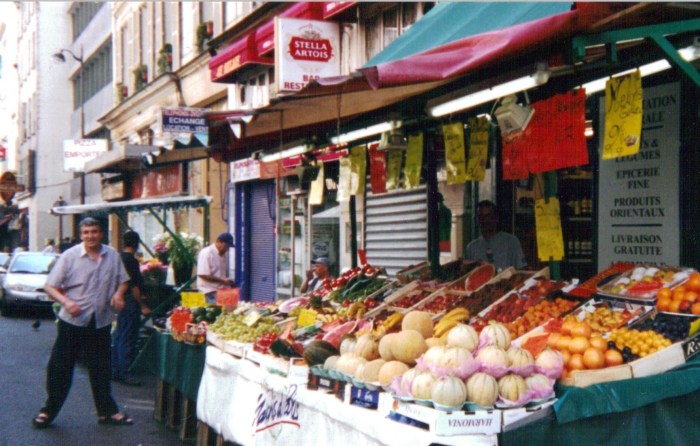
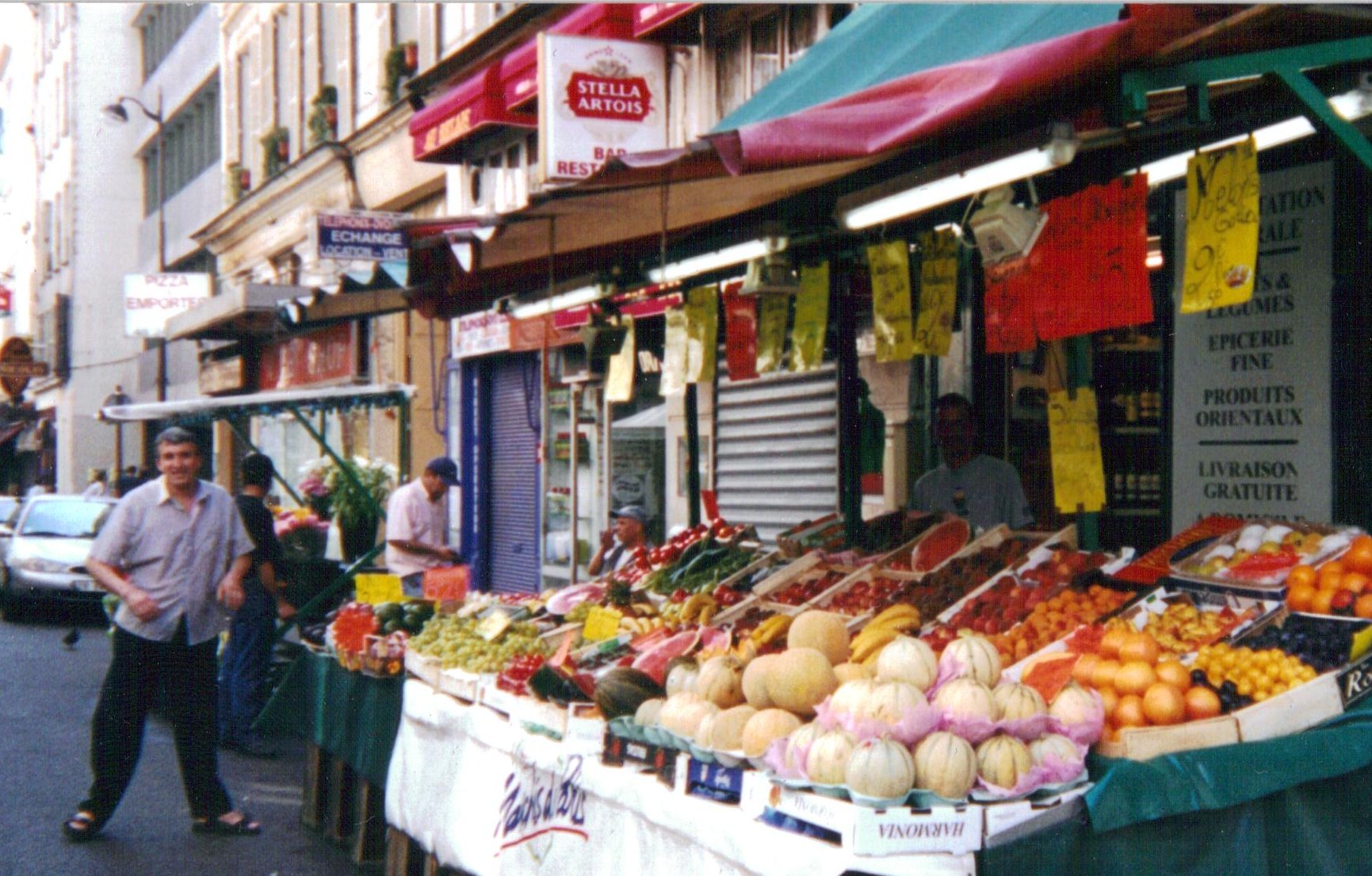
In front of a grocery, a fruit stand juts into the street—oranges, cherries, cantaloupes, grapes, peaches, plums, too many fruits to name heaped fat and fresh in cardboard flats. Tomorrow, when I aim for a photo of David flanked by produce, the shopkeeper runs out, waving his arms.

I’m appalled. Have I offended him? Is it gauche to want a picture of apricots?

I’m about to apologize when he takes David’s arm, pulls him behind the stand, then runs back into the street, grinning and gesturing for me to snap the picture. The wide-angle photo shows a young man wearing a short-sleeved gray shirt, dark slacks, and sandals, grinning beside a slice of watermelon. David lurks in shadow under the awning, recognizable only to me.

#

The first afternoon and evening, we concentrate on getting our bearings. We leave the hotel, walk a few blocks, look around. I remember reading that London is a city of gray and scarlet. I see Paris as a city of stone and lace; every building seems to be scalloped and edged with grillwork.

When the effect of our full English breakfast wears off, we order sandwiches at a small café. We’re the only customers. A waiter watches the Tour de France on a wall-mounted television near the back of the room. As we slide into a booth, he turns down the volume. We smile our thanks. He doesn’t seem to object to David’s jeans and red tee-shirt with the black Lab on the front.

The sandwiches appear. They’re made with baguettes. I’m delighted to be eating an authentic French sandwich and wonder whether the diners at the McDonald’s up the street are as pleased with their sesame seed buns.

Leaving the café, we take another stroll, return to the hotel to rest, go out again, come back for our street map, walk some more, return for something else we’ve left upstairs…Our act is not yet together. Each time we leave, we pass our key across the desk to the concierge. Each time we return, he passes it back. By the fifth or sixth exchange, his smile hints at both bemusement and fatigue.

In all our trekking back and forth, we’ve seen no one else in the lobby. David and I might be the only thing standing between the concierge and a quiet evening with a good book. I hope he doesn’t think we’re Ugly Americans. Judging from his smile, I suspect Crazy Americans is more likely.

#

To be continued: Starving, Gaping, More Starving

#

Image [Satellite view of the English Channel] file created by NASA.

Writing Competitions and Opportunities Digest – Edition 12

Limebird Writers post a list of contests and opportunities for writers. Search the archives for previous editions. Thanks, Limebird Writers.

limebirdvanessa's avatarLimebird Writers

Welcome to the 12th edition of our weekly selection of writing competitions and opportunities.

How would you like to be published in a magazine that has previously published original fiction by the likes of Thomas Hardy and F Scott Fitzgerald? You would? Then have a look at the first one below for details.

If you missed the last edition of our digest, you can view it here.

——————

Opportunity type – Short story competition.
Theme – Spring.
Word count – Up to 3,000 words.
Organiser/publisher – Harper’s Bazaar magazine.
Reward – “The winning entry will appear in the May 2014 issue. Its author will be able to choose a first-edition book from Asprey’s Fine and Rare Books Department to the value of £3,000 and enjoy a week-long retreat at Eilean Shona House, on the 2,000-acre private island off the west coast of Scotland where JM Barrie wrote his screenplay for…

View original post 299 more words

Talking Turkey and Cooking Goose

In the previous episode, Kaye George, author of the Immy Duckworthy, PI mystery series, had just suggested members of Austin Mystery Writers publish an anthology of short stories. Her proposal sent me into paroxysms of insecurity and doubt: could I write two stories of acceptable quality in the time allotted? Or would I embarrass myself and slink away, ostracized from the group, never to plot again?

Now, the rest of the story:

The burning questions posed in She Cannot Get Away have been answered, in part. I can write at least one story in the time allotted me. I’ve already done so. Almost.

As with every project, the key is to start early. I started two years ago. In a retreat workshop sponsored by the Writers’ League of Texas, I wrote a fragment beginning with the following sentence:

The day I found Mama stirring ground glass into the eggs she was about to scramble, I took the eggs away from her and called a family conference.

Some readers have seen that sentence before. They may be sick of it. I’ve gotten a lot of mileage out of it, fizzing over what comes next. My critique group suggested it’s the beginning of a novel, but I don’t think the situation has the necessary elasticity. In my hands, a novel starting with four siblings plotting to “put Mama out of her misery” could end up reading like the story board of a Road Runner cartoon: Children drop a metaphorical anvil off a bridge, miss Mama by a hair, light the fuse on a stick of dynamite, miss Mama by a hair, find themselves hoist with their own petard. Over and over for three hundred pages.

Shakespeare, given the same situation, would no doubt have come up with something fresh and original. But Shakespeare didn’t see as many Warner Brothers cartoons as I have. If he had, his creative faculty might have been warped, too.

Well. On July 4 of this year, I posted here that I was optimistic about the chances of getting a story out of the ground glass. Today I report that the two-year-old fragment is now part of a short story with a beginning, a middle, and an end. At our meeting last week, Austin Mystery Writers gave it their approval. Except for one thing. And I knew before a word was said exactly what it would be.

“But nobody died,” said Kaye.

I said I knew that.

“But it’s a murder mystery,” said Gale. “Somebody has to die.”

The three critique partners sitting  the other side of the table nodded.  In unison.

“I was going for subtlety,” I said. “It’s a death of the spirit.”

They stared at me. I stared back.

“But somebody really has to die,” said Kaye.

And then five people said they didn’t understand the last line. I had written the entire story so I could use that line, and no one understood what it meant.

I continued to stare. A string of pejoratives ran through my brain, notably philistines, peasants, and bourgeoisie. Finally I spoke.

“Thank you,” I said.

Then my friends began throwing out ideas for endings they preferred to mine, in each of which someone died. I sighed repeatedly and said things like, Yeahhhh, and Okayyyy, and I guessss…

People who tell inconvenient truths are so irritating. Especially when they gang up on you.

We moved on to discuss someone else’s submission. We chatted a while. We gathered our books and papers and parted.

I didn’t mention they were correct: The ending as written was weak. It fell flat. When I walked into the meeting, I already knew it was wrong. And I knew they wouldn’t let me get away with it.

Thirty minutes later, I sat across town in a writing work group, staring at my laptop monitor and thinking, Kaye gave me the perfect ending. All the suggestions were good, but hers works on multiple levels. It’s so right. Why didn’t I think of it myself?

Oh, who cares about why. What matters is that Kaye thought of it, and that she and four other writers talked turkey and made me listen.

If they hadn’t–and if I hadn’t–I’d have had a bigger problem than the embarrassment of

not turning in a story for the anthology. I’d have faced the humiliation of turning in a story whose last line four highly literate women couldn’t decipher.

Critique groups meet a variety of needs: for inspiration, encouragement, advice, mentoring, ideas, retreats, gossip…and for talking turkey. Carefully. Kindly. Intelligently. Honestly. Firmly. Timely.

I owe Austin Mystery Writers–big time. Because I’m convinced that if they hadn’t talked turkey to me, my literary goose would have thoroughly cooked.

AMW- logo

(Okay, guys, what do you have to say about that ending?)

She Cannot Get Away

Kaye - testimonial - pictures - croppedIf you read the previous post, reblogged from Gale Albright’s Visions and Revisions, you know mystery novelist Kaye George attended the Austin Mystery Writers meeting last week. Kaye, who for a number of years served as AMW’s Grand Pooh-Bah, moved to Tennessee last winter, leaving Gale and me forsaken and forlorn.

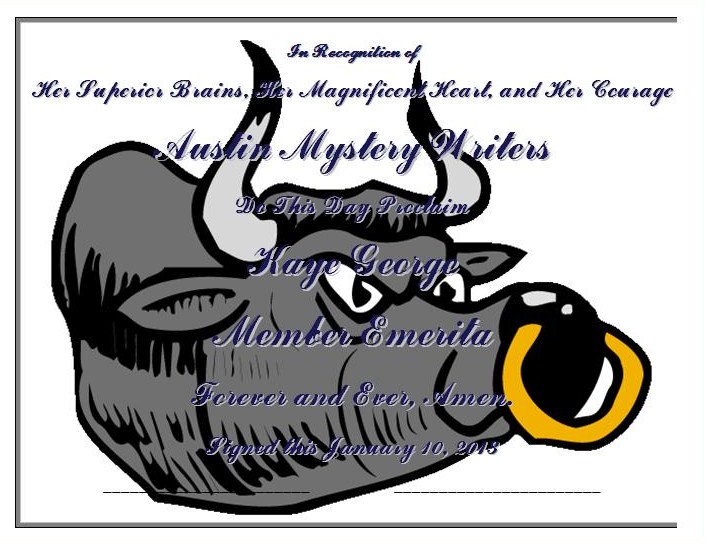
At the Last Lunch, celebrated at the Elite Cafe in Waco, Gale and I presented Kaye a certificate declaring her Member Emerita. It was supposed to say Grand Pooh-Bah Emerita, but, distraught over her impending move, I forgot that part.

The bull pictured on the certificate is an homage to Kaye’s first published novel, CHOKE, in which heroine Imogene Duckworthy narrowly escapes death by goring. I don’t believe that’s a spoiler, since Immy later appears in both SMOKE and BROKE.

Gale and I were foolish to suffer so over our friend’s disappearance because, thanks to the miracle of email, social media, and the Eyes of Texas, which are perpetually upon her, Kaye cannot get away. She’s been gracious about our continued presence in her life. She even suggested AMW publish an anthology of mystery stories, and so we shall. Each member has agreed to write two stories related to a central theme.

The prospect of putting out an anthology is exciting for those of us who haven’t published widely (roughly four of the eight current AMW members), but for me it’s also stressful: What if I can’t deliver? What if I’m already written out? What if I have to tell Kaye George the dog ate my homework? She knows I don’t have a dog.

At this point, I should tell a story related to the questions raised in the preceding paragraph. But it’s nearly 4:00 a.m., David just exchanged sleeping on the couch for sleeping on a bed, and I’m left downstairs hearing, sort of by default, Marvin Hamlisch first say that the music of the ’80s exemplifies our country’s return to family values, and then introduce a very old person I don’t recognize to sing “Under the Boardwalk.”

In other words, I’m outta here. The story will wait until tomorrow.

***

Oh, jeez. Now they’re singing “Jeremiah Was a Bullfrog.” Those family values just won’t quit. What are the PBS folks thinking? 

I have to retire now, before we all drown in sarcasm.

Kaye George Comes to Austin

Austin Mystery Writers were in a dither over a visit by Grand Pooh-Bah Emerita this week. Gale Albright supplies the gripping details.

Gale Albright's avatarVisions and Revisions

The members of Austin Mystery Writers were clustered at their literary haunt in the BookPeople café on Thursday morning, eagerly awaiting the arrival of famed author and Grand Poobah emerita Kaye George.

“Gosh,” I said to the group. “I hope she remembers the little people.”

august 15 bp 050I need not have worried. With all her usual charm and warmth, Kaye George appeared wearing a big fedora, carrying a giant magnifying glass, and blinding us with her dazzling smile.

We had missed Kaye George. Once a guiding beacon in AMW in Austin, she had moved to Waco, then Knoxville, Tennessee, too far away to attend the weekly critique group meetings.

However, that didn’t stop Kaye from being an active participant in AMW. She’s still a major player in the group, we’re glad to say.

august 15 bp 058Kaye George has been an inspiration to fellow writers. She fought hard to become a published author

View original post 194 more words

Janice Hamrick in Pflugerville

Austin Mystery Writer Gale Albright attended novelist Janice Hamrick’s book event at the Pflugerville Public Library and writes about it on her blog.

Gale Albright's avatarVisions and Revisions

100_0440

Hopeton Hay of KAZI Book Review interviewed author Janice Hamrick at the Pflugerville Community Library on Saturday, July 20, 2013 about her new mystery novel, Death Rides Again.

HAY: I first interviewed Janice about three years ago when her first book Death on Tour came out. I met her through Scott Montgomery, crime fiction coordinator at BookPeople. Janice was one of the most delightfully entertaining guests, better than some Pulitzer Prize winners with her bubbly spirit. She won a contest with her first book, which won the national Mystery Writers Minotaur contest for first crime novel. It was great to have her on the KAZI Book Review. Janice, your lead character, Jocelyn Shore, went from Egypt in the first novel, to Austin in the second, Death Makes the Cut, and now appears in a tiny Central Texas town in Death Rides Again, the third…

View original post 1,096 more words

Time Of Death / Forensic Investigator Steve Rush

I’m sitting in the conference room of a coffee shop in the Greater Austin Area, working on my current short story, or, as we writers say, my WIP. Two other people sit at the table with me. We’re part of a work group called Writers Who Write. We gather here because at our respective homes, we’re too often Writers Who Don’t Write.

Anyway. I pulled up the story I’ve been working on for what seems like an eon–the story about which I’ve said on at least four occasions, “I think I can finish it today.” I read over the paragraphs I wrote three days ago, made some minor changes that could have been done any time between now and January 2014, read the same paragraphs again, shifted my fingers into neutral, and wondered–

If I engage in a game of Poppit, would my fellow writers think less of me? Would they know I’m playing Poppit? The incessant click click clicking might give me away. If they did know, would they tell on me, and to whom?

Writers are generally good people. Some, however, are fiercely competitive. Others are downright mean. And most of them are constitutionally unable to keep their mouths shut. Consider the things Ernest Hemingway wrote about F. Scott Fitzgerald. Consider what William Faulkner wrote about Ernest Hemingway. Consider what Ernest Hemingway wrote about William Faulkner. Consider what Dorothy Parker wrote about everybody.

I decided Poppit was not an option and turned to the next best thing: writing a post for my blog. Sometimes posts don’t come easily. When blogging prevents my writing what I should be writing, however, they’re a breeze. Words flow. It’s like I’m channeling myself.

But on the way to my dashboard, I stopped by my WordPress Reader and what did I find but this post by forensic investigator Steve Rush, written for the Killer Nashville blog.

I need to read this, I thought. And if I need to read this, so do all my friends and followers.* And why write my own post when the little Reblog button sits at the bottom left corner of the screen, singing its siren song.

So in a couple of minutes I’m going to click on that button and share today’s spark of Serendipity, which is one of the loveliest words I know.

* I hope all my friends are followers and all my followers are friends, but in case they aren’t, I referred to them here separately.

Clay Stafford's avatarKiller Nashville Blog

Accurate details prove important when including crime scenes in our prose. Three basic questions we want to answer when writing these scenes are: What was my character doing before incident? What altered and/or interrupted her/him at the inciting moment? What took place afterward?

One or two details may be all that is necessary when trying to portray realism in our story. In the old TV series Dragnet, Jack Webb’s “Just the facts” statement identified the essential elements to solve the crime in question. Insert a fascinating fact in your scenario and capture your reader’s attention. Get it wrong and you risk losing them. We want to be certain every fact in our stories fits the scenario we are trying to portray.

For murder scenes, facts we choose may include things like type of weapon used, resulting harm to the character, and any potential evidence in our setting. One of…

View original post 761 more words

Like Sending a Bucket Down the Well

I never wrote a word that I didn’t hear as I read.
~     Eudora Welty

*

Familiarity. Memory of the way things get said. Once you have heard certain expressions, sentences, you almost never forget them. It’s like sending a bucket down the well and it always comes up full. You don’t know you’ve remembered, but you have. And you listen for the right word, in the present, and you hear it. Once you’re into a story everything seems to apply—what you overhear on a city bus is exactly what your character would say on the page you’re writing. Wherever you go, you meet part of your story. I guess you’re tuned in for it, and the right things are sort of magnetized—if you can think of your ears as magnets. I could hear someone saying—and I had to cut this out—”What, you never ate goat?” And someone answering, “Goat! Please don’t say you serve goat at this reunion. I wasn’t told it was goat I was served. I thought—” and so on, and then the recipe, and then it ended up with—I can’t remember exactly now—it ended with, “You can do a whole lot of things with vinegar.” Well, all these things I would just laugh about and think about for so long and put them in. And then I’d think, that’s just plain indulgence. Take it out! And I’d take it out.

~ Eudora Welty, quoted here