Blog

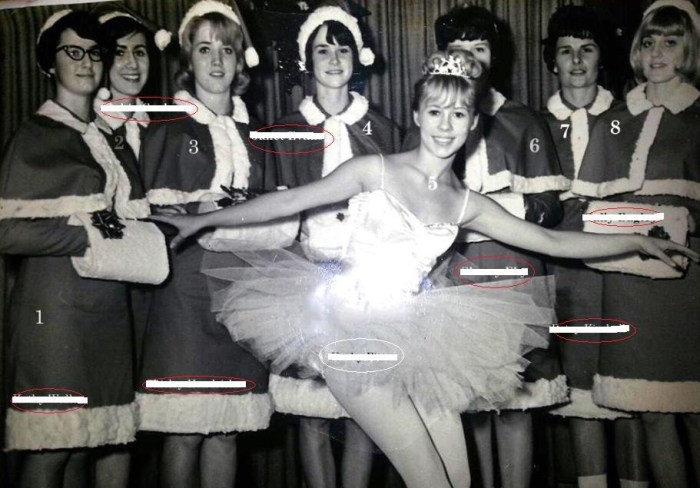
The Melody Maids at Christmas, 1966

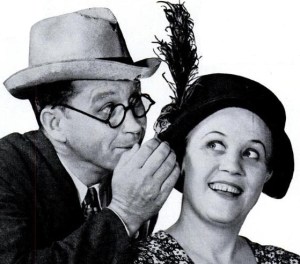
The Prairie Lea High School Melody Maids at the San Marcos Rotary Club meeting, December 1966

  1. Kathy Waller
  2. Guest
  3. Shirley Hendricks
  4. Sherry Eby
  5. Kathy Pitts
  6. Sally Barber
  7. Patsy Kimball
  8. Sally Bagley

White lines on the picture cover names that I restored in the list above.

***

When I posted this photo several years ago, I dated it 1967, It was really 1966.

A Christmas Memory: “What a Woman Will Do to Get Out of the House”

I should be picking up and tidying and making this place look, finally, Christmassy. But I don’t want to. So I’m thinking about a Ghost of Christmas Past.

It was 1961. I had just turned ten. The Methodist Youth Fellowship was going caroling. In Fentress, the MYF was more a Methodist-Presbyterian-Baptist-Whatever Fellowship, and the Baptists came from Prairie Lea, two miles south.

We weren’t just going caroling. We were going caroling. We were going to cover miles of territory. Very exciting.

We gathered behind the Methodist Church. Cullen Myers Dauchy—Hi, Cullen!—brought a big truck from the Dauchy Gin Company. There were bales of hay to sit on in the back.

I think Cullen was fifteen that year. He might have had a drivers license.

People in Fentress were kind of loose about unlicensed kids driving then. I was driving before I was eleven. Population was sparse, and there were few cars on the road, and we didn’t see a law enforcement officer from one year to the next, so if you were careful, it was easy to stay out of trouble.

My mother delivered me to the church. Eleanor Barber delivered Sally and Ann. They were twelve and nine, respectively, and we were all in the same Sunday school class. Sally was the teacher. Ann and I were the students. Classes comprised reading the lesson, doing an art project, and playing ping-pong. We sometimes met on Saturdays to draw maps of the Holy Land to hang on the walls of the classroom.

We got on the truck. It was pretty full. I don’t remember everyone who was there; I do remember Patty and Lela Kay Hardeman, and probably Carolyn and Sandra Smith, and some teens from Prairie Lea. I imagine Joe Dauchy, Cullen’s dad, was there, because he loved to sing. I don’t think there were any boys.

When Sally and Ann and I were safely loaded, and our mothers were about to leave, someone, probably Patsy Kimball, director of MYF (and teacher of Everything at Prairie Lea School), said, “Y’all come, too.” I think Jim Miller, the minister, seconded the invitation.

So Mother and Eleanor climbed onto the truck. As she was about to ascend, Eleanor turned to Mother and said, “It’s amazing what a woman will do to get out of the house.”

And so Cullen started the truck and we headed out. First we crept through Fentress.

Did I mention that the night was cold? I mean, cold. Riding in the back of a big, old truck, even one moseying up and down narrow streets, it was cold.

And it was blissfully dark, no street lights, no neon signs, only moon and stars and porch lights that came on when we began singing.

When we got out on the highway and Cullen put his foot down on the accelerator, and the wind whipped by, it got colder. It was fun to stand up and look over the high wooden sides, but we spent most of the trip huddled on the hay bales.

We serenaded Aunt Laura and Uncle Joe, a mile or so north of town, and then went down the gravel backroad for a mile or two to sing to Aunt Nettie and Uncle Marvin. Then we went back down the highway and out FM-20 to the Manns’. And maybe to Barber and Olga Smith’s.

After that, we might have gone down to Prairie Lea. Or we might have stopped at the Hardemans’ to thaw out before ending up at the church. It seems like we went farther than we did, I’m sure. Mostly I remember cold.

The thing I vividly remember is that every quarter-mile or so, somebody in the back of that truck mentioned that Cullen and Reverend Miller were warm and toasty in the cab, and that they possibly had a heater. I think there was some feeling that Reverend Miller should take his turn at freezing.

I’m afraid the thought gave a rather Grinchy glow to our Christmas spirit.

But we had a whale of a good time.

Merry Christmas!
The Road to Bethlehem

THE ROAD TO BETHLEHEM

If as Herod, we fill our lives with things and again things;
If we consider ourselves so important that we must fill
Every moment of our lives with action;
When will we have the time to make the long slow journey
Across the burning desert as did the Magi;
Or sit and watch the stars as did the shepherds;
Or to brood over the coming of the Child as did Mary?
For each one of us there is a desert to travel,
A star to discover,
And a being within ourselves to bring to life.

~ Author Unknown

Casper (name)

Journey of the Magi (1902) by James Tissot. Public domain. Via Wikipedia.

*

“The Road to Bethlehem” appears on other websites, where it’s attributed to Anonymous. If you know who wrote it, please share the name and, if possible, other documentation, in a comment, so I can give the poet credit for his creation and can search for copyright information. Until I know more, I will assume the poem is in the public domain. If it’s under copyright, I’ll delete it.

*

Find “The Road to Bethlehem” on these pages:

http://macrina-underthesycamoretree.blogspot.com/2009/12/desert-star-emerging-life.html
http://blueeyedennis-siempre.blogspot.com/2010/11/advent-prayer-and-poems-i.html

Fibber McGee’s Closet


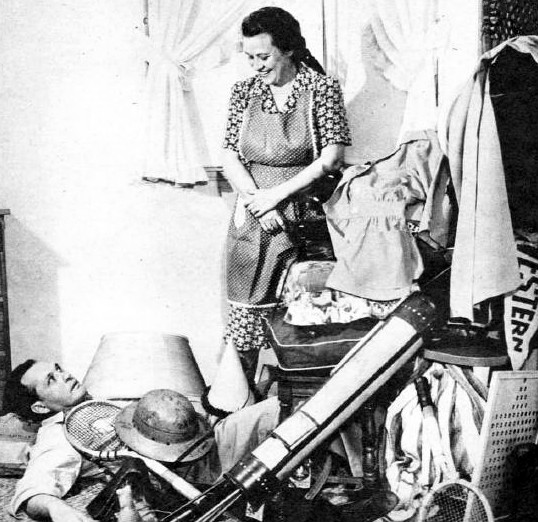
One Saturday when I was twelve, my mother, brandishing a dust mop, flushed a mouse out of my Fibber McGee’s closet.

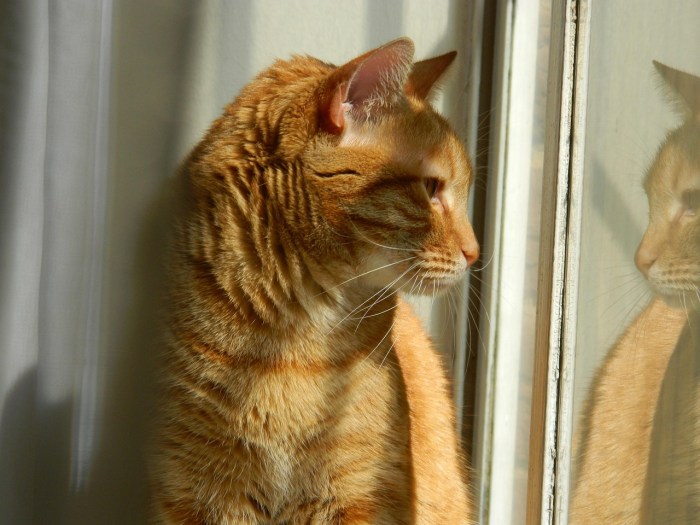
My cat, Ashley, brought in as a consultant, caught the mouse, his first, and pranced toward me with his offering.

I screamed and jumped onto the bed.

Ashley dropped the mouse.

The mouse ran back into the closet.

Ashley spent the rest of the afternoon sitting on the windowsill, staring out across the yard, refusing my mother’s pleas to try again.

“Ashley was proud of himself. He was bringing you a present. You hurt his feelings.” My mother spent the rest of the day glaring at me. It wasn’t about Ashley’s feelings.

Ashley resigned from his post as Head of Household Rodent Control.

I spent the rest of the day trying to civilize the closet.

I have no idea what happened to the mouse.

I don’t remember Fibber McGee’s closet myself, but I was told it was a dead ringer for mine.

*

Read about Fibber McGee and Molly at Wikipedia.

Listen to recordings of over 1,000 episodes of Fibber McGee and Molly at Internet Archive. (And if you come across the episode in which the phrase “Politics makes strange bedfellows” generates some confusion and considerable laughter, please leave its number in a comment.)

***

Image of mouse by Zachariah Kyle Pieterse from Pixabay

Image of cat by Zachariah Kyle Pieterse from Pixabay

Image of Fibber McGee’s closet by Dell Publications. Publisher and copyright information are on the magazine’s page 3., Public domain, via Wikimedia

Pangur Ban: A 9th-Century Irish Monk and His Cat

I and Pangur Bán, my cat,
‘Tis a like task we are at;
Hunting mice is his delight,
Hunting words I sit all night.

Better far than praise of men
‘Tis to sit with book and pen;
Pangur bears me no ill-will,
He, too, plies his simple skill.

‘Tis a merry thing to see
At our tasks how glad are we,
When at home we sit and find
Entertainment to our mind.

Oftentimes a mouse will stray
In the hero Pangur’s way;
Oftentimes my keen thought set
Takes a meaning in its net.

‘Gainst the wall he sets his eye
Full and fierce and sharp and sly;
‘Gainst the wall of knowledge I
All my little wisdom try.

When a mouse darts from its den,
O! how glad is Pangur then;
O! what gladness do I prove
When I solve the doubts I love.

So in peace our task we ply,
Pangur Bán, my cat, and I;
In our arts we find our bliss,
I have mine, and he has his.

Practice every day has made
Pangur perfect in his trade;
I get wisdom day and night,
Turning darkness into light.

***

“‘Pangur Bán is an Old Irish poem written in about the 9th century at or near Reichenau Abbey, in what is now Germany, by an Irish monk about his cat. Pangur Bán, ‘White Pangur’, is the cat’s name, Pangur possibly meaning ‘a fuller’. Although the poem is anonymous, it bears similarities to the poetry of Sedulius Scottus, prompting speculation that he is the author. In eight verses of four lines each, the author compares the cat’s happy hunting with his own scholarly pursuits.

“The poem is preserved in the Reichenau Primer (Stift St. Paul Cod. 86b/1 fol 1v) and now kept in St. Paul’s Abbey in the Lavanttal. . . .

“In 2016, Jo Ellen Bogart and Sydney Smith published a picture book based on the poem called The White Cat and the Monk.”

English translation by Robin Flower (1912, The Poem Book of the Gaef)

—From Wikipedia

Read the original Old Irish version at Wikipedia.

Hear The White Cat and the Monk read aloud on Youtube.

Brandon and the Shepherd

Once upon a time, a long time ago, when I was a lot younger but still old enough to know better, someone decided I should teach a children’s Sunday school class.

I don’t remember who came up with the idea, but I’m sure they knew I was a career co-dependent, constitutionally unable to say, No. Even when No would have been the sensible answer. Even when I knew, somewhere in the mists of my subconscious, that Yes would lead to disaster.

So I said, Yes, and spent Sunday mornings for the next several months perched on a small green-painted wooden chair, one of the very same chairs I’d occupied when I was four years old, in the very same classroom of the Fentress United Methodist Church.

Around me sat four or five children ranging in age from, say, four to ten. Nice children, polite, good listeners. But one stands out in my memory: Brandon.

His family lived one small-town block from me. They owned an enormous horse—white, gray, perhaps dappled, I don’t remember exactly—but I do remember driving by their house and seeing in the yard tiny Brandon in the saddle atop that great big horse. I don’t think the child was afraid of anything.

Brandon had straight blonde hair and, when I was around him, a perpetual smile. There was also a perpetual twinkle in his eye. He was beyond cute.

Anyway, regarding Sunday school—you can probably see where this is heading:

On the day in question, we were going great guns, singing and praying and playing a Sunday school game. Then, aided by my David C. Cook teacher’s guide, I told the Bible story.  The children hung on my every word.

Thus armed with a false sense of security, I read, “Jesus said, ‘These people need a shepherd.'” Then, because I believe all terms should be clearly defined, I paused and said, “Now, do we all know what a shepherd is?”

Brandon spoke up. “Yeah. It’s a dog.”

Well, when you’re right, you’re right.


***

I have used Brandon’s real name. I don’t think his mother will mind. If she’d rather, I’ll change it.

***


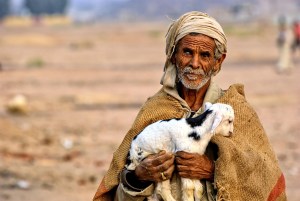
Image of Egyptian shepherd by Jarek from Pixabay

Image of German shepherd by Goran Horvat from Pixabay

Friday Fictioneers: Thingies

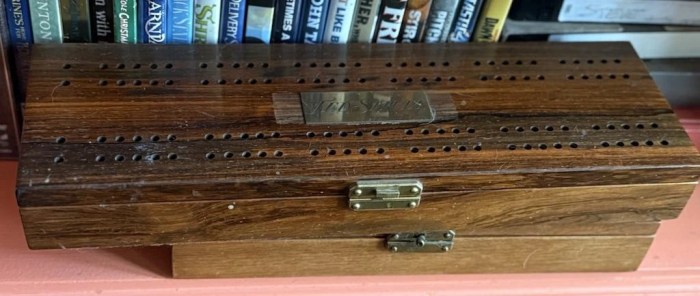
several wooden cribbage boards, stacked one on top of another
PHOTO PROMPT © Ted Strutz

Word count: 100


“What’s that?”

“What’s what?”

“That wooden thingie.”

“A flute case?”

“Flute cases don’t have holes.”

“Those look like holes you stick little thingies into.”

“What kind of thingies?”

“Little thingies. They’re called, like, widgets.”

“But what’s the wooden thingie for?”

“It looks like part of a game.”

“We need one of those books. Like a backwards dictionary. Where you look up a picture.”

“How do you look up a picture?”

“Well, there’s some kind of book where you can do that.”

“What’s it called?”

“Wait! I remember. The game.  My aunt plays it. It’s called ‘cabbage.’”

“We need a librarian.”

***

FRIDAY FICTIONEERS is a weekly challenge to write a 100-word story in response to a photo prompt. To read other Friday Fictioneers’ stories, click on the frog. To participate, find the rules and the photo prompt at Rochelle Wisoff-Fields’ blog.


In Flanders Fields

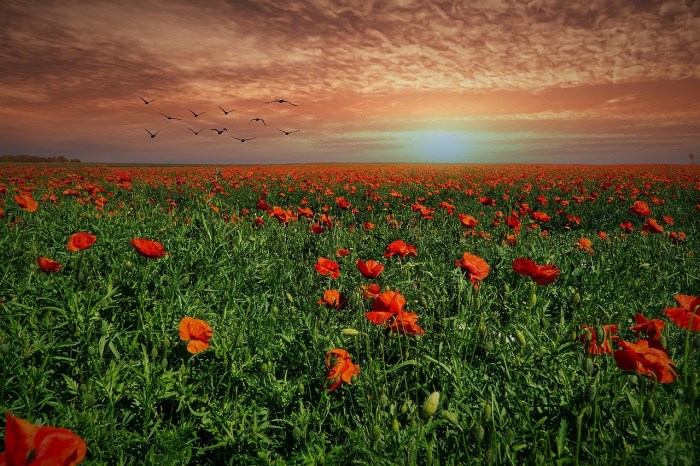
In Flanders fields the poppies blow
Between the crosses, row on row,
    That mark our place; and in the sky
    The larks, still bravely singing, fly
Scarce heard amid the guns below.
We are the Dead. Short days ago
We lived, felt dawn, saw sunset glow,
    Loved and were loved, and now we lie,
        In Flanders fields.
Take up our quarrel with the foe:
To you from failing hands we throw
    The torch; be yours to hold it high.
    If ye break faith with us who die
We shall not sleep, though poppies grow
        In Flanders fields.

***


The Story Behind the Poppies of Flanders Fields

John McCrae

Image by Benita Welter from Pixabay

“We cannot escape history.”

Fellow-citizens, we cannot escape history. We of this Congress and this administration, will be remembered in spite of ourselves. No personal significance, or insignificance, can spare one or another of us. The fiery trial through which we pass, will light us down, in honor or dishonor, to the latest generation.. . . . 

— Abraham Lincoln, Message to Congress, 1862


A Soft-looking, Middle-aged Woman


She is a soft-looking, middle-aged woman,
whose bust and stomach are always holding a get-together.

In the summer of 1982, while enrolled in a graduate seminar in contemporary women’s fiction, I happened across the above sentence. I was delighted. The description was so right. I didn’t have to memorize it. The image it evoked was vivid enough that the words, along with the author’s name, stayed with me.

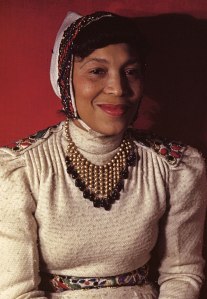
Today I finally hunted it down: “The Pleading Woman,” in The Eatonville Anthology, by Zora Neale Hurston


Zora Neale Hurston (January 7, 1891 – January 28, 1960) was an American writer, anthropologistfolklorist, and documentary filmmaker. She portrayed racial struggles in the early-20th-century American South and published research on Hoodoo and Caribbean Vodou.[3] The most popular of her four novels is Their Eyes Were Watching God, published in 1937. She also wrote more than 50 short stories, plays, an autobiography, ethnographies, and many essays.” — Wikipedia

Hurston’s unpublished works are still being released.

The Life of Herod the Great: A Novel came out in January 2025:

“A never before published novel from beloved author Zora Neale Hurston, revealing the historical Herod the Great—not the villain the Bible makes him out to be but a religious and philosophical man who lived a life of valor and vision.”


***

Image of Zora Neale Hurston by Carl van Vechten via Wikipedia

National Poetry Month Is Come–But Not Gone

“The only thing we have to fear is fear itself.”

The ON / ly THING / we HAVE / to FEAR / is FEAR / it SELF

A perfect iambic hexameter line.

If Shakespeare had written it in blank verse:

The only thing we have to fear is fear
Itself.

The rhythm most natural to the English language.

Repetition. Alliteration.

Short, common words.

Musical.

Easily remembered.

Poetry.

“The only thing we have to fear is fear itself.”

                                – Franklin D. Roosevelt, “First Inaugural Address”

Happy National Poetry Month!

***


Image of fear by Janusz Walczak from Pixabay

Image of courage by Danny See Chuan Seng from Pixabay