
Punctuation:
all those boring things
that prove you know how to write
~ The Room Upstairs
Image by ELLE RITTER from Pixabay
~ Telling the Truth, Mainly
Image by ELLE RITTER from Pixabay
[I don’t know why several paragraphs are jammed together.
I double-spaced. I triple-spaced.
But the paragraphs insist on bunching up
in an unattractive and almost unreadable lump.
My apologies.
I tried.]
Today I answer the question—Exactly what is a runcible spoon?
You no doubt remember that Edward Lear’s Owl and Pussy-Cat use one at their wedding breakfast:
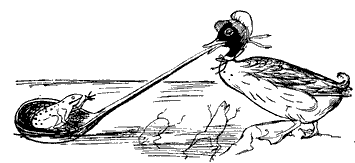
Tricia Christensen, writing in LanguageHumanities, notes that
A Latin word runcare means to weed out. This word could explain the Dolumphious Duck’s fishing process with a runcible spoon. The duck is really weeding out the frogs from the water.
That should settle the question. But it doesn’t.
For one thing, it seems to me that eating mince and slices of quince with a runcible spoon would be difficult if not downright messy.
And Christensen notes that Lear also applies the adjective to a goose, a hat, and a wall. Wikipedia points to a runcible cat and a Rural Runcible Raven. None of the aforementioned, at least as we understand them, resembles a ladle.
“Despite the nebulous meaning of the words runcible spoon,” she says, “they trip off the tongue with delight and account for their many uses by other authors.”
So—what is a runcible spoon? It’s nonsense.
What else would it be? It comes from the brain of Edward Lear.
###
Except, to muddy the water:
Wikipedia dates publication of “The Owl and the Pussy-Cat” at 1870.
Here’s a photo of a George III Sterling runcible spoon by Eley & Fearn, L0ndon, 1817
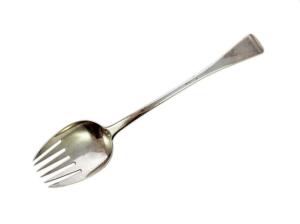
Maybe the item wasn’t originally called a runcible spoon. Maybe the adjective was applied post-1870. I don’t know.
More nonsense.
What does it mean to live boldly?
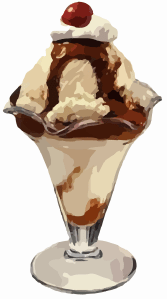
To live boldly
means
to serve
brownies,
ice cream sundaes,
and
cheese and fruit
instead of
wedding cake.
***
Image by Clker-Free-Vector-Images from Pixabay
 kangaroo: on a multiple choice test, an answer that is so obviously incorrect that no examinee with the sense God promised a monkey would ever select it
I learned about kangaroos in a senior level education course. There were two professors, one who taught testing and measurement and another who taught what I think of as the softer side of counseling. The info about kangaroos came from the T&M prof. He frowned upon them.
After a test covering the softer side, a student informed the SS prof that he’d included several kangaroos. He’d never heard the term. He also didn’t appear concerned.
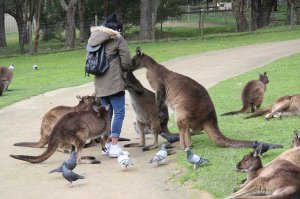
Concern. Sometime I’ve got it. Sometimes I don’t.
If I were concerned about sincerity, truth, design; about beauty and art; about, to quote the Duke, preserving the unities, I would end, as I began, with kangaroos.
But I have nothing more to say about them. And the videos I’ve examined don’t do a thing for me.
So for kangaroos, substitute kittens.
***
“Now,” says the duke, “after to-night we can run in the daytime if we want to. Whenever we see anybody coming we can tie Jim hand and foot with a rope, and lay him in the wigwam and show this handbill and say we captured him up the river, and were too poor to travel on a steamboat, so we got this little raft on credit from our friends and are going down to get the reward. Handcuffs and chains would look still better on Jim, but it wouldn’t go well with the story of us being so poor. Too much like jewelry. Ropes are the correct thing—we must preserve the unities, as we say on the boards.” ~ Mark Twain, Huckleberry Finn
***
Image by saratarshouby from Pixabay
 M. K. Waller