Loveliest of trees, the cherry now Is hung with bloom along the bough, And stands about the woodland ride Wearing white for Eastertide.
Now, of my threescore years and ten, Twenty will not come again, And take from seventy springs a score, It only leaves me fifty more.
And since to look at things in bloom Fifty springs are little room, About the woodlands I will go To see the cherry hung with snow.
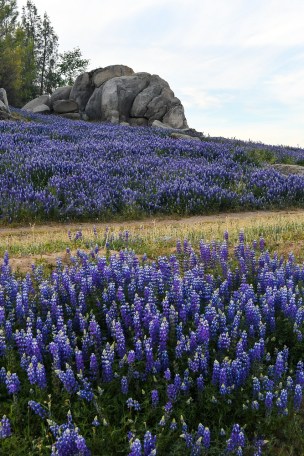
I post this poem every spring as a reminder that life is brief, and that wildflowers blanket Texas fields and roadsides for only a few weeks each year. Fifty springs—or fewer—are little room in which to look at them. Seize the day. Go out and see the bluebonnets.
Content was never in question: I post A. E. Housman’s “Loveliest of Trees” nearly every year at bluebonnet time as a reminder to seize the day, to get out and see beauty while it’s here–while we’re here.
Be sure to read–or at least scroll–to the bottom of the page. There’s an unexpected treat–not just a bunch of blue flowers.
I’ve said before, and loudly, that my Tennessee ancestors must have rolled into Central Texas in April, when the wildflowers were in bloom. Otherwise, like General Philip Sheridan, they would have chosen to rent out Texas and live in Hell.
My friend from Cleveland disagrees. He says the Wallers and the Grahams settled here because, as far as they looked in any direction, they didn’t see snow. He might be right. Perspectives on weather are heavily influenced by experience. I’ve never had to shovel snow, so I feel free to whinge about the heat.
April is a special time here. It’s the month when the landscape explodes with color, and a mild madness descends. People go wildflower hunting. Purists cruise around just looking. Artists set up easels and canvases and palettes and paint en plein air. We all risk snakebite to capture shots of family and friends amongst the bluebonnets.
And I post A. E. Housman’s “Loveliest of Trees” as a reminder that April isn’t forever.
This year I’m starting early. My friend Mary googled “Texas Hill Country Wildflowers” and sent me one of the links: image after image of spring landscapes. I’m sharing it here. The site loads in stages, so patience is called for.
Austin’s Lady Bird Johnson Wildflower Center, formerly the National Wildflower Research Center, seeks to “increase the sustainable use and conservation of native wildflowers, plants and landscapes.” According to her biographer, Mrs. Johnson’s legacy as First Lady “was to legitimize environmental issues as a national priority. The attitudes and policies she advanced have shaped the conservation and preservation policies of the environmental movement since then.” The Center’s comprehensive website addresses science, history, legislation, tourism, conservation, education–all areas Mrs. Johnson’s interest in the natural environment touched on.
The Texas Hill Country is beautiful in spring, but other parts of the state are just as lovely. Here are some more links to information about the best places to see wildflowers.
 Loveliest of trees, the cherry now



 M. K. Waller