[I don’t know why several paragraphs are jammed together.
I double-spaced. I triple-spaced.
But the paragraphs insist on bunching up
in an unattractive and almost unreadable lump.
My apologies.
I tried.]
Today I answer the question—Exactly what is a runcible spoon?
You no doubt remember that Edward Lear’s Owl and Pussy-Cat use one at their wedding breakfast:
- Paul McCartney‘s 2001 album Driving Rain includes the track “Heather” which features the lyrics: “And I will dance to a runcible tune / With the queen of my heart”. McCartney has explained the connection to “The Owl and the Pussycat” in various interviews since its release.
- In Lemony Snicket‘s 2006 The End, an island cult eats using only runcible spoons
Who caught Spotted Frogs for her dinner
With a runcible spoon
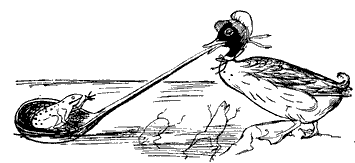
Tricia Christensen, writing in LanguageHumanities, notes that
A Latin word runcare means to weed out. This word could explain the Dolumphious Duck’s fishing process with a runcible spoon. The duck is really weeding out the frogs from the water.
That should settle the question. But it doesn’t.
For one thing, it seems to me that eating mince and slices of quince with a runcible spoon would be difficult if not downright messy.
And Christensen notes that Lear also applies the adjective to a goose, a hat, and a wall. Wikipedia points to a runcible cat and a Rural Runcible Raven. None of the aforementioned, at least as we understand them, resembles a ladle.
“Despite the nebulous meaning of the words runcible spoon,” she says, “they trip off the tongue with delight and account for their many uses by other authors.”
So—what is a runcible spoon? It’s nonsense.
What else would it be? It comes from the brain of Edward Lear.
###
Except, to muddy the water:
Wikipedia dates publication of “The Owl and the Pussy-Cat” at 1870.
Here’s a photo of a George III Sterling runcible spoon by Eley & Fearn, L0ndon, 1817
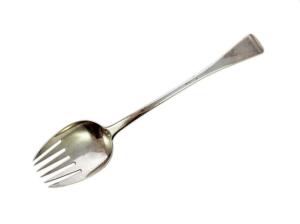
Maybe the item wasn’t originally called a runcible spoon. Maybe the adjective was applied post-1870. I don’t know.
More nonsense.


I can’t leave a comment today without logging into something. But I want to thank you for a really fun post. I enjoyed it immensely!
Kaye George Mysteries with a Twist (sent from my phone)
LikeLike
Thank you! I really thought I would define the term and that would be that. Then I started reading . . . Some questions just don’t have straight answers.
LikeLike
Once again you’ve caused me to follow links to answer questions I didn’t know I had. Keep it up! Hugs from one Fentressite to another. LKHG
LikeLike
Once again you’ve caused me to follow links to answer questions I didn’t know I had. Keep it up! Hugs from one Fentressite to another.
LikeLike
This is what happens when I stop staring at the wall and start thinking. Nothing productive ensues, but I use a lot of words. Hugs right back at you.
LikeLike
It’s such a lovely word though😊
LikeLike
You can see why it’s still around. Who cares what it means? It’s fun to say. And think. Like Lear’s poems.
LikeLike