Sores on the tops of the horses

Writing about his college years, James Thurber tells the story of Haskins, an agriculture student who takes up journalism, “possibly on the ground that when farming went to hell he could fall back on newspaper work.”

Haskins is assigned the animal husbandry beat, which comprises cows, sheep, and over two hundred horses.

Unfortunately, he is shy and doesn’t know how to use a typewriter. He writes slowly, and his stories are dull.

One day Haskins’ editor assigns him to bring in news from the horse pavilion. Haskins later comes back saying he has a story.

The editor, hoping for something more interesting than he’s been getting, says, “Well, start it off snappily.”

A couple of hours later, Haskins turns in a paper that starts with the following sentence:

“Who has noticed the sores on the tops of the horses in the animal husbandry building?”

That’s the other reason I’m not a journalist: When it comes to writing leads, I’m several steps behind Haskins.

Under most circumstances,  I wouldn’t care. I don’t make my living working for a newspaper.

But a lead sentence corresponds in at least one way to the first line of a short story or novel. They both catch the reader’s attention, draw him into the text, make him want to read on.

And there’s this novel I’m working on. And this short story…

And, like Haskins, I’ve heard from some of my critique partners that my first lines leave something to be desired.

After some thought and a brief cooling-off period, I’ve forgiven them and admitted they might be right.

The sad thing is that before my abject humiliation, I never paid much attention to first lines. The sadder thing is that I can quote so many.

Scarlett O’Hara was not beautiful, but men seldom noticed it when caught by her charm as the Tarleton twins were.

This is the saddest story I have ever heard.

He was born with a gift of laughter and a sense that the world was mad.

It is a truth universally acknowledged, that a single man in possession of a good fortune must be in want of a wife.

While Pearl Tull was dying, a funny thought occurred to her.

I write this sitting in the kitchen sink.

When he was nearly thirteen, my brother Jem got his arm badly broken near the elbow.

When the lights went off the accompanist kissed her.

All children, except one, grow up.

Well, I have broken the toilet.

You don’t know about me without you have read a book by the name of The Adventures of Tom Sawyer; but that ain’t no matter.

I woke this morning with a stranger in my bed.

Last night I dreamed I went to Manderley again.

They used to hang men at Four Turnings in the old days.

And so on. With all those lines suspended in my brain, you’d think I’d have caught onto why I remember them. And why they’re important.

Here’s the way it works.

A bookstore browser sees a book on the shelf. If the writer is lucky, it sits face out. He takes the volume down, looks at the front cover, the back cover, the first paragraph…and then either buys it or walks away.

And the whole process happens in under ten seconds.

The first line of a novel can make the difference between a sale and a return. Between another advance and a canceled contract.

There’s a lot riding on Scarlett O’Hara not being beautiful. And our not knowing Huck Finn. And what happened when the lights went off.

How does one get to be that good?

The same way one gets to Carnegie Hall, I guess.

Practice. Practice.

~~~~~~~~~~

And blog blog blog.

Because my concern isn’t just for novels and money and fame. I’d also like the gentle readers who land on To write… to linger longer than the first sentence.

~~~~~~~~~~

And please discount the business about money and fame. Unless you’re Tom Clancy or Stephen King, those aren’t really part of the package. But they sound good, so I throw them in.

~~~~~~~~~~

Sorry about that linger longer. Against some things there is no defense.
Les Liaisons Dangereuses, or The writerly thing to do

Cats are dangerous companions for writers because cat watching is a near-perfect method of writing avoidance.  ~Dan Greenburg

I returned home from Just for the Hell of It Writers filled with enthusiasm for the next assignment. Sat down in the recliner, put my feet up, booted up the laptop, read e-mail, checked a couple of blogs, and opened to write is to write is to write. I planned to compose a brief post about characterization–specifically, my reluctance to allow Molly, my protagonist, to exhibit less-than-stellar qualities, such as being human.

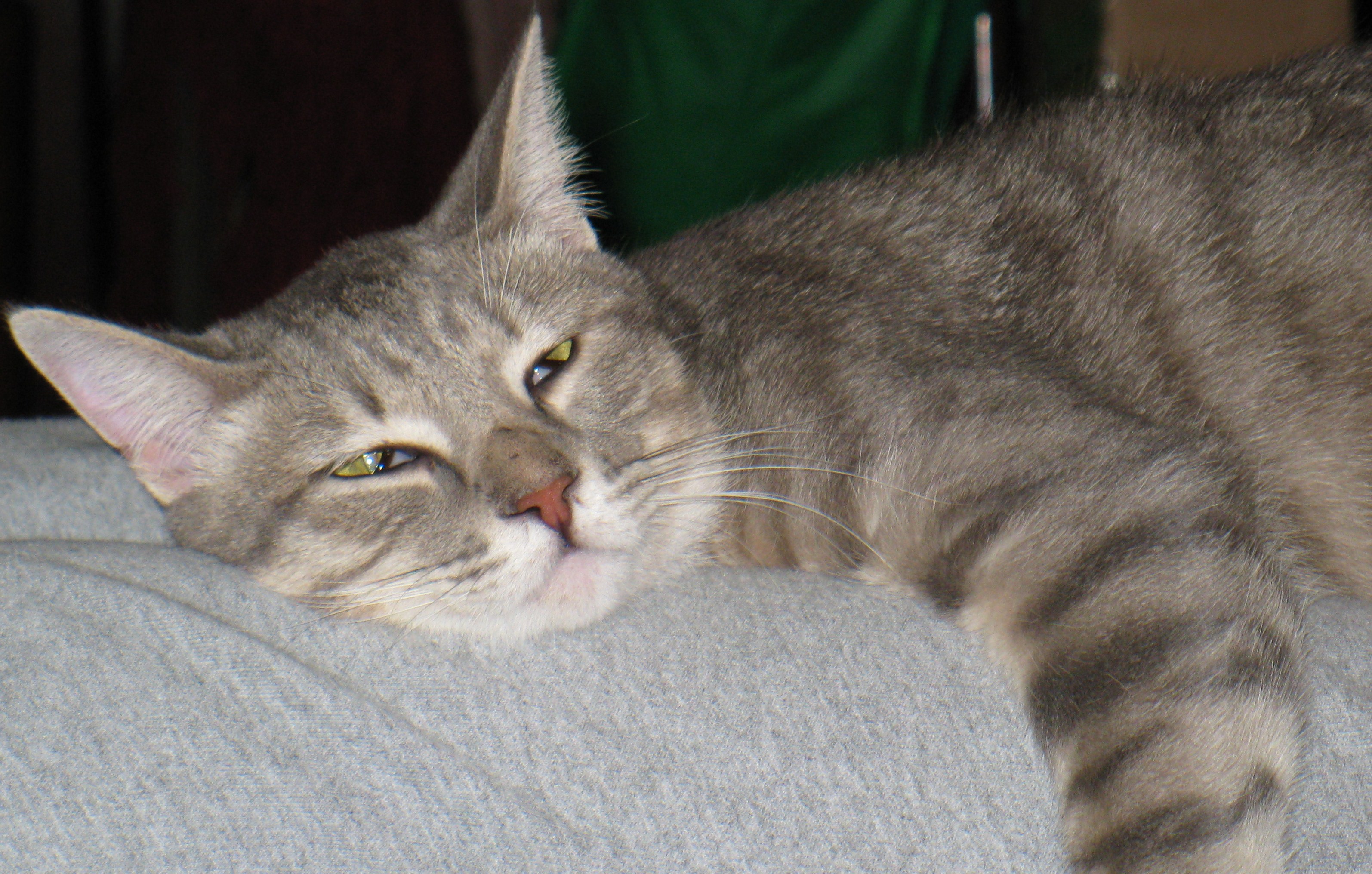
Before I could start, however, Ernest climbed into my lap. With the laptop already there, he didn’t have an easy time. He never does. But he made it.

So here I sit with a fuzzy gray tiger draped across my left forearm and wrist, cutting off blood flow to my hand. I don’t know how much longer my fingers will function. I don’t know how much longer this post will function either, because Ernest just touched something–a hot key or some other doohickey outside my sphere of knowledge–and it vanished. I’m lucky he didn’t delete it. Sometimes he does. When it comes to writing, cat watching is the least of my worries.

If he were on my left, I’d be fine with the arrangement. He used to perch there. But a couple of weeks ago he changed sides. As a result, I can’t use the mouse, and I have to bend my index finger at an unnatural angle to reach the touchpad. Periodically he throws his head back to let me gaze into his green, green eyes. That means he wants his ears scratched. 


I’ve tried moving him to the left, but he’s heavy and muscular, a feline Jesse Ventura. He’s also the master of his fate and the captain of his soul. After losing three consecutive matches, I gave up.

If you’ve read this far, you’re probably wondering why I don’t evict him from my person altogether.

It’s complicated.

There’s guilt. Yesterday I found him on the dining room table trying to eat a length of purple ribbon. I clapped my hands. That scared him. I spent the next five minutes trying to apologize. He spent the next five minutes evading capture. Then I realized that I’d forgotten to put out catfood on schedule, and that his acting out might have been caused by low blood sugar. I also considered that William, who has a wry sense of humor, might have dared him to jump onto the table. Ernest is impulsive, and I hadn’t taken into account the possibility of diminished capacity. I’m still making amends. 


Then there’s the purr. I’ve read that the vibration guards against bone loss and muscle atrophy. Some authorities believe that holding a purring cat benefits human tissue as well. Holding Ernest could protect my writing arm against osteoporosis. 


Furthermore, allowing cats a bit of leeway is a writerly thing do. Charles Dickens’ cat, Wilamena, had kittens in his study; the kitten Dickens kept later became his companion while he wrote. Raymond Chandler’s Taki, whom he called his “secretary,” sat on manuscripts he was trying to revise. T.S. Eliot sent his cats to Broadway. Mark Twain couldn’t resist cats, “especially a purring one.” I don’t know whether Garrison Keillor has cats, but he joined with the Metropolitan Opera’s Frederica von Stade to make an entire CD of cat songs (“Songs of the Cat”), and Bertha’s Kitty Boutique is one of The Prairie Home Companion’s most prominent sponsors. I can’t think of better role models than Keillor, Twain, and Von Stade. 


Finally, I allow Ernest to walk all over me because I’m concerned about mental and emotional balance. My own. Sigmund Freud emphasized the cat’s importance in coping with the stresses and strains of modern life: “Time spent with cats,” he wrote, ” is never wasted.”

Freud might not have known much about women, but he had a thorough grasp of cats.

Since I began this piece, Ernest has jumped down, back up, down, back up, and down again. William, who, bless his heart, parks on the left, has visited twice.

It’s not always easy to remember my reasons for being a doormat, especially the one about balance. But when the conscious mind fails, the subconscious defaults to guilt.

Well. Once again I’ve written about not writing. Once again the obstacle has been cats.

Greenburg is right. They’re dangerous companions.

*************

Sources:

Famous Cat Loving Authors and Pet Names

www.twainquotes.com

Wikipedia: Songs of the Cat

Thinkexist.com (Freud)

Thinkexist.com (Greenburg)

Frederica von Stade, Mezzo-Soprano

[Full disclosure: If I had my druthers, I’d emulate Miss Von Stade instead of the writers. She gets paid to sing, she doesn’t have to make up the words as she goes along, her picture appears on the front cover, the Amazon reviewers simply gush at her “magnificent” voice, and she doesn’t have to read Bird by Bird twice a month to keep her spirits up. What’s not to emulate?]

Many thanks to the author of “Invictus.” If we ever get a brother for William and Ernest, we’re going to name him Henley.


I need an emoticon

The low point of my teaching career–one of the low points, anyway–occurred at a literary festival hosted by Texas Lutheran University.

I’d accompanied several of my high school students, who had submitted pieces of writing to TLU weeks before. The morning of the festival, we were assigned to small groups, each comprising about a dozen secondary students from several high schools in the area and a teacher or two. A TLU professor and an English major led discussions of student submissions.

Somehow, talk turned to Jonathan Swift’s A Modest Proposal, the essay in which Swift appears to suggest that the poor of Ireland might benefit from selling their infants as food for the rich. My seniors had read the essay a month or two before.

In the middle of the ensuing talk about tone, irony, distance between meaning and text, Pat, one of my brightest students, turned to me and said in a voice audible to all, “I thought he was serious about eating Irish babies.”

“It’s satire,” I hissed, sliding under the sofa.

That’s what I get, I thought, for not polling the class at the end of the lesson. I imagine more than one of my students, considering their penchant for distraction, graduated thinking Swift approved of cannibalism. I should post a clarification on FaceBook.

But that was years ago. If I were teaching now I wouldn’t fear exposing my students to literary fests. If I were teaching now, I’d simply tell students to take their pencils and lightly mark Swift’s Proposal with an emoticon: a little smiley face that signifies, “Didn’t mean it. Just being amusing.”

I’d have them put one on Huckleberry Finn, too. In fact, I’d buy a box of them for Huck. We’d go page by page, sticking a little yellow smiley beside every paragraph likely to upset the terminally literal.

While I was at it, I’d stick on on me, too. I need an emoticon.

In a piece I wrote for Whiskertips, another blog for which I’m responsible, I issued guidelines for grocery shopping. I got the idea from Pat Hoglund’s Have I Got a Story from You. Hoglund writes about her dislike of shopping for groceries. I took the topic a step further, offering a codified version of the rules according to me. Θ*

*Didn’t mean it. Just being amusing.

Or, in the cases of Swift and Twain, scathing.

I didn’t mean people shouldn’t choose fruits and vegetables with care. I didn’t mean, “Get out of my way or I’ll run over you with my cart.” Or your children. I didn’t mean anything I said.

Well, I meant some of it. Men really do move through the checkout line faster than women, especially women with children. And when people look straight at me while talking on cell phones, I do jump into their conversations. And I think people should line up behind older people and not complain when they take a long time to get out their money. As I said, we’re all going to get to that point, if we’re lucky.

But I wrote the piece as if I meant everything I said–literally. And therein lies the problem. I’m aware some of my readers might have taken me literally. It’s happened before. Like in my post asking why men always end up with the remote control. That was meant to be lighthearted, ironic, neither a serious question nor a criticism of the social order.

If I had an emoticon, I could prevent misunderstanding. Unfortunately, this program doesn’t give me that option. The symbol Θ, marked with the asterisk, above, is theta, the closest symbol to an emoticon I could find.

I refuse to insert Θs when I mean something else.

So, dear readers, please muddle along with me, taking on faith that I am a well-meaning person without a malicious bone in my body, a writer whose one compulsion lies in a satirical, hyperbolic, amusing, flippant, frivolous, blithe, playful, sprightly, fanciful, dry, wry, droll, aslant, farcical, irreverent,** ironic but entirely non-sarcastic take on life that will burst forth no matter how I try to keep a lid on it.

** Thesaurus.com is a fine resource.