
“Recollected in Tranquillity”

Image of Blue plaque, 3 Kensington Court Gardens, Kensington, London, home from 1957 until his death in 1965

In  the movie Tom and Viv, about poet T. S. Eliot and his first wife, Vivien Haigh-Wood, Eliot’s character says that poetry is an “escape from emotion.”* When I heard that, a percentage of my brain defaulted to English 2310 (British Poetry from 1798. or something like that) and Wordsworth’s statement that poetry is the “spontaneous overflow of powerful feelings: it takes its origin from emotion recollected in tranquillity.”

Dr, Thomas Brasher said the key to Wordsworth’s phrase is “recollected in tranquillity.”** Poetry written in the grip of emotion usually turns out to be poetry which, reread the next day, must be revised and edited before it is “good.” Wordsworth composed much of his poetry while taking long walks and later dictated it to his to his sister Dorothy.
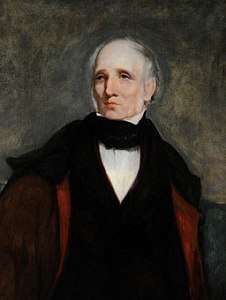
William Wordsworth

Everything I write should be recollected in tranquility. That is, I should wait at least twenty-four hours and edit before publishing.

Fiction I edit like crazy for days and days. In one case, for years.

But blog posts—no. I edit like crazy as I write, but that really isn’t adequate.

As a consequence, when I read old posts, I’m often embarrassed.

In twenty-four hours, this one may embarrass me. But I’ll risk it. When it comes to blog posts, my vanity slips a little.

*

*Eliot’s full statement: “Poetry is not a turning loose of emotion, but an escape from emotion; it is not the expression of personality, but an escape from personality.” Which echoes what Wordsworth wrote.

** I remember so much Dr. Brasher said. If you read the work he assigned and listened in class, you remembered. No lectures, just close textual analysis. I took three courses he taught. One of the two best, and most interesting, professors I ever had.

Dr. Brasher also said Eliot was “an intellectual snob,” but I doubt that I will find that on the Internet.

***

Image of Wordsworth by Anonymous via Wikipedia

Image of Blue plaque, 3 Kensington Court Gardens, Kensington, London, home from 1957 until his death in 1965 by Edwardx, licensed under CC SA-BY 4.0. Via Wikipedia

I include no photo of Eliot because those published on Wikipedia their owners assert they are under copyright and have filed claims against Wikipedia.
Les Liaisons Dangereuses, or The writerly thing to do

Cats are dangerous companions for writers because cat watching is a near-perfect method of writing avoidance.  ~Dan Greenburg

I returned home from Just for the Hell of It Writers filled with enthusiasm for the next assignment. Sat down in the recliner, put my feet up, booted up the laptop, read e-mail, checked a couple of blogs, and opened to write is to write is to write. I planned to compose a brief post about characterization–specifically, my reluctance to allow Molly, my protagonist, to exhibit less-than-stellar qualities, such as being human.

Before I could start, however, Ernest climbed into my lap. With the laptop already there, he didn’t have an easy time. He never does. But he made it.

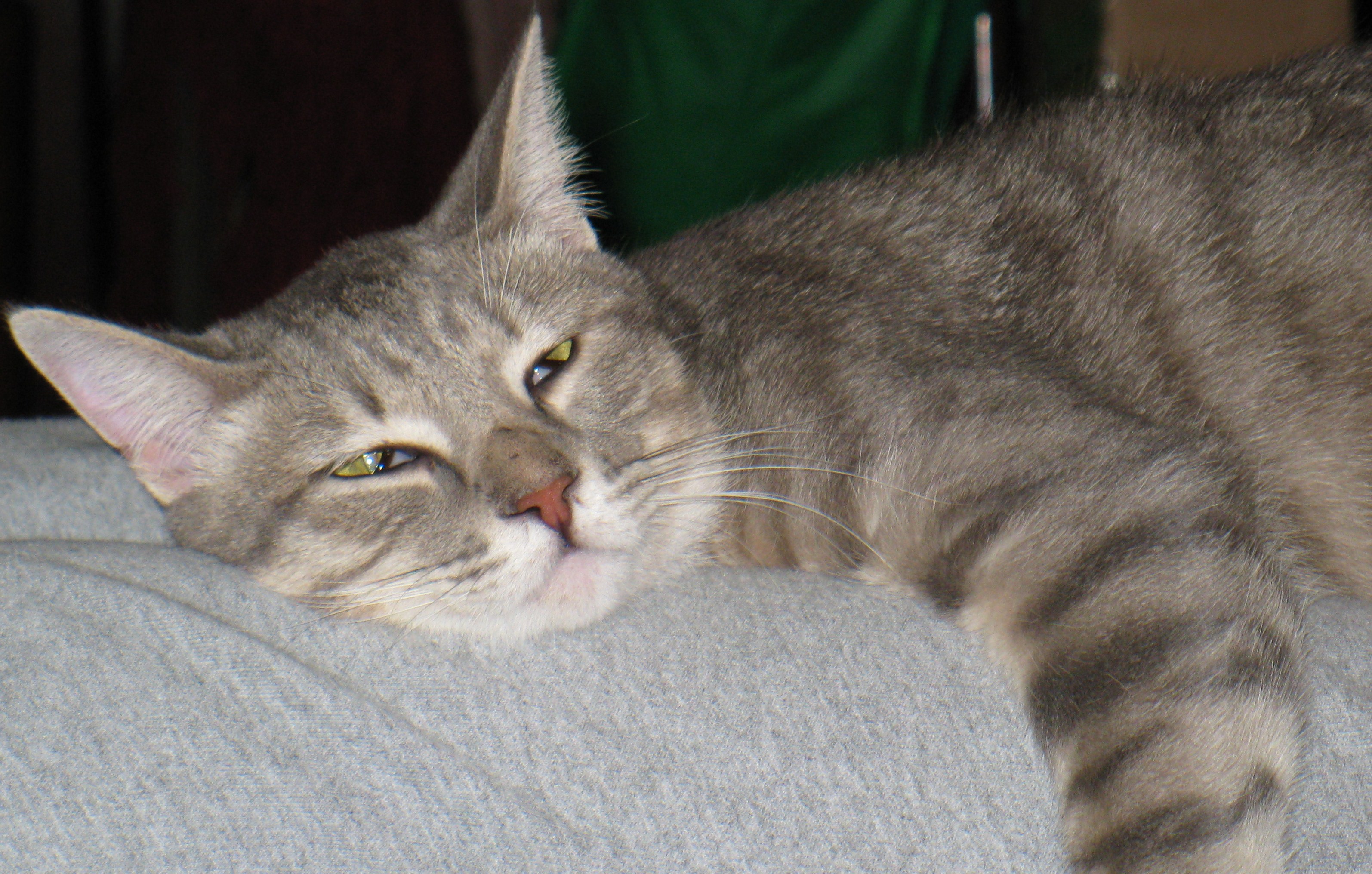
So here I sit with a fuzzy gray tiger draped across my left forearm and wrist, cutting off blood flow to my hand. I don’t know how much longer my fingers will function. I don’t know how much longer this post will function either, because Ernest just touched something–a hot key or some other doohickey outside my sphere of knowledge–and it vanished. I’m lucky he didn’t delete it. Sometimes he does. When it comes to writing, cat watching is the least of my worries.

If he were on my left, I’d be fine with the arrangement. He used to perch there. But a couple of weeks ago he changed sides. As a result, I can’t use the mouse, and I have to bend my index finger at an unnatural angle to reach the touchpad. Periodically he throws his head back to let me gaze into his green, green eyes. That means he wants his ears scratched. 


I’ve tried moving him to the left, but he’s heavy and muscular, a feline Jesse Ventura. He’s also the master of his fate and the captain of his soul. After losing three consecutive matches, I gave up.

If you’ve read this far, you’re probably wondering why I don’t evict him from my person altogether.

It’s complicated.

There’s guilt. Yesterday I found him on the dining room table trying to eat a length of purple ribbon. I clapped my hands. That scared him. I spent the next five minutes trying to apologize. He spent the next five minutes evading capture. Then I realized that I’d forgotten to put out catfood on schedule, and that his acting out might have been caused by low blood sugar. I also considered that William, who has a wry sense of humor, might have dared him to jump onto the table. Ernest is impulsive, and I hadn’t taken into account the possibility of diminished capacity. I’m still making amends. 


Then there’s the purr. I’ve read that the vibration guards against bone loss and muscle atrophy. Some authorities believe that holding a purring cat benefits human tissue as well. Holding Ernest could protect my writing arm against osteoporosis. 


Furthermore, allowing cats a bit of leeway is a writerly thing do. Charles Dickens’ cat, Wilamena, had kittens in his study; the kitten Dickens kept later became his companion while he wrote. Raymond Chandler’s Taki, whom he called his “secretary,” sat on manuscripts he was trying to revise. T.S. Eliot sent his cats to Broadway. Mark Twain couldn’t resist cats, “especially a purring one.” I don’t know whether Garrison Keillor has cats, but he joined with the Metropolitan Opera’s Frederica von Stade to make an entire CD of cat songs (“Songs of the Cat”), and Bertha’s Kitty Boutique is one of The Prairie Home Companion’s most prominent sponsors. I can’t think of better role models than Keillor, Twain, and Von Stade. 


Finally, I allow Ernest to walk all over me because I’m concerned about mental and emotional balance. My own. Sigmund Freud emphasized the cat’s importance in coping with the stresses and strains of modern life: “Time spent with cats,” he wrote, ” is never wasted.”

Freud might not have known much about women, but he had a thorough grasp of cats.

Since I began this piece, Ernest has jumped down, back up, down, back up, and down again. William, who, bless his heart, parks on the left, has visited twice.

It’s not always easy to remember my reasons for being a doormat, especially the one about balance. But when the conscious mind fails, the subconscious defaults to guilt.

Well. Once again I’ve written about not writing. Once again the obstacle has been cats.

Greenburg is right. They’re dangerous companions.

*************

Sources:

Famous Cat Loving Authors and Pet Names

www.twainquotes.com

Wikipedia: Songs of the Cat

Thinkexist.com (Freud)

Thinkexist.com (Greenburg)

Frederica von Stade, Mezzo-Soprano

[Full disclosure: If I had my druthers, I’d emulate Miss Von Stade instead of the writers. She gets paid to sing, she doesn’t have to make up the words as she goes along, her picture appears on the front cover, the Amazon reviewers simply gush at her “magnificent” voice, and she doesn’t have to read Bird by Bird twice a month to keep her spirits up. What’s not to emulate?]

Many thanks to the author of “Invictus.” If we ever get a brother for William and Ernest, we’re going to name him Henley.