
Tag: William Shakespeare
Bani-shed!

Tybalt is gone, and Romeo banished;
Romeo that kill’d him, he is banished. ~ Shakespeare, Romeo and Juliet, III.ii
They are free men, but I am banished.
And say’st thou yet that exile is not death?
Hadst thou no poison mix’d, no sharp-ground knife,
No sudden mean of death, though ne’er so mean,
But “banished” to kill me? “Banished”? ~ Romeo and Juliet, III.iii
Lake Superior State University has published its 2013 List of Banished Words, and, judging from what I found on Google, so has everyone else.
I intended to write about the LSSU list, which introduced me to the word YOLO. (That shows how far behind I am with regard to popular culture.) But while researching, I came across LSSU’s archive of banished words and decided to share them–as many as I can before I have to post this–starting at the beginning.
(Since 9:00 a.m., I’ve changed topics about fifteen times.)
1976 At this point in time – A holdover from the Watergate hearings
1977 To Share – Do we still do this?
1978 Nuk-U-Lar – Still here, but not widely used since President Obama took office
1979 Energy Crisis – Still here, and for good reason
1980 Interface – From a full professor in a faculty meeting I attended, regarding an outside candidate for a tenured position: “I’m not voting for anyone who says he wants to interface with students.”
1981 De-plane – Gone. No one de-planes any more. Airlines make travelers stay on planes for hours before taking off and after landing.
1982 Sit on It – To discourage graffiti in the boys’ restroom, one of my principals hung a small chalkboard and some chalk there. During a subsequent potty patrol, he discovered the message, “Sit on it.”
TBC
If I Had But One Penny

If I had but one penny in the world,
thou shouldst have it to buy gingerbread.
~ William Shakespeare, Love’s Labours Lost
Marshmallow Cats
Several readers have commented about Ernest’s eyes in the Halloween post, so I will clarify: their evil glow was merely the reflection of late-night lamplight.
Similar to the eyes of a wild animal caught in the headlights on a dark, deserted highway.
But there’s nothing wild about Ernest. He generally looks like this:
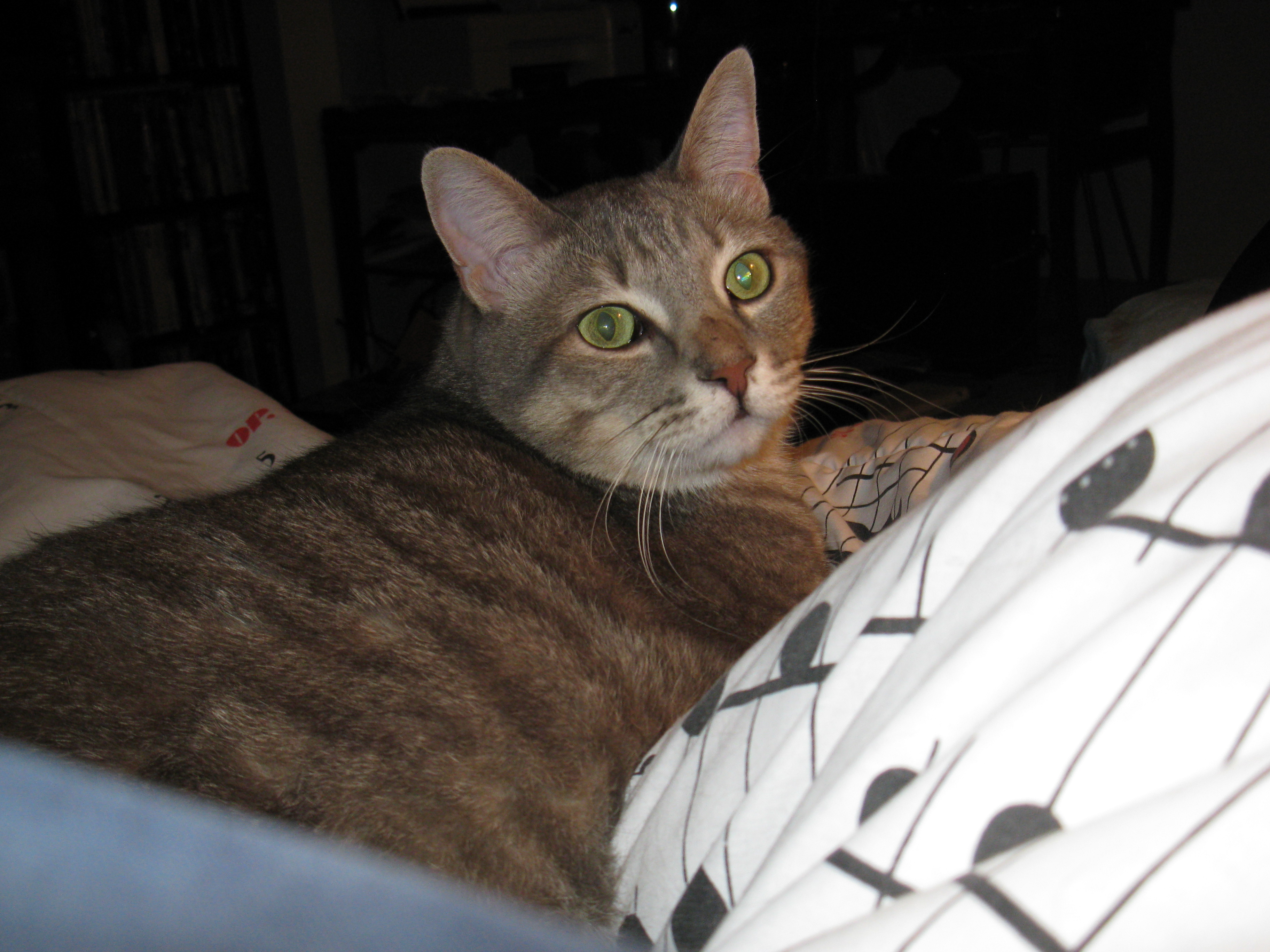
Or this:
That trick of light is the scariest thing about him. He’s three years old, and when he hears a knock on the door, he still runs upstairs and crawls under the bed.
We’re proud of the recent strides he’s made. After hiding from guests for over a year, he’s started prancing downstairs, snuffling shoes, and jumping into the lap of one human per evening. We thought at first he wanted make friends. It finally dawned on us that he always zeroes in on the person sitting in the recliner. That’s my chair. He considers it his chair. I am allowed to sit there, but he wants strangers evicted.
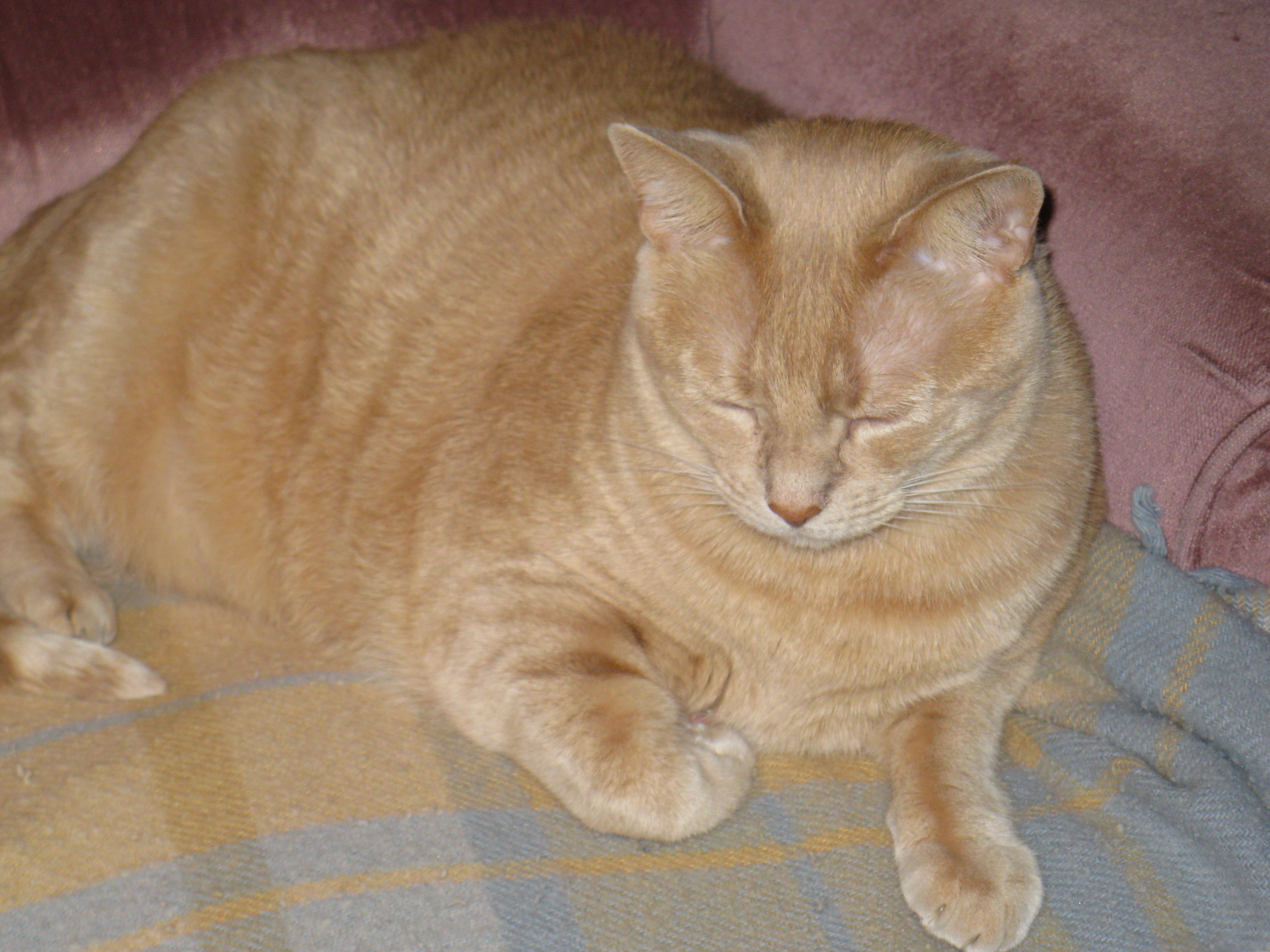
Speaking of scary, the most frightening thing in our house is William in repose. Because this snuggly strawberry blond is a canny creature, sharp and shrewd, possessed of a sly wit and a subtle intellect. William doesn’t sleep. He schemes.
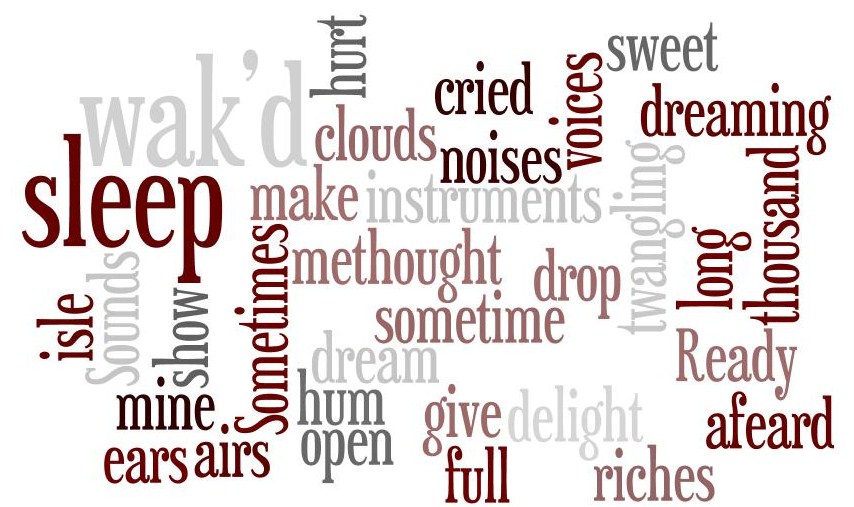
On His Birthday, Some Wordles from the Bard


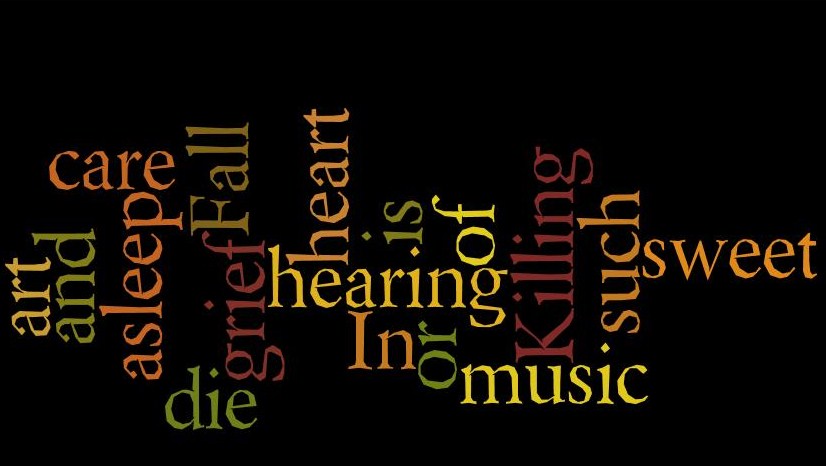
Select Tender Type or, Another Reason Literature Is Important

At HEB this afternoon, having verified that I had, indeed, spent my last sou on a cup of coffee at Waterloo Writers, I ran my credit card through the scanner. The resulting screen read, Select Tender Type.
Tender.
Such a formal, old-fashioned word for this new-fangled device.
It reminded me of the scene in which Polonius asks Ophelia about the status of her relationship with Hamlet:

Polonius: What is between you? give me up the truth.
Ophelia: He hath, my lord, of late made many tenders
Of his affection to me.
Polonius: Affection! pooh! you speak like a green girl,
Unsifted in such perilous circumstance.
Do you believe his tenders, as you call them?
Ophelia: I do not know, my lord, what I should think.
Polonius: Marry, I’ll teach you: think yourself a baby;
That you have ta’en these tenders for true pay,
Which are not sterling. Tender yourself more dearly;
Or–not to crack the wind of the poor phrase,
Running it thus–you’ll tender me a fool.
Poor Ophelia. She was a sweet thing, and young, and the men in her life treated her so shabbily.
But even though Polonius belittles his daughter to her face, the way Shakespeare moves tender through the passage, varying its meaning from one line to the next, renders the speech remarkable. As Hamlet later implies, Polonius is a rat—and he pays for his treachery a couple of acts down the road—but he has a way with words.
Thinking of Polonius and Ophelia reminded me of Lord Capulet‘s rage when Juliet tells him she will not marry Paris. He explodes, and Juliet adds fuel to the fire.
Capulet: How! will she none? doth she not give us thanks?
Is she not proud? doth she not count her blest,
Unworthy as she is, that we have wrought
So worthy a gentleman to be her bridegroom?

Juliet: Not proud, you have; but thankful, that you have:
Proud can I never be of what I hate;
But thankful even for hate, that is meant love.
Capulet: How now, how now, chop-logic! What is this?
‘Proud,’ and ‘I thank you,’ and ‘I thank you not;’
And yet ‘not proud,’ mistress minion, you,
Thank me no thankings, nor, proud me no prouds,
But fettle your fine joints ‘gainst Thursday next,
To go with Paris to Saint Peter’s Church,
Or I will drag thee on a hurdle thither.
Out, you green-sickness carrion! out, you baggage!
You tallow-face!
“Thank me no thankings, nor, proud me no prouds, / But fettle your fine joints ‘gainst Thursday next,…” Beautiful. Just seeing it on the page gives me the shivers.
To some, Capulet sounds like a terrible father, but, as I pointed out to my freshmen, year after year, Juliet started it. She was rude and disrespectful. Her father didn’t know she was already married; he thought she would be thrilled to marry Paris. But she behaved like a brat. It’s no wonder Capulet threatened to drag her on a hurdle thither.
The two female characters present an interesting contrast: Ophelia refuses to speak for herself; Juliet shouts. But neither one lasts to the end of Act V.
A scholarly paper might lurk in there somewhere: “Shakespeare’s Women: A Study of the Consequences of Self-Actualization Within the Context of the Father-Daughter Relationship Complicated by Nascent Heterosexual Bonding, with a Focus on Hamlet’s Ophelia and Romeo and Juliet’s Juliet.”
Or perhaps not.
By the time I finished with the Capulets, the cashier had almost finished with the scanning. While she bagged the items, I had time to wonder whether the name of Jason FForde’s protagonist, Thursday Next, was inspired by the once-projected date for Juliet’s wedding.
I also remembered that The Idylls of the King contains a line echoing Thank me no thankings, nor, proud me no prouds; I believe it’s spoken by Guinevere–maybe–but I’ve not been able to locate it, and it looks as if I’ll have to re-read the entire Idylls to ease my mind.
But I did find the next lines that drifted by: Guinevere, jealous of Elaine, takes up Lancelot’s gift of diamonds

And thro’ the casement standing wide for heat
Flung them and down they flash’d, and smote the stream.
Then from the smitten surface flash’d, as it were
Diamonds to meet them, and they past away.
That image—diamonds falling into the sunlit stream, and water splashing up, like diamonds to meet them—remains with me when the rest of the book has passed from memory.
Well. By this time, the cashier and I had completed our transaction. I wheeled the groceries to the car. End of shopping.
End of post.
Except to point out that I stood for ten minutes in one of the most boring places imaginable and forgot to be bored.
I was busy elsewhere.
Merry Christmas
An I had but one penny in the world,
thou shouldst have it to buy gingerbread.
~ William Shakespeare, Love’s Labour’s Lost
The Formula

Should I or shouldn’t I?
Tell, that is.
Experts advise against it. When you tell people you’re writing a novel, they reply.
“You still haven’t finished that thing?”
“Why is it taking so long?”
“How much longer are you going to have to work on it?”
“You need to just get busy and write it.”
The questions above fall into the category called Irritating. But the questioners don’t know any better. They’re not familiar with the writing process, they don’t know the difficulties of getting an agent, they don’t know how competitive the market is, especially as we transition into the digital age.
There’s another category of questions that, while unsettling, might be classified as Helpful.
For example, when a writer friend told an acquaintance she was working on a mystery, the acquaintance said, “Well, there’s a formula for that, isn’t there?”
Yes, there is a formula. No, you don’t just make up some new characters and fill in the blanks. No, it doesn’t make the writing any easier.
No–and here’s the answer to the real question–a formula doesn’t make the writing any less worthy of respect.
On the topic of the formula, please take note of the following:
Shakespeare wrote his tragedies according to a formula: five acts, technical climax at the midpoint of Act III, dramatic climax at end of Act V, protagonist with tragic flaw that causes his undoing, etc., etc., etc. He used similar formulas for comedies and histories. His sonnets comprised fourteen lines, iambic pentameter, rime scheme (ababcdcdefef), tied up with a couplet (gg) at the end.
Jane Austen used a formula: Darcy’s first proposal (and subsequent withdrawal of proposal) comes at the exact midpoint of Pride and Prejudice. Open the book to the proposal, and you get half the pages on the left and the other half on the right. It marks the point at which Elizabeth both realizes her folly and loses control of the action.
Edgar Allan Poe wrote according to formula and also wrote an essay explaining the formula.
Aristotle mentioned something about a formula. Writers check out his rules to make certain they have all their bases covered.
From the uninitiated, a formula may elicit sneers.
But Writers, even the Great Unpublished, are proud of the formula, and proud of the company we keep.
Scraping the Bottom of the Barrel

I was composing a post about Mountain Cedar, which is currently in extreme pollination mode, when I discovered I was boring myself silly.
I did chance to wonder why pollen is spelled with an –en and pollination with an –in, but I wasn’t curious enough to look it up. Perhaps for another post.
The only other likely topic was the dream I had last night about seeing Coriolanus on Broadway and during the performance being served chicken casserole in a 9″ x 13″ x 2″ sheet cake pan (everyone got one, not just me). Coriolanus wasn’t what I remember from grad school–it was more of a fusion of Romeo and Juliet, Julius Caesar, and Othello–and the casserole appeared to contain eggplant.
The dream was more interesting, to me at least, than cedar, but once I got past the eggplant there was nothing more to say.
So, instead of belaboring this, I shall link to the following page, where you will see what I do when I should be scrubbing the sink.
~~~~~~~~~~~~
P.S. Tomorrow, February 7, 2011, at 1:00 p.m. CST, author Sylvia Dickey Smith will interview debut author Tina Whittle on Sylvia’s first Blog Talk Radio interview program, Writing Strong Women. To listen, access http://www.blogtalkradio.com/writingstrongwomen on your computer.
~~~~~~~~~~~~
Image: By engraving by James Parker (1750–1805) after painting by Robert Ker Porter (1777–1842) [Public domain], via Wikimedia Commons.
Related Articles
- Ralph Fiennes takes Coriolanus to Berlin film festival (guardian.co.uk)
Day 4
Questions of the day:
When will I learn that writing is a slow process? That revision is a slow process? That no matter how much I enjoy what I’m doing–and, contrary to normal hyperbolic squawking, I do enjoy it, especially revision–I will not turn out page after page after page in a two-hour session?
That when I finish one scene, I have to go on to the next? That no matter how much I admire what I have just completed, I can’t stop to celebrate by stopping for the day?
That 1800 words is a lot, but measured against the NaNo 50,000, or indeed the 80,000 I really need, it’s a drop in the proverbial bucket? And less than that in the proverbial ocean?
No; this my hand will rather
The multitudinous seas incarnadine,
Making the green one red.
Those lines just popped into my head. They show the situation is worse than I thought. There isn’t just one proverbial ocean, there are multitudinous seas. And tossing my 1800 words from the shore would be like immersing a bottle of food coloring. Not even the sharks would notice.
Roll on, thou deep and dark blue Ocean – roll!
Ten thousand fleets sweep over thee in vain;
Man marks the earth with ruin – his control
Stops with the shore.
I thought of that, too. My grandfather, I’m told, sang scales to a truncated first line: Roll on thou deep blue ocean–roll! It doesn’t work in iambic pentameter, though. Accents go on Roll and roll.
On the road to Mandalay,
Where the flyin’-fishes play,
An’ the dawn comes up like thunder outer China ‘crost the Bay!
And that slipped in with the others. I sing this one because, as soon as I think of it, it sticks in my head. I would sing more, but this is all I know.
I’ve been wondering what to do after I leave this coffee shop. Now I know. I’ll sing. Driving home. Cooking dinner. From time to time throughout the evening, when I least expect it, I’ll burst into song. David won’t say anything. He appears to have gotten used to it.
I haven’t been stuck on “Mandalay” for quite a while. My default is
Never smile at a crocodile
No, you can’t get friendly with a crocodile
Don’t be taken in by his welcome grin
He’s imagining how well you’d fit within his skin
So there are advantages to having Kipling on the brain. I know only half a verse of the crocodile, and failing to reach a natural ending, an “Amen” of sorts, leads to immediate and unfortunate repetition. Sort of like what happens with Little Bunny Foo Foo. I taught Little Bunny Foo Foo to my cousin’s kids when I was in high school. I don’t think their mother has ever forgiven me. I may teach it to her grandchildren.
The clock on the computer tells me it’s past time to start home. I didn’t finish what I started out to do, but, having emptied my brain of over five hundred unnecessary words, I’m much lighter in spirit.
 M. K. Waller