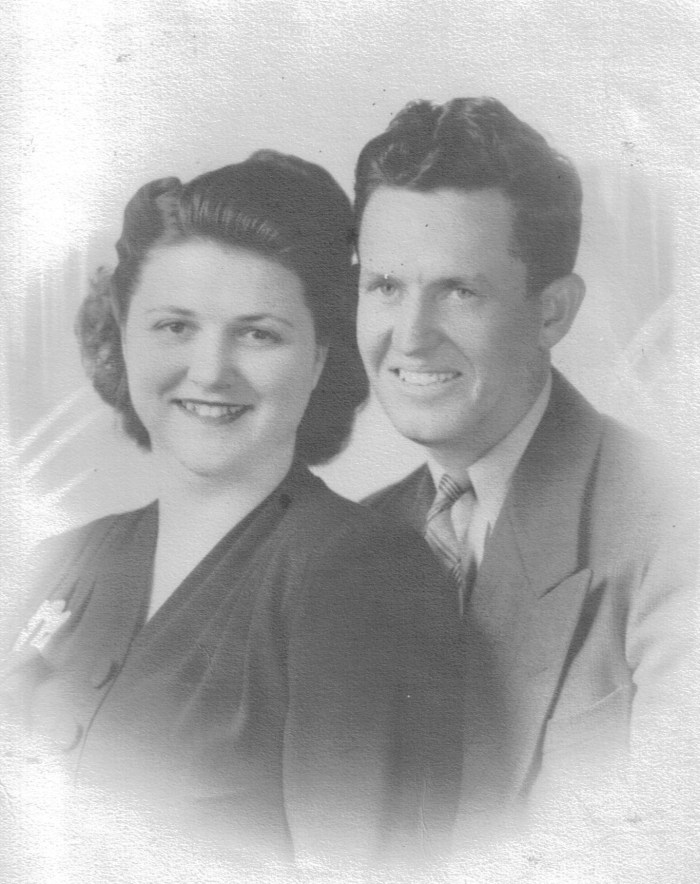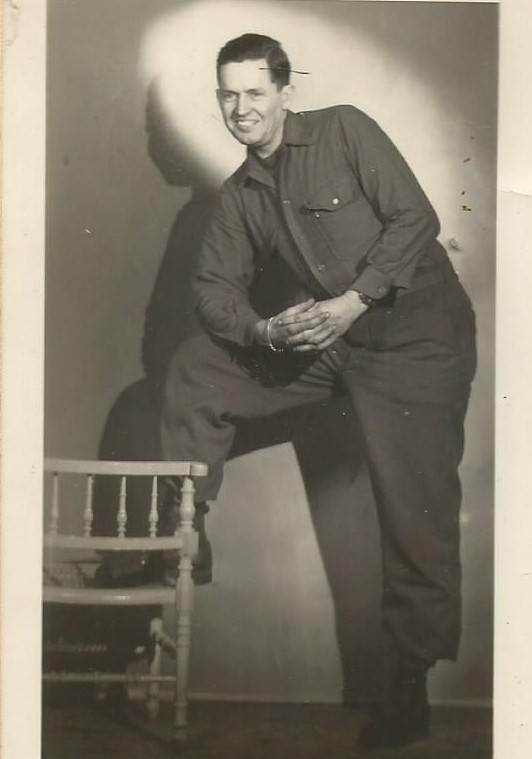
Veterans Day: World War II – PFC Bill Waller

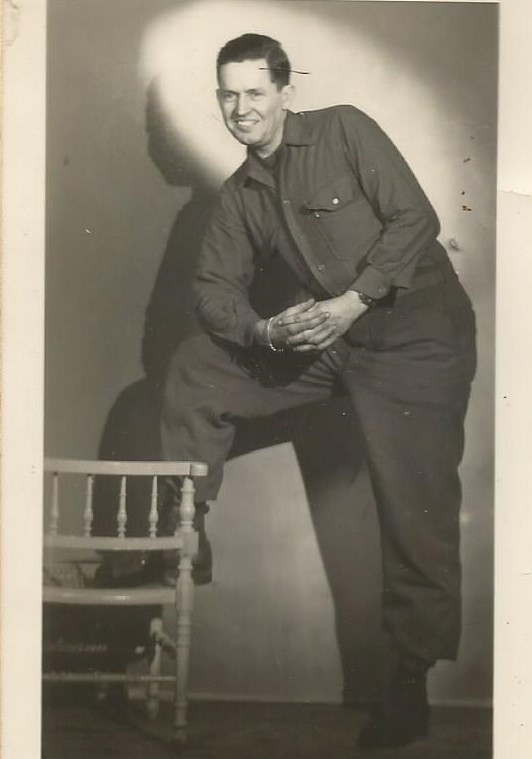
My father, Billie Waller, volunteered for the U.S. Army early in 1941.

He served in World War II in Northern Europe. He drove onto Omaha Beach on June 19th, 1944.

He refused all promotion.

He said the coldest winter he’d ever known was the one he spent in Cologne.

He repeatedly fell for a prank played by fellow soldiers: Knowing he had lost his sense of hearing, they would signal that a bomber was approaching and run; then, when he dived into a foxhole, they laughed. When Major Yarborough, the officer he drove for, finally happened to see, and so realized that one man under his command couldn’t hear and others were endangering him, he got the one out of harm’s way and disciplined the rest (how the Major did the latter, I don’t know).

My father was sent from the front lines in Germany to spend the last months of the war as an ambulatory patient in a Paris hospital, deaf from bomb concussion.

He arrived in Dallas, where my mother was living and working, before dawn on October 23, 1945, and handed his hearing aids to his mother-in-law with instructions not to tell my mother. Mother-in-law told. After several days of yelling to make herself heard, my mother told him to get the hearing aids and wear them. He’d been afraid she wouldn’t love a deaf husband.

He gave my mother his uniforms and said, “Get rid of these.”

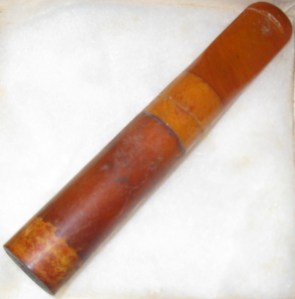
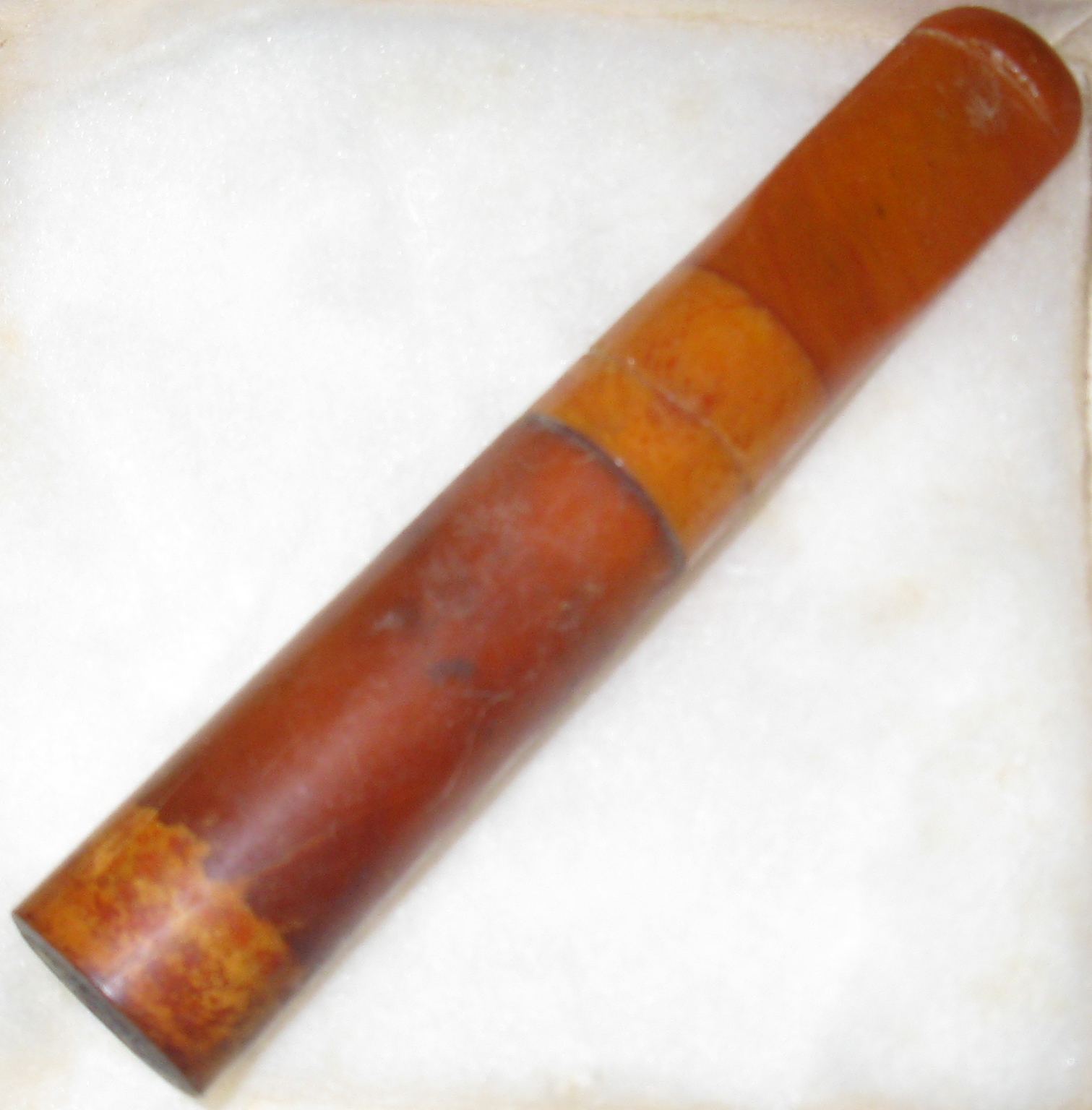
He kept his dog tags, some foreign coins, and a cigar holder given him by a Belgian farmer.

He delighted his mother-in-law by saying, “Oh la la!”

He had dinner ready every night when my mother got home from work. He specialized in chocolate pies topped by a mountain of meringue. Removing one from the oven, he flipped it upside-down onto the oven door and had to serve it as a pudding.

He was turned down for a job in warehousing because he was deaf (ironic, since he later worked in supply in Air Force Civil Service). He got a job in a toy store, where he sold a tricycle to a couple with a little boy. After the sale, he learned the trike was a demo, the only one the store had, and the only one it was likely to get in the foreseeable future. Having been overseas, he wasn’t familiar with shortages on the homefront. (My mother said if he had known, he’d have been tempted to sell it anyway, because he believed little boys who wanted tricycles shouldn’t have to wait.)

On May 1, his birthday, he took the day off and spent it with Yarborough (no longer Major) in Fort Worth. When he didn’t return timely for the birthday dinner she’d cooked, complete with chocolate cake with fudge icing, my mother cried and cried. She realized later, she said, laughing, that at that point, my dad had lived with Yarborough a lot longer than he’d lived with her, and that the two men probably had more in common.

After six months in Dallas, he achieved the dream that had kept him going throughout his years away. If my mother had worked for another six months, she would have had reinstatement privileges with Civil Service, but she didn’t hesitate. The San Marcos River was the only place he wanted to be, or would ever want to be. They moved to Fentress.

My mother said that of all the men she knew who served in World War II, he was the least changed.  He came home and was again just Bill, with the quiet, dry sense of humor and the twinkle in his blue eyes. He put the war behind him and went on with life.
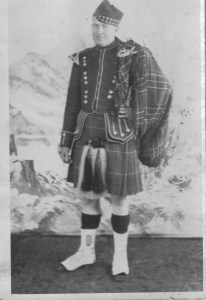
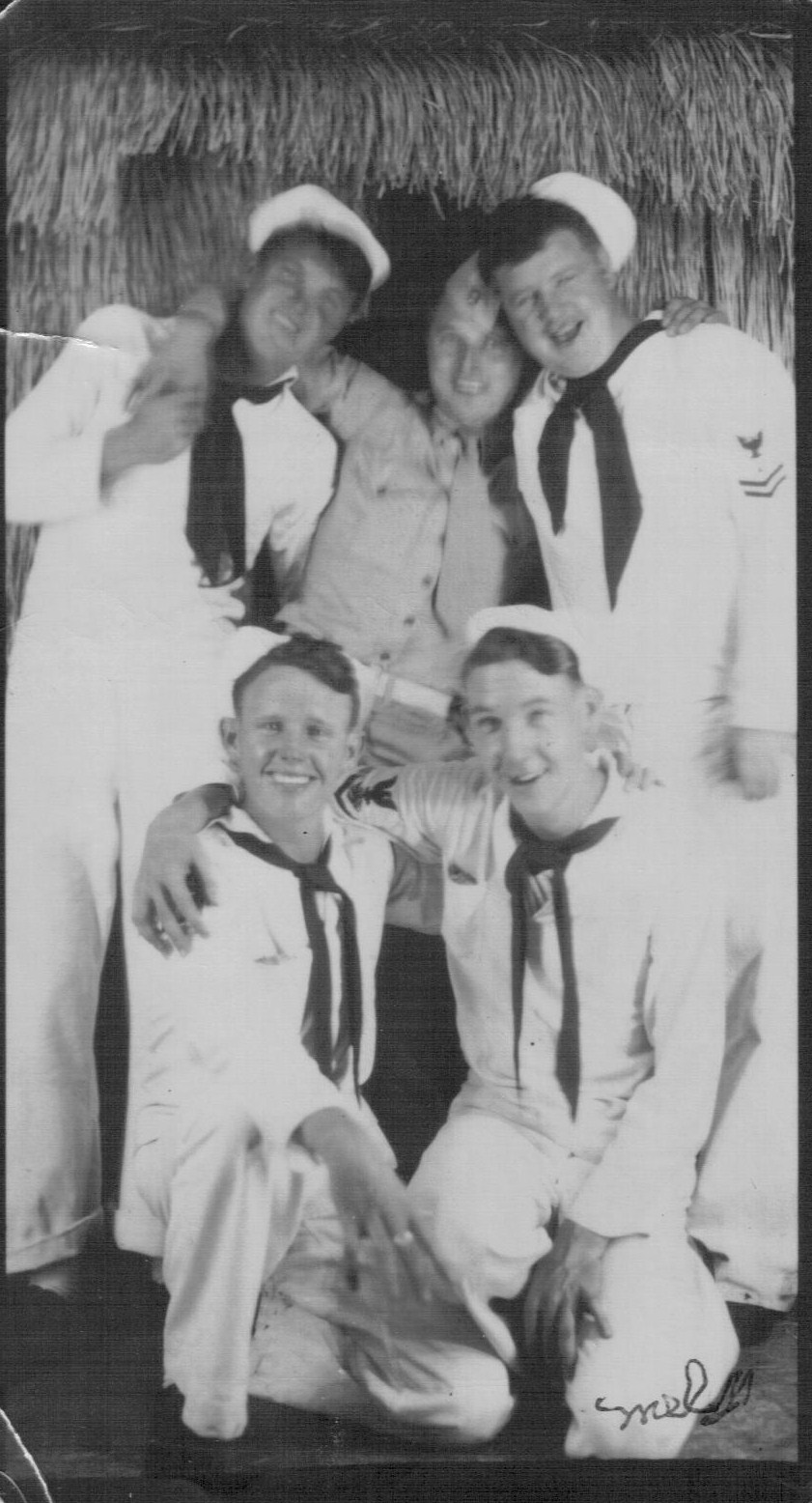
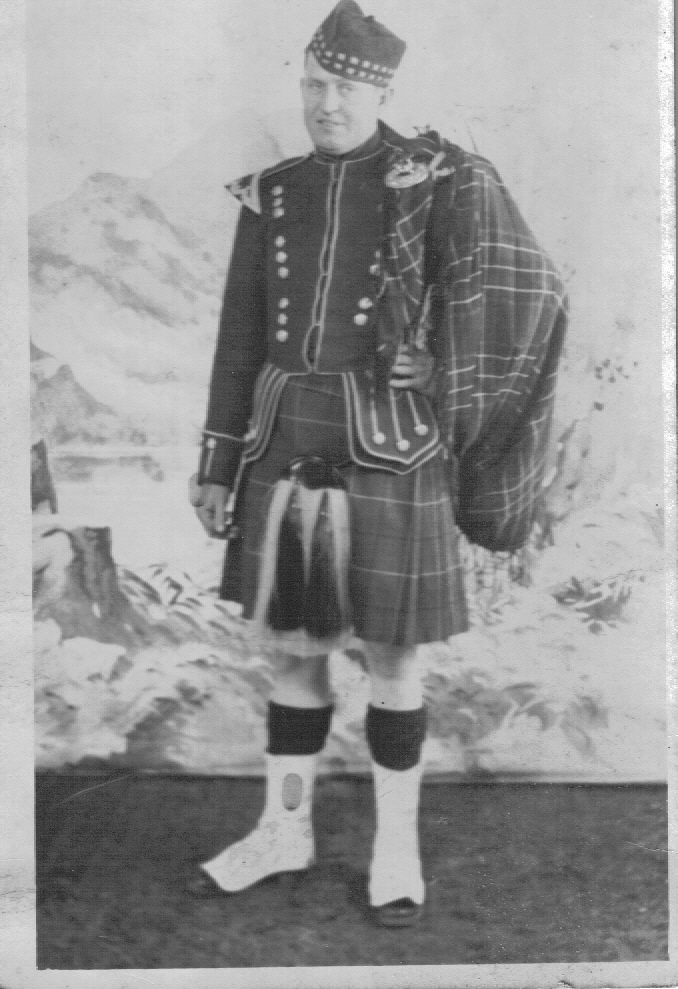
When he spoke of his service, he confined himself to people he’d known and the lighter side of daily life. While stationed in Scotland he and some friends had their pictures taken in traditional dress. He said one of the men, when changing back into uniform, forgot to take off the socks, and got back to the base wearing the photographer’s argyles. 

He made a few observations: He respected General Omar Bradley but had a low opinion of Patton. 

But he didn’t share stories of combat. He’d written my mother, “I’ve seen things you wouldn’t believe. I’ll tell you when I get home.” He never told.

Two remarks he made years later suggest why:

My mother told me about the first: When his brother Donald and others were talking about looting that occurred on the battlefield, my father, who’d been silent, suddenly said, “I’ve seen them cut off fingers to get rings.”

He made the second comment in my presence: My uncle’s stepson, who had served in the military but seen no combat, was looking forward to watching the movie Anzio on television. He said, “I can’t imagine hitting the beach and running into enemy fire like that.” My father replied, “There’s nowhere else to go.”

Such memories aren’t conducive to going on with life.

In 1964, when President Eisenhower’s memoir of D-Day and the Invasion was published serially in the San Antonio newspaper, he read it. Occasionally, he said, “No, that’s not quite right . . .” or, “He’s forgotten about . . .”

The one thing he couldn’t leave in the past was his deafness. The hearing aid didn’t filter out ambient noise, and he often walked out of gatherings–family get-togethers, wedding receptions, church dinners–that he would otherwise have enjoyed. He left Civil Service because his job at the time required taking sensitive, detailed information over the telephone, and he was afraid of making a mistake, which could have cost lives.

In 1967 and 1968, surgery at the VA hospital in Houston restored hearing in both of his ears and allowed him to lead a normal life.

In the summer of 1981, he finally expressed a desire to attend a reunion of the men he’d served with. An angina attack sent him to the hospital that weekend instead. He didn’t get another opportunity to see them again.

***
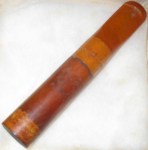
The cigar holder lived–and still lives–in the silver chest. I’ve known about it practically all my life and occasionally took it out and examined it when I was a child–but it took decades for me to realize its meaning. The farmer didn’t give a cigar holder to just some young man passing through; he gave it to an American GI, one among thousands he’d waited and hoped for, who was risking his life to free the Belgian people, and all of Europe, from the tyranny of Nazi Germany. The cigar holder represented gratitude, and more. In my mind’s eye, I see my my father and that farmer talking about the weather and how the crops were doing–if any arable land hadn’t been overrun by bootsoles and tanks. They’d have been speaking different languages, of course, but the language of farmers, and of friendship, is universal. And since my father was involved, they’d also have been laughing.

***

Two 50-centime Belgian coins.
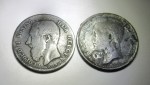
Left, the profile of King Leopold II, dated 1888 or 1886.

Right, the profile of King Albert, date obscured by tarnish. Albert succeeded Leopold in 1909.

A dose of silver polish and elbow grease and more will be revealed.
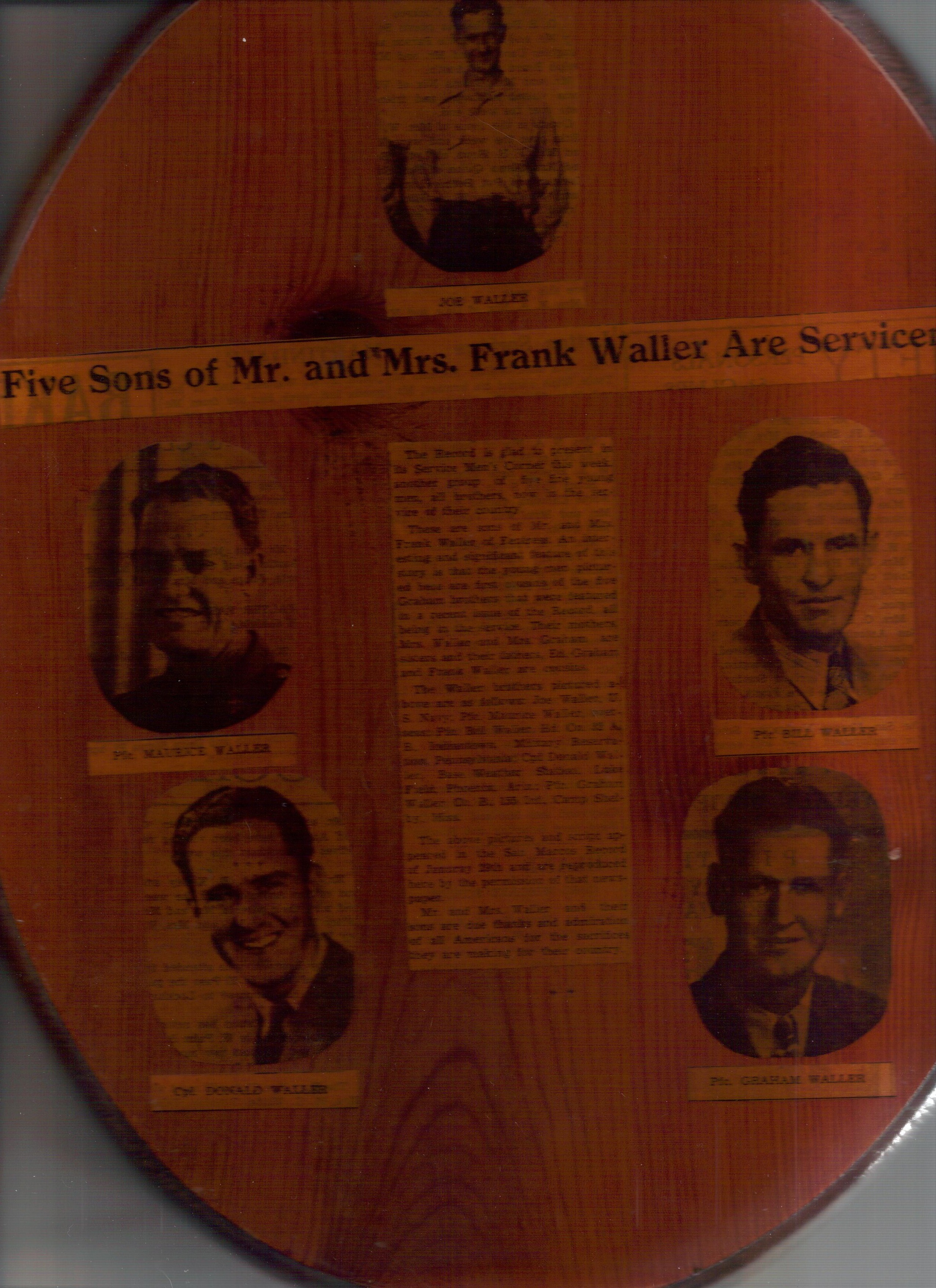
Veterans Day: World War II – The Waller Boys

Clockwise from lower left: Donald Waller, Maurice Waller, Joe Waller, Bill Waller, Graham Waller.

Five Sons of Mr. and Mrs. Frank Waller Are Servicemen

The Record is glad to present in its Service Men’s Corner this week another group of five fine young men, all brothers, now in the service of their country.

These are sons of Mr. and Mrs. Frank Waller of Fentress. An interesting and significant feature of this story is that the young men pictured here are first cousins of the five Graham brothers that were featured in a recent issue of the Record, all being in the service. Their mothers, Vida Waller and Bruce Graham, are sisters and their fathers, Ed. Graham and Frank Waller, are cousins.

The Waller brothers pictured above are as follows: Joe Waller, U. S. Navy; Pfc. Maurice Waller, overseas; Pfc. Bill Waller, Hd. Co. 32 A. B., Indiantown Gap, Pennsylvania; Cpl. Donald Waller, Base Weather Station, Luke Field, Phoenix, Ariz.; Pfc. Graham Waller, Co. B. 155 Inf., Camp Shelby, Miss.

The above pictures and script appeared in the San Marcos Record of January 29th and are reproduced here by the permission of that newspaper.

Mr. and Mrs. Waller and their sons are due thanks and admiration of all Americans for the sacrifices they are making for their country.

Source: Lockhart (TX) Post Register, 1943

*****

Joe, Donald, and Graham served in the Pacific. Bill and Maurice served in Northern Europe. All returned. Bill came home deaf from bomb concussion and spent the next twenty years telling curious children that his hearing aid was a telephone. In 1967 and ’68, a new surgery being taught at the VA hospital in Houston restored his conversational hearing.

81st Wedding Anniversary

My parents, Billie and Crystal Barrow Waller, were married on October 24, 1942. Today is their 81st anniversary.

They married on a Saturday afternoon at the home of the Baptist minister in San Marcos. My father’s first cousin and my grandmother Barrow’s best friend, Carmen Barber Harper, served as witness.

On Monday, my mother, an office manager at Fort Sam Houston in San Antonio, turned in a change-of-name form. Major Joseph, whom she’d worked for for nearly two years, called her into his office and said, “Miss Barrow, what have you done?”

She told him she’d married.

“How long have you known this man?”

“Six years.”

“Oh.” He seemed relieved to know she hadn’t formed a wartime alliance with a GI after a two-day acquaintance. “Where is your husband?”

He was at the house she shared with her mother and her younger sisters. In a week he would be rejoining his unit in Southern California.

“Miss Barrow, go home and stay there.”

She stayed there until my father’s leave was over.


When my father arrived in California, he found his unit had already shipped out. He rode a flatcar, guarding tanks, to Hershey, Pennsylvania, where he was stationed until he left for England, Scotland, England, France, Belgium, Germany, and again France.

My mother stayed in San Antonio, working at Fort Sam Houston. When her military employers moved to Dallas, she and her mother and sisters moved there.

My father returned home from service on October 23, 1945, one day before their third anniheversary. Six months later, my mother resigned her job and they moved to my dad’s home town of Fentress.

I was born on their ninth anniversary.

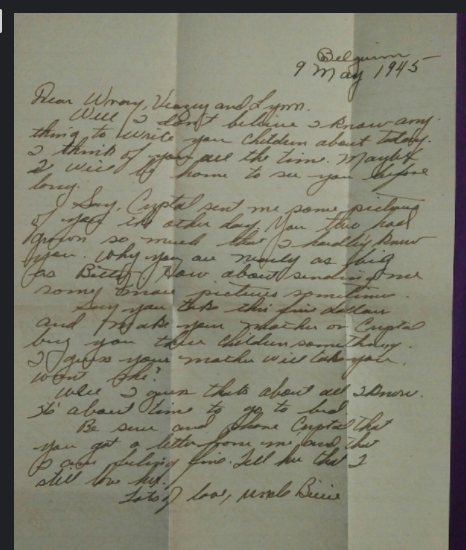
Maybe I Will Be Home Before Long

A letter my dad wrote to my cousins Wray, Mary Veazey, and Lynn Worden in Dallas while he was stationed in Europe during World War II. He’d been away from home since November 1942.


Belgium
9 May 1945

Dear Wray, Veazey, and Lynn,

Well, I don’t believe I know any thing to write you children about today. I think of you all the time. Maybe I will be home to see you before long.

Say, Crystal sent me some pictures of you the other day. You had grown so much that I hardly knew you. Why you are nearly as big as Betty. How about sending me some more pictures sometime.

Say you take this five dollars and make your mother or Crystal buy you three children something. I guess your mother will take you, won’t she?

Well I guess that’s about all I know. It’s about time to go to bed.

Be sure you phone Crystal that you got a letter from me and that I am feeling fine. Tell her that I still love her.

Lots of love, Uncle Billie

***

The last six months or so of World War II, my father was an ambulatory patient in Paris. He’d gone deaf from bomb concussion. For as long as possible, he hid the disability from his superiors. His fellow soldiers, however, amused themselves by running for foxholes, then laughing when Daddy jumped in. One day, Major Yarborough, for whom he drove, saw them. He took Daddy out of combat and sent him from Germany to a hospital in Paris. What happened to the others for tricking him into thinking bombs were falling, I don’t know, but I understand it wasn’t pretty.

I presume he was in Belgium on the way to Paris. He was slated to leave for the States asap but didn’t get to Dallas, where Mother was living, until October 23, 1945, the day before their third wedding anniversary.

My father was supposed to be released from service in San Antonio, so my mother had gone there, where she stayed with her aunt, uncle, and grandmother, and made cake after cake. When she got word Daddy would be coming to Dallas instead, she cried. Sam, her uncle, patted her head and told her to pack her suitcase and he would take her to the bus station.

The last time my dad had been home, the family had been living in San Antonio, where my mother and grandmother worked in Army Civil Service. When the Army moved to Dallas, they moved, too. So my father knew only the address. My grandmother and her younger daughters, Barbara and Betty, lived in the main house. My mom lived in a little  house in the back yard.

On the way through my grandmother’s house, my dad handed her his hearing aids and sad, “Don’t let Crystal know about these.” My grandmother, of course, told my mother as soon as possible.

After several days of shouting, Mother mentioned the hearing aids and said she thought he ought to wear them. He was embarrassed, and remained so for several years. One ear was so far gone he didn’t bother with the aid. He finally made peace with the other one and told small children who asked that it was his telephone.  When he took it off at night, he was sensitive to vibration but otherwise was gone. To make him hear her, Mother had to put her mouth next to his “good” ear and shout. Twenty-plus years later, a surgery to treat his kind of hearing loss was being taught by the doctor who developed it at the VA hospital in Houston. My dad, considered a good candidate, had the surgery, and his conversational hearing was restored. He said the only negative was that for a time the chirping of birds nearly drove him crazy.

When my cousins heard Uncle Billie was home, they declared a school holiday and hit my grandmother’s doorstep. Mary Veazey was seven and Wray was six. I don’t know whether they remembered him or had heard enough to think they did. I’ll add that they wrote to him, too, even though in the early years, Wray’s letters were scribbled. Lynn, the youngest, was born after he shipped out for the East Coast.

The remark about their being nearly as big as Betty was a joke of sorts. She was my mother’s youngest sister, only eight years older than Mary Veazey, and as an adult was five feet tall. It didn’t take long for any of her nieces and nephews to grow as tall as Betty. Even I got there.

***

The photos of my cousins were taken at Christmas in 1957, twelve years after they received the letter

***


Packing for our recent move, I came across the cigar holder a Belgian farmer gave my father when he passed through after the Normandy Invasion. It’s a valued keepsake.


***

Thanks to my cousin Denise Worden Allegri for retrieving this letter from her father’s files and sharing it with her aunt Mary Veazey, who shared it with me.

Memorial Day 2013: All My Boys

Marshall Barrow, Mary Veazey Barrow Worden, Barbara Barrow, Bertha Arnold, Betty Barrow, Mary Phereby Veazey Barrow, Crystal Barrow (Waller)
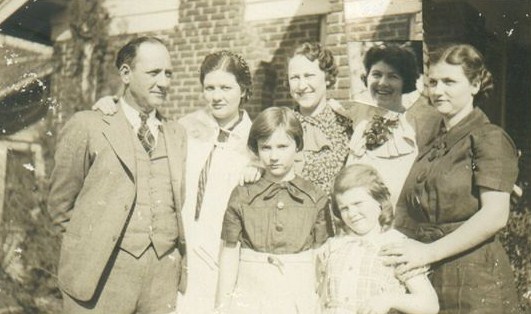
Marshall Lyle Barrow, Mary Veazey Barrow Worden, Barbara Barrow, Bertha Arnold, Betty Lyle Barrow, Mary Phereby Veazey Barrow*, Crystal Barrow (Waller), ca. 1935

My grandparents, Mary and Marshall Barrow, had four children. My grandfather had been certain that each prospective baby would be a boy, but he ended up instead with four daughters.

One evening shortly before his death in the spring of 1940, he was lying in bed, listening to a radio broadcast of news of war in Europe. He knew the United States would eventually be drawn into the fighting.

Turning to my grandmother, he said, “I’ve lived to see the day when I’m grateful that all my boys are girls.”

*****

*My aunt Barbara found this photograph with my grandmother’s face cut out, so she pasted one in from another photo.

Veterans Day 2012: The Waller Boys

Clockwise from lower left: Donald Waller, Maurice Waller, Joe Waller, Bill Waller, Graham Waller.

Five Sons of Mr. and Mrs. Frank Waller Are Servicemen

The Record is glad to present in its Service Men’s Corner this week another group of five fine young men, all brothers, now in the service of their country.

These are sons of Mr. and Mrs. Frank Waller of Fentress. An interesting and significant feature of this story is that the young men pictured here are first cousins of the five Graham brothers that were featured in a recent issue of the Record, all being in the service. Their mothers, Vida Waller and Bruce Graham, are sisters and their fathers, Ed. Graham and Frank Waller, are cousins.

The Waller brothers pictured above are as follows: Joe Waller, U. S. Navy; Pfc. Maurice Waller, overseas; Pfc. Bill Waller, Hd. Co. 32 A. B., Indiantown Gap, Pennsylvania; Cpl. Donald Waller, Base Weather Station, Luke Field, Phoenix, Ariz.; Pfc. Graham Waller, Co. B. 155 Inf., Camp Shelby, Miss.

The above pictures and script appeared in the San Marcos Record of January 29th and are reproduced here by the permission of that newspaper.

Mr. and Mrs. Waller and their sons are due thanks and admiration of all Americans for the sacrifices they are making for their country.

Source: Lockhart (TX) Post Register, 1943

*****

Joe, Donald, and Graham served in the Pacific. Bill and Maurice served in Northern Europe. All returned. Bill came home deaf from bomb concussion and spent the next twenty years telling curious children that his hearing aid was a telephone. In 1967 and ’68, a new surgery being taught at the VA hospital in Houston restored his conversational hearing.

Memorial Day 2012

This is a picture taken at the World War Two M...
This is a picture taken at the World War Two Memorial at night. This is specifically a photo taken from a balcony above the fountains. (Photo credit: Wikipedia) By Vcelloho. Public domain.

A number of men from Fentress, Texas, served in World War II. Two did not return.

Marshall Langley was the son of Will and Essie Langley, my family’s very good neighbors. Marshall graduated from Texas A & M,  which commissioned more officers during World War II than West Point did. His name appears in Texas Aggies Go to War: In Service of Their Country. He died in France in 1944, leaving a wife and an infant son.

Dunallen McCaskill was lost when the plane he was piloting went down over water. August 1942 USAAF Overseas Accident Reports lists the location as “Unknown, PAN” (Panama). Dunallen was my father’s friend. His family left Fentress before I was born but I heard many stories about them. They were described as kindhearted, spontaneous, and fun-loving, and were greatly loved by their neighbors. Dunallen’s mother never lost hope that one day he would come home.

*****