Such a Kerfuffle O’er a Runcible Spoon

[I don’t know why several paragraphs are jammed together.
I double-spaced. I triple-spaced.
But the paragraphs insist on bunching up
in an unattractive and almost unreadable lump.
My apologies.
I tried.]

Today I answer the question—Exactly what is a runcible spoon?

You no doubt remember that Edward Lear’s Owl and Pussy-Cat use one at their wedding breakfast:

“They dined on mince, and slices of quince,
   Which they ate with a runcible spoon;” . . . 
Since the term isn’t in general usage, many readers don’t understand it but accept it as a Lear-ism and ask no further.
Those who do go further and consult Merriam-Webster find it is “a sharp-edged fork with three broad curved prongs,”—but MW cites no sources, a no-no in scholarly circles. Some sources claim it’s a spork.
Wikipedia goes on and on about runcible spoons but offers no definitive answer. It includes a long list of authors, screenwriters, composers, and others who’ve used the word runcible. These two jump out at me:
  • Paul McCartney‘s 2001 album Driving Rain includes the track “Heather” which features the lyrics: “And I will dance to a runcible tune / With the queen of my heart”. McCartney has explained the connection to “The Owl and the Pussycat” in various interviews since its release.
  • In Lemony Snicket‘s 2006 The End, an island cult eats using only runcible spoons
Such a kerfuffle over something that should be as plain as the nose on the Pussy-Cat’s face.
Lear himself defines the term—not in O&P, but in a lesser-known work. In Twenty-Six Nonsense Rhymes and Pictures, he writes of
The Dolumphious Duck,
Who caught Spotted Frogs for her dinner
With a runcible spoon
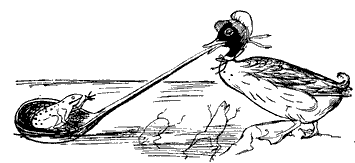
and provides a picture:


Tricia Christensen, writing in LanguageHumanities, notes that

A Latin word runcare means to weed out. This word could explain the Dolumphious Duck’s fishing process with a runcible spoon. The duck is really weeding out the frogs from the water.

That should settle the question. But it doesn’t.

For one thing, it seems to me that eating mince and slices of quince with a runcible spoon would be difficult if not downright messy.

And Christensen notes that Lear also applies the adjective to a goose, a hat, and a wall. Wikipedia points to a runcible cat and a Rural Runcible Raven. None of the aforementioned, at least as we understand them, resembles a ladle.

“Despite the nebulous meaning of the words runcible spoon,” she says, “they trip off the tongue with delight and account for their many uses by other authors.”

So—what is a runcible spoon? It’s nonsense.

What else would it be? It comes from the brain of Edward Lear.

###

Except, to muddy the water:

Wikipedia dates publication of “The Owl and the Pussy-Cat” at 1870.

Here’s a photo of a George III Sterling runcible spoon by Eley & Fearn, L0ndon, 1817
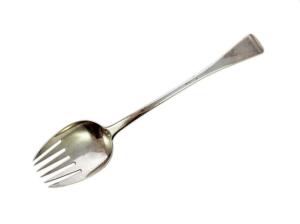
George III Sterling Silver runcible spoon – by Eley & Fearn, London. TonyGosling, CC BY-SA 4.0, via Wikimedia Commons


Maybe the item wasn’t originally called a runcible spoon. Maybe the adjective was applied post-1870. I don’t know.

More nonsense.

X Is for Xerxes: #atozchallenge


Lying in bed this morning, I came up with the perfect Y word. I began gathering information and working on an introduction.

Then something in my brain clicked and I realized today is X. I figured I might as well go back to sleep.

But then one of my characters, the sweet and very young Baptist preacher who told the teenagers he would drive them in the church van to take dancing lessons, walked into the cafe and sat down at a table with an old man who’s still cussing Roosevelt and long-haired hippies.

And then here came the old lady who’s always mad about something, and she jumped all over the preacher about the dancing thing, and she’s not even a member of his church, and then she whacked the back of his chair with her cane and scared him half to death.

She’s always on a rampage about something, and I knew they weren’t going to shut up and let me go back to sleep till I write chapter two and give them something else to do, so I gave up and got up. At 4:14 in the morning. 

Downstairs I turned on the TV to Youtube and Frederica Von Stade singing “Song to the Moon,” and then a string of other sopranos. I thought I might fall asleep listening. But so far I haven’t.

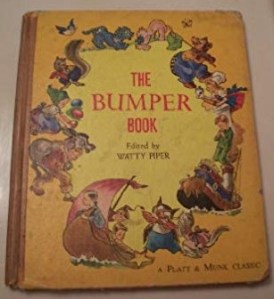
I have, however, come up with an X word: Xerxes. I heard about him when I was a toddler and my mother read nap time selections from The Bumper Book. The volume was big and pink and had tape–old yellowed tape–holding some of the pages together. The faded cloth on the hard cover had started to peel off at the corners, showing what looked like cardboard beneath. The book was obviously o-l-d, and I wondered where it came from, but I never asked, so I’ll never know.

But back to Xerxes.

He showed up in Edward Lear’s “A Nonsense Alphabet”:

X was King Xerxes,
Who, more than all Turks, is
Renowned for his fashion
Of fury and passion.

X

Angry old Xerxes!

I don’t remember hearing the poem, just X and Xerxes. To my embarrassment, I didn’t remember anything about Xerxes either, so I googled him. He was a Persian king who appears in the Book of Esther under the name Ahasuerus, and husband of Esther.

Regarding The Bumper Book, it’s available for purchase through Amazon. (Looks like the cover is yellow now.) Prices run from $41.76 for a Used copy to a Used-Like New copy for $245.00. Eighty-three per cent of reviewers give it a five-star rating. The low ratings refer to the condition of the used books. One reviewer, (four stars) said it was a replacement for the copy her dog ate and was smaller than the 1950 version. Just as I suspected.

In addition to Xerxes, it includes Lear’s “The Owl and the Pussycat,” A. A. Milne’s “Christopher Robin Is Saying His Prayers,” and Eugene Field’s “Winken, Blynken, and Nod” and “The Gingham Dog and the Calico Cat.” If I had my way, all of those would be required reading for children. I heard “The Owl and the Pussycat” so many times that I can still recite it from memory. Jan Brett’s picture book of TOATPC has the absolute best illustrations in existence.

Just sayin’.

Here’s Frederica Von Stade singing Dvorak’s “Song to the Moon.” You’re welcome.


https://www.youtube.com/watch?v=_uoSK5qZmG4


***

Images of The Bumper Book and The Owl and the Pussycat via Amazon.com


Love Poem for Valentine’s Day

I

The Owl and the Pussy-Cat went to sea
In a beautiful pea-green boat:
They took some honey, and plenty of money
Wrapped up in a five-pound note.
The Owl looked up to the stars above,
And sang to a small guitar,
“O lovely Pussy, O Pussy, my love,
What a beautiful Pussy you are,
You are,
You are!
What a beautiful Pussy you are!”

II
Pussy said to the Owl, “You elegant fowl,
How charmingly sweet you sing!
Oh! let us be married; too long we have tarried,
But what shall we do for a ring?”
They sailed away, for a year and a day,
To the land where the bong-tree grows;
And there in a wood a Piggy-wig stood,
With a ring at the end of his nose,
His nose,
His nose,
With a ring at the end of his nose.
III
“Dear Pig, are you willing to sell for one shilling
Your ring?” Said the Piggy, “I will.”
So they took it away, and were married next day
By the turkey who lives on the hill.
They dined on mince and slices of quince,
Which they ate with a runcible spoon;
And hand in hand, on the edge of the sand,
They danced by the light of the moon,
The moon,
The moon,
They danced by the light of the moon.

~ Edward Lear

***

Enhanced by Zemanta