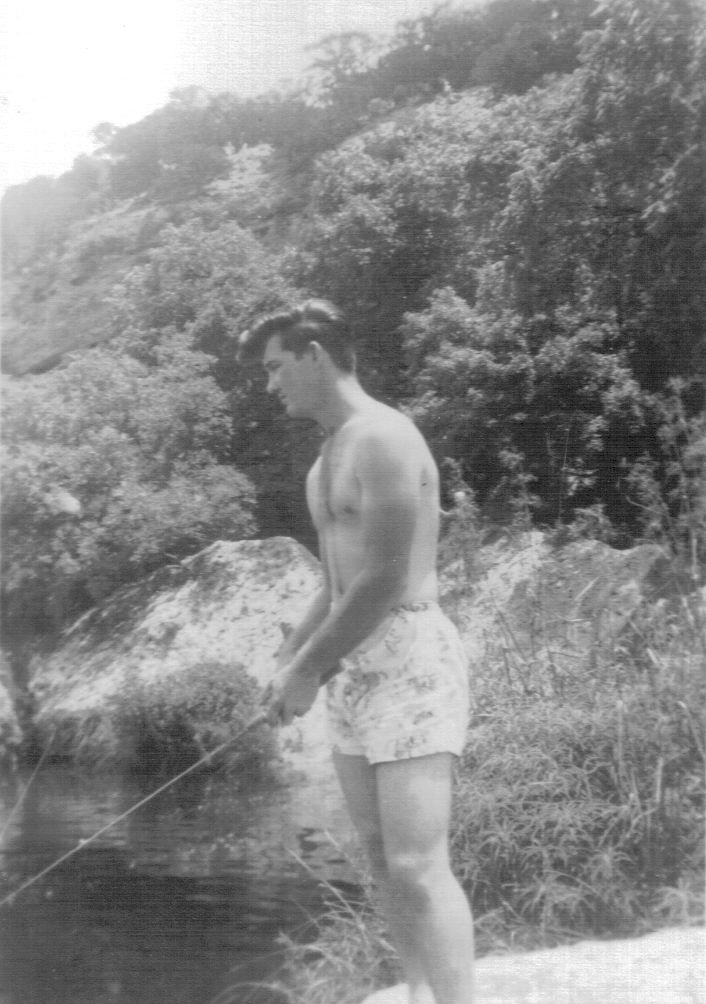
Billie

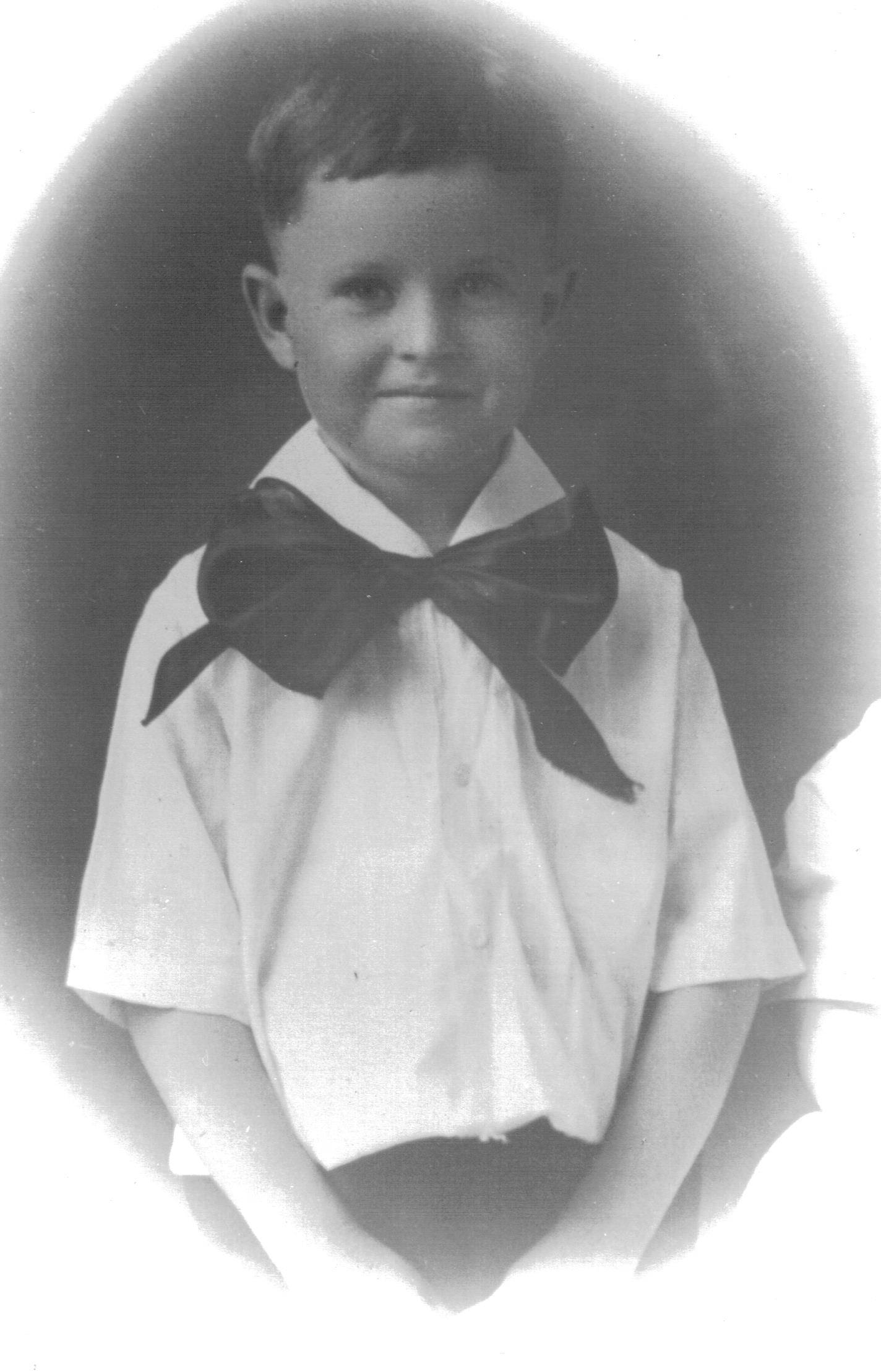
bill at 5 yrs 001
Billie Waller, 5 years old, 1920

My father would have been ninety-eight years old today.

In September, he’ll have been gone for thirty years.

It’s easier to imagine him as the child in this picture

than to imagine him at ninety-eight.

Of two things, however, I’m certain:

If here were here today,

his blue eyes would still be twinkling,

and

 he would still be making us laugh.

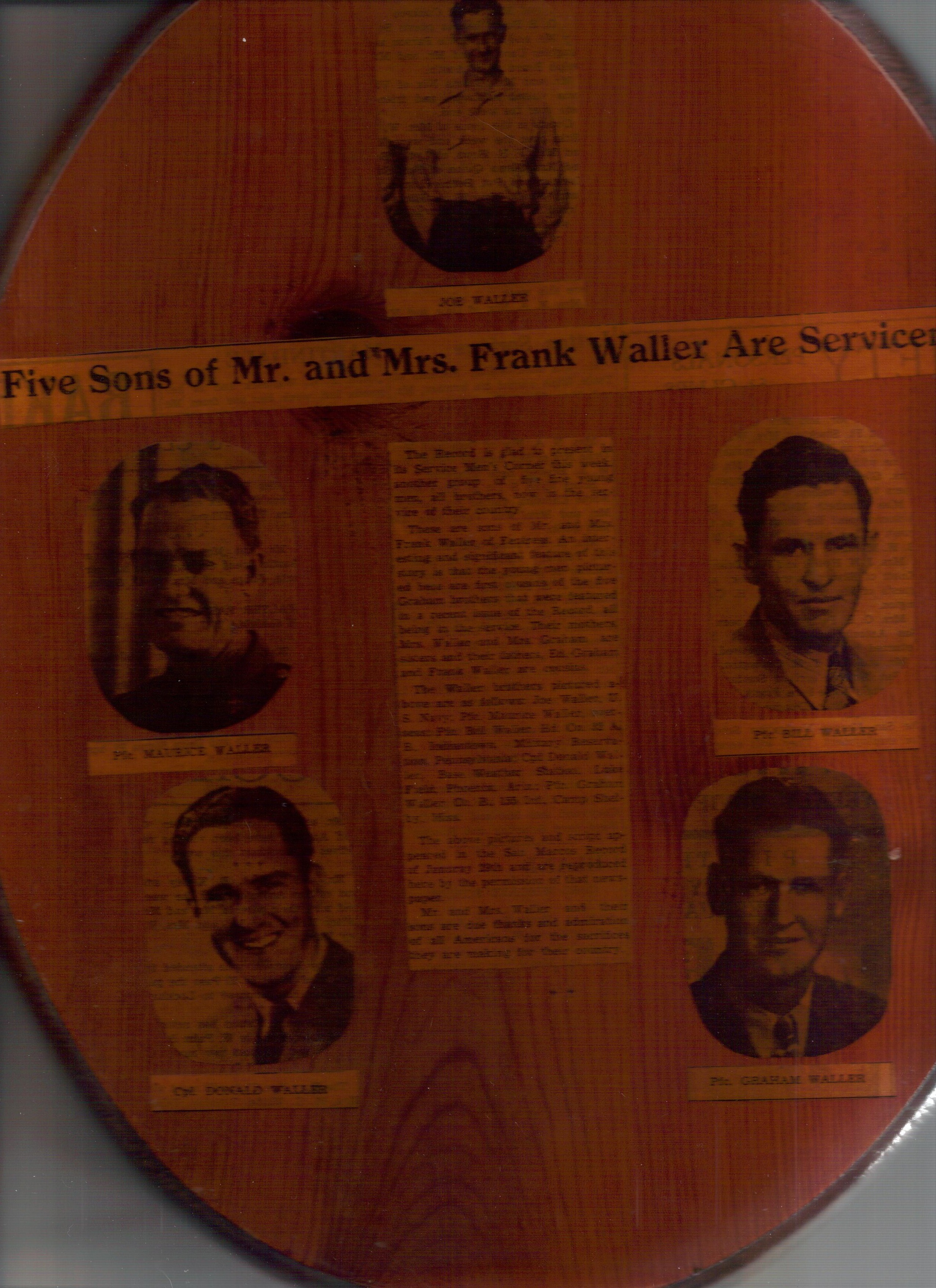
Veterans Day 2012: The Waller Boys

Clockwise from lower left: Donald Waller, Maurice Waller, Joe Waller, Bill Waller, Graham Waller.

Five Sons of Mr. and Mrs. Frank Waller Are Servicemen

The Record is glad to present in its Service Men’s Corner this week another group of five fine young men, all brothers, now in the service of their country.

These are sons of Mr. and Mrs. Frank Waller of Fentress. An interesting and significant feature of this story is that the young men pictured here are first cousins of the five Graham brothers that were featured in a recent issue of the Record, all being in the service. Their mothers, Vida Waller and Bruce Graham, are sisters and their fathers, Ed. Graham and Frank Waller, are cousins.

The Waller brothers pictured above are as follows: Joe Waller, U. S. Navy; Pfc. Maurice Waller, overseas; Pfc. Bill Waller, Hd. Co. 32 A. B., Indiantown Gap, Pennsylvania; Cpl. Donald Waller, Base Weather Station, Luke Field, Phoenix, Ariz.; Pfc. Graham Waller, Co. B. 155 Inf., Camp Shelby, Miss.

The above pictures and script appeared in the San Marcos Record of January 29th and are reproduced here by the permission of that newspaper.

Mr. and Mrs. Waller and their sons are due thanks and admiration of all Americans for the sacrifices they are making for their country.

Source: Lockhart (TX) Post Register, 1943

*****

Joe, Donald, and Graham served in the Pacific. Bill and Maurice served in Northern Europe. All returned. Bill came home deaf from bomb concussion and spent the next twenty years telling curious children that his hearing aid was a telephone. In 1967 and ’68, a new surgery being taught at the VA hospital in Houston restored his conversational hearing.

Cottonwood School Reunion at the Fentress Resort

Cottonwood School Reunion – Fentress Resort–Fentress, Texas–1930s (?)–Row 1, 2nd from left – Carl Waller; 4th from right – Jessie Waller Meadows (white collar); last on right – Ethel Waller (polka dots). Row  5, from left: Maurice Waller (partially hidden); Bettie Pittman Waller; Pearl Daniels; Frank Waller; Barney Waller

The Cottonwood community lay along Cottonwood Creek, Guadalupe County, across the San Marcos River from Fentress, Texas. The photograph above was taken at the Cottonwood School Reunion in–I believe–the 1930s. The people I know are identified in the caption. Some of the other surnames represented are probably Gregg, Rector, Daniels, Ward, and Fleming. I would be grateful for help in identifying individuals I don’t recognize. (The faces here aren’t exactly clear, but more of these pictures are out there in albums and attics, so if you find one with IDs, share the info, please?)

The picture was taken in front of the skating rink at the Fentress Resort. The skating rink now resides on Hwy 183 just south of Lockhart. It looks a lot smaller now than it did when it was in its proper home on the bank of the river.

I believe my grandfather, Frank Waller, is wearing a necktie. That didn’t happen often, at least when I was around.

In the caption, I note that Maurice Waller is partially hidden. I knew he was in the photo but had difficulty finding him until I realized he had to be beside Aunt Bettie. He was always beside Aunt Bettie. And partially hidden would have suited him just fine.

Memorial Day 2012

This is a picture taken at the World War Two M...
This is a picture taken at the World War Two Memorial at night. This is specifically a photo taken from a balcony above the fountains. (Photo credit: Wikipedia) By Vcelloho. Public domain.

A number of men from Fentress, Texas, served in World War II. Two did not return.

Marshall Langley was the son of Will and Essie Langley, my family’s very good neighbors. Marshall graduated from Texas A & M,  which commissioned more officers during World War II than West Point did. His name appears in Texas Aggies Go to War: In Service of Their Country. He died in France in 1944, leaving a wife and an infant son.

Dunallen McCaskill was lost when the plane he was piloting went down over water. August 1942 USAAF Overseas Accident Reports lists the location as “Unknown, PAN” (Panama). Dunallen was my father’s friend. His family left Fentress before I was born but I heard many stories about them. They were described as kindhearted, spontaneous, and fun-loving, and were greatly loved by their neighbors. Dunallen’s mother never lost hope that one day he would come home.

*****

ROW80 01.25.12 & Fentress Memories

I returned Sunday from four days in Higginsville, Missouri. I had accompanied my cousin Mary Veazey to see her brother, Wray, and his family. Wray has been in the hospital in Kansas City for the past couple of weeks. He’s doing much better now and will be released from captivity in another couple of weeks if he cooperates, says the physical therapist. He’s cooperating.

Before we left for the airport Sunday morning, Wray began reminiscing about the times he and Mary Veazey spent with my parents in Fentress, in the late 1940s, when the siblings were ten or eleven years old. Mary Veazey tossed in a few of her memories, too.

Note: Wray and Mary Veazey are my mother’s nephew and niece. They lived in Dallas. Fentress is my father’s hometown, and the aunts, uncles, and grandfather mentioned below are from his side of the family. Practically speaking, however, the two families sort of swamped together

Here’s an overview of the conversation:
Wray and Donnie mixed up some gunpowder and made firecrackers. There was a lot of gunpowder left over, so they poured it into a Coke bottle and made a fuse. It was a short fuse, and Wray almost didn’t make it to safety behind a tree when the bottle exploded. Donnie’s house was glass-studded ever after. (I suppose it still is.)

Mr. George Meadows wanted to show Wray what a possum looked like, so he caught a possum, hit it with a club, tied it up, and left it in the yard. Then Mr. George went into the house. Left alone, the possum stopped playing possum, chewed the string in two, and waddled back home, probably down in the pecan bottom on the river.

Wray was not allowed to go near the parrot that lived downstairs in Mrs. Bertie Smith’s house, where my parents had an apartment, because the parrot was mean. (Note: My mother went near the parrot and it caught the flesh between her thumb and index finger and clamped down and wouldn’t let go. Mother was pregnant at the time. She said she thought she would deliver before the bird finally released her.)

Mrs. Bertie’s house was right on the river. When my parents moved to a house down the street, Wray and Mary Veazey took a shortcut to the river by walking through the front door of Mr. George and Miss Minnie Meadows’ house and then out the back door. Mary Veazey said they were polite and always said Hello when they passed through. But they never bothered to knock.

They played among the cotton bales on the gin yard and, unbeknownst to anyone else, borrowed cotton from some of the bales to use in various other pursuits.

They found a mangy dog at the river bridge and coaxed it to come with them, then told my mother it had followed them home. The dog was foaming at the mouth. Moments later, it had some kind of fit. Mother hustled Wray and Mary Veazey into the house and called for my father, who ambled around from wherever he’d been and paused to size up the situation. The pause went on too long for Mother, who said, “Don’t just stand there with your teeth in your mouth. Do something.” (Note: Those encouraging words are still alive and well among certain members of the family.)

My grandfather took Wray trotline fishing once and they caught 149 pounds of catfish. A fish fry ensued. Wray described for his daughter how a catfish is prepared for the skillet. I won’t describe the process here, but I’ll add that I, too, used to help my grandfather skin catfish. (I was a cold-blooded little thing.) Wray could clean a fish in under a minute. I took a lot longer.

My Uncle Donald taught Wray to drive his 1947 Chevy pickup. When Donald was taking Aunt Ethel’s 1951 Buick roadster to Martindale, about seven miles north on Highway 80, for inspection, he told Wray to follow in the pickup. Because of a miscommunication, they were separated, and Wray had no one to follow. On the way, he discovered the pickup would go 80 miles per hour over the washboard road. By the time he arrived in Martindale, so many things had fallen off the pickup that it didn’t pass inspection. (Note: I later learned to drive in the same pickup, but if you think Donald let me out of his sight when I was behind the wheel, you have another think coming.)

One memory which wasn’t mentioned Sunday, but which I remember from before, took place several years later, after I had finally made an appearance: Mother looked out the kitchen window and saw Wray drag racing down the street with me in my stroller. She hollered at him to stop that before he killed me. He said I was having fun. I’m sure I was.

I always had fun when my cousins visited. They were considerably older than I and so were extremely interesting, and they were nice enough to pay attention to me and to behave as if they didn’t mind the fourteen-year age difference. They’re still nice to me. I appreciate that more than I can say.

I also appreciate their sharing memories of a time when Fentress was a child’s paradise. Not many remember those days, and it’s important we talk—and write—about them to keep them alive as long as possible.

***

Another note: Lest it be thought I have Fentress memories similar to those detailed above, I’ll clarify: I don’t. I never made gun powder, blew up Coke bottles, dismantled cotton bales, urged mad dogs to follow me home, invaded unsuspecting neighbors’ houses, or went roaring up Highway 80 in any make or model of pickup. And no one ever caught a possum for me. I was an obedient, unimaginative child, and I led a quiet, dull life of no adventure whatsoever.

And Veazey is my grandmother’s maiden name. In case anyone is wondering. Most people do.

***

ROW80 report: My reports for the past few weeks disappeared into a cloud of juniper pollen, but there wasn’t much to report anyway. While I was in MO, however, I began a story board, made notes, worked on organization. The next step: Take my list of scenes, pick one, and write it.
Vida Woodward Waller

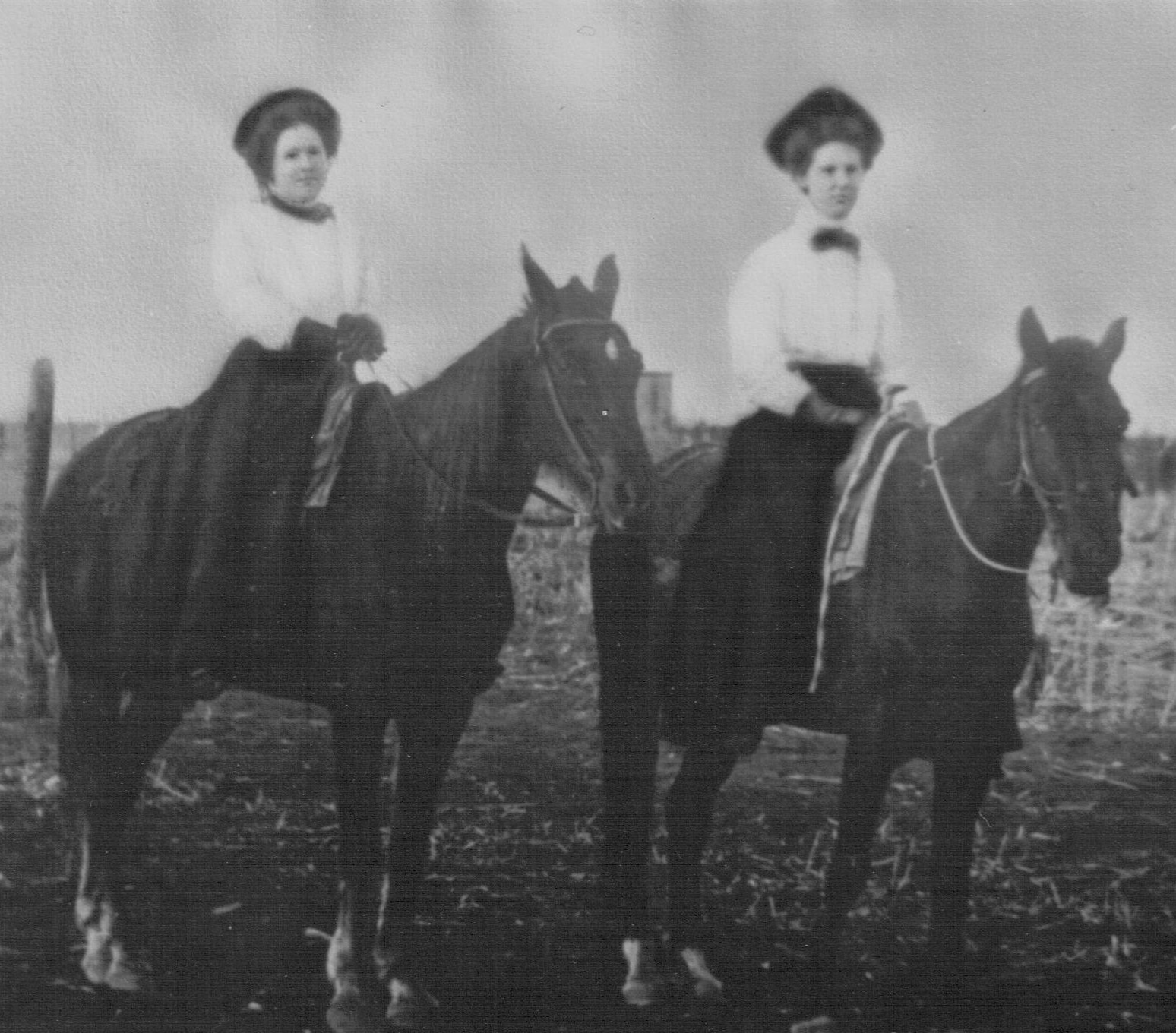
The woman on the left in the photograph above is my father’s mother, Vida Maud Woodward Waller. On the left is his father’s sister, Jessie Waller Meadows. The photo was taken, I believe, sometime before 1910.

Aunt Jessie lived to be nearly ninety, so I knew her well. I didn’t know my grandmother. She died in 1920, when my father was five years old. By the time I was born, thirty-one years later, she was rarely spoken of. Her younger sister, Nettie Watkins, who volunteered to be “Nanny,” and my grandfather’s sister-in-law, Bettie Waller, told me a little about her.

Here is what I know.

She was short and had red hair. She was the seventh of nine children in a family that remained close all their lives.

She had beautiful hands, and she was vain about them. She paid her older sister, Bruce, to take her turn at doing dishes so the hot, soapy water wouldn’t spoil her hands. In the mornings, before she and her brothers and sisters went into the field to pick cotton, she carefully wrapped and stitched each finger in strips of cotton fabric. Then she put on work gloves. “That just fascinated me,” Aunt Nettie said. “And she always slept in gloves.”

There wasn’t a horse in the county that she couldn’t handle.

She scandalized the town by being the first girl to ride astride, wearing a split skirt. (And judging from the photograph, she corrupted Aunt Jessie.)

She and my grandfather eloped. Her mother did not approve of my grandfather as a son-in-law. I don’t know what Granny’s objections were, but having known my grandfather, I imagine some were justified. We all loved him dearly, but he could try one’s patience.

She drove like a maniac and regularly plowed the car into a high curb or a fence post or a bridge abutment and had to send for my grandfather to get the bumper unstuck.

She had a wonderful sense of humor, and she loved babies. (No one told me that. I inferred it from being around her sisters.)

She had her first child in 1911, and the others in 1913, 1915, 1917, and 1919. All boys. One day when she was in town, she heard a woman say, “There’s that Mrs. Waller. She has a baby every year.” My grandmother turned around and said, “No, I have my babies every two years.” End of conversation. The tradition was convenient for the entire family: if you knew how old one of the sons was, you could easily calculate the ages of the others. From there, you could fill in most of the cousins.

She could do, and did, whatever needed to be done. If bedtime came and all the boys’ pajamas were in the wash, she sat down at the machine and sewed up a batch of pajamas. If she wanted a fence around the yard, she went out and put up a fence. I suspect she found out fairly early in her marriage that building a fence was quicker than waiting for my grandfather to build one. (See, try one’s patience, above.)

She tended to be plump but wanted the hourglass figure that was the fashion. She laced her corsets so tightly that during every dress fitting, she fainted. One dressmaker became so frightened at the prospect of a client who routinely toppled over that she refused to sew for her any more. (I should note that the Woodward family was known for its fainters, men as well as women, so the corset might not have been entirely to blame. They were a hardy family, not a nerve in the bunch, but under stress they fainted.)

She would dress up for a party, stand before the mirror, and say, “I don’t look good enough.” And she would stay at home.

She had a strong will. No one ran over her.

The morning of the day she died, she was preparing to make a cake for Donald’s third birthday. She went outside to draw kerosene to fill the kitchen stove, and some of the liquid spilled onto her robe. When she lit the stove, the robe ignited. She panicked and ran. Maurice and Joe, seven and nine years old, knew how to smother the flames, but they panicked, too, and could only scream. Bill, Donald, and Graham, the youngest at eight months, were there as well. Graham, of course, didn’t remember his mother. Donald and my father always said they remembered nothing about that day, but I believe my father did.

She was buried the next day, on her thirtieth birthday.