September SinC-Up: Lynna Williams’ Gift of Voice

On my way home from work one night in the ’90s, I heard actress Judith Ivey on Selected Shorts, reading “Personal Testimony,” a short story by Lynna Williams.

The narrator is eleven-year-old Ellen Whitmore, a preacher’s daughter from Fort Worth, who is at Southern Baptist summer camp in Oklahoma. At evening services, when campers are expected to witness to their experiences of sin and repentance, Ellen demonstrates a talent that catches the attention of fifteen-year-old Michael. Although he’s reputed to be most spiritual boy in camp, Michael has what Ellen’s brother calls “Jesus Jaw”– he has plenty to say but can’t complete a simple sentence: “I just–I mean, it’s just so–I just . . .” He tells Ellen he wishes he could speak about his spiritual life as easily as she can speak about hers, so, following her mother’s example, she offers to help. Within days, she has a thriving business writing personal testimonies for older campers, a gratifying popularity, and a fat stack of bills stashed in her Bible at John 3:16. Her adventure in capitalism ends at the summer’s final service, when she sees her father in the congregation, realizes he knows, and makes one last and very public attempt to avoid his wrath.

I’ve heard that people don’t laugh aloud when alone. That’s not true. I sailed down I-35 guffawing and then quickly broke out in tears.

(I hate it when writers manipulate me like that. It’s just one more skill to covet.)

I’d been writing off and on for a few years but hadn’t produced anything even marginally successful. A small circle of friends and family liked the pieces I showed them, but they also liked me– most of the time–and they weren’t seasoned critics anyway. The writing was bad. I was frustrated. Not knowing what was wrong, I couldn’t make it right. Classes and workshops didn’t help.

The night I heard Judith Ivey read, all that changed. I didn’t experience an epiphany, per se, but there was a definite moment of enlightenment: My best work was bad because it had no voice. I had no voice. The nearest I could manage was a small-time literary critic in love with semicolons.

Listening to “Personal Testimony,” I heard Lynna William’ voice and knew what I should do.

My work should sound natural to my ear. Informal. Fluid. First person narration by a self-absorbed eleven-year-old girl with attitude, precocious in some areas and in others absolutely clueless. That comprised Enlightenment, Part I.

Then came Enlightenment, Part II: I’ve been hearing that voice most of my life. It’s the one I think in. I didn’t have to worry about copying Williams–it’s my voice, too. I’d just never recognized its potential.

Not long after hearing “Personal Testimony,” I allowed the eleven-year-old in my head to dictate a story while I wrote. Then she dictated another. And they worked.

My inner child is different from Ellen, as is only right. Mine is sharper, has more attitude. I have no idea why.

A year ago, my eleven-year-old suddenly morphed into a forty-year-old woman. She has so much attitude she’s scary. Now there’s a third voice, very different from the other two, stronger and scarier even than the forty-year-old. The third voice came as a relief. I’d wondered whether the pre-teen was all I had. What if everything I wrote came from the same source and sounded just like what had come before? The child is fun to listen to, for a while, but after a time, she can become wearing. I spend enough time with her as it is. Readers would soon get their fill.

There are some things that can’t be learned in a classroom. An instructor might have told me my work lacked voice, but he couldn’t have said how to find the right fit.

I’m indebted to Lynna Williams for helping me to hear a girl’s voice, and to recognize its value. She inspired hope. She showed me that if I listen, the eleven-year-old in my head will tell me what I need to know.

 ###

Lynna Williams teaches creative writing at Emory University. Read excerpts from “Personal Testimony” at Google Books. The story also appears in Texas Bound: Stories by Texas Writers, Read by Texas Readers. This book comes with an audiobook on cassette tape featuring Judith Ivey’s reading.

Several sermons that appear online refer to “Personal Testimony.” Read one of them here.

###

Do you like dark and compelling mysteries? That’s how a reader describes Elizabeth Buhmann’s first novel, Lay Death at Her Door. I’m tagging Elizabeth. Click here to visit her blog and read another post in Sisters in Crime’s September SinC-Up.


Eeeeeeeeeeeeeeeeeee! is for Publish

[Links are scattered throughout this post. If you slide your pointer across the screen, you’ll see where to click. In the meantime, I’ll choose a theme that makes finding links easier.]

In yesterday’s abbreviated post, I promised an announcement to end all announcements.

Confession: Kaye George was quicker than I. She made the announcement on another blog, whose title and URL I will display later in this post. I’d hate for  readers to click on that link and forget to come back here.

The Announcement: “Murder on Wheels,” an anthology of eleven short stories written by members of Austin Mystery Writers critique group and two of its friends, has been accepted for publication by Wildside Press.

It’s occurred to me that we might be sending out this news prematurely, that we should wait for the book to appear. But yesterday the contract, and self-restraint, went the way of the dial telephone.

I doubt we’d have had the energy keep the secret anyway. We’ve been on the verge of dancing in the streets ever since receiving word that Wildside would publish. When one AMW member heard the good news, she broke into song. Thanks to the miracle of modern technology and a husband who knows how to make an .MP3 file from a voice mail, I have a recording. I would share it, but I value my life.

The next question, of course, is WHEN? 

We don’t know. There’s a lot to do between now and the launch date. Before Wildside’s final acceptance come edits. The others have informed me it’s gauche to tell a publisher that your stories are already perfect. So I imagine compliance with the editor’s requests won’t be an issue.

I promised I would display the address of Kaye George’s official announcement. An Agatha-nominated author, Kaye has published a number of mystery stories and novels. Although she’s no longer around attend AMW’s meetings, she’s still our leader and our guide through this new territory. She writes about how the idea for “Murder on Wheels” came about. Her account of this Eeeeeeeeeeeeeeeeee! experience is more detailed and more interesting than mine.

Read Kaye’s version of the story at Judy’s Stew.


###


Kaye George blogs at Travels with Kaye.

Read more about Kaye and her books at http://www.amazon.com/Kaye-George/e/B004CFRJ76

 Find other AMW members’ blogs at–

 VP Chandler

 Elizabeth Buhmann

 Gale Albright (Crime Ladies)

 Scott Montgomery

 Laura Oles (Austin Mystery Writers)

 ***

Find other contributors to “Murder on Wheels” here:

Reavis Z. Wortham

Earl Staggs


She Cannot Get Away

Kaye - testimonial - pictures - croppedIf you read the previous post, reblogged from Gale Albright’s Visions and Revisions, you know mystery novelist Kaye George attended the Austin Mystery Writers meeting last week. Kaye, who for a number of years served as AMW’s Grand Pooh-Bah, moved to Tennessee last winter, leaving Gale and me forsaken and forlorn.

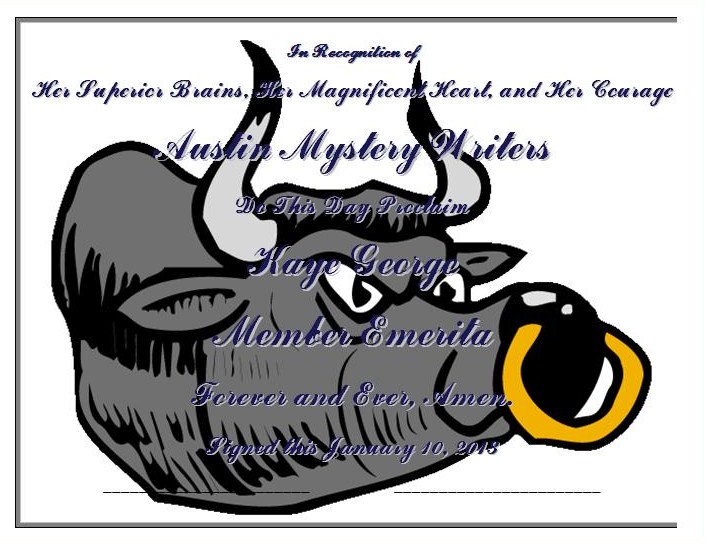
At the Last Lunch, celebrated at the Elite Cafe in Waco, Gale and I presented Kaye a certificate declaring her Member Emerita. It was supposed to say Grand Pooh-Bah Emerita, but, distraught over her impending move, I forgot that part.

The bull pictured on the certificate is an homage to Kaye’s first published novel, CHOKE, in which heroine Imogene Duckworthy narrowly escapes death by goring. I don’t believe that’s a spoiler, since Immy later appears in both SMOKE and BROKE.

Gale and I were foolish to suffer so over our friend’s disappearance because, thanks to the miracle of email, social media, and the Eyes of Texas, which are perpetually upon her, Kaye cannot get away. She’s been gracious about our continued presence in her life. She even suggested AMW publish an anthology of mystery stories, and so we shall. Each member has agreed to write two stories related to a central theme.

The prospect of putting out an anthology is exciting for those of us who haven’t published widely (roughly four of the eight current AMW members), but for me it’s also stressful: What if I can’t deliver? What if I’m already written out? What if I have to tell Kaye George the dog ate my homework? She knows I don’t have a dog.

At this point, I should tell a story related to the questions raised in the preceding paragraph. But it’s nearly 4:00 a.m., David just exchanged sleeping on the couch for sleeping on a bed, and I’m left downstairs hearing, sort of by default, Marvin Hamlisch first say that the music of the ’80s exemplifies our country’s return to family values, and then introduce a very old person I don’t recognize to sing “Under the Boardwalk.”

In other words, I’m outta here. The story will wait until tomorrow.

***

Oh, jeez. Now they’re singing “Jeremiah Was a Bullfrog.” Those family values just won’t quit. What are the PBS folks thinking? 

I have to retire now, before we all drown in sarcasm.

The Dog That Bit People

Airedale Terrier
Airedale Terrier (Photo credit: Wikipedia)

Having spent the week engaged in selfish pursuits, I wanted to do one good deed before midnight–less than half an hour from now.

I’ve chosen to share a story: Keith Olbermann reading James Thurber’s “The Dog That Bit People.”

I met Thurber in fifth grade, when all students, K-12, were herded into

English: Front of the James Thurber House, loc...
Front of the James Thurber House, located at 77 N. Jefferson Avenue in Columbus, Ohio. Built in 1873, it is listed on the National Register of Historic Places, and it is a part of a Register-listed historic district, the Jefferson Avenue Historic District. (Photo credit: Wikipedia)

the auditorium to hear high school students practice for an upcoming Interscholastic League prose reading competition. Cullen Myers Dauchy read “The Night the Ghost Got In.”

By the end of the first page, I was in love.

Five years later, I had the pleasure of preparing Thurber’s “The Dog That Bit People” for the same competition. Although I never read it in contest–it fell under category C, and for three years in a row, the contest manager drew A or B–I loved the story of Muggs, who sank his teeth into everyone except Mrs. Thurber–and he went for her once–and in old age, walked through the house muttering like Hamlet following his father’s ghost.

I can’t share Thurber’s drawing of Muggs, so I’ve posted a photo from Wikipedia. This dog looks sweet, not grumpy, and Muggs was “a big, burly, choleric dog,” so for the full effect, you’ll have to imagine him with wearing a frown.

Muggs lived in the house on Jefferson Avenue, also pictured here.

Oops. I’ve missed the deadline.

But happy listening anyway.

The Dog That Bit People, Part 1

The Dog That Bit People, Part 2

Related Articles

Sincerely, Jonathan

Girl Scout in uniform
Girl Scout in uniform, 1973--Image via Wikipedia--Public domain

Does anyone remember The American Girl magazine? The old one that was published by the Girl Scouts of America?

My mother surprised me with a subscription the year I was nine. I was in my second year as a Brownie, but I didn’t know the magazine existed until it landed in the mailbox with my name on it.

I loved The American Girl.

It provided access to information about movies, fashion, health, etiquette, and, most important, things I didn’t want to ask my mother or didn’t trust her to get right.

It also introduced me to fiction, as Nadine Bonner says, “about teen-aged girls trying to find their place in the world, just like me.”

Of the eighty-one issues I received over the next nine years, the  first is the one I remember best. And I remember it because of a story: “Sincerely, Jonathan.”

I don’t know who wrote it–except that the writer was not Betty Cavanna. I’ve googled and come up empty-handed. Without further research (probably of the paper kind) I can’t offer a citation. But I can tell what I remember:

Rosemary belongs to the “crowd” at her high school. They hang out at Ford’s, the malt shop. They burn up the roads in hotrods on Saturday night. They don’t study. They don’t make good grades. They manage to just slide by. They show no sense of responsibility or compassion. They’re cool.

Rosemary also has a secret. Before she moved here, she belonged to “The Honor Roll and Uplift Society.” At her new school, she had a hard time fitting in, and somehow she found herself taken up by the popular kids. She was embarrassed at first to introduce her friends at home, and she knows her parents worry about the change they see in her. But she does everything she can to protect her new identity. Her friends mustn’t suspect she’s a fraud.

Then one rainy morning on the way to school, she slips up. She sees the new boy, Jonathan Hockersmith, standing in the middle of the street, stopping traffic. With one arm he holds a stack of books; with the other, he holds his cello case as high off the ground as he can. A big Boxer pup is playfully jumping at the cello, blocking Jonathan’s way. Rosemary’s friends stand on the sidewalk, laughing.

On impulse, Rosemary hands her books to a friend and dashes into the street. She takes Jonathan’s books, he lifts the cello above his head, and together they run to safety. Jonathan thanks her, but she gets away from him as soon as she can.

Now she’s worried. She has allowed the crowd to glimpse the real Rosemary.

“I had reverted,” she says, “to type.”

Later, in class, Jonathan passes her a note:

“There’s rosemary, that’s for remembrance.”
I’ll remember you as someone who’s lovely and good and true.–Sincerely, Jonathan.

Rosemary quickly tucks the note into a book, but at the malt shop it falls out and into the hands of her friends. She tries to brush off their teasing, but Jonathan won’t leave her alone. He stops her in the hallway, waits for her after class, offers to help her study.

Spoiler alert: Because the ending is so fine, I’m going to tell it.

One afternoon, caught between protecting her “popular” persona and wanting to defend Jonathan to her friends, she surprises them by announcing that she won’t join them at the malt shop. Walking home, preoccupied, she catches her heel in a crack in the sidewalk and falls, hard, spraining her ankle. As she lies on the concrete, wondering whether her ankle is broken and how she’ll get home, Jonathan appears, picks her up, and carries her to her house. While her mother calls the doctor, Jonathan takes the casserole out of the oven and keeps the baby occupied.

Rosemary’s friends visit, laugh and joke, borrow a sweater and some pearls, and say they’ll be back. On Saturday night, however, they’re absent. Jonathan comes, though, and every night for the next week he brings her assignments and helps her prepare her work. He predicts she’ll make good grades. By the end of the week, she’s tired but happy.

When her friends finally crowd into her bedroom to report on the fun they’ve been having, and to say the pearls and sweater she loaned them are now ruined, they meet Jonathan on his way out. In response to their squeals and jokes, Rosemary tells them she won’t be coming back to Ford’s at all.

“At my last school,” she says, “I belonged to the Honor Roll and Uplift Society. And I aim to make it here.”

That statement breaks up the party. Alone with her thoughts, Rosemary summarizes what has occurred: “I had reverted, permanently, to type.”

That’s a lame account–I’d rather link to the story so you could read it yourself. But I’m surprised, after fifty years, at how much I remember.

At the age of nine, I didn’t hotrod (I never hotrodded, in fact). I was too young for malt shops and jukeboxes and a “crowd.” I was too young for the “needle heels” that Rosemary was wearing when she fell.

And it was years before I figured out what “reverted to type” meant. I didn’t think it had anything to do with a typewriter, but I wasn’t sure.

Still, I knew what the story was about. I read it over and over. I loved it. I tore it out of the magazine and put it away with my treasures.

I have a pretty good idea that it’s in a box somewhere in storage, waiting for me to feel industrious enough to clear things out and read it again.

I wish I thought today’s teen magazines were publishing stories like “Sincerely, Jonathan.” But unless something has changed since I shelved my last batch of periodicals, I know current fiction doesn’t come close. Nor do the magazines come close to matching the quality of The American Girl.

That’s not age talking. It’s fact.

I don’t know when I’ll read that story again. I feel no hint that I’ll be deluged with industry any time soon. Until then, I’ll have to go on depending on memory.

I’ll remember you as someone who’s lovely and good and true.
“There’s rosemary, that’s for remembrance.”

Sincerely, Jonathan

***************

Image of Girl Scout in uniform by father of JGKlein, used with permission (Father of JGKlein, used with permission) [Public domain], via Wikimedia Commons

A nice turn of events

I learned yesterday evening that my story “Personal Experience” won the second place prize in the Fiction: Short Story category of the 2010 Brazos Writers Writing Contest.

My critique partner’s story, “Taffy Lomita,” won first place and will be published online.

CP and I are officially Pleased With Ourselves. I’ve given myself permission to remain that way for at least a week.