“The time has come,” the Walrus said, “to talk of many things. Of cloture votes— and civil rights— and Martin Luther Kings.”
~ Lewis Carroll, “The Walrus and the Carpenter”
“The Walrus and the Carpenter” was in my seventh-grade literature book. I fell in love with it included it in my poetry notebook, written in ink with a then-newfangled cartridge pen. It took a lot of cartridges to copy it perfectly. I drew an illustration from the book on the front cover. I also memorized it.
About a year later, I was delighted to find the political cartoon in a newspaper—the San Antonio Express-News or the Austin American Statesman, whichever was delivering to my house fifty or sixty miles away. I cut it out and pinned it on my wall with pictures of my cow. Today it surfaced.
For those too young to recognize them, the Carpenter represents President Lyndon B. Johnson. The Walrus represents Everett Dirksen, Senate Minority Leader, who helped write the Civil Rights Acts of 1964 and 1968. Both Dirksen and the Walrus had exceedingly curly hair.
Not long after finding the cartoon, I learned that a cousin who visited every summer had memorized the poem, too. For three consecutive years, while waiting for her plane back to Los Angeles to board, we walked up and down the concourse of the San Antonio International Airport reciting “The Walrus and the Carpenter” in unison. We had plenty of time, because Continental was usually two to three hours late. The airport didn’t see much traffic in those days and the concourse was practically empty, so only a few travelers looked at us funny.
It used to be that the world had rested entirely on her father’s shoulders. He was the steady one, the safe one—the person she could depend on when her mother was in a state.
But even the thought of her mother, now, gave her a tugging feeling of loss, and she often found herself missing that shy look her mother used to send from under her eyebrows when she hoped to be forgiven for something, and her lighthearted, girlish laugh, and her floating soprano voice singing, “Write me a letter, send it by mail . . .”
Oh, sounds were what brought the past alive most clearly! “Take my hand,” she heard the back of the room boys crooning, “I’m a strange-looking parasite . . .” And then other, more anonymous voices, blurred and staticky like those ancient radio waves rumored to be traveling endlessly out into space. “One potato, two potato, three potato, four,” and “He-e-re’s Johnny! and “Instinctively, the arthritis sufferer rubs the afflicted area.”
From his bed across the room Peter gave a sudden sharp sigh, and Willa started. It took her a second to remember who he was.
~ Anne Tyler, Clockwork Dance
***
But your voice– never the rushing Of a river underground, Not the rising of the wind In the trees before the rain, Not the woodcock’s watery call, Not the note the white-throat utters, Not the feet of children pushing Yellow leaves along the gutters In the blue and bitter fall, Shall content my musing mind For the beauty of that sound That in no new way at all Ever will be heard again.
***
But the music of your talk Never shall the chemistry Of the secret earth restore. All your lovely words are spoken. Once the ivory box is broken, Beats the golden bird no more.
It’s 1967, and two sixth-grade girls are selling candy so Baltimore’s Herbert Malone Elementary School Orchestra can travel to regional competition in Harrisburg. Both girls have “sworn they would absolutely die if they didn’t get to go . . . ”
*
“Hold the whole carton up when they open the door,” Sonya told Willa. “Not just one candy bar. Ask, ‘Would you like to buy some candy bars?’ Plural.”
“I’m going to ask?” Willa said. “I thought you were.”
“I’d feel silly asking.”
“What, you don’t think I’d feel silly?”
“But you’re much better with grownups.”
“What will you be doing?”
“I’ll be in charge of the money,” Sonya said, and she waved her envelope.
Willa said, “Okay, but then you have to ask at the next house.”
“Fine,” Sonya said.
Of course it was fine, because the next house was bound to be easier. But Willa tightened her arms around the carton, and Sonya turned to lead the way up the flagstone walk.
The house had a metal sculpture out front that was nothing but a tall, swooping curve, very modern. The doorbell was lit with a light that glowed even in the daytime. Sonya poked it. A rich-sounding two-note chime rang somewhere inside, followed by a silence so deep that they could begin to hope no one was home. But then footsteps approached, and the door opened, and a woman stood smiling at them. She was younger than their mothers and more stylish, with short brown hair and bright lipstick, and she wore a miniskirt. “Why, hello, girls,” she said, while behind her a little boy came toddling up, dragging a pull toy and asking, “Who’s that, Mama? Who’s that, Mama?”
Willa looked at Sonya. Sonya looked at Willa. Something about Sonya’s expression–so trusting, so expectant, her lips moistened and slightly parted as if she planned to start speaking along with Willa–struck Willa as comical, and she felt a little burp of laughter rising in her chest and then bubbling in her throat. The sudden, surprising squeak that popped out seemed comical too—hilarious, in fact—and the bubble of laughter turned to gales of laughter, whole water falls of laughter, and next to her Sonya broke into sputters and doubled in on herself while the woman stood looking at them, still smiling with a question smile. Willa asked, “Would you like—? Would you like—?” But she couldn’t finish; she was overcome; she couldn’t catch her breath.
“Are you two offering to sell me something?” the woman suggested kindly. Willa could tell that she’d probably gotten the giggles herself when she was their age, although surely—oh, lord—surely not such hysterical giggles, such helpless, overpowering, uncontrollable giggles. These giggles were like a liquid that flooded Willa’s whole body, causing tears to stream from her eyes and forcing her to crumple over her carton and clamp her legs together so as not to pee. She was mortified, and she could see from Sonya’s desperate, wild-eyed face that she was mortified too, but at the same time it was the most wonderful, loose, relaxing feeling. Her cheeks ached and her stomach muscles seemed to have softened into silk. She could have melted into a puddle right there on the stoop.
Sonya was the first to give up. She flapped an arm wearily in the woman’s direction and turned to start back down the flagstone walk, and Willa turned too and followed without another word. After a moment, they heard the front door gently closing behind them.
They weren’t laughing any more. Willa felt tired to the bone, and emptied and a little sad. And Sonya might have felt the same way, because the sun still hung like a thin white dime above Bert Kane ridge, but she said, “We ought to wait till the weekend. It’s too hard when we’ve got all this homework.” Willa didn’t argue.
***
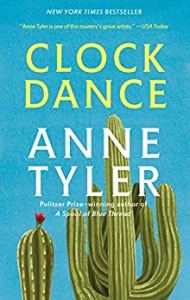
I observed in a recent post that Anne Tyler has a tendency to kill my favorite characters (and characters my favorite characters care about). I declare today that if Anne Tyler does that in Clock Dance, she will have much to answer for.
I don’t buy many physical books these days; in the interest of storage space and the planet, I buy ebooks. But reading some books, even those by authors who keep killing off characters I love—especially those who keep killing off characters I love—requires old technology. It’s an emotional thing.
And so today, breaking my own rules, I bought a paperback copy of Clock Dance. I’m up to page sixty-three and already see trouble coming—because Tyler writes about real people and tells the truth. And the thumb on my left hand—I call it my holding-the-book-open thumb—will protest for weeks after its job is done.
What’s worse, I’ll probably cry and my head will get all stuffy.
But as David once told me, “That’s okay. I’m getting used to sad movies.”
So, no matter how many crying towels I go through, I’ll have a warm and fuzzy feeling and memories of being curled up with a good book.
***
Anne Tyler Clock Dance
Vintage (July 10, 2018)
ISBN 978-0-525-56302-0
The next driver who honks at me while I’m waiting for a pedestrian to get across the street before I turn will find out I’m not so nice a person as I tell people I am.
I don’t mean I’m going make a rude gesture.
I mean that right there in the middle of the street, I’m going to put my car in Park and get out and drag that driver out of his car, and then all hell will break loose.
And I’ll repeat my performance for the policeman.
And then I’ll go to jail and get out and use the experience as background for my crime fiction. And non-crime fiction. And blog posts.
*
Imageof feet is courtesy of PaintedFeet01, via Pixabay.com.
Noreen Cedeno addresses the challenges of writing a mystery set in a real university in Texas. It’s more complicated than I thought. Her book comes out this month, so here’s an advance look!
My books by Dorothy Sayers. Picture by N. M. Cedeño
Academic mysteries are a timeless subgenre in crime fiction. Found on almost every list of the best mysteries ever written, Dorothy Sayer’s Gaudy Night is the epitome of British academic mysteries and is one of my favorite books. Several British mystery series that have been adapted for television are set in the university towns of Oxford or Cambridge with students and professors as witnesses and suspects. Academic mysteries fill a popular niche in the world of crime fiction.
While I enjoy academic mysteries, I never planned to write one. Instead, I fell into it. When I was creating my Bad Vibes Removal Services paranormal mystery series and fleshing out my characters, I blithely imagined my main character Lea to be a graduate student in history who happened to have the ability to see ghosts and the ability to sense the…
I said to my critique partner this morning, The whole project is stinky it stinks it’s just nothing no hope.
She read chapter 13 and said, But it’s so good so funny Molly is so funny it’s not stinky.
I said, Yes, the first part of chapter 13 and the last part of chapter 13 are funny and very very good but there’s still no middle of chapter 13 and what there is stinks and anyway the other 47,000 words stink except for a few hundred here and there.
And she said, But the middle could be revised edited it has promise.
I said, But it won’t work because I have written myself into a hole and can’t get out so I have to trash that part and anyway the whole concept stinks.
And she said, NO you can fix it just keep going because I like Molly she’s so funny.
And that is why I go to critique group every blessed week.
*****
Writing is a solitary activity, but most of writing isn’t writing. It’s rewriting, rewriting, and rewriting. And then it’s revising and revising. And editing editing editing. And rewriting again. And . . .
Sometimes it’s whingeing and complaining and eating peanut butter out of the jar with a spoon and buying larger clothes and telling Molly she’s a heartless ***** who doesn’t deserve one paragraph of her own, much less a whole book.
And it’s feeling like a fraud and deciding you’d be happier if you gave up and dedicated yourself to French cookery or tatting or riding a unicycle.
But if you’re lucky, it’s also going to critique group and then going home and writing and writing and writing and . . .
I posted “Why I Go to Critique Group” here on July 9, 2010, when I was a member of the two-member Just for the Hell of It Writers, which was soon swallowed up by Austin Mystery Writers (a consummation devoutly to be wished).
I periodically pull it out and repost. It’s important.
If you haven’t read the preceding post, “Disregard 15 Pages,” please do so before reading on. That post isn’t very long, but if you read it first, you’ll get more out of this very short one.
*
So finally, afterrevising and revising and revising, you give in, and give up, and stop, because you know it’s as good as it’s going to get—
and because the person you’re writing it with said she’ll “put you in a straightjacket if you try to change it again”—quoted verbatim from her email—
and you believe she’s capable of it—
and you think maybe it’s not the gosh-awful purple-prosed horror you dreaded—
and maybe it even has a couple of redeeming qualities—
and maybe you won’t be embarrassed to have your name on the cover—maybe—
and someday you might even tell people you did it—
and then the real critics come in—
and they put their heads together and consult and confer and say—
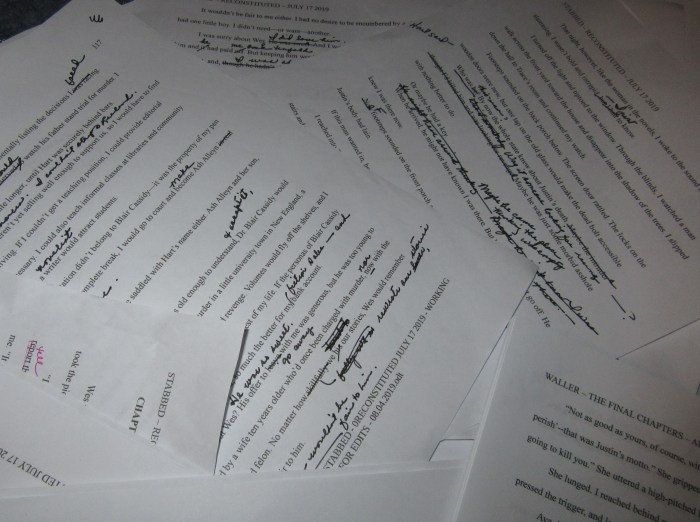
You know how even when you know what you’ve written isn’t as good as it ought to be, you think you’ve gone as far as you can go with it, but you also know you haven’t, and your deadline is tomorrow, about 18 months after your original deadline, so you give it one more going-over, and you spend a whole day marking and then a whole day making changes to the manuscript in LibreOffice, because there were so many things you found that needed to be changed, and when it’s finally done, both your brain and your body are just fried, and you send it off, and then even though you know you shouldn’t, you show 15 pages to your writer friends, and they say it’s better than it was the last time you showed it to us, BUT, and they scribble all over your pages, and they’re so right, and so you go back and change the manuscript again, here and here and here, everywhere they said to, and you send the 15 pages off with the message, Disregard that last part of what I sent yesterday and substitute these, and then your brain and body are re-fried, and you sleep for nearly twelve hours, and then even though you know you should let it alone, you send another 15 pages to your writer friends, and you know they’re going to say, Change this and Change this and Change this, and they’re going to be right, and tomorrow afternoon you’re going to be back at that manuscript, putting in changes there and there and there, and you’ve looked at the d****** thing for so long that the words are turning into squiggles on the page, but you’ll change it anyway because your artistic and OCD temperament won’t let you just leave it alone, and then you’ll send another email saying, Disregard another fifteen pages of what I sent you before and substitute these, and the person on the other end is already at the end of her rope, waiting and waiting and waiting for you to finally finish the thing, but you can’t help it, and when you say it’s a never-ending story, you’re not talking about the book . . .
Here is what I’ve accomplished since arriving Sunday afternoon.
(I believe I’ve mentioned I sometimes have a little trouble walking? Like from parking lots to buildings? If I didn’t, I would be bopping all over campus and wouldn’t have anything to put in this post.)
Sunday
Registered
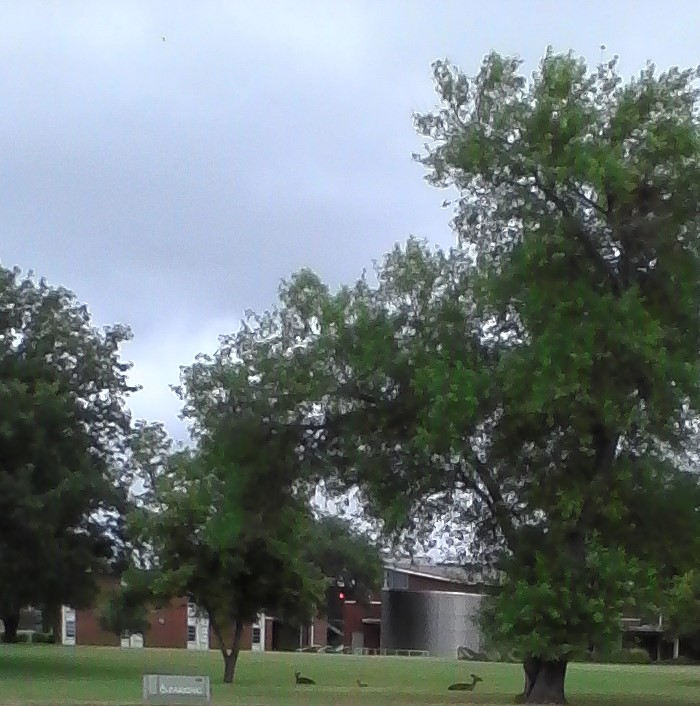
Saw doe wandering around dorms
Didn’t know where camera was so didn’t stop for picture of doe
Hauled provisions into the dorm
Noticed it was as hot as . . . I thought it would be
Drove to cafeteria; parked in nearby lot (very nearby)
Walked from lot to cafeteria; on the way, noticed my back was out
Considered possibility of walking to orientation
Skipped orientation
Said to myself, “I should not have retreated this summer.”
Drove into town for more provisions
Couldn’t make room key work
Threw two sets of keys down onto the walk as hard as I could, set my tote down carefully because it had breakable stuff in it, and swore I would go home the next morning to my husband, who does everything for me, and my cats, who don’t
Made room key work
Crashed in room
Monday, before leaving room
Got out of bed
Noticed my back was still out
Loaded totes for day of writing at Junkin Worship Center
Lost my room key
Found my room key
Lost my car key
Found my car key
Divested totes
(Do I really need my Kindle? No. Do I really need my camera? No. Do I really need eight pens?No. Do I really need three bottles of orange juice and a bunch of breakfast bars? Only if I want to stay upright. )
Lost my room key.
Found my room key.
Lost and found several other things.
Monday, after leaving room
Drove to WLT office; parked in nearest lot
Walked to office; took emergency contact info to director because I missed orientation
Lost my room key
Walked back to car
Became traditionally hungry for the first time in over three years
Considered walking to cafeteria
Drove into town to Burger King
Considered possibility of legally adopting my massage therapist
Lost my handicap parking permit
Parked in regular space at Burger King, no big deal
Bought Whopper, Coke, and Hershey shake; didn’t want Hershey shake but was unhappy about parking permit
Found my room key in my pocket
Put Hershey shake in freezer at dorm
Was still hungry
Ate remaining half of Whopper
Found my handicap parking permit
Flopped on couch, revised a few lines of manuscript
Regretted eating remaining half of Whopper
Fell asleep
Skipped buffet
Said if this walking thing keeps up, I will spend the whole week in my room writing, because that’s what I came to do, and the room is Very Nice, and the A/C works beautifully
Tuesday before leaving room:
Got out of bed
Noticed my back was better
Didn’t lose anything
Tuesday after leaving room
Drove to mid-campus and parked in lot across from Moody Science Building
Walked to Junkin Worship Center Quiet Writing Room
Collapsed onto couch
Found my handicap parking permit in tote bag
Emailed director re giving her permit numbers so she could testify for me in court, or of my calling campus security
Emailed husband for numbers on license plate because I remember only letters
Decided paying $500 – $750 in fine plus court costs a small price for not walking back to parking lot
WLT rep came from across room and walked permit to car, bless her heart, and I mean that most sincerely
And here I am.
Please note that none of the adventures listed here has anything at all to do with the Writers’ League of Texas. The director offered to have me golf-carted (that’s what they do) where I needed to go, but I can drive and park just about anywhere. My problem is getting from parking lots to doors, so I declined. The League and the Retreat are doing just fine. It’s all me, me, me.
I’m going to stay in the Junkin Center drinking orange juice and eating breakfast bars (horrid but convenient) till it closes and later try to make it to the dining hall.
When I started chemo, I vowed I would not excuse any of my shortcomings on chemo brain or chemo body or anything else related to it.
I might un-vow that. There’s probably some truth in it, and it’s much better than blaming everything on age.
Now, PLEASE don’t pity me or say you’re sorry about my trials and tribulations.
Okay. I’ve caught my breath. Now I have to stop this and do the writing I came here to do.
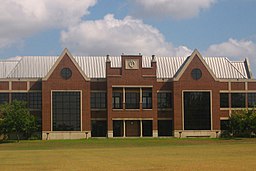
This is a photo of the Butt-Holdsworth Memorial Library in Kerrville, Texas. Round, two stories. I used to come here for library conferences. The interior is beautiful.
We’re back from our stay at a Very Nice Hotel, a fine dining experience, a delightful breakfast buffet, all thanks to the City of Austin.
Not funded by the City of Austin, but thanks to.
Last week the C of A turned off the water (10:00 p.m., turn handle of faucet, Surprise!) and rendered our residence plumbing-challenged. We thought it was just the usual grit in the kitchen faucet’s aerator, but it wasn’t, and rapidly the challenge grew. Cold water in the sink slowed to a trickle. The challenge spread from the kitchen to the shower upstairs. The maintenance man installed a new cartridge but that didn’t cure it, and by the time the challenge moved back downstairs to the water heater, it had ballooned into a curse.
The maintenance man took another whack at the problem. When that failed, the plumber came, and he and the maintenance man together took some whacks. A bunch of them. For two full days.
Yesterday evening, the end of Day #2, when they said our shower would be out of commission all night, we ran away from home.
This was Plumber Day #3. He and the maintenance man spent hours running up and down stairs–which, if you’ve ever seen our stairs, you know is no mean feat–and sitting outside on the sidewalk fiddling with metal part-looking thingies, and cutting out a section of the bathroom wall, and occasionally saying, “Rocks,” and attaching hoses to air compressors.
This afternoon a loud “OW!” floated down the stairs. I braced myself for news of disaster, but it turned out only that the maintenance man had pushed a lever and inadvertently taken a shower.
They frequently assured us as they passed between the front door and the stairs that they “will get this fixed.” We sat in our recliners working on our laptops and said we were sure they would. What we meant was that we recognized they were doing their darndest under horrendous conditions. The manager said she’d never seen anything like it. A few other units had minor issues, but ours was a mess. Location appeared to be the reason. We’re way at the end.
The day could have been as stressful for David and me as it was for the surgical team, but early in the process, we adopted an attitude of shared stoicism.
Late-breaking development: We overheard that the water heater had been turned back on and in about forty-five minutes, the water would be up to shower temperature.
“Does that mean it’s fixed?” I asked David.
“Sounds like it,” he replied.
We were afraid to ask.
Later-breaking development: Curse removed. Challenge completed. Water on. Everything works.
Cats left the bedroom where they were confined from early this morning to a few minutes ago. The front door stayed open (hose running through from outside) all day, and with errands to run, we weren’t around to catch them if they tried to escape. We didn’t think they would–escaping would have required walking past the upstairs bathroom, where strangers and tools and hoses and stuff were headquartered. But you never know.
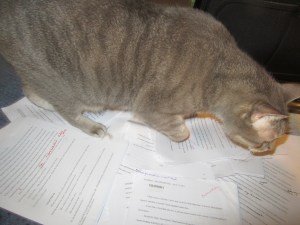
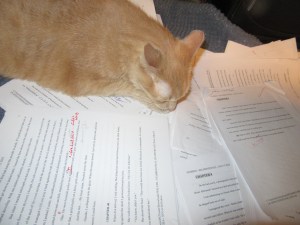
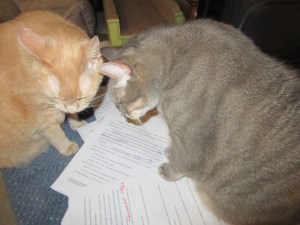
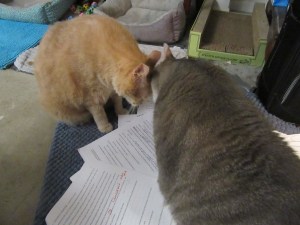
William is his usual unconcerned self. He came down, sashayed through the living room, and took his pill like a real trouper. Fight-or-flight Ernest came down, paused with front paws on the floor and hind paws on the bottom stair step, looked around, and went right back up. He’s down again, had supper, and is lying behind David’s chair.
Cats are fine, plumbing is fine, humans had a vacation of sorts and are fine.
This was our second stay at the Very Nice Hotel. (Note: It’s even Nicer than I thought. I looked it up. Wikipedia says that in the array of the company’s holdings, it’s classed as Upscale. Who knew? It seems a run-of-the-mill Very Nice, and rates are quite reasonable, but I should have known, because the restaurant claims it has 12,000 ways to make burgers.)
Anyway, we first stayed there last fall, during the Great Flea Invasion. William and Ernest hadn’t been outside in nine years, but the fleas came to them. Every safe, non-toxic, biodegradable flea killer known to man was tried and didn’t work, so we gave in and used a nasty chemical that required everything in the house be scrubbed on our return. Cats, already scrubbed by the veterinarian, stayed at the hotel with us.
We intended to stay only one night, but I said I wished we could stay two, and David said fine with him, so we did. I liked it. The cats didn’t.
I also liked that yesterday evening, when David learned we wouldn’t have water overnight plus part of today, he immediately called for a reservation. We spent one night. The cats stayed home. They have their own water bowl and other accommodations here and are not addicted to nightly showers.
So all is well. And David and I go back to Daily Life happy and secure in the knowledge that if we ever again face invasion by either blood-sucking parasites or the City of Austin, we can vacation at a Very Nice Hotel only a mile away.
*
10:30 p.m. David said we don’t have hot water.
No matter. This afternoon, the maintenance man came downstairs and said, “Miss, is that you in that picture up there?” I said yes. He said, “Wow.”
The picture is hidden in the upstairs hallway. It was taken after I graduated from high school. I was wearing the formal my mother had made from white watered taffeta and trimmed with seed pearls.
When we tried to medicate William last night, a pill fell into the pit between the seat of my recliner and the arm, and we weren’t able to locate it. It’s in there somewhere, or it fell through onto the floor under the chair. After a cursory look, we gave up. We feel safe leaving it there because it’s a sure thing neither cat will gobble it up. If it were one of my pills, they would vacuum it up in a nanosecond.
The pill fell because I was careless and William got his tongue in gear and spat it out. We got another pill. Which means he’ll get only twenty-nine pills instead of thirty. William thinks that’s okay.
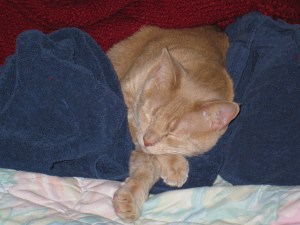
William
William is being dosed for pancreatitis. David is the cat holder. Due to my vast experience, I am the pill poker. It took a week for me to remember that coating the pill with butter makes the job easier. William doesn’t resist as enthusiastically and once in his mouth, the pill slides down more easily. He also doesn’t run upstairs after the ordeal, just jumps down and licks the inside of his mouth with vigor but no expression of distaste. Hurrah for butter. We have about two more weeks to go.
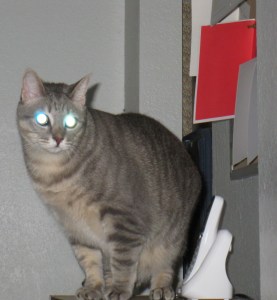
Ernest is probably unpillable. We haven’t tried, and I don’t want to.
I use a piller now. I had a piller in years past, but Chloe didn’t take to it, and I didn’t take to Chloe’s offer to use her fangs on my fingers while they were nearby. Every time she had to be pilled, I left her with the vet and let the experts handle her. Same with Christabel. Chloe was wiry and muscular and if she didn’t bite me, she wriggled out of my grasp. Christabel was big and built like Jello and rolled out of every half Nelson I applied.
At the end of this post, there’s a link to a video tutorial on pilling cats. I include it so you can see the piller. The starring vet says the process is easy peasy. Take that with a grain of salt. He’s a vet. He’s had practice. The cat knows resistance if futile. I suspect he’s a clinic cat. Those animals tolerate many outrages with aplomb. I suspect they have no reflexes at all.
My old neighbor, Steve Dauchy, a big orange tom, was a retired clinic cat. One cold winter day, his family smelled something burning and found Steve sleeping on a propane space heater in the kitchen with his tail hanging down beside the vent. His hair was singeing. He woke up when they pulled him off.
One winter night, I woke, reached out my hand, and touched fur I recognized as not my cat. Scared me half to death. I turned the light on, and there was Steve, snoozing away, the third cat on the bed. He’d sneaked into the house when I opened the door, hidden somewhere, and emerged at lights out, I guess. He was very astute. On cold nights, he slept on the seat of the riding lawnmower in his humans’ garden shed, a nice, tight bedroom, but when he saw a chance of a mattress, he jumped at it. The next morning, while Steve breakfasted in my kitchen, I called next door and told the worried humans about the slumber party he’d engineered, and later, when it warmed up, put him outside.
Tonight’s dose went down in record time. David wanted to medicate him before he went to the grocery store, but we waited for him to come downstairs under his own steam. Between four and five-thirty every day, awakened by his circadian rhythms, he waltzes downstairs for insulin and dinner. Mainly dinner. He hardly notices the insulin.
When I was a teen, I read a book about caring for cats. There was a chapter about medicating them. The authors, a married couple, used the terms cat holder and pill poker.
When I pilled my Siamese, Ms., I was both cat holder and pill poker, but after the first few confrontations, she cooperated. I didn’t have a piller, but she didn’t Didn’t open her mouth on command, but I didn’t have to use much force, and she sat still. She was highly intelligent and behaved more like a dog than a cat, except for pilling. Dogs never cooperated.
The Siamese’s first name was Mademoiselle–for some ridiculous reason–until I realized she was liberated, the Gloria Steinem of cats, good looks and all–and I changed it to Ms. That was ridiculous, too, because I called her Kitty. And Puddy. And Puddy-Wuddy. And Feetie-Pie. All the usual cat names.
Ernest
She produced kittens when she was eleven months old. Her idea, not mine. Wonder of wonders, they were Siamese kittens. Praise goodness for the gentleman Siamese down the street. The kittens would probably have been just as easy to give away as if they’d been generic, but people seemed extra pleased to have purebreds. No official papers, of course. Ms. was not an aristocrat, and considering the kittens were conceived under dubious circumstances, they would never have been accepted into High Society.
My one disastrous encounter with a sick cat occurred at the veterinarian’s. The tech was attending to one end of William and I was holding the other end, the one with teeth. He’d buried his head as far back between my body and my forearm as he could go, considering I had my arm clamped to my side. After suffering indignity for longer than I thought he would, he rebelled. I think he tried to bite me, but he managed only to rub his fang against my arm, hard enough to scrape the skin slightly. Within minutes, I had a budding case of cellulitis–I recognized it as such because I’d had it before from an encounter with cat teeth–and I had to go to the urgent care clinic for pills of my own plus shot of antibiotic. It turned out that William wasn’t sick. That night I wrote a verse about the experience and posted it on my blog, here:
William bit me at the vet,
Didn’t like the aide’s assistance,
Used his claws and fangs to set
On the path of most resistance.
Say I’m teary, say I’m mad,
Say that pills and needles hit me,
Say my arm’s inflamed, and add,
William bit me.
It’s patterned after one of my favorite poems, Leigh Hunt’s “Jenny Kissed Me”:
Jenny kissed me when we met,
Jumping from the chair she sat in;
Time, you thief, who love to get
Sweets into your list, put that in!
Say I’m weary, say I’m sad,
Say that health and wealth have missed me,
Say I’m growing old, but add,
Jenny kissed me.
If Hunt and Jane (Jenny) Carlyle were around to read the parody, they might not approve, but if I didn’t like the original, I wouldn’t have used it. I don’t consider my version an homage, exactly, but I’m fond of it. I’m a rotten poet, but I do pretty well at parody, if I do say so myself. I wish I could write them for a living.
I’m can’t write anything for a living. I don’t write fast enough, and as yet I haven’t hit upon the Great American Novel. I haven’t hit upon any novels at all, just short stories. A couple have brought in a few dollars from contests, and those that have been anthologized bring in a few cents in royalties (which are divided with the other authors), but the cents are donated to charity every year (supplemented, of course). The truth is–like many lightly published authors, I would be tempted to pay to get my stories in print or online. But I wouldn’t do that. My efforts are worth at least $0.00.
I didn’t plan to say anything about my literary efforts, but in a stream-of-consciousness post, things just happen, so I’ll happen to add that my stories appear in the three anthologies pictured in the sidebar–MURDER ON WHEELS, LONE STAR LAWLESS, and DAY OF THE DARK. My best stories, two of them, are in Murder on Wheels, which has an unimpressive cover but good stuff inside, so if you buy one, please buy that one. They’re all available in paperback and ebook formats. They might be available from your local public library–if they’re not, I’d appreciate your requesting the library acquire copies.
Royalties from Murder on Wheels go to Meals on Wheels in Austin, Texas. Royalties from Lone Star Lawless go to the Port Aransas Public Library, which lost its collection and everything else to Hurricane Harvey in 2018. Royalties from Day of the Dark go to Earth & Sky, which through its website presents information about science and nature. The radio program Earth & Sky (EarthSky) used to air on commercial, NPR, and other public radio stations, but since June 2013 has concentrated on its website and social media.
So there it is, a disjointed post. I went to bed too late last night and woke up too early this morning, so I can’t work on my novella-in-progress, because the characters are too tired to do or say anything interesting. They’ve already said and done one hundred + pages, but they need to do and say it better. Anyway, since they’re not cooperating, and since I’m tired, too, I abandoned them for this post.
The novella will be out this fall. I won’t mention the title or anything else, because it’s a secret, but you can be sure more Blatant Self Promotion will appear in a future post. Not a disjointed one, I hope.
Now I’ll go back to those characters and try to rev them up. They produced pretty well yesterday, when they were rested, so I know they can do it. With the deadline they’re working under, they need to get on a stick.
*
This turned out less disjointed than I expected it to. Half about cats, my default topic, and the rest about books and writing. All about me, my perpetual topic. The experts say not to write about yourself, but except for Helen Hunt Jackson’s nineteenth-century novel RAMONA, I’m about all I know.
I’m putting what I know about Ramona on a separate blog, but doing so requires typing a lot of footnotes, and that’s a slow and sleep-inducing procedure. The text is interesting, though, if I do say so myself.



 My books by Dorothy Sayers. Picture by N. M. Cedeño













 M. K. Waller