If you like mysteries, come to the Yarborough Branch Library on Sunday, January 11, @ 2:00 p.m., to hear author Mark Pryor. Mark is the author of the Hugo Marston mysteries; he’s also an Assistant District Attorney for Travis County. The meeting is FREE and OPEN TO THE PUBLIC. For the details, read on.
This quotation from Neil Gaiman that Purpleborough has posted means a lot to me. I’ve already started making my mistakes for 2015. Such a relief: The teacup is already broken.
“I hope that in this year to come, you make mistakes. Because if you are making mistakes, then you are making new things, trying new things, learning, living, pushing yourself, changing yourself, changing your world. You’re doing things you’ve never done before, and more importantly, you’re doing something.”
This is part two of the Shrewsday Christmas Ghost Story. You can find part one here.
When she woke, it was dark. And there was still no one there.
What time was it? Meg moved her head painfully. She must have hit it as she fainted. Two hours had passed, and Dylan was still not home. Her heart lurched as she remembered the events of the day, and involuntarily, she glanced at the mirror.
It was a blank stare, reflecting the room and Dylan’s Christmas lights
She heard sound of the key in the lock. Dylan hollered up the stairs: “Sorry I’m late. Traffic was a bugger. We’re going to have to make a quick turnaround I’m afraid….
And the woman in Meg took over. I look a sight, she thought, and I have five minutes. Without a thought for the bump on her head, or the mad woman in the…
Christmas never goes by, in the Shrewsday household without a rollicking good ghost story. We are late – I have been ill – but here is the first of three parts. Enjoy, and have a wonderful festive break.
In the darkest recesses of the little shop in Pravdy Street, in the great city of St Petersburg, the frame stood blind.
By blind, I mean it carried no mirror, though once it must have been made to stand on the dressing table of some impossibly rich and beautiful woman. It was carved in mahogany and had once been lavishly gilded by master craftsmen, but its crevices collected dust now, its unsettling features dulled by time and inattention.
Old Gorokhin could not remember a time when it had not stood there, glowering from the corner of his little shop. His father before him told him it had arrived after the house clearance of…
Travers in his most memorable role, as Clarence Odbody in It’s a Wonderful Life (Photo credit: Wikipedia). Public domain.
We’re watching, one more time, It’s a Wonderful Life.Clarence Oddbody, AS2 (Angel Second Class), aka Henry Travers, is showing George Bailey, aka James Stewart, how his hometown would look if George had never been born.
In a couple of minutes, George will learn that, because he never existed, his wife, Mary, aka Donna Reed, not only never married, but became a librarian. Judging from her granny glasses, frumpy hat, and bun, that’s a fate worse than death.
I like It’s a Wonderful Life, but it isn’t my favorite Christmas movie. I prefer Miracle on 34th Street, in which Edmund Gwenn–whom I rank right up there with Henry Travers–is declared, in court, to be the real Santa Claus. No librarians were defamed in the making of that show.
Nevertheless, as soon as half the town crowds into the Bailey living room to pile money onto the table, I start to cry. I cry through the credits and the next three commercials. Even a not-favorite movie can stir emotions. Year after year after year.
Favorites aren’t easy for me. I don’t have a favorite novel or a favorite song or a favorite color. Or a favorite teacher, actor, or pet. I have multiple favorites. For me, those get-your-password questions–“What is your favorite television show?”–are useless. I never remember whether I said Andy Griffith or Law and Order or I’ll Fly Away.
I do, however, have a favorite Christmas carol. The melody is lovely and singable–singable is important to me–but it’s the words that move me. They speak of peace and quiet and rest for the weary, of heavenly song floating above earthly babble. They speak of ancient tidings of peace to one small group of men, and of a promise of a world in complete harmony.
But the lyrics also speak of the present, of stopping, and looking up, and seeing angels. They’re there now, and they’re singing.
We have only to be still and listen.
*
It came upon the midnight clear, that glorious song of old, from angels bending near the earth to touch their harps of gold: “Peace on the earth, good will to men, from heaven’s all-gracious King.” The world in solemn stillness lay, to hear the angels sing.
Still through the cloven skies they come with peaceful wings unfurled, and still their heavenly music floats o’er all the weary world; above its sad and lowly plains, they bend on hovering wing, and ever o’er its Babel sounds the blessed angels sing.
Yet with the woes of sin and strife The world has suffered long; Beneath the angel-strain have rolled Two thousand years of wrong; And man, at war with man, hears not The love-song which they bring; O hush the noise, ye men of strife, And hear the angels sing.
And ye, beneath life’s crushing load, whose forms are bending low, who toil along the climbing way with painful steps and slow, look now! for glad and golden hours come swiftly on the wing. O rest beside the weary road, and hear the angels sing!
For lo! the days are hastening on, by prophet seen of old, when with the ever-circling years shall come the time foretold when peace shall over all the earth its ancient splendors fling, and the whole world send back the song which now the angels sing.
It’s once again time for the North American Aerospace Defense Command’s (NORAD) annual tracking of the flight of Santa Claus from the North Pole to points all over the planet.
During the Cold War, the colonel was commander of the Continental Air Defense Command (now NORAD). In case of an attack on the United States, he would have been the first to receive word.
Colonel Shoup was at his desk that day in 1955 when NORAD assumed the task of following the progress of Santa’s sleigh. But the new responsibility wasn’t ordered by President Eisenhower or any of the colonel’s military superiors.
The job resulted from a typographical error–one little mistake whose happy consequences are still being felt nearly sixty years later.
From the Storycorps website: “StoryCorps is a national nonprofit that gives people the chance to interview friends and loved ones about their lives. These conversations are archived at the American Folklife Center at the Library of Congress, allowing participants to leave a legacy for future generations. Learn more, including how to interview someone in your life, at StoryCorps.org.”
Storycorps is coming to Austin!
From the Storycorps website:
“The StoryCorps MobileBooth will be in Austin, TX, January 5 to January 30, 2015. Make a reservation today!
“Si desea hacer una reservación en españ ol o necesita más información, por favor llame al 800-850-4406, las 24 horas al día, los 7 días de la semana.
*****
Thanks to author Craig Johnson for sharing the link to the story about the NORAD Santa Tracker on his Facebook Author’s page.
“We do not convince others by telling them loudly how wrong they are and how right we are. We convince them by showing them a light so lovely they will want with all their hearts to know the source of it.”
If as Herod, we fill our lives with things and again things;
If we consider ourselves so important that we must fill
Every moment of our lives with action;
When will we have the time to make the long slow journey
Across the burning desert as did the Magi;
Or sit and watch the stars as did the shepherds;
Or to brood over the coming of the Child as did Mary?
For each one of us there is a desert to travel,
A star to discover,
And a being within ourselves to bring to life.
I read “The Road to Bethlehem” online and saved a copy of the poem but not the URL of the website where I found it. The poem was attributed to Anonymous, and I haven’t been able to find the author’s name. If you know who wrote it, please send the name and, if possible, other documentation in a comment, so I can give the poet credit for his creation and can seek information about copyright. Until I know more, I will assume the poem is in the public domain.
This is the story of Cuthbert, a five-year-old boy who visited my school library
for twenty minutes every week.
My job was to teach him about the library.
I’m not sure what his job was.
But he was very good at it.
*
Once upon a time, I read “Hansel and Gretel” to a class of kindergarteners. The audience, sitting rapt at my feet, comprised sixteen exceptionally good listeners, a fact I later regretted.
While I read, Cuthbert sat on the floor beside my chair and stroked my panty-hose-clad shin. Small children are fascinated by panty-hose.
When I reached, “And they lived happily ever after,” Cuthbert stopped stroking and tugged on my skirt. I ceded him the floor.
“But it’s a good thing, what the witch did.”
Since he spoke kindergartener-ese and sometimes I didn’t, I thought I had misunderstood. Come again?
“It’s a really good thing, what the witch did.”
I should have slammed the book shut right then, or pulled out the emergency duct tape, or something, anything to change the subject. But I’m not very smart, so I asked Cuthbert to elaborate.
His elaboration went like this:
When the witch prepared the hot oven to cook and then eat Hansel, she was doing a good thing. Because then Hansel would die and go to Heaven to be with God and Jesus.
I smiled a no doubt horrified smile and said something like But But But. While Cuthbert explained even more fully, I analyzed my options.
a) If I said, No, the witch did a bad thing, because it is not nice to cook and eat little boys and girls, then sixteen children would go home and report, Miss Kathy said it’s bad to go to Heaven and be with God and Jesus.
b) If I said, Yes, the witch did a good thing, because cooking and eating little boys and girls ensures their immediate transport Heavenward, then sixteen children would go home and report, Miss Kathy approves of cold-blooded murder and cannibalism. Plus witchcraft. Plus reading a book about a witch, which in our Great State is sometimes considered more damaging than the murder/cannibalism package.
c) Anything I said might be in complete opposition to what Cuthbert’s mother had told him on this topic, and he would report that to her, and then I would get to attend a conference that wouldn’t be nearly so much fun as it sounds.
Note: The last sentence under b) is not to be taken literally. It is sarcasm, and richly deserved. The earlier reference to emergency duct tape is hyperbole. I’ve never duct taped a child.
Well, anyway, I wish I could say the sky opened and a big light bulb appeared above my head and gave me words to clean up this mess. But I don’t remember finding any words at all, at least sensible ones. I think I babbled and stammered until the teacher came to repossess her charges.
I remember Cuthbert was talking when he left the room. There’s no telling what his classmates took away from that lesson.
I suppose, if I’d been in my right mind, I’d have said something to the effect that God and Jesus don’t like it when witches send people along earlier than expected.
But the prospect of talking theology with this independent thinker froze my neural pathways.
And anyway, it took all the energy I had to keep from laughing.
*
“Hansel and Gretel and Cuthbert and Me” appeared on this blog in 2011 and again in 2012. The discussion about fairy tales and religion took place twenty years ago. I think about it often and feel fortunate I’ve never had a nightmare about it. But I remember Cuthbert fondly for giving me what was simultaneously the worst and the best day of my career. He was a cute little boy.
Yesterday, I posted on Writing Wranglers and Warriors a piece (Boy, Am I Cranky) prompted by this post on Kristin Lamb’s Blog. I provided a link to that blog, but in case you didn’t have time to read it, I’m reblogging it. In a couple of days I’ll tell a (not-funny-to-me-except-in-hindsight-and-maybe-not-even-then) story about why that 2-hour post took more than five hours to write.
Last month I participated in NaNoWriMo even though it’s the holidays and, as many of you know, I am battling the last vestiges of Shingles which makes me tired, like down to the BONES tired. But, lest I go crazy, I had to write, because that’s what writers do. We aren’t happy unless we are writing something.
I figured in the beginning I likely wouldn’t make the 50,000 word mark not only because of feeling puny, but I also have other writing that doesn’t count toward NaNo.
Yet, the interesting thing is, being tired can have benefits. If we wait until that celestial alignment when the kids aren’t sick, our pants fit, there isn’t a heap of laundry, the garage is clean, the junk mail sorted, and we feel energized? We won’t get a lot of writing done, so here is some food for thought…
There is a time for many words, and there is also a time for sleep. ~ Homer
***************************************
(A word in this post contains a zero in place of an o. If you find it, go to the head of the class. I saw it but now I can’t find it to correct it. There’s an and for an, too. Yes, this is pertinent to the subject of the post.)
Ten a.m., and I was dead tired.
I’d awakened at seven a.m., put sheets in the washing machine, piled three loads on the landing to do later, folded a load taken from the dryer, hidden one load of clean towels under the couch pillows so the guy cats couldn’t sleep on them, dressed myself, and driven downtown.
Now I was sitting on a stool at the computer bar of my office-coffee…
In November, my friend and critique partner Gale Albright presented a NaNoWriMo write-in at the Hutto Public Library, in Hutto, Texas. Nine writers and their laptops gathered to write for four solid hours, supported by snacks and coffee provided by the Library.
Attendance was so robust that I had to scrounge* for a seat when I arrived. Late.
Welcome to Hutto
It would be trite to report that both writers and library staff expressed enthusiasm for the project. Nonetheless, that’s what happened, and I can’t pretend it didn’t.
They were so enthusiastic, in fact, that I foresee a future write-in, even without NaNoWriMo to serve as an excuse.
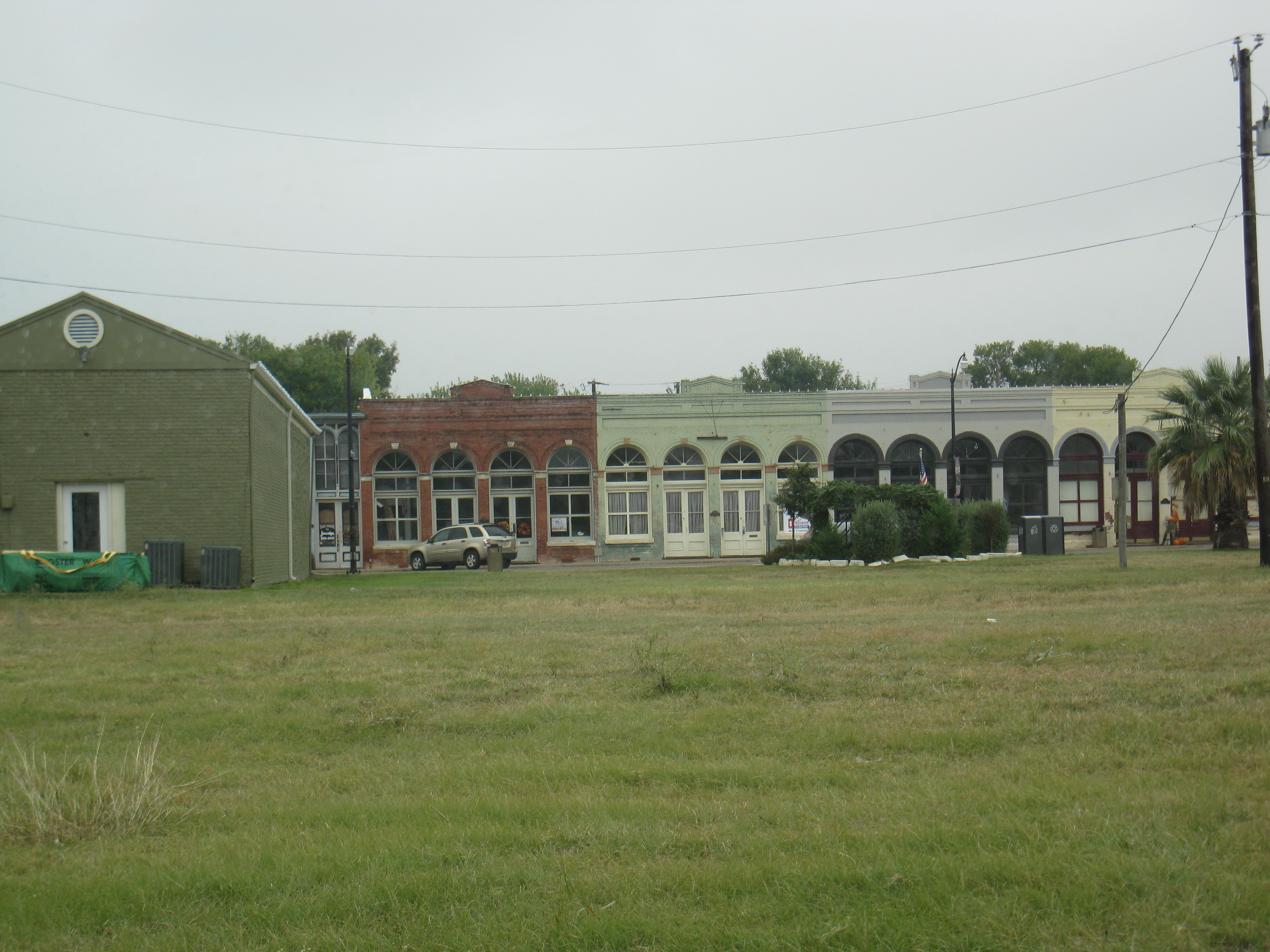
After the write-in, I drove around the city. Originally settled by Germans and Swedes, Hutto still looks like a small town, but it’s changing rapidly. New subdivisions are going up all around.
The older part of town has neat houses and yards,
Hutto neighborhood
a charming main street,
Hutto Main Street
and open spaces.
Hutto Main Street seen across a grassy area
The library is a renovated fire station. A couple of years ago, the reading room was tiny; then a second bay was opened, more than doubling the space and providing room for an enlarged children’s area.
Hutto Public Library sign
Hutto Public Library building
But what sets Hutto apart from other cities worldwide is its legend. You can read the whole story at How the Hippo Came to Hutto, on the Williamson County Historical Commission website, but here’s a summary: In 1915, a circus train stopped in Hutto to pick up passengers and to let workers care for animals. Somehow, a hippo got out of a railcar, headed for a nearby creek, took a dip, found the muddy water to its taste, and, no matter what trainers did to lure it out, refused to cooperate. Legend says the Depot Agent telegraphed two Taylor and Round Rock: STOP TRAINS, HIPPO LOOSE IN HUTTO. Somehow the hippo was returned to its railcar, but amused residents made his story their own. Soon afterward, Hutto School took the hippo as its mascot and the football team became the Hutto Hippos.
Today Hutto is
The largest stands near the Chamber of Commerce building.
A fourth, like the Guard Hippo, enhances its original concrete with an overlay of alabaster.
Alabaster Hippo
I wish I had taken more pictures of Hutto’s hippos, but drizzle had turned into rain, and I wanted to get home before rain turned into traffic problems. Suffice it to say there are hippos of every size and color all over town. A local artist can be commissioned to personalize hippos to the owner’s specifications.
Hutto is a pleasant little place. In some ways, it reminds me of my hometown as it was when I was a child.
In short, I think Hutto would be a good place to live.
As they say, three thousand hippos can’t be wrong.
*****
English: Photograph of Sophie Tucker (Photo credit: Wikipedia) Public domain.
Turn up the sound and enjoy Sophie Tucker singing “Fifty Million Frenchmen Can’t Be Wrong.” Cole Porter wrote the lyrics. I hate to say it, but this is three thousand times better than the hippos.
Sophie Tucker was quite a looker. I had no idea. Now I see what all the fuss was about.
By No machine-readable author provided. Johntex~commonswiki assumed (based on copyright claims). [GFDL, CC-BY-SA-3.0 or CC BY 2.5 , via Wikimedia Commons
Remember when Murphy Brown and her colleagues cooked and served Thanksgiving dinner at a shelter, and Miles brought in a bunch of live turkeys in his BMW (nobody had specified they were to be ready for the oven, and on arrival the inside of the BMW was not in good shape), and the turkeys ran all around the kitchen, and no one wanted to kill them anyway, and the turkeys refused to stick their heads in the oven so Murphy could turn on the gas (her suggestion)?
I don’t know what happened next. I was laughing at the turkeys and couldn’t pay attention. All I remember is the whole thing slid downhill fast.
Well. It could have been a whole lot worse. To see how, read “When Turkeys Strike Back,” by K. B. Owen, historical mystery writer.
I am grateful. For my husband, my family, parents who gave me a good start and kept on giving, my home, teachers, education, friends, time to use as I wish, the rights guaranteed to me by the Constitution, the freedom to pursue happiness, good health, and a host of other blessings.
But when I write about blessings, the resulting essay is maudlin, insipid, schmaltzy, and trite.*I just can’t do sincere.*******
So this post is about things not usually seen on Grateful-For lists.To wit:
Coffee shops with enough electrical outlets, appropriately placed, to serve nearly all the people who want to plug in. (There’s no way they could serve all of them.) And that say your car will be towed if it’s parked in their lot for more than three hours but don’t really mean it. (BookPeople. They probably do mean it, but I’ve never been towed. I think it depends on how full the parking lot is.)
Everywhere that provides free Wi-Fi.
Coffee shops that allow a critique group to sit around a table and discuss manuscripts, and moan about how hard writing is, and what their kids and their cats are up to, and what their dysfunctional families are up to, and that don’t mind when one member reads aloud a scene involving torture and murder** because both staff and other customers are entranced, listening and wondering whether they’re hearing part of a memoir. And that don’t tow their cars.*****
Blogs. Mine allows me to write to write to an audience, real or imagined. I need that audience. So do most other writers, including students of all ages.
Books. I like them. I like to read them. I like to buy them. Unfortunately, I like buying more than reading, which is why I have so much to-be-read nonfiction on my bookshelves and elsewhere.***
Bookstore going-out-of business sales. Closing a bookstore is a terrible thing, but if they’re going to close anyway, I don’t mind helping reduce inventory. That’s how I acquired most of that unread nonfiction.
English: Borders in West Quay Retail Park, Southampton (Photo credit: Wikipedia) Public domain.
Printers that work.****** Most of them work now, but years ago most didn’t. That’s why my students at the university turned in so many papers with text starting at the middle of the page and running diagonally to the bottom right corner. I told them they really couldn’t do that, and that they needed to do the work earlier and start printing days rather than minutes before leaving for class. But I knew if I used a printer, my papers would look like theirs. I was still using a typewriter. When I put the paper in straight, my pages looked okay.
Mark Twain, Emily Dickinson, William Dean Howells, Henry James, Edith Wharton, Clyde Edgerton, Kathie Pelletier, T. R. Pearson, Olive Ann Burns, Fannie Flagg, Elizabeth Berg, Josephine Tey, Ruth Rendell, P. D. James, and the list runs on. If there are any questions about why I’m grateful, pick up some of their books. For Elizabeth Berg, begin with Durable Goods (her first novel, and yes, I despise her). For Clyde Edgerton get Raney, Walking Across Egypt, Killer Diller (WAE’s sequel), or Lunch at the Picadilly; the man is a genius. For Olive Ann Burns, read Cold Sassy Tree, her first and only complete novel; I feel about her like I feel about Elizabeth Berg, see above. I’d like to feel that way about Clyde Edgerton, but I can’t, because I want to be Clyde Edgerton.
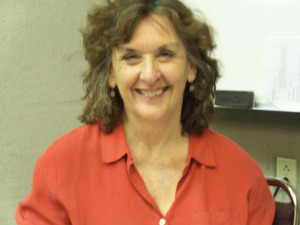
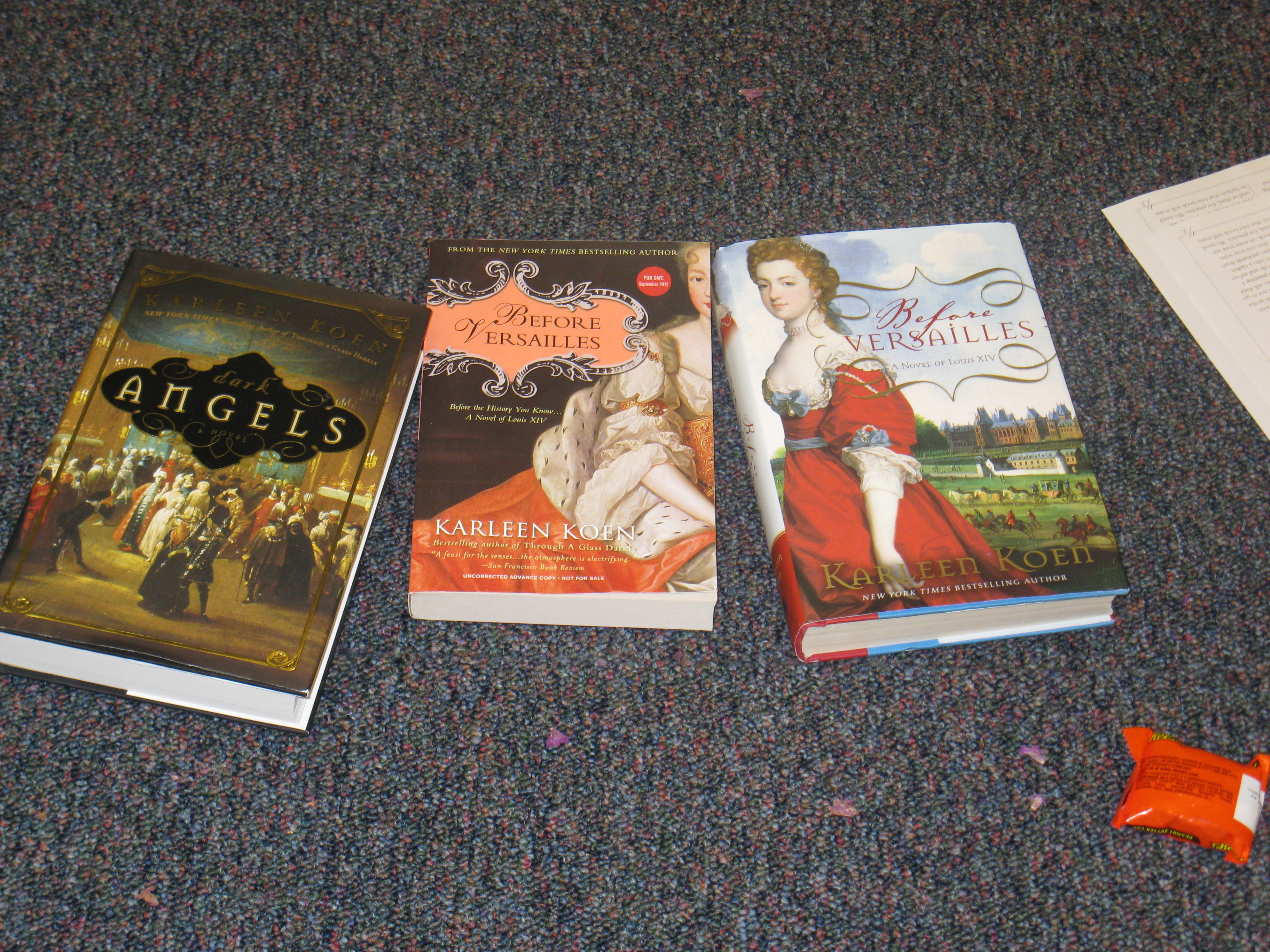
Karleen Koen,**** writer and instructor, who said, “I can’t teach you to write, but I can teach you to play.” And she can. And she did. And I had the time of my life writing and writing and writing. Anyone who wants to write and has the opportunity to take one of her classes should sign up asap. See her blog, Karleen Koen – Writing Life, and her webpage, Karleen Koen. Find information about the courses she teaches at Karleen Koen – Courses. Karleen has published four impeccably researched historical novels, set in the seventeenth and eighteenth centuries; the latest, Before Versailles, takes place in the court of Louis XIV, in the early years of his reign.
Karleen Koen
Three of Karleen Koen’s novels displayed on classroom floor at WLT retreat, Alpine, TX, 2014. The little orange things in the lower right corner might be peanut butter cups.
Dictionary.com and Thesaurus.com,which I keep running in the background when I work. Dictionary.com gives me exact definitions of words. Thesaurus.com answers the question, What’s that word that means something like XXXXXXXXXX but not exactly, and it’s standing at the beginning of my hypoglossal nerve but refuses to sprint on down to my tongue, and I cannot finish this sentence without it? These sites are a godsend for people who hyperventilate at the thought of leaving a blank space and moving on.
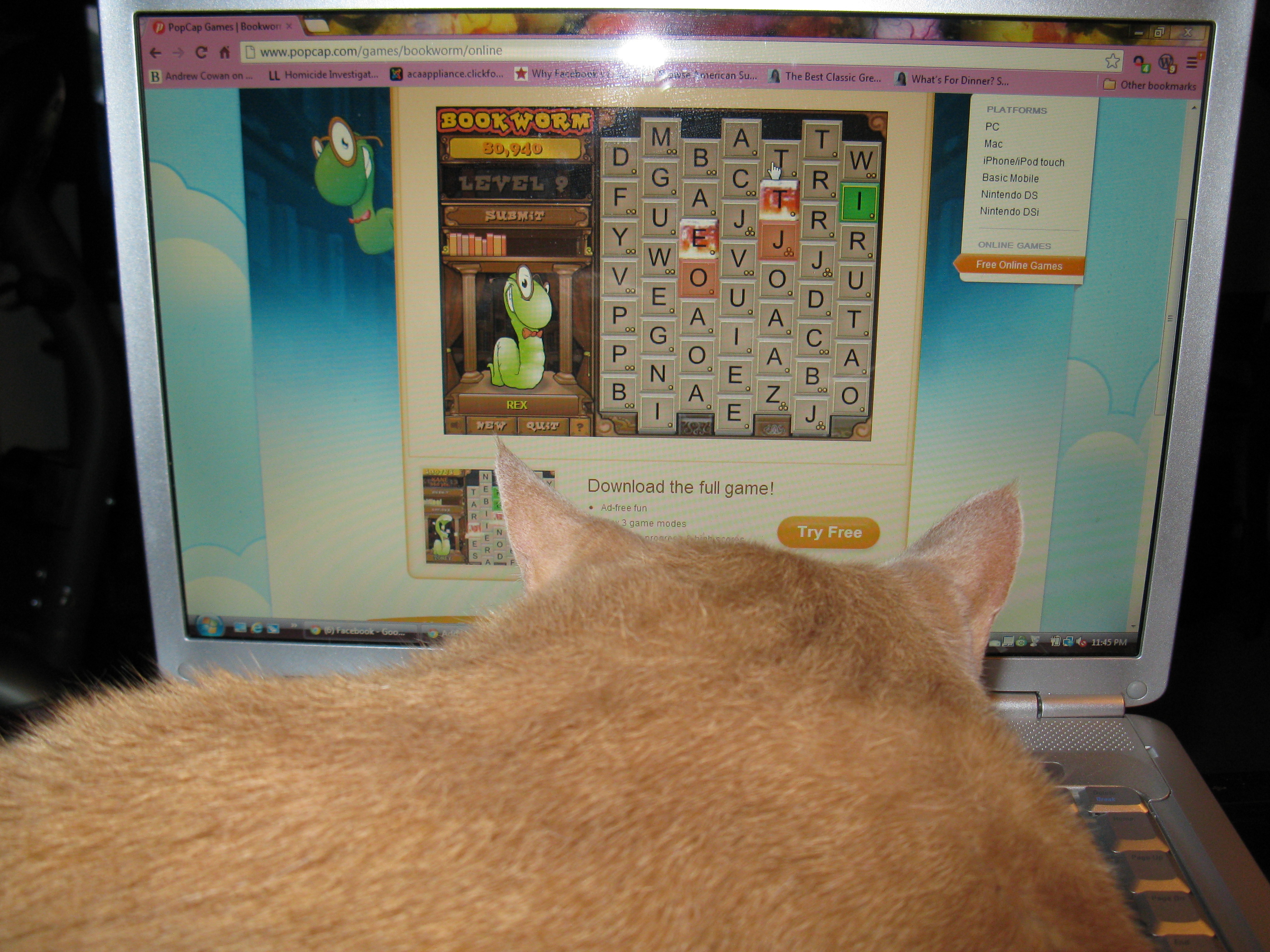
Bookworm.Yes, that one. The vile, disgusting, devilish online game that is a thousand times worse than solitaire, because if the Bookworm player is good enough, the game never ends. The player can sit mindlessly clicking on letters to make words, and if the letters he clicks don’t make a word, he just tries again, and he can play while he’s watching-listening to television, or petting the cat, or carrying on a conversation, or trying to think what his Main Character should do next because he’s painted her into a corner . . . Obviously, I know whereof I write.
I’m grateful for Bookworm, however, because sometimes I need the comfort of a mindless, repetitive task. Playing Bookworm can be a method of avoidance, but it can also be a way of putting the mind on autopilot, giving it the freedom to figure out how to get the Main Character out of the corner she’s stuck in.
Caveat: Playing Bookworm for too long at one sitting, day after day, month after month, can result in repetitive stress injuries. For example, the mouse hand and all that’s attached to it, right on up to the shoulder, can be rendered painful and practically useless until the light dawns and the victim realizes why she can’t raise her right arm.
Readers. I’m grateful for everyone who reads my posts, especially the posts that are two or three times as long as blog posts should be. This one is four times as long. Contrary to my expectations, everything on the list relates to writing. I had intended to include Relaxed Fit Slacks and The Demise of the Girdle. But tomorrow is another day.
(The Demise of the Girdle. Wouldn’t that make a marvelous title for a novel? Should it be mystery, romance, or science fiction?)
William Davis & Bookworm
* See Thesaurus.com. That’s where I found all these synonyms for bathetic.
*** Don’t ask where elsewhere is. It’s not relevant.
**** This is not an advertisement, paid or otherwise. Karleen is an excellent teacher–few instructors can keep twenty tired adults happy for a whole week by assigning more homework. (See Morning Pages)
***** See Coffee Shops, above.
****** And printers that don’t drink ink.
******* Last summer, when I wept bitter tears because I couldn’t write what I was trying to write (not my usual practice, but I was having a bad summer), Karleen told me what to do instead, and before anyone says Hahahahahah, I’ll add she was quite nice about it, and said I should aspire to write like David Sedaris. Have you ever known of David Sedaris to do sincere?
English: Tenniel illustration of Tweedledum (centre) and Tweedledee (right) and Alice (left). Español: Ilustración de Tenniel de Patachunta y Patachún. Ilustración de John Tenniel para el capítulo 4º de Alicia a través del espejo (Lewis Carroll), originalmente publicado en 1871. Escaneado de la edición impresa (Modern Library). (Photo credit: Wikipedia)
Pantsing, when successful, lets you create a story closely resembling the spark that ignited it. ~Janalyn Voigt, Live, Write, Breathe
The first step in starting a blog is finding the perfect name. I wanted to call mine Contrariwise, as an homage to Lewis Carroll and to my ability to locate an argument in nearly any issue I come across.
Contrariwise was already in use, however, several times over, and I couldn’t find another literary allusion that satisfied, so I named it Whiskertips. It was my own invention, an homage to the two whiskered beasts with whom I share living quarters.


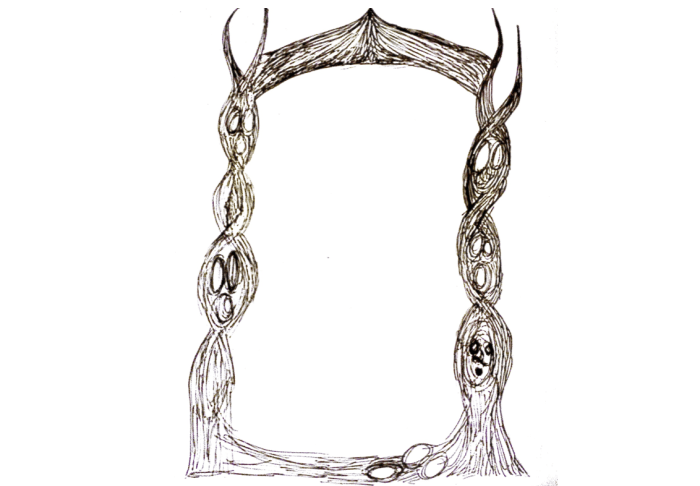


 Christmas never goes by, in the Shrewsday household without a rollicking good ghost story. We are late – I have been ill – but here is the first of three parts. Enjoy, and have a wonderful festive break.













 M. K. Waller

