Texas Spring: Loveliest of Flowers


Loveliest of trees, the cherry now
Is hung with bloom along the bough,
And stands about the woodland ride
Wearing white for Eastertide.

Now, of my threescore years and ten,
Twenty will not come again,
And take from seventy springs a score,
It only leaves me fifty more.

And since to look at things in bloom
Fifty springs are little room,
About the woodlands I will go
To see the cherry hung with snow.

~ A. E. Housman, “Loveliest of Trees”

Image by gmoyer via pixabay.com

“We Have Met the Enemy, and He Is Us”


In the early 1970s, I watched the British series Upstairs, Downstairs—the original, which was called the best depiction of the effects of World War I on the upper and lower classes that had been produced up to that time.

In one episode, James Bellamy’s wife, Hazel, contracts the Spanish flu. A brief synopsis of the next episode, published in the TV section of the newspaper, said James and Hazel would leave London for a quieter life in the countryside. At the end of the show, however, Hazel dies.

I cried for a half-hour. Maybe the shock value was worth it to the producers, but I felt betrayed by the false publicity.

That was my introduction to pandemics. At that point, I was protected by both a television screen and time.

A hundred years later, the world faces another pandemic. Experts said ten, twenty years ago that we were overdue for it. There’s no vaccine. We’re told to wash our hands, disinfect surfaces, and avoid contact with other people.

This isn’t Pogo, and he doesn’t live in a swamp, but it’s as close as I can get. See note at the end of the post.

But we see from the experience of other countries that personal measures alone aren’t sufficient; governments have to take action. The U.S. lags far behind in attempts to delay the spread of infection.

To quote Walt Kelly’s Pogo, “We have met the enemy, and he is us.”

What to do? Keep Calm and Carry On. Keep Calm and Wash Your Hands.

One psychologist says—I wish I could remember who and where I read it—that instead of Keeping Calm, we should feel some fear, because fear can prompt action, such as admitting the gravity of the situation and acting on the advice of medical experts.

And if you’re elderly, recognizing their advice as a warning.

My husband and I are elderly—I don’t know when that happened, but the experts say we are—so we have soup, tuna fish, TV dinners (for junior citizens, frozen entrees), canned everything, frozen fruit and vegetables, orange and cranberry juice, and other non-perishables in the pantry for self- or government-mandated quarantine. And Cheetos, of course.

We’ve also stocked up on medications and other necessities.

We’re not hoarding. We’d have trouble if we tried: David, the shopper, says shelves normally housing toilet paper and hand sanitizer are empty.

We canceled a trip to Florida. We’ve reduced—practically ceased—our out-and-about. I’m sorry about Florida, but we can reschedule. I’ll hardly notice the out-and-about; it’s not like I get out much anyway (lazy). Maybe I’ll finish that eternally-budding novel.

There is a certain irony in being more concerned about a contagious disease than about cancer. The cancer belongs to me alone; I continue treatments; I’m in remission; I don’t worry about my husband contracting it; I can be in a crowd without catching or transmitting it. At some point it will recur, but I don’t often think about it. Uncertainty exists, but within limits.

With this virus, uncertainty has no boundaries, for any of us. It’s everywhere.

But about fear: We need to smile, too. It’s good for the immune system.

Dr. Murray Grossan, an ENT-otolaryngologist in Los Angeles, says that smiling has been shown “over and over again” that happiness boosts the body’s resistance.

From and article on NBC News Better”:

“What’s crazy is that just the physical act of smiling can make a difference in building your immunity,” says Dr. Grossan. “When you smile, the brain sees the muscle [activity] and assumes that humor is happening.”

In a sense, the brain is a sucker for a grin. It doesn’t bother to sort out whether you’re smiling because you’re genuinely joyous, or because you’re just pretending.

“Even forcing a fake smile can legitimately reduce stress and lower your heart rate,” adds Dr. Sivan Finkel, a cosmetic dentist at NYC’s The Dental Parlour. “A study performed by a group at the University of Cardiff in Wales found that people who could not frown due to botox injections were happier on average than those who could frown.”

And there are plenty more studies out there to make you smile (or at least, serve as reference for why you should). 

And then there’s laughter. From WebMD’s “Give Your Body a Boost—With Laughter”:

Immune response. Increased stress is associated with decreased immune system response. . . . Some studies have shown that the ability to use humor may raise the level of infection-fighting antibodies in the body and boost the levels of immune cells, as well.

When I was in chemotherapy, I tried to maintain a smile (a beatific one I like to think). That may be one reason I’ve done better than my oncologist predicted. It at least seemed to make him feel better. My radiation oncologist appears genetically programmed to smile. She made me feel better.

Anyway, I take the advice of these experts as seriously as I do the epidemiologists’: We’re washing hands, disinfecting surfaces, stocking up, staying out of crowds, and laughing as much as we can.

Marx Brothers 1931
The Marx Brothers, by Ralph Stitt. Public domain. Via Wikipedia

*

For anyone too young to remember, Pogo was a comic strip by Walt Kelly, featuring a possum and his friends, who lived in the Okefenokee Swamp. Children enjoyed the animals and their adventures; adults enjoyed the“layers of political satire.”

To see why Pogo said the enemy is us, click here. The strip ran on Earth Day in 1971.

*

Image by daynaw3990 via pixabay.com

Buoyed Up, Parasite, & #ROW80


Friday I announced the goal of

a) adding another 1,000 words to my Work in Progress; OR,

b) rewriting the oatmeal,

and said I would say which I’d accomplished in my Sunday A Round of Words in 80 Days report.

The oatmeal refers to the 1,000+ words I added last Thursday.

Report: I accomplished neither, and this is Monday, not Sunday.

I do not despair, however. I’m buoyed up by the thought of those 1,000+ words extant.

My next goal is to do b), above, and to submit to Austin Mystery Writers, my critique group, by Tuesday night. Monday night would be better, but a Tuesday submission is not to be sneezed at.

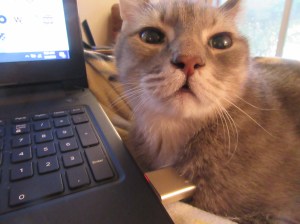
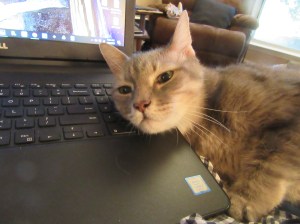
Here are two pictures of Ernest. In the first, he’s trying to damage a USB device.

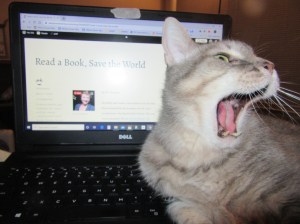
In the second, he’s pretending he’s not leaning on the keyboard while I’m reading K.P. Gresham‘s Ink-Stained Wretches post, “Read a Book, Save the World.” 

If you have—or haven’t—seen the movie Parasite, you’ll be interested in K.P.’s post.

1,188 Down; 2,812 to Go: #ROW80

Here’s my A Round of Words in 80 Days report for Wednesday, March 4. It’s currently Friday, March 6, but this is my Wednesday report.

Last Sunday, I reported that I had not added 1,000 words to my Work in Progress, and that, as a consequence, I would “have to add 1,333.3333333 words per week to meet my goal” of 4,000 new words by March 26, the end of #ROW80.

Well. On Monday, my powers were under a cloud, so I didn’t add anything to the WIP. On Tuesday, the cloud thickened into pea soup, and I didn’t add anything to anything. My body was slightly improved on Wednesday, but my brain was still mush, so the WIP remained unaltered.

Yesterday, however, I added 1,188 words.

They’re bad words, slapped down off the top of my head, thrown at the page, forming one big, glutinous lump as mushy as my brain. The literary equivalent of oatmeal.

That isn’t my usual process. I write slowly and usually get it almost right the first time. This thousand words will have to be kneaded and turned and completely transformed. Into oatmeal cookies, as it were.

I hate that.

But the WIP is longer than it was two days ago. Can’t complain about that.

The next goal:

a) add another 1,000 words to the WIP; OR,

b) rewrite the oatmeal.

On Sunday I’ll report which it is.

1,333.3333333 X 3 or 160 X 25: #ROW80

I’m running a little behind in my attempt to add 4,000 words to my WIP by March 26.

I didn’t add 1,000 words last week.

Which means I have twenty-five days in which to add the 4,000 words.

Calling that 3 weeks, and dividing 4,000 words by 3, I’ll have to add 1,333.3333333 words per week to meet my goal.

Calling it 25 days, and dividing 4,000 by 25, I’ll have to add 160 words per day.

If the math is wrong, please don’t tell me.

I tried to find a picture associated with goals but found nothing but goals associated with sports. So I’m displaying a picture associated with nothing at all.

A Harbinger of Spring & a Video Fest

Today we saw the first sign that spring is upon us.

It wasn’t a robin. It wasn’t a bluebonnet.

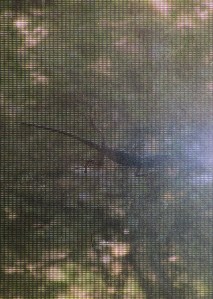
chameleon on screen 2/29/2020
Chameleon on window screen

It was a chameleon, the first one I’ve seen in years. Once, a zillion lived in my yard in Fentress, crawled across window screens, sneaked into a bedroom and blended into the leaf-patterned draperies, causing minor panic when discovered.

Then Ms, my Siamese cat, went on a lizard binge, causing more havoc. If you think it’s unsettling to see, without prior notice, a lizard running across the bedroom floor, try opening the door and finding one lying belly up, dead, often minus the skin of his soft underbelly, right where you were planning to plant your foot. I appreciated Ms’s thought, but the gift, not so much.

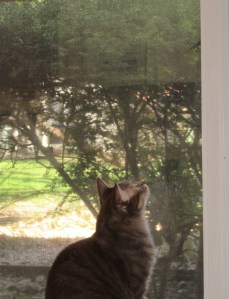
Ernest focusing on chameleon

Anyway—maybe because the chameleon population had been decimated, maybe because survivors got wise and relocated—by the early ’80s, they were gone.

They didn’t frequent our former apartment, either. But now that one has appeared outside the window at our new place, more will surely follow. I hope.

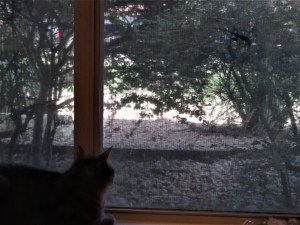
Ernest hopes so, too. He saw the visitor before I did, jumped onto the window sill, stood, and batted. Stood down, stood up, and batted. Again and again.

Ernest not looking at chameleon 2/29/2020
Ernest not focusing on chameleon

Watching a beloved pet hunt and not gather is heartrending, up to a point. Mostly it’s a grab-the-camera-and-holler-at-David-to-come-see moment. We focused on the scene as closely as Ernest focused on his prey.

The hunt ended when the lizard scooted eighteen inches to the right. Ernest lost him.  He lay down and stared out the window. David tapped on the window and pointed but failed to catch his attention.

A few minutes later, we abandoned him and headed downtown to the Violet Crown Theater for CatVideoFest—”a compilation reel of the best cat videos culled from countless hours of unique submissions and sourced animations, music videos, and, of course, classic internet powerhouses.”

Most were short-shorts, amateur cats being cats, filmed by their owners. A few were scripted. I’ve included links to two of those—”An Engineer’s Guide to Cats 2.0—The Sequel” and “Henri 2—Paw de Deux.” Cat lovers—crazy or not—have likely seen them online. Crazies might think they’re worth watching again.

Here’s a link to a list of theaters (nationwide) where you can view the movie. Today’s showing was the last in Austin, but if you’re elsewhere and interested, you can look it up.

CatVideoFest raises funds for “cats in need.” Part of the proceeds from the three Austin showings will go to Austin Pets Alive, an animal rescue and advocacy organization that fosters homeless animals and finds them forever homes.


Bonus: Chris the Story Reading Ape’s Blog with “Caturday Funnies”

Years ago, I closed my first blog, Whiskertips, because it had, against my will, become catcentric. The title was the only one I could think of that wasn’t already in use, and I’d just acquired William and Ernest (from APA) and so had cats on the brain. I suppose the name constituted a self-fulfilling prophecy.

I’ve vowed this blog will not fall into feline paws, but lately I’ve been walking a very fine line.

Why I (Don’t/Didn’t) Write #ROW80

Ernest felt fine when he woke this morning, but then he was unceremoniously hauled down to the vet’s for labs, blood draw, glucose and fructosamine, all that, and now he feels exposed, defenseless, in need of laptime. So that’s what he’s getting.

I didn’t want to work anyway.

*

Ernest having abandoned the keyboard for more interesting pursuits, I type unhindered.

I planned a brief statement about a cat and a keyboard, nothing else, but as Wednesday appears to have rolled around while my back was turned, I’ll add the #ROW80 report.

The goal I stated Sunday was to add 4,000 words to my WIP by March 26. Roughly 1,000 words per week—written and submitted to my critique group—would answer.

At five o’clock Monday morning, however, my body told my brain that I wasn’t going to add 1,000  words to anything, and my brain said my body was oh, so right about that.

On Tuesday, my body said I could add some words if I wanted, but my brain said Monday’s meltdown had been so demoralizing that it had no intention of contributing one independent thought, thank you very much.

In other words, I’m where I was on Sunday.

Except I’m really a little further back than that, because I just realized the post I prepared to link to my #ROW80 announcement—which I’d put up on the group blog Ink-Stained Wretcheswas never posted here at all. I didn’t click Publish. It’s been sitting here in draft form for three days, just sitting, waiting for something to happen that never happened. 

A lot like that proposed 1,000 words.

Well. Four more days in this week. Twenty-nine more days in the month.

See § 2, ¶ 3  above.

Onward and upwards, I guess.

*

He’s back.

Rejection of Things Past

Last week I posted the following to my Facebook timeline:

I learned last month—and only now have recovered enough to speak of it—that my story was not selected for inclusion in a collection I’d submitted to. The odds were high enough against me that, although the news affected me, it did not crush my spirit. I may, however, pretend it did so I’ll have an excuse for seeking out and indulging in a couple of pounds of serotonin-producing dark chocolate, plus a large box of sugar cubes to keep the bitterness of the chocolate from curdling my teeth.

So many friends responded with comments and emojis of such warmth and kindness that, in addition to thanking them—Thank you, friends—I feel I should add an update.

Update:

I did not seek out chocolate. For four whole days, I did not seek it out.

In fact, I forgot about it.

Forgot to seek. Forgot why I’d thought about seeking.

Forgot until today when David said, “What do you want from the grocery store?”

Oh, yes. “Chocolate.”

 “A Snickers?”

“No. Maybe a peanut butter cup . . . ”

Then, remembering that Easter is icumen in: “Or maybe a Cadbury egg. But,” I said, “one Cadbury egg won’t do.”

A single egg would have sent me flying across the green space in search of a follow-up.

Dependable and then some, David returned with five Cadbury eggs.

I ate one. Then I ate another.

Two eggs for rejection of things past.

The rest I’ll polish off tomorrow, as a kind of insurance against rejection of things future.

Lines That Shut Your Eyes


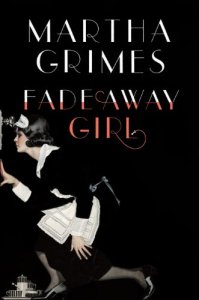
Twelve-year-old Emma Graham and elderly Mr. Root sit outside the grocery store in a little town in the mountains of Maryland, discussing poetry. From Martha Grimes’ Fadeaway Girl:

“What’s the poem, Mr. Root?”

. . . It was a paperback, not very thick. I saw it was the poetry of Robert Frost. “But I thought you didn’t like Robert Frost. You were all against ‘Stopping by Woods on a Snowy Evening.’ Remember?”

“That one, yeah. But he’s wrote a couple of good ones. I kind of put ’em in between Emily’s, you know, . . .”  Mr. Root cleared his throat and intoned in a sing-song fashion:

This saying good-by on the edge of the dark—

It shut my eyes, that line did, as sure as someone passing a hand over them. “Oh,” I said.

“What?”

“Nothing.”

He read on, although I was still back there on the edge of the dark.

Then he came to:

I wish I could promise to lie in the night
And think of an orchard’s ar-bo-re-al plight
When slowly (and nobody comes with a light)
Its heart sinks lower under the sod.

My eyes snapped shut again. I had never heard anything so fearfully sad. I bit my lip to keep from crying. I could almost see it, the trees too young to be left alone, waiting for someone or something to come, and finally knowing no one ever would.

“Yep,” said Mr. Root. “Some of his, well, I’d say he knows what he’s talking about. Straight talk. That’s what Frost was really good at, none of those namby-pamby poems about Greek urns and stuff. Nope”—he held up the book—”just plainspoken, to-the-point words about nature and stuff.”

“Mr. Root,” I said, “I don’t think he’s plainspoken. He means a lot more than what he seems to be saying.” . . .

Mr. Root pushed his feed cap back on his head and scratched his forehead. . . .

“What do you mean by that?” His eyes narrowed as if I were insulting him.

I didn’t want to talk about it; I don’t know why I had to open my big mouth. “Well, I think he means something different from what he’s saying. Or seems to be saying.” . . .

I asked Mr. Root if I could borrow the book for a minute, and he handed it to me.

“And could I have a piece of paper and use your pencil?”

He tore off a little sheet and handed that to me, too, along with his pencil. “Whatcha doin’?”

“Just copying.”

I wrote the last lines on the paper and folded it up and stuck it in my change purse.

***

Are there any lines of poetry or prose that shut your eyes?

For Valentine’s Day: John Anderson, My Jo

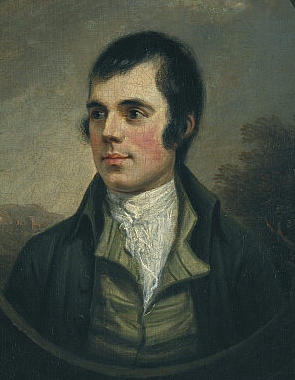
John Anderson, My Jo

Robert Burns

Song and glossary follow

https://upload.wikimedia.org/wikipedia/commons/f/fb/PG_1063Burns_Naysmithcrop.jpg
Portrait of Robert Burns, by Alexander Naysmith, 1787. Via Wikipedia. Public domain.

John Anderson, my jo, John
When we were first acquent;
Your locks were like the raven,
Your bonie brow was brent;
But now your brow is beld, John,
Your locks are like the snaw;
But blessings on your frosty pow,
John Anderson, my jo.

John Anderson, my jo, John,
We clamb the hill thegither;
And mony a cantie day, John,
We’ve had wi’ ane anither:
Now we maun totter down, John,
And hand in hand we’ll go,
And sleep thegither at the foot,
John Anderson, my jo.


Sung by Christy-Lyn


***

Meanings of most of the words from Scottish dialect are obvious, but here’s a glossary just in case.

jo-sweetheart
acquent-acquainted
bonny-beautiful
brent-polished new
beld-bald
snaw-snow
pow-head
thegither-together
cantie-great
one anither- together
maun totter down-must climb down

Fentress Society 1922: Maud and Carmen


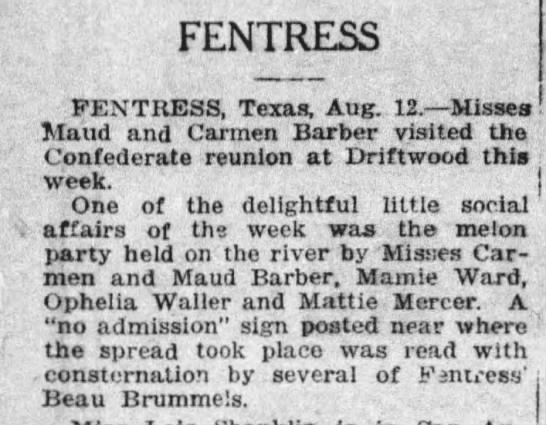
From the Austin Statesman, Sunday, August 13, 1922. “Out of Town Society.”


David and I were looking at images of Fentress, Texas—thank you, Google—when he said, “Maud and Carmen Barber.”

“Where?” I said. I get very excited when names I know crop up on the Internet.

In 1922, Fentress was in its heyday, larger and busier than it was when I arrived thirty years later, and its social events were reported in the Austin newspaper.

Here’s a little something extra:

Carmen Barber, who attended the Confederate reunion at Driftwood and co-hosted the melon party, was my father’s first cousin on his mother’s side. Among the the older of his twenty-seven Woodward cousins, she spent her married life, as Mrs. Jack Harper, in nearby Martindale, where she was one of my maternal grandmother’s best friends. When my parents married, she went with them to the Baptist preacher’s house in San Marcos to be a witness.

Ophelia Waller was my father’s first cousin on the Waller side—a total of sixteen cousins there. Married to Tom Ashworth, she lived most of her life in La Feria, Texas. She died there in 2011 at the age of one hundred six. At the time of the party, she would have been seventeen years old.

Mamie Ward (Day) was the daughter of W. F. “Dick” Ward, owner of the town’s ice cream parlor. She taught school in Refugio, Texas. I remember Miss Mamie well from her visits to Fentress during the summers. I contend that her family was the closest thing to royalty Fentress ever had, because of the huge double-dip nickel ice cream cones Dick sold there for close to fifty years. If you dropped yours while getting on your bicycle, he rushed back inside his shop and scooped you up a replacement cone for free.

That’s what I know about three of the girls at the melon party.

What I don’t know—and sincerely wish I did—is the identity of the Beau Brummells who were barred from the delightful little social affair. If I think hard enough, maybe I’ll come up with some possibilities.

Already Read 2020: January


You’ve seen those “How Many of These Books Have You Read?” quizzes that populate the Internet? You click on the titles and the little people inside the website tally them and tell you what percentage you’ve read. I’m sure their purpose is to make me feel inferior.*

Some do more than count. One calculated my age. Imagine my surprise/embarrassment/shame when I learned that, based on the number clicked, I’m in my twenties.

Boy, did they get that wrong.

But the fault is mine—I haven’t been reading much as I should.

To remedy that, on January 1, 2020, I resolved to read more** books.

###

Book Report

In January, I read the following:
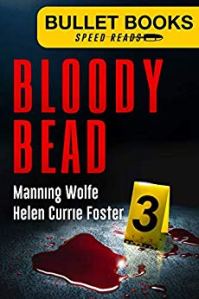
The Bloody Bead, co-written by Helen Currie Foster and Manning Wolfe, part of the Bullet Books Speed Reads*** collection. When sweet Miss Cherry goes missing, garbageman Juan Agosto reports his suspicions to his older sister, Teresa, a police officer. The investigation that follows provides a suspenseful read. And a fast one—like the other Bullet Books, it’s a novella, designed for busy people who want short reads. Or, for that matter, idle people who want short reads.

No spoilers here, but I will say there are some things Juan Agosto would prefer not to find in a garbage bin.

***
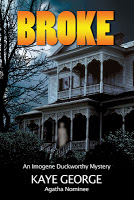
Broke,***** by Kaye George. In this third volume of the Immy Duckworthy series, wannabe private eye Immy moves out of the double-wide where she and her daughter, Nancy Drew, have been living with Immy’s mother, retired librarian Hortense.  The three-story house Immy rents—the one she can afford on what she earns as (real) PI Mike Mallet’s secretary—looks like it’s about to fall down, and some parts of it are. But it’s filled with antique furniture. Plus a room filled with dusty old books. Plus a ghost. Plus, on the third floor,  something that doesn’t belong there at all.

Immy’s policeman boyfriend, Ralph, is his same, dependable self, but the gorgeous Vance Valentin proves a formidable competitor, sort of. Also present are pet pig Marshmallow and Larry Bird, the vicious hen.

And then there’s the body.

***
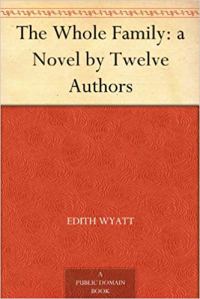
The Whole Family: A Novel by Twelve Authors, edited by Elizabeth Jordan. This collaborative novel, conceived by author and editor William Dean Howells, concerns the effect an engagement has on an entire family. The book comprises twelve chapters, each by a different author. Each chapter is written from the point of view of a different character. Chapter I, written by Howells, introduces Mr. Talbert, the father of the prospective bride, and alludes, briefly, to the others in his household. One of these is Mr. Talbert’s sister, described as “a lady of that age when ladies begin to be spoken of as maiden.”

Here’s where the fun begins.

Chapter II, entitled “The Old Maid Aunt,” was written by Mary E. Wilkins Freeman. Mrs. Freeman was forty-nine when she married a man seven years younger than she. One critic reports that Mrs. Freeman didn’t appreciate the phrase maiden lady, so she scrapped the stereotype.

The aunt she created is young, attractive, and vibrant. And she has a past—she and the prospective groom have recently engaged in a flirtation—or something. We don’t know exactly how serious the relationship was, but it was serious enough to make the visiting groom turn white when he sees her— and to catch the first train out of town. To complicate things further, the Talbert’s new neighbor had once threatened to shoot himself if the aunt wouldn’t marry him. Neighbor’s wife is not amused.

In other words, Mrs. Freeman hijacked the plot.

The rest is a romp, with each character—the bride, her mother, her grandmother, her teenage sister and pre-teen brother, her older brothers and their wives, the groom, and others—weighing in with their own descriptions of events, opinions of other characters, and plans to help fix things. There’s a lot to fix and they are oh, so helpful.

The Whole Family was published in 1908, so, compared to contemporary novels, it begins slowly. When the maiden aunt appears in Chapter II, however, things pick up considerably.

An Amazon note: One Amazon reviewer, who gave the book four stars, writes, “I would say they [the authors] did very well , except for one, who’s chapter was so rambling and unintelligible I had to just scan the paragraphs to get any sense out of it. But, all in all, it was a good book.”*****

My note: The “unintelligible” chapter was written by Henry James. With all due respect to Mr. James, don’t feel bad if you have trouble getting sense out of it. It’s been said that Mr. James “chewed more than he bit off.” (Attributed to Oscar Wilde, Mrs. Henry Adams, and the author’s brother William) All in all, it’s a good book.

#

* Important to consider when deciding how inferior to feel: Lists vary according to the whims and biases of the makers. Pride and Prejudice, Wuthering Heights, and Winnie the Pooh show up on all the lists I’ve examined. The Twits appears on just one.

** Goals and objectives should be quantifiable, and this one isn’t, but I’ll deal with that later. The way I’ve been going, more might mean three.

*** As I’ve mentioned before, numerous times, I co-wrote a Bullet Book, too. See the sidebar.

**** Read my review of Choke, the first Immy Duckworthy mystery, here.

***** I would link directly to the review, but when I do, an enormous picture of the book cover appears on this page.

###

The authors: Helen Currie Foster, Manning Wolfe, Kaye George, William Dean Howells, and Mary E. Wilkins Freeman

###

So that’s January. According to Kindle, I’m now 40% through Elizabeth George‘s A Banquet of Consequences.


What’s Literature For?


What good is literature? What’s it for? Why do we study it?

High school English students used to ask me that all the time.

I told them that reading novels and short stories, especially classics, would give them an edge on Jeopardy.

Today I’m going to tell the truth.

Once upon a time, the library I directed sponsored a scholarship contest for seniors going on to post-high school education—$100 for the best essay on the subject, “A Book That Changed My Life.”

One student wrote about Sylvia Plath’s The Bell Jar, an autobiographical novel about a young woman’s descent into depression. At her lowest point, she attempts suicide and is hospitalized. With treatment, her condition improves. The book ends with her preparing to have an interview to determine whether she can leave the hospital. It’s suggested that she will go on to live a normal life.

About The Bell Jar, the girl wrote that she had once seriously contemplated suicide. After reading the novel, however, she abandoned the thought and had hope for her future.

Another student wrote about Judy Blume’s Forever. Katherine, who is preparing for college, falls in love with Michael and begins a sexual relationship with him. They’re sure they’ll be together forever. Later, Katherine becomes attracted to another boy. She sees that her relationship with Michael is limiting. She breaks up with him. She realizes that she can get over the break-up and knows she will go on to have other relationships in the future.

Disclaimer: I believe that teenagers should be allowed to read widely. I believe teens are capable of reading at a deeper level than many adults give them credit for. But when I read Forever in a graduate course in library school, I was horrified. The sex scenes are graphic, and the protagonist’s main concern is her sex life. No, no, absolutely not.

Then I read the girl’s essay. What she took from the novel: “I love my boyfriend, but I learned I have to be responsible for myself, and not depend on somebody else to take care of me. I carry the book in my purse all the time,” she wrote.

Wow.

One novel convinces a teenage girl not to commit suicide; another shows a girl that she must be responsible for herself.

So what is literature for?

For that.

I apologize for being flippant. The next time I’m asked what literature is for, I’m going to be serious.

Literature has nothing to do with Jeopardy.

Literature is for life.


Rules for Writers

The following is a guest post I wrote for the Bullet Books Speed Readsblog. In it I explain what an author does when she discovers she doesn’t have a clue about what she’s writing about. I also include a link to a book trailer, but you have to read to the end of the post to find that.

***

There are many rules for writers. Two of the major ones: Write what you know and write what you love.

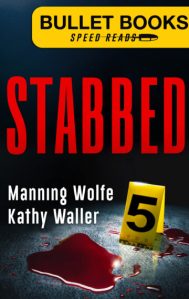
I was pleased that Stabbed, which I co-wrote with Manning Wolfe, was set in Vermont. I love vacationing there: mountains and trees, summer wildflowers and narrow, winding roads, rainstorms and starry nights, white frame churches and village greens.

In Chapter 1, Dr. Blair Cassidy, professor of English, arrives home one dark and stormy night, walks onto her front porch, and trips and falls over the body of her boss, Dr. Justin Capaldi. She jumps back into her car and calls the sheriff. The sheriff arrives and . . .

What happens next? Who takes charge of the investigation? The sheriff? Or the state police? What do their uniforms look like? Where do rail lines run? What’s the size of a typical university town? And a typical university? And several other details not gathered during a typical vacation.

I didn’t know, so, new rule: Write what you learn. Research. Research. Research. The best mystery authors have been avid researchers.

Agatha Christie, for example, is known for her extensive knowledge of poisons. As a pharmacy technician during World War I, she did most of her research on the job before she became a novelist. Later she dispatched victims with arsenic, strychnine, cyanide, digitalis, belladonna, morphine, phosphorus, veronal (sleeping pills), hemlock, and ricin (never before used in a murder mystery). In The Pale Horse, she used the less commonly known thallium. Christie’s accurate treatment of strychnine was mentioned in a review in the Pharmaceutical Journal.

Francis Iles’ use of a bacterium was integral to the plot in Malice Aforethought. His character, Dr. Bickleigh, serves guests sandwiches of meat paste laced with Clostridium botulinum and waits for them to develop botulism. If Dr. Bickleigh had been as knowledgeable about poisons as his creator, he wouldn’t have been so surprised with the consequences.
Among modern authors, P.D. James is known for accuracy. Colleague Ruth Rendell said that James “always took enormous pains to be accurate and research her work with the greatest attention.” Before setting Devices and Desires near a nuclear power station, she visited power plants in England; she even wore a protective suit to stand over a nuclear reactor. Like Christie, James used information acquired on the job—she wrote her early works during her nineteen years with the National Health Service—for mysteries set in hospitals.

Most authors don’t go as far as standing over nuclear reactors in an attempt to get it right, but sometimes even the simplest research is time-consuming. And, even the most meticulous researchers make errors.

Dorothy L. Sayers was as careful in her fiction as she was in her scholarly writing. But she confessed in a magazine article that The Documents in the Case contained a “first-class howler”: A character dies from eating the mushroom Amanita muscaria, which contains the toxin muscarine. Describing the chemical properties of muscarine, Sayers said it can twist a ray of polarized light. But only the synthetic form can do that—the poison contained in the mushroom can’t.

Most readers don’t forgive big mistakes. And why should they? Thorough research is a mark of respect for readers. And sometimes, getting the facts straight in fiction has consequences the author can’t predict. Christie’s The Pale Horse is credited with saving two lives: In one case, a reader recognized the symptoms of thallium poisoning Christie had described and saved a woman whose husband was slowly poisoning her; in the second, a nurse who’d read the book diagnosed thallium poisoning in an infant. The novel also credited with the apprehension of one would-be poisoner.

As to Stabbed—Well, we don’t expect it to save lives or help catch criminals. I knew Vermont, but I didn’t know Vermont criminal procedure. Now, readers will come out knowing what the uniform of the Vermont State Police looks like and what happens at a courtroom arraignment.

And choosing the murder weapon was easy. We considered the book’s title and – well, d’oh – no more research was required.

***

More about Stabbed: http://bulletbooksspeedreads.com/book/stabbed/

Book trailer for Stabbed: https://youtu.be/URDtnyRvfq0


Reviews of Several Movies, One of Which I’ve Seen


I didn’t sleep well last night and as a result am as dumb as a box of rocks today. My husband came home with a “temporary” flip phone to replace the flip phone I lost (I think it’s really Under Something), and I told him I had to keep my phone number because I’m incapable of remembering any new numbers, even when I get plenty of sleep. It’ll take several hours to two business days for them to arrange for the new number.* I also have to think carefully before saying or writing my new address. I scramble the numbers. Anyway, this may turn out to be a disjointed post, but it won’t be the first.

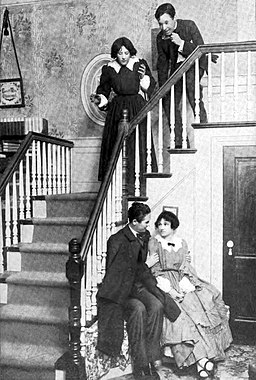
Scene from the 1912 Broadway production of Little Women, adapted by Marian de Forest. Via Wikipedia. Public domain.

David and I saw the latest adaptation of Little Women two weeks ago. I’d read glowing reviews but had also heard some viewers are conflicted, haven’t decided what to think.

I loved it. Absolutely loved it.

I’m embarrassed, sort of, to admit I’ve never read the book. I’ve skimmed it. But, as high school freshmen say, I saw the movie—the one made in the ’90s, and I loved it, too. I’ve also seen the version in which Katherine Hepburn played Jo. And the series aired on PBS a couple of years ago.

I’ve read three or four of Alcott’s other novels. In the sixth grade, I read Alcott’s Eight Cousins–and recently found the book report I did on it–and its sequel, Rose in Bloom. The latter was very affecting; I cried when that poor young man died in an alcohol-induced accident, but that’s what happens to young men who’ve been spoilt by their mothers and as a result are wild and even their Cousin Rose can’t reform them. Rose then fell in love with her medical doctor Cousin Mac, whom she’d always thought of as “the worm”; that’s what happens to women in novels of that period. I think Mac was a doctor. Or a medical student. He was Serious and Responsible. So was Rose.

At the end of Little Women, Alcott marries Jo to a teacher and scholar, as the director does at the end of the movie—hurrah for faithful adaptations—but the movie makes clear that Jo did so reluctantly. The director allows viewers to infer that Alcott was just as reluctant. But she wanted the book to sell, and the public wouldn’t have accepted a spinster who goes to New York to publish or perish.

A documentary that aired a few years ago on PBS includes the reading of a letter Alcott wrote refusing a proposal of marriage. It was hilarious. I’m glad I wasn’t the would-be groom who received it.

The movie’s one flaw is that the story is not told in chronological order. I think the format works perfectly. But the movie jumps back and forth in time without adequate transition from scene to scene. Viewers unfamiliar with the story might have trouble following along.

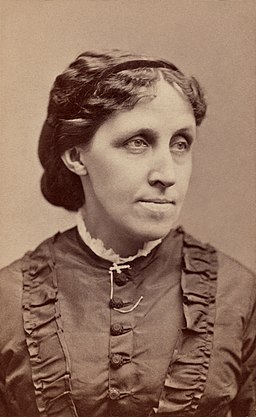
Louisa May Alcott, ca. 1870. Via Wikipedia. Public domain.

I also have a concern about the script, which applies to all the LW feature films I’ve seen—the characterization of Marmee. In this movie and the one made in the ’90s, she’s depicted as a cheerful, youthful feminist, neatly and attractively dressed, rather perky. In the PBS series, she looks older, as if she’s raising four daughters on a tight budget, with a husband away at war, and a seriously ill daughter, and mid-19th century housework that affords no time for idleness. She’s happy, but not perky, and she often looks tired. “Housekeeping,” wrote Louisa May Alcott, “ain’t no joke.” She knew. At one point, while her impractical philosopher father discussed and wrote about ideas, his wife and daughter worked as domestics.

When David and I got to the ticket window, we were told there were only three seats available, first row. We took the two on the far aisle. I hadn’t sat on the front row since I saw Toby Tyler when I was nine. Fortunately, the seats reclined, so I didn’t get a crick in my neck from looking up at an 88-degree angle. There were four people, including David and me, on the front row, the other two on the opposite aisle. At least half of the reserved seats were empty.

David commented afterward that there weren’t many young(er) people in the audience. No, the majority had gray hair, or at least visible wrinkles. Post-Boomers don’t know, or want to know, I guess, about Little Women. It’s all Game of Thrones, or whatever. Since retiring and losing the school’s subscription to Booklist, I don’t know anything about recent publications. My latest read was written in 1908. It was delightful. More about that later.

The other movie—there was a trailer—was a new Dr. Doolittle. It’s a 2020 adaptation. I think Robert Downey, Jr. is as cute as a bug, but I’ll skip this one. There’s so much noise (chaos) I couldn’t hear the animals talk, except for one little bear, or something, lying on his back and crying, “I’m too pitiful to die.” I think that was what he said. He was on board a ship in a terrible storm on the open sea.

I once cried something like that when I was on board a cruise ship in choppy waters. Nine other relatives and me, celebrating Thanksgiving in style. First night out, a norther hit. The next morning, when I phoned for someone to come attend to the carpet, the man in housekeeping, or whatever they call it, said, “You bomited in your room?” Yes, I bomited in my room. Which was better than the rest of the revelers, who were bomiting in the halls. That afternoon, they had to give me an injection of phenergan and pills to take every three hours, after which, because I was blissfully unconscious, I stopped wailing to my travel-agent cousin/roommate, who that morning had brought me a Sprite and abandoned me to my fate, “I’m going home. When we find land, you get me a plane ticket or I’ll walk home.”** The next day, we walked to the market in Cozumel and I bought some earrings.

Well, sorry for the disgusting story, but when I saw that poor little bear, that’s what I thought about. He might have just been afraid, but I suspect he was plain old seasick.***

###

*It might be a burner phone, which will come handy for research when I put one in a mystery, or if I myself decide to do  something untoward.

**Her leaving was heartless but for the best. An optimist, she kept saying I would be fine tomorrow and I was not going home. Mal de mer is misery enough. Victims do not need the added affliction of cheerful healthy people.

***Those patches work. The next cruise, I went prepared.