
The star of Christmas shines for all,
No matter big, no matter small,
No matter spotted, black, or white,
It calls us all to share the light.


***
Author unknown.
~ Telling the Truth, Mainly
The star of Christmas shines for all,
No matter big, no matter small,
No matter spotted, black, or white,
It calls us all to share the light.
Author unknown.
Posted on Whiskertips, December 24, 2009, when William and Ernest were still young adults.

If you read my earlier post, our Christmas tree
has been the subject of intense, but not unexpected, conflict.
As soon as the tree lit up, so did William and Ernest.
William had to be physically restrained from chewing on the lights.
The next morning Kathy found the tree lying on its side and the cats out of sight.
The tree spent the day en deshabille, as it were.

After lengthy trilateral negotiations, a compromise was reached.
Ornaments and tree skirt are, of course, out of the question.
Gifts will appear Christmas morning immediately before they’re to be opened.

After Ernest began eating everything he found interesting–
thread, twine, string, ribbon, “elongated things,” the veterinarian said–
and his health care became repeatedly expensive,
David and Kathy decided Christmas tree needles shouldn’t be allowed in the house.
David bought a small artificial tree complete with lights and set it on a chair.
William supervised setup and checked for stability.


A certain instability was discovered, but William said Ernest was at fault.
Ernest said, “Liar, liar, pants on fire.”
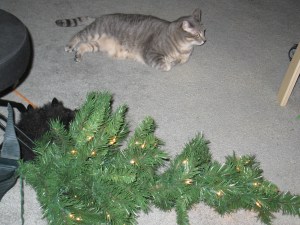
Since then, however, nothing untoward has occurred.
William continues to keep watch.
In 2018, gifts still appear Christmas morning immediately before they’re to be opened.
Note: The black thing William is lying on started as my bearfoot slipper
but soon became a soft, squishy thing for William to make biscuits on.
Another note: I don’t think my cats are cuter
than other people’s children and grandchildren,
but I don’t have children or grandchildren,
so William and Ernest get their pictures broadcast worldwide.
Christmas Night, and all through the house, one person and two cats are sleeping all snug in their beds, while I’m sitting here watching Apollo 13 and a lava lamp.
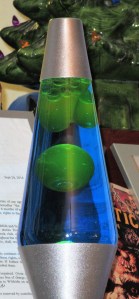
This is my first lava lamp. I skipped the ’70s. David said it’s his first lava lamp, too. He was present for the ’70s but skipped some of the trappings.
The lamp is fascinating: like a kaleidoscope but with fewer colors and curved edges.
We had a quiet day, one of our traditional nonstandard Christmases. We opened gifts, ate a light breakfast, and sat around.
Then we repaired to Saffron Restaurant, which serves an eclectic mixture of traditional Indian Cuisine punctuated by the flavors of the Himalayas. Goat curry, chicken tikka masala, tandoori chicken, steamed basmati rice, naan… and several things I can’t name because instead of wearing my glasses to the buffet, I left them on the table.
After lunch we came back home, plugged in the lava lamp, and waited for it to erupt. It did not disappoint.
Of course, we took the obligatory photos of the children with gifts under the traditional nonstandard Christmas tree. Changes in living room geography kept us from giving our real artificial tree center stage, so this morning we moved our ceramic artificial tree to a snow-covered chair and accorded it official status.
Facebook reminded me that four years ago, I found these bear foot slippers under the tree. They were the warmest slippers ever. A week later, William sat down and started making biscuits on them. Now they’re called William’s shoes.
It’s now past midnight. Christmas Day is over. Time to turn off the lava lamp and sleep snug in my bed and dream of goat curry and naan. Which, come to think of it, would make a fine traditional nonstandard New Year’s Day lunch.
Posted on Whiskertips, December 10, 2009, when William and Ernest were young adults.

Last night David strung lights on Christmas tree.
William began gnawing on lights.
Kathy went bananas, envisioning surgery
to pick shards out of William’s GI tract.
William said he didn’t care. Ernest said he didn’t care either.
David distracted William and Ernest.
This morning Kathy picked up tree, sopped up water,
dragged lights to higher altitude, considered going back to bed.
Kathy regrets she didn’t get a shot of tree lying on its side,
blocking entrance to kitchen.
William and Ernest said if Kathy had gotten up and fed them
the first time they pounced on her,
she wouldn’t be sitting here now, thinking about dragging tree to dumpster.

THE ROAD TO BETHLEHEM
If as Herod, we fill our lives with things and again things;
If we consider ourselves so important that we must fill
Every moment of our lives with action;
When will we have the time to make the long slow journey
Across the burning desert as did the Magi;
Or sit and watch the stars as did the shepherds;
Or to brood over the coming of the Child as did Mary?
For each one of us there is a desert to travel,
A star to discover,
And a being within ourselves to bring to life.
~ Author Unknown

“The Road to Bethlehem” appears on other websites, where it’s attributed to Anonymous. If you know who wrote it, please share the name and, if possible, other documentation, in a comment, so I can give the poet credit for his creation and can search for information about copyright. Until I know more, I will assume the poem is in the public domain.
Find “The Road to Bethlehem” on these pages:
http://macrina-underthesycamoretree.blogspot.com/2009/12/desert-star-emerging-life.html
http://blueeyedennis-siempre.blogspot.com/2010/11/advent-prayer-and-poems-i.html
The star of Christmas shines for all,
No matter great, no matter small,
No matter spotted, brown or white,
It bids us all to share the light.
~ Unknown
![Two Rabbits (Kobi). By Kobi (active 19th century) (http://www.hwwilson.com/Databases/artmuseum.htm) [Public domain], via Wikimedia Commons](http://commons.wikipedia.org/wiki/File:Two_Rabbits_%28Kobi%29.jpg "Two Rabbits (Kobi)")
In an Atlanta gift shop, on the last road trip my mother and I took together, I bought a packet of Christmas cards designed by a local artist. In the background on the front, there was a star; in the foreground, there were three rabbits–brown, white, and black-and-white. The verse above appeared inside. The design was simple, unsentimental, and touching.
I used all but one of the cards, and kept that one thinking I might be able to find more. But I couldn’t, and sometime over the past twenty-eight years, the last card disappeared. I hope I’ve quoted the verse exactly. The image above doesn’t duplicate the charm of the original, but perhaps it’s close.
I’ve searched the web for the name of the artist-poet but have found nothing. If anyone reading this knows the artist or has seen the card I’ve described, please leave a comment. I would like to give proper attribution. If possible I will contact the author to ask permission to use it; if he wishes, I’ll remove the post. (Note: A friend pointed me to the website of Michael Podesta. I suspect the card might be one of his.)
I don’t usually post anything without getting permission and crediting the author, but I love the card and it seems a shame not to share.


We’re watching, one more time, It’s a Wonderful Life. Clarence Oddbody, AS2 (Angel Second Class), aka Henry Travers, is showing George Bailey, aka James Stewart, how his hometown would look if George had never been born.
In a couple of minutes, George will learn that, because he never existed, his wife, Mary, aka Donna Reed, not only never married, but became a librarian. Judging from her granny glasses, frumpy hat, and bun, that’s a fate worse than death.
I like It’s a Wonderful Life, but it isn’t my favorite Christmas movie. I prefer Miracle on 34th Street, in which Edmund Gwenn–whom I rank right up there with Henry Travers–is declared, in court, to be the real Santa Claus. No librarians were defamed in the making of that show.
Nevertheless, as soon as half the town crowds into the Bailey living room to pile money onto the table, I start to cry. I cry through the credits and the next three commercials. Even a not-favorite movie can stir emotions. Year after year after year.
Favorites aren’t easy for me. I don’t have a favorite novel or a favorite song or a favorite color. Or a favorite teacher, actor, or pet. I have multiple favorites. For me, those get-your-password questions–“What is your favorite television show?”–are useless. I never remember whether I said Andy Griffith or Law and Order or I’ll Fly Away.
I do, however, have a favorite Christmas carol. The melody is lovely and singable–singable is important to me–but it’s the words that move me. They speak of peace and quiet and rest for the weary, of heavenly song floating above earthly babble. They speak of ancient tidings of peace to one small group of men, and of a promise of a world in complete harmony.
But the lyrics also speak of the present, of stopping, and looking up, and seeing angels. They’re there now, and they’re singing.
We have only to be still and listen.
*
It came upon the midnight clear,
that glorious song of old,
from angels bending near the earth
to touch their harps of gold:
“Peace on the earth, good will to men,
from heaven’s all-gracious King.”
The world in solemn stillness lay,
to hear the angels sing.
Still through the cloven skies they come
with peaceful wings unfurled,
and still their heavenly music floats
o’er all the weary world;
above its sad and lowly plains,
they bend on hovering wing,
and ever o’er its Babel sounds
the blessed angels sing.
Yet with the woes of sin and strife
The world has suffered long;
Beneath the angel-strain have rolled
Two thousand years of wrong;
And man, at war with man, hears not
The love-song which they bring;
O hush the noise, ye men of strife,
And hear the angels sing.
And ye, beneath life’s crushing load,
whose forms are bending low,
who toil along the climbing way
with painful steps and slow,
look now! for glad and golden hours
come swiftly on the wing.
O rest beside the weary road,
and hear the angels sing!
For lo! the days are hastening on,
by prophet seen of old,
when with the ever-circling years
shall come the time foretold
when peace shall over all the earth
its ancient splendors fling,
and the whole world send back the song
which now the angels sing.
*****
From Wikipedia:
“‘It Came Upon the Midnight Clear” (1849) — sometimes rendered as ‘It Came Upon a Midnight Clear’ — is a poem and Christmas carol written by Edmund Sears, pastor of the Unitarian Church in Wayland, Massachusetts. Sears’ lyrics are most commonly set to one of two melodies: ‘Carol,’ composed by Richard Storrs Willis, or ‘Noel,’ adapted from an English melody.
“Edmund Sears composed the five-stanza poem in Common Metre Doubled during 1849. It first appeared on December 29, 1849, in the Christian Register in Boston. Sears is said to have written these words at the request of his friend, William Parsons Lunt, pastor of United First Parish Church, Quincy, Massachusetts.”
*****
Reposted from December 25, 2010
Related Articles

How did NORAD become the official Santa Tracker?
The children of Col. Harry Shoup told the story on a recent episode of Morning Edition’s Storycorps on National Public Radio.
During the Cold War, the colonel was commander of the Continental Air Defense Command (now NORAD). In case of an attack on the United States, he would have been the first to receive word.
Colonel Shoup was at his desk that day in 1955 when NORAD assumed the task of following the progress of Santa’s sleigh. But the new responsibility wasn’t ordered by President Eisenhower or any of the colonel’s military superiors.
The job resulted from a typographical error–one little mistake whose happy consequences are still being felt nearly sixty years later.

And follow the Santa Tracker Countdown:
1 d, 5 h, 52 m, and 10 s–the last time I checked
From the Storycorps website:
“StoryCorps is a national nonprofit that gives people the chance to interview friends and loved ones about their lives. These conversations are archived at the American Folklife Center at the Library of Congress, allowing participants to leave a legacy for future generations. Learn more, including how to interview someone in your life, at StoryCorps.org.”
From the Storycorps website:
“The StoryCorps MobileBooth will be in Austin, TX, January 5 to January 30, 2015. Make a reservation today!
“Si desea hacer una reservación en españ ol o necesita más información, por favor llame al 800-850-4406, las 24 horas al día, los 7 días de la semana.
Thanks to author Craig Johnson for sharing the link to the story about the NORAD Santa Tracker on his Facebook Author’s page.
THE ROAD TO BETHLEHEM
If as Herod, we fill our lives with things and again things;
If we consider ourselves so important that we must fill
Every moment of our lives with action;
When will we have the time to make the long slow journey
Across the burning desert as did the Magi;
Or sit and watch the stars as did the shepherds;
Or to brood over the coming of the Child as did Mary?
For each one of us there is a desert to travel,
A star to discover,
And a being within ourselves to bring to life.
~ Author Unknown
I read “The Road to Bethlehem” online and saved a copy of the poem but not the URL of the website where I found it. The poem was attributed to Anonymous, and I haven’t been able to find the author’s name. If you know who wrote it, please send the name and, if possible, other documentation in a comment, so I can give the poet credit for his creation and can seek information about copyright. Until I know more, I will assume the poem is in the public domain.
In an Atlanta gift shop, on the last road trip my mother and I took together, I bought a packet of Christmas cards designed by a local artist. In the background on the front, there was a star; in the foreground, there were three rabbits–brown, white, and black-and-white. The verse above appeared inside. The design was simple, unsentimental, but touching.
I sent all of the cards but one, and I kept that thinking I might be able to locate more. But I didn’t find any, and sometime over the past twenty-seven years, the card I saved disappeared. I don’t remember the artist’s name, but I do remember the verse. The drawing above doesn’t duplicate the charm of the original, but perhaps it’s close enough.
I’ve searched the web trying to find the name of the artist-poet but have found nothing. If anyone reading this knows the author, or has seen the card I’ve described, please leave a comment. I would like to give proper attribution.
I don’t normally post anything without giving credit, but I love the card and it seemed a shame not to share the verse just because I can’t locate the source.

As you know if you saw our last post, our Christmas tree has been the subject of intense, but not unexpected, conflict.
As soon as the tree lit up, so did William and Ernest. William had to be physically restrained from chewing on the lights.
The next morning found the tree lying on its side and the cats out of sight. The tree spent the day en deshabille, as it were.

After lengthy trilateral negotiations, a compromise was reached.
Ornaments and tree skirt are, of course, out of the question.
Gifts will appear Christmas morning immediately before they’re to be opened.
Compromise
*****
Featured image by SDRandCo via morguefile.com


Last night David strung lights on Christmas tree.
William began gnawing on lights.
Kathy went bananas, envisioning surgery to pick shards out of William’s GI tract.
William said he didn’t care.
Ernest said he didn’t care either.
David distracted William and Ernest.
This morning Kathy picked up tree, sopped up water, dragged lights to higher elevation, considered going back to bed.
Kathy regrets she didn’t get a shot of tree lying on its side, blocking entrance to kitchen.
William and Ernest said if Kathy had gotten up and fed them the first time they pounced on her, she wouldn’t be sitting here now, thinking about dragging tree to dumpster.

This post first appeared on Whiskertips, December 10, 2010
 At Christmas play and make good cheer
For Christmas comes but once a year.
~ Thomas Tusse
David and I met friends Geoff and Emme at the Root Cellar yesterday morning for a belated Christmas breakfast. Our plan for a Christmas-David’s Birthday-New Year’s dinner in December fell through when both Emme and I came down with whatever people get at this time of year and we had to cancel.
The breakfast worked out better, however, because we dressed less formally (if such a thing be possible) and because I didn’t have to make a salad.
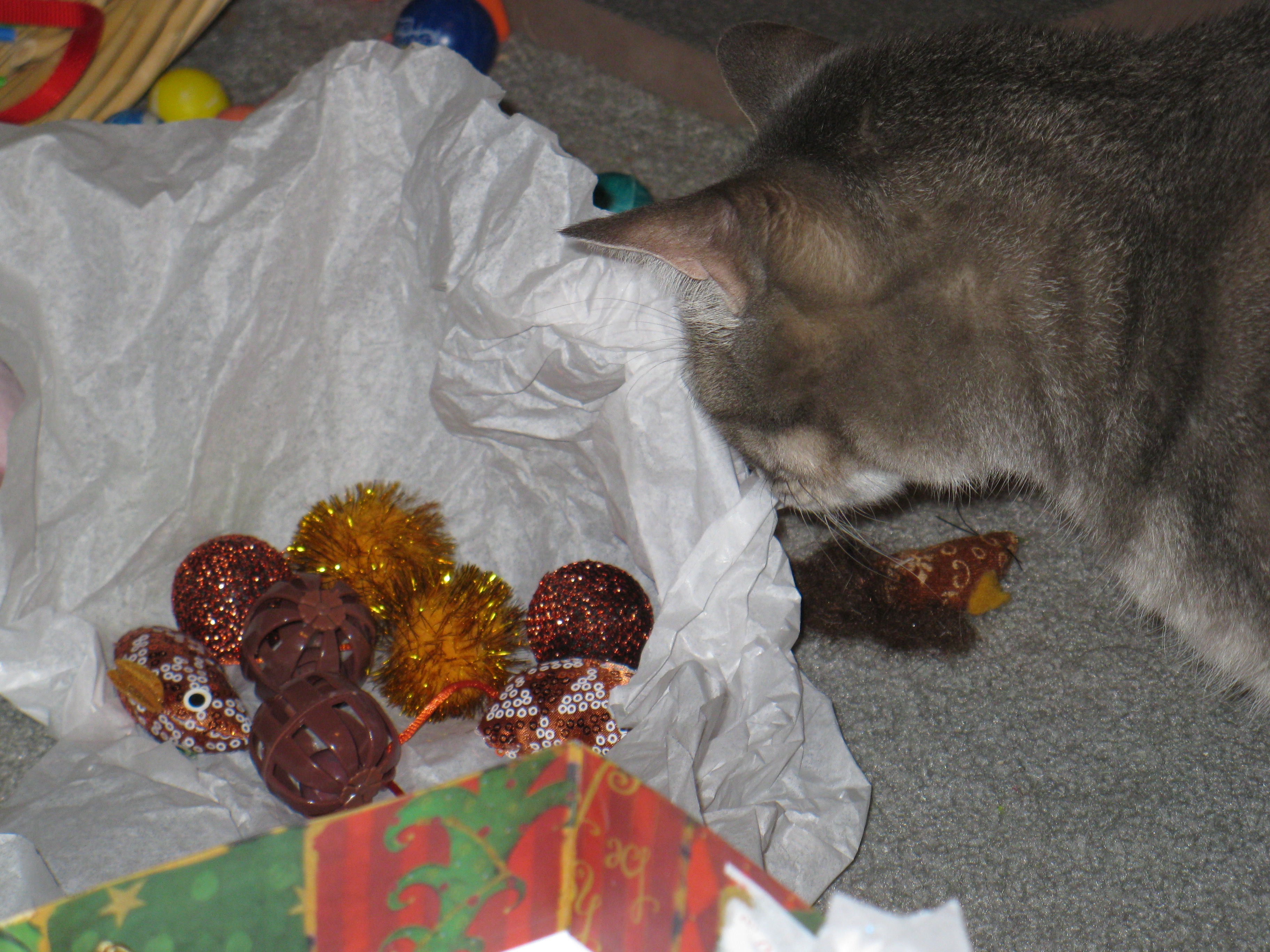
The gift exchange comprised books, homemade granola, a kazoo, cute little plastic thingeys to bind cords and cables, and a Christmas ornament.
The best, however, were the gifts exchanged by the cats and Geoff and Emme’s dogs, Tuck and Abbey. Tuck and Abbey received toys best described as big blue squeaking Scrubbing Bubbles covered with jiggly cilia. I would describe Tuck and Abbey, but I can’t do them justice, except to say that if you turn your back and walk away from Abbey, you’ll never do it again. More info in the form of photos will be provided at a later date.
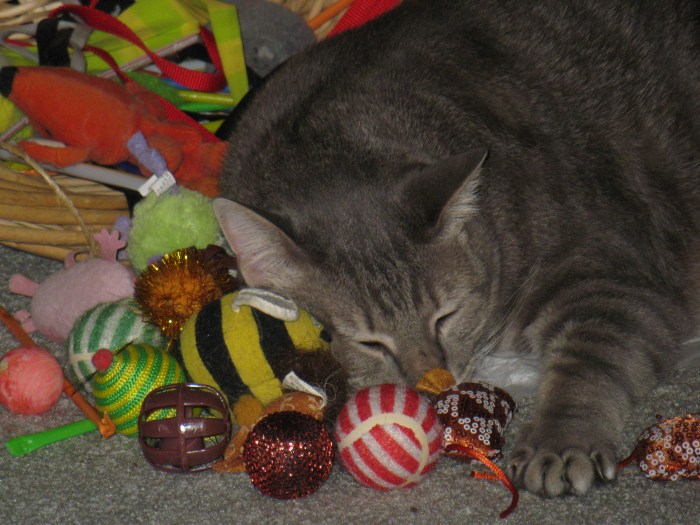
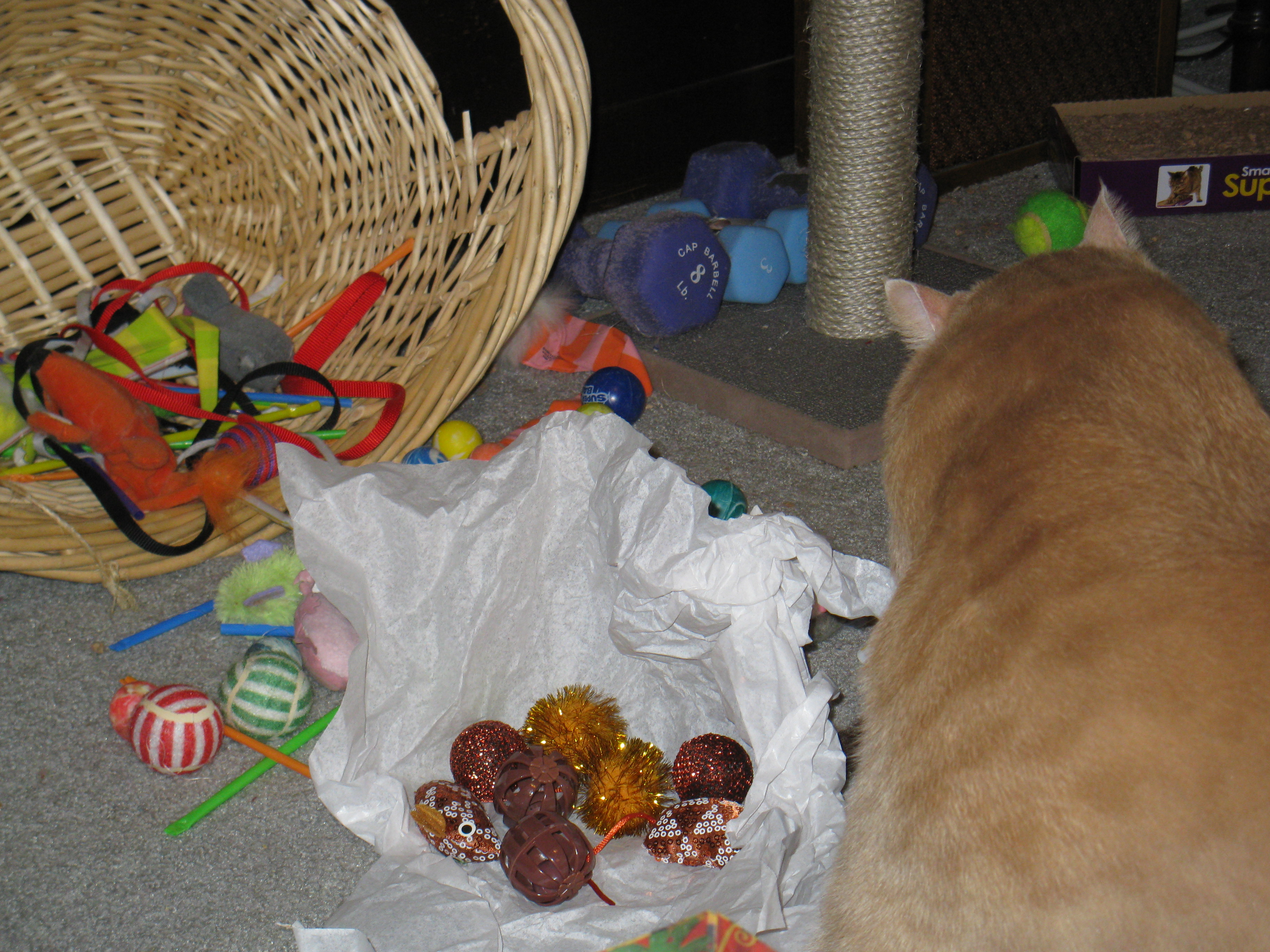
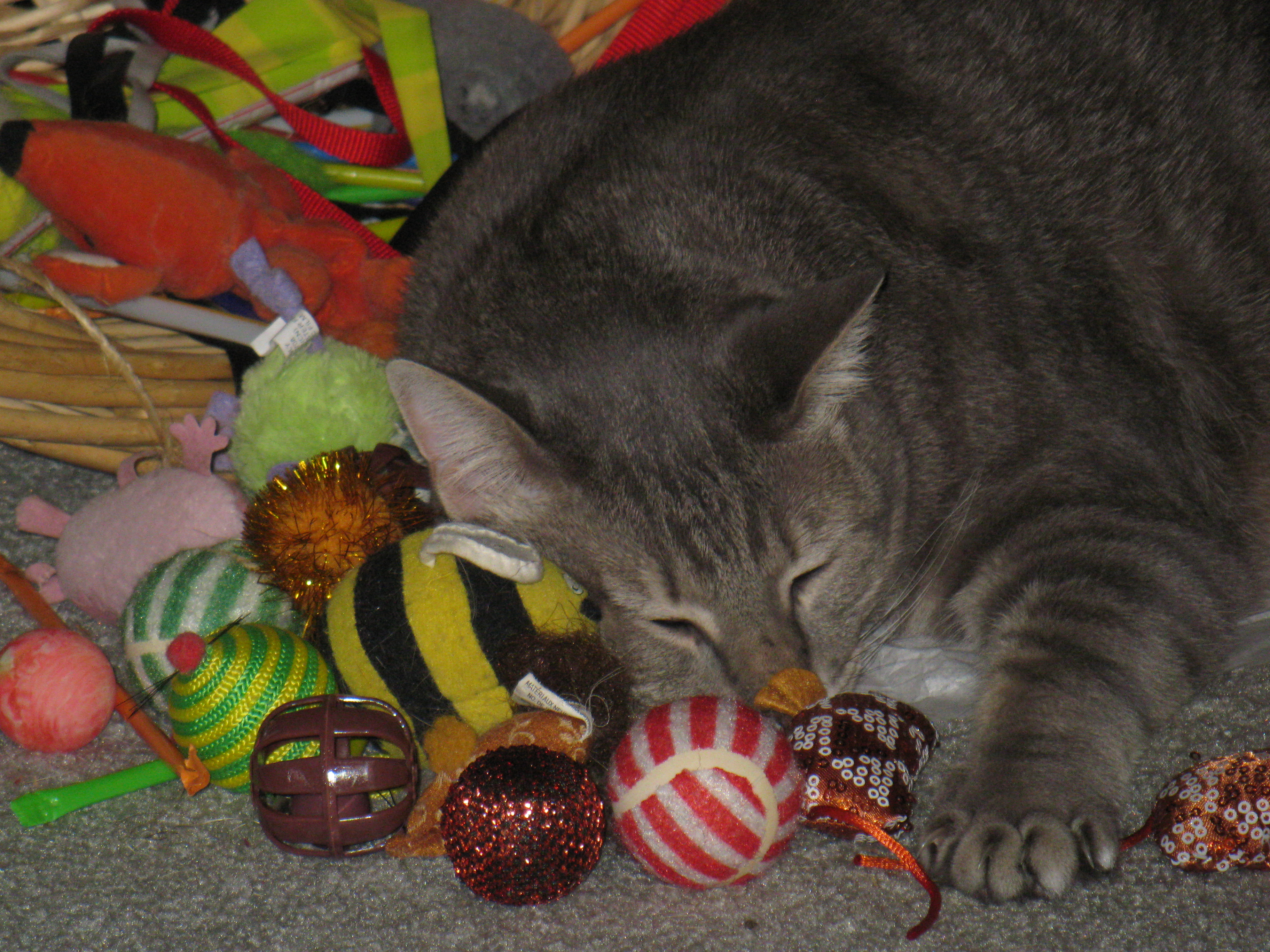
Ernest and William hit the jackpot. They received fancy sequined mice and a variety of balls, most with noisemakers–jingle, rattle, clack–inside. In little more than twenty-four hours, half the balls have disappeared.
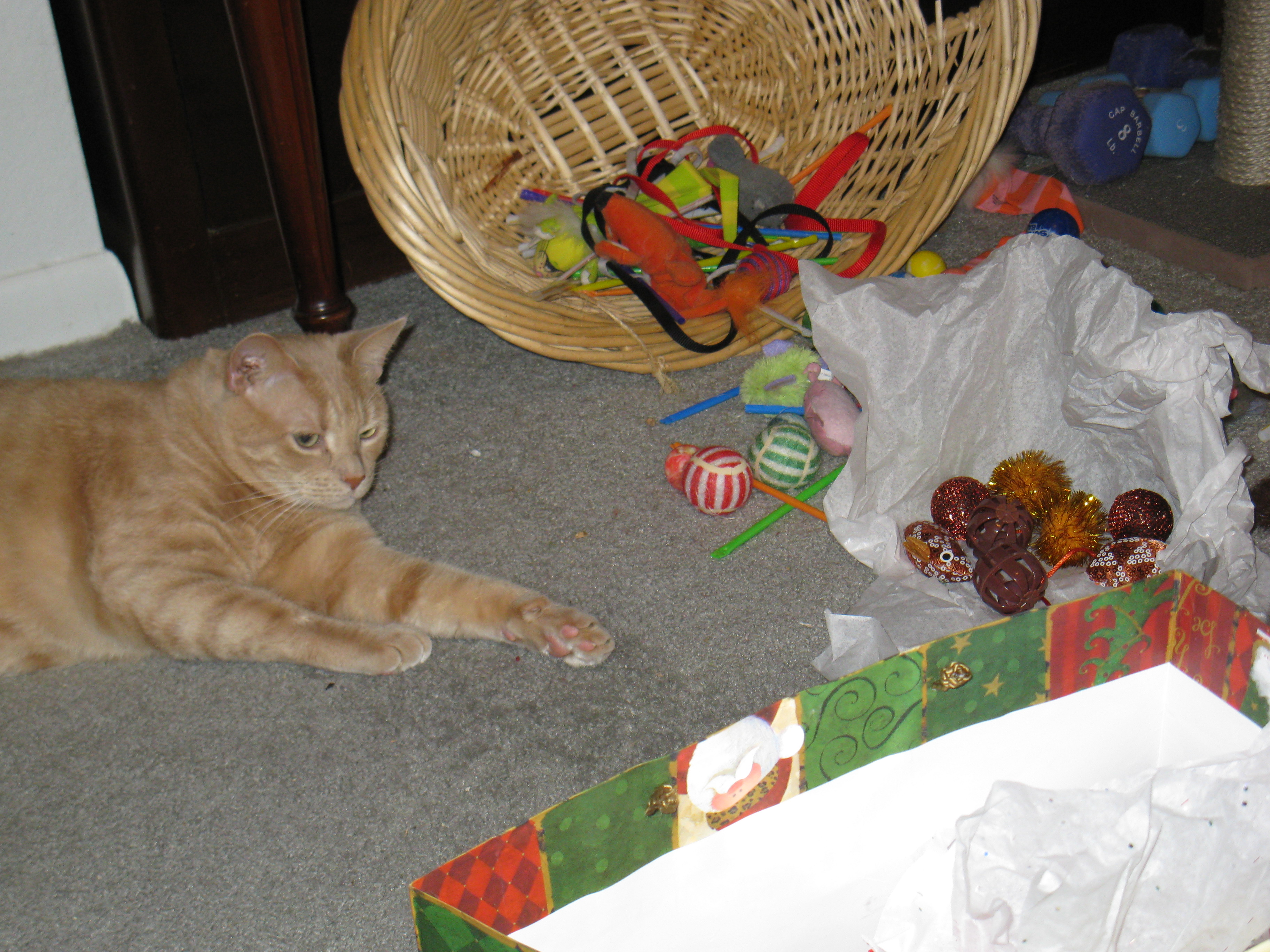
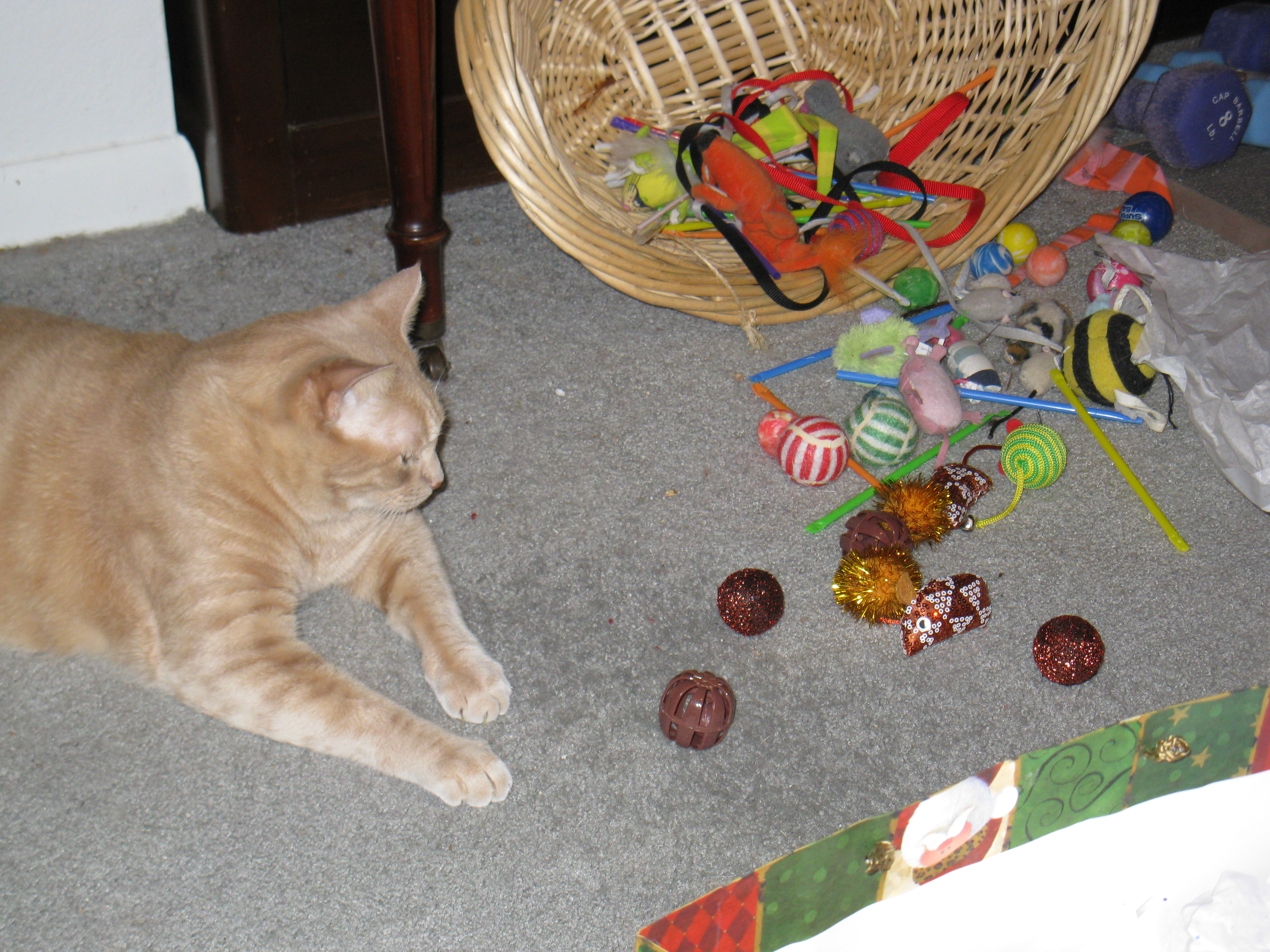
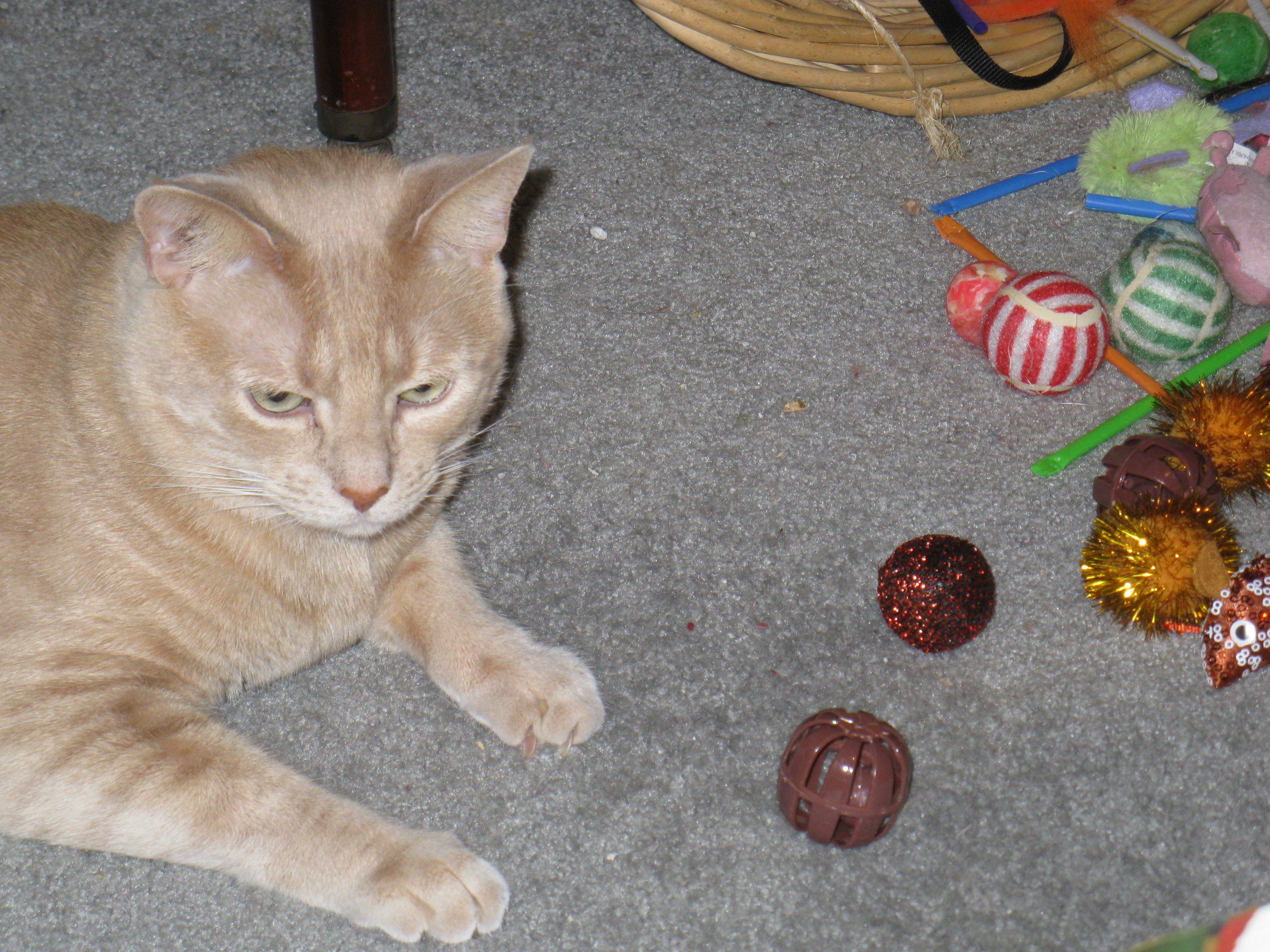
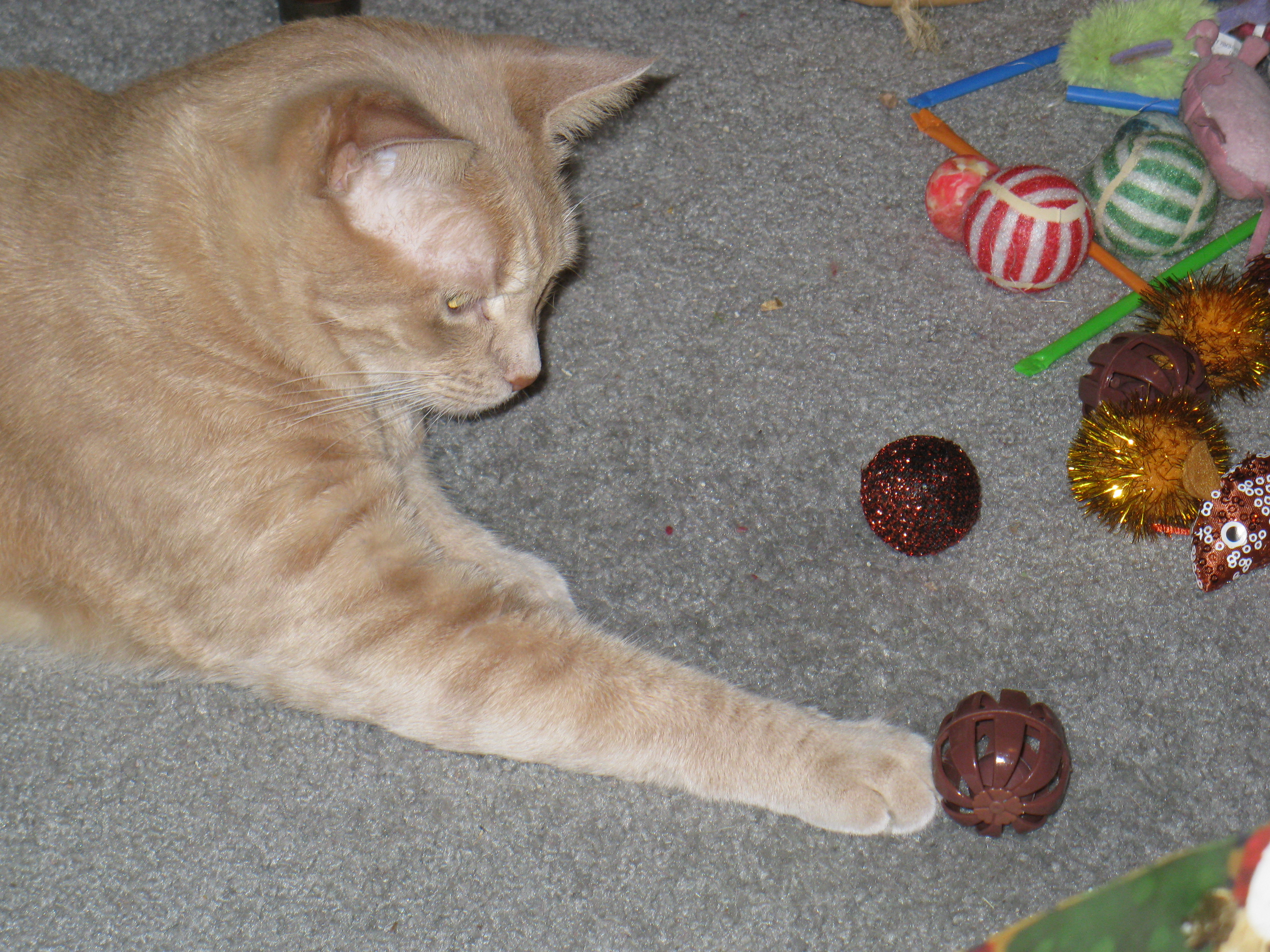
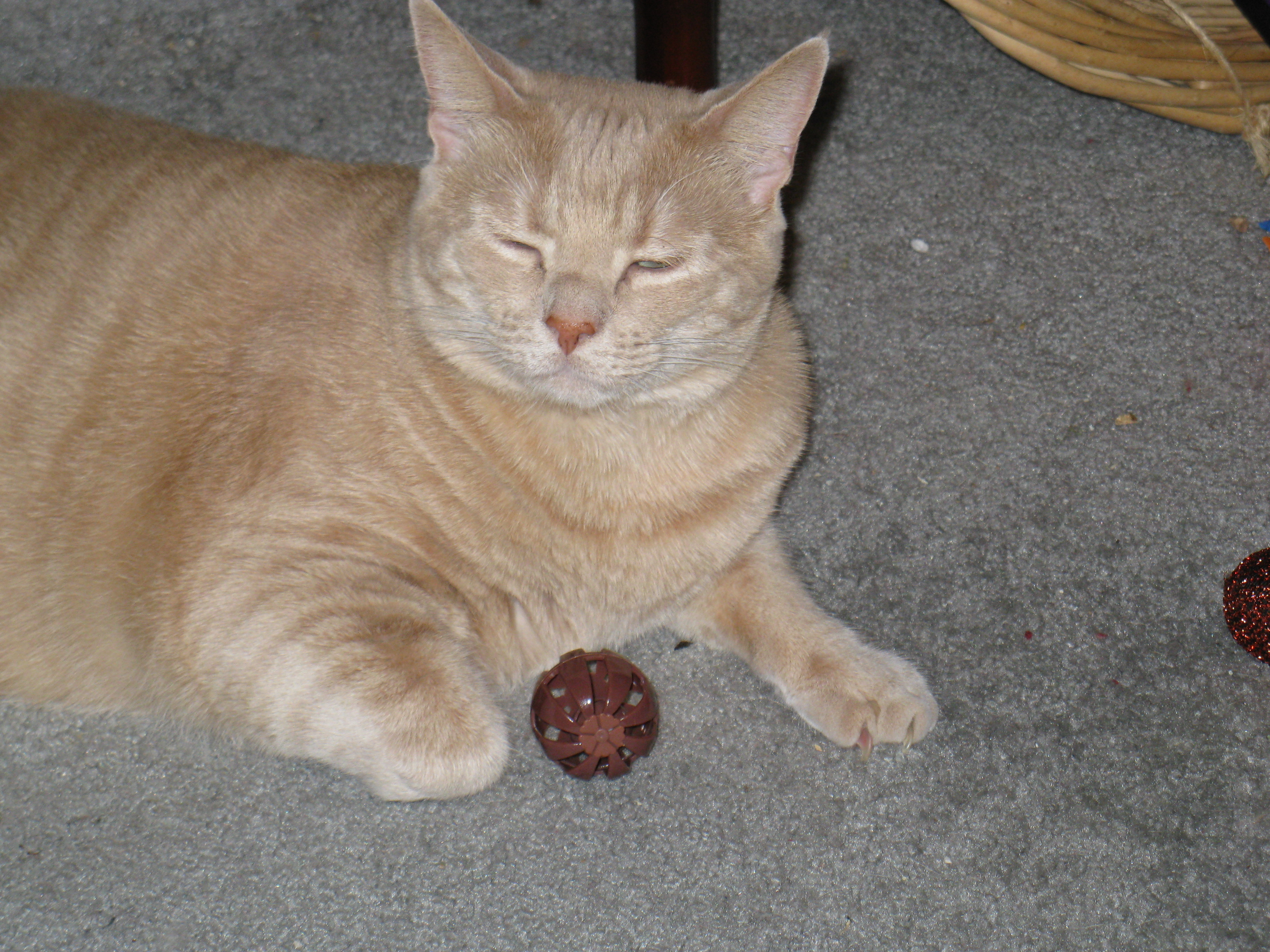
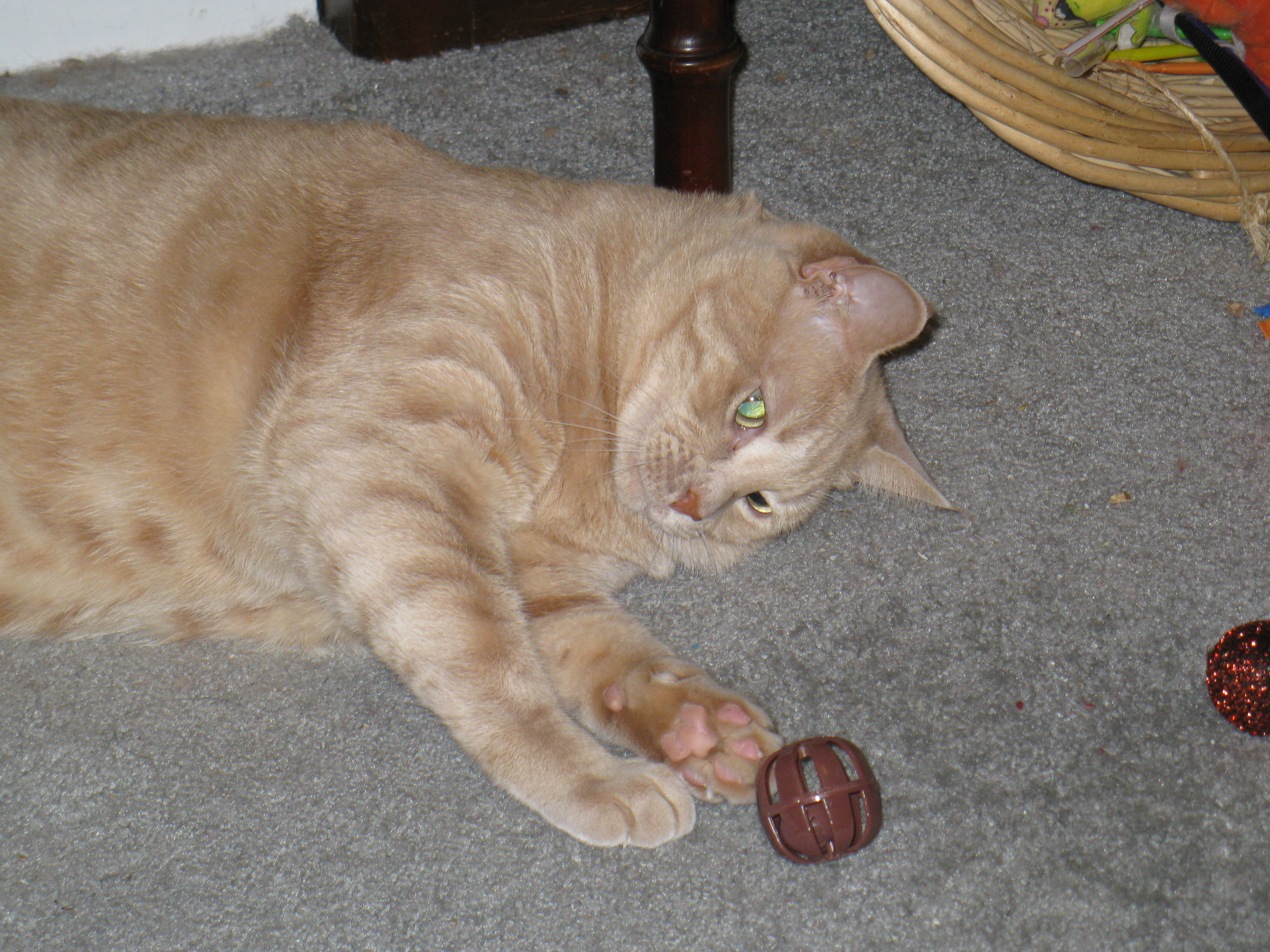
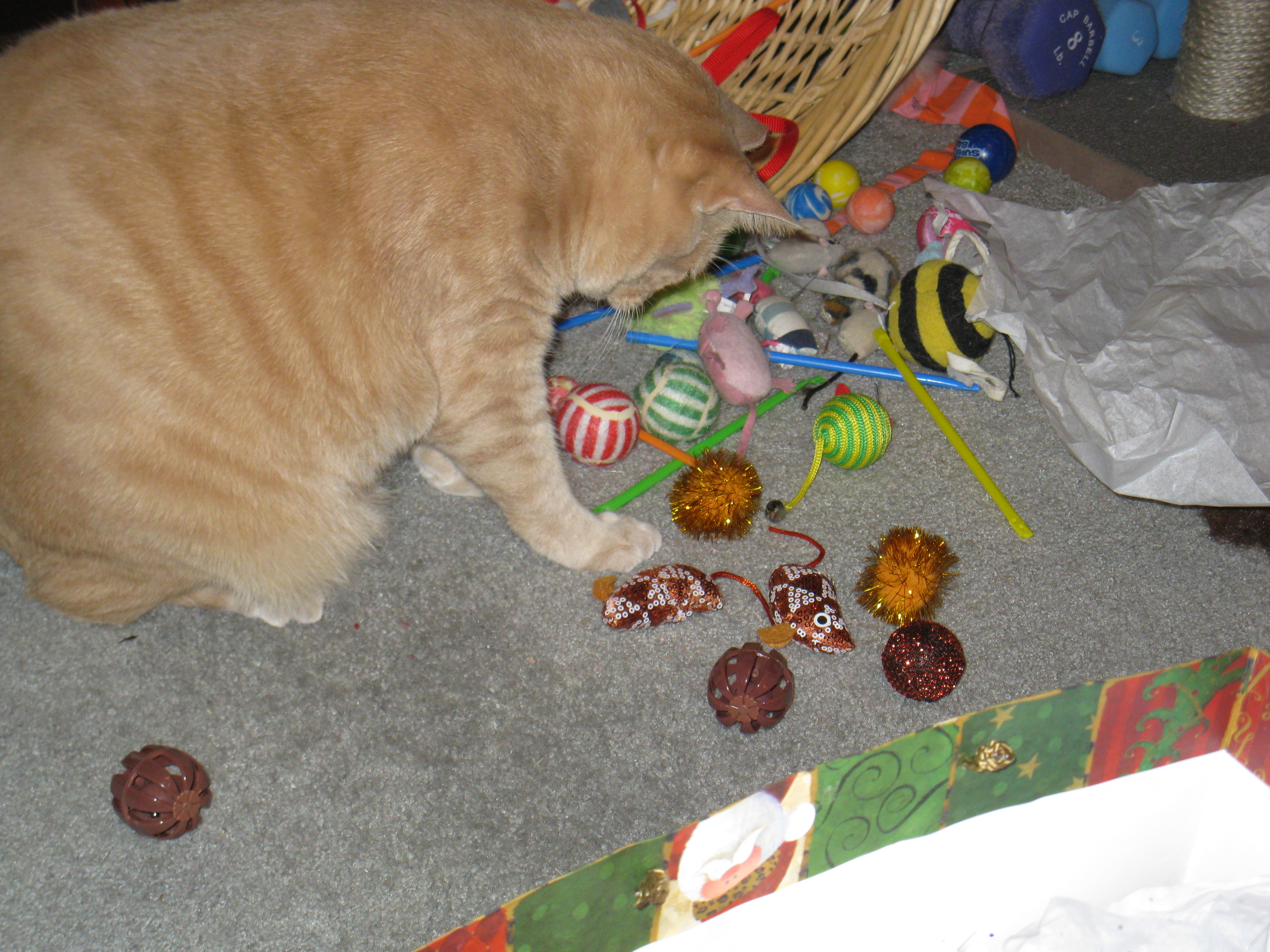
William and Ernest have always found it convenient to store toys under the bed for spontaneous midnight romps. By morning, I may know where they’ve hidden these.
*****
ROW80 Report:
1. I wrote for an hour a day for five days and took two days off.
2. I tried to stay awake all week. Slight exaggeration, but not much.
Next weeks goals:
1. Write for an hour a day on the novel. The blog doesn’t count.
2. Go do bed before midnight. Before 10:30 p.m. Before 10:00 p.m.
To see what other ROW80 writers are up to, click here.







The rest of the story: David and I watched the clock for twenty minutes and then headed for the nearest movie theater to see Hitchcock. Of the seven viewers, six lasted to the end of the movie. One bailed out early. He looked too young to know who Alfred Hitchcock was. If he’d stayed, he’d have seen a pretty good show.
Tuesday marked my first visit a movie theater on Christmas Day. For my first four or five decades, my mother’s family clumped together every Christmas, singing carols, tearing into packages, eating too much, laughing, watching my grandmother try out a toy in the living room accompanied by protests that we kids had to play with them out by the garage.
But time passes and things change, and now David and I are the family. Our holiday was quiet. Since we’ve been married, I’ve cooked Christmas turkey, duck, Cornish hens, and goose, the last in homage to the Cratchit family. The experience of parboiling a goose prompted me to give up the pretense of enjoying domesticity. After the movie, we went to a Chinese restaurant, where the scales fell from my eyes. Everybody in Austin was at the Asian Lion, most of them queued up in front of David and me. But the chicken and green beans made the wait worthwhile. I came away feeling no guilt for breaking with tradition.
That wasn’t the first time I stepped out of my comfort zone around the holiday. Our first Christmas together, David and I spent Christmas Eve night in Cuidad Acuna, across the Rio Grande from Del Rio, Texas. It was cold. David managed to turn off the hotel room heater the wrong way, and it refused to come back on when needed.
He had originally wanted to spend Christmas in San Miguel de Allende, but I knew we would be beset by banditos or federales and wouldn’t get home for New Year’s, so he settled for Acuna. I should have kept my mouth shut. I didn’t realize at the time that David knows what he’s doing, and he has no intention of walking into danger. But the moment has passed, and now I’ll probably never get to see the church that I’m told looks like a birthday cake.
Come to think of it, there was an atmosphere of anxiety during the trip. That was the Christmas Osama bin Laden had threatened to attack the U. S. At that time, I was oblivious to the possibilities (as were most of us before 2001), and focused on eating tacos Tapatios, tacos pastor, and tacos barbacoa, and on using as much of my thirty-year-old Spanish as I remembered, which consisted mostly of saying to David things like, “Como se llama soap?”
Anxiety arose on the way out of the country. A lot of traffic goes across the International Bridge every day, and pre-9/11 it seemed a mere formality. But, showing my drivers license to the guard, I remembered that this weekend, authorities were on alert. The guard asked where we were from. David, with his lawyerly background, answered the question he was asked:”Austin.” The guard looked a me, and my mind shattered: I was from Austin, well, I’d driven from Austin, but I lived in Fentress, but I was born in Luling…” I forgot to mention three years in the dormitory in San Marcos.
The guard gave me a l-o-n-g, speculative stare. I looked him straight in the eye. Finally, he nodded us through. I resumed breathing. I’m sure he’d concluded that if I had a secret, it would have tumbled out by then.
Well. I started out to say we had a good Christmas, and I wind up nearly eight hundred words later trying to get back across the Mexican border. But it’s a pleasant memory, right down to my bare feet on that cold, cold tile, so I’m glad I allowed myself to meander.

1st row: James Burnside King IV, Stephen Marshall King, Barbara Lee King, Mary Katherine Waller
2nd row: Crystal Lynn Worden, Mary Veazey Barrow, Eugene Wray Worden, Mary Whiting Worden,
Mary Veazey Worden


 M. K. Waller