Loving Molly

Author Susan Woodring’s post “This Writer’s Wish List: A Love Story” has been on my mind since I read it two days ago. I can’t make it go away.

Susan Woodring (short story)
Susan Woodring (short story) (Photo credit: suzanne carey)

It sticks with me because what Woodring says is true. Uncomfortably so.

She says if we write because we want something–wealth, fame, a room of our own, shoes–we’re destined to fail.

To write well, we have to ask what the story wants. We must write out of love.

I have at times worked according to the love principle: when I wrote an eight-chapter satire on life in the teachers’ lounge; my first couple of short stories;  a segment of the Mystery in Four Parts for the annual Austin Sisters in Crime celebration; the daily assignments for the retreat in Alpine last year; the very first, and unspeakably horrible, draft of Molly; every post that appears on this blog. The less the product matters, the more I’m willing to consent to its requests, and the more I love to write.

My Friday critique partner and I even wrote the love principle into the title of our partnership. Recognizing that publication would not be a slam-dunk, we lowered our expectations–or as my thesis advisor once recommended, modified our aspirations–and named ourselves the Just for the Hell of It Writers. 

Somewhere along the way, however, I meandered away from the ideal. I focused on getting it right the first time, being perfect, failing to trust that something would come from nothing. I wandered away from the playground and haven’t found my way back.

While wandering, I suggested to CP that we change our name to something more serious, more business-like, a name we could take out of our tote bags and flash around at writing conferences, a name that would look good on our resumes. After much discussion, we chose Waterloo Writers. We even voted. The motion passed unanimously, 2-0.

Ah, the pomp and the circumstance. One could almost hear the strains of “Land of Hope and Glory” replacing Willie Nelson from BookPeople’s speakers overhead.

(Epiphany: As I write this, a Frasier marathon, compliments of Netflix, plays on TV. I just realized I am a Frasier. Uptight. Perfectionistic. OCD. No wonder I’m not having fun.)

Anyway, I haven’t loved Molly for quite a while. I haven’t asked what she wants, and I’ve ignored her attempts to tell me. Even when she’s yelling. She yells a lot, all day every day. And at night when I’m trying to sleep. I can’t make her–or her passel of friends–shut up. No one else hears them.

Ignoring the cacophony takes energy. And sugar. Today the shouting was so intense I plowed right through the sticky, cloying chocolate thingies my husband bought at Wal-Mart to take to work for lunch. Enough for the next two days, he thought. Tonight, to make amends, I baked brownies, which I have already sampled. If I go to bed soon, they have a chance of lasting till morning.

Obviously sugar isn’t working. It never does.

Giving up isn’t an option either. In the words of another critique partner–one I consider my mentor–“Writing is part of my condition.” I may stray from the rule, but never from the desire. The voices in my head keep clamoring, and there’s just one way to calm them.

For this writer’s brand of schizophrenia, the only effective drug is the one Susan Woodring prescribes: love.

Plus, I would add, equal measures of faith and hope. The three have a history of joyful collaboration.

*****
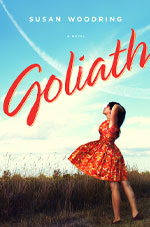
Susan Woodring’s latest novel is Goliath (St. Martin’s, 2012). She lives in North Carolina. More information about Susan and her books is available on her blog.

*****

Picture of Susan Woodring by Suzanne Carey, via Flickr, CC BY- NC 2.0.

Goliath cover from Susan Woodring’s blog. 

ROW80, AMW, Dorothy, & Tallulah

Promotional photo of Tallulah Bankhead.
Promotional photo of Tallulah Bankhead. (Photo credit: Wikipedia)

I owe A Round of Words in 80 Days (ROW80) another Wednesday check-in. Fortunately, I finally have something significant to report.

My original goals were to sleep (get to bed before midnight, I believe); eat well (get off the white stuff, processed foods, added salt, sweeteners); and show up at critique meetings with  something to be critiqued (in other words, write).

Before I discuss progress, I’ll note that Austin Mystery Writers (AMW) is alive and well. Several members have been on hiatus, dealing with other projects (such as work), another can’t attend regularly (again, work), and this week our Grand Pooh-Bah moved a hundred miles to the north. Only two non-Pooh Bahs remained to stay the course, and we considered four eyes insufficient to ferret out the flaws in our respective manuscripts.

Last night, however, concern vanished. Two new members joined us, a third has promised to drop in next week, and two others have listed themselves as maybes.

American writer Dorothy Parker (1893-1967)
American writer Dorothy Parker (1893-1967) (Photo credit: Wikipedia)

Being in a critique has been a good experience for me. In addition to ideas and advice, I’ve received  encouragement and support for my writing and for my personal life. My partners have helped me over some rough spots in the past couple of years.

I’ve also learned a lot. Since we’ve been together, one partner has published a novel and has more in line for publication. Two others have completed manuscripts. While in one sense I’ve been stalled–scrambling down bunny trails, trying to get my plot under control–I’ve learned about the business of writing.

As to my own WIP: Pieces continue to fall into place. Listening to a presentation at the Austin Sisters in Crime meeting last Sunday, I had a brainstorm–a detail that would make a central character’s motivation much more credible. I flipped to the next page in my notebook and scribbled it down. I’ve also had another idea about reframing the novel to update it a bit. When I realized that Molly hadn’t once, in nearly three hundred pages, gone online, I pulled out Chapter One and inserted Internet.

Today I retyped Chapter One. The experts say not to do that–especially considering the number of times I’ve rewritten it, trying to get the foundation right–but I’m not revising so much as remembering. It’s been through many incarnations, and typing requires me to read more closely than I would if only my eyes were involved. I’ll continue this process for three or four more chapters, inserting new segments where appropriate (I hope!). Projected changes add originality. They give Audrey Ann, a minor character, more opportunity for mischief-making. Audrey Ann is a hoot, and I look forward to spending more time with her.

(One of my critique partners suggested Audrey Ann would make a good victim, but she’s too much fun to kill. Very much like my first intended victim, whom I couldn’t bring myself to knock off. If this becomes a trend, I’m in big trouble.)

I’ve added a progress meter to the sidebar on the left. Five percent represents progress on the current draft–in other words, what I retyped today. I’ve been working on this project, and talking and writing about it, for a long time. I don’t want to give the impression that I’ve eked out just four thousand words.

Now, as to my plan for eating real food: Sometimes I have and sometimes I haven’t. I have, however, dropped nineteen pounds since the first of the year, so I claim at least modified success.

(Who am I trying to kid? I rock.)

Regarding sleep: It’s after 1:00 a.m. No excuses.

One last thing about Austin Mystery Writers: When the other left-behind critique partner mentioned we might need to put several of the coffee shop’s tables together to handle the potentially large turnout, it occurred to me that if we works things right, AMW could become the Austin equivalent of the Algonquin Hotel’s Round Table. A heady thought. Critique partner said I could be Dorothy Parker. She wants to be Tallulah Bankhead. I wish I could be the glamorous one, but with my evil tongue, Dorothy P. is right down my alley. More’s the pity. I’ll try to be nice.

*****

“I should wash him!”

“Well, then,” returned my aunt… “Now, here you see young David Copperfield, and the question I put to you is, what shall I do with him?”

“What shall you do with him?” said Mr. Dick, feebly, scratching his head. “Oh! Do with him?”

“Yes,” said my aunt, with a grave look, and her forefinger held up. “Come! I want some very sound advice.”

“Why, if I was you,” said Mr.Dick, considering, and looking vacantly at me, “I should—” The contemplation of me seemed to inspire him with a sudden idea, and he added, briskly, “I should wash him!”

“Janet,” said my aunt, turning round with a quiet triumph, which I did not then understand, “Mr. Dick sets us all right. Heat the bath!” ~ Charles Dickens, David Copperfield

Bleak House where Dickens wrote David Copperfi...
Bleak House, Broadstairs, England, where Dickens wrote David Copperfield--Image via Wikipedia

During our (brief) study of Paradise Lost, a high school senior said, “Do you actually read this stuff when you’re home at night?”

Actually, and emphatically, No. I read Dickens.

Today marks Charles Dickens’ 200th birthday, and I’m determined to get my greeting in before I have to add the word belated. That means finishing this in 21 minutes, a daunting task when William is curled up in my lap, trying to control the touchpad and the space bar, and licking my hands. And deleting things. The deleting is bad, but the licking is worse. Ick.

Speak of the devil. He just deleted the paragraph above. I got it back.

Anyway.

When I was twelve, I checked out a copy of David Copperfield from the bookmobile and fell in love. Peggoty, Barkis, Aunt Betsey Trotwood, Mr. McCawber, Little Emily, Dora, Agnes, Uriah Heep, Mr. Dick, King Charles’ head, even the nasty little pug. I followed up with A Tale of Two Cities, Great Expectations, Bleak House, Our Mutual Friend, Dombey and Son…I haven’t read all his books, but I also haven’t given up the idea that someday I’ll be able to say I have.

Author and editor William Dean Howells said that Dickens wasn’t so much a novelist as a caricaturist, and paid homage to Dickens by creating in Annie Kilburn a wrong-headed character who is always trailed by his wife and a passel of children (a la Mr. McCawber) and who frequently speaks of his Growlery (a la Mr. Jarndyce of Bleak House).

I like Howells’ novels and think his comment about Dickens has its merits. But I couldn’t care less. Finding that Dickensian gentleman in Howells’ book delighted me. It was like finding an old friend.

Note that although I banged out twenty pages of lit. crit. on Annie Kilburn, I don’t remember that gentleman’s name. I never wrote a word about Dickens, except perhaps on an undergrad exam, but I can recite names from a string of his novels.

I’ve often thought that certain artists give such pleasure to so many, it’s a shame they have to leave. John Gielgud, Scott Joplin, George Gershwin, Lew Ayres, Katharine Hepburn, Alfred Hitchcock, Mark Twain, P. G. Wodehouse, Edith Wharton, Agatha Christie, Emily Dickinson, Victor Borge, Mary Cassatt…They’re keepers. They should be allowed to stay with us, acting, playing, reading, painting, composing, writing.

Charles Dickens is a keeper. But in his absence, books fill his place.

The clock tells me that once again my birthday card will be stamped belated.

But I don’t think the recipient will care.

Happy 200th birthday, Mr. Dickens, and many more.

***

Photo by Heron on 3rd October 2005. Released into the public domain.

Excerpt

Rosary...

The footfall of a spider in Ramona’s room had not been light enough to escape the ear of that watching lover outside. Again Alessandro’s tall figure arose from the floor, turning towards Ramona’s window; and now the darkness was so far softened to dusk, that the outline of his form could be seen. Ramona felt it rather than saw it, and stopped praying. Alessandro was sure he had heard her voice.

“Did the Senorita speak?” he whispered, his face close at the curtain. Ramona, startled, stopped her rosary, which rattled as it fell on the wooden floor.

“No, no, Alessandro,” she said, “I did not speak.” And she trembled, she knew not why. The sound of the beads on the floor explained to Alessandro what had been the whispered words he heard.

“She was at her prayers,” he thought, ashamed and sorry. “Forgive me,” he whispered, “I thought you called;” and he stepped back to the outer edge of the veranda, and seated himself on the railing. He would lie down no more. Ramona remained on her knees, gazing at the window. Through the transparent muslin curtain the dawning light came slowly, steadily, till at last she could see Alessandro distinctly. Forgetful of all else, she knelt gazing at him. The rosary lay on the floor, forgotten. Ramona would not finish that prayer, that day. But her heart was full of thanksgiving and gratitude, and the Madonna had a better prayer than any in the book.

~ Helen Hunt Jackson, Ramona

*****

Image of rosary by miqul via Flickr. Creative Commons Attribution 2.0 Generic License.


How It Ends

Chicken Korma
Image by TheCulinaryGeek via Flickr

I am not devastated.

Season 8 of MI5 just ended. Nuclear war between India and Pakistan was averted.

The team, however, did not come out unscathed. Something bad happened to one of the characters.

This time last year, I would have been in tears. But I’m calm. I have discovered the way to peaceful acceptance of the demands of the script:

Wikipedia.

When I discovered Wikipedia carries a plot summary of each season of the series, I read to the very end. I knew how X would leave the show, and then Y, and now Z.

And I’m okay. I’ve had time to reconcile myself to loss. It’s easier this way.

That’s only for television.

About books, I’m more particular.

A couple of months ago, I started a novel but couldn’t get into it. I passed it to Friend #1, who read it, said she loved it, and passed it to Friend #2.

Last week, at a Proxy Valentine dinner, Friend #2 returned the book. Handing it to me, she said, “I loved it. All but the way it ended…I didn’t want the little girl to die.”

I refrained from fainting dead away and falling into the chicken korma.

I assured Friend #2 she hadn’t spoiled the book for me. It’s quirky. I knew anything could happen.

And it might be best this way. This time. For this book.

But I see no trend developing.

When Wikipedia adds Season 9, I’ll read ahead.

Otherwise, the book report rule stands: Don’t tell me how it ends.

Thank you for noticing.

For the past month and more, my writing has been on hold. There are two reasons for the lapse. First, I’ve been short on energy. Second, I’ve been afraid I don’t have what it takes to read a novel, much less write one. Fear played off lethargy. Lethargy played off fear. I played Bejeweled.

Bejeweled is not an activity that gives the subconscious mind freedom to explore and create. It’s an activity that requires no neural activity at all.

But I’m getting back on track. There are three reasons for that. First, my internist, who appears to believe I have a brain even when it feels like it’s made of cotton, diagnosed vitamin deficiencies and an electrolyte imbalance. He prescribed supplements. I’m taking them. Synaptic transmission is once more in progress.

Second, a few hours ago I received the judge’s critique from a manuscript contest I entered last February. The score is good. Very. Much better than I’d expected. The judge pointed out the positives, the negatives, and the watch-out-fors. He said that although it is “a fun and entertaining read,” I will need to find an agent who understands the South. I will also need to pitch it “in the tone of a Fannie Flagg novel.”

Fannie Flagg! Fannie Flagg’s name appears on my critique sheet! Twice! Not that the judge was comparing our writing, of course. He was just comparing pitches.

I don’t know how to pitch in the tone of a Fannie Flagg novel. But I don’t have anything to pitch yet either. There’s time to figure it out.

(I do a pretty decent impression of Fannie Flagg doing an impression of Ladybird Johnson: “Whenever I see a candy wrapper on the ground, I pick it up and give it to Lyndon….Lyndon collects candy wrappers.” I saw her perform that on the Garry Moore Show when I was thirteen. I suppose the material is dated, but then so am I.)

Enough of that. The point is, a good critique can do wonders. It’s like B12 for the spirit.

Which brings me to the third reason I’m writing, and the most important: someone noticed I wasn’t.

The knowledge that a reader is paying attention and registering my absence means a lot, especially when the going is as tough as it has been for the past couple of months.

Thanks, Susan Woodring, for noticing.