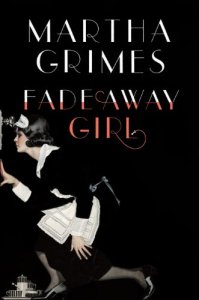
Twelve-year-old Emma Graham and elderly Mr. Root sit outside the grocery store in a little town in the mountains of Maryland, discussing poetry. From Martha Grimes’ Fadeaway Girl:
“What’s the poem, Mr. Root?”
. . . It was a paperback, not very thick. I saw it was the poetry of Robert Frost. “But I thought you didn’t like Robert Frost. You were all against ‘Stopping by Woods on a Snowy Evening.’ Remember?”
“That one, yeah. But he’s wrote a couple of good ones. I kind of put ’em in between Emily’s, you know, . . .” Mr. Root cleared his throat and intoned in a sing-song fashion:
This saying good-by on the edge of the dark—
It shut my eyes, that line did, as sure as someone passing a hand over them. “Oh,” I said.
“What?”
“Nothing.”
He read on, although I was still back there on the edge of the dark.
Then he came to:
I wish I could promise to lie in the night And think of an orchard’s ar-bo-re-al plight When slowly (and nobody comes with a light) Its heart sinks lower under the sod.
My eyes snapped shut again. I had never heard anything so fearfully sad. I bit my lip to keep from crying. I could almost see it, the trees too young to be left alone, waiting for someone or something to come, and finally knowing no one ever would.
“Yep,” said Mr. Root. “Some of his, well, I’d say he knows what he’s talking about. Straight talk. That’s what Frost was really good at, none of those namby-pamby poems about Greek urns and stuff. Nope”—he held up the book—”just plainspoken, to-the-point words about nature and stuff.”
“Mr. Root,” I said, “I don’t think he’s plainspoken. He means a lot more than what he seems to be saying.” . . .
Mr. Root pushed his feed cap back on his head and scratched his forehead. . . .
“What do you mean by that?” His eyes narrowed as if I were insulting him.
I didn’t want to talk about it; I don’t know why I had to open my big mouth. “Well, I think he means something different from what he’s saying. Or seems to be saying.” . . .
I asked Mr. Root if I could borrow the book for a minute, and he handed it to me.
“And could I have a piece of paper and use your pencil?”
He tore off a little sheet and handed that to me, too, along with his pencil. “Whatcha doin’?”
“Just copying.”
I wrote the last lines on the paper and folded it up and stuck it in my change purse.
***
Are there any lines of poetry or prose that shut your eyes?
John Anderson, my jo, John
When we were first acquent;
Your locks were like the raven,
Your bonie brow was brent;
But now your brow is beld, John,
Your locks are like the snaw;
But blessings on your frosty pow,
John Anderson, my jo.
John Anderson, my jo, John,
We clamb the hill thegither;
And mony a cantie day, John,
We’ve had wi’ ane anither:
Now we maun totter down, John,
And hand in hand we’ll go,
And sleep thegither at the foot,
John Anderson, my jo.
Sung by Christy-Lyn
***
Meanings of most of the words from Scottish dialect are obvious, but here’s a glossary just in case.
jo-sweetheart
acquent-acquainted
bonny-beautiful
brent-polished new
beld-bald
snaw-snow
pow-head
thegither-together
cantie-great
one anither- together
maun totter down-must climb down
Last night, embroiled in the Great Throwing-Away, I made surprising discoveries. I found
*The senior will, which I read at the junior-senior banquet (1969)
*The judge’s comments on ten pages of a novel I submitted to the Writers’ League of Texas (2007), not as bad as I remembered
*The essay, with judge’s comments, that I wrote for the state Ready Writing contest (1969), during which I was imprisoned in a classroom with other students from all over Texas for two hours or until I’d written a 1000-word essay, whichever came first. It was torture.
*Several pages–or maybe all–of a story I wrote in the early ’80s for my fellow teachers to read in the teachers’ lounge or (surreptitiously) in meetings. In chapter one, the principal expires while eating poisoned chocolate mousse prepared by home economics students.
*But the big, really big, surprise was the discovery of a paper I wrote in grad school for a Tennyson/Browningclass and presented at the Conference of College Teachers of English back in 1984, my first year as a college teacher of English. I’d thought it was gone forever.
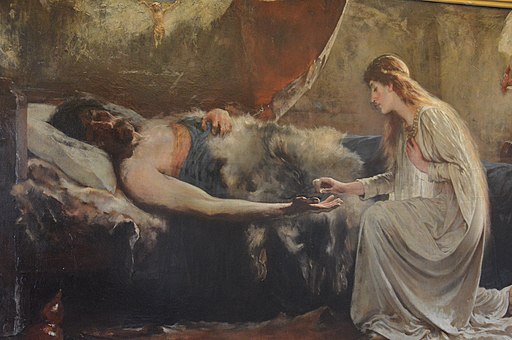
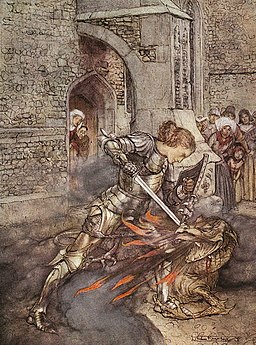
The paper is titled, “Sickness and Death in Tennyson’s ‘Lancelot and Elaine,‘” from Tennyson’s The Idylls of the King. I wrote it six months after my father died unexpectedly. If that year had been happy, I might have seen something happier in the poem, but it was a miserable year, so I saw sickness and death.
It was a miserable year for Lancelot, Elaine, and Guinevere, too. Guinevere, Queen of Camelot, is sick and can’t go to the fair jousts King Arthur has arranged. When she tells Arthur she can’t go, Sir Lancelot, his closest friend, says “‘Sir King, mine ancient wound is hardly whole, / And lets me from the saddle.'”
I’ve forgotten how he got his ancient wound, but it’s healed; he could sit in that saddle if he wanted to. When he claims to be ailing, he’s lying through his teeth. He doesn’t want to go to the joust. He wants to stay with Guinevere. Although Tennyson doesn’t come out and say it, he makes it clear that Arthur knows–or at least suspects–it’s not a wound that’s keeping him at home.
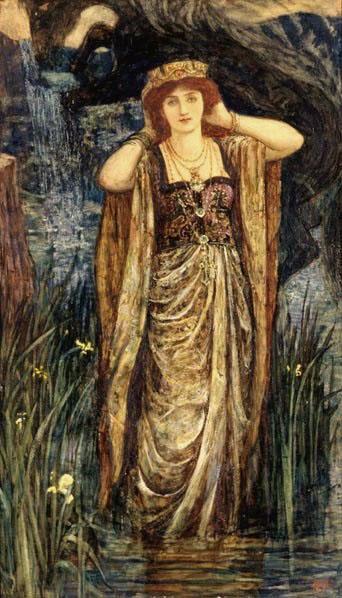
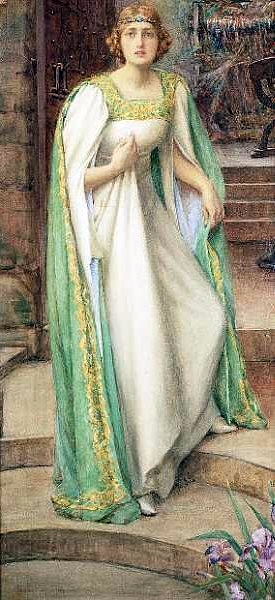
Then there’s Elaine, the Lily Maid. Lancelot dreams about her and then meets her, and she immediately falls in love with him. She’s young, lovable, sweet, and pure. After Lancelot is wounded in a joust–he went to the fair joust after all, but in disguise–Elaine cares for him. Her company has a healthful effect on him. But his spirit is also sick–carrying on with your dearest friend’s wife and fibbing about it and then becoming semi-involved with another woman will do that to you–and Elaine can’t restore his spirit. And, unfortunately, although he’s attentive, he’s not in love with her.
Elaine isn’t in good health either. She lives in sterile, self-imposed isolation, refusing to express emotion. She wants Lancelot, but he can’t live in her fantasy world, and when she realizes he doesn’t love her, the mirror cracks from side to side and the curse comes upon her. Infected by reality, she decides to die.
(The mirror and the curse are in “The Lady of Shalott,” not the Idylls, but Tennyson wrote both, and he wouldn’t mind my combining them).
Well. If this weren’t enough, Guinevere is behaving badly. She starts out by rebuking Lancelot for lying to Arthur. When she sees he’s become fond of Elaine, jealousy overtakes her–spiritual sickness runs rampant in this Idyll–and carps at Lancelot unmercifully. She doesn’t have one good word for the man. Granted, she’s been sick, but I don’t think that excuses the carping.
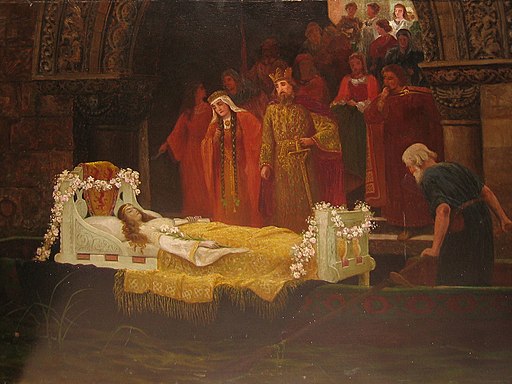
When Lancelot brings her a gift of diamonds he’s won in a series of jousts, a gesture most women would appreciate, she throw a hissy fit and tells him to give them to Elaine, then changes her mind and says, “She shall not have them,” and throws them out the window into the river. Then, while Lancelot is leaning on the window sill, watching his diamonds hit the water, here comes a lifeless Elaine, floating down the river on a barge.
Not a good day. A triangle with two sides sick and the other dead.
And it doesn’t stop there. The last line of the poem predicts that Lancelot will “die a holy man.”
“Lancelot and Elaine” tells a sad story. It could be a downer, especially for someone not in the best state of mind. Looking back, I can see that focusing on sickness and death for several weeks while I studied the text and wrote the paper was depressing.
But now when I think of the the Idyll, I remember not sickness and death but a beautiful image. Ironically, it grows out of Guinevere’s rage, when she exclaims that Elaine shall not have the diamonds.
Saying which she seized,
And, through the casement standing wide for heat,
Flung them, and down they flashed, and smote the stream.
Then from the smitten surface flashed, as it were,
Diamonds to meet them, and they past away.
When the diamonds, flashing in the sun, hit the surface of the stream, water splashes up, droplets flashing in the sun like diamonds.
More than thirty years after first reading the Idylls, I retain that image: diamonds meeting diamonds.
Those are some of the loveliest lines I’ve ever read.
Coming across the paper on “Lancelot and Elaine,” was true serendipity. A delightful surprise, because it reminds of me of a time when I was smart. When I was a scholar. When I engaged in literary criticism. When I could write formal prose. When I would never have inserted an incomplete sentence into a formal composition. Or in an informal composition. When I had a personal lexicon of more than a dozen words. When I could spell.
And when I would have floated down the river on a barge before I’d let anyone read what I’ve written in this irreverent little post.
Dear March — Come in —
How glad I am —
I hoped for you before —
Put down your Hat —
You must have walked —
How out of Breath you are —
Dear March, Come right up the stairs with me —
I have so much to tell —
I got your Letter, and the Birds —
The Maples never knew that you were coming — till I called
I declare — how Red their Faces grew —
But March, forgive me — and
All those Hills you left for me to Hue —
There was no Purple suitable —
You took it all with you —
Who knocks? That April.
Lock the Door —
I will not be pursued —
He stayed away a Year to call
When I am occupied —
But trifles look so trivial
As soon as you have come
That Blame is just as dear as Praise
And Praise as mere as Blame —
While at the store, I also made notes about a second book about libraries. Three days later, they look like runes, though not nearly so attractive or so organized.
Poet Alice Massa asks, “What Is the Name for a Group of Poets?” She answers the question in a poem–and if you read all the way to the end, you get more than just the answer.
I like the term she chose very much, but I wondered if there are alternatives. So I went to the glossary of literary terms–several of them, in fact, since they’re all over the Internet–and came up with some possibilities:
a verse of poets
a rime of poets
an iamb of poets
a lyric of poets (although lyric is more suited to songwriters)
a scansion of poets
a prosody of poets
The search sparked a new question: What is the name for a group of mystery writers?
a plot of mystery writers
a conspiracy of mystery writers
a complication of mystery writers
a murder of mystery writers (perhaps to close to a murder of crows)
a grit of mystery writers
a cozy of mystery writers
And another question: What are the members of a critique group called?
This one is easy. Borrowing from an unkindness of ravens, I choose to call members of a critique group a kindness.
Little Google Fiber’s come to our house today,
To scramble through the attic and drag cables on the way,
And cut some boards and drill some holes and stuff some cables that
Will link up with some other stuff beside the thermostat;
But first the upstairs closet had to be cleared out for space,
The downstairs china cabinet moved and china all displaced,
“And Kathy can’t just lie in bed,” they said, “or lounge about,
‘Cause we’ll see her in her jammies
Ef she
Don’t
Watch
Out.”
I heered ’em in the attic, flippin’, flappin’ like a bat,
And a-scritchin’ and a-scratchin’, like a sheetrock-eatin’ rat,
And the warnin’ that they said we’d get? Like knockin’ on the door,
And sayin’, all polite-like, “Ma’am? Here’s me and all my corp
Of drillers and of draggers, we don’t want to scare you none
By creatin’ a cacophony before your sleep is done,
So please wake up, get up out of bed. It puts us in a pout
When we see you in your jammies
‘Cause you
Don’t
Watch
Out.”
But, no, the warning never came, and I was in still in bed,
Although my husband came upstairs an hour ‘fore and said,
“Dear, don’t you think you’d better rise and put some lipstick on
And stretch your arms and stretch your legs and give a drowsy yawn,
And don some clothes and stuff those PJs in the nearest vase,
Cause those raggedy old things reflect on us a sad disgrace,
And the Google guys will run and flee. You’ll cause a general rout
If they see you in your jammies
‘Cause you
Don’t
Watch
Out.
Though I am a thoughtful wife and always try to please,
My lids were heavy, and I stayed in bed and took my ease,
And so it was that I was still in Morpheus’ embrace
When the scritchin’ and the flappin’ up above me did take place.
And I sprang up from my bed and ran, but threw up neither sash,
Nor did I fly to ingle-side to brush aside the ash.
I screeched, “That isn’t Santa, it’s the Google men, no doubt!
And they’ll see me in my jammies
Ef I
Don’t
Watch
Out!”
So I scrabbled and I flipped and flapped and sounded like that rat,
Although louder and lots faster, like unto a scalded cat.
“I’d be ready now,” I said, “if only Google had been nice,
And not made me move the china so my muscles needed ice,
And my body and my soul cried out, ‘This raveled sleave of care
Must be knit up, and sore labor’s bath I needs must have! Oh swear
That Google will not taunt me for a loathesome layabout
‘Cause they see me in my jammies
Ef I
Don’t
Watch
Out.'”
Exciting stories sometimes end in flaming denouements.
This one has a climax that is really, really blah.
I got up, brushed my hair, found clothes, as usually I do,
And dressed and, looking ‘neath the bed, dragged out my other shoe,
Went downstairs, and stared at the wall, and checked email, and when
The Google man knocked on the door, and David went, ’twas then
I said, “Ha ha ha, you cannot say, you early-rising lout,
That you saw me in my jammies,
The poem “Little Orphan Annie” was written by James Whitcomb Riley in 1885. The original title was “Little Orphant Annie,” but an error in a later printing changed the name.
James Whitcomb Riley, known as the Children’s Poet, poses with a group of children for a photo to be included in a book published for the Indiana state’s centennial anniversary. (Photo credit: Wikipedia)
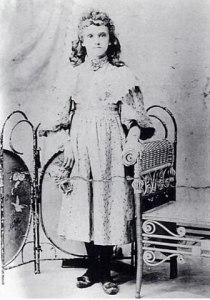
The poem was inspired by Mary Alice Smith, a child who came to the home of Riley’s parents as a “bound” servant to earn her board and keep. She worked alongside Mrs. Riley and the other children and helped with housework. The Rileys referred to her as a guest and treated her as one of the family. In the evenings she told ghost stories to the children, including James, the future poet.
In the 1920s, Mary Alice Smith inspired the comic strip “Little Orphan Annie” and the Raggedy Ann doll created by Johnny Gruelle.
Thanks to Wikipedia for the information shared here.
Thanks to James Whitcomb Riley for writing the delightful poem that popped into my head as soon as I heard the Google men scrabbling around in the attic. Read in just the right way, the last four lines can scare the stuffings out of a bunch of eight-year-old girls at a Brownie troop meeting.
***
Little Orphant Annie’s come to our house to stay,
An’ wash the cups an’ saucers up, an’ brush the crumbs away,
An’ shoo the chickens off the porch, an’ dust the hearth, an’ sweep,
An’ make the fire, an’ bake the bread, an’ earn her board-an’-keep;
An’ all us other childern, when the supper things is done,
We set around the kitchen fire an’ has the mostest fun
A-list’nin’ to the witch-tales ‘at Annie tells about,
An’ the Gobble-uns ‘at gits you
             Ef you
                Don’t
                   Watch
                      Out!

Onc’t they was a little boy wouldn’t say his prayers,--
So when he went to bed at night, away up stairs,
His Mammy heerd him holler, an’ his Daddy heerd him bawl,
An’ when they turn’t the kivvers down, he wasn’t there at all!
An’ they seeked him in the rafter-room, an’ cubby-hole, an’ press,
An’ seeked him up the chimbly-flue, an’ ever’wheres, I guess;
But all they ever found was thist his pants an’ roundabout--
An’ the Gobble-uns’ll git you
             Ef you
                Don’t
                   Watch
                      Out!

An’ one time a little girl ‘ud allus laugh an’ grin,
An’ make fun of ever’one, an’ all her blood an’ kin;
An’ onc’t, when they was “company," an’ ole folks was there,
She mocked ‘em an’ shocked ‘em, an’ said she didn’t care!
An’ thist as she kicked her heels, an’ turn’t to run an’ hide,
They was two great big Black Things a-standin’ by her side,
An’ they snatched her through the ceilin’ ‘fore she knowed what she’s about!
An’ the Gobble-uns’ll git you
             Ef you
                Don’t
                   Watch
                      Out!

An’ little Orphant Annie says when the blaze is blue,
An’ the lamp-wick sputters, an’ the wind goes woo-oo!
An’ you hear the crickets quit, an’ the moon is gray,
An’ the lightnin’-bugs in dew is all squenched away,--
You better mind yer parents, an’ yer teachers fond an’ dear,
An’ churish them ‘at loves you, an’ dry the orphant’s tear,
An’ he’p the pore an’ needy ones ‘at clusters all about,
Er the Gobble-uns’ll git you
             Ef you
                Don’t
                   Watch
                      Out!

To read other Day J posts, click AtoZ.

This post first appeared on Telling the Truth, Mainly in July 2017.
Last month,New York Timescolumnist Nicholas Kristoffannounced a contest for Trump poems. Guidelines called for verses written from any political stance. I wrote two sonnets but forgot the October 8 deadline for submission. It seemed a shame to let them languish on the hard drive, so I share them here. The first appears below. Views expressed are mine alone and reflect my rights as set out in the First Amendment to the Constitution of the United States. President Putin would call them disrespectful, but he is not the boss of me.
Shall I compare thee to a summer’s day?
A darling bud of May
Shall I compare thee to a summer’s day? Thou art too blowy and inelegant.
Sweet-scented, like the darling buds of May?
Thou art like offal sans refrigerant.
Thou’rt graceless, racist, foul-mouthed, cold, and mean,
Misogynistic; driven to inflame
Rank passions: malice, hatred, spite, and spleen.
The sun doth blush and hide his face in shame.
A tweeting fool a-twitter in our ears;
A braying donkey sends forth sweeter sound,
And tells more truth, than thy bleats breeding fears.
The Ship of State thy bullying runs aground.
But when bold Nancy plays her final card,
Thou’ll find thyself hoist on thine own petard.
Edgar Allan Poe (1809-1849) by Félix Valloton (1865-1925) (Photo credit: Wikipedia) {{PD-US}}
Why? Because–A friend, calling to confirm David and I would meet her and her husband the next day at the Harry Ransom for the Edgar Allan Poe exhibit, reported her house was being leveled for the second time in three years. “There are thirteen men under my house.”
I hooked up Edgar Allan Poe with “thirteen men under my house” and wrote the following. It may be the best thing I’ve ever written, and Halloween approaches, so I’m posting it again. If you’ve read it before, feel free to move on.
Note: Maven means expert. I looked it up to make sure.
THE MAVEN
To G. and M. in celebration
of their tenth trimester
of home improvement,
with affection
Forgive me for making
mirth of melancholy.
Once upon a midnight dreary, while I pondered weak and weary
Over many a quaint and curious volume of forgotten lore,
While I nodded, nearly napping, suddenly there came a rapping,
As of someone gently tapping, tapping at my chamber floor.
“‘Tis some armadillo,” said I, “tapping at my chamber floor,
Only this, and nothing more.”
Ah, distinctly I remember it was in the dry September,
And my house was sinking southward, lower than my bowling score,
Pier and beam and blocks of concrete, quiet as Deuteron’my’s cat feet,
Drooping like an unstarched bedsheet toward the planet’s molten core.
“That poor armadillo,” thought I, “choosing my house to explore.
A light exists in spring
Not present on the year
At any other period.
When March is scarcely here
A color stands abroad
On solitary hills
That science cannot overtake,
But human nature feels.
It waits upon the lawn;
It shows the furthest tree
Upon the furthest slope we know;
It almost speaks to me.
Then, as horizons step,
Or noons report away,
Without the formula of sound,
It passes, and we stay:
A quality of loss
Affecting our content,
As trade had suddenly encroached
Upon a sacrament.
~ Emily Dickinson
*****
This a picture of Emily Dickinson.
English: Daguerreotype of the poet Emily Dickinson, taken circa 1848. (Original is scratched.) From the Todd-Bingham Picture Collection and Family Papers, Yale University Manuscripts & Archives Digital Images Database, Yale University, New Haven, Connecticut. (Photo credit: Wikipedia) {{PD-US}}
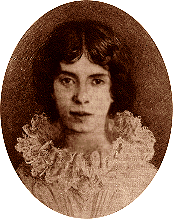
This is a “fabricated” picture of Emily Dickinson.
Fabricated portrait of Emily Dickinson (1830-1886), the American poet. It is an altered version of the only authenticated portrait of Dickinson made after childhood, with added frilled collar and changed hair to make her appear more feminine. Public domain. {{PD-US}}
According to a docent at the Emily Dickinson Museum in Amherst, Massachusetts, in the late 1990s, the photograph was probably altered after Dickinson’s death in 1886, as a tribute and a keepsake. At that time, families often had photographs “enhanced” after a loved one’s death.
I didn’t know Emily Dickinson personally, but judging from what I’ve read and heard about her, I think if she’d seen the enhanced version, she’d have hooted.
Emily Dickinson Museum, Amherst, Massachusetts – side view of Emily Dickinson’s house. (Photo credit: Wikipedia). By Daderot (Own work) [Public domain], via Wikimedia CommonsShe was obviously depressive, but she also had a sense of humor.
The docent told the following story (documented in an LA Times review by Susan Reynolds):
‘Once, when Samuel Bowles, an old family friend and the subject of Dickinson’s Master poems, went to visit, he found himself yelling up the stairs: “Emily, you damned rascal. No more of this nonsense! I’ve traveled all the way from Springfield to see you. Come down at once!”‘
The detail that doesn’t appear in the article, but that the docent added, is that, at Bowles’ summons, Emily left her room and came down the stairs, laughing.
Try calling someone without a sense of humor a “damned rascal” and see what happens.
And she wasn’t quite as antisocial as she’s generally portrayed. Alix North, in a biographical sketch of the poet, writes that in her twenties, Dickinson had a “busy social life” but that by her thirties, she had become reclusive and withdrew when visitors came.
It’s been speculated that Dickinson pulled away from the public because she thought she wasn’t beautiful, or that she was mourning an unrequited love, or that she was agoraphobic. But perhaps Dickinson “became an isolata , creating a moat around herself to preserve the rarity of her soul and because she believed that isolation was critical to artistic expression.”
In other words, she knew exactly what she was doing: Social butterflies rarely, if ever, compose more than 1100 poems by the time they’re 35, at least not concise, powerful ones.
[Sentiments expressed in the preceding paragraph are mine alone. I could be wrong, but I’m not. A 14-year-old boy once told me that anyone who stayed at home as much as Emily Dickinson did couldn’t know enough about life to write anything worthwhile. I refrained from replying that 14-year-old boys don’t know enough about anything to say what Emily Dickinson could or could not do. Now I wish I’d said it. But as I was saying before I interrupted myself . . .]
Edward Dickinson, the poet’s father, was described by contemporaries as “stern and unyielding”; “within his home his decisions and his word were law.” Emily wrote that she didn’t learn to tell time by the clock until she was fifteen because “[m]y father thought he had taught me but I did not understand & I was afraid to say I did not & afraid to ask anyone else lest he should know.”
The museum’s docent pointed out, however, that he was also kind. He could have required Emily to work and support herself or at least to contribute to family finances. Instead, he supported her until his death in 1874. Her sister, Lavinia, took care of most domestic tasks that would normally have been shared. Her family allowed Emily time and space in which to write.
Well, I’ve gone on about Emily Dickinson for a lot longer than I intended, and I hope you’re still with me. I’ll stop now, but not before saying this, which I’ve said before, but I’m going to say again:
A textbook I taught from in 1973, my first year in the Texas secondary school trenches, contained the statement that Emily Dickinson is one of America’s greatest women poets.
Once upon a time, a few days before Halloween, my friend ME called and said, “There are thirteen men under my house. They’re leveling it. For the second time in five years.” Then she invited David and me to go with her and her husband to see the Edgar Allan Poe exhibit at the Harry Ransom Center, on the University of Texas campus. The next day, I presented ME, via email, the following verse. This is its annual appearance on Telling the Truth. Mr. Poe might be horrified, but since ME is my Muse, the result was bound to be quirky.
To G and ME,
in celebration of their tenth trimester of home improvement,
with gratitude and affection
Forgive me for making mirth of melancholy
Once upon a midnight dreary, while I pondered weak and weary
Over many a quaint and curious volume of forgotten lore,
While I nodded, nearly napping, suddenly there came a rapping,
As of someone gently tapping, tapping at my chamber floor.
“‘Tis some armadillo,” said I, “tapping at my chamber floor,
Only this, and nothing more.”
Ah, distinctly I remember it was in the dry September,
And my house was sinking southward, lower than my bowling score,
Pier and beam and blocks of concrete, quiet as Deuteron’my’s cat feet,
Drooping like an unstarched bedsheet toward the planet’s molten core.
“That poor armadillo,” thought I, “choosing my house to explore.
He’ll squash like an accordion door.”
“Tuck,” I cried, “and Abby, come here! If my sanity you holddear,
Go and get that armadillo, on him all your rancor pour.
While he’s bumping and a-thumping, give his rear a royal whumping,
Send him hence with head a-lumping, for this noise do I abhor.
Dasypus novemcinctus is not a beast I can ignore,
Clumping ‘neath my chamber floor.”
While they stood there prancing, fretting, I imparted one last petting,
Loosed their leashes and cried “Havoc!” then let slip the dogs of war.
As they flew out, charged with venom, I pulled close my robe of denim.
“They will find him at a minimum,” I said, “and surely more,
Give him such a mighty whacking he’ll renounce forevermore
Lumbering ‘neath my chamber floor.”
But to my surprise and wonder, dogs came flying back like thunder.
“That’s no armadillo milling underneath your chamber floor.
Just a man with rule and level, seems engaged in mindless revel,
Crawling ’round. The wretched devil is someone we’ve seen before,
Measuring once and measuring twice and measuring thrice. We said, ‘Senor,
Get thee out or thee’s done for.’”
“Zounds!” I shouted, turning scarlet. “What is this, some vill’nous varlet
Who has come to torment me with mem’ries of my tilting floor?”
Fixing myself at my station by my floundering foundation,
Held I up a quaint and curious volume of forgotten lore.
“Out, you cad!” I said, “or else prepare to sleep beneath my floor,
Nameless there forever more.”
Ere my words had ceased resounding, with their echo still surrounding,
Crawled he out, saluted, and spoke words that chilled my very core.
“I been down there with my level, and those piers got quite a bevel.
It’s a case of major evolution: totter, tilt galore.
Gotta fix it right away, ma’am, ‘less you want your chamber floor
At a slant forevermore.”
At his words there came a pounding and a dozen men came bounding
From his pickup, and they dropped and disappeared beneath my floor.
And they carried beam and hammer and observed no rules of grammar,
And the air was filled with clamor and a clanging I deplore.
“Take thy beam and take thy level and thy failing Apgar score
And begone forevermore.”
But they would not heed my prayer, and their braying filled the air,
And it filled me with despair, this brouhaha that I deplore.
“Fiend!” I said. “If you had breeding, you would listen to my pleading,
For I feel my mind seceding from its sane and sober core,
And my house shall fall like Usher.” Said the leader of the corps,
“Lady, you got no rapport.”
“How long,” shrieked I then in horror, “like an ominous elm borer,
Like a squirrely acorn storer will you lurk beneath my floor?
Prophesy!” I cried, undaunted by the chutzpah that he flaunted,
And the expertise he vaunted. “Tell me, tell me, how much more?”
But he strutted and he swaggered like a man who knows the score.
Quoth the maven, “Evermore.”
He went off to join his legion in my house’s nether region
While my dogs looked on in sorrow at that dubious guarantor.
Then withdrawing from this vassal with his temperament so facile
I went back into my castle and I locked my chamber door.
“On the morrow, they’ll not leave me, but will lodge beneath my floor
Winter, spring, forevermore.
So the hammering and the clamoring and the yapping, yawping yammering
And the shrieking, squawking stammering still are sounding ‘neath my floor.
And I sit here sullen, slumping in my chair and dream the thumping
And the armadillo’s bumping is a sound I could adore.
For those soles of boots from out the crawlspace ‘neath my chamber floor
If as Herod, we fill our lives with things and again things;
If we consider ourselves so important that we must fill
Every moment of our lives with action;
When will we have the time to make the long slow journey
Across the burning desert as did the Magi;
Or sit and watch the stars as did the shepherds;
Or to brood over the coming of the Child as did Mary?
For each one of us there is a desert to travel,
A star to discover,
And a being within ourselves to bring to life.
“The Road to Bethlehem” appears on other websites, where it’s attributed to Anonymous. If you know who wrote it, please share the name and, if possible, other documentation, in a comment, so I can give the poet credit for his creation and can search for information about copyright. Until I know more, I will assume the poem is in the public domain.
William bit me at the vet,
Didn’t like the aide’s assistance,
Used his claws and fangs to set
On the path of most resistance.
Say I’m teary, say I’m mad,
Say that pills and needles hit me,
Say my arm’s inflamed, and add,
William bit me.
***
Jane Carlyle, wife of philosopher Thomas Carlyle, was not a demonstrative woman. But one day when writer Leigh Hunt arrived for a visit, Jane jumped up from her chair, ran across the room, and kissed him. Surprised and delighted, Hunt memorialized the event in a poem: “Jenny Kissed Me.”
Jenny kissed me when we met,
Jumping from the chair she sat in;
Time, you thief, who love to get
Sweets into your list, put that in!
Say I’m weary, say I’m sad,
Say that health and wealth have missed me,
Say I’m growing old, but add,
Jenny kissed me.
If as Herod, we fill our lives with things and again things;
If we consider ourselves so important that we must fill
Every moment of our lives with action;
When will we have the time to make the long slow journey
Across the burning desert as did the Magi;
Or sit and watch the stars as did the shepherds;
Or to brood over the coming of the Child as did Mary?
For each one of us there is a desert to travel,
A star to discover,
And a being within ourselves to bring to life.
I read “The Road to Bethlehem” online and saved a copy of the poem but not the URL of the website where I found it. The poem was attributed to Anonymous, and I haven’t been able to find the author’s name. If you know who wrote it, please send the name and, if possible, other documentation in a comment, so I can give the poet credit for his creation and can seek information about copyright. Until I know more, I will assume the poem is in the public domain.
Mark Twain is given official credit for this poem, but it was really composed by Emmeline Grangerford, whose family Huckleberry Finn met on his Adventures down the Mississippi River.
Below, Huck quotes Emmeline’s tribute to Stephen Dowling Bots, who came to a watery end. He also records what happened to Emmeline, whose compulsive rhyming finally led to her sadful demise.
This young girl kept a scrap-book when she was alive, and used to paste obituaries and accidents and cases of patient suffering in it out of the Presbyterian Observer, and write poetry after them out of her own head. It was very good poetry. This is what she wrote about a boy by the name of Stephen Dowling Bots that fell down a well and was drownded:
Ode to Stephen Dowling Bots, Dec’d. And did young Stephen sicken, And did young Stephen die? And did the sad hearts thicken, And did the mourners cry?
* No; such was not the fate of Young Stephen Dowling Bots; Though sad hearts round him thickened, ‘Twas not from sickness’ shots. * No whooping-cough did rack his frame, Nor measles drear, with spots; Not these impaired the sacred name Of Stephen Dowling Bots.
* Despised love struck not with woe That head of curly knots, Nor stomach troubles laid him low, Young Stephen Dowling Bots.
* O no. Then list with tearful eye, Whilst I his fate do tell. His soul did from this cold world fly, By falling down a well.
* They got him out and emptied him; Alas it was too late; His spirit was gone for to sport aloft In the realms of the good and great.
If Emmeline Grangerford could make poetry like that before she was fourteen, there ain’t no telling what she could a done by-and-by. Buck said she could rattle off poetry like nothing. She didn’t ever have to stop to think. He said she would slap down a line, and if she couldn’t find anything to rhyme with it she would just scratch it out and slap down another one, and go ahead. She warn’t particular, she could write about anything you choose to give her to write about, just so it was sadful. Every time a man died, or a woman died, or a child died, she would be on hand with her “tribute” before he was cold. She called them tributes. The neighbors said it was the doctor first, then Emmeline, then the undertaker- the undertaker never got in ahead of Emmeline but once, and then she hung fire on a rhyme the dead person’s name, which was Whistler. She warn’t ever the same, after that; she never complained, but she kind of pined away and did not live long.
 “What’s the poem, Mr. Root?”






















 M. K. Waller