Baker, Russ. Family of Secrets: the Bush Dynasty, American’s Invisible Government, and the Hidden History of the Last Fifty Years. New York: Bloomsbury Press, 2009.
Flagg, Fannie. I Still Dream About You: A Novel. New York: Random House, 2010.
Jacobs, A. J. The Year of Living Biblically: One Man’s Humble Quest to Follow the Bible as Literally as Possible. New York: Simon & Schuster, 2007.
Kessler, David A. The End of Overeating: Taking Control of the Insatiable American Appetite. New York: Rodale Press, 2009.
MacInerney, Karen. Berried to the Hilt: A Gray Whale Inn Mystery. Woodbury, Minn.: Midnight Ink, 2010.
What a revolting development. In the interest of time, I’m cross-posting another piece from Whiskertips. But I can’t get the photographs to transfer, and they’re not saved on this computer. I suspect they’re on one of the flash drives, but I don’t have time to check that out.
I’m on my way to see Fannie Flagg, and I’m afraid if I hang around here much longer, I won’t find a parking place. So I have to leave soon.
Now.
Any minute now, I’ll start to sing.
I’m late, I’m late for a very important date No time to say “Hello”, “Goodbye” I’m late, I’m late, I’m late, I’m late
I really want to post the photos. They add to the piece. They’re necessary.
But really, I must make haste.
In a burst of creative thinking, I’ve decided to post now and add the photos later. That will satisfy both the requirement that I post daily and my determination to include the photos and my obsession with at least waving at Ms. Flagg across the parking lot. So, if you’ll come back later, you can see my grandfather dressed up in his painting duds, and me when I was little and cute. And some catfish.
~~~~~~~~~~~~~~~~~~~~~~~~~
I don’t believe it! The second photo transferred, and I didn’t even notice! I’m going back to see whether I can grab the others. Maybe I’ve made a mountain out of a molehill, or Ossa like a wart.
Obviously only half a wart. I can’t unbold the last section. No matter. I’ll take care of that later, too.
Really, I have to leave.
~~~~~~~~~~~~~~~~~~~~~~~~~~
I have the awful feeling I’ve posted this here before, but I can’t find it in the index, so here goes.
~~~~~~~~~~~~~~~~~~~~~~~~~~~
Dad
Frank Waller dressed for painting, Fentress, Texas, ca. 1953
“My grandfather thinks stop signs cause wrecks.
“That’s what he told Mama when they put up those signs at FM 20. If you just go on across, you’ll get out of the way, but if you have to stop, you can’t build up enough speed and somebody’ll come along and hit you for sure. Mama didn’t argue. She’s a firm believer in safe driving, but she says when you marry into the Coburn family, you learn to choose your battles. In the meantime, you’re polite. Of course, with Daddad driving, stopping isn’t an option anyway. He hasn’t had a car with brakes since 1925.”
The lines above open my short story “Stop Signs.”
The story is fiction. The first two paragraphs, however, are pretty much true. Frank Waller did think stop signs cause wrecks. But instead of telling my mother, he said it to Mr. Farr, a new neighbor about his age. Although Mr. Farr nodded, I was sure he was just being polite. I was seven years old, and I thought the idea was crazy. The reasoning seemed sound, but the facts were skewed.
Of course, I also knew my grandfather was capable of making outrageous statements just to see the listener’s reaction.
But having been his passenger the day he tested that theory, I’m satisfied that in this case he believed what he said.
The flaw in his system was that he drove so slowly he rarely built up any speed at all. He also drove on the wrong side of the road. If he saw a car approaching, he moved to the right, but not until he had scared the bejeebers out everyone else in the car.
His five sons, four daughters-in-law, and several dozen “adopted” relatives called him Dad. He was especially delighted when one of his tenant farmers addressed him that way. Rejecting the suggestion of Granddaddy, I called him Daddad until I got too old for such juvenile behavior and joined the adults.
Dad was tall, built like a scarecrow and, as is evident from the photograph above, mostly leg. He wore khaki shirts and slacks and a scruffy old hat. When he did house painting, he wore white overalls. I think I saw him wearing a suit once, but I can’t remember when or why.
He farmed. In the 1920s, he also ran a filling station and sold Chevrolets. When I was very young, he turned the farm over to one of his sons and moved to a little house he built on his sister’s lot in town.
When he wasn’t sitting on the bench outside the post office with the other old men, he did painting and paper-hanging. He was slow and meticulous. Seams he taped and floated became invisible. Wall-paper he hung was perfectly aligned, and he used enough paste to keep it up for decades. He fell short in only one area: according to my mother, every room he papered was missing two or three feet of border.
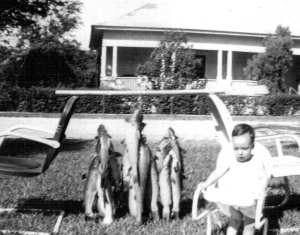
Everyone who hired Dad knew he would interrupt the job to indulge in his great love, trotline fishing in the San Marcos River. He used Crystal White soap for bait. The picture below is an average catch. By the time I was seven, I was helping him skin the fish. He then filleted them and put them in his freezer. When he had enough, he’d host a fish fry on his front porch: fried cornbread, Aunt Bettie’s potato salad, Aunt Jessie’s tartar sauce, my mother’s pecan pie.
Me, with the catch of the day, courtesy of Dad, ca. 1953
The summer I was eight, while I was spending a week with him, a friend who’d been hunting gave Dad two wild rabbits. Dad told me we’d have fried rabbit for supper. When I mentioned the plan in front of my uncle’s wife, she said, “You’re not going to eat a bite of that rabbit!” Thinking her just a tad bossy, I ate extra to spite her. Ten years later in a college biology course, I learned why I shouldn’t have eaten the rabbit. It’s a wonder I’m alive today.
A widower for over forty years, Dad lived on canned Pillsbury biscuits, sorghum molasses, instant coffee, and roll-your-own Bull Durham cigarettes. A daughter-in-law occasionally got him to eat a square meal.
He saucered his coffee and gave lessons to anyone who asked. On a camping trip, I watched him coach a thirteen-year-old boy. They sat side by side on the edge of an army cot, the boy holding the steaming, trembling saucer halfway to his mouth, Dad saying, “Now you’ve got to let go with that right hand.”
He let me roll cigarettes and smoked them even though they were severely deficient in tobacco.
The day he died, one of my uncles called to say Dad was sick but refused to see a doctor. My mother and my uncle’s wife convinced him to go with them to the hospital.
When he was settled in a room, a nurse came in and said, “Mr. Waller, I need to get your temperature.”
I was sitting here, working on a story, minding my own business, when I glanced at the clock.
11:08 p.m.
And today’s post is still a figment of my imagination.
Or it was. Or, more accurately, they were.
The process never varies.
I spend the day writing, reading, laundering, driving, meeting, critiquing, shopping, cooking and whatever other –ing happens along. And all the while, ideas whirl inside my head: I’ll write about this–and this–and this–and every this comes bearing its own first line, flawlessly conceived, flawlessly phrased, flawlessly flawless.
But by the time I open the screen with the words Add New Post emblazoned across the top, I find creation vaporized, all my pretty chickens taken in one fell swoop.
O hell-kite.
All right, that’s not what happens. Not literally anyway. Except for the hell-kite part. It’s genuine.
What happens is that I forget. I don’t carry little index cards in my pocket, as Anne Lamott says I should, or a little notebook in my purse. I don’t stop to record my epiphanies. I keep on whirling.
And then it’s 11:08, or in the instant case, 11:52 p.m. and counting, and I’ve said I’ll post daily, so I have to post something, so I just catch the nearest way. And tonight this is it.
In the matter of resolutions, I look to Henriette Ann Klauser’s Write It Down, Make It Happen.
Instead of focusing on action, Klauser focuses on objective: what do you want? Make a list, she says. Then put the list away. Relax and let the subconscious and the universe work.
In her book, she profiles the experiences of a number of individuals for whom the process has worked. The story that impressed me most concerned one of her sons.
He was a teenager when he showed her a list he’d found, I believe, on the floor of his closet. The implication was that it had been buried there for a while. He said he’d made it several years before–just written down five or six things he wanted. What was really interesting, he said, was that even though he’d forgotten about the list, everything on it had happened.
I read Klauser’s book at a time when I specialized in reading self-help books. I rarely took any of the advice in them, but Klauser’s plan required little effort–no getting up early, jogging an hour a day, giving up caffeine, eating seven helpings of vegetables–so I tried it.
I wrote the list: things I wanted, things I had no expectation of, things I could not imagine happening.
And then I lost the list. Buried it, in fact.
Five years later, during one of my feng shui periods, I ran across the book and remembered the list.
Everything I’d written had happened. I had it all.
So for 2011, I’m not writing resolutions. Instead, I’m going to make another list.


 M. K. Waller