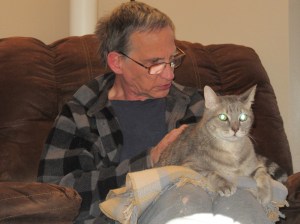
Ernest arrived at the veterinarian’s under the influence–that calming spray is magic–and was immediately ushered into the cat lounge, a small room with four comfortable chairs for humans and just enough space in the middle for a carrier.
Wall pheremones were plugged into an electrical socket, and music filled the air: the album Music for Cats. David Teies, a soloist with the National Symphony Orchestra, worked with animal scientists to develop music designed to help cats de-stress.
Eleanor Stanford, reviewing Teies’ CD for the New York Times, describes it as, “a series of whirring, lilting and at times squeaky musical tracks designed for cats’ brains and ears.”
In some tracks, sounds similar to the chirps of birds are overlaid with hurried streams of staccato for an energizing effect; in others, crescendos of purring and suckling sounds are designed to relax.
“To a human ear,” she says, “the sounds are otherworldly and at times soporific.”
Regarding cats, Charles Snowden, professor emeritus of psychology at the University of Wisconsin-Madison, who worked on the project, reports,
My cat, Pocket, could do with some music-induced relaxation. She was found wandering the streets of the Bronx, and when we took her from the New York City Animal Care and Control shelter to her new home in Brooklyn, she developed a nervous habit of running full speed down the hallway, smacking her head against doors along the way.
Listening to the track “Cozmo’s Air,” built upon soothing vibrato sounds, she sat still. By the end of the four and a half minutes, she had curled herself around the speakers, purring.
A link to one of the tracks, “Katey Moss Catwalk,” appears on Youtube. A link is below.
Ernest huddled in his carrier the entire time we were in the lounge, and I didn’t have a good view of him, so I couldn’t gauge his response, but he remained calm, even, the technician reported, during some unpleasant tests. So who knows?
Anyway, if he didn’t care for “Music for Cats,” I did. It is truly soporific.
Having recently been plagued by insomnia, I may buy a copy for myself.
*
For anyone who hasn’t run across the word before–and I mean no disrespect, since the first time I heard it, I had to look it up, and I was working on a master’s degree in English at the time–soporific means, “causing or tending to cause sleep; tending to dull awareness or alertness.”
The word appears in the first lines of Beatrix Potter’s The Tale of the Flopsy Bunnies.
It is said that the effect of eating too much lettuce is “soporific.”
I have never felt sleepy after eating lettuces; but then I am not a rabbit.
They certainly had a very soporific effect upon the Flopsy Bunnies!
From this we may infer than young children can learn big words and will learn them if they’re used and explained in the proper context. It is wrong to underestimate the abilities of children. They don’t have to be graduate students to add grown-up words to their personal lexicons.
*
On impulse, I include Rossini’s “Cat Duet,” sung by Felicity Lott and Ann Murray, also on Youtube.
One comment: “The perfect response to everyone who thinks classical music is dead serious, dull and boring.”
Another: “My cat just left the room.”
And a third: “Dear God I cannot believe two grown women actually did this.”
Ernest listened and appreciated it.
(Note: The comments above refer to a performance by Kiri Te Kanawa and Norma Burrows. But this one is funnier.)
Music for Cats
P.S. Ernest is doing well.
 Lester Hessenpfeffer awakens on a bath rug stuffed into the corner of a gigantic cage and stares into the open eyes of the bull mastiff. The dog wags his tail once, twice, and Lester feels his chest tighten with joy. Just before he fell asleep, he’d been preparing a speech for the dog’s owners about how he’d done his best, how he’d tried everything, but . . . Samson had ingested a few Legos the day before, which the owners’ great-grandchildren had left lying about. One had perforated his intestine. By the time he was brought to Lester’s clinic, the dog was in shock and the prospects for saving him were almost nil. Lester had slept in the cage with him to provide comfort not so much for the dog as to himself. He’d known Samson since he was a puppy, and he was very fond of the owners, an elderly couple who thought Samson hung the moon. They’d wanted to spend the night at the clinic, but after Lester told them he’d be literally right beside the dog, they reluctantly went home. Lester had hoped they’d get some sleep, so that they could more easily bear the news he was pretty certain he’d have to deliver in the morning. This is always the worst part of his job, telling people their pet has died. Sometimes they know it, at least empirically; on more than one occasion someone has brought a dead animal into the office hoping against hope that Lester can revive it. And when he can’t, he must say those awful words: I’m so sorry. He’s noticed a certain posture many people assume on hearing those words. They step back and cross their arms, as though guarding themselves against any more pain, or as though holding on more time the animal they loved as truly as any other family member, if not more. Oftentimes, they nod, too, their heads saying yes to what their hearts cannot accept.







 M. K. Waller