Day D: Dilly-Dallying #AtoZChallenge

Yes, definitely running behind in the Blogging from A to Z Challenge. No surprise, of course. If I were all caught up, I would worry.

Blogging with a theme would have helped. Instead of choosing topics, I’m wallowing around in a sea of them, waiting for one to come to my rescue.

April was a ready-made topic for Day A, because I planned to write about Texas bluebonnets anyway, and April is their peak time. But I could have published the same post on Day B, for bluebonnets.

Ben Hur, Day B’s official topic, appeared by chance–I checked the television schedule; I’ve always done my homework with half my brain trained on the TV–but about two paragraphs in, I remembered I had something to say about boo-boos, and say it I did. But instead of dropping Ben Hur, an any reasonable person would have done, I put Charlton Heston and Stephen Boyd on hold and wrote an extra post about boo-boos for a different blog, and then went back and finished Ben Hur. That was a big time waster. 

Day C? Before choosing contrariwise, I considered contractionCompositae, color, campfires, cats (of course) . . . chaos . . .
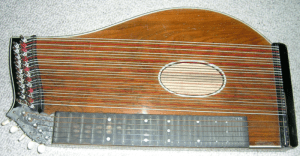
“Zither” by Ludwig Gruber (Own work) [Public domain], via Wikimedia Commons
As I was explaining on Day C before I strayed onto Alice and Lady the Horse, I considered making contrariwise my theme for the entire challenge. Instead of blogging from A to Z, I’d have blogged from Z to A. The topic of the Day A(Z) post would have been zither, specifically the one from James Thurber’s “The Night the Ghost Got In.

In case you’ve forgotten, Thurber says it began this way:

I had just stepped out of the bathtub and was busily rubbing myself with a towel when I heard the steps. They were the steps of a man walking rapidly around the dining-room table downstairs. The light from the bathroom shone down the back steps, which dropped directly into the dining-room; I could see the faint shine of plates on the plate-rail; I couldn’t see the table. The steps kept going round and round the table; at regular intervals a board creaked, when it was trod upon. I supposed at first that it was my father or my brother Roy, who had gone to Indianapolis but were expected home at any time. I suspected next that it was a burglar. It did not enter my mind until later that it was a ghost.

He woke his brother Herman and they went to the top of the stairs and listened. The footsteps had stopped, and Herman wanted to go back to bed, but Thurber insisted something was down there–and as soon as he said it, the invisible something ran up the steps toward them. Herman ran into his bedroom and slammed the door. Thurber slammed the door at the top of the stairs and held it closed, then cautiously opened it. No none was there. That should have been the end of the story, but in the Thurber household, nothing is ever the end.

The slamming doors woke Thurber’s mother. She decided there were burglars in the house. Because the phone was downstairs, she couldn’t call the police, so she “flung up a window of her bedroom which faced the bedroom windows of the house of a neighbor, picked up a shoe, and whammed it through a pane of glass across the narrow space that separated the two houses.”

“Guinea pig eating a piece of apple” by Jg4817 (Own work) [CC BY-SA 3.0], via Wikimedia Commons
After Mrs. Thurber finally made the neighbor, Mr. Bodwell, understand the burglars were in her house, not his–which wasn’t easy, considering he’d been awakened by a shoe shattering his bedroom window, and Mrs. Bodwell was in the background saying, “We’ll sell the house and go back to Peoria”–he called the police.

The police came and broke the door down (Mrs. Thurber wouldn’t allow her son to go downstairs to let them in because he was still dressed in a bath towel and would have caught his death of cold). A search ensued:

Downstairs, we could hear the tromping of the other police. Police were all over the place; doors were yanked open, drawers were yanked open, windows were shot up and pulled down, furniture fell with dull thumps. A half-dozen policemen emerged out of the darkness of the front hallway upstairs. They began to ransack the floor: pulled
beds away from walls, tore clothes off hooks in the closets, pulled suitcases and boxes off shelves. One of them found an old zither that Roy had won in a pool tournament. “Looky here, Joe,” he said, strumming
it with a big paw. The cop named Joe took it and turned it over. “What is it?” he asked me. “It’s an old zither our guinea pig used to sleep on,” I said. It was true that a pet guinea pig we once had would never sleep anywhere except on the zither, but I should never have said so. Joe and the other cop looked at me a long time. They put the zither back on a shelf.

Had contrariwise been the theme, that’s what I would have written about on Day A. What I’d have posted on Days B(Y) and C(X), I don’t know.

Nor do I know what I’ll write about today, on Day D. But by Day E, I’ll have something worked out.

***

Here are some #AtoZChallenge blogs you might enjoy reading.

Iain Kelly  

Mainely Write 

Anne’s Family History

Poetry, Law and Something More

Lighter Side

For the Master List, click here.

For more Day D posts, click AtoZ.

#AtoZChallenge Day C: Contrariwise

I believe I’ve fallen behind.

My Day B (April 2) post went online about five minutes before Day C started in my time zone. Now, less than four hours before Day D begins, I’m just starting on Day C.

Technically, I’m okay–observing the letter of the law (take some time to chuckle over that before reading on) but giving the spirit short shrift.

I haven’t observed a few other guidelines, either. I was supposed to–or maybe just invited to–choose a theme and reveal it here last month. But I couldn’t settle on anything, so I skipped that step.

It’s a shame, because I had a pretty good idea: Contrariwise. In the first place, I love the word. It reminds me of the first time I saw it in print, Alice’s meeting with Tweedledum and Tweedledee:

They stood so still that she quite forgot they were alive, and she was just looking round to see if the word “TWEEDLE” was written at the back of each collar, when she was startled by a voice coming from the one marked `DUM.’

`If you think we’re wax-works,’ he said, `you ought to pay, you know. Wax-works weren’t made to be looked at for nothing, Nohow!’

`Contrariwise,’ added the one marked `DEE,’ `if you think we’re alive, you ought to speak.’

`I’m sure I’m very sorry,’ was all Alice could say . . .

`I know what you’re thinking about,’ said Tweedledum: `but it isn’t so, nohow.’

`Contrariwise,’ continued Tweedledee, `if it was so, it might be; and if it were so, it would be; but as it isn’t, it ain’t. That’s logic.’

I was seven years old, lying on the back seat of my Uncle Joe and Aunt Laura’s new car, on the way home to Del Rio after a week-long visit with family in Fentress, and reading Alice in Wonderland, when all of a sudden, my stomach revolted. We stopped at the next service station so they could hose me down. My grandfather, who occupied the other half of the back seat, somehow managed to stay out of the line of fire. Aunt Laura said, “I told you lying down to read would make you carsick.” But it never had, and it hasn’t since, so I think other forces must have been at work.

Anyway, I’ve loved contrariwise ever since. Go figure.

I learned the base word, contrary, long before Alice. My great-aunt Ethel used it to describe her mare, Lady. It was an apt term. That horse personified the expression, “Beauty is only skin deep.”

She never unseated anyone; she simply refused to cooperate: hard to catch (she could walk faster than I); hard to bridle (she was taller than I); hard to saddle (she found the nearest pecan tree, leaned against it, and walked ’round and ’round while I followed, holding the saddle shoulder high and trying to heave it across a moving target.

Once saddled, she gave up being a moving target and became a stationary one. If I wanted to go one way and she wanted to go another, she didn’t insist on her way. She just stopped. And stood. And stood. And stood.

When I was four or five years old, my father let me ride her around in the little fenced enclosure where we kept chickens while he worked. Every time we neared the gate, she stopped. I would holler for my dad. He would come, say, “I told you not to let her get near the gate,” and lead her past. We would make another circuit. She would stop. I would holler for my dad. He would come, say, “I told you not to let her get near the gate,” and lead her  . . . You get the idea.

So there it was. Contrary Lady. Contrary Kathy.

Oh, darn. It’s nearly midnight. Day D.

Contrariwise.

***

To read what other bloggers in the Blogging A to Z Challenge wrote on Day C, click AtoZ.

***

Lewis Carroll, Alice’s Adventures in Wonderland.

Day B: Ben Hur #AtoZChallenge

Sunday night, and I’m watching Ben Hur on the local PBS channel. I saw it the first time on a Saturday afternoon at the Rita Theatre in Del Rio, Texas, in 1961. The movie was released in 1959, but Del Rio was an out-of-the-way place, and films didn’t travel as quickly then as they do today.

It’s a beautiful movie. The highlight is the chariot race that pits the main character, Judah Ben Hur, against his childhood friend, later enemy, the Roman Messala.

My friends and I didn’t go home raving about the chariot race, of course. The story was about friendship and betrayal and hatred and revenge and forgiveness–mature themes–and if we appeared too much interested in the race, adults might think us childish. Nine-year-old girls don’t like to be thought childish.

Watching tonight (for the fifth or sixth time at least), I think how silly we were. The chariot race is magnificent. Andalusian horses and Lippizans, pounding hooves, blades on the hubs of Mesalla’s chariot cutting through his rivals spokes, cars tipping, drivers flying out, being dragged and trampled, Messala lashing Judah with his whip, the crowd cheering…

One critic wrote that chariot race “will probably be preserved in film archives as the finest example of the use of the motion picture camera to record an action sequence. The race . . .  represents some 40 minutes* of the most hair-raising excitement that film audiences have ever witnessed.”

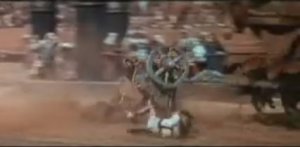
Wreckage from the chariot race in Ben Hur (1959) trailer. Public domain. Via Wikipedia.

Moreover, it was done without the aid of sophisticated computer software. Those were real men, real horses, real dangers. I’m glad I grew up before special effects became easy, when we were still capable of being impressed and saying Wow!

A Baby Boomer, I’ve had a lifetime of Wows! When I was five, Charlton Heston parted the Red Sea. Wow! When I was nine, Alan Shepard traveled into outer space. Wow! When I was ten, the Absentminded Professor ironed Flubber onto the soles of high school basketball players, and they bumped their heads on the gymnasium ceiling. Wow! When I was eleven, John Glenn orbited the Earth. Wow! When I was eighteen, two Americans walked on the moon. Wow! 

Older people told stories that elicited Wows, too. In 1910, my great-uncle and -aunt, Maurice and Bettie Waller, and Aunt Bettie’s best friend, Miss Annie Barber saw a stage performance of Ben Hur. After sending students home early–Aunt Bettie and Miss Annie taught together at a rural school–they and Uncle Maurice traveled by horse and buggy fifty miles north to Austin, saw the play, and immediately headed back home. They arrived just in time to open school the next morning.

When Aunt Bettie told me that, I was so impressed. Bouncing over a hundred miles of gravel roads in a horse-drawn buggy in less than twenty-four hours, just to go to the theater–that was a big deal.

But even more impressive–there was a chariot race. Two real chariots and two real horses. On the stage.

Wow!


To read what other A to Z Challenge bloggers wrote on Day B, click here.

***

* The chariot race scene lasts for nine minutes. I’m not sure what the critic’s reference to 40 minutes means.

“All in the April Evening”

Last year on Good Friday, I posted “All in the April Evening,” words and music by Sir Hugh Roberton, based on a poem by Katharine Tynan. I’d forgotten about it until a few minutes ago, when I looked at my stats page and saw the post has been viewed three times today.

Good Friday is past, but it’s never too late for music, so here it is again.

Roberton modified the words slightly; his version is the one I use. A link to the poem is here.

Links to performances and biographies of the composers follow.

Years ago my voice teacher introduced me to the song. Now I can’t sing it, because I can’t even hear it without tears.

***

All in the April evening
April airs were abroad
The sheep with their little lambs
Passed me by on the road
The sheep with their little lambs
Passed me by on the road
All in the April evening
I thought on the lamb of god

The lambs were weary and crying
With a weak human cry
I thought on the lamb of god
Going meekly to die
Up in the blue blue mountains
Dewy pastures are sweet
Rest for the little bodies
Rest for the little feet

But for the lamb, the Lamb of god
Up on the hilltop green
Only a cross, a cross of shame
Two stark crosses between

All in the April evening
April airs were abroad
I saw the sheep with the lambs
And thought on the Lamb of God

***

All in the April Evening
Sung by the Glasgow Orpheus Choir
Directed by Sir Hugh Roberton

 *

All in the April Evening”
Instrumental performed by the Grimethorpe Colliery Band

***

–from Wikipedia

Sir Hugh Stevenson Roberton (23 February 1874 – 7 October 1952) was a Scottish composer and Britain’s leading choral-master.

“Roberton was born in Glasgow, where, in 1906, he founded the Glasgow Orpheus Choir. For five years before that it was the Toynbee Musical Association. A perfectionist, he expected the highest standards of performance from its members. Its voice was a choir voice, its individual voices not tolerated. He set new standards in choral technique and interpretation. For almost fifty years until it disbanded in 1951, on the retirement of its founder, the Glasgow Orpheus Choir had no equal in Britain and toured widely enjoying world acclaim. Their repertoire included many Scottish folk songs arranged for choral performance, and Paraphrases, as well as Italian madrigals, English motets and the music of the Russian Orthodox Church. The choir also performed the works of Bach, Handel, Felix Mendelssohn, Peter Cornelius, Brahms and others.

“He wrote the choral work (words by Katharine Tynan) All in the April Evening, and the popular songs Westering Home and Mairi’s Wedding.

“He was a pacifist and member of the Peace Pledge Union. For this reason both he and the Glasgow Orpheus Choir were banned by the BBC from broadcasting during the Second World War.”

*

–from Wikipedia

Katharine Tynan (23 January 1859 – 2 April 1931) was an Irish writer, known mainly for her novels and poetry.

“Tynan was born into a large farming family in Clondalkin, County Dublin, and educated at St. Catherine’s, a convent school in Drogheda. Her poetry was first published in 1878. She met and became friendly with the poet Gerard Manley Hopkins in 1886. Tynan went on to play a major part in Dublin literary circles, until she married and moved to England; later she lived at Claremorris, County Mayo when her husband was a magistrate there from 1914 until 1919.

“For a while, Tynan was a close associate of William Butler Yeats (who may have proposed marriage and been rejected, around 1885), and later a correspondent of Francis Ledwidge. She is said to have written over 100 novels. Her Collected Poems appeared in 1930; she also wrote five autobiographical volumes.

Superscripts have been deleted from the Wikipedia articles.

***

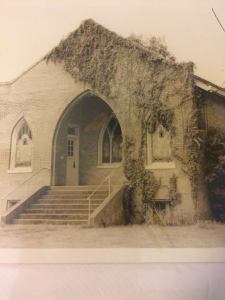
Fentress United Methodist Church (Fentress Community Church)
Fentress Presbyterian Church

April in Texas: Loveliest of Flowers #AtoZChallenge


Loveliest of trees, the cherry now
Is hung with bloom along the bough,
And stands about the woodland ride
Wearing white for Eastertide.

Now, of my threescore years and ten,
Twenty will not come again,
And take from seventy springs a score,
It only leaves me fifty more.

And since to look at things in bloom
Fifty springs are little room,
About the woodlands I will go
To see the cherry hung with snow.

~ A. E. Housman

***

I’ve signed on to participate in the Blogging from A to Z Challenge this month, and this is Day A: April.

Content was never in question: I post A. E. Housman’s “Loveliest of Trees” nearly every year at bluebonnet time as a reminder to seize the day, to get out and see beauty while it’s here–while we’re here.

Be sure to read–or at least scroll–to the bottom of the page. There’s an unexpected treat–not just a bunch of blue flowers.

Here’s a link to the A to Z Challenge Master List-links to the nearly 700 blogs taking part in the challenge.

A short analysis of  “Loveliest of Trees” appears at Interesting Literature.

Info about 2018 bluebonnet sightings can be found at the Texas Wildflower Report on Facebook.

Paintings by Julian Onderdonk.  http://texaspaintings.com/JulianOnderdonk.htm

… by Robert Wood. http://radstudies.tumblr.com/post/146477004552/robert-william-wood-american-1889-1979-texas

… by Porfirio Salinas. https://www.bing.com/images/search?q=Porfirio+Salinas+Bluebonnet+Paintings&id=61B8119D2E9E1BC63C9D221D5774776F07B2D13B&FORM=IDBQDM


And…

*****

To see what other bloggers wrote about on Day A, click A2Z.