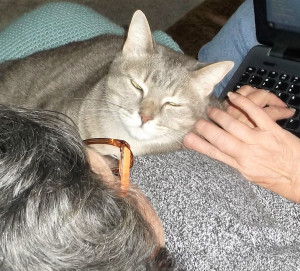
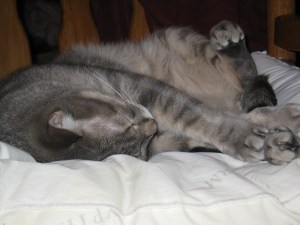
Sixteen pounds of Ernest lies across my right forearm, pinning it to the arm of the recliner. He’s on his side, positioned so he can turn his head and, with a moonstruck expression, gaze upside-down into my eyes and/or reach across to pat my chest. At present, he’s making biscuits on my upper arm and, head thrown back, pushing with his chin at the mouse, which will soon fall to the floor. It doesn’t matter. With my arm weighed down, my fingers are the only movable part of that appendage, and they’re typing as fast as my brain can make up words. The mouse is purely decorative. I’m surprised to have gotten a whole paragraph down.
Well, no, not really surprised. We do this all the time. I say, “We’ve talked about this. You…
Before airing tonight’s Inspector Lewis mystery, PBS issued the usual disclaimer, something like, This program contains material that some viewers might consider objectionable. Viewer discretion is advised.
Now. Every program contains something potentially objectionable. Objection is a matter of choice. (Why doesn’t the same disclaimer run before afternoon soap operas and tacky prime time reality shows? I choose to object to their content.)
It’s reasonable to warn parents about content they might not want their children to see, I suppose. Some PBS programming does fall into the PG range. Some people might not want their children to see as many murder victims as Robbie Lewis does.At times, I wish a firm hand had turned off the television before I saw the bisected woman in the first episode of The Tunnel.
Portrait of Jane Austen (Photo credit: Wikipedia)
But the same disclaimer ran when Masterpiece Theatre presented a series of adaptations of Jane Austen novels. What could be considered objectionable about Jane Austen novels?
Well, anyway, that’s one of the questions bouncing around my brain, taking up space that would be better occupied by more pressing concerns. Anyone who has an answer is welcome to leave a comment.
But first take note: They’re boring is not an answer. It’s not even accurate. Jane Austen is not boring. Attempts to change my mind are futile.
###
Now for #ROW80. The past couple of weeks haven’t been conducive to doing anything, productive or not. I didn’t dust, organize, or shred. But the most important item is behind me.
The July 27 Buffet
♫♫♫ Complete the edit the AMW story for its (I hope) last major critique I reversed the tampering, re-edited the story. When Kaye George sent her critique, excellent as usual, she added, “OK, stop fiddling with it, OK?” OK. After the other critiques are in. Next stop, the independent editor.
♪Draft the second half of the story “Texas Boss” and submit to AMW for critique “Brahman Baby” by Lea Maimone is licensed under CC BY-SA 2.0 (Photo credit: Wikipedia)I wrote several hundred words in a doctor’s waiting room, then two days later realized that I’ve left no place for the incident that gave me the idea for the story in the first place. I can insert it–I hope. But if I can’t make it work, I’ll have to leave it out, which comes under the heading of Kill Your Darlings. I would prefer not to.
Finish a very rough draft of “Thank You, Mr. Poe”
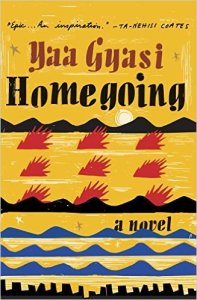
♪By September 5th, read at least ten of the books on my 20 Books of Summer 2016 list. (The list appears at Writing Wranglers and Warriors.) I finished Isabel Allende’s The Japanese Lover and began Yaa Gyasi’s Homegoing
‼Post #ROW80 reports on Sundays and Wednesdays. I’ve already dropped Sundays. This is the Wednesday report, late. The upside: If I’d reported on Wednesday, I’d have had nothing to say about #2.
Visit three new #ROW80 blogs a day
?Take three naps a week I napped. Don’t know when or how often, but I napped. The question: Is it acceptable to count naps I took because I couldn’t stay awake?
Go to bed at by 11:00 p.m. / 9. Cook at least one decent meal for David / 10. Dust the piano. / 11. Get rid of ten things a day / 12. Collect and organize books / 13. Shred
###
Carrying on:
August 7 Buffet
Eat no refined sugar. Eat a minimum of carbohydrates, including starchy vegetables and fruit. (I ate an ungodly amount of sugar over the weekend; had a reason but let things get out of hand; in other words, went crazy). A PET scan is scheduled for Wednesday, and, for the most accurate results, I need to be as sugar-free as possible. Bottom line, I hope I didn’t run up my blood sugar. Shouldn’t have but you never know. Cancer cells like sugar.
Finish critiques of remaining AMW stories and return to writers
Continue drafting the second half of the story “Texas Boss.” Revise enough to submit to AMW for critique
Finish a very rough draft of “Thank You, Mr. Poe”
By September 5th, read at least ten of the books on my 20 Books of Summer 2016 list. (The list appears below.)
Post #ROW80 reports on Sundays and Wednesdays.
Visit three new #ROW80 blogs a day
Take three naps a week
Go to bed at by 11:00 p.m. / 12. Cook at least one decent meal for David / 13. Dust the piano. / 14. Get rid of ten things a day / 15. Collect and organize books / 16. Shred
###
20 Books of Summer Buffet
√A Spool of Blue Thread by Anne Tyler
My thoughts on Anne Tyler appear here.
√Garden Spells by Sarah Addison Allen
Saw it, liked the cover, bought it. Serendipity.
√The Japanese Lover by Isabel Allende
Loved it. Allende tells more than shows and makes it work.
Homegoing by Yaa Gyassi
Semantic Antics: How and Why Words Change Meaning by Sol Steinmetz
White Heat: The Friendship Between Emily Dickinson and Thomas Wentworth Higginson by Brenda Wineapple
The Saturday Big Tent Wedding Party by Alexander McCall Smith
Dr. Wortle’s School by Anthony Trollope
Time of Fog and Fire by Rhys Bowen
The Autobiography of Mark Twain by Mark Twain
The Sweetness at the Bottom of the Pie by Alan Bradley
Because last night I waltzed up to the watermelon buffet and chose
Complete the edit the AMW story for its (I hope) final major critique
If I’d been taking naps, #1 would be only a memory. But there’s more to do.
Weeks ago, I edited out a couple of sentences but later realized I’d removed a bit of necessary information and created a contradiction. The error would be so difficult to resolve, and the lapse in logic was so subtle and so trivial, and the remaining text flowed so smoothly that I thought about saying, with Walt Whitman,
“Do I contradict myself? Very well, then, I contradict myself;”
and leave it alone and hope no one would notice.
But someone always notices. Sometime, somewhere, some reader would say, But the character says this is going to happen, and this doesn’t happen, or maybe it does, but whatever happened, she never says another word about it, so it sounds like maybe both things happened, and she should have told us…
So I tried a number of fixes, none of which pleased me, settled on one, and moved on. In a few days, I’ll go back and try again.
Just wo-ahn out
In moving on, I went from editing/revising to tampering. The official word is polishing, but I tampered: with words–thank goodness for thesaurus.com running in the background; with phrases; with sentence structure… Tampered with things better left untouched.
Tampering–especially when you think you’re polishing–is doomed to fail. It usually takes place near the end of a project, when you think everything is perfect, but not quite. So you make one little change, and then another, and another, and soon, part of your brain–the part where judgment lives–shuts off and you go on automatic pilot. You keep on clicking that mouse, cutting, pasting, copying, deleting, inserting…
Do this long enough and you can drain the life out of a story.
I’m most likely to tamper when I’m tired. I was tired last night. I should have watched Acorn TV or read or, better yet, given in and gone to bed at a reasonable hour. But I didn’t. Hyperfocused on the manuscript, I lost track of time and stayed up long after midnight. Then, in a perverse turn of events, I woke today up at 7:00 a.m.
So, as I said at the top of the page, I am tired.
A deadline approaches. I need to finish that story. First, though, I’ll let it rest. Several days. A week. Until I’m sufficiently rested. Until I don’t hate it with every fiber of my being. Until I’m detached enough to distinguish the good from the bad from the ugly.
#ROW80 Update
The July 20 Buffet
The original Buffet was meant to cover 80 days beginning with July 4, not just a few days or a week. Some haven’t been completed. Number 5 is on-going. So nothing changes.
Complete the edit the AMW story for its (I hope) final major critique Tried but didn’t finish, might have created a monster instead. See above, if you haven’t already.
Draft the second half of the story “Texas Boss” and submit to AMW for critique–Nope.
Finish a very rough draft of “Thank You, Mr. Poe”–Nope.
By September 5th, read at least ten of the books on my 20 Books of Summer 2016 list. (The list appears at Writing Wranglers and Warriors.) Still reading Isabel Allende’s The Japanese Lover, 68 pages toBy Mutari (Own work) [Public domain], via Wikimedia Commonsgo. I used the calculator to figure that out. I didn’t have to. I can still subtract in my head. But I don’t want to think that hard. Sad.
Post #ROW80 reports on Sundays and Wednesdays. It’s Wednesday and I’m posting.
Visit three new #ROW80 blogs a day.–Nope. I don’t know why, but nope.
Take three naps a week.–Nope. And I’m so sorry I didn’t.
###
The July 27 Buffet
They don’t change much. The point of the buffet, per shanjeniah, is to have choices and plenty of them. So I’ll add more watermelon.
Complete the edit the AMW story for its (I hope) final major critique
Draft the second half of the story “Texas Boss” and submit to AMW for critique
Fort Worth Indie Film Festival, 2016 – Family Shorts Block – “The Places You’ll Go”
It appears to be Wednesday–the scheduler from my doctor’s office had to tell me it wasn’t Thursday, but since her call woke me up, I take no responsibility for mixing up the days–and thus time for the #ROW80 report.
If I were playing by the rules, I would have reported last Sunday, but we’d been out of town all weekend and there was little to say. And since #ROW80 knows I have a life, I play by my rules.
I probably shouldn’t post today. I’m not in the best state of mind. I feel the way many of us do when we did the right thing, and because we did, life went all to you-know-where. But that’s another story. For anyone wanting more information, check the end of the post.
Fort Worth Indie Film Festival, 2016 – Family Shorts Block – “The Interview”
On a brighter note, which I’m sure will be welcome, David’s “Alike and Different” was screened at the Fort Worth Indie Film Festival on Saturday. There was a good turnout, and the audience laughed in all the right places. The one drawback was that two of the other films starred very cute children and thus received an inordinate amount of attention. I’ve advised David to include William and Ernest the Cats in all future videos. Children, no matter how cute, are not as cute as our cats.
Edit the AMW story for its (I hope) last major critique On the way home from Fort Worth, I scribbled on the manuscript. No major changes, the kind that will make a difference, just little changes in wording that will make no difference at all, but that will keep me doing the Should I? Shouldn’t I? dance. Just north of Waco, I put the ms. away to look at when I don’t care.
Draft the second half of the story “Texas Boss” and submit to AMW for critique Nope.
Finish a very rough draft of “Thank You, Mr. Poe,” the story I started last week Nope again.
By September 5th, read at least ten of the books on my 20 Books of Summer 2016 list. I’ve read about half of Isabel Allende’s The Japanese Lover. I’m glad I made the effort to see Allende when she was at BookPeople several months ago. I’m glad I bought the book. At the time, I felt guilty for buying a hardback I don’t have room for when I could have spent less for a Kindle “copy.” But after I read the first few pages, guilt atomized. It’s a delightful book, one that, for maximum enjoyment, must be read from paper. I still don’t know where I will put the book after reading it.
Post #ROW80 reports on Sundays and Wednesdays. I skipped Sunday. See paragraph #2, above.
Visit three new #ROW80 blogs a day. Started this but fell along the wayside.
Take three naps a week.* Not too bad. Napped Wednesday, Thursday, Friday (on the way to Fort Worth; I think that counts), Saturday (practically passed out, so maybe I can’t claim credit), and Sunday (on the way home). Sad but true, I can’t remember what I did Monday or yesterday. But that’s five naps, two more than I set for myself, and four more than I expected to take.
*Start as soon as this has been posted. I did, with a nap.
*****
The July 20 Buffet:
The original Buffet was meant to cover 80 days beginning with July 4, not just a few days or a week. Some haven’t been completed. Number 5 is on-going. So nothing changes.
Complete the edit the AMW story for its (I hope) final major critique
Draft the second half of the story “Texas Boss” and submit to AMW for critique
A Round of Words in 80 Days (#ROW80) is The Writing Challenge That Knows You Have a Life.
To read what other #ROW80 writers are doing, click here.
*****
“Alike and Different”
*****
For the curious: The reason for my nasty state of mind: I flossed out a crown. And had to get it put back in. As I said, you do the right thing, and still…
Edit the AMW story for its last (I hope) critique; Not yet, but tomorrow I’ll get a critique from another partner. It’s better to have everything in before making changes.
Write and schedule the WWW post at least two days before the July 19 deadline; It’s finished, and SIX days before the deadline. I’m going to the doctor to see what’s wrong–I never finish a piece SIX days before the deadline. I’ll continue to change little things, but it’s polished enough to be posted today. So I’m putting this one in the Watermelon Met* column.
Draft the second half of the story “Texas Boss” and turn in to AMW for critique;
Finish a very rough draft of “Thank You, Mr. Poe,” the story I started last week;
Complete the piece for the AMW blog and schedule it to post before midnight tonight. I posted it. Not before midnight. At 3:00 a.m. But I met the AMW deadline, and that’s close enough. Watermelon Met.
Summary: I set out to meet two deadlines and met them. The three remaining tasks aren’t time-sensitive. They carry over. The first, polishing the story for the proposed AMW anthology, must be finished by August 1, so it’s priority.
I’m adding three new goals to the list. Then I’m going to take a nap.
Edit the AMW story for its (I hope) final major critique
Draft the second half of the story “Texas Boss” and submit to AMW for critique
Finish a very rough draft of “Thank You, Mr. Poe,” the story I started last week
Today I’m posting on the Austin Mystery Writers blog about A Round of Words in 80 Days (ROW80): The Writing Challenge That Knows You Have a Life. I hope you’ll want to read the entire post. To do so, click the link at the bottom of this excerpt.
(If you read the whole thing, you’ll find out what I mean when I say I have the fantods.)
It is a truth universally acknowledged that to accomplish anything of worth, one must first set goals.
English: 85. Functions and Use Scenarios Mapping to Requirements and Goals (Photo credit: Wikipedia)
But goals drive me crazy, and that’s no secret either. Periodically, fellow Austin Mystery Writer Gale Albright pulls out her notebook and says, “All right. Let’s write down our goals.” Her goals, my goals, goals for us as a team. She’s serious about goals.
As soon as she says the magic word, I start a major case of the fantods. I can come up with goals, but when I see them on paper, claustrophobia sets in. I dig in my heels and think, “I will not do [whatever I’ve written that I will do]. And you can’t make me.” Sometimes I don’t just think it–I say it.
I’ve said it to Gale so often that now when she pulls out…
In June, David’s “Alike and Different,” a video “dedicated to the kindness of strangers,” won the Out of This World Award at the Lionshead Film Festival in Dallas.
The emcee who introduced the video said–and I wrote this down so I would get it right–“Not much I can say. Four minutes.” And then, to the audience, “We’ll see what you say.”
But he was half grinning/half giggling, which said a lot. And the audience laughed in all the right places.
When people you don’t know, and who don’t know you, laugh in all the right places–well, it makes you feel darned good.
Afterward, the emcee said David’s video shows what can be done using just a few household objects. I assume the household object to which he referred was my vegetable steamer. It does make a stunning spacecraft.
David @ Lionshead Film Festival, June 2016
When David told me the festival would be held at Valley View Center, an old mall on Preston Road, I said, “I know Preston Road.” And that is true. Sort of. I know approximately two blocks of Preston Road. Or, I knew two blocks of it. My knowledge peaked sometime between, oh, 1957 and 1965.
Consequently, as a navigator, I was hopeless. I read the big green exit signs and said things like, “There’s Walnut Hill Lane. I know that.” And, “There’s Belt Line. I know that.” I’m just a bit hazy on how all the streets I know fit together, like on a map.
[Typical on-the-road conversation:
David: The mall is in the Galleria area. Do you know where the Galleria is?
Me: Yes. It’s in Houston.]
Fortunately, David had performed due diligence and we reached our destination without having to depend on the kindness of strangers.
The Lionshead festival was smaller than others we’ve attended: all fifty-two films were screened in one small room. But I was impressed by the quality. “Call for a Good Time,” was one of my favorites. It was named Best Student Comedy Micro Short. The director, a student at Baylor University, said it was inspired by Baylor’s Moody Memorial Library, which serves as an unofficial social center. He said you have to get pretty deep into the library to study, which is what his characters do. Sort of.
My other favorite was a comedy titled “Hard Broads.” I can’t explain. You have to see it for yourself. It was named Best Female Directed Short. I didn’t see a Best Male Directed Short on the list.
Two days before the festival, the Dallas City Council voted to tear down Valley View Center to make way for the Dallas Midtown development. It seems it’s “a dead mall on life support.” Dead, maybe, but I liked what I saw of it–art galleries and studios and kiddie rides and a train. I’m a sucker for trains. And stuffed animals, and a store displaying the most well-endowed mannequin I’ve ever seen. I snapped a few of the highlights.
This slideshow requires JavaScript.
For more out-of-this-world experiences, check out Alien Resort.
William and Ernest have been part of our family for seven years now–or, more accurately, they have been the family for seven years–and to celebrate I’m reblogging a piece originally posted on Whiskertips. It was written when they were little and cute and spent less time sleeping in sunbeams.
Please forgive the mangled text. Because of changes WordPress has made to its platform, captions that appeared under photographs in the original posting do not appear under photographs in the reblog. They appear in the main text and make a bit of a mess. This poses a problem, as is obvious in the post below, but I can’t correct it.
I hate that. I hate the author. I continue to like the book, but the author I despise.
This time it’s Anne Tyler. I love her novels. The Accidental Tourist. Breathing Lessons. Dinner at the Homesick Restaurant. My favorites, if I have favorites, are Back When We Were Grownups and Saint Maybe.
Tyler’s plots are rather loose. Instead of going directly from here to there, they detour, turn corners you didn’t see coming, abandon the now for backstory that might take you a generation or two into the past before returning to the main narrative. “[C]haracter is everything,” Tyler said in an interview. “I never did see why I have to throw in a plot, too.”
She writes about families: ordinary, quirky, dysfunctional families–dysfunctional as ordinary families tend to be. They’re humble people, living in ordinary houses, working at ordinary jobs; their furniture is often mismatched and their carpet runners often worn from someone’s pacing. Her families stick together; children and grandchildren don’t stray far, come home often, and sometimes don’t leave at all.
Even their extraordinary problems are ordinary, the kinds of problems real people experience.
Her characters’ days are filled with matters of little importance. “As for huge events vs. small events,” says Tyler, “I believe they all count. They all reveal character, which is the factor that most concerns me….It does fascinate me, though, that small details can be so meaningful.”
She loves to “think about chance–about how one little overheard word, one pebble in a shoe, can change the universe…The real heroes to me in my books are first the ones who manage to endure.”
If her plots meander, it’s because they reflect the common, insignificant, everyday events that are so important, because, taken together, they form the essence of life.
Tyler cares about her characters. “My people wander around my study until the novel is done,” she said in another interview. “It’s one reason I’m very careful not to write about people I don’t like. If I find somebody creeping in that I’m not really fond of, I usually take him out.”
And therein lies my problem, and the reason that Anne Tyler is, for the moment, on my bad list.
She isn’t alone in liking her characters. I like them, too. Some of them, I love. And when one dies–or, as I see it, when she kills one–I take it personally. The character’s family stand around in the kitchen saying all the plain, simple, often awkward, frequently funny things that real people say when someone they love has died. They crowd together in pews to hear a sermon by a minister who didn’t know the loved one and might not know how to pronounce his name. They return home to refrigerators stuffed with casseroles and play host to friends and neighbors until they’re so tired they’re about to drop. Left alone, they get on one another’s nerves and offend with, or take offense at, the most innocent remarks. Then they pick themselves up and go on with their lives.
But I don’t. Because even though I stand outside the novel, reading about people who don’t exist, never have, never will, I know them. I’ve been where they are, said what they say, done what they do. And when I have to go through it one more time, with them–that seriously messes up my day.
Tyler always manages to redeem herself, though. One of her characters says or does something so remarkable, so absolutely right. And the world of the novel shifts. And so does mine.
In the book I’m reading now–I won’t mention the title so as not to spoil it for you–Tyler gives that role to the “disconcertingly young” minister who conducts the funeral. After a friend and a sister-in-law and a fourteen-year-old granddaughter wearing “patent leather heels and a shiny, froufrou dress so short she could have been a cocktail waitress,” have paid tribute to the deceased, he approaches the lectern and does what the deceased wanted–to “say something brief and–if it wasn’t asking too much–‘not too heavy on religion.'”
He starts by saying he didn’t know their loved one and so doesn’t have memories like they have.
But it has occurred to me, on occasion, that our memories of our loved ones might not be the point. Maybe the point is their memories–all that they take away with them. What if heaven is just a vast consciousness that the dead return to? And their assignment is to report on the experiences they collected during their time on earth. The hardware store their father owned with the cat asleep on the grass seed, and the friend they used to laugh with till the tears streamed down their cheeks… The spring mornings they woke up to a million birds singing their hearts out, and the summer afternoons with the swim towels hung over the porch rail… and the warm yellow windows of home when they came in on a snowy night. “That’s what my experience has been,” they say, and it gets folded in with the others–one more report on what living felt like. What it was to be alive.
And so Anne Tyler performs her magic. Once more I start bawling. I reconsider. My hostility passes into nothingness. I forgive her. We’re friends again.
I leave the church and go home with the family to a refrigerator stuffed with casseroles, and visit with their friends, and watch them give and take offense but then quickly, or perhaps slowly, repair their relationships, and pick themselves up and go on with life.
Now I have to read the second half of the book. That’s a lot of pages to cover without the character I love. But, like the others, I pick myself up and get on with it.
If I can’t have the character, I can still love Anne Tyler. And I will. And I do.
And because the music is so much fun, I lay there listening, replaying, listening, replaying… I don’t know how many times I listened to it. I also don’t know what time I finally went to sleep.
Ragtime is my favorite music–pianoonly, no interference from lesser instruments. Morath is my favorite ragtime pianist. There’s something about his touch… I can’t describe it, but it’s right.
I discovered him years ago in a program on PBS. Then I bought the LP. Recently I repurchased it for Kindle. (Or Fire, or whatever this beast is supposed to be called.)
Tonight, googling for a link to the album, I came across a 1986 New York Timesreview of Morath’s one-man show, “Living a Ragtime Life.” Serendipity. I didn’t know there’d been a show. Or that Morath is a musicologist.
Or also, according to Wikipedia, a composer, actor, and author. Or known as”Mr. Ragtime.” Or called a “one-man ragtime army.”
I hadn’t planned to say this much about Max Morath, but he’s worth some words, so I’ll quote part of the Times review (which you may skip if you wish):
”IT’S our music that labels our history, more than our wars and our politicians,” asserts Max Morath early in his one-man show, ”Living a Ragtime Life.” Seated at a grand piano under a Tiffany lamp, and flanked by an Edison phonograph, the musicologist, storyteller and expert in turn-of-the-century Americana seems the very epitome of an old-time vaudevillian. But in reflecting with a sly ironic humor on our longing for ”the good old days,” Mr. Morath is much more than a devoted nostalgist. He is a philosopher of American popular culture with Mark Twain’s gift of gab and farsighted historical view. The picture he paints of the 1890’s, ”when sex was dirty and the air was clean,” is of a world that we might want to visit, but, he convincingly persuades us, we almost certainly wouldn’t want to live there.
But back to what I was listening to over and over last night and why.
First the why: As I’ve already said, it was fun.
The what: Music from the turn of the century–that other century–through World War I. Some pretty bad songs. Some pretty silly ones. Some pretty good ones, usually because they were pretty bad or pretty silly.
Chorus: We don’t want the bacon We don’t want the bacon, What we want is a piece of the Rhine. We’ll feed “Bill the Kaiser” with our Allied appetizer. We’ll have a wonderful time. Old Wilhelm Der Gross will shout, “Vas is Los?” The Hindenburg line will sure look like a dime; We don’t want the bacon We don’t want the bacon, What we want is a piece of the Rhine.
CHORUS 1: “You are going far away, but remember what I say When you are in the city’s giddy whirl. From temptations, crimes, and follies, Villains, taxicabs and trolleys, Oh! Heaven will protect a working girl.”
CHORUS 2: “Stand back, villain! Go your way! Here I will no longer stay, Although you were a marquis or an earl. You may tempt the upper classes With your villainous demitasses, But Heaven will protect a working girl.”
And a song the sheet music of which Max Morath’s fourteen-year-old mother was not allowed to bring home: “Always Take a Girl Named Daisy.”
If you take a girl out walking Down a little shady dell Always take a girl named Daisy ‘Cause daisies won’t tell
The lyrics quoted here are just excerpts of the songs, and are just a sample of Morath’s presentation.
So there’s my idea of fun, the pastime that kept me awake when decent folk were sound asleep. It’s not for everybody, I realize–though, of course, it should be.
Says Morath, “Scorned by the establishment as ephemeral at best, trashy at worst, ragtime was the fountainhead of every rhythmic and stylistic upheaval that has followed in a century of ever-evolving American popular music.”
If ragtime and its offshoots strike your fancy, the album cited at the beginning of this post and “Living a Ragtime Life” are available from Amazon (and other vendors no doubt).
And the program “Max Morath: Living a Ragtime Life!” that I watched on PBS many years ago now appears in seven parts on Youtube.
A pilon:
CHORUS: I’ve got a ragtime dog, and a ragtime cat; A ragtime piano in my ragtime flat; … Got ragtime troubles with my ragtime wife: I’m certainly living a ragtime life.
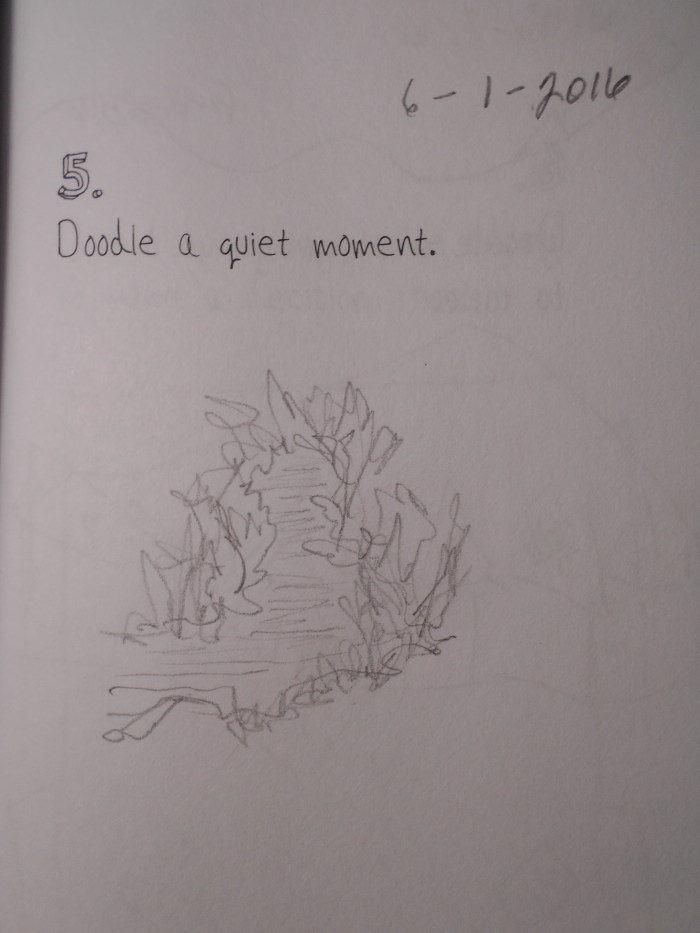
For the past few weeks, on my personal blog, I’ve posted doodles I’ve done from prompts taken from 365 Days of Doodling by Carin Channing.
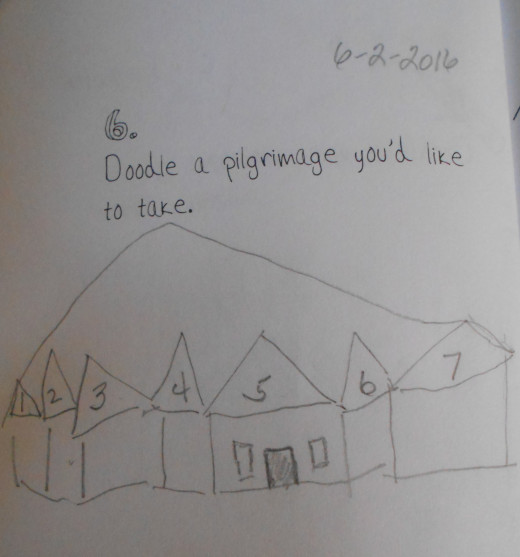
Doodle #6. Doodle a pilgrimage you’d like to take.
Doodle #6. House of the Seven Gables
In November, while in Salem, Massachusetts, for Writer Unboxed’s UnCon, I’ll make a pilgrimage to the House of the Seven Gables, which Nathaniel Hawthorne made famous in his novel of the same name.
Fortunately, it won’t look like my doodle. If I’d been sensible, I’d have chosen to travel to a two-dimensional setting, something flat, with no corners or gables. I’d have planned the drawing more carefully, too. I was so wrapped up in keeping the gables from running off the page, I forgot the house would need a roof.
To help with identification, I numbered the gables.
Many years from now Will you still be sending me a valentine Birthday greetings, bottle of wine?
If I’d been out till quarter to three Would you lock the door? Will you still need me Will you still feed me When I’m sixty-four?
~Lennon & McCartney, “When I’m Sixty-Four”
My cousin Mary Veazey (the cousin who used to boss me around) told me that while preparing to attend her high school reunion, she wondered how many years it’s been since she graduated. She did a little subtracting and came up with the number 60.
She subtracted again, several times in fact, but kept getting the same number.
Sixty years since high school graduation.
She’s the oldest of the cousins, and I’m the baby, about fifteen years younger. That used to mean she was practically a generation ahead of me. She says I was more like her niece than her cousin. Lately, though, she’s suggested I might be catching up with her. For instance, she’s been saying things like, “When did you get so old?”
But I’m kind, so when she said she graduated sixty years ago, I agreed the number is impressive but refrained from saying, “Wow.” Wouldn’t have been prudent. She might have asked how long ago I graduated.
I’ve been sitting here playing a game on my laptop–Scary Halloween Match, which is a silly because there’s nothing scary about it except how many hours I’ve invested in playing it–and letting my mind wander. It’s funny the things that floated by on my stream of consciousness. James Joyce would be impressed.
Bob Dylan performing at St. Lawrence University in New York. (Photo credit: Wikipedia)
One of the floaters took me back to high school. My friend and I played guitars and sang here and there whenever an invitation arose. Bob Dylan; Peter, Paul, Mary; a lot of our material came from their recordings: “Blowin’ in the Wind,” “Leaving on a Jet Plane,” “Puff, the Magic Dragon,” songs like that.
At one program we sang Lennon and McCartney’s “When I’m Sixty-Four.” I don’t know whether our contemporaries approved, but several retirees told me they got a real kick out of it.
I got a kick out of it a year later when Mary Veazey’s seven-year-old son asked me to sing, “Blow Your Hair Off.” It took a while, but finally I realized that’s how he remembered, “When I get older / losing my hair.”
One thought, however, stopped my stream of consciousness, just dammed it up and let nothing else through:
I’m sixty-four.
When did that happen?
I don’t feel sixty-four. I don’t look sixty-four. Or didn’t. After six rounds of chemotherapy, I really look a hundred and twenty-four. Tonight at dinner I remarked that chemo has brought out every wrinkle I never expected to have. David said I don’t have any wrinkles at all. He’s kind.
He’s something else as well. He’s sixty-three. And at fourteen months my junior, he’ll never catch up with me.
Which means I married a younger man.
Which means I’m a cougar.
Sixty-four, you can go jump in the lake.
###
I searched for a recording of “When I’m Sixty-four,” but they’ve all been blocked because of copyright. As a writer, I support the right of artists of all kinds to be paid for their creative efforts and their labor. As a former librarian and as a blogger, I wish the people responsible for the blocks would loosen up and give me what I want.
Doodle #4. Doodle something you love about yourself.
Doodle #4. Something I love about myself. Had to think about it for several days before doodling.
Doodle #4: I thought about skipping #4 because I couldn’t think of anything. But skipping one might lead to skipping two or three, or… It’s a slippery slope. So I settled for the question mark.
Then I remembered hair. We’ve had our battles, but for the most part I like it. Neil, my stylist, told me if he ever puts on a show, he will take me along as his model. I’ve been taken to spelling contests, declamation contests, prose reading contests, ready writing contests, and typing contests, but at each I had to do something. Neil is the only person to suggest I could just sit and let people look at me.
About that typing contest: Friday morning, my teacher thought I could type. Friday afternoon, she knew I couldn’t. She never said a word of reproach to me, but I’m sure she wished I’d just sat and let people look at me. What she said in the teachers’ lounge I can imagine.
But back to hair: Here’s a personal chronology:
*Bald plus curls.
Scraggly ponytail, but it was Christmas morning and hair wasn’t a priority
*In vogue: the ponytail.
My ponytail was so successful that the neighbor’s granddaughter, Connie, wanted one and wanted it now. Her mother, thinking way outside the box, pulled up what hair Connie had in back and put a rubber band around it. Then she cut strips of newspaper and stuck the ends under the rubber band. Instant ponytail.
*Gone with the ponytail.
Weary of doing battle every morning over tangles, my mother and I agreed a new ‘do was in order. Dixie at the beauty shop whacked off the ponytail. Somehow, the curls went, too. Cowlicks stayed.
*Pain.
Pink foam rollers. Brush rollers. Bobby pins. Hair dryers. Teasing combs. Hairspray. Hairspray combined with high humidity. Wishing for the ponytail.
c 2006 throwback to 1971
*Short and… Short and straight. Short and Afro. Short and straight. Short and gray. Short and rinse. Short and gray. Curls are back. Don’t know why.
I had the official outfit, complete with coonskin cap, and a charred mop handle named Old Betsy, and I spent a lot of time in the back yard hiding behind the butane tank and shooting bears and Indians. I would have made a good Davy Crockett. I knew the song by heart and was happy to belt it out for anyone who asked.
But somewhere along the line I lost focus–maybe when the TV show was canceled–and by the time I was eight, I had my heart set on growing up and wearing very high heels and smoking Winston cigarettes and leaving a red lipstick stain on the filter, like my cute little red-headed aunt Betty did. She gave me a pair of decommissioned very high heels for play clothes. I tied an old sheet around my waist and clomped up and down our concrete driveway, holding a candy Winston in the approved fashion and looking teddibly sophisticated. It’s a wonder I didn’t fall and break my neck.
Betty and me a long time ago. Betty is wearing very high heels.
Actually, I wanted to grow up and be Betty. But I didn’t have red hair. You couldn’t be Betty without having red hair.
Well, anyway. By the time I was ten and had outgrown Betty’s size 4½B shoes–she was my cute little red-headed aunt–I knew that wearing spike heels and smoking wouldn’t be quite enough for a career. I also knew that if I even thought about taking a puff of a real cigarette I would be grounded until I was older than Betty. So I settled on my third and final choice:
I would grow up and be Roberta Peters.
I would wear low-cut gowns with fitted waists and big, swishy skirts and sing at the Metropolitan Opera.
Publicity photo of soprano Roberta Peters. (Photo credit: Wikipedia) By Sol Hurok, concert promoter. (eBay item photo front photo back) [Public domain], via Wikimedia CommonsMy specialty would be Adele’s “Laughing Song” from Johann Strauss’ The Fledermaus. In English, of course, so the audience would know how funny the lyrics are.
I would include lyrics here, but the only ones I’ve located online aren’t nearly so amusing as those Ms. Peters sang, and I refuse to settle. If I ever find my opera book, I’ll come back and fill in the blank. The book is around somewhere, in a box or maybe just under something. Many of my possessions are currently under something.
The doodle depicting my career choice shouldn’t require commentary, but I’ll comment anyway, just in case. As you might have inferred, the ha ha ha‘s are taken from “The Laughing Song.” The notes rising from my/Ms. Peters’ right hand to the top of her head symbolize the range the singer covers at the end of the song. I think it goes from D above middle C to a high D-flat. When I find my opera book, I’ll check that. Some singers work their way up. The genuine articles make the jump from low to high with nothing between. No safety net.
Here’s Roberta Peters singing “The Laughing Song” in German. The language doesn’t really matter, nor do the lyrics. The voice is everything.
Although this blog is dedicated to telling the truth, mainly, I’m going break with tradition and tell the truth whole, plain, and unvarnished:
I still want to be Roberta Peters when I grow up.
###
Doodling prompt from 365 Days of Doodling by Carin Channing
 Writing Wranglers and Warriors
 Ernest pinning down left arm



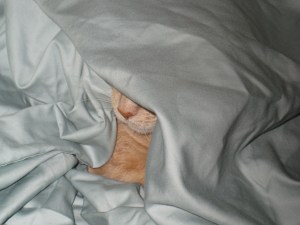








 William with straw When William came to live with us, he brought a straw toy.
 William and Ernest with straw
  More William and Ernest with straw
  William and Ernest without straw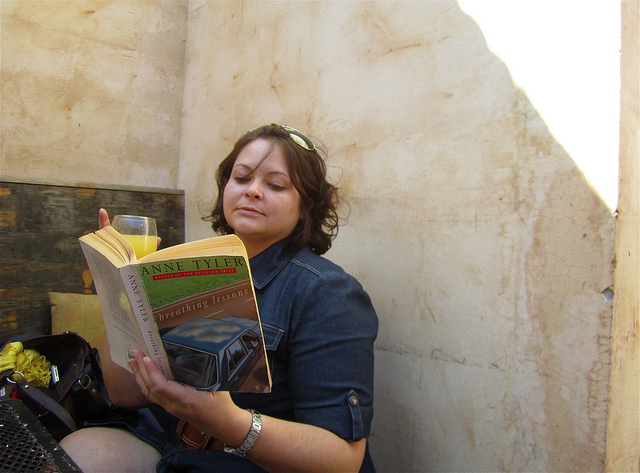

![House of the Seven Gables. By Detroit Publishing Co. [Public domain], via Wikimedia Commons](https://kathywaller1.com/wp-content/uploads/2016/06/house_of_the_seven_gables_1915.jpg)







 M. K. Waller
