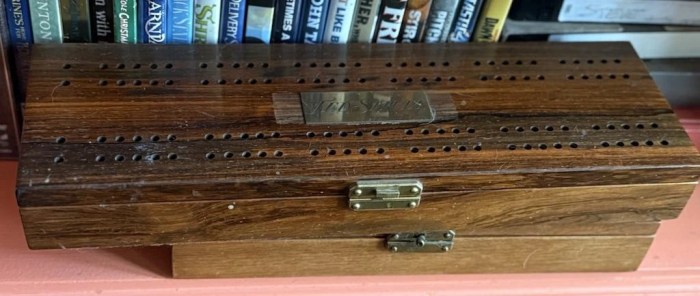
“Those look like holes you stick little thingies into.”
“What kind of thingies?”
“Little thingies. They’re called, like, widgets.”
“But what’s the wooden thingie for?”
“It looks like part of a game.”
“We need one of those books. Like a backwards dictionary. Where you look up a picture.”
“How do you look up a picture?”
“Well, there’s some kind of book where you can do that.”
“What’s it called?”
“Wait! I remember. The game. My aunt plays it. It’s called ‘cabbage.’”
“We need a librarian.”
***
FRIDAY FICTIONEERS is a weekly challenge to write a 100-word story in response to a photo prompt. To read other Friday Fictioneers’ stories, click on the frog. To participate, find the rules and the photo prompt at Rochelle Wisoff-Fields’ blog.
There’s nothing like a writing challenge to teach you something you should already know. Or to remind you of something did know but forgot or stopped believing.
For several months before the fundraiser began, I went through a slump. The I-hate-writing/Everything-I-write-is-worthless/The-book-I’ve-been-working-on-forever-is-trite-trivial-stupid-flawed-doomed/I-can’t-make-the-plot-work-anyway/I-should-scrap-all-40,000-words-and-binge-watch-Law-and-Order-and-play-Candy-Crush slump.
It happens periodically. But this was a particularly long and depressed dry spell.
And when you get out of the habit of writing, it’s difficult to start again. I dreaded the arrival of May 1. It arrived anyway.
To ease back in, I got out the journal I bought in January. I had resolved to write in it every day. That resolution, of course, wandered away with the others. But better late than never.
I’ve always enjoyed writing longhand, so the journal seemed just the thing. Sort of.
The first few days were modified torture. I stopped every few minutes to check the clock: 25 more minutes; 18 more minutes;12 more minutes; 11 more minutes . . .
It was like writing a 500-word essay in high school, when I stopped every few lines to count the words I’d written.
That went on for eight days.
On May 9, sitting in the infusion room at Texas Oncology, I opened the journal, uncapped my pen, and prepared for misery. After two lines in which I expressed frustration at having gotten myself into this mess, a shift occurred. I was suddenly rewriting part of a scene for the novel—brief, but pivotal to the plot. Then I drafted a new scene.
While I was working, the volunteer who’d provided me with a blanket and a cup of hot tea approached. “May I ask a question?”
Of course.
“Are you writing a journal?”
I said I was.
“The reason I ask,” she said. “My daughter gave me a journal, but I don’t know what to write in it.”
“Anything,” I said. “Everything. Start by writing, ‘I don’t know what to write. I don’t know what to write. I don’t know what to write.’ And suddenly you’ll be writing about something.”
Arkansas
She smiled. “That’s very encouraging.”
After she left, I thought, “Well, d’oh.” How many times had I read that same advice in how-to-journal books: Start writing about nothing and your topic will appear.
How many times had I told my students to do that? How many times had I forgotten to take my own advice?
And what had I just done? I’d started writing about nothing—I am so frustrated with having to write and not being able to think of anything to say—and worked my way into something. The very something I’d needed—and wanted—to write.
Three days later, we left on a road trip. I wrote in the car. From Little Rock to Knoxville to Lake Charles to Houston to Austin. On smooth roads (Arkansas and Tennessee) and rough (Louisiana). Through road construction (Texas).
Louisiana
I worked on that-trite-trivial-stupid-flawed-doomed book. I wrote new scenes and revised old ones. I wrote notes about scenes I need to shift around, characters I need to flesh out, darlings I need to kill.* I wrote blog posts. I continued to write that night at the hotel.
I didn’t stop at 30 minutes. I kept going for two or three hours.
Since we got home last week, I’ve continued to write. I’ll write to the end of the fundraiser.
And on June 1, I’ll still be writing.
Thanks to the American Cancer Society for all it does to find a cure for cancer and to make life better for those affected by it.
“The phrase “kill your darlings” has been attributed to many writers over the years. Writers as varied as Oscar Wilde, G. K. Chesterton, and William Faulkner have been credited with coming up with the phrase. But many scholars point to British writer Sir Arthur Quiller-Couch who wrote in his 1916 book On the Art of Writing: “If you here require a practical rule of me, I will present you with this: ‘Whenever you feel an impulse to perpetrate a piece of exceptionally fine writing, obey it—whole-heartedly—and delete it before sending your manuscript to press. Murder your darlings.’”
Since then, variations of Quiller-Couch’s phrase has been used by many writers and scholars. Stephen King had this to say on the art of writing in his book On Writing: A Memoir of the Craft: “Kill your darlings, kill your darlings, even when it breaks your egocentric little scribbler’s heart, kill your darlings.”
Sometime back in the 1930s, my grandmother picked up the telephone receiver just in time to hear the Methodist minister’s wife, on the party line, drawl, “I am just wo-ahn out. I’ve been waterin’ the yahd.”
To the layman, the statement might not seem funny, but my family has its own criteria for funny. And so those two sentences entered the vernacular.
They were used under a variety of circumstances: after stretching barbed wire, frying chicken, mowing the lawn, doing nothing in particular.
My father would fold the newspaper, set it on the table, and announce, “I am just wo-ahn out. I’ve been waterin’ the yahd.”
I am wo-ahn out now but not from waterin’ the yahd.
Last night David, the family’s official printer, printed the manuscript of what I’ve been calling my putative book. It runs to over two hundred pages, 51,000 words. It isn’t finished–far from it. There’s more to write, scenes to put in order, clues and red herrings to insert, darlings to kill. All that stuff. And more.
However, for the first time it feels like I can stop calling it putative. No longer supposed, alleged, or hypothetical. It’s looking more like a potential novel. Possible, Even probable,
Now, about being wo-ahn out.
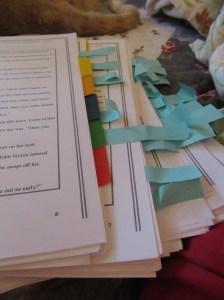
Last night I started putting the manuscript, scene by scene, into a three-ring binder. That required using a three-hole punch.
I hate using three-hole punches. I hate fitting the holes in the paper onto the binder rings. They never fit properly. Getting them on the rings requires effort. It’s tiring.
When I went to bed, I was all the way up to page 37.
Then I woke at 5:30 this morning. Instead of turning over and going back to sleep, I got up. I just couldn’t wait to get back to organizing my manuscript.
But I didn’t organize. I managed to drop the whole thing and then couldn’t pick it up. I had to wait for David.
By the time the notebook and manuscript were back in my possession, I was sick and tired of the whole thing. I played Candy Crush.
If I’d had any sense at all, I’d have gone back to bed. I was sleepy. I felt awful. I needed to sleep.
But did I go back to bed? Noooooooooooooooooooooo. That would have been the act of a rational person.
I stayed up added to my sleep deprivation.
I could go to bed right now. I could conk out and tomorrow feel ever so much better.
But will I? No. Because I’m too tired to stand up, too tired to put on my pajamas, too tired to pull down the sheets.
I am just wo-ahn out. I’ve been waterin’ the yahd.
***
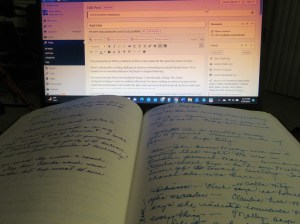
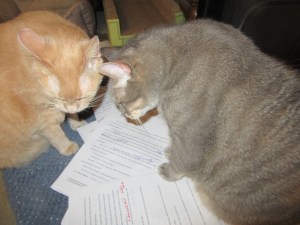
Look above the notebook in the picture and you will see the tail of William the Cat. I lay on the bed all afternoon doing trivial, unnecessary tasks. William lay on the bed all afternoon and slept. He should be writing the book.
I like writing dialogue. I hear characters talking while I write. Sometimes I hear them talking when I’m trying to go to sleep; I don’t like that.
The critics
I like building plots, getting the structure right. There’s a line from a high school literary magazine I read a million years ago when I was teaching–I don’t remember the author’s name: “Poetry is geometry exploded.” It’s also an algebraic equation. When I get a turn in the middle, and the two halves balanced, the solution found, I’m happy.
I like writing parodies. Here’s a link to a verse based on Leigh Hunt’s “Jenny Kissed Me.”
I like blogging because I can go back and fix errors in both grammar and judgment, and I can write whatever I want and not care what people think. (Yeah, right.)
I like best when I have written. And revised. And revised. And written. And edited. And proofed. And finally given up and let it go.
My author-friend V.P. Chandler wrote today about putting a sticker on a little calendar when she accomplishes something.
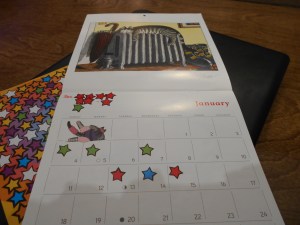
That reminded me I used to do the same thing to designate when I worked on my writing. The system lasted a few days before breaking down, mostly because of color coding.
January 2015. Color-coded accomplishments. Can’t remember what the colors meant.
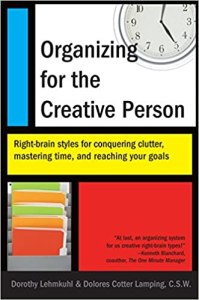
There’s a book, Organizing for the Creative Person, that says creative people should never try to color code. I read the book not because I considered myself creative but because at the time I read every self-help book I could find, especially those about organizing. The book was excellent.
It said that creative people file on the floor behind their desks, and that’s when I knew I was definitely creative, because my office floor was always covered with little piles of paper. I had to take great care not to roll my chair over them when I left my desk.
Anyway, the book advised not to color code but since I rarely take advice from self-help books, there went my system of recording my writing accomplishments. And the less I record, there less there is to record.
It was a shame, because I just loved the little Kliban Kat calendar bought especially for the purpose.
Anyway, when V.P. mentioned calendars, I thought about planners. I love planners and have spent several hours this week wandering through Amazon, looking at planners. But I decided I couldn’t justify spending so much–because it would have to be a really special planner–on something I wouldn’t use more than a week or two. (My best planner is David’s Google calendar, and it works because he uses it and reminds me of what he knows good and well that I won’t remember.)
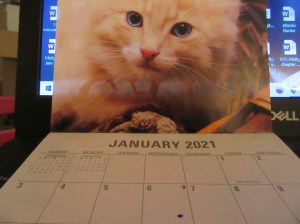
January 6, 2021. Accomplishment (little blue dot)
Anyway, if I can’t justify a planner, how can justify buying a calendar?
Then I remembered the calendars my friend Mariana gave me for Christmas–one is just the size for stickers. But it has cats on it, real ones, and I hate to think of messing it up with extraneous matter. It should remain pristine.
So I went back to Amazon . . .
But then I came to my senses. I will not just hang that little cat calendar on the wall. I will use that little cat calendar. I will put a sticker on it for every time I write. That is the best use I can put it to.
As a symbol of my intent–because I have no stickers–I inked a little circle on January 6, when I wrote a scene and sent it to my critique group. I had to look back in my email to find the date; sent mail makes a wonderful archive.
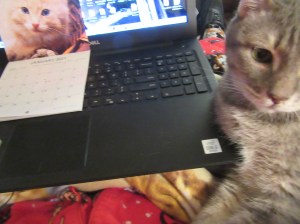
Ernest, impeding accomplishment
The cat calendar will be just for writing. The large kitten calendar Mariana gave me might become a record of general accomplishments. Like getting my first COVID-19 vaccine dose yesterday. Cooking. Putting on makeup. Getting out of bed before noon. Not playing Candy Crush. Brushing my hair.
The calendar issue having been solved, I now move on to the next project: buying stickers. One color only.
I shall not, will not, color code.
#
Maybe I’ll use gold stars for working on my novel and red stars for other writing. Surely a little color coding couldn’t hurt.
(The following was first posted on partner blogs Ink-Stained Wretches and Austin Mystery Writers.
I wrote it, but, due to technical difficulties,
couldn’t reblog it here.
Had to post the whole shebang again.)
When I opened my personal blog, back in the Dark Ages, I titled it To Write Is to Write Is to Write. I intended to tell everything I know about writing.
Everything I knew filled roughly 2.5 posts.
Now I write about what I don’t know about writing and leave giving advice to those who know what they’re doing.
Reverting to my old librarian persona, I also write about blogs by writers who aren’t anywhere near running out of material. Here’s a short list.
Each Friday, Rochelle Wisoff-Fields invites readers to compose 100-word stories based on a photo prompt. Writers post stories on their own blogs and then link to an inLinkz list to share with other Fictioneers and with the public. It’s fun. Specific rules are found here.
Sammi Cox posts a weekend word prompt: The rules: “Write a piece of flash fiction, a poem, a chapter for your novel…anything you like. Or take the challenge below – there are no prizes – it’s not a competition but rather a fun writing exercise.” Participants are free to link their efforts in the comments.
TSRA also promotes—and thank goodness, considering how much writers need it—”FUN and an OASIS OF CALM and Font of useful Knowledge andTips for Indies (please do NOT feed my naughty chimps or they may follow you home) from the woes and stresses of the real world”—such as,
Kate was on a bit of a hiatus for a while but is back now with “Social Distancing for Dogs.” She’s posted a lot of dog stories—my favorites are about the dear (and sometimes smelly) Macaulay, the dog with the Neville Chamberlain mustache, including
I could go on—my first draft is twice as long as this one—but the deadline loomed hours ago. I hope you’ll check out some of these blogs. And I hope you enjoy them and return for more.
And—do you have any blogs you’d like to share? Including your own. Record them in a comment.
My blog’s original title, To Write Is to Write Is to Write, is a fragment of a quotation from Gertrude Stein, who knew how to write and who told Ernest Hemingway how to write.
The current title comes from the first chapter of Mark Twain’s Huckleberry Finn. Mark Twain knew all about writing. Ernest Hemingway said so.
I woke late this morning. The day was overcast, blinds were drawn, room was dim.
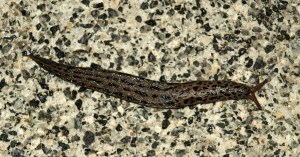
On the wall to my right, I saw a thing.
It was a brown, elongated thing, about four inches from on end to the other, two-thirds of the way up the wall, behind the cedar chest, pointing toward the ceiling.
I couldn’t remember any light switches or thermostats in the vicinity. I sat up, squinted. Squinted some more.
Got up, tiptoed—why?—to lamp on left side of the room, turned it on, advanced a half-step toward the unidentified object.
Saw little horns sticking out of the end at the top.
Called for David. “Now!”
He came. “A slug!”
He picked up a shoe.
“Noooooooo.”
He ran for a paper towel.
The camera was in the living room. “Should we take a picture first?” I stepped toward the door.
“It might get away.” Paper towel in hand, David pounced, then ran.
There went my chance for authentic photo on my blog post.
He returned. “I relocated it.”
And all was well.
But questions remain:
Where did he come from? How did he get in? Where had he been hiding?
How long did it take him to crawl up that wall? I mean, he’s a slug. Sluggish. Did he cover all that territory while I slumbered only inches away?
What if he had turned toward the bed instead of away from it? Would I have opened my eyes and found myself nose to nose with him?
And, more to the point—
Was he alone? Or did he have company? Are there more? His spouse? His children? His sisters and his cousins and his aunts?
His sisters and his cousins, Whom he reckons up by dozens, And his aunts!
A Facebook friend asks what we’ve accomplished during this week of sheltering in place.
On Sunday, I wore matching socks.
Things have gone downhill since.
Sleep deprivation takes its toll. Reasons are varied and fixes limited. And unpleasant. I don’t mind meditating, but I do mind turning off screens an hour before bedtime so my “overly sensitive” pineal glad isn’t exposed to too much blue light.
I also mind not being able to write at night, which is my most creative time.
I’ll do what I’m supposed to, but I won’t like it.
Last night, dead tired after three wakeful nights, I fell into bed, certain I would immediately pass out. Instead, before Morpheus overtook me, I thought about Donny. He’s a fifteen-year-old boy, lives on a South Texas ranch, and has raised a Brahman bull from an orphan calf. He’s having trouble letting go of his friend, and more trouble avoiding a no-account ranch hand who’s taken a dislike to them both.
Donny is a sweet boy. I’ve known him since I created him four years ago. Our relationship was difficult at times until I backed off and let him figure out how to solve his own problems. But he’s done well. Now it’s my turn.
Consequently, he’s been on my mind a lot lately, and last night when the thought of him floated through, my brain switched on, and the revising began: In the first scene, Donny says this—should he say that instead? Or should he say nothing at all?
And so it went, and so it goes.
Again, night has fallen, and after a day of feeling ratty from lack of sleep, I’ve suddenly revived. I want to write.
I’ve yielded to temptation: The laptop should have been turned off three hours ago, but I’m still writing. I feel better now than I did when I began this post, right after dinner. Chances are when I get to bed, I’ll still be thinking about Donny.
This has to stop. When I don’t get enough sleep at night, I can’t work during the day. I must write.
I was reading the dictionary. I thought it was a poem about everything. ~ Steven Wright
My random brain, which seems to be in the ascendency where the A to Z is concerned, thought first of the dictionaryagain today. The first word that jumped out was
pachmann, who turned out to be a Russian pianist, not a computer game
followed by, among others,
pachyblepharon – a thickening of the tarsal border of the eyelid
which sounds like something I might have ended up with when I disinfected my eye
and
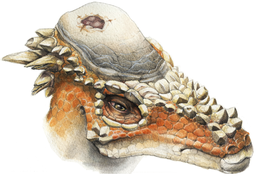
pachycephalosaurus – A large herbivorous dinosaur of the genus Pachycephalosaurus of the late Cretaceous Period. It grew to about 7.6 m (25 ft) long and had a domed skull up to 25.4 cm (10 inches) thick that was lined with small bumps and spikes. The thick skull may have been used for head-butting during mating displays
pachychromatic – having coarse chromatin threads [not thick musical scales]
pachydactyly – abnormal enlargement of fingers and toes
I figured out pachycephalosaurus and pachydactyly before looking them up, I’m pleased to say, since it means I haven’t forgotten all my Greek roots.
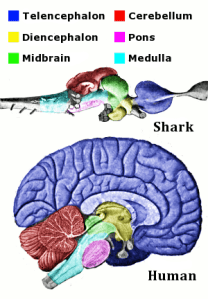
I then thought about random thought, and so googled “random brain,” and found an article (Cosmos, May 18 2017) describing a study in which
Neuroscientists at the Champalimaud Centre for the Unknown (CCU) in Lisbon, Portugal, reveal the unexpected finding in a report that aims to unpack how humans and other animals decide how and when to act.
Neuroscientists have long accepted that even in strictly controlled laboratory conditions, the exact moment when a subject will decide to act is impossible to predict.
In short, the scientists found that “‘[t]he brain’s prefrontal cortex – the seat of decision-making – has no input into the timing of random actions,'” but that
“‘[t]he medial prefrontal cortex appears to keep track of the ideal waiting time based on experience. The secondary motor cortex also keeps track of the ideal timing but in addition shows variability that renders individual decisions unpredictable.'”
The researchers were surprised at discovering the “‘not-well-appreciated “separation of powers” within the brain.'”
Personal observation underscores the finding: It’s four p.m., and William and Ernest are lying in the kitchen, watching David prepare their dinner and insulin injections. Several times a day they watch David go to the kitchen but at four o’clock they follow him. Their actions must be based on experience; hence the medial prefrontal cortex determines their action, and David’s as well. Human experience shows that if dinnertime is random, cats chew the carpet, a consummation devoutly not to be wished.
In the course of my mental ramblings, I thought of other things: Miss Petunia, an old neighbor well worth two or three posts, and more appropriate to the day, but better left to my putative novel.
Then there was my misuse of since in the paragraph following pachydactyly, because since means because, which I just used properly.
I also thought of stories about Mr. F., Mr. J., and Miss Fl., also not the best post material. To get them out of my system, I just put them in an email to a friend who has long suffered random thoughts I can’t make post-public.
I thought about changing the appearance of my blog, because I’m tired of looking at it, but how would I display my photographs so prominently?
I got mixed up and posted on Sunday, April 12, which was supposed to be my day of rest. But I didn’t realize I was off schedule until after I posted yesterday’s Day N, on what was really Day M.
I could pretend I’m in an advanced time zone, but that would be dishonest.
So I’m taking today off. Tomorrow, I’ll post my Day O post on Day O.
And if I’ve got this wrong, too, don’t bother telling me. It won’t do a bit of good.
Yesterday I loved Nancy Drew. Today I love washing machines.
The latest model is a year old, and it’s still a minor miracle. It balances the load, pours in about a teacup of water, goes swish . . . swish . . . swish . . . and, when it’s finished, plays Schubert’s “The Trout.”
Delightful.
I intended to write more about washing machines, but I’ve decided instead to address a misconception related to my novel in progress: the use of the title Miss.
One of my characters, Miss Emma, is what used to be called a little old lady. She’s a widow with a forty-year-old son.
Two editors who’ve critiqued the early chapters have the character should be called Mrs. Emma, because Miss is reserved for unmarried women.
No.
Miss is an all-purpose title. I understand the issue can be confusing, but I know whereof I speak:
Miss Ethel, Miss Edna, Miss Pearl, Miss Beulah, Miss Louise, and Miss Bessie were spinsters.
Miss Blanche, Miss Gladys, Miss Minnie, Miss Mamie, and Miss Cora were widows.
Miss Jessie, Miss Bettie, Miss Katie Maude, Miss Sammie, Miss Polly, Miss Carmen, Miss Essie, Miss Janie, Miss Lily, and Miss Sallie were married.
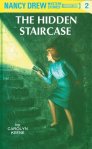
For my eighth Christmas, my grandmother gave me two Nancy Drew Mysteries: The Secret of the Old Clock and The Hidden Staircase.
And I fell in love.
Nancy Drew was so lucky. She was eighteen years old and had a housekeeper, a steady boyfriend, two best girlfriends, and a blue convertible. The convertible seemed to have a perpetually full tank of gasoline. She was also a blonde, which meant she had fun.*
Her father, prominent River Heights lawyer Carson Drew, was not the average parent. He rarely, if ever, asked where she’d been all day, and when he found out, he never said anything like, “Nancy, the next time you climb into a moving van driven by thugs and hide under a rug, you’ll be grounded till you’re thirty.” Or, for that matter, “Time to get serious, Nancy. Either enroll in Emerson College and start working on a degree, or find yourself a job. You can’t play detective for the rest of your life.”
Hannah Gruen cooked and cleaned, so Nancy did no chores. Boyfriend Ned Nickerson escorted her to dances when appropriate but otherwise stayed busy at Emerson College and didn’t get underfoot. Friends—tomboy George, whose pet phrase was, in 1959, an anachronistic “Hypers! You slay me!”; and George’s “plump” cousin Bess—provided companionship as well as help with investigations.
What was there not to love? Well, Nancy herself wasn’t perfect. She teased Bess about being plump; I didn’t like that. And her unfailing self-confidence sometimes grated; I’d have been happier if she’d expressed self-doubt now and then.
But she was eighteen and could take off in her convertible, wind blowing through her hair, seeking and finding adventure, solving mysteries along the way. To an eight-year-old convinced she’ll never be old enough for a driver’s license, much less a car, Nancy’s freedom sounded like heaven.
But Nancy wasn’t a party girl; she took detective work seriously. She solved mysteries because she wanted to help people.
In The Clue of the Tapping Heels, for example, she helped restore a child’s trust fund. In The Secret of the Wooden Lady, she found the lost figurehead belonging to a historic clipper and helped the captain establish clear title to the ship. In The Clue of the Leaning Chimney, while looking for a valuable Chinese vase she stumbled upon a gang using immigrants as slave labor. In The Secret in the Jewel Box, she reunited Madame Alexandra with her long-lost grandson, a prince.
In addition to enjoying the stories, I picked up some interesting bits of information. From The Clue of the Black Keys, I learned about obsidian; from The Clue of the Leaning Chimney, about kaolin.
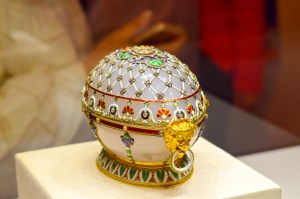
And Madame Alexandra, her long-lost grandson, and Mr. Faber, the jeweler who created the ornate jewel box, took on new meaning when I later read about the Tsarina Alexandra of Russia, Tsarevitch Alexei, and the Faberge eggs.
I said earlier that I fell in love with Nancy Drew mysteries, but I could just as well have said I was hooked. Two years after I read the first ones, I was penciling, in my neatest handwriting, letters to Joske’s Department Store:
Dear Sir:
Please send me the following books:
1 copy of The Secret in the Old Attic $2.00 1 copy of The Clue of the Tapping Heels $2.00
Please charge my account.
My mother signed them. It was, after all, her account.
By my eleventh birthday, I’d moved along, fallen in love with Zane Grey’s westerns—society ladies from the East meeting up with cowboys down on the Mexican border, very romantic—and was writing to Joske’s about those.
But even though I no longer read Nancy Drews, I’m still hooked—on mysteries. Every time I pick up an Agatha Christie, a P. D. James, a Ruth Rendell, an Elizabeth George, a Martha Grimes, a Tana French, a Donna Leon, a . . . as I said, I’m hooked.
Nancy Drew made me a mystery reader. And Nancy is the reason I write mysteries.
From what my friends tell me, a lot of them are in the same boat.
That Nancy Drew has a lot to answer for.
***
How did we know blondes have more fun? Television told us so.














 M. K. Waller