I need an emoticon

The low point of my teaching career–one of the low points, anyway–occurred at a literary festival hosted by Texas Lutheran University.

I’d accompanied several of my high school students, who had submitted pieces of writing to TLU weeks before. The morning of the festival, we were assigned to small groups, each comprising about a dozen secondary students from several high schools in the area and a teacher or two. A TLU professor and an English major led discussions of student submissions.

Somehow, talk turned to Jonathan Swift’s A Modest Proposal, the essay in which Swift appears to suggest that the poor of Ireland might benefit from selling their infants as food for the rich. My seniors had read the essay a month or two before.

In the middle of the ensuing talk about tone, irony, distance between meaning and text, Pat, one of my brightest students, turned to me and said in a voice audible to all, “I thought he was serious about eating Irish babies.”

“It’s satire,” I hissed, sliding under the sofa.

That’s what I get, I thought, for not polling the class at the end of the lesson. I imagine more than one of my students, considering their penchant for distraction, graduated thinking Swift approved of cannibalism. I should post a clarification on FaceBook.

But that was years ago. If I were teaching now I wouldn’t fear exposing my students to literary fests. If I were teaching now, I’d simply tell students to take their pencils and lightly mark Swift’s Proposal with an emoticon: a little smiley face that signifies, “Didn’t mean it. Just being amusing.”

I’d have them put one on Huckleberry Finn, too. In fact, I’d buy a box of them for Huck. We’d go page by page, sticking a little yellow smiley beside every paragraph likely to upset the terminally literal.

While I was at it, I’d stick on on me, too. I need an emoticon.

In a piece I wrote for Whiskertips, another blog for which I’m responsible, I issued guidelines for grocery shopping. I got the idea from Pat Hoglund’s Have I Got a Story from You. Hoglund writes about her dislike of shopping for groceries. I took the topic a step further, offering a codified version of the rules according to me. Θ*

*Didn’t mean it. Just being amusing.

Or, in the cases of Swift and Twain, scathing.

I didn’t mean people shouldn’t choose fruits and vegetables with care. I didn’t mean, “Get out of my way or I’ll run over you with my cart.” Or your children. I didn’t mean anything I said.

Well, I meant some of it. Men really do move through the checkout line faster than women, especially women with children. And when people look straight at me while talking on cell phones, I do jump into their conversations. And I think people should line up behind older people and not complain when they take a long time to get out their money. As I said, we’re all going to get to that point, if we’re lucky.

But I wrote the piece as if I meant everything I said–literally. And therein lies the problem. I’m aware some of my readers might have taken me literally. It’s happened before. Like in my post asking why men always end up with the remote control. That was meant to be lighthearted, ironic, neither a serious question nor a criticism of the social order.

If I had an emoticon, I could prevent misunderstanding. Unfortunately, this program doesn’t give me that option. The symbol Θ, marked with the asterisk, above, is theta, the closest symbol to an emoticon I could find.

I refuse to insert Θs when I mean something else.

So, dear readers, please muddle along with me, taking on faith that I am a well-meaning person without a malicious bone in my body, a writer whose one compulsion lies in a satirical, hyperbolic, amusing, flippant, frivolous, blithe, playful, sprightly, fanciful, dry, wry, droll, aslant, farcical, irreverent,** ironic but entirely non-sarcastic take on life that will burst forth no matter how I try to keep a lid on it.

** Thesaurus.com is a fine resource.

Ella Minnow Pea Redux or, My keys won’ work

Wa do you do wen your keyboard malfunions?

Wen my spae bar sopped working, I aed online wi Dell e suppor.  e e old me I would reeie a new keyboard in e mail. I was supposed o insall i.

“Me?” I said. “Insall a keyboard?”

e e said i would be a snap. If I needed elp, e would walk me roug i.

I go e keyboard and looked up e insruions, wi said I ad o unsrew e bak. I jus knew I would be eleroued.

Bu I boug a se of srewdriers a RadioSak and flipped e lapop oer, remoed e baery, and aaked e srews.

e srews wouldn’ budge. I exanged a srewdrier for anoer srewdrier. I used all six. None of em worked.

I wen online again o a wi Dell. e e lisened, en old me o ry again.

I oug abou e definiion aribued o Einsein: Insaniy is doing e same ing oer and oer and expeing a differen resul.

“I wouldn’ urn,” I old e e.

He said e would send a e ou o e ouse o insall e keyboard for me. (I’m no dummy. Wen I boug e lapop, I boug a e o go wi i.)

Anyway, e nex day a e ame. He go ou is se of 3500 srewdriers, remoed e srews, ook off e old keyboard, and insalled e new one. He said I didn’ ave e rig size srewdrier. en e asked wa else I needed.

“I know you don’ ae an order for is, bu ould you wa me insall is exra memory a Dell e said I’m ompenen o insall myself?” He said e’d o i for me. I oug a was ery swee.

Anyway, i’s appened again, exep is ime i’s more an e spaebar. I’s e , , , and  keys.

I’e used anned air. So far all i’s done is make ings worse. Wen I began, only e  key was ou.

How an I wrie wiou a keyboard?

So tomorrow I’ll chat with my Dell tech and–

Well, mercy me. I took a half-hour break and now all the keys are working again. I wonder what that was all about.

Nevertheless, I shall report the anomaly. Call me an alarmist, but I don’t want this to happen a third time when I’m preparing a manuscript for submission. If the keyboard should be replaced, I want it replaced now.

But still–I’m torn. If I do need a new keyboard, I want a tech to make a house call. I don’t have the proper screwdriver, I don’t know the size screwdriver to buy, and I don’t want to tamper with something that is still under warranty.

On the other hand, I have to consider the worst-case scenario: He takes out his screwdriver, loosens the screws, turns the laptop over, removes the keyboard, and sees lurking there beneath the metal and plastic plate the reason for my current technical distress: rumbs.

e same, e earae, e disgrae a being found guily of su a soleism. e prospe is oo illing o spell ou.

Bu for the sake of ar, I sall submi myself o e proud man’s onumely. omorrow I sall a wi Dell.

Letting the miracle happen

I ended an earlier post with the sentence, “There’s a hole I have to write myself out of.”

Parse that and you’ll find it equal parts wish, bravado, pretense, and humbug.

I had no idea how to write myself out of that hole. I thought I’d have to scrap “A Day in the Life of a Rancher’s Wife” and replace it with “A Day in the Life of a One-Room Schoolteacher.” Or anything else I could both start and finish.

But I gave it a shot, opened the document, and began revising. For the Rancher’s Wife, that meant squeezing 700 words into under 500, just in case I came up with a conclusion.

And in the middle of all that deleting, adding, shuffling, it happened. I knew how to end the story.

By the time the epiphany occurred, it was after midnight. I tacked on a couple of sentences to hold the thought and the  next day continued reworking the piece. The result is a story I’m satisfied with. Almost. There’s still time for tweaking.

When I was teaching English in the late ’70s, the latest fashion was to teach the writing process: brainstorming, prewriting, writing, revising, editing, polishing, proofreading. Sometimes prewriting was put before brainstorming. Sometimes editing and polishing were rolled into one. It was neat and tidy and linear.

But there was no step to describe that epiphany.

If there’s frustration here–and there is–it’s that I can’t explain that missing step. I had given up. I wasn’t trying think of a solution. I was playing with words. And then I knew.

Maybe that’s the heart of the process: relax, play, stay in the now, allow ideas to come. Maybe the process isn’t a process at all.

I’ve read that creativity has something to do with the frontal cortex, the anterior cingulate, the temporal lobe, the limbic brain, alpha brain rhythms, gamma brain rhythms, warm showers, long walks, and happiness. When scientists have it all observed and assimilated and indexed, I’ll try to understand.

For the present, however, I like to think that extra step is Gertrude Stein’s miracle.

Not knowing. Knowing.

And the process is letting the miracle happen.

Wormwood, wormwood

I told a little fib in that last post.

I said that before the Texas Mountain Trail Writers retreat in early April, I have to write a 500-word story.

The truth is, I don’t have to. It’s optional.

Then why do I put myself through this torture?

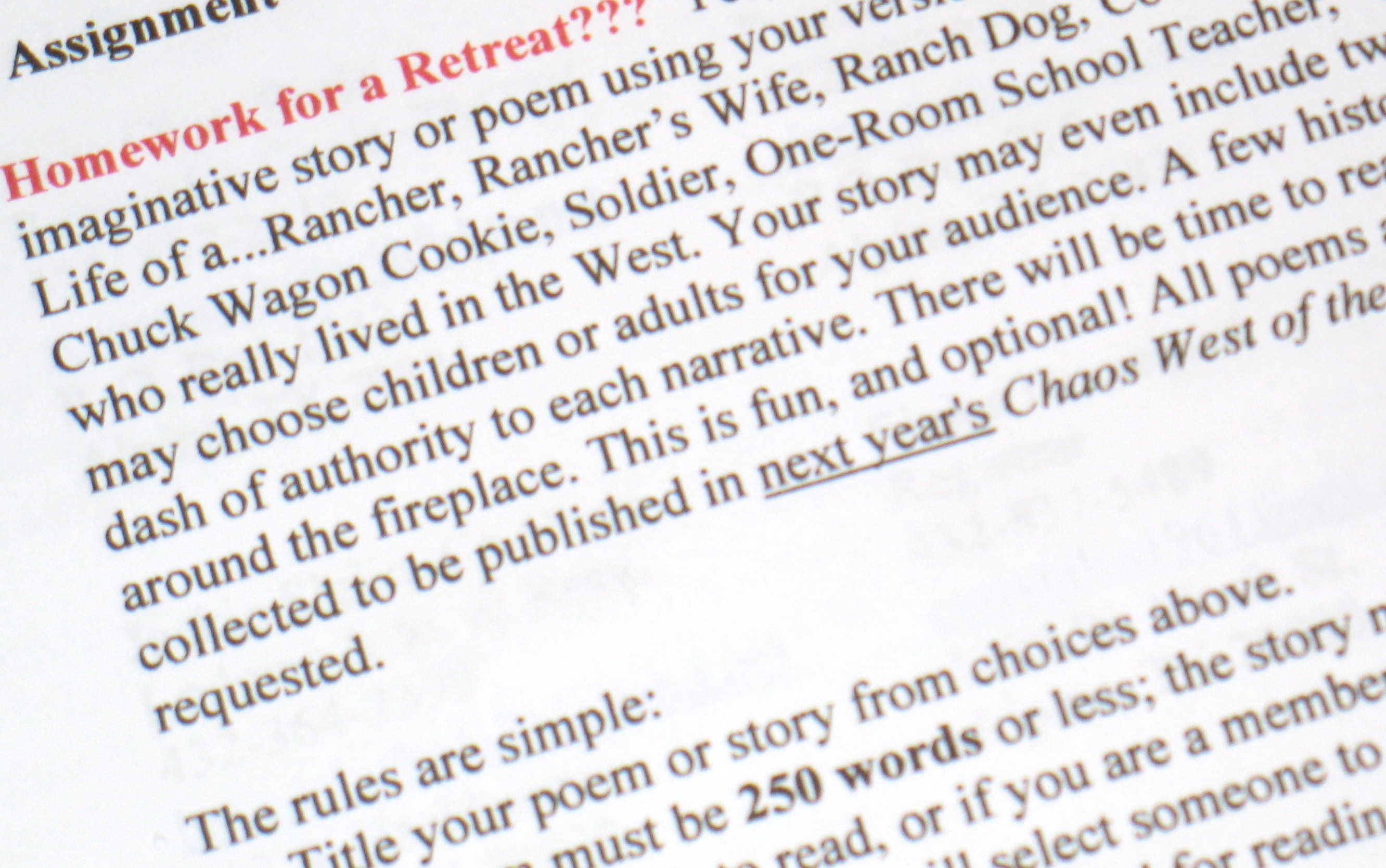
I do it because retreat participants will get to read their stories around the fireplace. And then the stories will be collected and  included in the next issue of TMTW’s annual publication, Chaos West of the Pecos.

I refuse to be the fireplace  spoil-sport, and I’m sure as all get-out not going to miss an opportunity to see my words glued between the two covers of a publication.

And then there’s the other thing. It’s fun. It says so in the retreat literature: “This is fun, and optional.”

Despite having written myself into a hole I can’t crawl out of, writing “A Day in the Life of a Rancher’s Wife” is fun. It’s like creating a puzzle and solving it at the same time. I’m partial to puzzles.

But fun and writing seldom appear in the same sentence, at least sentences that come from writers. Red Smith said to write you have to “open a vein.” E. L. Doctorow said writing is “a socially acceptable form of schizophrenia.” Colette’s husband locked her in a room to make her write. He wouldn’t let her out until she’d produced something he could sell (under his name).

I don’t have it that bad. My husband doesn’t lock me in, I have most of my marbles or at least know which pile of paper they’re under, and I’m not anemic.

But because I’ve yowled around to family, friends, and acquaintances that writing is equal parts wormwood and woe, I have to stick to the story. Claiming the TMTW assigned a composition is a minor fudge, but it’s enough to convince them I’m suffering. They remember senior English.

Confession over, I’ll end this post and move on. There’s a hole I have to write myself out of.

Channeling me

In April, CP and I will attend the Texas Mountain Trail Writers’ Spring Retreat near Alpine. We’ll stay in a cabin, go to a reception and a cowboy breakfast, hear authors and historians, hike, take photographs, write haiku, breathe clean mountain air…

I can hardly wait.

The catch is that each of us has to write a 500-word story about the Old West.

I don’t think I’ve ever written a 500-word anything. I need 500 words just to get started.

I know, I know. Revise, revise, revise.

I decided to use an amusing anecdote my uncle told about my great-grandmother, who lived in West Texas when she was first married. It begins in first person, with the Ranch Wife talking about learning to make biscuits when she was six years old. Then I have her describe the heat and the absence of shade and the patch of grass she slaves over and the wind that turns soil into dirt. And how her husband promised to take her back to Central Texas to live. And bathing children on the porch.

I’ve read it aloud several times. It sounds pretty good. It bears no resemblance to anything Grandmama would have said, at least in that tone of voice. But that’s not a problem. This is fiction.

The problem is that by the time I’m ready to insert the story my uncle told, the Ranch Wife sounds so depressed I can’t figure out how to work it in. Nothing I can say is going to cheer that woman up.

And it’s already over 500 words. After cutting.

I know what’s wrong. I’m using Grandmama’s persona but I’m channeling myself. Heat. Dirt. Wood stoves. Hauling water. Bathing on the porch. Grandmama was a pioneer. I’m a hothouse plant.

So I have a choice. I can start over in a lighter vein. Or I can come up with an ending to match the Ranch Wife’s misery.

Or I can take the easy way out: scrap the Ranch Wife and go with an account of West Texas life as told by the Ranch Dog.

67 points

While we’re talking about contests, I’ll tell you my secret:

In 2005, I submitted the opening pages of a novel to a manuscript contest. The judge praised the strengths, noted the weaknesses, and awarded me a score of 85.

In 2006, I submitted the very same pages to the very same manuscript contest. The judge praised nothing and awarded me a score of 18.

The 67 points between high and low scores taught me a valuable lesson.

Judging is subjective. What one judge likes, another hates. Not everyone loves my work as much as I think they should. Or as much as I do. I’m competing with a large pool of writers who have talent, skill, and experience.

If I allow one rejection to discourage me, I might as well quit right now.

I don’t want to quit.

I won’t pretend I was thrilled with the second score or with the judge’s comments. I won’t pretend I didn’t rampage around the house telling husband and cats exactly what I thought. I won’t pretend I was surprised when husband and cats announced they needed their beauty sleep and high-tailed it up the stairs.

But by the next day I’d regained my equilibrium. One contest, one critique sheet, one manuscript.

I went to the literature. I reread Ralph Keyes’s The Writer’s Book of Hope, and Anne Lamott’s Bird by Bird, and Elizabeth Berg’s Escaping into the Open.

Then I sat down at the computer, and opened a file, and began to write.

Two days before the deadline

My partner in Just for the Hell of it Writers (JFTHOIW) and I delivered our submissions to a manuscript contest Monday–two days before the deadline.

I have Critique Partner (CP) to thank for that. I normally hand-deliver everything the last day, just under the wire. CP, however, tries to get her entries in early, and she set up a schedule that helped me get mine in early as well.

The truth is, if it hadn’t been for CP, I wouldn’t have submitted anything at all. I had decided to skip the contest. The first ten pages of my novel didn’t seem strong enough to merit submission.

CP, however, encouraged me. Once we’d agreed to enter, she initiated a plan of attack. Each Friday, we set ourselves an assignment for the upcoming week. When I didn’t meet my objective, CP kept me on track. In fact, she believed in me until I could believe in myself. I think somewhere along the line I began to encourage her as well.

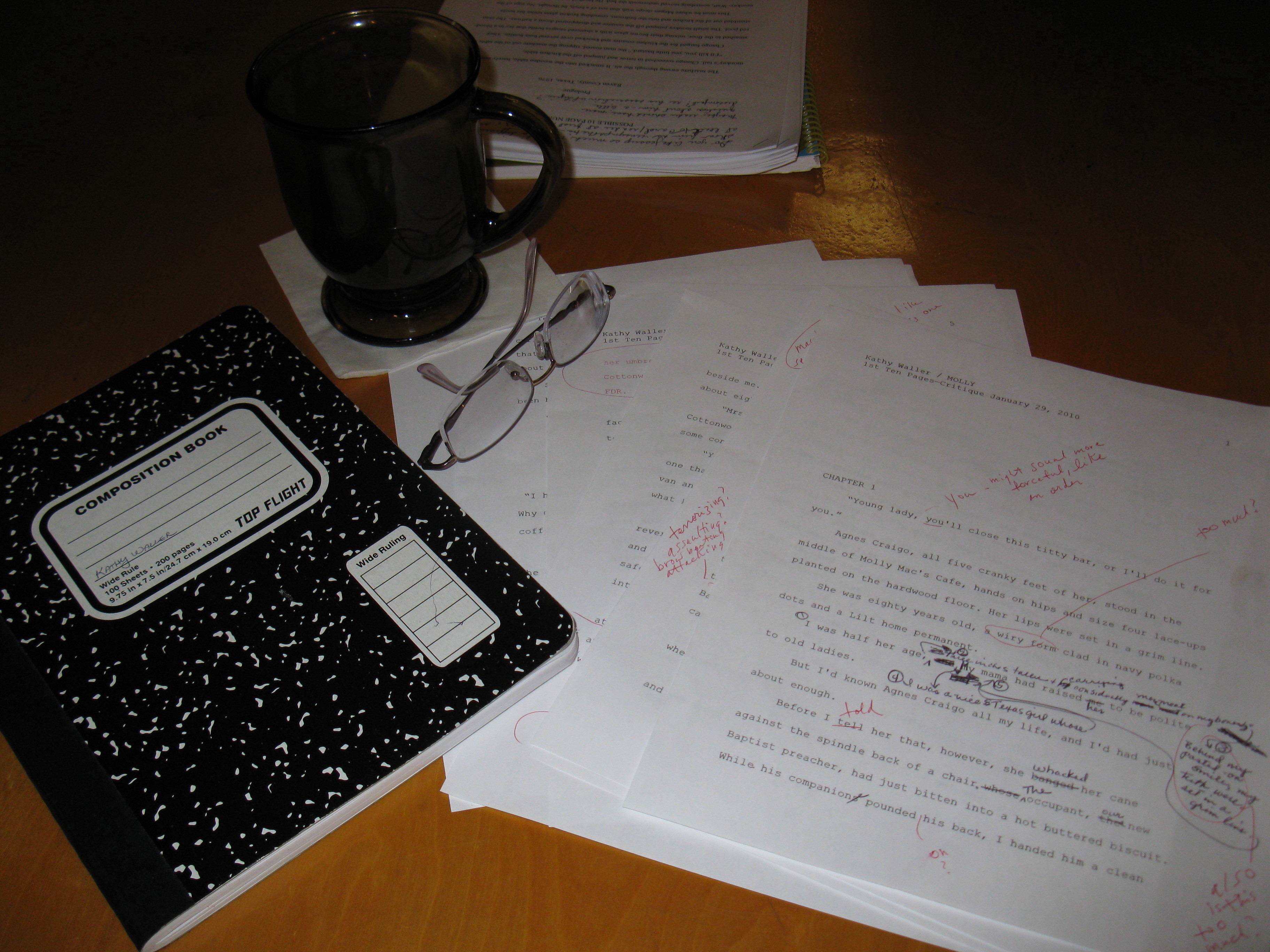
We worked for two months. During that time, I reconsidered what my first ten pages needed to accomplish with respect to characters and plot. I scrapped previous drafts and wrote new scenes. I weighed words and images. I tightened, tightened, tightened, cutting wherever I could.

Throughout, I listened to CP. We share an ear for Southern speech. When my ear went tone-deaf, CP let me know. “I really don’t like that word,” she’d say. Or, “I just don’t think he’d say it that way.” Or, “If the readers know something about roses, that line would be okay, but if they don’t, I think they’ll be confused.”

Of course, I didn’t have to take her advice. Both of us make our own decisions about what we change and what we keep. When she felt sure of herself, however, she didn’t hesitate to tell me, sometimes more than once, and in no uncertain terms. “I still don’t like cranky there. It just irks me every time I see it.”

The third or fourth time I heard the same advice, I’d give up and start to listen more closely to my own words. Did I really want to say, “all five cranky feet of her”? Should I have Rhys tell Miss Agnes she “looks as lovely as the Bride’s Dream rose growing beside your door?” Or would he say, “My, don’t you look lovely?”

Granted, he’s soft-soaping her, but Rhys isn’t dumb. Neither is Miss Agnes. If he spouted all that rose talk, she’d probably take charge of the scene and whap him with her cane.

When we formed JFTHOIW, a couple of friends expressed reservations. Critique groups, they said, could be negative. I knew they were right. Some critics aren’t graceful in giving criticism; others aren’t graceful in receiving it. Some don’t have the best interests of the writer in mind. Some don’t have the expertise necessary to be helpful.

In addition, criticism of a work in progress can stifle creativity, especially if the critic doesn’t understand the writer’s intent and tries to substitute his own vision.

But CP and I haven’t run into problems. I think that’s because we do have each other’s best interests in mind. We respect each other’s feelings. We admit we don’t know everything, and we attempt to learn more. We want each other to succeed.

We’ve also become friends. I’d like to do well in the manuscript contest we’ve just entered. I’d like to be a finalist. Oh, let’s be honest–I’d like to win the thing. But I also want CP to do well. If she wins, I’ll be just as happy–well, almost as happy–as if I’d taken the top spot.  I believe she’d be happy for me if I won.

Writing in Helen Ginger’s blog, Straight from Hel, literary publicist Stephanie Barko said, “One of the best reasons to enter a contest is to evoke creativity. It is by exploring the unknown that we find our answers, not by having the answers before we explore. There’s nothing like serving yourself a problem to jar your synapses loose and bend your brain in ways it doesn’t normally move.”

When I read that, I understood what CP had done. By pushing me to enter the contest, she required me to push at the boundaries of my own creativity. She made me find new answers to problems I’d been trying to wish away. She helped jar my synapses loose and bend my brain in ways it doesn’t normally move.

And that jarring and bending produced ten pages that are much better than they were before. I submitted an entry that, win or lose, I could be proud of.

And I delivered it two days before the deadline.

Thank you, CP.

Cross-posting again

Yes, I did it. I cross-posted.

I wrote “Try, Try Again” for Whiskertips. Then, because it was about writing, I posted it on write is to write is to write as well.

I didn’t even retype it. I copied and pasted.

To those kind people who read both blogs, I offer my apologies. To those who saw the two blogs with the same post title listed together on the SCN Blogging Circle page, I offer my confession of how foolish I felt when I saw that.

To everyone, I offer advance notice that in just a few minutes, I’m going to do it again.

Try, try again

“Insanity: doing the same thing over and over and expecting different results.” ~ attributed to Albert Einstein

“Insanity: staying up until 3:00 a.m. both Friday and Saturday revising your manuscript contest submission and then expecting to have enough functional brain cells to proof the final copy on Sunday before submitting it on Monday, when repeated replication of the experiment over the past four decades has already told you it ain’t gonna happen that way.” ~ attributed to Kathy

Pea green: the color you feel every time you replicate the experiment

Fifteen Minutes of Fame

Two Saturday mornings a month, when reasonable people are still in bed, David and I sit around a table with five or six other like-minded individuals and practice writing.

We do timed writings–ten minutes, twelve minutes, the magic fifteen, sometimes even twenty–and then read aloud what we’ve written.

Write. Read. Write. Read. Write. Read.

We follow principles set forth in Natalie Goldberg’s Writing Down the Bones. David supplies prompts for those who need a jumpstart. Subjects are neither prescribed nor forbidden.

Some of us write from life. Some write fiction. Some write poetry. David writes in a genre that can only be called “off-the-wall.” Everything we write is creative.

We do that for two hours.

Why?

Friendships. Fluency. Fun.

We see the people we write with only four hours a month, but we know them, in some ways, as well as–perhaps better than–some members of our own families. Their stories tell us who they are.

And there’s something about being with them, playing with words, playing off one another’s words, that creates energy–parallel energies, if you will–that affects our minds and our hands. We become more fluent. We become better writers.

As for fun–what can I say? We laugh a lot. When David, the temporary facilitator, looks at his watch and announces it’s time to leave, I’m always surprised. And disappointed. Those are the shortest two hours of my week.

Now here’s where we get personal. Our group is called Fifteen Minutes of Fame. It’s free and open to the public. New members are welcome.

If you live in or near Austin, Texas, you’re invited to join us. Bring pen and paper and just show up on the third floor of BookPeople Independent Bookstore, 603 N. Lamar Boulevard (corner of 6th St. and Lamar), on the first and third Saturdays of the month. We write from 10:00 a.m. to noon.

If you’re visiting Austin, you’re welcome to visit us as well.

And if you ever attended an Austin writing practice group called Writing From the Heart, you’ll feel right at home with us. Fifteen Minutes of Fame originated as Writing from the Heart. It’s been in existence for fifteen consecutive years. The name is different, but the process is just the same.

For more information, including 2010 meeting dates, check out our blog, Fifteen Minutes of Fame. If you have  questions, send an e-mail to the address listed on the FoF blog, or leave a comment there or at the end of this post.

Start with the headline…dear


“SCORPIO (Oct. 24-Nov. 21): No one can argue with your powers of conversation. You make language dance. Insightful without being overbearing, you’re a joy to be around. And you are about to meet your match.” ~ Holiday Mathis, “Horoscopes,” American Statesman [Austin, TX] 6 Jan. 2010, final ed. : D2.


Ha! My horoscope is way behind. I met my match years ago.

It was the fall of 1999, and I was right in the middle of one of my best stories, when my husband began to wave his hand in that circular  motion–the universal symbol for “Get on with it”– and said, “Start with the headline.”

He was actually my pre-husband then, and I hadn’t known him long, and he was telling me I wasn’t a joy to be around. I burst into tears.

He patted me and apologized. (And no doubt wondered what he was apologizing for.)

I cried some more, mourning our relationship’s untimely end. Because I was incapable of starting with the headline.

I am a Southerner. When I share an anecdote or impart information–such as the conversation I had with Cousin Bob at the post office yesterday–I am genetically programmed to start at the beginning. I may need to go back three generations before I can get to the core communication.

To properly set the stage, I must introduce Cousin Bob’s parents and grandparents, and possibly his great-grandparents, and maybe his aunts, uncles, brothers, and sisters. I have to say who married whom and why and how many children they had. I have to mention economic status, level of education, and geographic location. I have to describe outstanding traits and idiosyncrasies as well as interesting interrelationships, such as major quarrels, grudges, and feuds.

When I finally get down to Cousin Bob, I have to flesh him out as well.

Then, once I get the plot moving, I sometimes need to digress and pull in anything else I think might be helpful.

It takes time.

But I’ve  sat on enough front porches listening to old people talk to know the rule: Never start with the headline.

Still, in the interest of continuing romance, I made an effort. And in the interest of same, my pre-husband said no more about my tendency to mosey.

A couple of years later, however, taking a course in legal writing, I heard the lawyer at the front of the room say, “Start with the headline.” In other words, when you’re writing a legal memo or a case brief, state the conclusion; then explain how you got there.

The light dawned. My pre-husband had a law degree. He was trained to start with the headline. He didn’t want me to tell my stories backwards. He just wanted me to talk like a paralegal. Eleven months later, I emerged from the university with an official certificate in paralegal studies and an unofficial certificate in interpersonal communication, probably a first for that program.

Still, starting with the headline seemed a dreary thing for both writer and reader. How can the reader understand the headline before he’s met all the characters, seen where they live and how they’re related? And isn’t starting with the headline like reading the last page first? All the suspense oozes out.

I was so glad fiction doesn’t have to start with the headline.

A few years later, however, I decided to try my hand at writing a mystery. I set it in a small Southern town populated with characters whose family relationships go back several generations. I developed an intriguing plot. I jumped into the action. I wrote several chapters, revised them, and handed them off to a friendly writer.

She handed them back with some positive comments and a great big, “GET THE BACKSTORY OUT OF THE FIRST CHAPTER.”

In other words, start with the headline.


I’m good enough, I’m smart enough…

Before we go further, we have to talk about the P-word: publication.

I want it.

Now. Often. And accompanied by immense public acclaim and financial reward.

I want to go on book tours and do readings. I want to be wined and dined by the literati.

I want to be the literati.

I want a loft in The Village. I want a croft on the Isle of Mull.

I want it all. And I can have it.

The thing is, before I can have it, I have to finish a manuscript.

That last has become a bit problematic.

My critique partner and I have discussed the situation at length. We’re weary of writers who have a string of books to their credit advising us to forget about being published, to “just write for yourself.” Easy for them to talk.

Unfortunately, they seem to have a point. The more we obsess about agents, editors, and cover design, the flatter our prose becomes. And the more we feel like tossing our multiple revisions into the air and walking away.

Which would be a shame after so much work, and which would probably make the BookPeople barista, who’s been so nice to us, really mad.

So at a recent powwow we decided that from now on, we will write just for the hell of it.

We are now, officially, the Just for the Hell of It Writers.

**********

I should make clear that my critique partner has finished one manuscript and has won a manuscript contest, so she’s considerably closer to being literati than I am. She says, however, that her accomplishment hasn’t made manuscript #2 any easier to birth.

The daily miracle

The most serious problem the writer encounters is coming up with a topic, coming up with an original topic, finding the form you’re comfortable with, writer’s block, creating interesting characters, writing sparkling dialogue, finding your voice, weeding out unnecessary modifiers, weeding out passive voice, appealing to the five senses, revising, finding a good critique group, accepting criticism, polishing the manuscript, f inding an agent, selling the manuscript, hanging in there… forgetting how the process works, forgetting the process works, forgetting the process forgetting the daily miracle will come.