Posted on Whiskertips, December 24, 2009, when William and Ernest were still young adults.
If you read my earlier post, our Christmas tree has been the subject of intense, but not unexpected, conflict.
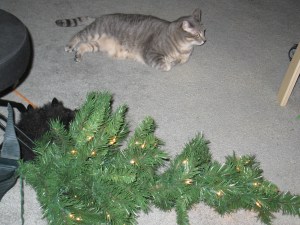
As soon as the tree lit up, so did William and Ernest. William had to be physically restrained from chewing on the lights.
The next morning Kathy found the tree lying on its side and the cats out of sight. The tree spent the day endeshabille, as it were.
After lengthy trilateral negotiations, a compromise was reached.
Ornaments and tree skirt are, of course, out of the question.
Gifts will appear Christmas morning immediately before they’re to be opened.
***
Christmas Compromise, 2013
After Ernest began eating everything he found interesting– thread, twine, string, ribbon, “elongated things,” the veterinarian said– and his health care became repeatedly expensive, David and Kathy decided Christmas tree needles shouldn’t be allowed in the house.
David bought a small artificial tree complete with lights and set it on a chair.
William supervised setup and checked for stability.
A certain instability was discovered, but William said Ernest was at fault.
Ernest said, “Liar, liar, pants on fire.”
Since then, however, nothing untoward has occurred.
William continues to keep watch.
In 2018, gifts still appear Christmas morning immediately before they’re to be opened.
***
Note: The black thing William is lying on started as my bearfoot slipper but soon became a soft, squishy thing for William to make biscuits on.
Another note: I don’t think my cats are cuter than other people’s children and grandchildren, but I don’t have children or grandchildren, so William and Ernest get their pictures broadcast worldwide.
“Jest ‘Fore Christmas” appeared in an anthology of Christmas stories and poems given to me by my Aunt Betty Barrow on my seventh Christmas. I memorized the poem and recited it at my fourth-grade music appreciation class party. The anthology is long gone, but the memory remains.
Father calls me William, sister calls me Will, Mother calls me Willie, but the fellers call me Bill! Mighty glad I ain’t a girl—ruther be a boy, Without them sashes, curls, an’ things that’s worn by Fauntleroy! Love to chawnk green apples an’ go swimmin’ in the lake— Hate to take the castor-ile they give for belly-ache! ‘Most all the time the whole year round, there ain’t no flies on me, But jest ‘fore Christmas, I’m as good as I kin be!
Got yeller dog named Sport, sick him on the cat; First thing she knows she doesn’t know where she is at! Got a clipper sled, an’ when us kids goes out to slide, ‘Long comes the grocery cart, an’ we all hook a ride! But sometimes when the grocery man is worrited an’ cross, He reaches at us with his whip, an’ larrups up his hoss, An’ then I laff an’ holler, “Oh, ye never teched ME!” But jest ‘fore Christmas, I’m as good as I kin be!
Gran’ma says she hopes that when I git to be a man, I’ll be a missionarer like her oldest brother, Dan, As was et up by the cannibuls that lives in Ceylon’s Isle, Where every prospeck pleases, an’ only man is vile! But gran’ma she has never been to see a Wild West show, Nor read the Life of Daniel Boone, or else I guess she’d know That Buff’lo Bill and cowboys is good enough for me! EXCEP’ jest ‘fore Christmas, when I’m as good as I kin be!
And then old Sport he hangs around, so solemn-like an’ still, His eyes they keep a-sayin’: “What’s the matter, little Bill?” The old cat sneaks down off her perch an’ wonders what’s become Of them two enemies of hern that used to make things hum! But I am perlite an’ ‘tend so earnestly to biz, That mother says to father: “How improved our Willie is!” But father, havin’ been a boy hisself, suspicions me When, jest ‘fore Christmas, I’m as good as I kin be!
For Christmas, with its lots an’ lots of candies, cakes, an’ toys, Was made, they say, for proper kids an’ not for naughty boys; So wash yer face an’ brush yer hair, an’ mind yer p’s an’ q’s, An’ don’t bust out yer pantaloons, an’ don’t wear out yer shoes; Say “Yessum” to the ladies, an’ “Yessur” to the men, An’ when they’s company, don’t pass yer plate for pie again; But, thinkin’ of the things yer’d like to see upon that tree, Jest ‘fore Christmas be as good as yer kin be!
***
Eugene Field’s “Jest ‘Fore Christmas” appears on Project Gutenberg, “a volunteer effort to digitize and archive cultural works, to “encourage the creation and distribution of eBooks.” (Wikipedia)
“The writer of an article about Dr. Seuss reported that at the end of an interview Theodore Geisel congratulated him for not asking the one question that people invariably ask. When the writer asked him what that one question might be, Dr. Seuss replied, “Where do you get your ideas?” “Well, all right,” said the reporter. “Where do you get your ideas?” “I’m glad you asked that,” Dr. Seuss said, and pulled out a printed card. On the card was spelled out the secret that the world pants for. It seems that on the stroke of midnight at the full moon of the summer solstice, Dr. Seuss makes an annual pilgrimage into the desert, where an ancient Native American hermit and wise man has his abode. That old Indian, Dr. Seuss declared, is the source of all of his ideas. But where the old Indian gets his ideas, he has no notion.
“Where do you get your ideas? I suppose the people who ask this question are expecting a rational, one-sentence reply. What they get from me is a rather stupid stare.”
“This is an opera for children because it tries to recapture my own childhood. You see, when I was a child I lived in Italy, and in Italy we have no Santa Claus. I suppose that Santa Claus is much too busy with American children to be able to handle Italian children as well. Our gifts were brought to us by the Three Kings, instead.
“I actually never met the Three Kings—it didn’t matter how hard my little brother and I tried to keep awake at night to catch a glimpse of the Three Royal Visitors, we would always fall asleep just before they arrived. But I do remember hearing them. I remember the weird cadence of their song in the dark distance; I remember the brittle sound of the camel’s hooves crushing the frozen snow; and I remember the mysterious tinkling of their silver bridles.
Gian Carlo Menotti. Carl Van Vechten [Public domain], via Wikimedia Commons“My favorite king was King Melchior, because he was the oldest and had a long white beard. My brother’s favorite was King Kaspar. He insisted that this king was a little crazy and quite deaf. I don’t know why he was so positive about his being deaf. I suspect it was because dear King Kaspar never brought him all the gifts he requested. He was also rather puzzled by the fact that King Kaspar carried the myrrh, which appeared to him as a rather eccentric gift, for he never quite understood what the word meant.
“To these Three Kings I mainly owe the happy Christmas seasons of my childhood and I should have remained very grateful to them. Instead, I came to America and soon forgot all about them, for here at Christmas time one sees so many Santa Clauses scattered all over town. Then there is the big Christmas tree in Rockefeller Plaza, the elaborate toy windows on Fifth Avenue, the one-hundred-voice choir in Grand Central Station, the innumerable Christmas carols on radio and television—and all these things made me forget the three dear old Kings of my old childhood.
“But in 1951 I found myself in serious difficulty. I had been commissioned by the National Broadcasting Company to write an opera for television, with Christmas as deadline, and I simply didn’t have one idea in my head. One November afternoon as I was walking rather gloomily through the rooms of the Metropolitan Museum, I chanced to stop in front of the Adoration of the Kings by Hieronymus Bosch, and as I was looking at it, suddenly I heard again, coming from the distant blue hills, the weird song of the Three Kings. I then realized they had come back to me and had brought me a gift.”
—Gian-Carlo Menotti, from the booklet with the original cast recording of Amahl and the Night Visitors
“This past fall I spent an afternoon talking with a group of persons who work with children at risk. The question I had asked them to help me answer was this: Why do our children turn to violence? It was a question many of us have struggled with this past year.
“These professionals were very concerned about the Internet. Today, they said, when a child behaves aggressively at school, the routine solution is expulsion. At the very time when a child is most vulnerable, most reachable, he is further isolated. Often he goes home to an empty house and spends time with violent video games or on the Internet, desperately seeking out connections, and whom does he make connections with? All too often with other desperate, isolated, self-hating individuals who confirm his belief that all his hatreds are justified and that violence is the only way to relieve his mortal pain.
“Access to the Internet is not the answer for these attic children. They need much more than that. They need much more even than access to good books. Fortunately, what they need is precisely what you can give them–and that is yourself. ‘Every child,’ said the director of the program, ‘needs a connection with a caring adult.'”
“Last month I was asked to speak to a group of teachers who would be taking their classes to see a production of the play version of Bridge to Terabithia. I spent more than an hour telling them about how the book came to be written and rewritten and then how Stephanie Tolan and I adapted it into the play their classes would see. There was the usual time of questions, at the end of which a young male teacher thanked me for my time and what I had told them that morning. ‘But I want to take something special back to my class. Can you give me some word to take back to them?’
“I was momentarily silenced. After all, I had been talking continuously for over an hour; surely he could pick out from that outpouring a word or two to take back to his students. Fortunately, I kept my mouth shut long enough to realize what I ought to say–it is what I want to say to all of you.
“‘I’m very biblically oriented,’ I said, ‘and so for me the most important thing is for the word to become flesh. I can write stories for children, and in that sense I can offer them words, but you are the word become flesh in your classroom. Society has taught our children that they are nobodies unless their faces appear on television. But by your caring, by your showing them how important each one of them is, you become the word that I would like to share with each of them. You are that word become flesh.'”
“What I want to say to that isolated, angry, fearful child in he attic is this: You are not alone, you are not despised, you are unique and of infinite value in the human family. I can try to say this through the words of a story, but it is up to each of you to embody that hope–you are those words become flesh.”
~ Katherine Paterson, “The Child in the Attic,”
Ohio State University Children’s Literature Festival, February 2000
Several years ago, during my annual physical exam, my doctor asked, “Do you drink?” He always asks that.
I like to give doctors accurate information, so I said, “About three glasses of wine a year.”*
He said, “You don’t drink.”
This year when asked I said, “I don’t guess I can drink since I’ve had chemo.”
He said he thought I could get away with a little.
I said I hoped so, because when I have the respiratory miseries, a stuffy head, sore throat, and heavy chest, I take a mixture of bourbon and sugar.
“Does it work?” he said.
Oh, yeah. It’s the only thing that works.
So I asked my oncologist’s assistant if I can have alcohol. She said Yes, and the guidelines say the acceptable amount is fourteen drinks a week.
Mercy, I thought, that’s more than I expected.
I thought about the Recipe today when I woke with a budding case of the miseries but I didn’t act on it. When the miseries increased, I thought of it again and decided to act. But having had nothing to eat today, I was reluctant.
In addition, the thought of eating three inches of sugar was off-putting. I didn’t want it, and I don’t need it, but it’s impossible to send perfectly good sugar down the drain.
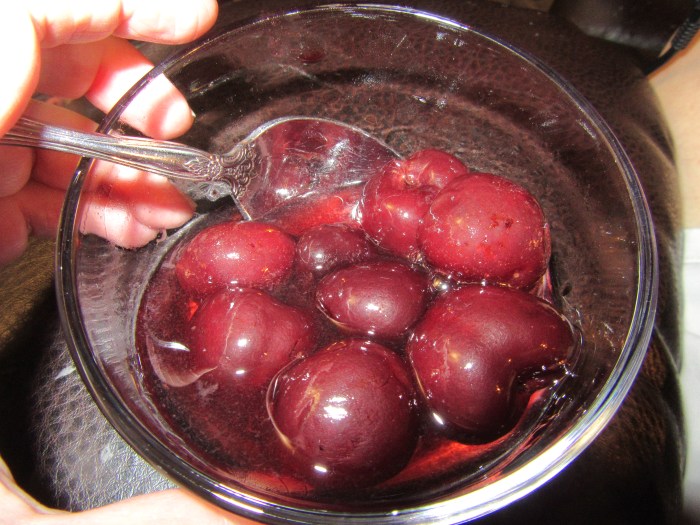
So I poured the bourbon over a small bowl of frozen cherries. I didn’t cover them, because that would have been excessive. I didn’t want this post to trail off before I’d said what I have to say.
I thought about setting them on fire but David wasn’t here to extinguish them.
Cherries aren’t as sweet as I’d like, but they aren’t bad. I’m eating slowly, so the only bourbon I’ve had is what has soaked into the fruit. It’s not bad either.
As my good deed for the day, I offer the Recipe. I call it the Recipe it as an homage to the Waltons Baldwin sisters, Miss Emily and Miss Mamie, who made the Recipe, pronounced Recipi.
Ingredients
1 small mug
pure cane sugar
bourbon
1 teaspoon
Directions
Spoon or pour three inches or more of sugar into mug. More is better.
Pour bourbon into mug until it’s about 1/4 to 1/2 inch or more above sugar. More is better.
Sip bourbon.
Eat sugar with teaspoon.
Result
Your throat and chest, and possibly your head, will feel better.
If you use more than the Recipe calls for, the rest of you will feel better. If you like bourbon, don’t use sugar. I don’t like bourbon.
If you have a problem with alcohol, don’t take this medicine. So far I don’t have a problem. If I drank enough of it, I would, and that’s the truth, and I know it. That’s why I drink only three glasses of wine a year, if that.
If you have a problem with sugar, don’t take this medicine. I do have a problem. That’s why I’ve switched to cherries.
Many people who have a problem with sugar also have a problem, or are likely to develop a problem, with alcohol, which my ophthalmologist calls a supersugar. I throw in that tidbit as my second good deed for the day.
I don’t know what the white specks on the cherries are, but they’re not sugar.
____________
*That’s a little more than accurate, since some years I don’t drink any, but I also like my doctor to have all the information.
**I wasn’t happy about the prospect of having unmedicated miseries.
I am grateful for
a husband
who knows how to perform the Heimlich maneuver
and
a doctor
who knows how to prescribe codeine
for ribs
that may or may not
be cracked.
No, it didn’t happen at Thanksgiving dinner. It was over a week ago.
David and I are in Dallas for What the Fest 2at the Pocket Sandwich Theatre, and we are officially chuffed. David’s “Invisible Men Invade Earth,” which was named Judges’ Pickin the 2017 WTF, was screened last night, first on the program–and will be shown again tonight.
What the Fest highlights films that don’t fit into any particular genre. (An understatement if there ever was one.)
Last night’s fan favorite was “Deletion,” the story of a psychiatrist who specializes in erasing patients’ memories. My favorite was “Toasted,” a look at what appliances, including a Scotch tape dispenser that handles tape about as well as I do, get up to when the master isn’t home.
Everyone in the audience received a raffle ticket for door prizes. If you let them stamp your forehead, you got an extra raffle ticket. Well, why not? David won a tote bag. Or maybe I did. I gave him my tickets to care for, and we don’t know whose number was called.
At the second intermission, girls* came around with a black light thingy and took pictures of our foreheads. Results are under Well, why not, above.
Pocket Sandwich Theatreis little and cute and specializes in melodrama, as you can tell from the carpet of popcorn on the floor.
What the Fest is my favorite of all the festivals we’ve been to, in part because little and cute also means informal–the principals say they’re a family, and they act like it. They have fun. So does the audience.
They also like David’s film. When they introduced it, they said they’d watched nine hours of submissions, and to keep themselves going throughout the arduous task, they periodically played “Invisible Men,” because it made them giggle. When we were leaving, a couple of the guys said they watch it a lot and also quote some of the lines (“Well, that sucks,” and “It is not a coincidence.”) One of the girls said she watches it with her mother.
In Austin, “Invisible Men, the story of two cats who save Earth by facing down a horde of space aliens,” and David’s other films are called weird.”** The folks in Dallas speak of “purity” and “a place of love.” In other words, it’s the kind of film you can take home to your mother, and that says a lot.
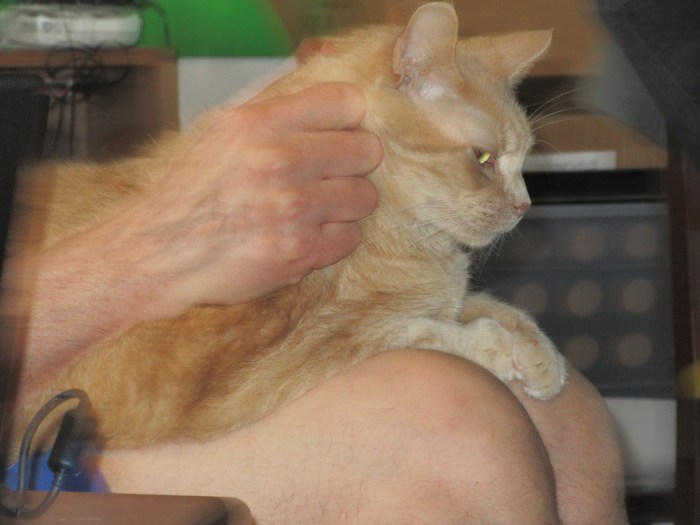
Once again, stars William and Ernest chose to stay home under the twice-a-day supervision of Charla, who feeds them, pets them, and gives William his insulin injection. They don’t like the carriers or the car, but they like Charla a lot. Charla emailed us that they’re playful.
We’re now using the wi-fi at the Denny’s next door to our hotel. The hotel’s wi-fi keeps slipping off the Internet and refuses to let me upload photos, but Denny’s is excellent.
In about four hours, we’ll head back to Pocket Sandwich Theatre to see “Invisible Men Invade Earth” and several new films. Last night, the audience started laughing before the first scene ended. I’m sure tonight’s viewers will be just as discerning.
***
*A purist would call them women, but where I come from, women that age are girls unless you’re trying to make a point.
**In Austin, weird is a compliment. I don’t know who decided Austin is weird, but “Keep Austin Weird” is right up there, or maybe above,“The Live Music Capitol of the World.”Weird may have started when Jim Franklin drew that armadillo. Oh. I just looked it up. Here’swho decided Austin is weird.
Further note: Lone Star used to be the National Beer of Texas, and I guess it still is. I haven’t seen the commercial in a long time, but there’s a video on youtube extolling its virtues. (See link above.) According to the expert, It’s got a perfect taste that’s hard to describe.






 “The writer of an article about Dr. Seuss reported that at the end of an interview Theodore Geisel congratulated him for not asking the one question that people invariably ask. When the writer asked him what that one question might be, Dr. Seuss replied, “Where do you get your ideas?” “Well, all right,” said the reporter. “Where do you get your ideas?” “I’m glad you asked that,” Dr. Seuss said, and pulled out a printed card. On the card was spelled out the secret that the world pants for. It seems that on the stroke of midnight at the full moon of the summer solstice, Dr. Seuss makes an annual pilgrimage into the desert, where an ancient Native American hermit and wise man has his abode. That old Indian, Dr. Seuss declared, is the source of all of his ideas. But where the old Indian gets his ideas, he has no notion.



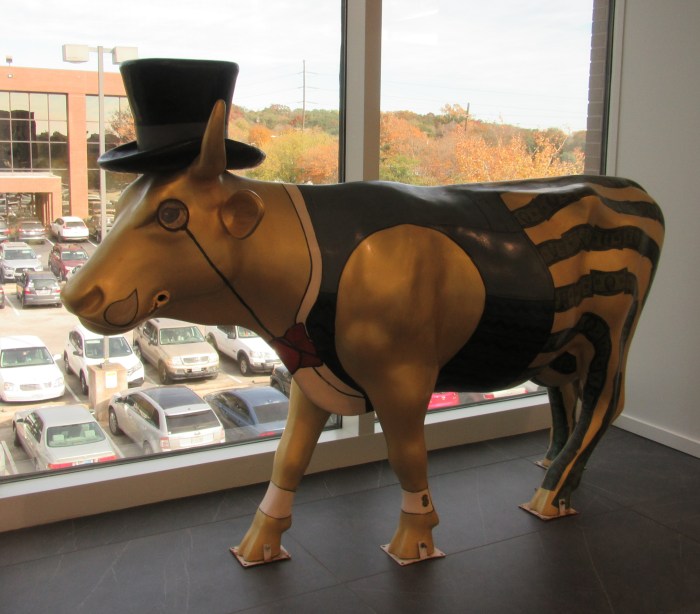






 What the Fest highlights films that don’t fit into any particular genre. (An understatement if there ever was one.)
 Pocket Sandwich Theatre is little and cute and specializes in melodrama, as you can tell from the carpet of popcorn on the floor.
 Once again, stars William and Ernest chose to stay home under the twice-a-day supervision of Charla, who feeds them, pets them, and gives William his insulin injection. They don’t like the carriers or the car, but they like Charla a lot. Charla emailed us that they’re playful.


