The total solar eclipse–the first across the entire continental United States in ninety-nine years–will take place on August 21. David and I will view it from Kansas City, where the full eclipse will be visible. We have our eclipse glasses and hotel reservations and look forward to a jaw-dropping experience.*
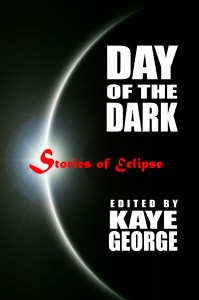
Not to take anything away from the eclipse, but I’m more excited about an event scheduled for later this month–Wildside Press’ release of Kaye George’s crime fiction anthology DAY OF THE DARK: Stories of the Eclipse. The book has twenty-four stories, each centered around a solar eclipse.
Individual authors are donating royalties from DAY OF THE DARK to various organizations. Mine will go to the Texas Museum of Science and Technology in Cedar Park.
As a sneak peek, I’ll say that my story, “I’ll Be a Sunbeam,” concerns Marva Lu Urquhart, Kilburn County librarian, who set out to “put Mama out of her misery” in her debut story, “Hell on Wheels,” which appears in Austin Mystery Writers’MURDER ON WHEELS: 11 Tales of Crime on the Move. If you’ve read that story, you know that when planning a murder, Marva Lu takes into account every eventuality–she thinks.
A number of online events are scheduled to celebrate the release. An interview with Kaye George, editor and contributor, will soon appear on Criminal Elements. Interviews with all the authors will appear on Writers Who Kill. Austin Mystery Writers will carry an interview with Laura Oles and me. For a complete list of events, as well as other information, see Travels with Kaye.
Total Solar Eclipse (Photo credit: Wikipedia) By E. Weiß (E. Weiß: “Bilderatlas der Sternenwelt”) [Public domain], via Wikimedia CommonsTo see paths of future eclipses, click here. It looks like the one scheduled for 2024 won’t require travel. David and I will just step outside, pull up a couple of lawn chairs, and look up. Which is kind of a shame, because part of the excitement resides in getting out of town. But maybe Kaye will put together another anthology. That’s exciting. I’ll ask.
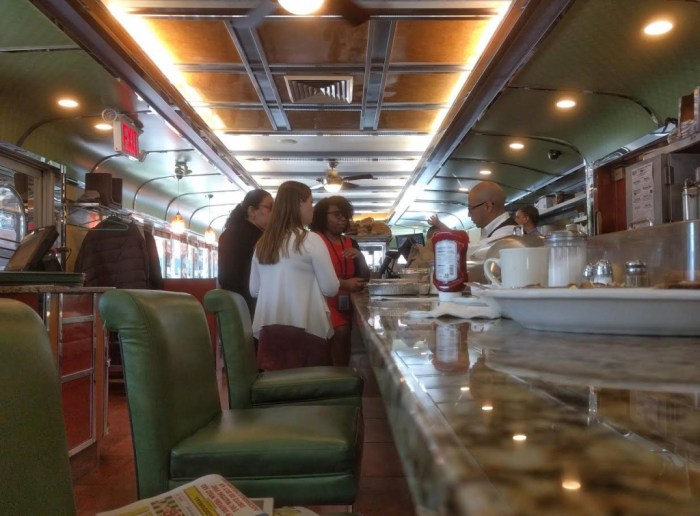
“The convention center? Well, go about six blocks, to where the old movie house used to be–the one that burned in ’87–What’d you say, Fred?”
“It’s The Oaks now. Condos.”
“Oh, that’s right. Well, just before the condos, turn right, and when you get to where the Masonic lodge used to be, there’s a–What’s that, Fred?”
“It’s the Hyatt–”
“All right, the Hyatt. Turn right again, and almost to where Milton Badey’s furniture store used to be–”
“The Omni.”
“Omni. One day they’ll knock down this diner and this’ll be where we used to be.”
***
On my husband’s first visit to my hometown, I took him on a walking tour: There’s where Miss Blanche Harris used to live, and my great-grandmother lived there, and when my grandfather moved in from the farm he built that little house, and the house across the street was Uncle Carl’s, and that one belonged to Aunt Bettie and Uncle Maurice, and Rob and Nell’s grocery store was there, and right next door was where Dick Ward sold double-dip ice cream cones for a nickle, and next door to that was Earl and Lorene McCutcheon’s store, and that was the Masonic lodge, and across the street was Dr. Luckett’s office, and that was the cotton gin, and there are the scales where they weighed the cotton wagons, and there’s the old post office that was a bank before it was a post office, and that was the gin yard where they stored the cotton bales, and the skating rink was back there on the river before they moved it to Lockhart . . .
And when the tour ended, I realized everything I’d told him was history.
*
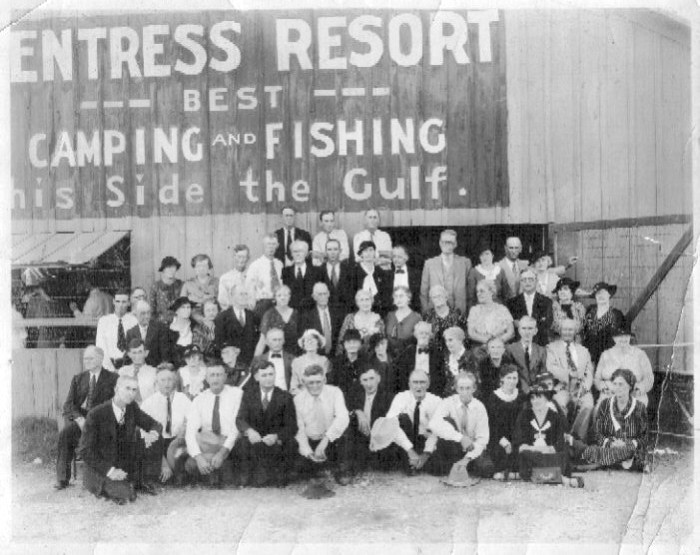
(The the event pictured below happened before my time. And it’s Fentress Resort. That’s the skating rink in the background.)
Cottonwood School Reunion – Fentress Resort–Fentress, Texas–1930s (?)–Row 1, 2nd from left – Carl Waller; 4th from right – Jessie Waller Meadows (white collar); last on right – Ethel Waller (polka dots). Next-to-last row, from left: Maurice Waller (partially hidden); Bettie Pittman Waller; Pearl Daniels; Frank Waller; Barney Waller
On Tuesdays, Rochelle Wisoff-Fields posts a photo prompt on her blog. The following Friday, writers post 100-word stories inspired by the photo on their blogs.
To read what other Friday Fictioneers have written, click the blue frog.
“The good old days.” Joe turned his eyes up to the ceiling and sighed.
“Oh, I remember it all. Fried chicken, sunbathing, you grabbing me and holding me under the water till I almost drowned before you let me go. . . . What I don’t remember is anybody actually swimming.”
“We had too much fun doing other things. I wasn’t a strong swimmer anyway. But I loved playing in the water. And just being with y’all.”
I personally believed what he loved most was Bonita and her bikini. My sister Bonita was the youngest in the crowd, but she developed early. Mama absolutely forbade her to wear anything but her blue gingham one-piece, and as long as Mama was taking us out to Paradise Bluff, that’s what she wore. But when I turned fifteen and got my driver’s license, I started driving us out there. And every day, as soon as we got to the Mobil station on Main Street, Bonita would set up a howl, and nothing would do but we had to stop so she could slip into the restroom and change.
Joe goofed around with me, but when Bonita was wearing that bikini—there wasn’t enough cotton in it to stop up an aspirin bottle—he only had eyes for her.
Joe leaned forward and rested his elbows on his knees. He had a faraway look in his eye. “I haven’t been out there in years. It’s kind of sad, you grow up and get responsibilities, seems like you to forget the simple pleasures of youth.”
“Um-hmm, sad.” Watching him leave with that silly smile on his face, I knew he was thinking about Bonita’s little red bikini.
~ M. K. Waller, “I’ll Be a Sunbeam”
Marva Lu Urquhart is on the move again. This time, she’s celebrating the 2017 eclipse with a picnic at Paradise Bluff.
If you remember Marva Lu from “Hell on Wheels,” in Austin Mystery Writers’ anthology MURDER ON WHEELS, you’ve probably already guessed the picnic has less to do with the eclipse than with–well, it has more to do with knocking the memory of Bonita’s little red bikini out of Joe’s head and replacing it with–let’s put it this way: Marva Lu hasn’t been taking belly dance lessons all these years for nothing.
All twenty-four stories in DOTD focus on those crucial minutes at midday when the moon devours the sun and anything can–and does–happen
Especially if you’re Marva Lu Urquhart.
Austin will see only a partial eclipse, so David and I will watch from Kansas City. Our eclipse glasses arrived through the mail this week.
Now there’s nothing to do but pack, grab my copy of DAY OF THE DARK–a little escape reading for the drive–drop William and Ernest off at their hotel, and head north. Where we trust our experience will be much less eventful than the one Marva Lu has planned for her friends.
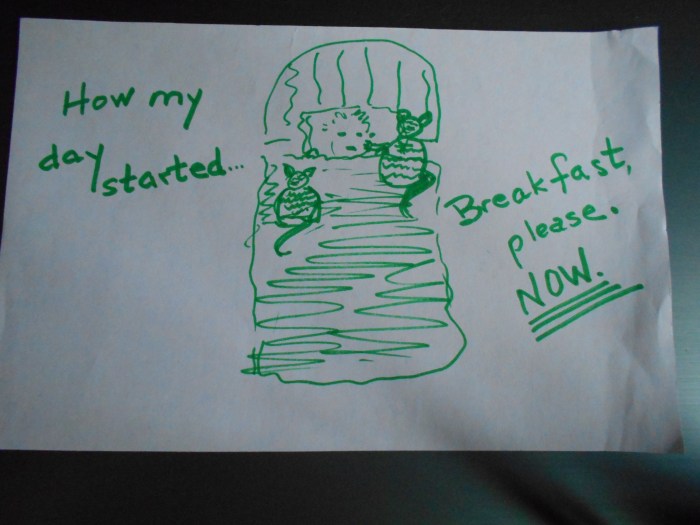
Speaker # 1 didn’t go shopping for red pumps. He stayed home, worked on his cartoons, did laundry, and massaged William the Cat. “Rorschach cover” is his.
Speaker #2 said, “Thank you,” then wrote and cut and cut and cut. And wrestled with Ernest the Cat.
In such moments of doubt, I look to history for reassurance. It’s always comforting to be reminded that literary whoring — I mean, self-marketing — has been practiced by the greats.
When I think of brands, I think of Opal the White-faced Hereford.
She was big and sleek and fat, the only registered cow in the Waller herd, and the best escape artist in the history of cowdom.
No matter how strong the fence–heavy cedar posts, six strands of barbed wire, stretched tight, a barricade I couldn’t get through without a follow-up of iodine and gauze–she broke out. How the beast breached the barricade was a mystery and remained so for a long time.
Finally she slipped up, as bovines sometimes do, and busted out while my father was watching. He said she just lay down beside the wire and rolled under. A regular Hairy Houdini.
To her credit, she never fled, nor did she meander into the neighbor’s maize, but grazed beside the narrow lane between the fence and the property line.
Nevertheless, since cows are capricious, my father bought a brand. In my honor–and because technically Opal was mine–he chose a K.
I hasten to say the branding was nothing like you see on Rawhide. He did not restrain Opal, stick the iron into a blazing fire, and sear her hide. After repeatedly shooing her back through the gate, he probably wanted to, but he didn’t.* He merely dipped the iron into an acid designed for the purpose, walked up to her, patted her on the back, and pressed it against her hip. The acid ate the hair and killed the follicles, so she was left wearing the initial. Maybe she itched a for a few days, but that was nothing compared to what the barbs must have felt like.
The K didn’t keep her confined, of course, but it made her easier to spot if she ever decided to widen her social circle.**
Well, anyway, when I think of brands, I think of Opal, or did until the writing thing came along–and I learned I must have a brand so readers can identify me.
The prospect wasn’t pleasant. I felt like a box of Kleenex.™
But it had to be done, so finally I’m designing my brand.
Unfortunately, the K won’t do. I mean, it really won’tdo. When I put MURDER ON WHEELS (see sidebar) on Goodreads, I was immediately confused with a different Kathy Waller. That required some straightening out. Googling Kathy Waller brings up a multitude of people I’m not, including the EVP and CFO of the Coca-Cola Company (NYSE: KO). (I wouldn’t mind being the EVP of Coca-Cola, but the company would.)
Officially, I’m a Mary Katherine, so I have options. Mary Katherine isn’t one of them. In the early years, I liked it just fine, but lately I’ve heard, “Are you a nun?” often enough not to want it hanging around.
People who don’t know me well, and some who do, call me Mary, so when I hear that name shouted out in a doctor’s waiting room, I answer, but it’s still a little foreign. I sign Mary K., a name I’ve come to despise, in part because it’s sometimes confused with Mary Kaye and I have to get that untangled, but mainly because Mary Kay makes lipstick and I don’t.
Once again, Google proves its worth. M. K. Waller brings up only one other person with my initials. That’s good.
When I search for MK, Google thinks I mean MK Wallet and pulls up only Michael Kors, which appears to be more of a business (jet set luxury: designer handbags, watches, shoes, clothing & more. Receive free shipping and returns on your purchase). That’s even better. But I don’t like the way it looks on the page.
So I’ve settled on M. K.
The name chosen, I changed the theme–appearance–of the blog. I wanted to change it anyway, because I was tired of the previous one, and it seemed best to make one smooth transition rather than two bumpy ones. I’m not sure about the new theme. I may change it again, but M. K. will remain.
There’s one more aspect of branding I’m still ruminating** over, so I’ll leave it for another time.
I’ll add, however, that I first ran across the word ruminate in a line from James Thomson’s “Winter”:
The Cattle, from th’untasted Fields, return, And ask, with Meaning low, their wonted Stalls; Or ruminate in the contiguous Shade . . .
And I complete this post by circling back to the beginning, starting with cows and ending with cows, and thus preserve the unities, as every writer, duke, and scoundrel knows is proper.
*
P. S. What do you think of the new design? Both positive and negative comments are welcome. I need to know. The page I’d like feedback on is here: http://kathywaller1.com
***
* If he’d threatened to brand her the old-fashioned way, I would have cried and that would have been the end of that. (Maybe.)
**In fairness, I add that Opal wasn’t the only one who*** got over the wall. Clyde Barrow escaped a couple of times. But he was a Holstein and flew over the fence, as Holsteins are often wont to do, so there was no mystery. We would have been surprised if he hadn’t.
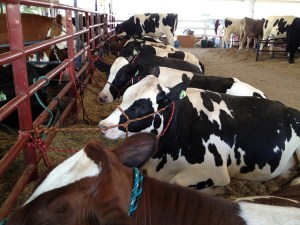
The animals in the photograph are cows, not steers, and they might not be Holsteins, but they’re black and white, and they’re sweet, and I have poetic license, so I ask you to suspend disbelief for the moment.
A light exists in spring
Not present on the year
At any other period.
When March is scarcely here
A color stands abroad
On solitary hills
That science cannot overtake,
But human nature feels.
It waits upon the lawn;
It shows the furthest tree
Upon the furthest slope we know;
It almost speaks to me.
Then, as horizons step,
Or noons report away,
Without the formula of sound,
It passes, and we stay:
A quality of loss
Affecting our content,
As trade had suddenly encroached
Upon a sacrament.
~ Emily Dickinson
*****
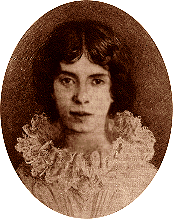
This a picture of Emily Dickinson.
English: Daguerreotype of the poet Emily Dickinson, taken circa 1848. (Original is scratched.) From the Todd-Bingham Picture Collection and Family Papers, Yale University Manuscripts & Archives Digital Images Database, Yale University, New Haven, Connecticut. (Photo credit: Wikipedia) {{PD-US}}
This is a “fabricated” picture of Emily Dickinson.
Fabricated portrait of Emily Dickinson (1830-1886), the American poet. It is an altered version of the only authenticated portrait of Dickinson made after childhood, with added frilled collar and changed hair to make her appear more feminine. Public domain. {{PD-US}}
According to a docent at the Emily Dickinson Museum in Amherst, Massachusetts, in the late 1990s, the photograph was probably altered after Dickinson’s death in 1886, as a tribute and a keepsake. At that time, families often had photographs “enhanced” after a loved one’s death.
I didn’t know Emily Dickinson personally, but judging from what I’ve read and heard about her, I think if she’d seen the enhanced version, she’d have hooted.
Emily Dickinson Museum, Amherst, Massachusetts – side view of Emily Dickinson’s house. (Photo credit: Wikipedia). By Daderot (Own work) [Public domain], via Wikimedia CommonsShe was obviously depressive, but she also had a sense of humor.
The docent told the following story (documented in an LA Times review by Susan Reynolds):
‘Once, when Samuel Bowles, an old family friend and the subject of Dickinson’s Master poems, went to visit, he found himself yelling up the stairs: “Emily, you damned rascal. No more of this nonsense! I’ve traveled all the way from Springfield to see you. Come down at once!”‘
The detail that doesn’t appear in the article, but that the docent added, is that, at Bowles’ summons, Emily left her room and came down the stairs, laughing.
Try calling someone without a sense of humor a “damned rascal” and see what happens.
And she wasn’t quite as antisocial as she’s generally portrayed. Alix North, in a biographical sketch of the poet, writes that in her twenties, Dickinson had a “busy social life” but that by her thirties, she had become reclusive and withdrew when visitors came.
It’s been speculated that Dickinson pulled away from the public because she thought she wasn’t beautiful, or that she was mourning an unrequited love, or that she was agoraphobic. But perhaps Dickinson “became an isolata , creating a moat around herself to preserve the rarity of her soul and because she believed that isolation was critical to artistic expression.”
In other words, she knew exactly what she was doing: Social butterflies rarely, if ever, compose more than 1100 poems by the time they’re 35, at least not concise, powerful ones.
[Sentiments expressed in the preceding paragraph are mine alone. I could be wrong, but I’m not. A 14-year-old boy once told me that anyone who stayed at home as much as Emily Dickinson did couldn’t know enough about life to write anything worthwhile. I refrained from replying that 14-year-old boys don’t know enough about anything to say what Emily Dickinson could or could not do. Now I wish I’d said it. But as I was saying before I interrupted myself . . .]
Edward Dickinson, the poet’s father, was described by contemporaries as “stern and unyielding”; “within his home his decisions and his word were law.” Emily wrote that she didn’t learn to tell time by the clock until she was fifteen because “[m]y father thought he had taught me but I did not understand & I was afraid to say I did not & afraid to ask anyone else lest he should know.”
The museum’s docent pointed out, however, that he was also kind. He could have required Emily to work and support herself or at least to contribute to family finances. Instead, he supported her until his death in 1874. Her sister, Lavinia, took care of most domestic tasks that would normally have been shared. Her family allowed Emily time and space in which to write.
Well, I’ve gone on about Emily Dickinson for a lot longer than I intended, and I hope you’re still with me. I’ll stop now, but not before saying this, which I’ve said before, but I’m going to say again:
A textbook I taught from in 1973, my first year in the Texas secondary school trenches, contained the statement that Emily Dickinson is one of America’s greatest women poets.
The house where we stayed is way out there–waaaaaaaaaaaay out there–and I had trouble finding it. It was one more instance of leaving the address tucked away safely in my email inbox.
When I reached the end of the road–literally–I turned around, retraced the route to the nearest post office and, fingers crossed, asked for directions to the nearest establishment offering free wi-fi. The postmaster directed me to her best guess, then said, “But it’s a bar.” I didn’t care. I can’t stand the smell of beer, but I’d have been glad to buy a six-pack for the privilege of Internet access.
I was on my way out when she said, “Wait. You can use my computer.” When the United States Postal Service declined to connect to gmail, she pulled out her mobile phone, accessed my account, and said, “You should change your password, of course, when you get home.” I wrote down the address, she gave me further directions, and in less than five minutes, I was where I should have been a half-hour before. Or maybe a full hour.*
In his essay “El Dorado,”Robert Louis Stevenson writes, “Little do ye know your own blessedness; for to travel hopefully is a better thing than to arrive, and the true success is to labour.”
I agree. I always travel hopefully and, most of the time, enjoy winding around, wondering whether I’ve passed the point of no return. There comes a time, however, when I’m relieved to finally arrive.
And so ends the obligatory account of my most recent episode of winding around. Now to get on with the retreat.
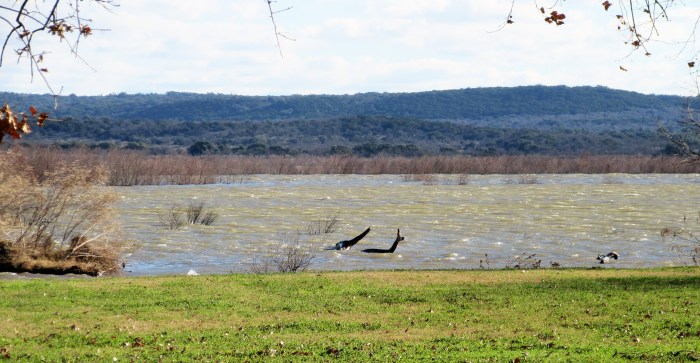
Come to think of it, there’s not a lot to get on with. We sat outside and watched birds flying and sticks floating; and discussed whether one stick, which stayed in the same place for a long time, wasn’t a stick but instead something that might crawl out of the lake and bite somebody, namely us; and monitored current events by periodically glancing at the television, sound off; and, when the spirit moved, ate.
Evidence of writing. AMW retreat on Lake Buchanan, January 2017
But most of the time, we wrote. I slapped down over 1900 words in one day. It’s been ages since I did that. Many of them won’t end up in the final version of the story, and those that do will be shifted from page to page before settling. But, to quote novelist Nancy Peacock, in A Broom of One’s Own, “if I don’t have the pages I hate I will never have the pages I love.”**
I expected to take pictures but was too relaxed/lazy to get out my camera until Sunday. A cold front had come in overnight, and that morning the lake was choppy. I wish my photos had picked up the whitecaps. I also wish they could show the tranquility of our surroundings.
The other photos are wretched, but I include them to prove that on our writing retreat we actually wrote.
So what is it with writers and retreats? Getting away from routine, from everyday-ness and common distractions, refreshing the mind and the soul, opening new vistas, viewing life from new perspectives…
All of the above. None of the above. It doesn’t matter.
Laura Oles accepts Silver Falchion Award from Anne Perry. Photograph by Manning Wolfe.
If you’ve already heard about the award, my apologies. I’ve spread it all over Facebook. That’s called BSP–Blatant Self-Promotion–but self, in this case, refers to everyone involved in the anthology’s production. We’re surprised–we didn’t know we’d been nominated until three days before the awards ceremony–and honored and excited, so we’ve announced it at every opportunity.
I like to think that someday I’ll develop the air of dignified detachment that is the hallmark of the professional writer. Maybe I will. Maybe.
(In case the word falchion isn’t familiar–Wikipedia says it’s a “one-handed, single-edged sword of European origin, whose design is reminiscent of the Persian shamshir, the Chinese dadao, and modern machete.” The Silver Falchion seal, above, displays crossed falchions.)
The second item of good news isn’t mine–it’s my husband’s. His video “Invisible Men Invade Mars,” starring cats William and Ernest, will be screened at the Walker Museum Internet Cat Video Festival on Wednesday, August 24, at the Texas Theater in Dallas. David is pleased, but he isn’t bouncing off the walls, as I am over the AMW’s Silver Falchion. He’s taken videos to film festivals, and his Alien Resort Christmas card won John Kelso’s contest. And he’s always been dignified and professional.
Third on the list: I’ve completed five days of radiation treatments. That’s five of a projected twenty–25%. I learned today that I’m doing in twenty days what is normally done in thirty. I don’t know why, and I didn’t ask. This is another area requiring detachment, and I’ve found that detachment and too much information don’t play well together. The doctor kept using the word if –“If you do well with this, then we’ll…”–and upset the balance between optimism and uncertainty I try to maintain. If is too much information. So I pronounce the situation good and move on.
(Before I move on, and I really shouldn’t publicize this, but while I’m being unprofessional–since the first of June, I’ve lost twenty-nine pounds. Disclaimer: twenty-nine pounds equals the nineteen I had gained from taking steroids during chemo, and the ten I lost from having no appetite during chemo. The doctor doesn’t like it, and I understand why. It’s a hell of a way to lose weight, but with a net loss of ten pounds, I’m happy, and I’m taking credit for every one of them. I like being able to take my jeans off without unbuttoning and unzipping them.)
Boycotted refined sugar and starches, including starchy vegetables, longer than necessary before the PET scan. Blood sugar was normal. There was no reason to think it wouldn’t be, but still…
Critiqued and returned AMW stories I had at the time.
Wrote and posted on AMW blog, but not exactly on time. I traded post dates with another member, then realized I hadn’t traded. It’s complicated. I posted on the 20th instead of the 15th, but got it in before the Silver Falchion winner was announced.
Have a blast visiting with Kaye George at this week’s Austin Mystery Writers meeting.
Might as well face facts. I’ll dust the piano if I dust it, organize books if I organize books, and shred if I shred. They’re more likely to get done if I don’t write them down.
###
I dood it was “one of Red Skelton’s radio catchphrases” of the 1930s and ’40s. It was also the title of a song written by Jack Owens for Skelton in 1942, titled “I Dood It! (If I Do, I Get a Whippin’),” and the title of a movie released the next year.
a young boy full of mischief, who typically did things he was told not to do. “Junior” would say things like, “If I dood it, I gets a whipping.”, followed moments later by the statement, “I dood it!”
My mother told me about Skelton’s I dood it line when I was a child. She thought it was funny; I thought it was funny; I still think it’s funny. I never heard him say it–until today, when I watched the movie trailer on Youtube. The first part is devoted to introducing the cast, so it takes a little time to get to Skelton.
Wikipedia refers to the movie’s rather ungrammatical title. I agree: it is, rather.
Because last night I waltzed up to the watermelon buffet and chose
Complete the edit the AMW story for its (I hope) final major critique
If I’d been taking naps, #1 would be only a memory. But there’s more to do.
Weeks ago, I edited out a couple of sentences but later realized I’d removed a bit of necessary information and created a contradiction. The error would be so difficult to resolve, and the lapse in logic was so subtle and so trivial, and the remaining text flowed so smoothly that I thought about saying, with Walt Whitman,
“Do I contradict myself? Very well, then, I contradict myself;”
and leave it alone and hope no one would notice.
But someone always notices. Sometime, somewhere, some reader would say, But the character says this is going to happen, and this doesn’t happen, or maybe it does, but whatever happened, she never says another word about it, so it sounds like maybe both things happened, and she should have told us…
So I tried a number of fixes, none of which pleased me, settled on one, and moved on. In a few days, I’ll go back and try again.
Just wo-ahn out
In moving on, I went from editing/revising to tampering. The official word is polishing, but I tampered: with words–thank goodness for thesaurus.com running in the background; with phrases; with sentence structure… Tampered with things better left untouched.
Tampering–especially when you think you’re polishing–is doomed to fail. It usually takes place near the end of a project, when you think everything is perfect, but not quite. So you make one little change, and then another, and another, and soon, part of your brain–the part where judgment lives–shuts off and you go on automatic pilot. You keep on clicking that mouse, cutting, pasting, copying, deleting, inserting…
Do this long enough and you can drain the life out of a story.
I’m most likely to tamper when I’m tired. I was tired last night. I should have watched Acorn TV or read or, better yet, given in and gone to bed at a reasonable hour. But I didn’t. Hyperfocused on the manuscript, I lost track of time and stayed up long after midnight. Then, in a perverse turn of events, I woke today up at 7:00 a.m.
So, as I said at the top of the page, I am tired.
A deadline approaches. I need to finish that story. First, though, I’ll let it rest. Several days. A week. Until I’m sufficiently rested. Until I don’t hate it with every fiber of my being. Until I’m detached enough to distinguish the good from the bad from the ugly.
#ROW80 Update
The July 20 Buffet
The original Buffet was meant to cover 80 days beginning with July 4, not just a few days or a week. Some haven’t been completed. Number 5 is on-going. So nothing changes.
Complete the edit the AMW story for its (I hope) final major critique Tried but didn’t finish, might have created a monster instead. See above, if you haven’t already.
Draft the second half of the story “Texas Boss” and submit to AMW for critique–Nope.
Finish a very rough draft of “Thank You, Mr. Poe”–Nope.
By September 5th, read at least ten of the books on my 20 Books of Summer 2016 list. (The list appears at Writing Wranglers and Warriors.) Still reading Isabel Allende’s The Japanese Lover, 68 pages toBy Mutari (Own work) [Public domain], via Wikimedia Commonsgo. I used the calculator to figure that out. I didn’t have to. I can still subtract in my head. But I don’t want to think that hard. Sad.
Post #ROW80 reports on Sundays and Wednesdays. It’s Wednesday and I’m posting.
Visit three new #ROW80 blogs a day.–Nope. I don’t know why, but nope.
Take three naps a week.–Nope. And I’m so sorry I didn’t.
###
The July 27 Buffet
They don’t change much. The point of the buffet, per shanjeniah, is to have choices and plenty of them. So I’ll add more watermelon.
Complete the edit the AMW story for its (I hope) final major critique
Draft the second half of the story “Texas Boss” and submit to AMW for critique
Fort Worth Indie Film Festival, 2016 – Family Shorts Block – “The Places You’ll Go”
It appears to be Wednesday–the scheduler from my doctor’s office had to tell me it wasn’t Thursday, but since her call woke me up, I take no responsibility for mixing up the days–and thus time for the #ROW80 report.
If I were playing by the rules, I would have reported last Sunday, but we’d been out of town all weekend and there was little to say. And since #ROW80 knows I have a life, I play by my rules.
I probably shouldn’t post today. I’m not in the best state of mind. I feel the way many of us do when we did the right thing, and because we did, life went all to you-know-where. But that’s another story. For anyone wanting more information, check the end of the post.
Fort Worth Indie Film Festival, 2016 – Family Shorts Block – “The Interview”
On a brighter note, which I’m sure will be welcome, David’s “Alike and Different” was screened at the Fort Worth Indie Film Festival on Saturday. There was a good turnout, and the audience laughed in all the right places. The one drawback was that two of the other films starred very cute children and thus received an inordinate amount of attention. I’ve advised David to include William and Ernest the Cats in all future videos. Children, no matter how cute, are not as cute as our cats.
Edit the AMW story for its (I hope) last major critique On the way home from Fort Worth, I scribbled on the manuscript. No major changes, the kind that will make a difference, just little changes in wording that will make no difference at all, but that will keep me doing the Should I? Shouldn’t I? dance. Just north of Waco, I put the ms. away to look at when I don’t care.
Draft the second half of the story “Texas Boss” and submit to AMW for critique Nope.
Finish a very rough draft of “Thank You, Mr. Poe,” the story I started last week Nope again.
By September 5th, read at least ten of the books on my 20 Books of Summer 2016 list. I’ve read about half of Isabel Allende’s The Japanese Lover. I’m glad I made the effort to see Allende when she was at BookPeople several months ago. I’m glad I bought the book. At the time, I felt guilty for buying a hardback I don’t have room for when I could have spent less for a Kindle “copy.” But after I read the first few pages, guilt atomized. It’s a delightful book, one that, for maximum enjoyment, must be read from paper. I still don’t know where I will put the book after reading it.
Post #ROW80 reports on Sundays and Wednesdays. I skipped Sunday. See paragraph #2, above.
Visit three new #ROW80 blogs a day. Started this but fell along the wayside.
Take three naps a week.* Not too bad. Napped Wednesday, Thursday, Friday (on the way to Fort Worth; I think that counts), Saturday (practically passed out, so maybe I can’t claim credit), and Sunday (on the way home). Sad but true, I can’t remember what I did Monday or yesterday. But that’s five naps, two more than I set for myself, and four more than I expected to take.
*Start as soon as this has been posted. I did, with a nap.
*****
The July 20 Buffet:
The original Buffet was meant to cover 80 days beginning with July 4, not just a few days or a week. Some haven’t been completed. Number 5 is on-going. So nothing changes.
Complete the edit the AMW story for its (I hope) final major critique
Draft the second half of the story “Texas Boss” and submit to AMW for critique
A Round of Words in 80 Days (#ROW80) is The Writing Challenge That Knows You Have a Life.
To read what other #ROW80 writers are doing, click here.
*****
“Alike and Different”
*****
For the curious: The reason for my nasty state of mind: I flossed out a crown. And had to get it put back in. As I said, you do the right thing, and still…
Edit the AMW story for its last (I hope) critique; Not yet, but tomorrow I’ll get a critique from another partner. It’s better to have everything in before making changes.
Write and schedule the WWW post at least two days before the July 19 deadline; It’s finished, and SIX days before the deadline. I’m going to the doctor to see what’s wrong–I never finish a piece SIX days before the deadline. I’ll continue to change little things, but it’s polished enough to be posted today. So I’m putting this one in the Watermelon Met* column.
Draft the second half of the story “Texas Boss” and turn in to AMW for critique;
Finish a very rough draft of “Thank You, Mr. Poe,” the story I started last week;
Complete the piece for the AMW blog and schedule it to post before midnight tonight. I posted it. Not before midnight. At 3:00 a.m. But I met the AMW deadline, and that’s close enough. Watermelon Met.
Summary: I set out to meet two deadlines and met them. The three remaining tasks aren’t time-sensitive. They carry over. The first, polishing the story for the proposed AMW anthology, must be finished by August 1, so it’s priority.
I’m adding three new goals to the list. Then I’m going to take a nap.
Edit the AMW story for its (I hope) final major critique
Draft the second half of the story “Texas Boss” and submit to AMW for critique
Finish a very rough draft of “Thank You, Mr. Poe,” the story I started last week
I hate that. I hate the author. I continue to like the book, but the author I despise.
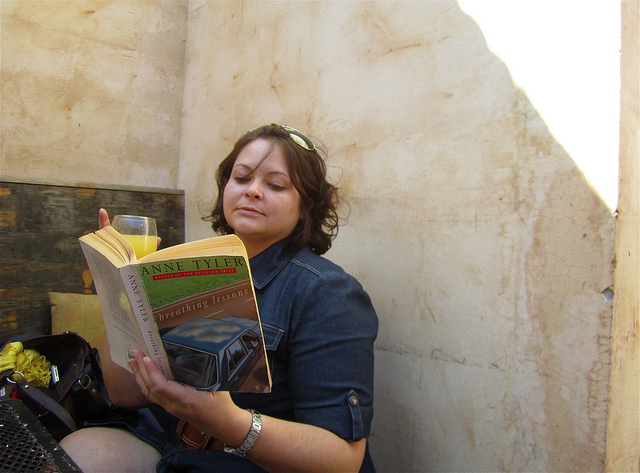
This time it’s Anne Tyler. I love her novels. The Accidental Tourist. Breathing Lessons. Dinner at the Homesick Restaurant. My favorites, if I have favorites, are Back When We Were Grownups and Saint Maybe.
Tyler’s plots are rather loose. Instead of going directly from here to there, they detour, turn corners you didn’t see coming, abandon the now for backstory that might take you a generation or two into the past before returning to the main narrative. “[C]haracter is everything,” Tyler said in an interview. “I never did see why I have to throw in a plot, too.”
She writes about families: ordinary, quirky, dysfunctional families–dysfunctional as ordinary families tend to be. They’re humble people, living in ordinary houses, working at ordinary jobs; their furniture is often mismatched and their carpet runners often worn from someone’s pacing. Her families stick together; children and grandchildren don’t stray far, come home often, and sometimes don’t leave at all.
Even their extraordinary problems are ordinary, the kinds of problems real people experience.
Her characters’ days are filled with matters of little importance. “As for huge events vs. small events,” says Tyler, “I believe they all count. They all reveal character, which is the factor that most concerns me….It does fascinate me, though, that small details can be so meaningful.”
She loves to “think about chance–about how one little overheard word, one pebble in a shoe, can change the universe…The real heroes to me in my books are first the ones who manage to endure.”
If her plots meander, it’s because they reflect the common, insignificant, everyday events that are so important, because, taken together, they form the essence of life.
Tyler cares about her characters. “My people wander around my study until the novel is done,” she said in another interview. “It’s one reason I’m very careful not to write about people I don’t like. If I find somebody creeping in that I’m not really fond of, I usually take him out.”
And therein lies my problem, and the reason that Anne Tyler is, for the moment, on my bad list.
She isn’t alone in liking her characters. I like them, too. Some of them, I love. And when one dies–or, as I see it, when she kills one–I take it personally. The character’s family stand around in the kitchen saying all the plain, simple, often awkward, frequently funny things that real people say when someone they love has died. They crowd together in pews to hear a sermon by a minister who didn’t know the loved one and might not know how to pronounce his name. They return home to refrigerators stuffed with casseroles and play host to friends and neighbors until they’re so tired they’re about to drop. Left alone, they get on one another’s nerves and offend with, or take offense at, the most innocent remarks. Then they pick themselves up and go on with their lives.
But I don’t. Because even though I stand outside the novel, reading about people who don’t exist, never have, never will, I know them. I’ve been where they are, said what they say, done what they do. And when I have to go through it one more time, with them–that seriously messes up my day.
Tyler always manages to redeem herself, though. One of her characters says or does something so remarkable, so absolutely right. And the world of the novel shifts. And so does mine.
In the book I’m reading now–I won’t mention the title so as not to spoil it for you–Tyler gives that role to the “disconcertingly young” minister who conducts the funeral. After a friend and a sister-in-law and a fourteen-year-old granddaughter wearing “patent leather heels and a shiny, froufrou dress so short she could have been a cocktail waitress,” have paid tribute to the deceased, he approaches the lectern and does what the deceased wanted–to “say something brief and–if it wasn’t asking too much–‘not too heavy on religion.'”
He starts by saying he didn’t know their loved one and so doesn’t have memories like they have.
But it has occurred to me, on occasion, that our memories of our loved ones might not be the point. Maybe the point is their memories–all that they take away with them. What if heaven is just a vast consciousness that the dead return to? And their assignment is to report on the experiences they collected during their time on earth. The hardware store their father owned with the cat asleep on the grass seed, and the friend they used to laugh with till the tears streamed down their cheeks… The spring mornings they woke up to a million birds singing their hearts out, and the summer afternoons with the swim towels hung over the porch rail… and the warm yellow windows of home when they came in on a snowy night. “That’s what my experience has been,” they say, and it gets folded in with the others–one more report on what living felt like. What it was to be alive.
And so Anne Tyler performs her magic. Once more I start bawling. I reconsider. My hostility passes into nothingness. I forgive her. We’re friends again.
I leave the church and go home with the family to a refrigerator stuffed with casseroles, and visit with their friends, and watch them give and take offense but then quickly, or perhaps slowly, repair their relationships, and pick themselves up and go on with life.
Now I have to read the second half of the book. That’s a lot of pages to cover without the character I love. But, like the others, I pick myself up and get on with it.
If I can’t have the character, I can still love Anne Tyler. And I will. And I do.
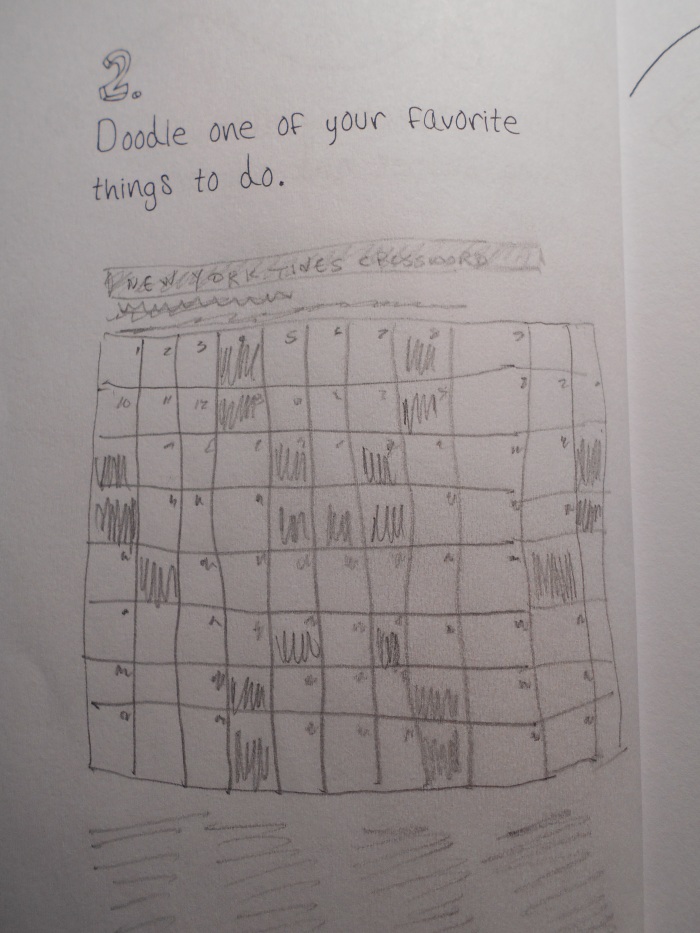
My favorite thing is to fly to Albany, rent a car, get a hotel room in Williamstown, Massachusetts, and spend several days driving up U.S. Route 7 to Burlington, Vermont, and down U.S. Route 7 to Lenox, Massachusetts (Edith Wharton’s house), and up to Burlington, and down to Lenox, and then turning east to Amherst (Emily Dickinson’s house), and on to Lexington and Concord (Emerson’s, Hawthorne’s, the Alcotts’, Margaret Sidney’s, etc., house…) But that’s more of a video than a doodle.
So I chose to draw my Saturday morning occupation, the Sunday New York Times Crossword Puzzle. We don’t subscribe to the Times, so I wait till it comes out in the Austin American-Statesman and do it retroactively.
Working the puzzle is a two-step process.
Step One: I start. Sometimes I finish the whole thing or leave only a few squares empty. Sometimes it goes fast. Sometimes I suffer and struggle but persevere. Sometimes I get mad and read Dear Abby instead.
I use a pen. It’s better to blot out wrong answers than to erase and make holes in the paper.
Step Two: When I’ve gone as far as I can go, I hand the paper to David. He fills in the rest. In other words, I do the easy part and he does the part that uses the other 90% of the brain.
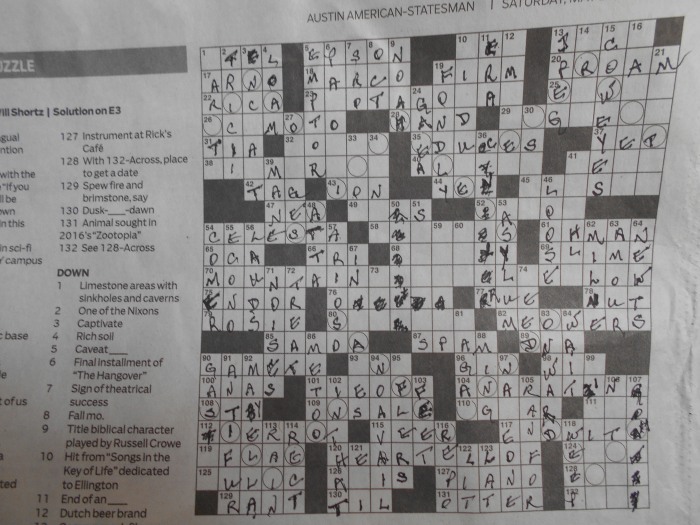
Here’s a current photo of today’s Step One. It’s not as neat and tidy as I’d like because (a) Ernest the Cat was draped across my right forearm, pinning it to the arm of the chair, while I wrote; (b) Ernest the Cat insisted on nudging the pen while I wrote; (c) I woke up in a nasty mood and hadn’t worked my way out, and superior penmanship wasn’t a priority.
Yesterday I veered off course and skipped the Times puzzle, and because these things have to be done in the proper sequence, the Los Angeles Times puzzle, which I normally work on Sundays, will have to wait till tonight. Or tomorrow. Or whenever.
In other words, until the nasty mood has passed, I may do no puzzles at all. I may instead hop a plane to Albany and spend the rest of the year visiting every literary house in New England.
Doodle prompt from 365 Days of Doodling, by Carin Channing
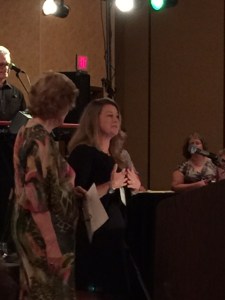
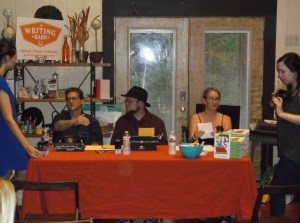
Seated, L-R: Poets Sean Petrie and David Fruchter of Typewriter Rodeo, and author/doodler Carin Channing
Ms. Channing didn’t know she was a doodler until she was forty, when she accepted an online 30-day Doodle Challenge. When the month was up, she began doodling with friends… and with strangers… and then she started teaching doodling.
Why? Because doodling is–I’m pulling from her long list of adjectives–“fun… liberating… fun… energizing… youthfulizing… clarifying… fun…”
I’ve never been a doodler. I have a heavy touch and a tight grip. My pencil doesn’t sweep lightly, freely, and steadily across the page. The pictures on my paper don’t look like the pictures in my head. Frustration guaranteed.
But at Words & Wine, Ms. Channing made doodling sound as much fun as her book claims it is. She handed out paper and markers and invited us to draw.
Ms. Channing’s books were, like Mt. Everest, there, so I bought one.
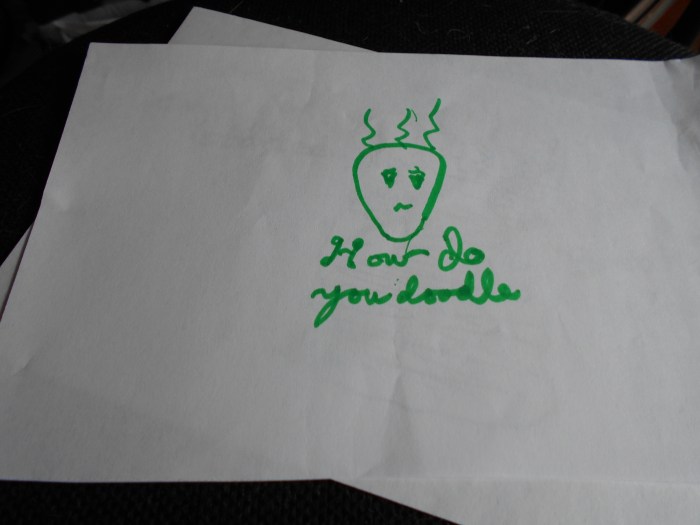
Today I did my first official doodle, displayed at the top of the post.
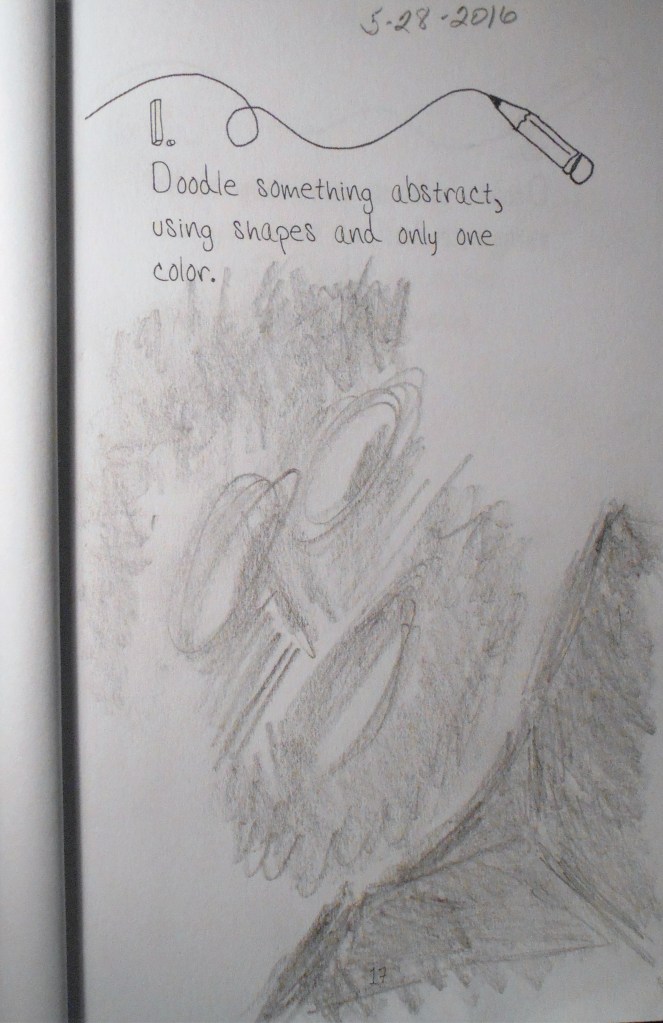
English: Action painting – own work. Somewhat similar to Jackson Pollock (Photo credit: Wikipedia) By Michael Philip (Own work) [Public domain], via Wikimedia CommonsOf course, I dithered first. Abstract? My doodle shouldn’t be anything? How can I draw without knowing what I’m drawing?
Didn’t Jackson Pollock’s wife say to him, “But you have to abstract from something. What are you abstracting from?” (If Mrs. Pollock didn’t really say that, Marcia Gay Harden said something similar in the movie, which is close enough.)
I quashed the dither by turning my pencil on its side and making a blurry square, and another one, and then a couple of ovals, and another blurry square, and another oval… and the ovals began to look like eyes and a mouth. An oval blur in one of the eye-ovals looked like an iris, so I added a blur to the other eye-oval. That made the eyes focus. I restrained myself from putting a ladybug on the shoulder.
So much for abstraction. Some of us, I guess, abstract to rather than from.*
Where creativity is the goal–and this is oh, so important–judgment must be silent. As Mr. Pollock no doubt said to his wife.
###
*I write that way, too.
###
Typewriter Rodeo, who create “custom, on-the-spot poems for event guests, using vintage typewriters,” was also featured at Words & Wine Wednesday. The typewriters are beautiful. More about that in a later post.
 The total solar eclipse–the first across the entire continental United States in ninety-nine years–will take place on August 21. David and I will view it from Kansas City, where the full eclipse will be visible. We have our eclipse glasses and hotel reservations and look forward to a jaw-dropping experience.*



















 M. K. Waller