Repost: Guidelines for Efficient and Effective Grocery Shopping

A shopping cart filled with bagged groceries l...
Image via Wikipedia

While transferring groceries from the shopping cart to my car this afternoon, I remembered the following post, which appeared on Whiskertips last year.

Specifically, I remembered sections 10.1 and 10.2, concerning the connection between heat index and the propriety of leaving one’s shopping cart right in the middle of someone else’s potential parking space.

Today’s heat index was ‘way above 85, and it took all the energy I had to be a good citizen and march that cart back to where it belonged.

While marching, I remembered a few other things I’d written. And from the distance of fifteen months, some of them seemed rather opinionated. Sharp. Pointed. Callous. Mean-spirited. Churlish. Malicious. Downright nasty.

Not too nasty, however, to keep me from re-posting here.

***************

While reviewing Pat Hoglund’s Have I Got a Story for You, I was impressed by how similar Ms. Hoglund and I are in our approach to grocery shopping. We both want to get in and out of the store as soon as possible.

For several years, I’ve been compiling a list of guidelines for grocery shopping. I offer them here for your edification.

How to Shop for Groceries

1.0      Produce

1.1      If you have to examine every single green bean before selection, you should not be buying green beans. Wait until a fresh crop comes in. See section 6.1.

1.2      There is no such thing as a perfect apple, orange, tangerine, tomato, lemon, onion, potato…I could go on ad infinitum. Unless it’s markedly discolored or mushy to the touch, take it and move along. See section 6.1.

2.0      Everything else

2.1      It doesn’t matter whether you get the potato chips or the Doritos. If the kids don’t like them, let them eat broccoli. Put something in your basket and move along. See section 6.1.

2.2      Section 2.1 applies to everything else the store sells except cottage cheese.

3.0      Cottage cheese

3.1      When buying cottage cheese in a plastic carton, take off the lid and check the seal underneath before putting the carton into your cart. People will look at you funny but any embarrassment you experience will shrink in reverse proportion to the disgust you’ll feel at home when you remove the lid and curds schloop down the side.

3.2      If you find the seal broken, do not replace the carton in the dairy case for someone else to buy. Other people don’t want it either. Hand it to a store employee and explain.

4.0      Cell phones

4.1      Do not use your cell phone while shopping.

4.2     In an emergency, calling home to ask a grocery-related question is marginally acceptable, but step out of the flow of traffic until the conference has concluded, and do not block shelves. See section 6.1.

4.3      When observing section 4.2, do not look directly at me, because that makes me think you’re talking to me, and I’m tired of feeling foolish for answering the questions you aim at me.

5.0      MP3 players

5.1      If you insist on walking through the store with those little buttons jammed into your ears, at least turn down the volume so other shoppers don’t have to listen to the bop-bop-bop.

5.2      Pay attention to your surroundings. The littlest of blue-haired ladies will exhibit aisle rage when stepped on by a person one-third her age.

6.0      Physical activity

6.1      When a shopper with a determined glint in her eye comes charging down the aisle toward you, do not just stand there mulling over Campbell’s versus Progresso. Get out of the way. Some people get most of their physical activity between the celery and the tortillas, and slowing down to avoid hitting you also slows their heart rate. Other people just want to get home. Furthermore, unless you’re making green bean casserole, buy the Progresso. The tomato basil is good.

7.0      Children

7.1      Corral your children. See section 6.1.

8.0      Socializing

8.1      When you meet the best friend you haven’t seen since last Friday, repair to the coffee shop for a tete-a-tete. See section 6.1.

9.0      Checkout

9.1      At the checkout, do not line up behind a woman* with children. Women with children are too distracted to have their cash, check, or credit card ready when it’s time to pay. It’s also possible they’ve sent one of the children back to the aisles to find something they forgot, in which case they probably chose the least obedient, the most distractible, or the one with the lowest reading level.

*The term woman is intended to be inclusive. Seeing a man in charge of children at the grocery store is so rare, at least in my experience, that I consider woman the more acceptable term.

9.2      At checkout, do not line up behind anyone who smokes.** The smoker will ask for a pack of cigarettes, and the cashier will have to either open the little safe above her head or walk the length of the store to access the vault where tobacco products are stored.

**I have no idea how to identify people who smoke. Just do your best.

9.3      At checkout, do not line up behind anyone holding a cell phone. This rule is self-explanatory.

9.4      At checkout, do line up behind men. Unless they smoke, men pay and leave quickly.

9.5     At checkout, do line up behind older people, even those who look like they will take forever. And be nice. You’ll get there yourself someday.

9.6      Have cash, check, or credit card ready as soon as possible after your order is rung up.

9.7      Smile at the cashier and the sacker. They’ve been on their feet all day waiting for people to get out their cash, checks, and credit cards, and to finish their cell phone conversations.

10.0   Parking lot

10.1   Leave the shopping cart in the cart return.

10.2   If heat index is above 85 degrees, feel free to ignore section 10.1.

10.3   In observing section 10.2, secure cart so it cannot run amok.

10.4   When leaving the parking lot, turn right. Do not attempt to turn left across traffic. Going around the block is faster than waiting for an opportunity to avoid being broadsided.

Although the above list is extensive, it is by no means exhaustive. I will post further suggestions as they occur to me. I would also be happy to hear from any readers who care to add guidelines I’ve not included. Feel free to list them in the comments section following this post.

***************

It Doesn’t Rain at Night in June

Rain, Rainy weather
Image via Wikipedia

For anyone who hasn’t heard the shouts of wild rejoicing, here’s the latest weather report:

Shortly after 1:00 a.m., thunder rumbled and the skies opened.

And once more the humble little cenizo proved itself a prophet: a harbinger of rain.

Forgive the purple prose; I’m still a touch giddy.

A piece of lore I picked up in my youth went like this: In Texas, it doesn’t rain at night in June.

When I was nine or ten and had had several years to ponder the statement, I pointed out that I’d awakened in the night and heard rain falling on the roof.

Of course, someone would say. That was after midnight, which means it was morning. Because in Texas, it doesn’t rain at night in June.

Some parts of Central Texas had as much as 3.5 inches this morning. Austin proper didn’t get that much. The airport, several miles west, got an inch and a half. I don’t think my part of town did that well. But we’re grateful for what we got. It cooled things down.

In my family, rain always brought the same response. My father herded us into the car so we could drive around and see the results. Were the ditches full of water? Was it standing in the fields? Did it rain on York Creek as much as it did closer to town? We could spend hours on a Sunday afternoon, exploring the back roads, speculating on what the precipitation would do to grass, cotton, corn, maize…whatever happened to be growing at the time.

(Note: In those days, I didn’t always appreciate the finer points of rainfall. I usually sat in the back seat with my nose in a book.)

Once my family joined my uncle and aunt on a Sunday afternoon tour of the wetlands. We passed property belonging to one of the town’s more outspoken citizens–in fact, this citizen had for several months been saying some undeservedly nasty things about my uncle, day after day, in his presence (that’s another story). He was a public servant and generally mild-mannered, so he never responded. But his good nature was beginning to fray.

When we reached the gate, he stopped the car, hopped out, and made his way through puddles to the fence, where the rain gauge held a couple of inches of water. He took the gauge off its stand, filled it with water from the ditch, and set it back in place.

He came back to the car grinning. “Tomorrow old Soandso will come into the post office telling how she got over six inches out at her place.”

In other words, if you can’t–or are too much of a gentleman to–lick ’em, just play a practical joke.

That was over forty years ago. Some people I know are still laughing.

The CENIZO IS BLOOMING!

Leucophyllum frutescens - Purple Sage, Texas S...
Image via Wikipedia

My community theater debut came the year tee-shirts read, I Survived the Summer of 1980.

That was a bad one, weather-wise. It was hot and dry. No rain, no time, no how.

I spent June and most of July, four evenings a week, in the auditorium of a San Marcos junior high school.

At the director’s signal, the lead tenor ambled onstage singing:

Overhead the sun is shining
Not a cloud across the sky
Not a sign on the horizon
And it’s gonna be another hot day

Underneath, the earth is burning
Crops is bad and land is dry
Still the sun
Keeps on returnin’
and it’s gonna be another hot day

Then the chorus, of which I was a member, ambled on after him:

Yes, it’s gonna be another hot day.

We sang a lot about heat. We sang a lot about rain, too.

None of us had to be told to move slowly or to look tired and sweaty and miserable. Except for a set of double doors on each side, the auditorium was sealed shut. No breeze swept through. Until opening night,  the air conditioner stayed off.

The play in rehearsal was 110 in the Shade, Tom Jones’ and Harvey Schmidt’s musical adaptation of The Rainmaker.

In every night’s backstage conversation, someone noted the irony of our situation. A college girl said, “Wouldn’t it be neat if it doesn’t rain all summer, and then, on opening night, at the very end of the last act, when sound-effect thunder begins to rumble, rain begins to pour down outside?”

We forgave her the thought. She was young, and heat had obviously addled her brain. In addition, it’s always been my policy to cut sopranos of her quality quite a bit of slack.

As it happened, rain spoiled the effect by arriving a few days before the play opened, and by the time we closed, most people skipped the cast party. Drought followed by heavy rain usually equals flooding of area creeks, sometimes of rivers. No one wanted to get caught by high water.

Heat notwithstanding, I loved that summer. The privilege and joy of singing made the discomfort worthwhile. Let me sing and I’ll put up with a lot.

Or I would in 1980. The current summer finds me in a different frame of mind.

The spring of 1980 was relatively cool. Thermometers waited until early June to skyrocket.

This summer began in April. This summer, we’re losing trees. Most of Texas is in extreme or exceptional drought. An arborist told one of my friends that we’ll be seeing the effects for years to come. Wildfires cover the state. The Llano River is drying up, and with it that area’s source of water. And then there are the farmers and ranchers, and the crops and the livestock. And the people who live without anything to cool their houses. Family Eldercare is once again collecting fans for people who can’t afford fans or air conditioning.

Technically, we’re now in the midst of a cold front: highs are between 95 and 99, two-digits temps until next Monday. Tomorrow and Thursday, there’s a slight chance of rain.

I confess–every time the local weatherman predicts that chance of rain, I laugh. Bitterly. Derisively.

Then today, I saw cause for hope: the cenizo is blooming. A hedge bordering a little strip mall just a mile or so from my house bears a dozen or so little purple flowers.

Google cenizo and you learn the shrub blooms after a rain.

Ask me, and you learn it blooms before. I know. I’ve been watching it for years.

This afternoon, when I saw those purple petals, I got so excited, I came close to running the car right up onto the sidewalk.

One swallow doesn’t make a spring, of course, nor do a dozen flowers make a deluge.

But tomorrow I’ll drive down to check on their progress, perhaps get out and take a more exact count. And hope those flowers contain a message:

It’s gonna rain
All through the mornin’.
It’s gonna rain
All through the night.

It’s gonna rain
All day tomorrow!
And Lord God A-mighty.
Now won’t that be a sight!

***************

Lyrics to “Gonna Be Another Hot Day” and “The Rain Song (Reprise)” by Tom Jones; music by Harvey Schmidt.

Image of cenizo (purple sage) by J.M.Garg (Own work) [GFDL (www.gnu.org/copyleft/fdl.html) or CC-BY-3.0 (www.creativecommons.org/licenses/by/3.0)], via Wikimedia Commons


Book Review: Kaye George’s CHOKE

Question: If you combined Lucille Ball with Inspector Clouseau, what would you get?

Answer: Imogene Duckworthy, amateur PI and main character of Kaye George’s new mystery, CHOKE.

Immy is a delight–the 22-year-old unwed mother of 3-year-old Nancy Drew Duckworthy (Drew), she lives with her retired-librarian mother, Hortense, in Saltlick, Texas; slings hash at her Uncle Huey’s cafe; and wants with all her heart to be a detective like her “dead sainted father.”

When Immy up and quits her job (Huey wants her to work double shifts again), and then explains her sudden unemployment by telling Hortense that Huey pinched her bottom (well, he DID pinch the other waitress’s bottom), Hortense heads to the cafe to give Huey what-for. Then Huey is murdered, the police take Hortense to the station, and Immy has her very first case. Guided by the Moron’s Compleat PI Guidebook, she sets out to find the perp.

The Moron’s Compleat PI Guidebook says nothing about staging a jailbreak, holing up in a Cowtail motel, or color-coding her list of suspects. But it does mention disguises, just what Immy needs to investigate on her home turf. An outfit that combines “Buns of Foam” with “Boobs and Belly,” however, leaves the amateur PI in need of the Jaws of Life, and the reader in stitches.

Kaye George’s CHOKE is a different kind of mystery. In most detective novels, the reader watches the sleuth-protagonist work his way through chapter after chapter, picking up clues and discarding red herrings, until he finally comes up with the answer. In CHOKE, however, the reader picks up clues while watching the gullible, ultra-literal, but enthusiastic Immy charge through to the solution while remaining blissfully clueless.

With CHOKE, first-timer Kaye George has accomplished something special: an original mystery, an original Immy, and a novel that leaves readers laughing and wanting more.

FTC Disclaimer: No one gave me this book. I bought it with my own money. Kaye George is one of my critique partners, but our relationship did not influence my review. I did not tell her how to write CHOKE, and she did not tell me what to write in my review. In fact, I never even critiqued the manuscript, and my introduction to the novel came when my copy arrived in the mail. I wish I had critiqued it, because I would like to take credit for “Boobs and Belly,” and the part about the letter opener, and the chicken. But the whole thing was Kaye’s idea. Even the orange pickup on the cover.

The fault, dear Brutus

Astrology, Horoscope, equal houses, example, S...
Image via Wikipedia

A friend asked where I am in my Molly-writing process.

I explained:

My horoscope for June 7 read as follows:

June 7 – SCORPIO (Oct. 24-Nov. 21). You may not want to show people your work because you feel that it’s unfinished. But a project that is completely finished is lifeless. So show where you are in the process, and you’ll be enthralling.”

So.

On June 7, I bought a new notebook. I have always believed that buying a new notebook will solve all my problems. That’s why I have so many notebooks and so little money.

I also bought some new Pilot Precise pens–black, blue, red, green, and some other color. Pilot Precise fits my hand.

I also bought 300 lined 3×5 index cards, plus a soft plastic card file that closes with an elastic band and contains more index cards and some clear plastic tabbed dividers.

The notebook and the card file are green. They don’t match perfectly, but I thought green would be the easiest color to see when they get lost among my other notebooks, books, and various other paper goods.

I will grapple the notebook and the card file (and a couple of pens) unto my soul with hoops of steel (when they’re not under a stack of something) so they’ll be available every time I have an idea or write a word for Molly.

That is where I am.

And that’s where I thought I was.

While proofing this post, however, I realized I had misread one word. I thought the astrologer meant that if I left Molly completely unfinished, the novel would be lifeless. That would goad me to action.

But it actually says

But a project that is completely finished is lifeless.

After rereading and pondering, I understand the meaning of the original statement. And it’s all right. I accept it.

But I like my way better.

So, with apologies to all concerned, I’m adding an un-.

June 7 – SCORPIO (Oct. 24-Nov. 21). You may not want to show people your work because you feel that it’s unfinished. But a project that is completely UNfinished is lifeless. So show where you are in the process, and you’ll be enthralling.”

Now, critique groups, prepare to be enthralled.

*****

Scorpio for June 7, 2011 can be found at Horoscopes by Holiday by Holiday Mathis (or by clicking the link below). It also appears in the Austin American-Statesman, where I read it this morning before my eyes had finished opening.

*****

Check on other ROW80 participants’ progress by clicking here.

And is it gone, yes it is gone, alas

Hamlet_viliam.jpg
Image via Wikipedia

I was about 500 words into a post about Kaye George’s new novel, Choke: An Imogene Duckworthy Mystery, when, upon clicking Save Draft, I received an error message I’d never seen before.

Then I discovered I was logged into HOTSHOTS!, the local Sisters in Crime chapter’s newsletter, and was, in effect, about to post on the wrong blog. The Sisters probably wouldn’t have approved.

Grateful for the error message, I tried to get back to the draft so I could cut and paste it into To write is to write is to write.

Guess what. It wasn’t there. Sometimes To write is not to write.

Sounds downright Shakespearean, doesn’t it?

Never mind.

I then logged into To write, etc., and rummaged around to see whether the vanished draft had somehow landed here. Stranger things have happened. But not this time.

So. I shall behave with my usual grace under pressure. I shan’t say mean things about anyone. Or anything. Or lament the loss of that most excellent essay.

I shall instead close up shop and go to bed.

If, tomorrow, I can bring myself to start again, I shall, but with the knowledge that any attempt to match the quality of the original is futile.

That piece was dead brilliant.

ROW80 Wednesday 6/1 Report

cat
Image via Wikipedia

Pursuit of Goal #2 (exercise 30 minutes a day) having resulted in a disgusting case of sun poisoning rash, I cannot pursue either Goal #1 (write 500 words a day on Molly) or Goal #3 (go to bed by 11:00 p.m. every night).

I’m much too busy scratching.

Tomorrow, Goal #4: Calamine lotion.

To check up on people who are writing instead of scratching, click here.

***************

Image of cat by Hisashi (originally posted to Flickr as D01_6510) [CC-BY-SA-2.0 (www.creativecommons.org/licenses/by-sa/2.0)], via Wikimedia Commons

ROW80 Sunday 5/29/11 Report

Sunburn, photographed 2 days after a 5-hour su...
Image via Wikipedia

In the pool three days this reporting period. Sunburned Thursday morning, slathered on Neutrogena SPF 60 Saturday afternoon, slathered on SPF 60 and waited until after 5:00 p.m. and found a spot in the shade of an umbrella today. And all three days, wore a hat.

For the record, I am not the woman in the photo. I looked like that once, and it was unintentional. I sat beside the Frio River in Concan one August afternoon, painting the scene and managing to forget that no amount of shade protects against the sun reflecting off the water. I burned through the white tee-shirt I was wearing.

The other time I risked looking like that, I answered the call to garden by creating a twine lattice for the queen’s crown to climb around my side porch. At high noon. On a 100-degree June day. I didn’t burn, however. I broke out in an itchy rash on my face, neck, and arms. I went to the doctor and begged for steroids, my only hope of stopping the misery. Two weeks later, I walked in on a group of my colleagues taking a break from the library’s summer reading program.

“I have a job interview on Monday,” I said. “Should I mention the rash, or just ignore it?”

The response was unanimous. “Mention it!” After disposing of my question, they asked their own, beginning with, “What in the world did you do to yourself?”

Frio River in Concan, Texas (Uvalde County).
Frio River in Concan, Texas--Image via Wikipedia

I’ve spent time in the sun–on bicycle, on horseback, in river and pool–but I’ve never been a sunbather. The heat, the sweat, the glare (which made reading impossible), the boredom…Soaking up rays for the sole purpose of turning into toast is not my idea of fun.

I learned about ultraviolet radiation when my family joined my aunt’s family for a day on the beach at Galveston. I was three years old. My mother spent the day rubbing me down with Sea-N-Ski and dragging me back into the shade of the big umbrella. She later explained she was afraid that if I burned, she would have a very sick child on her hands.

As it turned out, she should have made my father, who shared my black hair and blond complexion, spend his day under the umbrella as well. He was unable to work the next day. My mother assigned him and Lynn, my thirteen-year-old cousin, who had come home with us, to twin beds in the large, airy back bedroom. Several times a day, she applied her favorite burn remedy: Foille. It had been used on our soldiers in World War II, she said, and was therefore the best balm for civilian burns as well.

Chinese checkers inicio
Image via Wikipedia

Unfortunately, Foille, a nasty-looking yellow ointment, had a doubly nasty odor. Daddy didn’t complain–I don’t think he said much at all that day–but Lynn did. The exchanges went like this:

“Oooohhhh, Crystal, that stinks. It’s going to make me sick.”

“No, it’s not. Now be still and let me put this on your back.”

Ooooooohhhhhhhhh, it sti-i-i-i-i-i-nks. I’m going to be si-i-i-i-i-ck.

“Lynn, stop that right now. They used this on the soldiers in the war. Be still so I can put it on your back.”

I remember all this vividly because I observed it first-hand. Every time Mother went on a Foille raid, I trailed along behind. I spent the rest of the time making raids of my own to check on the invalids. Exchanges went something like this:

“Lynn, when are you going to play with me?”

“Uuuuuuuuuuuhhhhhhhhhhhhhhhhhhhhhhh. Go away.”

“You want to play Chinese checkers?”

“Go away.”

“Will you draw me a picture of a horse?”

“Crystallllllllll, make Kathy GO AWAYYYYYYYYYYYYYYYYYYYYYYYYYY!”

Mother made me go away, I sneaked back, Daddy went to work the next day, Lynn got up and drew me a picture of a horse. And for years after, I periodically reminded everyone of the time Lynn and Daddy got sick from too much sun and I didn’t.

I was an insufferable child, but cute.

This began as report on my progress regarding exercise, sleep, and writing, but, as so often happens, it drifted. Since there isn’t a lot to say about sleep and writing, I’ll stop in mid-drift. There’s still time to work on sleep before the sun comes up.

ROW80 Wednesday 5/26 Report

A pair of Blue Blood jeans
Image via Wikipedia

I am too tired to speak of goals or progress. I will say that I got to bed by 11:00 p.m. two days in  a row, and that I’m about to make that three.

I am still trying to come up with just the right way to begin Molly Chapter 5. That means, of course, I’m fighting a losing battle. It’s interesting, the things you do when you know they’re not going to work. Or perhaps you don’t. But I do.

My conclusion: I must go back to pen and paper, slow myself down, write what’s wrong, leave it there, scratch it out, whatever, but–live with it. Let it stare me in the face while I keep a-going. End up with a mass of scribbled-on paper instead of a screen blank from repeated deletions.

Someday, when I’ve broken through the need for perfection–or at least the idea that I can attain it–I’ll return to the keyboard.

Regarding exercise, I ran all over the house this afternoon trying to get out the door to an appointment. Last-minute tasks kept calling me: find keys, find socks, find purse, find sunglasses, find cash, take clothes out of dryer, put clothes into dryer, put note on door for AC technician telling him not to let cats out…

It wasn’t the last-minute things that caused me to run late, though. It was the amount of time I spent trying to put on a pair of David’s jeans.

Sally Barber, stop laughing.

*****

ROW80 Sunday 5/22 Report

Day Services Unit waiting room
Image via Wikipedia

Let’s get down to brass tacks.

Wednesday=Stayed home. Electrician didn’t come.

Thursday=Stayed home. Electrician didn’t come.

Friday=Gave up and left home to take care of business.

Plumber did come. He is a delightful young man. I would adopt him except he’s already replaced just about every fixture on the property, both inside and  out, and he would have nothing to do. I hate to ask him to crawl under the house until absolutely necessary. On Monday, I ran into a snake in the yard, and you never know where his family might reside.

Renter did come. He is a delightful young man. It’s a pleasure to see him so excited to be living in the house where I grew up. Since he will be around anyway, I may adopt him.

In the half-hour between plumber and renter, I sat on the side porch steps and looked at the pecan trees across the driveway, and the brush pile that should be burned but can’t be until the burn ban is lifted, and my cousin’s new barn across the street. I relaxed, breathing in country air and quiet.

I took out pen and notebook and wrote the first lines of Chapter 5.

I crossed out and started over and turned pages and started over, and by the time I was finished, I had only three or four sentences. But I was back in the dream again, with neighbors gathered in a hospital waiting room, little girls listening to an old man telling stories, women gossiping, and men standing in the hallway, arms crossed, not saying much at all.

To see what other ROW80 participants are doing, click here.

Morals

“River Smiles” by Sean Loyless, via Flickr, CC BY 2.0

When I was in my late twenties, three of my co-workers and I met every Friday during summer vacations to tube down the San Marcos River.

We would start with burgers at Pepper’s or salads at Palmers’ or, joy of joys, real, old-fashioned Tex-Mex at Herbert’s Taco Hut. Then we’d go to Vivian’s, change into swimsuits, throw tractor tubes into the back of her husband’s old truck, and head for City Park. We’d tiptoe into the bone-chilling water (a “warm” 72 degrees all year, they say), lash the tubes together, and for the next hour, just drift along. Then, after handing the driver limp dollar bills that had traveled downstream tucked, like Lydia Bennet’s lace, into the bosoms of our swimsuits, we would take the River Taxi back to City Park. There we sometimes we tossed the tubes back into the water and floated down again.

If we wanted to take the long route, we drove two vehicles, parked the pickup under the I-35 overpass, and drove the second car to City Park. Then, instead of getting out and boarding the River Taxi, we walked around the dam, and, leaving the crowd behind, floated along a quiet stretch lined with elephant ears and shaded by cypress and pecan trees. At the interstate, took waiting pickup back to Vivian’s for chips and dips and games of Mexican dominoes.

On the river, we talked about school, complained about school, gossiped about school, rehashed last year, and pondered possibilities for fall. We discussed our private lives: would the builder ever finish Vivian’s house, would Patty really leave us for that high-powered engineering job, and was Nell really—really—pregnant? We had enough material to last all summer.

To the uninitiated, this probably sounds dead boring. But we knew–from experience–the potential for adventure every time we got together.

Drifting along in cold water and hot sun, paying attention only to ourselves, we floated into spider webs. We floated into elephant ears. We floated into pockets of debris. We floated into other people. We screamed at spiders and debris. To other people, we apologized.

In drought years, when the river was low, our bottoms dragged on the broken pilings of bridges past. We ducked under low branches and paddled furiously to escape teenagers cannonballing off the old railroad bridge. When a boy lucked out and landed almost dead center, drenching us, Nell yelled, “That’s about a D-minus in maturity!” While the rest of us hissed, “Shut up, they’ll know we’re teachers,” the dozen boys watching from the bridge launched themselves directly at us.

Sometimes adventure occurred away from the water. Whenever we left the pickup under I-35, transportation to the starting point was a challenge. We all drove compacts. Getting four women and four tractor-tire inner tubes into one little car and navigating through traffic, even in a very small city, took courage, cunning, and creativity. I don’t remember exactly how we did it. I think we tied one tube onto the roof and looped the others together; then the non-drivers hung out the windows and held onto the tubes to keep them from flopping around.

At the end of one trip, we found the truck partially blocked by other vehicles. Vivian, who was far from proficient in standard shift, had to back up. “But I’ve never done reverse,” she wailed.

Another time we took Vivian’s little yellow Toyota to Rio Vista Park to retrieve a car we’d left there. June had been wet. On the way in, Vivian drove into a mud hole and the Toyota sank to the axle. We changed cars and returned to Vivian’s. When we pulled up at the curb, her husband emerged from the house saying his truck was making a funny noise and he needed Vivian to drive him to a meeting pronto. A few days later, her husband developed Bell’s palsy. I’ve always felt partially responsible.

The most exciting event involved Vivian’s Toyota, her purse, and a kind stranger. Leaving Pepper’s after lunch, we had to turn left onto Sessom Street, a four-lane racetrack winding along the edge of the university campus. Turning left onto Sessom at any time wasn’t easy; at noon it took a good sense of timing and nerves of steel. Vivian had neither. She turned anyway.

Suddenly the Toyota stalled, straddling the center line, engine running but steering wheel locked. Vivian’s purse strap had looped around the steering column, settled into a groove, and then caught around the handle that operates the windshield wiper. How it happened we never figured out. But without scissors or a knife, we couldn’t free the strap from the column, and without freeing the strap, Vivian couldn’t turn the steering wheel, or, in fact, make the car move at all.

So we sat, blocking the inside lanes, while cars whizzed by on both sides, horns blaring. Somehow the purse strap impinged upon something in the guts of the steering column and our horn started blaring. Intermittently. Long blasts, short blasts, medium blasts. Vivian and Nell worked frantically to unwind the strap. Confined to the back seat, I couldn’t help, so I toppled over and guffawed.

Our savior came in the person of a pedestrian with an amazing configuration of dreadlocks (a style seldom seen in 1970s San Marcos) who dashed into the street, opened the passenger door, leaned across, and addressed the tangle.

I don’t know what happened next, because I was still collapsed, but after several more minutes of cars tearing by and horns blowing and the three people up front pulling and tugging and breathing heavy and muttering, the strap released its stranglehold on the steering apparatus, the wheel turned, Vivian and Nell said, “Thank you thank you thank you,” (I was laughing too hard to enunciate clearly), and the stranger ran back across the street to safety. We eased into traffic and drove the four miles to Vivian’s, right through the middle of town, horn blaring all the way. By the time it was over, I had released enough endorphins to keep me pain-free for the rest of the summer.

The stories I’ve related are a mere sample of the fun four school teachers had on their Friday afternoons on the river.

In fact, we had so much fun we decided to share. Vivian had a relative, Barb, about our age, who had expressed interest in joining us on one of our jaunts. She was nice, but she was so organized and so competent and so confident, and so willing to confess to being all three of those things, and more, that she didn’t fit well with our ragtag crew. But she wanted to go, so we invited her.

She brought her swimsuit and tube. She brought a cooler of sodas and lemonade. She brought a little float to hold the cooler and a rope to tie it to our tubes. She brought cups and a trash bag. She organized the expedition so we could drift along smoothly and efficiently.

And we did. We ate lunch, we floated, we played dominoes, we went home. Period. It was the quickest and least eventful float on record. No spiders, no debris, no dragging bottoms, no submerged axles, no stuck steering wheels, no helpful men with interesting hair. No laughing. No shrieking. No joyful hysteria.

In other words, as my students would have said, bo-ring.

Afterwards, Vivian and I analyzed the situation and pinpointed the problem: Barb had organized all the fun out of the trip. Vivian, who never said an unkind word about anyone, leaned toward me and murmured, “She’s always made me nervous.” I could see why.

Over the past thirty years, however, I’ve thought a lot about that analysis and have concluded that Vivian and I were wrong. It wasn’t the organization. Vivian and I (liberal arts) were scattered, to put it mildly, but Patty (engineering and math) and Nell (business) could have organized things as well as Barb had if they’d wanted to. And what I wouldn’t have given (still would) for the organizational skills Barb possessed.

No. I believe the problem wasn’t that Barb brought ice and chilled sodas, but that she left something at home–the ability to just let things happen, the understanding that fun requires spiders, sunk axles, stuck steering wheels, and screaming.

Looking back, I also suspect that Barb didn’t have the time of her life either. At times, when the rest of us didn’t appear to be taking the project seriously, she became visibly impatient. I think she was as happy to end the day as we were.

From this story about my life in tubing, I draw the following moral: a chacun son gout,* or, to each his own taste.

Or, on second thought, the real moral of this story is that there doesn’t have to be a moral at all.

*****

*I didn’t learn this phrase in my one semester of French. I heard it as chacun a son gout years ago in Die Fledermaus. I’ve always wanted to use it, and this seemed like a good time. But, cautious creature that I am, I checked Wikipedia first and discovered that the correct phrase is the one I used in the text of this post. It doesn’t scan, but I suppose we can’t have everything.

***************

Image of River Smiles by Sean Loyless, via Flickr, CC BY 2.0.

ROW80 Wednesday 5/18 Report

Slagroom
Image via Wikipedia

I spent Monday with the plumber. I spent Tuesday at meetings. I spent today waiting for the electrician.

While waiting for the electrician, I wrote e-mails and prepared for the next newsletter I edit. I admit I could have done more about the novel. But I didn’t.

I did make Fresh Strawberry Pie from a recipe from Marcia Mayne’s Inside Journeys. Since I had two crusts and too many strawberries and plenty of whipping cream, I made two pies. Mine don’t look like the picture on Marcia’s blog, but they are eminently edible.

These are the first pies I’ve made since, oh, 1999. I decided to end my boycott because the strawberry pie recipe calls for no sugar. Plenty of fat, but nothing that would promote a craving for brownies or divinity or carrot cake or anything else that’s evil. The need for only three ingredients influenced me as well.

Preparation was as easy as pie, lol, but I ran into one little problem: whipping the cream. After ten minutes of beating with a whisk, I called David at work and asked him to stop by Wal-Mart and pick up the least expensive electric mixer he could find.

David said, “Don’t we have one?”

I said I would call him back.

Sure enough, after scrabbling around in a cabinet, I discovered a Black & Decker electric mixer. Even more surprising, I found both beaters.

Thank goodness for technology. Without it, and without someone who knew where it was, I would still be whisking. I don’t know how the pioneer women did it.

We enjoyed the end product for dessert this evening, and we will do so for days if I don’t find someone to take this second pie off my hands.

Or not.

Inside Journeys, by the way, isn’t a food blog. Marcia, a native of Jamaica, writes about travel. I haven’t had time to rummage around in her blog, but I when I do, I know where I’m going to start: a post titled, “Are Airline Seat Sizes Shrinking?”

I think I know the answer, but I don’t wish to discuss it in a post about pie.

*****

Image of slagroom by Eprickaerts (Own work) [Public domain], via Wikimedia Commons

*****

*****

P.S. Don’t bother to ask about my progress.

For other people’s progress, click here.

Egregiously Underedited

Her Grave Mistake
Image via Wikipedia

Glancing over a recent post, I came across the following line:

I suppose it’ll keep growing as long as it’s watered and sunned properly. Or until the cats knock demolish it.

That post has been sitting on this blog for eight days, and no one has pointed out that until the cats knock demolish it does not make sense.

Knock demolish does not make sense, and furthermore, it’s ridiculous.

It is an error, a phrase I partially deleted, leaving one extra word to stick out for all the world to see.

All  my world, anyway.

I would prefer that not happen again.

So, Dear Readers, be advised: Whenever you see an egregious* error in one of my posts, you are welcome, nay, encouraged to point it out. Just note it in a comment.

There’s no need to be rude, of course, or to imply that you are superior because you found it before I did.

But I want to know when my phraseology is out of joint.

So don’t hold back.

*Egregious is one of my favorite words. I use it as often as possible.

ROW 5/15 Report

LesCorsetsLeFuretParis18cutA
Image via Wikipedia

Write 500 words / day on Molly:  Who knows what might happen before midnight?

Exercise 30 minutes / day: 1

Go to bed by 11:00 p.m.: 2

It’s time for some specific, short-term goals:

Monday 5/16: Write 500 words on Molly, exercise 30 minutes, go to bed by 11:00 p.m.

Deal with Tuesday when it gets here.

*****

Writer and editor Russ Hall, on accepting the Sage Award at today’s Barbara Burnett Smith Aspiring Writers Event, said that we learn to write by a process of “smart recognition”: making mistakes and recognizing when we’ve made them. As Anne Lamott’s father advised, we “take it bird by bird,” knowing that each time the red pen touches the paper, the manuscript gets better. We learn to enjoy and embrace the process, knowing there is still room to grow.

*****

To see how other ROW80 participants are doing, click here.


Paris, Day 1: Getting There

Satellite view of the English Channel
Image via Wikipedia

When David and I land at Gatwick in July of 2002, we come armed with goals and objectives: spend two nights in London; pick up a car at Waterloo Station; head north for Oban, Scotland; ferry over to Duarte Castle on the Isle of Mull; drive south to Exeter for a look at Robbers’ Bridge in Lorna Doone country; spend another night in London; return the car to the rental agency; and board the train for Paris.

To ensure we return the car timely, David maps a route that allows us to drive the thirty miles from our bed-and-breakfast in East Grinstead to Waterloo Station without ever turning right. When you’ve spent ten days driving on the wrong side of the road, you learn to think ahead.

Our plan for Paris, however, is not to plan. Paris is for spontaneity. We step off the train carrying luggage, the name and address of our hotel, and the assurance that everything will be fine

Mostly, it is.

#

Hotel Opera Cadet sits on a narrow street only one block long. The exterior is elegant but so understated that we walk back and forth in front of it several times before realizing we’ve reached our destination. We go inside and present our voucher to the concierge.

Standing at the reception desk in the soft light of the oak-paneled lobby, I release my grip on David’s shirttail.

I’ve been latched onto the hem of that blue windbreaker ever since stepping off the Eurostar and going into culture shock. All the signage is in French. I know people in France speak French, but I’ve never considered they also write it. Crossing the English Channel has rendered me functionally illiterate.

Although the station is enormous and we have no idea how to get from here to the hotel, David isn’t concerned. He knows some French, but he’s been told that the natives resent hearing foreigners mangle their language. Many of them, however, will speak Spanish. Since David speaks Spanish fluently, there will be no barrier.

But first we see what we can do on our own.

He picks up his suitcase and strikes off through the crowd. I grasp the handle of my rolling bag and follow him like a barge trailing a tugboat.

#

After completing several laps without finding an information desk, David breaks out the Spanish. With me still attached, he approaches a young woman wearing khaki slacks and a navy blazer.

¿Habla Usted espanol?

I first think of the woman as African-American, but when she tells David she speaks neither Spanish nor English, I once again remember where I am.

David takes a breath and resorts to mangling French. The woman mangles some English. They wave their hands in the air. I stand by, detached, congratulating myself on my decision to wear khakis. I’ve heard the French consider Americans in bluejeans gauche. I don’t want to be gauche.

After five minutes of intense effort, the woman gestures for us to follow, leads us to the bureau d’information, explains to the man behind the desk what we want, and smiles. “Au revoir.”

I risk mangling a heartfelt “Merci.”

#

Our second-floor room is small but comfortable. I flop onto the bed. David opens the refrigerator. He’s impressed by our choices: almonds, chocolate bars, and bottled water. He doesn’t intend to eat or drink any—the prices are exorbitant—but he’s impressed.

I’m comforted by the knowledge that in case of emergency, real French chocolate is within reach

From the window I see the shops across the street. “Boulanger Patisserie,” “Atelier 13,” names so much more sophisticated than “Dillards'” and “HEB.” Even “meat market” reads better in French.

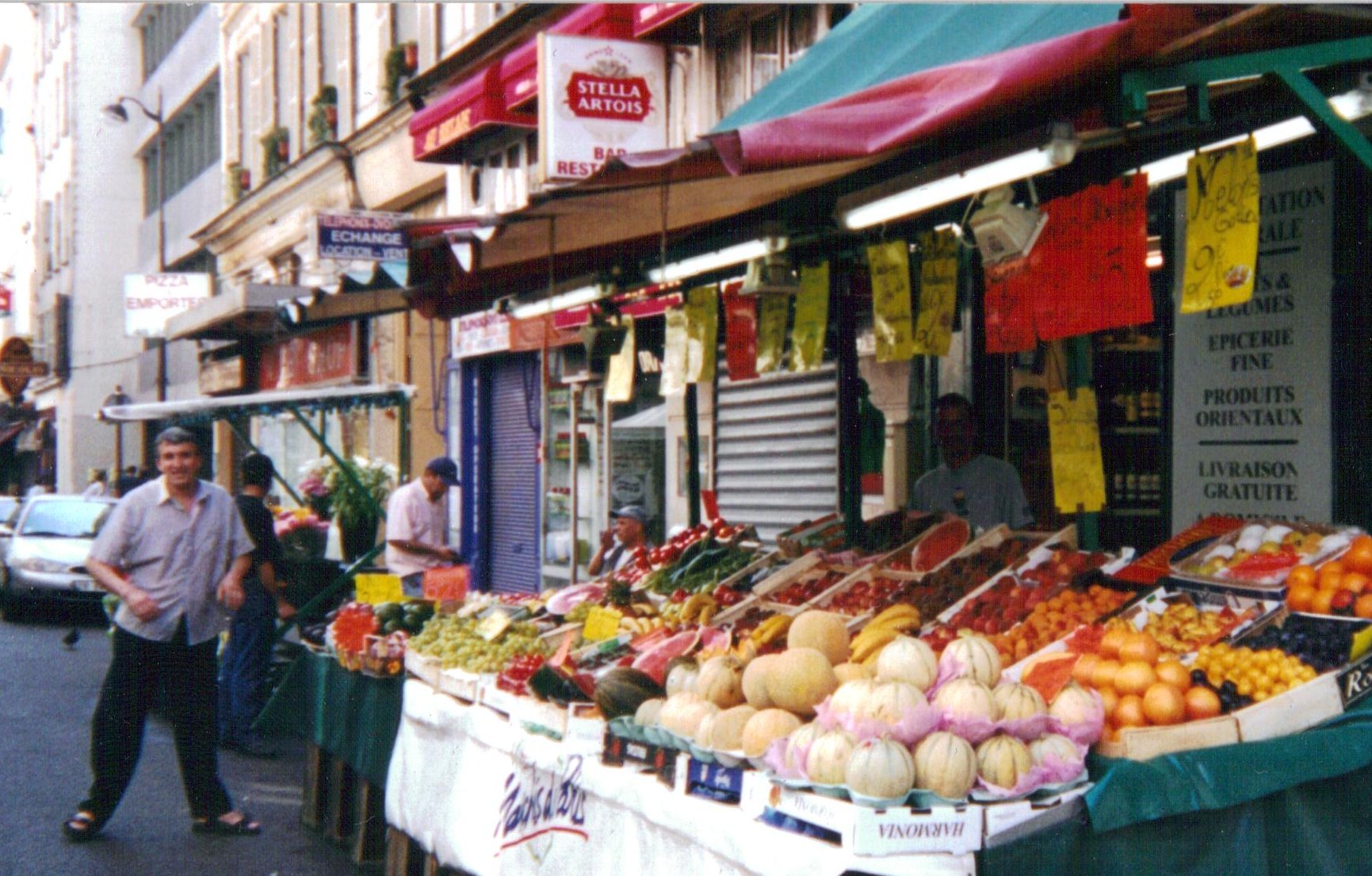
In front of a grocery, a fruit stand juts into the street—oranges, cherries, cantaloupes, grapes, peaches, plums, too many fruits to name heaped fat and fresh in cardboard flats. Tomorrow, when I aim for a photo of David flanked by produce, the shopkeeper runs out, waving his arms.

I’m appalled. Have I offended him? Is it gauche to want a picture of apricots?

I’m about to apologize when he takes David’s arm, pulls him behind the stand, then runs back into the street, grinning and gesturing for me to snap the picture. The wide-angle photo shows a young man wearing a short-sleeved gray shirt, dark slacks, and sandals, grinning beside a slice of watermelon. David lurks in shadow under the awning, recognizable only to me.

#

The first afternoon and evening, we concentrate on getting our bearings. We leave the hotel, walk a few blocks, look around. I remember reading that London is a city of gray and scarlet. I see Paris as a city of stone and lace; every building seems to be scalloped and edged with grillwork.

When the effect of our full English breakfast wears off, we order sandwiches at a small café. We’re the only customers. A waiter watches the Tour de France on a wall-mounted television near the back of the room. As we slide into a booth, he turns down the volume. We smile our thanks. He doesn’t seem to object to David’s jeans and red tee-shirt with the black Lab on the front.

The sandwiches appear. They’re made with baguettes. I’m delighted to be eating an authentic French sandwich and wonder whether the diners at the McDonald’s up the street are as pleased with their sesame seed buns.

Leaving the café, we take another stroll, return to the hotel to rest, go out again, come back for our street map, walk some more, return for something else we’ve left upstairs…Our act is not yet together. Each time we leave, we pass our key across the desk to the concierge. Each time we return, he passes it back. By the fifth or sixth exchange, his smile hints at both bemusement and fatigue.

In all our trekking back and forth, we’ve seen no one else in the lobby. David and I might be the only thing standing between the concierge and a quiet evening with a good book. I hope he doesn’t think we’re Ugly Americans. Judging from his smile, I suspect Crazy Americans is more likely.

#

To be continued: Starving, Gaping, More Starving

#

Image [Satellite view of the English Channel] file is in the public domain because it was created by NASA. NASA copyright policy states that “NASA material is not protected by copyright unless noted.”