The Tale of Kerwin, Part III

I realized only yesterday that I left the story of Kerwin‘s ostracism unfinished. When I left off, I had just–whoops!–Mary had just walked into the front room of the library and found Kerwin sitting beside the door, where she had left him over a half-hour before.

He looked a little pale.

Mary felt a little surprised.

She had escorted the rest of his class out the library’s back door, as she did every week, and had forgotten Kerwin wasn’t with them. His teacher was no doubt wondering where he was.

“Kerwin, what are you doing there?” she said.

“You told me not to move.”

Oh.

He was correct. That’s what Mary had said. It hadn’t occurred to her that he would take the instruction so literally.

“All right, Kerwin, go on back to class.”

Color returning to his cheeks, he jumped from the chair and shot out the door.

Mary packed up and walked back to the high school library, where she officed.

The end.

I regret the story ends so anticlimactically. For literary purposes, I wish it had a dramatic ending.

If I were writing fiction, I’d have stopped with Part II. But I wanted to make clear that everyone survived intact.

I’m sure I’m the only one involved who remembers.

Crying Towels

I’m watching MI-5. Twenty minutes left. Things are not going well, but then they never are.

This time things won’t end well either. At the top of the hour, a helpful announcer volunteered the information that one agent will not get out alive.

I think I know who it is. In fact, I know I know. Several months ago I did a little research on Wikipedia. I wanted only to find the correct spelling of Harry’s surname, but I found a complete synopsis, from the first episode to the latest.

So I know.

Normally I don’t like to have advance notice. I never begin a book with the last page. I prefer to be surprised.

But tonight I’m glad for the warning. When I know what’s coming, I can prepare.

My stack of crying towels is at hand.

*****

And I’m going to need them.

Insigna of MI5
Image via Wikipedia

Inside the box

The WordPress poll asked, How long does it take you to write a post?

I don’t like to participate in surveys of this kind, but I do like to see the results. And unless I submitted my information, WordPress wouldn’t let me see anyone else’s.

I clicked 2 to 4 hours. So did 200 other bloggers. That puts us at not quite 15%

More than 4 hours, which I thought about clicking, garnered 55 votes, for 4%.

The majority, 455 people, or 33.9%, take 30 minutes to an hour.

Some people average 15 to 30 minutes, some less than 15. I choose to pretend they don’t exist.

It’s taken me nearly 30 minutes to get this far.

In my Saturday morning paralegal classes, I sat beside an organized person. She carried a homemade spreadsheet–the kind that spreads across a 6-foot-wide table–with everything in the syllabus plugged into cells. Readings, lectures, quizzes, tests, labs, reports, papers. Everything. Color-coded. And that wasn’t all. Everything she did was neat and tidy and perfect. Little boxes all over the place.

I carried the looseleaf notebook containing course materials (including a calendar listing all assignments) and a spiral notebook.

I envied that woman. I didn’t want her spreadsheet. I wanted to be a person who made such spreadsheets.

For our first major composition, we wrote a letter to an imaginary client. We discussed three statutes and three cases and explained how each applied, or did not apply, to the charges the client faced. In addition to including other information, we were supposed to be extremely clear, extremely polite, and extremely careful not to make any promises.

When letters were handed in, the instructor asked students to think how much time went into the production of that one four-page letter. Then she announced a break.

I turned to my organized classmate and said, “I wonder–when I calculate the time I spent working on the letter, does that count the time I spent playing solitaire while I was thinking what to say next?”

My classmate’s eyes got big and round, and she shook her head. “I don’t think so.”

Well, I didn’t really think so either.

We’d been warned that flippancy does not play well in a law office. It obviously didn’t pay well in the classroom either.

Sometimes I wish I were better at thinking inside the box.

Get right to the action

There’s a bit of a flap over Downton Abbey, the British television series now being shown on PBS’s Masterpiece Theater. It’s been reported that the version shown in the U. S. was cut from eight hours to six.

The change seems to be rooted in Americans’ short attention span and desire to get right to the action.

There’s also the problem of the entail, which Americans might not understand.

Oh, well. I could be insulted by the slander regarding the attention span. One of the people who implied that, however, is an American. Also, I’ve heard the same thing about my manuscript: Hook readers with the first sentence, and get the murder in by the end of chapter three.

But I do think most Yanks watching Masterpiece have patience enough to delay gratification, and intelligence enough to figure out the provisions of the entail.

I understood most of I, Claudius. Ancient Rome was more foreign and more complex than pre-World War I England. I understood Fawlty Towers, too–even Manuel, and he was from Barcelona.

Some say the two versions of Downton Abbey differ because PBS programming isn’t interrupted by advertising. Some have said the two are essentially the same.

Whatever. When all is said and done, I’ll watch it on Netflix and decide for myself.

Until then, I’ll be grateful for the fuss. It’s given me something to write about.

Coming soon: The Entail

Dull people

Only dull people are bored. ~ Adela Rogers St. John

I’ve just begun a book about structuring the novel. So far I’ve learned that I don’t know how to write my novel because I don’t know the structure, and that, because only I know the story, no blueprint exists until I create it.

I’m pretty sure I already had that figured out.

My plot is acting up. Or, worse yet, maybe it’s the story that’s giving me fits. Several months ago, CP convinced me I could make it work, but once again, I’m not so sure.

She asked whether I’m bored with my characters. I’m not. But I’m bored with a situation. I don’t know whether I can make it work. I don’t know whether I want to make it work.

CP said maybe this isn’t the book I want to write. Maybe it’s the second. Maybe it’s just back story.

Maybe I’m afraid to push through to the end.

I wrote a post several months ago about being all grown up and adequate to the task ahead.

Yeah, right.

Today’s Scorpio says I’m filled with courage and the heart to get the job done. And my tenacity will carry me through.

Not today.

I’ll be honest: I do not feel adequate and I have no ideas for tonight’s post, which, because of more network problems, was posted prematurely and is now being fixed. A little.

I don’t think that’s what WordPress had in mind when it invited me to post daily.

Phooey.

Oh well. I’ll think about that tomorrow. It’s another day.

Seeing Fannie

As I was saying when I was so rudely interrupted–

Never mind.

The section that vanished when the wireless network disappeared concerned A. S. Byatt’s Possession. It’s a magnificent novel.

My comments were anything but.

So I’ll quit while I’m ahead.

Now to the update on Fannie Flagg: I heard Ms. Flagg speak last Saturday at BookPeople. She read from her latest book, I Still Dream About You, and signed.

Before the program, a BookPeople staff member announced that Ms. Flagg would stay until every copy was signed, and that she would be happy for people to take photographs. In other words, she was gracious. She demonstrated appreciation and respect for the people who came out to see her.

Ms. Flagg took her reading from the chapter titled “Hazel Whisenknott Begins.” Hazel is a real estate agent, the smallest one in the state, not much more than three feet tall. She is also dead when the book begins. When she is five years old, she starts a weed-pulling business that becomes remarkably successful.

I Still Dream About You is a murder mystery. I don’t know the victim yet. I presume it’s not Hazel. I also presume I will know who by the end of chapter three.

I hope I know by the end of chapter three. That’s when everyone says I have to have my murder taken care of. I wouldn’t like to think there there’s a set a rules for me and another set for Fannie Flagg.

In summary, regarding Fannie Flagg’s appearance at BP, a good time was had by all. Especially me.

A coil of hair

Minna Katherine Stagner Veazey, front row center, at a reunion of the Lipscomb Rifles, San Antonio, Texas, ca. 1950. Mary Phereby Veazey Barrow, front row left, wearing picture hat.

My mother’s family recycles names.

In my generation there are seven grandchildren, each with two given names. Of those fourteen names, only one is new. The rest are hand-me-down, used by parents, grandparents, great-grandparents, an aunt.

I’m the youngest, a Mary Katherine. For my first thirty years, the name drew no comment. Then people began to ask: Are you Catholic? Are you a nun?

Sorry, no. Just the child of Southern Protestants who had no imagination.

Actually, I was supposed to be just Katherine. My mother tacked the Mary on at the last minute before the birth certificate was prepared. She said my grandmother, who was on the scene, grew all fluttery at the compliment.

My great-grandmother presented me with a silver locket in the shape of a heart. One of my early memories is of visiting her at my great-aunt’s house. Mother clipped a lock of her white hair, coiled it, and put it into the locket. I was fascinated at the process. I think I wore the locket once. It’s spent most of its time stored away, carefully preserved. Someday the next Katherine, two generations younger than I, will care for it.

Locks of the Ages: The Leigh Hunt Hair Collection is now on display at the Harry Ransom Center. It features hair from, among others, George Washington, Edgar Allan Poe, Charlotte Bronte, John Keats, Robert and Elizabeth Barrett Browning, and William Wordsworth.

Lord Byron stole a strand of Lucretia Borgia’s hair from the Ambrosian Museum in Milan and presented it to Hunt for his collection. That strand, however, appears not to have been part of the collection sold by the Hunt family in 1921.

***

Leigh Hunt was a Romantic poet and essayist. I read that he was the model for Mr. Skimpole in Dickens’ Bleak House. The portrait Dickens painted wasn’t complimentary, and I don’t know whether they remained friends.

Literature textbooks generally included only one of Hunt’s poems. Semesters were short; there wasn’t time to read everything, so the syllabus jumped from Wordsworth and Coleridge to Byron, Shelley, and Keats. I’ve never been curious enough to learn anything else about him on my own.

The one poem by Hunt, however, was too nice to ignore. The professor who taught the Romantics told how Hunt came to write it. He’d gone to visit philosopher Thomas Carlyle and his wife, Jane. Hunt had recently recovered from a long bout with influenza, and when Jane Carlyle saw him, she leaped up and kissed him. Because she was not usually a demonstrative  person, Hunt was moved by her gesture and later wrote his poem.

Jenny kiss’d me when we met,
Jumping from the chair she sat in;
Time, you thief, who love to get
Sweets into your list, put that in!
Say I’m weary, say I’m sad,
Say that health and wealth have miss’d me,
Say I’m growing old, but add,
Jenny kiss’d me.

~~~~~~~~~~~~~~~~~~~~~~~

Note: This post was on its way to publication when the wireless network vanished. When the network returned, the final third of this post had vanished, as had the tags. As had January 13, 2011, so this piece was published after midnight, on January 14. Drat!

After a decent night’s sleep, however, I’ll recreate the rest of the post and republish. And then I’ll publish a second post.

One of  my resolutions was to eschew perfectionism. I might as well get started now.

The Tale of Kerwin, Part II: Ostracism

In yesterday’s post, I introduced my first best teaching story, that of Kerwin. Tonight brings that story’s stirring conclusion.

If you have not read Part I, please do so now. Part II will pack a much harder punch if you know what came before.

Since publishing Part I, I’ve realized I failed to name the librarian who serves as our main character. For convenience, I shall call her Mary.

And before beginning, I once again emphasize that although I know every detail of this story, and that Mary’s every thought and emotion resonates with me as if it were mine alone–even so, the story is not mine. The fact that Mary is my name as well as hers is mere coincidence.

Now to resume.

You recall that Mary has been stressed almost to the point of saying a word she has never said. And that it is the Class from Hail that she fears she will say it to.

I will not identify the C from H except to say that its students were old enough to know better. Period.

Mary and the C from H had maintained a peaceful coexistence for several months without incident. Mary had simply begun carrying a strong antacid in her purse on their class day.

On the day we meet them, Mary has prepared a lesson on reference books. She has made a set of transparencies. She plans to lecture. She plans to assign class work. She has great expectations. In the next forty-five minutes, she will turn the C from H into crack encyclopedia users.

Things did not go as Mary planned. Students came barreling across campus from the gymnasium. They were jiggly. They were wild. They did not care to sit and listen. Every time Mary opened her mouth, one of the C from H opened his or her mouth and spoke a gross irrelevancy. Mary thought about the antacid in her purse.

When, after eight or ten interruptions, Mary thought she had things under control, she began her lecture–again–but here came Kerwin. Late. Loud. Fully aware of the production he was making of himself.

Mary stopped, got Kerwin settled in his chair, got him settled again, got everybody settled again. Then she began–how many times now?–her talk.

For some reason, Kerwin decided he needed to move his chair. Halfway across the room. He stood, reached between his legs, took the seat of the chair in hand, and scooted it backwards across the carpet.

Now for another digression. I have described Mary as soft-spoken, polite, well-mannered. She was. But when pushed too far, Mary sometimes snapped. She increased in height. She became majestic. She spoke–not loudly–but even more softly, but in majestic, measured tones. She became Maya Angelou, Dame Edith Evans, John Gielgud, and the Incredible Hulk, all rolled into one. She was a most impressive sight.

And when Kerwin and his chair went scooting across the room, Mary snapped.

She strode over to Kerwin and took him oh-so-gently by the nape of the neck.

“Come with me,” she said. She turned and marched Kerwin to the door to the front room.

She had no idea where she was going or what she was going to do when she got there.

Once in the front room, she saw a chair by the front door. She marched Kerwin over to it.

“Sit there and don’t move,” she said.

She waved to the computer teacher to let her know Kerwin was there. Then she walked–majestically–back to the C from H.

When she walked in, the C from H were sitting at their tables. They were hushed. Their eyes were enormous.

Mary walked to the overhead projector, switched it on, pointed to the first transparency, and defined encyclopedia. She talked and talked and talked about the encyclopedia.

The C from H sat and stared with their great big eyes.

Finally, one of the C from H mustered enough courage to speak.

“Where’s Kerwin?” he said.

Mary answered, as if she’d never even heard of an antacid, “Kerwin has been ostracized.”

And in the little silence that followed, she saw one member of the C from H lean toward his neighbor and heard him whisper:

“She castrated him?”

If Mary’s career had a high point, this was it. Because she kept her cool. She got right back to her lecture.

She did not smile. She did not laugh. She did not fall on the floor and have a first-class case of hysterics.

She maintained her dignity.

When the time came, she escorted her class to the back door and shooed them out. Then she packed up her transparencies, shelved some books, did whatever had to be done before leaving campus.

Twenty minutes later, when she walked into the front room to return a reference book, she found Kerwin, still sitting in the chair by the door.

She’d forgotten to dismiss him.

He hadn’t moved a muscle.

The Tale of Kerwin, Part I

Last week I shared the story of Cuthbert, my second best teaching story. Today I share the story of Kerwin, my first best teaching story.

I offer it against my better judgment. But it’s been years since judgment factored into any of my decisions. So we begin.

~~~~~~~~~~

Once upon a time, there was a librarian–for this story, Gentle Reader, is not my own; I heard it from someone who heard it from someone who heard it from a reliable source.

As I said, there was a librarian.

This librarian was a lovely person. She was kind and patient. She was soft-spoken. She was in no way profane. She was not in the habit of using what were once called unprintable words.

She did admit to employing two words that were once frowned upon, but that are now, in our advanced culture, hardly noticeable: damn and hell.

Those were her father’s words. And, because they were the only not-nice words she heard until she was nearly into her teens, she thought they were the worst words in existence.

And, although she understood they were not-nice words, and that she was not supposed to say them on pain of bad things happening, her father used them in such a way that made them sound perfectly acceptable.

In fact,  her Baptist Southern Belle hat-and-glove-wearing maternal grandmother (who had once told the future librarian, when said future librarian at the age of seven had impulsively demonstrated her erudition in spelling, that privy wasn’t the nicest word for a little girl to know how to spell),–as I say, her grandmother was so taken with the future librarian’s father’s by-words that she sometimes uttered them herself, mimicking his singular pronunciation: Well, day-um. (Hell was pronounced hail.)

(The grandmother never got in trouble for saying those words either.)

But, after the librarian’s father died, the librarian missed hearing those words, and she had attained her majority and then some, so she adopted the words as her own.

She sometimes worried that her usage didn’t always sound as innocent as her father’s. She sometimes said those words as if she really meant them. She wasn’t proud of that, but she managed to live with it.

She did not, however, venture further down the list of not-nice words without serious provocation. And such instances were practically unheard of. With her even temper and unfailing sense of propriety, she did not require that safety valve.

There were days, of course, when she came close. But when students were present, she never let an improper word pass her lips.

For years, she maintained this high linguistic standard.

So time passed. Enrollment in her school district increased rapidly. The Powers That Were decreed that the primary/elementary library should be moved to temporary lodgings in a house.

A small house. A small, old house.

The arrangement of the is germane to our story. The front room was divided by a partition about four feet high; to the right and down a couple of steps was a “sunken” computer lab supervised by a teaching assistant; to the left was a larger room where library reference books were shelved. Behind the reference room was a 12 x 30-foot room that ran the width of the building.

The rest of the library collection was shelved in that back room; the circulation desk was there; the card catalog was there; tables and chairs were there; the librarian taught her classes there.

Did I mention it measured 12 x 30?

The day after the roof leaked, a large puddle of water appeared there as well, but the card catalog was so expertly built that the liquid pooling atop it did not seep inside.

I will not mention the mold.

Now, a digression: Lest it be thought the librarian complained, I’ll add that the library’s sojourn in the old house lasted only three years, and that its next home, across the street, was new and roomy and bright and cheerful. And that pending relocation to the new building, the librarian polished her martyr complex and pretended she was having fun.

But pressure was building.

Sometimes she discussed her feelings with friends in similar boats.

One of those friends, Janie, a librarian who doubled as a preacher’s wife, confided to our librarian that she and certain individuals were embroiled in an ongoing disagreement over policy. Janie said she had been trying to rid herself of negative feelings about her opponents. She said that on frequent visits she made to a nursing home, she often saw an elderly lady sitting in the hallway in her wheelchair, cursing like a sailor. Janie was afraid that if she continued to harbor ill feeling in her bosom, she would end up the same way.

“I can’t think of anything worse,” she said, “than a preacher’s elderly widow sitting all day in a public hallway, cursing.”

Our librarian countered that if her own situation didn’t improve, she would disgrace herself by spouting out a word in the presence of her students.

And she knew exactly which students and what word:

The word would be smarta**.

And the students would be the Class from–Hail.

To Be Continued

Pushing the envelope

Twenty-three minutes to post, a cat in my lap bent on playing with the touch pad, several ideas in my head, none of which can be explored in twenty-two minutes. An unpredictable wireless connection.

A cat on my lap licking my wrist as I type. I don’t like to be licked as I type.

My evening critique group has had an online conversation today about typing vs. keyboarding. Are papers still typewritten? Are papers still papers, for that matter. Do we come to the page or to the screen?

The cat has stopped licking my wrist and has hidden his face against my arm. He’s stretching his foreleg to pat the mouse, which lies on the arm of the recliner.

There’s another one: mouse.

Forty years ago, the sentence, The cat is patting the mouse, which lies on the arm of the recliner, would have sparked an image entirely different from the one it creates today.

Someday, perhaps, cat will have a meaning in the cyber world. Perhaps it already does.

He’s now stretching both forelegs toward the mouse and using his elbow to control the touch pad. The cursor jumps around. Boxes pop up, offering me the opportunity to do things I have no intention of doing. I have to take a hand off the keys to move the box.

He has shifted. Now he’s resting his head on my right hand. His left foreleg rests on my left hand. A minute ago he tried to rest his chin on my thumbs.

He’s shifted again. There are two forelegs on my left hand. His head is still on my right hand, but his whiskers are sticking straight up. Another stretch. Another shift. His head is up again.

Another shift. A paw on the keys.

I took the time to click Save.

The purring vibrates the chair. I hope it doesn’t dislodge something the laptop needs to keep going.

Two minutes. No time for a photograph. Time to post.

Books in Progress

Baker, Russ. Family of Secrets: the Bush Dynasty, American’s Invisible Government, and the Hidden History of the Last Fifty Years. New York: Bloomsbury Press, 2009.

Flagg, Fannie. I Still Dream About You: A Novel. New York: Random House, 2010.

Jacobs, A. J. The Year of Living Biblically: One Man’s Humble Quest to Follow the Bible as Literally as Possible. New York: Simon & Schuster, 2007.

Kessler, David A. The End of Overeating: Taking Control of the Insatiable American Appetite. New York: Rodale Press, 2009.

MacInerney, Karen. Berried to the Hilt: A Gray Whale Inn Mystery. Woodbury, Minn.: Midnight Ink, 2010.

Dad

What a revolting development. In the interest of time, I’m cross-posting another piece from Whiskertips. But I can’t get the photographs to transfer, and they’re not saved on this computer. I suspect they’re on one of the flash drives, but I don’t have time to check that out.

I’m on my way to see Fannie Flagg, and I’m afraid if I hang around here much longer, I won’t find a parking place. So I have to leave soon.

Now.

Any minute now, I’ll start to sing.

I’m late, I’m late for a very important date
No time to say “Hello”, “Goodbye”
I’m late, I’m late, I’m late, I’m late

I really want to post the photos. They add to the piece. They’re necessary.

But really, I must make haste.

In a burst of creative thinking, I’ve decided to post now and add the photos later. That will satisfy both the requirement that I post daily and my determination to include the photos and my obsession with at least waving at Ms. Flagg across the parking lot. So, if you’ll come back later, you can see my grandfather dressed up in his painting duds, and me when I was little and cute. And some catfish.

~~~~~~~~~~~~~~~~~~~~~~~~~

I don’t believe it! The second photo transferred, and I didn’t even notice! I’m going back to see whether I can grab the others. Maybe I’ve made a mountain out of a molehill, or Ossa like a wart.

Obviously only half a wart. I can’t unbold the last section. No matter. I’ll take care of that later, too.

Really, I have to leave.

~~~~~~~~~~~~~~~~~~~~~~~~~~

I have the awful feeling I’ve posted this here before, but I can’t find it in the index, so here goes.

~~~~~~~~~~~~~~~~~~~~~~~~~~~

Dad

Dad and Kathy, 1952
Frank Waller dressed for painting, Fentress, Texas, ca. 1953

“My grandfather thinks stop signs cause wrecks.

“That’s what he told Mama when they put up those signs at FM 20. If you just go on across, you’ll get out of the way, but if you have to stop, you can’t build up enough speed and somebody’ll come along and hit you for sure. Mama didn’t argue. She’s a firm believer in safe driving, but she says when you marry into the Coburn family, you learn to choose your battles. In the meantime, you’re polite. Of course, with Daddad driving, stopping isn’t an option anyway. He hasn’t had a car with brakes since 1925.”

The lines above open my short story “Stop Signs.”

The story is fiction. The first two paragraphs, however, are pretty much true. Frank Waller did think stop signs cause wrecks. But instead of telling my mother, he said it to Mr. Farr, a new neighbor about his age. Although Mr. Farr nodded, I was sure he  was just being polite. I was seven years old, and I thought the idea was crazy. The reasoning seemed sound, but the facts were skewed.

Of course, I also knew my grandfather was capable of making outrageous statements just to see the listener’s reaction.

But having been his passenger the day he tested that theory, I’m satisfied that in this case he believed what he said.

The flaw in his system was that he drove so slowly he rarely built up any speed at all. He also drove on the wrong side of the road. If he saw a car approaching, he moved to the right, but not until he had scared the bejeebers out everyone else in the car.

His five sons, four daughters-in-law, and several dozen “adopted” relatives called him Dad. He was especially delighted when one of his tenant farmers addressed him that way. Rejecting the suggestion of Granddaddy, I called him Daddad until I got too old for such juvenile behavior and joined the adults.

Dad was tall, built like a scarecrow and, as is evident from the photograph above, mostly leg. He wore khaki shirts and slacks and a scruffy old hat. When he did house painting, he wore white overalls. I think I saw him wearing a suit once, but I can’t remember when or why.

He farmed. In the 1920s, he also ran a filling station and sold Chevrolets. When I was very young, he turned the farm over to one of his sons and moved to a little house he built on his sister’s lot in town.

When he wasn’t sitting on the bench outside the post office with the other old men, he did painting and paper-hanging. He was slow and meticulous. Seams he taped and floated became invisible. Wall-paper he hung was perfectly aligned, and he used enough paste to keep it up for decades. He fell short in only one area: according to my mother, every room he papered was missing two or three feet of border.

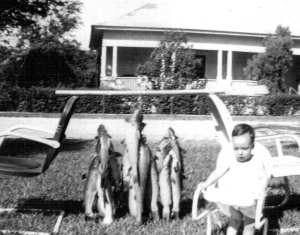
Everyone who hired Dad knew he would interrupt the job to indulge in his great love, trotline fishing in the San Marcos River. He used Crystal White soap for bait. The picture below is an average catch. By the time I was seven, I was helping him skin the fish. He then filleted them and put them in his freezer. When he had enough, he’d host a fish fry on his front porch: fried cornbread, Aunt Bettie’s potato salad, Aunt Jessie’s tartar sauce, my mother’s pecan pie.

San Marcos River Catfish
Me, with the catch of the day, courtesy of Dad, ca. 1953
The summer I was eight, while I was spending a week with him, a friend who’d been hunting gave Dad two wild rabbits. Dad told me we’d have fried rabbit for supper. When I mentioned the plan in front of my uncle’s wife, she said, “You’re not going to eat a bite of that rabbit!” Thinking her just a tad bossy, I ate extra to spite her. Ten years later in a college biology course, I learned why I shouldn’t have eaten the rabbit. It’s a wonder I’m alive today.
A widower for over forty years, Dad lived on canned Pillsbury biscuits, sorghum molasses, instant coffee, and roll-your-own Bull Durham cigarettes. A daughter-in-law occasionally got him to eat a square meal.

He saucered his coffee and gave lessons to anyone who asked. On a camping trip, I watched him coach a thirteen-year-old boy. They sat side by side on the edge of an army cot, the boy holding the steaming, trembling saucer halfway to his mouth, Dad saying, “Now you’ve got to let go with that right hand.”

He let me roll cigarettes and smoked them even though they were severely deficient in tobacco.

The day he died, one of my uncles called to say Dad was sick but refused to see a doctor. My mother and my uncle’s wife convinced him to go with them to the hospital.

When he was settled in a room, a nurse came in and said, “Mr. Waller, I need to get your temperature.”

He replied, “Now, you just call me Dad.”

Dad

Review (again): A Broom of One’s Own

I wrote the following post two years ago to answer a “challenge.” I intended to post it at the end of September 2009. I got all tangled up in words and couldn’t write a thing. I intended to post it at the end of October. I still couldn’t write it. I think I managed to write it after the October deadline.

In the middle of the “process,” I considered posting the following review: “I like Nancy Peacock’s A Broom of One’s Own very very very very very much.”

But the challenge specified a four-sentence review, and I had hardly one, and I didn’t want to repeat it three times.

So there’s the background.

I must also add this disclaimer: I bought my copy of A Broom of One’s Own myself, with my own money. No one told, asked, or paid me to write this review. No one told, asked, or paid me to say I like the book. No one told, asked, or paid me to like it. No one offered me tickets to Rio or a week’s lodging in Venice, more’s the pity. I decided to read the book, to like it, and to write this review all by myself, at the invitation of Story Circle Book Review Challenge. Nobody paid them either. Amen.

*********************************************

I like Nancy Peacock’s A Broom of One’s Own: Words About Writing, Housecleaning & Life so much that it’s taken me over two months and two missed deadlines to untangle my thoughts and write this four-sentence review, an irony Peacock, author of two critically acclaimed novels, would no doubt address were I in one of her writing classes.

She would probably tell me that there is no perfect writing life; that her job as a part-time house cleaner, begun when full-time writing wouldn’t pay the bills, afforded time, solitude, and the “foundation of regular work” she needed;  that engaging in physical labor allowed her unconscious mind to “kick into gear,” so she became not the writer but the “receiver” of her stories.

She’d probably say that writing is hard; that sitting at a desk doesn’t automatically bring brilliance; that writers have to work with what they have; that “if I don’t have the pages I hate I will never have the pages I love”; that there are a million “saner” things to do and a “million good reasons to quit” and that the only good reason to continue is, “This is what I want.”

So, having composed at least two dozen subordinated, coordinated, appositived, participial-phrase-stuffed first sentences and discarded them before completion; having practically memorized the text searching for the perfect quotation to end with; and having once again stayed awake into the night, racing another deadline well past the due date, I am completing this review—because I value Nancy Peacock’s advice; and because I love A Broom of One’s Own; and because I consider it the equal of Anne Lamott’s Bird by Bird; and because I want other readers to know about it; and because this is what I want.

~~~~~~~~~~~~~~~