Blog

Day I: Ideas #AtoZChallenge

I broke another rule: Never again would I drop in at my favorite independent bookstore. I would go to my Austin Mystery Writers critique group in the cafe every other Thursday. But go there without a specific reason–no.

The reason for the rule: I buy books. It started over twenty years ago, the day I walked in with a purse and walked out with four or five books and my purse much diminished. The indulgence must stop.
Today, however, on the way home from an appointment, I remembered a legitimate reason to stop there: In February, leaving the store after AMW’s book launch, I realized I’d left two plates of brownies on the refreshment table. David asked if we had enough plates at home that we wouldn’t starve. I said, Yes. I’d planned to leave some brownies for the staff anyway, and I could get the plates the next time I was there. So we went on home.

I’ve visited the store several times in the past two months. However, I’ve thought about plates only when I was elsewhere.

Today, on the way home from an appointment, I remembered. It occurred that I would be there legitimately next week. But I managed to come up with an excuse: It had been two months. How thoughtless of me. Their break room probably didn’t room for extra dishes. I doubled back.

Unfortunately, no one at the information desk (or anywhere else) knew where they were–or even remembered them–and it took several people a full half-hour to find them.

Fortunately, that gave me time to fall into my favorite trap: I saw books, wanted them, carried three to the cafe, read the cover flaps, and took notes. The good news is that I didn’t buy they them. The other good news is that they gave me an idea for a blog post. In addition, each of those books started with an idea.

That may be stretching things, but today is all about breaking rules.

###

Joshua Hammer, The Bad-Ass Librarian of Timbuktu.
Simon and Schuster, 2016.

Abdel Kader Haidara, an archivist and historian, traveled from Timbuktu across the Sahara, along the Niger River (the first person to do so), in search of ancient Islamic and secular manuscripts that were “crumbling in the trunks of desert farmers.” Then a complication arose: Al Qaeda showed up. The manuscripts were “destined for sure destruction.”

Among the manuscripts he saved:

  • a treatise on Islamic jurisprudence from the 12th century;
  • a 13th century Koran written on vellum made from antelope hide;
  • the original travel diary of Maj. Alexander Gordon Laing, the first explorer to reach Timbuktu via Tripoli and the Sahara, who in 1826 was murdered by his Arab escorts;
  • an Arabic grammar written over Maj. Laing’s the pages of Maj. Laing’s diary.

In his race to save “the world’s most precious manuscripts,” Haidera became “one of the world’s greatest and most brazen smugglers.” He and a network of librarians sneaked 350,000 volumes to safety in southern Mali. His act demonstrates that “ordinary citizens often do the most to protect the  beauty and imagination of culture.”

An article about Haidara and the manuscripts published on April 21, 2014 appears on the National Geographic website.

Author Joshua Hammer speaks about his book, the history of Timbuktu, and Haidara’s accomplishment on Youtube. Slides of manuscripts are included.

###

Instead of writing about the other two books in this post, as I planned, I’m going to save them for a later. They’ll fit Days L and T.

Or, if I’m creative, they’ll fit any letter I wish them to.

###

To read more posts dedicated to the letter I, click AtoZ

Day H: House of the Seven Gables #AtoZChallenge

In November 2016, I posted about my upcoming visit to Salem, Massachusetts for UnCon, the writers’ conference hosted biannually by Writer Unboxed.

And in my usual flippant fashion, I said, “Cold is what I wanted when I registered for the conference last summer. Sweater weather. I don’t get nearly enough.”

The truth is that I’d heard good things about the conference and wanted to go to it.

But there’s also truth in the flippancy: the Austin fall was unseasonably warm, and I wanted to wear sweaters.

So my wishes were granted. Good conference; cold weather.

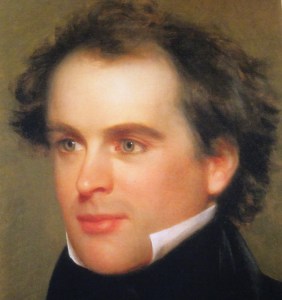
The the other draw was Salem itself and specifically, the House of the Seven Gables, the house Nathaniel Hawthorne used as his setting for the novel by the same name. What English major could resist?

I attended a class in the annex, a modern building on the property, and during a break walked around outside. Across a courtyard are the Counting House and Hawthorne’s birthplace.

Photo: detail of a portrait of Hawthorne hanging at the House of the Seven Gables Museum store

Hawthorne and his wife, Sophia Peabody, moved from Concord to Salem in 1845 and the next year he was appointed “Surveyor for the District of Salem and Beverly and Inspector of the Revenue for the Port of Salem.” While in the position, he had difficulty writing, and told writer Henry Wadsworth Longfellow, whom he’d met in college, “Whenever I sit alone, or walk alone, I find myself dreaming about stories, as of old; but these forenoons in the Custom House undo all that the afternoons and evenings have done. I should be happier if I could write.”

After Whig Zachary Taylor’s election to the presidency in 1848 election Hawthorne, a Democrat, lost his job. A letter he wrote in protest was published in a Boston newspaper, and his dismissal became known and talked about throughout New England. But he returned to writing and in 1850 published The Scarlet Letter

It was one of the first mass-produced books in America, selling 2,500 volumes within ten days and earning Hawthorne $1,500 over 14 years. The book was pirated by booksellers in London and became a best-seller in the United States; it initiated his most lucrative period as a writer. (Wikipedia)

It has been called the first psychological novel, and writer D. H. Lawrence later said about the book that there “could be no more perfect work of the American imagination.

Unfortunately, Hawthorne died long before Lawrence expressed his opinion; the novel became the subject of controversy among his contemporaries.

Hawthorne’s friend Edwin Percy Whipple objected to the novel’s “morbid intensity” and its dense psychological details, writing that the book “is therefore apt to become, like Hawthorne, too painfully anatomical in his exhibition of them.” (Wikipedia)

It also added to his troubles. There was a “furious” response from newspapers, politicians, and members of the clergy. (Hawthorne also mentioned his job in the introduction and referred to certain politicians, so he shouldn’t have been surprised that those readers weren’t complimentary. Just my opinion.)

In A Chapter from Nathaniel Hawthorne: Studies In The House Of The Seven Gables, Thomas St. John quotes Hawthorne on Salem:

I detest this town so much that I hate to go into the streets, or to have the people see me. . .I feel an infinite contempt for them, and probably have expressed more of it than I intended; for my preliminary chapter has caused the greatest uproar that ever happened here since witch-times.

“He half-expected the crowds to tar and feather him,” says St. John: ‘from such judges as my fellow-citizens, I should look upon it as a higher honor than a laurel-crown.'”

The Scarlet letter was published in mid-March 1850. In late March, the Hawthorne family moved to Lenox, Massachusetts, in the Berkshires. In 1851, he published The House of the Seven Gables, which poet  James Russell Lowell said was better than The Scarlet Letter and called “‘the most valuable contribution to New England history that has been made.'”

When I began this post, I intended it to comprise mostly pictures of the House of the Seven Gables. But to ensure I got my facts straight, I googled, found the chapter by St. John, and was struck by the above quotation. I’d assumed Hawthorne had positive feelings about Salem. After all, he’d set a novel there.

Never assume. Research instead.

I also thought I would post early for a change. Vain hope. Once I began clicking, I followed one bunny trail after another–for over three hours. And I enjoyed every minute. I learned Hawthorne translated The Aeneid  for entrance to Bowdoin College when he was sixteen , and that The House of the Seven Gables is closely linked to Virgil’s epic. That in itself makes the search worthwhile.

Now, end of digression and on to the heart of the matter.


For more Day H posts click here.


Day G: Good News & Glitches #AtoZChallenge


Glitch.

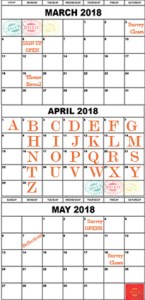
The A to Z Blogging Challenge calendar looks like this:


But in my mind’s eye, until this evening, the calendar looked like this:

If I’d paid attention, I’d have noticed I was supposed to post yesterday, a Saturday, instead of taking the day off.

If I’d paid close attention, and counted, I’d have seen that my April calendar provides for only 22 letters, four fewer than the official calendar assigns spaces to, and also four fewer than are found in the alphabet. I was embarked on an A to V Challenge.

When I realized I’d gone wrong, I considered dropping out. After all, I’ve breached the rules, failed to post as required.

But it’s a glitch, not a transgression, and a blog challenge isn’t a life-and-death matter. So I proceed.

Good News.

Two weeks ago, my radiation oncologist used the word remission.

Nothing has changed. My most recent CT scans show the same results as those done in December 2016, three months after I completed radiation treatments. The bone scan, my first, was also clear.

The oncologist, although he’s now smiling as if he means it, continues to be conservative. Stable is the word he uses. “As long as you’re stable…”

The radiation oncologist has always been more upbeat, possibly because she isn’t in charge of my case, possibly because she has a cheerful nature. A year ago, she was calling my scans awesome. I liked that word.

Remission, though, has a certain ring to it–a medical ring.

5. Medicine/Medical.

  1. a temporary or permanent decrease or subsidence ofmanifestations of a disease.
  2. a period during which such a decrease or subsidence occurs:
    The patient’s leukemia was in remission.

For two years, I’ve been living from scan to scan, and that won’t change either. The challenge continues: to live with past, present, future all at once; to wrap my mind around the contradiction–I have cancer, I had cancer, I . . . what?

The next CT is scheduled for early June. Scan to scan.

*****

Read more posts dedicated to the letter G by clicking AtoZ.

Day F: The Faraday Cage #AtoZChallenge

The new Roku remote, purchased as an upgrade so I could listen to the television through earbuds, didn’t work as planned. Periodically, without warning, the sound left the earbuds and reverted to the TV speakers.

(That’s not  a technical explanation. It’s just the best I can do.)

After several momentarily successful fixes–push this button, push that button, push the other button–David said my laptop might be causing interference and he would build a Faraday cage.

A what?

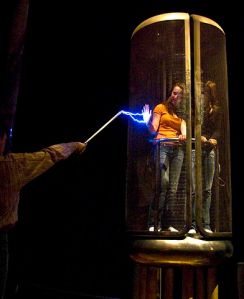
An enclosure to block electromagnetic fields, named after the inventor, English scientist Michael Faraday.

He constructed two, neither of which resembled the one in Wikipedia:

By Antoine Taveneaux [CC BY-SA 3.0 or GFDL], from Wikimedia Commons
The beta looked like this:

Faraday cage Beta

The working model looks like this:

Faraday cage 

When the sound continued to cut out, David investigated further and discovered the batteries were at 0%. He changed the batteries.

Believing there was more to the malfunction than maxed-out-batteries–after all, sometimes they worked and sometimes they didn’t–David suggested I continue to use the Faraday cage.

Better safe than soundless.

***

We visited the Faraday Museum in London in 2002–David’s choice. It was much easier than my choice, St. Paul’s Cathedral. At the Faraday, we didn’t have to walk up a mile of stairs, and I didn’t get a bad case of acrophobia plus a mild case of the fantods in the Whispering Gallery.

***

Read more Day F posts from the #AtoZChallenge here.

Day E: Epistles #AtoZChallenge

The Way I read a Letter’s — this —
‘Tis first — I lock the Door —
And push it with my fingers — next —
For transport it be sure —

And then I go the furthest off
To counteract a knock —
Then draw my little Letter forth
And slowly pick the lock —

Then — glancing narrow, at the Wall —
And narrow at the floor
For firm Conviction of a Mouse
Not exorcised before —

I’ve been trying to remember the last time I opened a real letter. Not a bill, not an invoice, not a request for donation, but a real letter from someone who knows me well, that begins with Dear Kathy, ends with Love, and has a middle meant just for me.

Oh, all right, I admit it–I never opened my mail behind a locked door, as Emily Dickinson does hers–but still, there was something delicious about those pieces of paper now called, with condescension, snail mail.

Opening a snail mail envelope was like opening a gift.

Sometimes it held two page on onionskin from my English pen pal, telling me about a rock concert she’d attended.

Sometimes it held fifteen pages from my cousin in California, a detailed narrative of the plot of a movie she’d seen on the late show.

Once it enclosed a card from my Aunt Betty, picturing a sad little dog and the caption, “I’m feeling dejected ’cause you was neglected,” and a note saying she’d planned to call and wish me happy birthday but had fallen asleep on the couch, and when she woke it was past both our bedtimes.

Most letters weren’t memorable; they contained news of school plays and shopping and chickenpox and report cards and last night’s overdone roast and church and swimming and Christmas caroling, just everyday life.

But they were special nonetheless, and it was the snail that made them so–traveling slowly, making us wait, and then, when hope was dwindling–surprise!— an envelope addressed in a familiar hand would fall out of messy handful of bills and circulars and slide across the concrete floor of the post office foyer.

Sheer bliss.

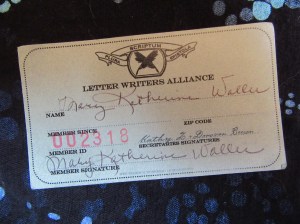
Several years ago, I joined the Letter Writers Alliance, an organization “dedicated to preserving this art form; neither long lines, nor late deliveries, nor increasing postal rates will keep us from our mission.” I received a membership card and pledged to “carry on the glorious cultural tradition of letter writing.”

As a member, I’m supposed to take every opportunity to write letters. But I don’t. My penmanship isn’t what it used to be–too much time at the keyboard.

But I have good intentions. I buy pens and stationery to feed my habit. Who knows when I’ll loosen up and begin to correspond?

By the way, here’s what Emily does when she finally gets that envelope unlocked.

Peruse how infinite I am
To no one that You — know —
And sigh for lack of Heaven — but not
The Heaven God bestow —

It’s what we all do: We read how infinite we are to the writer–the person whose name is written beneath the word Love.

***

Emily Dickinson, “The Way I read a Letter’s — this –“

***

Blogging from A to Z Master List.

For Day E posts, click Day E.


Day D: Dilly-Dallying #AtoZChallenge

Yes, definitely running behind in the Blogging from A to Z Challenge. No surprise, of course. If I were all caught up, I would worry.

Blogging with a theme would have helped. Instead of choosing topics, I’m wallowing around in a sea of them, waiting for one to come to my rescue.

April was a ready-made topic for Day A, because I planned to write about Texas bluebonnets anyway, and April is their peak time. But I could have published the same post on Day B, for bluebonnets.

Ben Hur, Day B’s official topic, appeared by chance–I checked the television schedule; I’ve always done my homework with half my brain trained on the TV–but about two paragraphs in, I remembered I had something to say about boo-boos, and say it I did. But instead of dropping Ben Hur, an any reasonable person would have done, I put Charlton Heston and Stephen Boyd on hold and wrote an extra post about boo-boos for a different blog, and then went back and finished Ben Hur. That was a big time waster. 

Day C? Before choosing contrariwise, I considered contractionCompositae, color, campfires, cats (of course) . . . chaos . . .

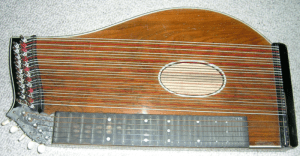
“Zither” by Ludwig Gruber (Own work) [Public domain], via Wikimedia Commons
As I was explaining on Day C before I strayed onto Alice and Lady the Horse, I considered making contrariwise my theme for the entire challenge. Instead of blogging from A to Z, I’d have blogged from Z to A. The topic of the Day A(Z) post would have been zither, specifically the one from James Thurber’s “The Night the Ghost Got In.

In case you’ve forgotten, Thurber says it began this way:

I had just stepped out of the bathtub and was busily rubbing myself with a towel when I heard the steps. They were the steps of a man walking rapidly around the dining-room table downstairs. The light from the bathroom shone down the back steps, which dropped directly into the dining-room; I could see the faint shine of plates on the plate-rail; I couldn’t see the table. The steps kept going round and round the table; at regular intervals a board creaked, when it was trod upon. I supposed at first that it was my father or my brother Roy, who had gone to Indianapolis but were expected home at any time. I suspected next that it was a burglar. It did not enter my mind until later that it was a ghost.

He woke his brother Herman and they went to the top of the stairs and listened. The footsteps had stopped, and Herman wanted to go back to bed, but Thurber insisted something was down there–and as soon as he said it, the invisible something ran up the steps toward them. Herman ran into his bedroom and slammed the door. Thurber slammed the door at the top of the stairs and held it closed, then cautiously opened it. No none was there. That should have been the end of the story, but in the Thurber household, nothing is ever the end.

The slamming doors woke Thurber’s mother. She decided there were burglars in the house. Because the phone was downstairs, she couldn’t call the police, so she “flung up a window of her bedroom which faced the bedroom windows of the house of a neighbor, picked up a shoe, and whammed it through a pane of glass across the narrow space that separated the two houses.”

“Guinea pig eating a piece of apple” by Jg4817 (Own work) [CC BY-SA 3.0], via Wikimedia Commons
After Mrs. Thurber finally made the neighbor, Mr. Bodwell, understand the burglars were in her house, not his–which wasn’t easy, considering he’d been awakened by a shoe shattering his bedroom window, and Mrs. Bodwell was in the background saying, “We’ll sell the house and go back to Peoria”–he called the police.

The police came and broke the door down (Mrs. Thurber wouldn’t allow her son to go downstairs to let them in because he was still dressed in a bath towel and would have caught his death of cold). A search ensued:

Downstairs, we could hear the tromping of the other police. Police were all over the place; doors were yanked open, drawers were yanked open, windows were shot up and pulled down, furniture fell with dull thumps. A half-dozen policemen emerged out of the darkness of the front hallway upstairs. They began to ransack the floor: pulled
beds away from walls, tore clothes off hooks in the closets, pulled suitcases and boxes off shelves. One of them found an old zither that Roy had won in a pool tournament. “Looky here, Joe,” he said, strumming
it with a big paw. The cop named Joe took it and turned it over. “What is it?” he asked me. “It’s an old zither our guinea pig used to sleep on,” I said. It was true that a pet guinea pig we once had would never sleep anywhere except on the zither, but I should never have said so. Joe and the other cop looked at me a long time. They put the zither back on a shelf.

Had contrariwise been the theme, that’s what I would have written about on Day A. What I’d have posted on Days B(Y) and C(X), I don’t know.

Nor do I know what I’ll write about today, on Day D. But by Day E, I’ll have something worked out.

***

Here are some #AtoZChallenge blogs you might enjoy reading.

Iain Kelly  

Mainely Write 

Anne’s Family History

Poetry, Law and Something More

Lighter Side

For the Master List, click here.

For more Day D posts, click AtoZ.

#AtoZChallenge Day C: Contrariwise

I believe I’ve fallen behind.

My Day B (April 2) post went online about five minutes before Day C started in my time zone. Now, less than four hours before Day D begins, I’m just starting on Day C.

Technically, I’m okay–observing the letter of the law (take some time to chuckle over that before reading on) but giving the spirit short shrift.

I haven’t observed a few other guidelines, either. I was supposed to–or maybe just invited to–choose a theme and reveal it here last month. But I couldn’t settle on anything, so I skipped that step.

It’s a shame, because I had a pretty good idea: Contrariwise. In the first place, I love the word. It reminds me of the first time I saw it in print, Alice’s meeting with Tweedledum and Tweedledee:

They stood so still that she quite forgot they were alive, and she was just looking round to see if the word “TWEEDLE” was written at the back of each collar, when she was startled by a voice coming from the one marked `DUM.’

`If you think we’re wax-works,’ he said, `you ought to pay, you know. Wax-works weren’t made to be looked at for nothing, Nohow!’

`Contrariwise,’ added the one marked `DEE,’ `if you think we’re alive, you ought to speak.’

`I’m sure I’m very sorry,’ was all Alice could say . . .

`I know what you’re thinking about,’ said Tweedledum: `but it isn’t so, nohow.’

`Contrariwise,’ continued Tweedledee, `if it was so, it might be; and if it were so, it would be; but as it isn’t, it ain’t. That’s logic.’

I was seven years old, lying on the back seat of my Uncle Joe and Aunt Laura’s new car, on the way home to Del Rio after a week-long visit with family in Fentress, and reading Alice in Wonderland, when all of a sudden, my stomach revolted. We stopped at the next service station so they could hose me down. My grandfather, who occupied the other half of the back seat, somehow managed to stay out of the line of fire. Aunt Laura said, “I told you lying down to read would make you carsick.” But it never had, and it hasn’t since, so I think other forces must have been at work.

Anyway, I’ve loved contrariwise ever since. Go figure.

I learned the base word, contrary, long before Alice. My great-aunt Ethel used it to describe her mare, Lady. It was an apt term. That horse personified the expression, “Beauty is only skin deep.”

She never unseated anyone; she simply refused to cooperate: hard to catch (she could walk faster than I); hard to bridle (she was taller than I); hard to saddle (she found the nearest pecan tree, leaned against it, and walked ’round and ’round while I followed, holding the saddle shoulder high and trying to heave it across a moving target.

Once saddled, she gave up being a moving target and became a stationary one. If I wanted to go one way and she wanted to go another, she didn’t insist on her way. She just stopped. And stood. And stood. And stood.

When I was four or five years old, my father let me ride her around in the little fenced enclosure where we kept chickens while he worked. Every time we neared the gate, she stopped. I would holler for my dad. He would come, say, “I told you not to let her get near the gate,” and lead her past. We would make another circuit. She would stop. I would holler for my dad. He would come, say, “I told you not to let her get near the gate,” and lead her  . . . You get the idea.

So there it was. Contrary Lady. Contrary Kathy.

Oh, darn. It’s nearly midnight. Day D.

Contrariwise.

***

To read what other bloggers in the Blogging A to Z Challenge wrote on Day C, click AtoZ.

***

Lewis Carroll, Alice’s Adventures in Wonderland.

Day B: Ben Hur #AtoZChallenge

Sunday night, and I’m watching Ben Hur on the local PBS channel. I saw it the first time on a Saturday afternoon at the Rita Theatre in Del Rio, Texas, in 1961. The movie was released in 1959, but Del Rio was an out-of-the-way place, and films didn’t travel as quickly then as they do today.

It’s a beautiful movie. The highlight is the chariot race that pits the main character, Judah Ben Hur, against his childhood friend, later enemy, the Roman Messala.

My friends and I didn’t go home raving about the chariot race, of course. The story was about friendship and betrayal and hatred and revenge and forgiveness–mature themes–and if we appeared too much interested in the race, adults might think us childish. Nine-year-old girls don’t like to be thought childish.

Watching tonight (for the fifth or sixth time at least), I think how silly we were. The chariot race is magnificent. Andalusian horses and Lippizans, pounding hooves, blades on the hubs of Mesalla’s chariot cutting through his rivals spokes, cars tipping, drivers flying out, being dragged and trampled, Messala lashing Judah with his whip, the crowd cheering…

One critic wrote that chariot race “will probably be preserved in film archives as the finest example of the use of the motion picture camera to record an action sequence. The race . . .  represents some 40 minutes* of the most hair-raising excitement that film audiences have ever witnessed.”

Wreckage from the chariot race in Ben Hur (1959) trailer. Public domain. Via Wikipedia.

Moreover, it was done without the aid of sophisticated computer software. Those were real men, real horses, real dangers. I’m glad I grew up before special effects became easy, when we were still capable of being impressed and saying Wow!

A Baby Boomer, I’ve had a lifetime of Wows! When I was five, Charlton Heston parted the Red Sea. Wow! When I was nine, Alan Shepard traveled into outer space. Wow! When I was ten, the Absentminded Professor ironed Flubber onto the soles of high school basketball players, and they bumped their heads on the gymnasium ceiling. Wow! When I was eleven, John Glenn orbited the Earth. Wow! When I was eighteen, two Americans walked on the moon. Wow! 

Older people told stories that elicited Wows, too. In 1910, my great-uncle and -aunt, Maurice and Bettie Waller, and Aunt Bettie’s best friend, Miss Annie Barber saw a stage performance of Ben Hur. After sending students home early–Aunt Bettie and Miss Annie taught together at a rural school–they and Uncle Maurice traveled by horse and buggy fifty miles north to Austin, saw the play, and immediately headed back home. They arrived just in time to open school the next morning.

When Aunt Bettie told me that, I was so impressed. Bouncing over a hundred miles of gravel roads in a horse-drawn buggy in less than twenty-four hours, just to go to the theater–that was a big deal.

But even more impressive–there was a chariot race. Two real chariots and two real horses. On the stage.

Wow!


To read what other A to Z Challenge bloggers wrote on Day B, click here.

***

* The chariot race scene lasts for nine minutes. I’m not sure what the critic’s reference to 40 minutes means.

“All in the April Evening”

Last year on Good Friday, I posted “All in the April Evening,” words and music by Sir Hugh Roberton, based on a poem by Katharine Tynan. I’d forgotten about it until a few minutes ago, when I looked at my stats page and saw the post has been viewed three times today.

Good Friday is past, but it’s never too late for music, so here it is again.

Roberton modified the words slightly; his version is the one I use. A link to the poem is here.

Links to performances and biographies of the composers follow.

Years ago my voice teacher introduced me to the song. Now I can’t sing it, because I can’t even hear it without tears.

***

All in the April evening
April airs were abroad
The sheep with their little lambs
Passed me by on the road
The sheep with their little lambs
Passed me by on the road
All in the April evening
I thought on the lamb of god

The lambs were weary and crying
With a weak human cry
I thought on the lamb of god
Going meekly to die
Up in the blue blue mountains
Dewy pastures are sweet
Rest for the little bodies
Rest for the little feet

But for the lamb, the Lamb of god
Up on the hilltop green
Only a cross, a cross of shame
Two stark crosses between

All in the April evening
April airs were abroad
I saw the sheep with the lambs
And thought on the Lamb of God

***

All in the April Evening
Sung by the Glasgow Orpheus Choir
Directed by Sir Hugh Roberton

 *

All in the April Evening”
Instrumental performed by the Grimethorpe Colliery Band

***

–from Wikipedia

Sir Hugh Stevenson Roberton (23 February 1874 – 7 October 1952) was a Scottish composer and Britain’s leading choral-master.

“Roberton was born in Glasgow, where, in 1906, he founded the Glasgow Orpheus Choir. For five years before that it was the Toynbee Musical Association. A perfectionist, he expected the highest standards of performance from its members. Its voice was a choir voice, its individual voices not tolerated. He set new standards in choral technique and interpretation. For almost fifty years until it disbanded in 1951, on the retirement of its founder, the Glasgow Orpheus Choir had no equal in Britain and toured widely enjoying world acclaim. Their repertoire included many Scottish folk songs arranged for choral performance, and Paraphrases, as well as Italian madrigals, English motets and the music of the Russian Orthodox Church. The choir also performed the works of Bach, Handel, Felix Mendelssohn, Peter Cornelius, Brahms and others.

“He wrote the choral work (words by Katharine Tynan) All in the April Evening, and the popular songs Westering Home and Mairi’s Wedding.

“He was a pacifist and member of the Peace Pledge Union. For this reason both he and the Glasgow Orpheus Choir were banned by the BBC from broadcasting during the Second World War.”

*

–from Wikipedia

Katharine Tynan (23 January 1859 – 2 April 1931) was an Irish writer, known mainly for her novels and poetry.

“Tynan was born into a large farming family in Clondalkin, County Dublin, and educated at St. Catherine’s, a convent school in Drogheda. Her poetry was first published in 1878. She met and became friendly with the poet Gerard Manley Hopkins in 1886. Tynan went on to play a major part in Dublin literary circles, until she married and moved to England; later she lived at Claremorris, County Mayo when her husband was a magistrate there from 1914 until 1919.

“For a while, Tynan was a close associate of William Butler Yeats (who may have proposed marriage and been rejected, around 1885), and later a correspondent of Francis Ledwidge. She is said to have written over 100 novels. Her Collected Poems appeared in 1930; she also wrote five autobiographical volumes.

Superscripts have been deleted from the Wikipedia articles.

***

Fentress United Methodist Church (Fentress Community Church)
Fentress Presbyterian Church

April in Texas: Loveliest of Flowers #AtoZChallenge


Loveliest of trees, the cherry now
Is hung with bloom along the bough,
And stands about the woodland ride
Wearing white for Eastertide.

Now, of my threescore years and ten,
Twenty will not come again,
And take from seventy springs a score,
It only leaves me fifty more.

And since to look at things in bloom
Fifty springs are little room,
About the woodlands I will go
To see the cherry hung with snow.

~ A. E. Housman

***

I’ve signed on to participate in the Blogging from A to Z Challenge this month, and this is Day A: April.

Content was never in question: I post A. E. Housman’s “Loveliest of Trees” nearly every year at bluebonnet time as a reminder to seize the day, to get out and see beauty while it’s here–while we’re here.

Be sure to read–or at least scroll–to the bottom of the page. There’s an unexpected treat–not just a bunch of blue flowers.

Here’s a link to the A to Z Challenge Master List-links to the nearly 700 blogs taking part in the challenge.

A short analysis of  “Loveliest of Trees” appears at Interesting Literature.

Info about 2018 bluebonnet sightings can be found at the Texas Wildflower Report on Facebook.

Paintings by Julian Onderdonk.  http://texaspaintings.com/JulianOnderdonk.htm

… by Robert Wood. http://radstudies.tumblr.com/post/146477004552/robert-william-wood-american-1889-1979-texas

… by Porfirio Salinas. https://www.bing.com/images/search?q=Porfirio+Salinas+Bluebonnet+Paintings&id=61B8119D2E9E1BC63C9D221D5774776F07B2D13B&FORM=IDBQDM


And…

*****

To see what other bloggers wrote about on Day A, click A2Z.


Headline: Guess Who Sold a [Copy of a] Book

Our first full day at All-Con Dallas 2018 was a rousing success. I sold a book.

A man picked up a copy of DAY OF THE DARK and asked if I had change. I was gobsmacked. Of course I didn’t have change. I hadn’t thought about needing change. I didn’t even have my purse.

David, standing behind me, pulled out his wallet and handed me two fives. I handed them to the customer in exchange for a twenty.

It was fun. I forgot to say, “Would you like me to autograph that for you?” But I’m new at this.

David, as usual, was more prepared than I. He came armed with Tootsie Pops and a bowl he’d bought at Walmart. Two Pops were taken, the first by a monster, and the second by me.

I’d forgotten how much trouble lollipops are. When you have one in your mouth, you can’t talk, and when you take it out of your mouth, you lose the use of one hand. David suggested I set it on a sticky note. Later, when I picked it up, I discovered something interesting: the stickum on the back of the sticky note was stickier than the stickum under the Tootsie Pop.

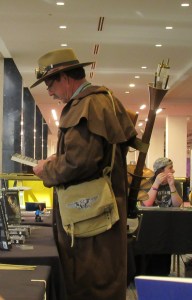
Most of the attendees were in costume, and we took a lot of pictures. David’s are good; he didn’t mind asking people to stop so he could get a shot. I was reluctant to ask anyone to do anything, so I snapped many of my subjects as they walked toward, by, and away from me. Moving targets, as it were. Fortunately, David shares.

Selling the book was the first Big Deal of the day.

The second also occurred while I was parked at the Aliens and Mysteries table. A man stopped to look at books and stayed to talk about crime fiction, and then about crime, and that led to his saying his grandfather was a Texas Ranger from 1928 into the 1950s. For over a year, I had looked without success for a certain piece of information about the Rangers in the ’50s. So I asked; he told me. I just love serendipity.

The second experience was also serendipitous, but it goes well beyond Big Deal. Tonight I had a sudden inspiration–an epiphany–that could change the course of my life as a writer.

And the credit goes to Lady Lola Lestrange of La Divina Burlesque.

I didn’t get a picture of her. But you can look her up.


Elevators, Mysteries, Aliens, Swords, and One Bunny Rabbit

Reporting from All-Con 2018 in Dallas, Texas. Tomorrow we’ll sit at a table outside the Lalique Ballroom and sell our wares–David has Alien Resort patches; I have copies of Lone Star Lawless, Day of the Dark, and Murder on Wheels.

I say we’ll sell, but that’s to be seen. I asked David if he plans to stand in front of the table and call to passersby, “Do you like aliens? I have some alien stuff here. And my wife has books for sale. She’s a writer.”

He said, “No.”

That’s not good. I expected him to hawk my merchandise. Like Jane Austen’s Lizzie, I don’t initiate conversations with people to whom I haven’t been introduced. Especially when I want them to buy something.

Years ago, a friend encouraged me to sell Mary Kay makeup. It could have been a lucrative career. I might have ended up with a pink Cadillac and a bulging bank account.

Water tower, Holland, TX

But my pitch would have gone like this: “Mary Kay makes excellent makeup, and reasonably priced, and you don’t have to go to Dillard’s and stand around waiting for the saleslady to notice you’re there; just call and I’ll deliver it to your door. But women don’t need really need makeup, they put all that goop on their faces and for what?, vanity, just vanity, and you know what the Bible says about that, and you can’t afford it anyway, save your money to buy something of lasting value.”

I liked the makeup, but I kept on teaching.

Our drive to Dallas was uneventful and as pleasant as a drive from Austin to Dallas can be. If you’ve ever taken that route, you know what I mean. I rode the train to Fort Worth several years ago. Boarding, I so looked forward to the scenery: trees and grass and farmhouses and cattle and horses and possibly a chicken or two.

Oh, silly me.

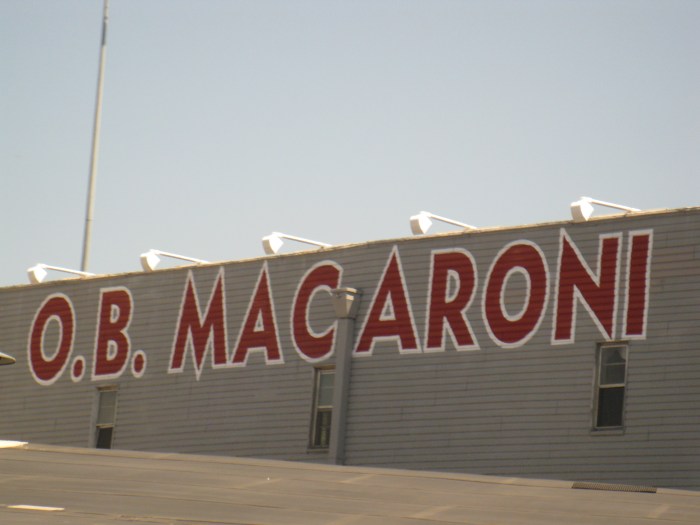
Building with Macaroni on side

It was flat, barren plowed land, and scrubby fields lying fallow, pretending to be pasture, and the warehouse districts of a string of small towns. The most interesting sights were the water tower in Holland and a building with Macaroni painted on the side. A few cows grazed in the distance. No chickens.

No wi-fi, either, for writers who have to keep an online thesaurus running behind their digitized manuscripts.

Unlike IH-35 scenery, the hotel is attractive. The convention holds promise, too. On the way to our room, we met a bunny rabbit. She wore a G-rated costume of electric blue and black and had black ears, black fishnet stockings, and a reasonable amount of visible skin. She was cute. I didn’t want to be obvious, so I didn’t turn around to check for a powder puff tail. 

Fortunately, David registered early enough to get a room on a lower floor. It’s near the elevators, so we don’t have to walk down a long hall to reach them. Also, our rides down will be brief.

At a hotel where we stayed last year, only one of the two elevators was in service, and therefore was always crowded. During each ride, I was sorely tempted to break into a chorus of “Getting to Know You.” We got to know one another quite well.

Elevator rides could be critical this weekend. David reported that on one of his recon missions, he saw people with swords. I don’t want to be in close quarters with a bunch of Game of Thrones wannabes, especially when they might have spent happy hour swilling mead.

Now I backtrack: As I wrote the preceding paragraph, I realized All-Con elevators pose no particular threat. Since last September, it’s been legal in Texas to carry blades over 5.5 inches.

Said Time Magazine shortly after Gov. Greg Abbot signed the bill into law,

People could already carry knives with blades under the 5.5-inch limit, but they generally could not purchase or carry longer weapons. Now they will be able to take many more weapons with them when they run errands, for example, or when acting out their favorite scenes from Game of Thrones in the local park.”*

Not long after, CBS News reported,

“Carrying a sword down the street, carrying a Bowie knife down the street… completely legal. Machetes if you want to,” said general manager at the House of Blades in Fort Worth, Ahnna Escobedo.

“I think it was more to give people more rights and to make sure they felt like they were free to carry what they wanted,” Escobedo said. “Texas move right there, sure.”

Time points out the law wasn’t pushed through without thought.  “… [A]fter a man was accused of killing a University of Texas at Austin student and wounding three others with a hunting knife, debate on the legislation was delayed. And the bill’s author, State Rep. John Frullo, stated, “House Bill 1935 provides a common sense solution by prohibiting any knife with a blade over five-and-a-half inches in certain location restricted areas,…”


Not a bunny rabbit

Frullo also said, he just wanted to simplify current laws: “‘What we wanted to do was make a law where citizens could understand it, law enforcement could understand it and the judicial system could understand it … It adds clarity. All we have to do is use a tape measure and we can tell whether or not a knife is legal to carry.'”

The law also prohibits anyone under the age of 18 from carrying swords, machetes, and other long, pointy weapons.

[I think law enforcement understood the original law–heck, I understood it. If a tape measure said a knife was longer than 5.5 inches, police should then haul the carrier to straight to the pokey. But that’s just me.]

Anyway. Forgive my whining about elevators and swords. We’re probably as safe here in the hotel with people dressed up as pirates and ogres and princesses as we are on the streets of Austin. Safer. Who can say? Not I.

Tomorrow I shall rise, breakfast, help David attach our banner to our table outside the Lalique Ballroom, and prepare to do battle with whoever and whatever comes at me.

I hope it’s nothing scarier than the bunny rabbit.

*

*Am I the only reader to detect a hint of laughter in this sentence? I’ll wager I’m not.

*

Did I say David also witnessed this scene:

A woman walked in carrying a long gun.

A man said, “Is that a deer rifle?”

“Yes,” said the woman. “I got it for twenty dollars. They were having a going-out-of-business sale.”

Just one more thing to think about in the elevator.


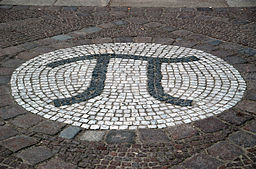
My 3.14 Day Poem*


With thanks to Abbie Taylor,
who told me about Pi Day Poems,
and to Shakespeare, whose sonnet
provided the form.

“Mosaic” by Holger Motzkau licensed under CC-BY-SA-3.0  via Wikimedia Commons

 Anti-Ode on Pi


Shall I compare thee to a summer’s day?

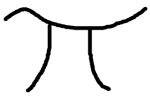
Thou‘rt such a strange shape, legs much like a chair,

A top so curved there’s just no stinkin’ way

It’d seat a current Cabinet secretaire

Or former. Neither dost thou have a crust

Of lard and flour or crumbled crackers graham

That Grandma or Nabisco make, or just

Some chocolate or a blob of strawb’ry jam.

Thou art a cold, hard number made to hurt,

Confuse, and boggle students young and old,

A plethora of digits that exert

Thy pow’r and squeeze, with rude and vile chokehold.

Thou three point one four one six, now I say

I’ll not compare thee to a summer’s day.


For the poem’s sake, 3.1416, rather than 3.14159, is used in the third stanza. Because it is not March 14, 2016 (3-14-16), 3.14 is used in the title.


To see 100,000 digits of pi, go to http://www.geom.uiuc.edu/~huberty/math5337/groupe/digits.html

To see 1,000,000 digits of pi, go to http://www.piday.org/million/   (This page just goes on and on.)


Photograph: Mosaic outside the Mathematics Building at the Technical University of Berlin.


When a Writer Quits . . .

Novelist Nancy Peacock on quitting…

“I’m writing again,” I told Ben.

“I thought so,” he said.

Ben has the good sense to never say, “I told you so,” no matter how many times we go through this. And we’ve gone through it a lot, because I am a serial quitter. Like an alcoholic, I need to put this statement in the present tense. I don’t think I’m cured. I could quit again when the going gets tough. I know I’ll feel the urge. 

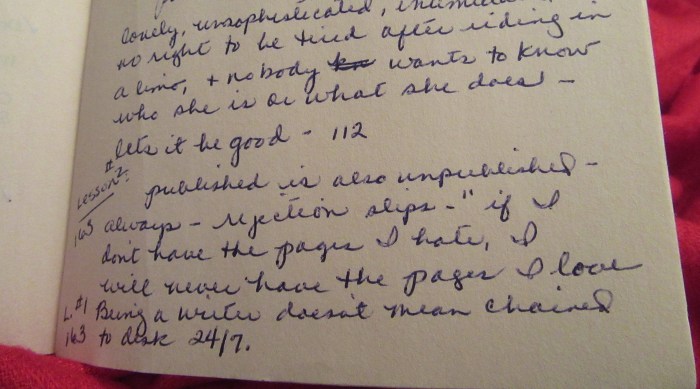
But quitting exacts a price, not just on my writing but also on my soul. When I can’t give my soul what it needs through writing, I go off in search of some other bright ball of yarn. And what I need to learn is that I don’t have to be so extreme. When my soul yearns for the tactile, it’s okay to weave. In fact it’s a good thing for a writer to be nonverbal for a while. It’s a big lesson for me to learn that being a writer shouldn’t mean that I’m chained to my desk twenty-four-seven.

Another big lesson is to finally understand that once I am a published writer I will always be a published writer, but that I will also always be an unpublished writer. I will get rejection slips, no matter what the New York Times said about my first novel. And hopefully I will always have material in need of some work, because if I don’t have the pages I hate I will never have the pages I love.

***

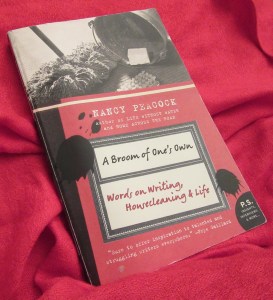
Nancy Peacock, A Broom of One’s Own: Words on Writing, Housecleaning and Life
Harper Perennial (2008)
ISBN: 987-0-06-135787-9

Other books by Nancy Peacock

Life Without Water

Home Across the Road

Dirt: The Quirks, Habits and Passions of Keeping House

The Life and Times of Persimmon Wilson

How Much Money Do Writers Make?

Question: I’ve written a novel. Should I quit my day job now or wait till I’m published?

In A Broom of One’s Own: Words on Writing, Housecleaning and Life, author Nancy Peacock answers that question with a story:

*

Two women are walking down the road and pass a frog sitting in the grass. “Hey,” says the frog.

“Wow. It’s a talking frog,” says one of the women. She picks the frog up and holds it in her hand.

The frog says, “Listen, I’m not really a frog. Actually, I’m a critically acclaimed writer. A spell was cast on me and I was turned into a frog. But if you kiss me I’ll turn back into a critically acclaimed writer.”

“Well, I’ll be damned,” says the woman, and puts the frog in her pocket.

Her friend asks, “Aren’t you going to kiss it?”

And she answers, “Hell, no. I’ll make a lot more money with a talking frog.”

*

Read my review of A Broom of One’s Own here. You may have already read the review–it’s been around for a while–but the book is so good, I can’t help mentioning it again. After you’ve read the review, read the book.

[P. S. Did you know that when you buy a used book, the author doesn’t receive any money from the sale?]

Nancy Peacock, A Broom of One’s Own: Words on Writing, Housecleaning and Life
Harper Perennial (2008)
ISBN-10: 0061357871
ISBN-13: 978-0061357879