Remember Burma Shave signs? I do. They’re the topic of today’s post at Writing Wranglers and Warriors. Come on over and remember with me. Or, if you’re too young to remember, let me educate you. They were a lot of fun.
Then I happened across another poem she wrote about March, and it seemed a shame to keep it to myself, so I prepared to post it on the 2nd.
Like “To March,” the new poem celebrates nature, specifically the natural light that appears in early spring. Unable (after an extensive search of several databases) to find a suitable photograph of Dickinson’s Central Massachusetts in springtime, I settled for a picture of a Texas landscape covered in bluebonnets. . . .
Then I added a few paragraphs about bluebonnets. I wrote about the annual tradition of driving around looking for bluebonnets, the different species, the history of the…
A light exists in spring
Not present on the year
At any other period.
When March is scarcely here
A color stands abroad
On solitary hills
That science cannot overtake,
But human nature feels.
It waits upon the lawn;
It shows the furthest tree
Upon the furthest slope we know;
It almost speaks to me.
Then, as horizons step,
Or noons report away,
Without the formula of sound,
It passes, and we stay:
A quality of loss
Affecting our content,
As trade had suddenly encroached
Upon a sacrament.
~ Emily Dickinson
*****
This a picture of Emily Dickinson.
English: Daguerreotype of the poet Emily Dickinson, taken circa 1848. (Original is scratched.) From the Todd-Bingham Picture Collection and Family Papers, Yale University Manuscripts & Archives Digital Images Database, Yale University, New Haven, Connecticut. (Photo credit: Wikipedia) {{PD-US}}
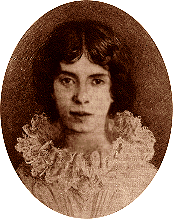
This is a “fabricated” picture of Emily Dickinson.
Fabricated portrait of Emily Dickinson (1830-1886), the American poet. It is an altered version of the only authenticated portrait of Dickinson made after childhood, with added frilled collar and changed hair to make her appear more feminine. Public domain. {{PD-US}}
According to a docent at the Emily Dickinson Museum in Amherst, Massachusetts, in the late 1990s, the photograph was probably altered after Dickinson’s death in 1886, as a tribute and a keepsake. At that time, families often had photographs “enhanced” after a loved one’s death.
I didn’t know Emily Dickinson personally, but judging from what I’ve read and heard about her, I think if she’d seen the enhanced version, she’d have hooted.
Emily Dickinson Museum, Amherst, Massachusetts – side view of Emily Dickinson’s house. (Photo credit: Wikipedia). By Daderot (Own work) [Public domain], via Wikimedia CommonsShe was obviously depressive, but she also had a sense of humor.
The docent told the following story (documented in an LA Times review by Susan Reynolds):
‘Once, when Samuel Bowles, an old family friend and the subject of Dickinson’s Master poems, went to visit, he found himself yelling up the stairs: “Emily, you damned rascal. No more of this nonsense! I’ve traveled all the way from Springfield to see you. Come down at once!”‘
The detail that doesn’t appear in the article, but that the docent added, is that, at Bowles’ summons, Emily left her room and came down the stairs, laughing.
Try calling someone without a sense of humor a “damned rascal” and see what happens.
And she wasn’t quite as antisocial as she’s generally portrayed. Alix North, in a biographical sketch of the poet, writes that in her twenties, Dickinson had a “busy social life” but that by her thirties, she had become reclusive and withdrew when visitors came.
It’s been speculated that Dickinson pulled away from the public because she thought she wasn’t beautiful, or that she was mourning an unrequited love, or that she was agoraphobic. But perhaps Dickinson “became an isolata , creating a moat around herself to preserve the rarity of her soul and because she believed that isolation was critical to artistic expression.”
In other words, she knew exactly what she was doing: Social butterflies rarely, if ever, compose more than 1100 poems by the time they’re 35, at least not concise, powerful ones.
[Sentiments expressed in the preceding paragraph are mine alone. I could be wrong, but I’m not. A 14-year-old boy once told me that anyone who stayed at home as much as Emily Dickinson did couldn’t know enough about life to write anything worthwhile. I refrained from replying that 14-year-old boys don’t know enough about anything to say what Emily Dickinson could or could not do. Now I wish I’d said it. But as I was saying before I interrupted myself . . .]
Edward Dickinson, the poet’s father, was described by contemporaries as “stern and unyielding”; “within his home his decisions and his word were law.” Emily wrote that she didn’t learn to tell time by the clock until she was fifteen because “[m]y father thought he had taught me but I did not understand & I was afraid to say I did not & afraid to ask anyone else lest he should know.”
The museum’s docent pointed out, however, that he was also kind. He could have required Emily to work and support herself or at least to contribute to family finances. Instead, he supported her until his death in 1874. Her sister, Lavinia, took care of most domestic tasks that would normally have been shared. Her family allowed Emily time and space in which to write.
Well, I’ve gone on about Emily Dickinson for a lot longer than I intended, and I hope you’re still with me. I’ll stop now, but not before saying this, which I’ve said before, but I’m going to say again:
A textbook I taught from in 1973, my first year in the Texas secondary school trenches, contained the statement that Emily Dickinson is one of America’s greatest women poets.
Dear March — Come in —
How glad I am —
I hoped for you before —
Put down your Hat —
You must have walked —
How out of Breath you are —
Dear March, Come right up the stairs with me —
I have so much to tell —
I got your Letter, and the Birds —
The Maples never knew that you were coming — till I called
I declare — how Red their Faces grew —
But March, forgive me — and
All those Hills you left for me to Hue —
There was no Purple suitable —
You took it all with you —
Who knocks? That April.
Lock the Door —
I will not be pursued —
He stayed away a Year to call
When I am occupied —
But trifles look so trivial
As soon as you have come
That Blame is just as dear as Praise
And Praise as mere as Blame —
On the ash heap lay a bottle, an empty cigarette pack, a broken doll.
“Stop,” she’d said. “Stop or I’ll leave.”
“You won’t.” He laughed. “You’re just a baby, still playing with dolls. Out there, you’ll be alone. You leave, you die.”
She’d come to him, her father’s choice, not hers, the doll her only token of the past.
“I’ll leave.” She packed her clothes and walked away, eyes on the future, never looking back.
The doll remained.
He watched. When she was out of sight, he threw her childhood on the ash heap along with his.
*****
I’m posting late for last week’s Friday Fictioneers, so my link doesn’t appear on their page. But you can find links to their short-short stories by clicking on the Frog.
Last weekend, I wrote a post about cows. It ran to over 1100 words, and I hadn’t covered even half of the cows I’d planned to. Furthermore, it was silly. I scrapped it.
Today I started a post in which I intended to compare a book by artist-author Shel Silverstein to the novels of Katherine Paterson. The first part–the Shel Silverstein part–ran to over 1300 words, and there were more to come.
That posed a problem, as most of the piece was to be about Katherine Paterson. I liked what I’d written, and so would other English majors, some of them, maybe, but most people aren’t English majors. They find literary criticism tedious. So I scrapped it.
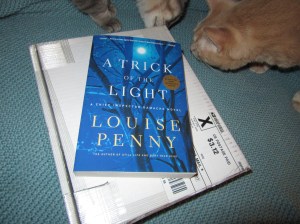
William and Ernest examine Louise Penny’s A Trick of the Light and the box it came in.
When I was eight, my grandmother gave me two Nancy Drew mysteries for Christmas: The Secret in the Old Clock and The Clue of the Tapping Heels, and I was hooked. One title led to another.
A Trick of the Light has received the following honors:
English: Louise Penny (Photo credit: Wikipedia). By Ian Crysler (Transferred from en.wikipedia) [CC BY-SA 3.0 ]
Winner of the Anthony Award for Best Crime Novel 2012
Finalist for the Macavity Award for Best Crime Novel in the US 2012
Finalist for the Agatha Award for Best Mystery of 2011
Finalist for the Arthur Ellis Award for Best Crime Novel in Canada in 2011
Finalist for the Dilys Award from the Independent Mystery Booksellers Association for the book they most enjoyed selling in 2011
Finalist GoodReads Choice Awards for 2011
Publishers Weekly top 10 Mysteries of 2011
Amazon.com top 10 Thrillers and Mysteries of 2011
Aunt Agatha’s Bookstore: Favorites of 2011
The Toronto Star: Favorite Read of 2011 New York Times Book Review: Favorite Crime Novel of 2011 BookPage, Readers’ Choice: Best Books of 2011 (#6 all genres)
Women Magazine: Editor’s Pick #1 Book of 2011
The Globe and Mail: Top 10 Mystery of 2011
The Seattle Times: Top 10 Mystery of 2011
Quill and Quire: Top 10 Mystery of 2011
I-Tunes: Top 10 AudioBook of 2011
Richmond Times-Dispatch: top 5 Fiction Books of 2011
NBR reviews a variety of genres by both established authors and those newly published. Subscribers receive notice of reviews by email. Only recommended books are reviewed–“books that are great reads.”
NBR also conducts drawings for free books from the list of email subscribers. I’m a subscriber. My name was drawn. A Trick of the Light arrived in today’s mail.
“Okay. Roadside Flowers of Texas. Short. Illustrated. With pictures.”
“Meh.”
“For non-readers.“
“Sez you.”
“Look. Pink. Oenothera. Prim-rose.”
“Big deal.”
[Sigh] “Back to daffodil.”
“Jonquil.”
“Narcissus. Same. Both daf-fodils.”
“Why?”
“Science.“
“I spit on your science.”
“Cretin.”
“No. Poetic.”
“What?”
“Po-et-ic.”
“Huh?”
“Can’t be daffodil.”
“Why?”
“Because my heart‘s not dancing.“
*****
Click on the frog to find more short-shorts by Friday Fictioneers.
*****
The spring of my junior year, I took a college course in plant taxonomy. I learned to identify flowering plants by dissecting them and consulting a dichotomous key. I learned the difference between monocotyledons and dicotyledons. I learned to arrange plants for the herbarium, one flower turned up, one turned down, one open (or as close to that arrangement as one can manage).
I learned that poison ivy is a mimic, that its leaves take on a variety of forms, and that if one collects a specimen of poison ivy on every outing (because its leaves take on a variety of forms), one has a perpetual itchy rash. I learned that if one stores a box of dried plants under one’s bed in one’s dorm room, one has a perpetual itch without a rash.
I learned that one’s car can take to the ditch and almost plow through a row of mailboxes while one scans the roadside for flowering plants instead of watching where one is going. I learned the scientific names of over 300 species (I am was blessed with a good memory and excelled at subjects requiring rote memory instead of thought).
A few days after the plant tax course ended, I was standing outside the biology department office, reading the list of upcoming course offerings, when the Plant Tax professor came down the hall. He stopped behind me, leaned over, and whispered, “Looking for a course that’s as easy as the one you just finished?”
And I said, “Yes.”
But here’s the point: The longer I look at the prompt picture, the less it looks like a daffodil, a jonquil, or a Narcissus anything.
The house where we stayed is way out there–waaaaaaaaaaaay out there–and I had trouble finding it. It was one more instance of leaving the address tucked away safely in my email inbox.
When I reached the end of the road–literally–I turned around, retraced the route to the nearest post office and, fingers crossed, asked for directions to the nearest establishment offering free wi-fi. The postmaster directed me to her best guess, then said, “But it’s a bar.” I didn’t care. I can’t stand the smell of beer, but I’d have been glad to buy a six-pack for the privilege of Internet access.
I was on my way out when she said, “Wait. You can use my computer.” When the United States Postal Service declined to connect to gmail, she pulled out her mobile phone, accessed my account, and said, “You should change your password, of course, when you get home.” I wrote down the address, she gave me further directions, and in less than five minutes, I was where I should have been a half-hour before. Or maybe a full hour.*
In his essay “El Dorado,”Robert Louis Stevenson writes, “Little do ye know your own blessedness; for to travel hopefully is a better thing than to arrive, and the true success is to labour.”
I agree. I always travel hopefully and, most of the time, enjoy winding around, wondering whether I’ve passed the point of no return. There comes a time, however, when I’m relieved to finally arrive.
And so ends the obligatory account of my most recent episode of winding around. Now to get on with the retreat.
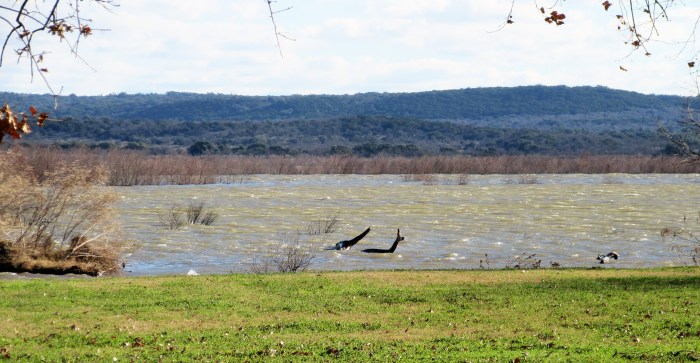
Come to think of it, there’s not a lot to get on with. We sat outside and watched birds flying and sticks floating; and discussed whether one stick, which stayed in the same place for a long time, wasn’t a stick but instead something that might crawl out of the lake and bite somebody, namely us; and monitored current events by periodically glancing at the television, sound off; and, when the spirit moved, ate.
Evidence of writing. AMW retreat on Lake Buchanan, January 2017
But most of the time, we wrote. I slapped down over 1900 words in one day. It’s been ages since I did that. Many of them won’t end up in the final version of the story, and those that do will be shifted from page to page before settling. But, to quote novelist Nancy Peacock, in A Broom of One’s Own, “if I don’t have the pages I hate I will never have the pages I love.”**
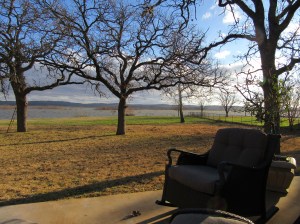
I expected to take pictures but was too relaxed/lazy to get out my camera until Sunday. A cold front had come in overnight, and that morning the lake was choppy. I wish my photos had picked up the whitecaps. I also wish they could show the tranquility of our surroundings.
The other photos are wretched, but I include them to prove that on our writing retreat we actually wrote.
So what is it with writers and retreats? Getting away from routine, from everyday-ness and common distractions, refreshing the mind and the soul, opening new vistas, viewing life from new perspectives…
All of the above. None of the above. It doesn’t matter.
For several months, William has been taking insulin injections.
William, 2016. Up and at ’em.
The good newsis that he cooperates, mostly. If he’s downstairs when shot time comes around, David grabs him and puts him on his lap; I give the shot. If he’s upstairs on the bed, that’s different.
David goes up first and pets him. I follow a minute later. When he sees me, he starts to get up. David positions him so I can scruff him. Sometimes before I get hold of him, he lunges, and David has to redouble his efforts. Then I give him the shot and we pet him and tell him he’s a good kitty, something he already knows, and that’s that. In short, he doesn’t mind the shot, just the temporary loss of free will.
The most difficult part is scruffing him. There’s not much to scruff. Sometimes I have to try several times to pull up enough skin so the needle doesn’t go too deep. The veterinarian has trouble, too.
The other good newsis that in all the time I’ve been sticking a needle into him, I’ve stuck it into myself only three times.
The second other good news is that have I never injected myself with insulin.
The really, really good news is that I always stuck myself before, or instead of, sticking him.
Ernest, 2012. Probably the day he chewed a cable in two.
Except for once last week when the needle went through his skin and into my thumb. As I said, there isn’t much up there to scruff. Since them, I’ve aimed more carefully.
The best news is that his blood sugar is down and he’s back to his old self, wrestling with Ernest (William starts it); staying downstairs more; playing with the Filthy Pink Mouse; grabbing my hand, holding on (claws), and biting my fingers. Sometimes he just licks my hand. That’s icky, worse than the biting.
###
It’s been a calendar year since I was diagnosed with breast cancer.
My good news is that I finished chemo (the evil drug) at the end of May and now am much stronger. I said many times during chemotherapy that the side effects were mild. Now I realize that during that time, I felt pretty rotten. I was weak. The feel of water on my skin was unpleasant. I couldn’t walk more than five or ten steps without stopping to rest. I lived on Benadryl to keep my hands and arms from itching. But I still believe I had it easy.
In June, I had lumpectomies (I didn’t know you could have surgery twice within one week). In September, I went through radiation, twenty consecutive days, weekends and Labor Day excluded, smiled cheerily at the technicians, let them admire my cute socks, lay perfectly still for a few minutes while they zapped me, and drove home.
The hardest part was getting the gown tied correctly.
On the last day, in the hallway outside the radiation room, one of the techs asked if I wanted to celebrate. I said, “Sure.” He brought out a small cardboard box and the three of them threw confetti at me.
If I seem to be making light of the experience, I suppose I am. In part, that’s because it’s what I do. It makes better copy. In part, it’s because I didn’t go through the hell others go through. In part, it’s because I have to.
Within days after the last radiation treatment, I slid into depression. The radiation oncologist said she’d seen it before, and I needed a goal: travel (just did); creative activity (got one story with an editor, working on another one); gardening (no place to plant and I kill everything anyway); talk to a therapist (already do); exercise? (oh d*mn).
Before it ended, I heard myself thinking, I’ll buy the package of 300 stars instead of the one with 1000. I might not be around long enough to use 1000. Every time, I immediately countered that with, Stop it, you can’t think that way, buy the 1000.
Radiation might have caused the downhill slide, but I believe it stemmed from the feeling that I wasn’t doing anything to help myself heal. Three months without the chemo drug, I felt all right. I no longer had to report at 8:00 a.m. for radiation. There were no technicians to impress with my brave, cheery attitude; nurses didn’t seem impressed. Taking a pill every morning took no effort. Periodical infusions to boost the immune system had weeks ago lost their luster. I wasn’t working at it.
Hearing, or telling myself, Cheer up! didn’t help. As all depressives will tell you, it never does. It makes us want to cuss or, better yet, to kick the sunshiny idiot adviser in the knee.
My other good news is that by Christmas I was on the mental mend, thank goodness. Because the scariest part was that depression and big T-cell boosting smiles don’t coexist.
My second other good news is that my latest CT scan, done in early December, shows the lesion in each lung and the two lymph nodes that were radiated in September have decreased in size so much that they wouldn’t show up on a PET scan. The radiation oncologist’s pronouncement: “Awesome.” Indeed. The oncologist is pleased and said he hopes I am, too. Yes, I’d say I’m pleased. The next scan is scheduled for March.
I continue to juggle a positive attitude and uncertainty. The next scan may be clear. The lesions and lymph nodes may show metabolic activity again. Problems may show up elsewhere. I’ve been having pre-cancerous tissue removed here and there for the past fifteen years. Cancer is the Curse of the Wallers. It’s in the other side of my family, too.
But I’m here, and I had an excellent report, and I keep on keeping on.
Which makes everything I’ve written here not just good news, but the best.
When the January schedule for Writing Wranglers and Warriors came out, I was pleased to find I would post on Friday the 13th. Last month–I’ve spent the past three hours writing about exactly what happened last month, but the result was so deadly dull it could have been used as a substitute for Ambien, so I’ll summarize–
Anyway, I got the dates mixed up, tried to post a day ahead of schedule, ended up posting a day behind schedule, took the post down–
In short, Friday the 13th seemed a good idea. You can’t forget Friday the 13th. Unless you forget to look at the calendar until 10:00 p.m. on the 12th.
So I spent three hours banging away at the keyboard only to find that the result read more like typing than writing. I hate it when that happens. Fortunately, I’ve been blogging long enough to have…
Elizabeth Barrett Browning Rome, 1858 (Photo credit: Wikipedia). By From a chalk drawing by Mrs. E. F. Bridell Fox [Public domain], via Wikimedia CommonsBack to doodling. I gave myself permission to skip days–as long as I doodle on all 365 pages, I’m meeting my goal; I don’t have to fill the book in a calendar year or to doodle in order. In other words, I’m also back to eschewing perfectionism.
My image of silence comes from one of Elizabeth Barrett Browning’s Sonnets from the Portuguese. She imagines two lovers, their souls standing “erect and strong, / Face to face, silent, drawing nigh and nigher,” contented to be on earth. “Think,” she says.
In mounting higher, The angels would press on us and aspire To drop some golden orb of perfect song Into our deep, dear silence.
The doodle is of song, not silence. Sometimes it’s easier to depict a thing as what it’s not instead of what it is.
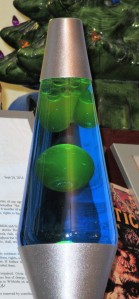
Christmas Night, and all through the house, one person and two cats are sleeping all snug in their beds, while I’m sitting here watching Apollo 13 and a lava lamp.
2016 lava lamp
This is my first lava lamp. I skipped the ’70s. David said it’s his first lava lamp, too. He was present for the ’70s but skipped some of the trappings.
The lamp is fascinating: like a kaleidoscope but with fewer colors and curved edges.
We had a quiet day, one of our traditional nonstandard Christmases. We opened gifts, ate a light breakfast, and sat around.
Then we repaired to Saffron Restaurant, which serves an eclectic mixture of traditional Indian Cuisine punctuated by the flavors of the Himalayas. Goat curry, chicken tikka masala, tandoori chicken, steamed basmati rice, naan… and several things I can’t name because instead of wearing my glasses to the buffet, I left them on the table.
After lunch we came back home, plugged in the lava lamp, and waited for it to erupt. It did not disappoint.
Of course, we took the obligatory photos of the children with gifts under the traditional nonstandard Christmas tree. Changes in living room geography kept us from giving our real artificial tree center stage, so this morning we moved our ceramic artificial tree to a snow-covered chair and accorded it official status.
Facebook reminded me that four years ago, I found these bear foot slippers under the tree. They were the warmest slippers ever. A week later, William sat down and started making biscuits on them. Now they’re called William’s shoes.
It’s now past midnight. Christmas Day is over. Time to turn off the lava lamp and sleep snug in my bed and dream of goat curry and naan. Which, come to think of it, would make a fine traditional nonstandard New Year’s Day lunch.
This 1663 painting by Abraham Hondius has a matching painting of the Adoration of the shepherds. (Photo credit: Wikipedia) Public domain
We’re watching, one more time, It’s a Wonderful Life.Clarence Oddbody, AS2 (Angel Second Class), aka Henry Travers, is showing George Bailey, aka James Stewart, how his hometown would look if George had never been born.
Travers in his most memorable role, as Clarence Odbody in It’s a Wonderful Life (Photo credit: Wikipedia) Public domain.
In a couple of minutes, George will learn that, because he never existed, his wife, Mary, aka Donna Reed, not only never married, but became a librarian. Judging from her granny glasses, frumpy hat, and bun, that’s a fate worse than death.
I like It’s a Wonderful Life, but it isn’t my favorite Christmas movie. I prefer Miracle on 34th Street, in which Edmund Gwenn–whom I rank right up there with Henry Travers–is declared, in court, to be the real Santa Claus. No librarians were defamed in the making of that show.
Even though It’s a Wonderful Life isn’t my favorite, as soon as half the town crowds into the Bailey living room to pile money onto the table, I start to cry. I cry through the credits and the next three commercials. Even a not-favorite movie can stir emotions. Year after year after year.
Favorites aren’t easy. I don’t have a favorite novel or a favorite song or a favorite color. Or a favorite teacher, actor, or pet. I have multiple favorites. For me, those get-your-password questions–“What is your favorite television show?”–are useless. I never remember whether I said Andy Griffith or Law and Order or I’ll Fly Away.
But I do have a favorite Christmas carol. The melody is lovely and singable–singable is important–but it’s the words that move me. They speak of peace and quiet and rest for the weary, of heavenly song floating above earthly babble. They speak of ancient tidings of peace to one small group of men, and of a promise of a world in complete harmony.
But the lyrics also speak of the present, of stopping, and looking up, and seeing angels. They’re there now, and they’re singing.
We have only to be still and listen.
*
It came upon the midnight clear, that glorious song of old, from angels bending near the earth to touch their harps of gold: “Peace on the earth, good will to men, from heaven’s all-gracious King.” The world in solemn stillness lay, to hear the angels sing.
Still through the cloven skies they come with peaceful wings unfurled, and still their heavenly music floats o’er all the weary world; above its sad and lowly plains, they bend on hovering wing, and ever o’er its Babel sounds the blessed angels sing.
Yet with the woes of sin and strife The world has suffered long; Beneath the angel-strain have rolled Two thousand years of wrong; And man, at war with man, hears not The love-song which they bring; O hush the noise, ye men of strife, And hear the angels sing.
And ye, beneath life’s crushing load, whose forms are bending low, who toil along the climbing way with painful steps and slow, look now! for glad and golden hours come swiftly on the wing. O rest beside the weary road, and hear the angels sing!
For lo! the days are hastening on, by prophet seen of old, when with the ever-circling years shall come the time foretold when peace shall over all the earth its ancient splendors fling, and the whole world send back the song which now the angels sing.
 Writing Wranglers and Warriors
 © MK Waller

















 M. K. Waller