D Is for Stinky, Ruffy, and a Dollop of Muggs*: #atozchallenge

Probably no one man should have as many dogs in his life as I have had, but there was more pleasure than distress in them for me except in the case of an Airedale named Muggs. He gave me more trouble than all the other fifty-four or -five put together, although my moment of keenest embarrassment was the time a Scotch terrier named Jeannie, who had just had six puppies in the clothes closet of a fourth floor apartment in New York, had the unexpected seventh and last at the corner of Eleventh Street and Fifth Avenue during a walk she had insisted on taking.

~ James Thurber, “The Dog That Bit People”

 

Now you would probably rather read “The Dog That Bit People” instead of the rest of this post, and so would I, but bear with me for the next few paragraphs and then you can do what you want.

The Muggs James Thurber references was a “big, burly, choleric” Airedale who acted as if Thurber wasn’t one of the family. “There was a slight advantage in being one of the family, for he didn’t bite the family as often as he bit strangers.” Over the years, he bit everyone but Thurber’s mother, “and he made a pass at her once but missed.” Mrs. Thurber felt sorry for Muggs and often said, “He’s not strong.” Thurber says, ” [B]ut that was inaccurate; he may not have been well but he was terribly strong.” He was also sorry after he bit someone, she said, but Thurber observed he didn’t act sorry either. Mrs. Thurber’s philosophy was, “If you didn’t think he would bite you, he wouldn’t,” but the ice man didn’t buy it. “Once when Muggs bit Mrs. Rufus Sturtevant and again when he bit Lieutenant-Governor Malloy” she told the cops “that it hadn’t been Muggs’ fault but the fault of the people who were bitten. ‘When he starts for them, they scream,’ she explained, ‘and that excites him.'” The time he emerged from under the couch and bit elderly Mrs. Detweiler, Mrs. Thurber said it was just a bruise and, “He just bumped you,” but “Mrs. Detweiler left the house in a nasty state of mind.”
I met Muggs and got to know him intimately (practice, practice, practice) for a high school prose reading competition, and I’ve loved him ever since.

Well, enough. If you want to read the story, here’s the link, but I hope you’ll wait till I’ve told you about my dogs.

First came Stinky, when I was about three years old. He was a rat terrier. My dad had tied a rope to the handle of my little red wagon so he wouldn’t have to bend double when he pulled me around in it. Stinky watched, and, intelligent dog that he was, often took hold of the rope and replaced my dad at the helm. He also took the helm when I wasn’t in the wagon; on hot, moonlit summer nights, through their open bedroom windows, my parents heard him pulling the wagon around the back yard. I don’t remember it, but I was told that one day I ran into the house crying as if my heart would break and said, “I hit Stinky.” I know what happened–I had invited him to jump up on me, and he did, but pretty soon I’d had enough and he hadn’t, and I hit him to get him to back off. My heart was breaking, and over sixty years later, I still get teary when I think of it. I’m always sorry after I’ve someone. Except for my friend Phyllis, but that’s a story for another time. H, perhaps, for hit.
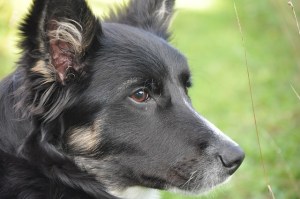
My mother brought home Ruffy, a Border Collie-Shepherd mix, when he was only four weeks old. The giver insisted that was old enough. It wasn’t. The acquisition of a second dog surprised my father, who, I presume, thought it should be a family decision (even at that age I was surprised they didn’t discuss it, but I suppose Mother thought a 2/3 majority was enough), but he didn’t say anything, simply set his jaw in the same way he did the summer before my senior year of college when I said I was going to drop out and go to work for the IRS. I stayed in college and got my degree, but if I hadn’t, I’d have been spared a lot of school-teacher grief and would now have federal employee health insurance, which is a super deal.

(My dad played ball with all our dogs when he thought no one was looking.)

Except for a white bib and little brown “eyebrows,” Ruffy was all black, even his eyes; his hair was thick and wavy. His official name was Rough Bones, which shows why you should never ask a pre-schooler what she wants to name a pet. We gave our dogs bones from steaks and roasts, and they gnawed on and then hid them in the lush St. Augustine grass, and I stepped on them with my perpetually bare feet and cried out in pain. Two or three times a day. At four weeks, Ruffy wasn’t yet weaned, so Mother had to feed him warm milk mixed with white Karo syrup from little doll bottles I’d gotten for Christmas. At first I woke for the four a.m. feeding–yip yip yip–but soon stopped hearing his call and slept through it.

As a young adult, Ruffy, who spent most of his time confined to a big back yard plus the adjoining quarter-acre of chicken yard that lay on the other side of the driveway, chased a twelve-year-old neighbor boy who was passing the house, and ran another one up onto the porch across the street. The stiff, heavy pocket of his new jeans saved the second one from puncture wounds. After that occurrence, we confined the dog for ten days, the time prescribed for making sure he didn’t have rabies (he’d been vaccinated).

My parents took his behavior seriously but my mom noted that both boys teased him through the hog wire fence every time they walked down the street. She believed the dog considered himself provoked; she definitely considered him provoked. (She’d told the boys to stop teasing him, to no avail.)

However, when some of Mother’s out-of-town relatives couldn’t rouse anyone at the front door and offered to enter the back yard through the picket gate, Ruffy told them in no uncertain terms not to bother.  We decided he was being a conscientious, if overzealous, watch dog. We weren’t home when they came and so couldn’t call him off. Considering these particular relatives, I thought he’d been provoked.

(When it came to me, my parents always gave the dog the benefit of the doubt. “You know Sabre snaps when you pet him; leave him alone.” Sabre, my cousins’ Cocker Spaniel, didn’t often see me, and didn’t like me bothering him (probably didn’t like me at all), and he did snap, and I knew he would snap, but he was a dog and I couldn’t help myself. I saw a dog, I petted the dog. When common sense set in, about the time I was forty, I learned restraint.)

The situation with Ruffy became clear, unfortunately, the evening we had a yard full of other relatives sitting in lawn chairs and eight-year-old Sharan appeared from down the street. While she was standing in the middle of the family circle, Ruffy walked up, in my mother’s words, “smiling, with his tongue lolling out and his tail wagging,” and bit her on the thigh.

I was in the house and didn’t see him bite. When they told me they had to take Ruffy to Dr. Matthews to be watched for ten days, and then Dr. Matthews would find him another home, I cried so hard they gave me a St. Joseph’s (baby) aspirin and put me to bed. The aspirin didn’t help. Dr. Matthews told my parents Ruffy was too good a dog to put down, and he would give him to some rancher living out in the country, away from little girl visitors. I was sad but understood. Later Dr. Matthews told them that when the ranchers he offered Ruffy to learned he’d bitten someone, they declined to take him, and so . . .  It was years before I realized what had happened to him. I asked and was told the whole story.
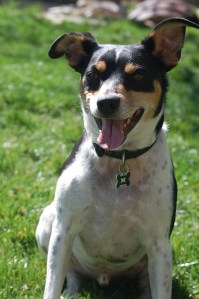
We later learned that Smoky, a litter mate owned by another family in town, also bit. They were both sweet, beautiful dogs, good playmates for their children, and we wondered if there was something in the genes that prompted them to bite strangers. Probably not.

I have pictures of Stinky and Ruffy, but they’re not, shall we say, accessible, so I can’t post them. The dogs pictured here don’t do them justice.

So. I’ve expended all these words on two dogs. Like Thurber, I’ve probably had more dogs than one person should have, but I’ll have to write about the rest of them later, perhaps for M, as in More Dogs.

Okay. Go read “The Dog That Bit People.” You’ll be glad you did.

***

*D is also for Dogs.

***

I wish I could post pictures of Muggs, but I’m sure they’re under copyright. However, the two links in the second paragraph take you to Thurber’s sketches of him.

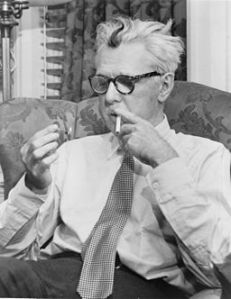
Image of James Thurber by Fred Palumbo, via Wikipedia. Public domain.

Image of Rat Terrier by kteri3565, via Pixabay.com

Image of Border Collie by PascalCottel, via Pixabay.com

Day K: Kerfuffle #AtoZChallenge

For more Day K posts click here.

K is obviously for Kathy, a name at the heart of a lifelong kerfuffle.

The plan was to name me Katherine for my great-grandmother and to call me Kathy. But at the last minute, when the nurse came in and asked for the baby’s name so they could type up a birth certificate, my mother added Mary for my grandmother. Later she told my father what she’d done and he said that was fine with him. He liked his mother-in-law. My grandmother liked the name.

Mother later told me she’d wanted to spell Katherine with a C, but she was afraid her grandmother would say I wasn’t really named for her (the family was funny that way).

Thus was I denied the privilege of assuming the mantle of romanticism connected with hearing Heathcliff call across the moor, Catherine! Catherine! (I don’t think he did that in the book or the movie, but I have a good imagination.)

The precaution turned out to be unnecessary, because every time my great-grandmother, whom we called Grannygirl (that’s another story) wrote my name, she spelled it Catherine.

(I was glad I’d been spared her first name, Minna. She didn’t like it either and changed it to Minnie but later wished she hadn’t.)

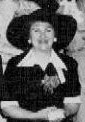
My grandmother, Mary Veazey Barrow, front row 3rd from left (big hat); my great-grandmother, Minna Katherine Stagner Veazey, front row 5th from left.

Otherwise, my name was fine with me, too, as long as we stayed put. But when we moved and I had to enroll in a new school in the middle of second grade, the teacher said they already had a Kathy so I had to be Mary. I didn’t mind–it was just one more of the slings and arrows of being uprooted from my hometown and moving halfway across the universe*–but when I discovered the other Kathy was always called Kathleen, I thought the teacher’s reasoning was a little off.

The next September, I sat with twenty-something other third-graders and their mothers while the teacher called names from a stack of book cards. She got to Mary K. Waller; my mother marched me up and said she’s here, and she’s called Kathy; the teacher said, No this is Mary K-A-Y. I sat back down. Mary Kay didn’t appear. The teacher went through the no-shows and once again, Mary Kay didn’t appear. My mom said she thought that must be a clerical error–one person read the names, another person wrote them down?–and so I settled in as Kathy.

The next year, mothers didn’t hang around for the settling in–I suppose fourth graders were deemed able to fend for themselves–and when the teacher called Mary Waller? I let it slide. Later when my mother asked why, I said something like, “Meh.” Vicki, my best friend from third grade, called me Kathy; others who’d known me before took their pick.

Fast forward to college: Roommates said Kathy, but otherwise, I was Mary. Once I was Mark. The first time the philosophy professor called for Mark Waller, I said nothing, but when Mark didn’t answer the second time, I raised my hand and said in a small voice–one doesn’t want to accuse a prof of illiteracy on the first day of class–Mary? he rechecked the list and laughed. Since then, two more people have made the same error. Perfectly understandable: when you’re skimming, Mary K. resembles Mark.

I was a bit miffed, however, last Christmas Eve, when the young man at Best Buy told me he didn’t have my order. I said the computer said he did have it. He said he didn’t. I said would he check again. He pointed at his monitor and said there was only one Waller on the list.

I said, “Mark?”

He said, “Yes.”

I said, “Mary K.?”

He said, “Oh,” and forked over the box. I was as sweet about the situation as I could manage, considering it was Christmas Eve and I knew he’d  been extra busy; but, considering it was late afternoon on December 24th, and I’d started shopping on December 23rd, my store of sweetness was at low ebb. My words might have carried an undertone that said, Knothead.

My adult life has comprised a series of minor tangles with officialdom. Minor, because I’ve defaulted to Mary. Sometimes I forget. Last week, the nurse assigned to handle my infusion looked up from her monitor and said, “Hi. I’m Holly.”

I said, “I’m Kathy.”

Her expression changed from welcoming to stricken. I got it, admitted I was Mary, and watched her begin to breathe normally again.

My mother once said she thought I didn’t like my name. I did, and I do. It has a pleasant sound, and my written initials have a pleasing symmetry.


It’s sharpened my mental acuity and flexibility by requiring me to (usually) remember who I am in (almost) any setting.

But there are drawbacks. The first hearkens back to the third-grade Mary Kay thing. I do not like being confused with a cosmetics company.


The second concerns two questions I’m asked more and more frequently by young people who don’t understand that Mary Katherine was a perfectly acceptable, mainstream, plain, ordinary, everyday name before it gave way to Lisa and Jennifer and Ashley and Madison:

Are you Catholic?

Are you a nun?

Neither.

I’m a member of a large Protestant family that recycles names.


#####

* About 250 miles to the southwest, to Del Rio, on the border with Mexico. It was a nice place, and after a few months, I loved being there. Sometimes I wish we’d stayed.

** Serendipity! [An English major thing] Attempting to find a reference to Heathcliff calling Catherine, I came across this article–Heathcliff and Cathy, out on the wild, windfarmed moors–by Lucy Mangan, published in The Guardian, April 12, 2012.

I hate to admit it, but I like Ms. Mangan’s starcrossed lovers much more than I like Emily Bronte’s.


#AtoZChallenge Day C: Contrariwise

I believe I’ve fallen behind.

My Day B (April 2) post went online about five minutes before Day C started in my time zone. Now, less than four hours before Day D begins, I’m just starting on Day C.

Technically, I’m okay–observing the letter of the law (take some time to chuckle over that before reading on) but giving the spirit short shrift.

I haven’t observed a few other guidelines, either. I was supposed to–or maybe just invited to–choose a theme and reveal it here last month. But I couldn’t settle on anything, so I skipped that step.

It’s a shame, because I had a pretty good idea: Contrariwise. In the first place, I love the word. It reminds me of the first time I saw it in print, Alice’s meeting with Tweedledum and Tweedledee:

They stood so still that she quite forgot they were alive, and she was just looking round to see if the word “TWEEDLE” was written at the back of each collar, when she was startled by a voice coming from the one marked `DUM.’

`If you think we’re wax-works,’ he said, `you ought to pay, you know. Wax-works weren’t made to be looked at for nothing, Nohow!’

`Contrariwise,’ added the one marked `DEE,’ `if you think we’re alive, you ought to speak.’

`I’m sure I’m very sorry,’ was all Alice could say . . .

`I know what you’re thinking about,’ said Tweedledum: `but it isn’t so, nohow.’

`Contrariwise,’ continued Tweedledee, `if it was so, it might be; and if it were so, it would be; but as it isn’t, it ain’t. That’s logic.’

I was seven years old, lying on the back seat of my Uncle Joe and Aunt Laura’s new car, on the way home to Del Rio after a week-long visit with family in Fentress, and reading Alice in Wonderland, when all of a sudden, my stomach revolted. We stopped at the next service station so they could hose me down. My grandfather, who occupied the other half of the back seat, somehow managed to stay out of the line of fire. Aunt Laura said, “I told you lying down to read would make you carsick.” But it never had, and it hasn’t since, so I think other forces must have been at work.

Anyway, I’ve loved contrariwise ever since. Go figure.

I learned the base word, contrary, long before Alice. My great-aunt Ethel used it to describe her mare, Lady. It was an apt term. That horse personified the expression, “Beauty is only skin deep.”

She never unseated anyone; she simply refused to cooperate: hard to catch (she could walk faster than I); hard to bridle (she was taller than I); hard to saddle (she found the nearest pecan tree, leaned against it, and walked ’round and ’round while I followed, holding the saddle shoulder high and trying to heave it across a moving target.

Once saddled, she gave up being a moving target and became a stationary one. If I wanted to go one way and she wanted to go another, she didn’t insist on her way. She just stopped. And stood. And stood. And stood.

When I was four or five years old, my father let me ride her around in the little fenced enclosure where we kept chickens while he worked. Every time we neared the gate, she stopped. I would holler for my dad. He would come, say, “I told you not to let her get near the gate,” and lead her past. We would make another circuit. She would stop. I would holler for my dad. He would come, say, “I told you not to let her get near the gate,” and lead her  . . . You get the idea.

So there it was. Contrary Lady. Contrary Kathy.

Oh, darn. It’s nearly midnight. Day D.

Contrariwise.

***

To read what other bloggers in the Blogging A to Z Challenge wrote on Day C, click AtoZ.

***

Lewis Carroll, Alice’s Adventures in Wonderland.

Happy Birthday, Veazey

seven-cousins (2)Today is my cousin Mary Veazey’s birthday. I will not say how old she is. I’ll say only that she is old enough that she’s always thought she had the right to boss me around.

We have had many good times together.

The most memorable, right now, aside from the times we almost broke up church because we couldn’t stop laughing, and the time she made me go on the Cruise from You-Know-Where, is the time we went to the drive-in movie to see The Great Gatsby, and her eleven- and twelve-year-old sons–I’ll call them Boy C and Boy G–sat in the back seat griping for the length of the dumb, boring show and yowling to go home.

When the second feature came on, however, the boys displayed immediate interest. It was The Sterile Cuckoo, a cute, sweet movie starring Liza Minnelli. We hadn’t planned to stay for it, but every time Mary Veazey said we had to leave, the boys protested. This was a real good movie, Mom, so we stayed.

We stayed so long that we ran into the scene in the little motel room in which Minneli’s college freshman girl, Pookie Adams, offers Wendell Burton’s sweet, shy freshman boy the opportunity to “Peel the Tomato.”
 And there we were, as they say, ketched.

The boys in the back seat were leaning head and shoulders into the front. They were very, very quiet. I don’t think they were breathing.

Their mother and I didn’t breathe either, because if we had, laughter would have bounced off the screen and echoed throughout the lot.

Suppressing that much laughter for an entire scene hurts.

Finally, the camera pulled waaaay back on the two young characters walking across a field of green, accompanied by the Sandpipers’ lovely rendition of “Come Saturday Morning.”

Mary Veazey saw an opportunity and grabbed it. “Okay, time to go.” She replaced the speaker on its stand, started the car, threw it into gear, and tore out of there.

Boys: “Aw, Mom, it’s not over yet.”

Mom: “Yes it is.”

Boys: “But the music isn’t over. Let’s stay till the music’s over.”

Mom: “No, I want to get out before everybody else does. Don’t want to have to wait in line.”

Boys: “Awwww, Mom. We want to stay.”

Mom: “No, it’s late. Gotta get home.”

Kathy: “Hahahahahaahahahaha.”

Mary Veazey couldn’t give me the evil eye because by that time she was laughing, too.

All the way home, we heard from the back seat, “Boy, that was a good movie.” “Yeah, that was good.” “I wish we could have stayed till the music was over.” “Yeah. That was good.” Periodically, one leaned forward and said, “What’re y’all laughing at?”

Then Boy G said, “What was the name of that movie?” They looked back at the still visible marquee.

Boy G read, “Shirley Cuckoo.”

From the front seat: “Hahahahahahahahahahahahahahahahahaha…”

“Not ‘Shirley,'” said Boy C. “The Stirlee Cuckoo.”

Front seat, louder, “Hahahahahahahahahahahahahahahahahahahahahahahahahahahahaha…”

Laughing that hard hurts, too. And it can be dangerous. I’m surprised Mary Veazey didn’t run the car up onto the sidewalk and get us all hauled off to jail. It’s good she didn’t, because we’d have just laughed harder.

The next morning no one mentioned the movie. But that afternoon, while the boys and two neighbor girls played cards in the living room, and I sat in the kitchen waiting for cookies to bake (cookies the boys were making, hahahaha again), I caught part of the conversation.

Boy G (quietly): “We went to a movie last night.”

Girls: “What was it rated?”

Boy C (whispering): “X, I think.”

I was sorry Mary Veazey was at work and missed the punch line.

Several years later, The Sterile Cuckoo aired on television. About five minutes into the movie, the phone rang. It was Mary Veazey. “What are you doing?”

“You know what I’m doing. Watching The Stirlee Cuckoo.

“Hahahahahahahahahahahahahahahahahaha…”

Happy Birthday, Mary Veazey. We ought to take the boys to the movie again sometime.


Embed from Getty Images


*****

mamaw in hat
Mary Veazey Barrow

Note 1: Our grandmother’s maiden name was Mary Veazey. For people who say, Mary What?, it’s pronounced VEE-zee. Alternatives, for those in the family, are Veazey, Merveazey, and other such diminutives. She introduces herself as Mary. I got the Mary part of our grandmother’s name but was spared the Veazey confusion. My problem comes from the Katherine I got from my great-grandmother. I’m Kathy, but I have to introduce myself as Mary to anyone holding an official, or unofficial, record. On seeing Mary Katherine, many people say, “Are you a nun?” I’m not.

Note 2: All this happened in 1974. I don’t know whether Boys C and G have even seen the real ending of The Stirlee Cuckoo. I don’t know whether they ever learned the correct title. I don’t even know whether they remember any of this at all. But if I send this post to their wives on Facebook, they will.

Note 3: President Nixon resigned later that week, but the movie is my more vivid recollection.

Note 4: Both The Great Gatsby and The Sterile Cuckoo had been out for several years before this story took place. I’m always behind in my movie-going.

Here’s a clip from The Sterile Cuckoo.

*****


You’re Sixty

Today would have been my mother’s ninety-eighth birthday. On last May 1, my father would have been one hundred.

When I take the time to really think about that, it’s mind-boggling. I can’t imagine them at those ages.

Mother used to tell a story about my great-aunt Lydia’s sixtieth birthday. Lydia, her mother, her two younger sisters, and two of her nieces–my mother and her youngest sister, who was generally referred to as “that cute little Betty,”*–went to dinner to celebrate.

Back home, my great-grandmother put on her nightgown and got into the big four-poster bed in Lydia’s downstairs bedroom. The other women sat around her and did what they always did when they got together–talked and laughed. No topic was off limits and everything was funny. A quiet child could learn a lot in those sessions.

That night, my great-grandmother, whom the younger ones called Grannygirl, sat propped against her pillows, old but still the quintessential sharp-witted (and sharp-tongued) Southern belle. While the others talked, she said nothing.

Finally, looking into the distance, such as it was, she uttered a single sentence: “Lydia, you’re sixty.” Her tone was contemplative, but it also carried an undertone of surprise.

In the silence that followed, Lydia said yes, she was.

A few minutes later, still gazing somewhere above her descendants’ heads, Grannygirl broke in again. “Lydia, you’re sixty.

Again, Lydia agreed she was.

Another few minutes passed and Grannygirl said it once more: “Lydia, you’re sixty.

Obviously having heard enough on that topic, Lydia responded, a bit sharply, “Well, Mother what does that make you?”

End of conversation.

I thought of that story because, like Grannygirl trying to get used to having a sixty-year-old daughter, I can’t quite get used to the idea of my parents at the century mark. At the same time, I believe, were they alive today, they would not have changed. I know, however, that to them, I would be radically different.

I wish they could have attended my wedding. I wish they could know my husband. I wish they could read this blog and my fiction. I wish they could read the pieces I’ve published. I wish they could know that, though I miss them terribly,  I’m secure and happy.

One thing I’m certain of: If my parents had been here to celebrate my birthday a few years ago, we would  have gone out to dinner, and then we would have come home and changed into more comfortable clothes. And then, while we sat in the living room talking about anything and everything, my mother would at some point have looked into the distance and said, “Kathy, you’re sixty.”

Crystal Barrow Waller and Billie Waller, 1942

*

*Betty was short, had red hair and a sweet Irish face, and was drop-dead funny. She was everybody’s favorite, her nieces and nephews adored her, and she left us much too soon.

betty-and-kathy-19521
Betty and Kathy, 1952

Petting Zoos, Methodists, and Misbehavior

The petting zoo has come to BookPeople!

Consequently, the average age in the coffee shop–aka my office–is considerably lower than usual. I estimate it at approximately two.

Normally I filter out noise and activity to concentrate on writing. The ability to hyperfocus is a gift.

Today, however, what’s going on around me is more interesting than the story to be revised.

Behind and to the right, a little-bitty with black eyes and a pixie cut sings, “E-I-E-I-OOOOO.” She began in atonal mode but soon picked up the melody.

Directly behind me, a little boy I imagine as blond protested. “I don’t like to sit down.” Then he shrieked and wailed.

“OoooooooooooooooooOoooooooooooooooooOooooooooooooooo.” Finally he settled down to snuffling. I assume at some point, probably while the Ooooooooos were wearing down, he sat. Now he’s either resigned to his fate or he’s left the store.

There’s been a lot of wailing today. I don’t know why, considering the petting zoo is here. Maybe it’s tension. Maybe it’s that little kids are like adults: some days you get out of bed in a snit and you just have to share it.

Mothers have changed since I was a child. In my day, a mother would have taken the child outside and given him a choice: behave or go home and not get to see the animals or have a cookie or whatever special treat has been promised. I don’t know a child who was actually hauled home, and I don’t know a parent who meant what she–or he–said, but generally things quieted down a bit.

Something similar happened to me when I was a child. But I wasn’t offered a choice. And I wasn’t hauled home. I imagine a lot of people wished I had been.

At church one Sunday, the Methodist little-bitties–or, as one of my teacher friends calls them, ankle-biters–were all decked out to stand at the front and sing a song. Our teacher, who should have known better, had seated us in a pew, side-by-side. While the adults were doing their thing, Helen Ruth and I took the opportunity to converse.

My parents sat in the pew right behind us. They disapproved of talking during the service. My father picked me up, took me out on the front porch, and gave me a swat.

137
First United Methodist Church of Fentress, 2015. By MKW.

Ours was a small country church, and Daddy and I were maybe twenty feet from the back pew, so the congregation got the full benefit of my caterwauling.

And when we returned to the sanctuary, I refused to perform with the rest of the class.

Have I mentioned I don’t remember any of this?

Talking in church got me in trouble, but the swat got Daddy in trouble.

Because Mother blamed him for my declining to stand in front of the communion rail and be cute–and she was right; no way would I display myself in front of a bunch of people who’d heard that swat–and she stayed righteously indignant for the rest of her life. Periodically, she would say, “I was so mad at your father. All he had to do was lean over and say, ‘Girls, stop talking.'”

What really got her goat was that I refused to perform in Sunday school programs for several years thereafter.

I can’t fault my father, however. An inexperienced parent, he was trying to do the right thing.

Knowing what I do about myself, I’m sure I was angry and embarrassed. I was an eminently embarrassable child. I was also obstinate.

I know something else, too.

Years later my parents and I were sitting in the First Methodist Church in San Marcos, waiting for the choir to perform selections from The Messiah, when Daddy said, “I haven’t been in this church since I was ten years old.” That was 1925. “I went to Sunday school with Johnny Graham [a cousin], and they made me stand up and say my name and where I was from, and I never went back again.”

So there you are. Embarrassable is hereditary. So is obstinacy.

It gives me satisfaction to know that if my father had been removed to the front porch and given a swat, he wouldn’t have just refused to sing with his Sunday school class.

My father would have waited fifty years before he darkened that Methodist door.

 ***

I started this post for the purpose of telling a personal anecdote about a petting zoo but somehow got off onto Methodists and lost my way back. Because I have much more experience with Methodists–and Presbyterians and Baptists–than I do with petting zoos, it’ll be a while before I return to the animals. But that’s okay, because the church stories are a lot more interesting. And you won’t read them anywhere else.

The House

Only Day 2, and I’m already tempted to drop out of Writing 101.

Yesterday I had all day. I started early, ignored the instructions and wrote what and how I wanted, and took my time doing it. Fine.

Today I had both morning and afternoon meetings, and now I’m as tired as I was when I had an eight-to-five job. In addition, I don’t like the topic. There’s no place I want to beam up to right now except bed.  I’m trying to get my sleep patterns straightened out, and I can’t do that if I stay up writing.

Furthermore–and this the heart of the matter–I don’t like doing descriptive writing. I’m not good at it. When reading, I often skim or skip. I miss a lot of great prose, I know, but I prefer to get on to what the characters are doing. A professor remarked that Hemingway‘s description of the scenery during a drive through the Pyrenees in The Sun Also Rises was some of the finest writing in the English language. We had just read the novel. I tried to look as if I agreed about the quality of the description I hadn’t noticed.

 Now that I’ve expressed my discontent with the topic, I’ll move on to a place I memorized:

My great-grandmother’s house two blocks from the house where I grew up. After you cross FM 20, the street angles off toward the left, and the one house and the foliage between hid Grandmama’s house from ours. The houses weren’t far apart, but when you crossed the two-lane road we called “the highway,” and the street made that little jog you felt like you were in a different part of town altogether.

 My great-grandmother died three years before I was born. When I was a child I called it “Aunt Ethel’s house” for the great-aunt who lived there. When my uncle inherited it, it became “Donald’s house.” My father, who, with his four brothers, had lived there as a child, after his mother died called it simply “the house.” “I’m going up to the house,” he would say. No one ever asked him to explain.

 It sat on the corner a block from Main Street, a white frame house with a big front porch. At each end a door led to a bedroom; the door to the living room was in the middle. Queen’s crown growing up the brick supports (pillars and columns sound too grand) and provided shade in summer and sometimes a measure of privacy. Inside there was no privacy at all: there were lots of windows, and most rooms had french doors. That they had sheers was little comfort. When we spent the night there once, my mother commented it was like living in a fish bowl. Surrounded by trees, it was hot in summer. On winter nights, when propane space heaters were turned off, it was absolutely freezing.

While my father called it “the house,” my mother called it “Grand Central Station.” Two of Grandmama’s sons lived across the street. Their children and grandchildren were in and out all day. Some walked in through the front door, stopped in the kitchen for a glass of water, and walked out the back without saying Hello. (I always said Hello.) When there was a funeral, four generations met there for lunch, sitting in the dining room, spilling out onto the front porch and the back yard. Those who lived there gathered there in the evenings. Mother offended my father early in their marriage by saying she’d rather stay home and listen to Jack Benny on the radio.

 By the time I was out of high school, things had changed. For the first time, I knocked on the door before walking in. The house was no longer a gathering place. Later, it passed out of the family, and none of us went there at all.

 Several years ago, I was invited back. An estate sale had been scheduled, and the auctioneer, knowing that many things there had been in my family for years, allowed me to come in for a pre-sale sale. I bought an old china cheese keeper that my mother had coveted, and some demitasse spoons from what had probably been Grandmama’s first set of flatware, and a place setting of the flatware used daily when I was a child, entirely utilitarian and, in my opinion, about the ugliest pattern imaginable.

It was strange being back after all those years. I remembered huge bedrooms, huge living room and dining room . . . Everything had shrunk. Except the porch. There was still room for several card tables of domino-playing ladies on summer afternoons.

For years, I felt as if that house belonged as much to me as to the great-aunts and the uncle who lived there. When it passed into new hands, I was sad. But it was a house. People had made it special.

The house was sold. My memories were not.

*****

Recently, the house was sold again, this time to a friend. I’m pleased to know it’s in good hands.

Shut-eye

A brief report: I’m spending a couple of days with my cousin VZ. That’s the one who fell asleep while I was reading her the first pages of my work in progress two years ago.

I posted about the incident here even as she was snoring away in the other bed–we were sharing a hotel room after attending a bridal shower that afternoon–and I hated to do it but felt it served her right. There’s a certain deference due to writers, and that night she didn’t give me any at all.

Nonetheless, I came to officiate at VZ’s cataract surgery. Experience allows me to say things like, There’s nothing to it, and, Don’t worry, and, They’ll give you enough Valium, you won’t care what they’re doing. I’m also an expert eye drop dropper. Steady hand, good aim, all that.

Surgery took place this morning and all went well. Waiting went well, too, because the ophthalmologist’s office had Wi-Fi and I had my Chromebook. We spent the afternoon doing drops and sleeping. I was supposed to be reading a book but I suppose Valium is contagious. Fortunately, her prescription read every two hours when awake.

VZ crashed again two hours ago. It’s approaching ten o’clock, so I am waking up, as I tend to do about this time every night. I’ll read for a while but will retire in about a half-hour. It’s important that I be awake and alert in the morning. VZ wakes early and will need her eye drops, three different drugs, each with its own set of instructions.

And at present I’m the only one of us who can read.

*****

Image: A Maid Sleeping, Johannes Vermeer [Public domain], via Wikimedia Commons

Let’s Talk About…

Some charcoal briquettes
Image via Wikipedia

Let’s talk about chickens.

When I was very young, I had a pet chicken, a white bantam hen named Dickie.

I don’t remember how she, of all the chickens my parents raised for fun and drumsticks, became a pet. I think she belonged to a clutch of chicks my mother raised in the kitchen closet beside the water heater. As such, she would have had an advantage over the yard chicks.

Dickie wasn’t much of a playmate. She preferred wandering around the yard scratching for bugs. In summer, when the back door was open, she spent the mornings on the porch, looking through the screen door while mother worked in the kitchen. They conversed. Dickie clucked, Mother answered. Discussions were superficial but pleasant.

My pictures of Dickie are packed away, but I remember them well. In the best shot, I held her up for a good view of the camera. I wore jeans, a long-sleeved striped t-shirt, a scarf, and a straw cowboy hat. A six-gun was holstered on each hip. We were a couple of tough customers, Dickie and me.

The only thing detracting from our dauntless image was the scarf that covered my head and tied under the chin. It made the hat fit more snugly than usual, and it made me look like a sissy. Dale Evans never wore a scarf. But it was winter, and I was subject to sinus infections. Anyway, whenever my mother was cold, she made me wear a scarf.

Dickie’s claim to family fame lay in her refusal to lay. While other hens were fruitful and multiplied, Dickie just kept up the daily kaffeeklatsche. She didn’t bother to produce even the occasional breakfast egg. My parents discussed the un-hen-like behavior.

Then she stopped appearing at the back door. Mother found her in a dark corner of the garage, where, after barbecuing, my father had set a lidless cardboard box of charcoal briquettes.

Dickie had transformed the box into a nest. She intended to hatch charcoal.

At first we thought was it cute. Then it turned serious. She was obsessed. Every time my parents removed her from the nest, she returned. Her appearance altered: her back remained white, but her underside was as black as the eggs.

This led to more discussion. Mother said hens would “set themselves to death” and that Dickie was on the path.

So Mother hatched a plan.* We visited the Luling hatchery and purchased a half-dozen baby chicks. Unable to get white, to match Dickie, we settled for black, to match the charcoal.

Back at home, Mother tiptoed into the garage and placed the chicks, one by one, under their new mama.

Instead of welcoming the hatchlings, however, Dickie went ballistic, squawking, scratching, flapping her wings. Mother scooped the babies back into their ventilated box and retreated.

Dickie lowered herself onto the briquets and resumed setting.

Later, Mother said it had been a mistake to attempt the transfer during the day. Chickens are more easily deceived in the dark.

That night, my parents discussed the situation over dinner, again, and decided on a new strategy.

The next day, my father evicted Dickie and trashed the box of charcoal.

Mother prepared to raise more poultry in the kitchen closet.

Dickie picked up where she’d left off, scratching for bugs, visiting with Mother, occasionally helping me gun down a horse thief.

_____

*Sorry about that.

***

Image by Vladsinger (Own work) [GFDL (www.gnu.org/copyleft/fdl.html) or CC-BY-SA-3.0-2.5-2.0-1.0 (www.creativecommons.org/licenses/by-sa/3.0)], via Wikimedia Commons


ROW80 01.25.12 & Fentress Memories

I returned Sunday from four days in Higginsville, Missouri. I had accompanied my cousin Mary Veazey to see her brother, Wray, and his family. Wray has been in the hospital in Kansas City for the past couple of weeks. He’s doing much better now and will be released from captivity in another couple of weeks if he cooperates, says the physical therapist. He’s cooperating.

Before we left for the airport Sunday morning, Wray began reminiscing about the times he and Mary Veazey spent with my parents in Fentress, in the late 1940s, when the siblings were ten or eleven years old. Mary Veazey tossed in a few of her memories, too.

Note: Wray and Mary Veazey are my mother’s nephew and niece. They lived in Dallas. Fentress is my father’s hometown, and the aunts, uncles, and grandfather mentioned below are from his side of the family. Practically speaking, however, the two families sort of swamped together

Here’s an overview of the conversation:

Wray and Donnie mixed up some gunpowder and made firecrackers. There was a lot of gunpowder left over, so they poured it into a Coke bottle and made a fuse. It was a short fuse, and Wray almost didn’t make it to safety behind a tree when the bottle exploded. Donnie’s house was glass-studded ever after. (I suppose it still is.)

Mr. George Meadows wanted to show Wray what a possum looked like, so he caught a possum, hit it with a club, tied it up, and left it in the yard. Then Mr. George went into the house. Left alone, the possum stopped playing possum, chewed the string in two, and waddled back home, probably down in the pecan bottom on the river.

Wray was not allowed to go near the parrot that lived downstairs in Mrs. Bertie Smith’s house, where my parents had an apartment, because the parrot was mean. (Note: My mother went near the parrot and it caught the flesh between her thumb and index finger and clamped down and wouldn’t let go. Mother was pregnant at the time. She said she thought she would deliver before the bird finally released her.)

Mrs. Bertie’s house was right on the river. When my parents moved to a house down the street, Wray and Mary Veazey took a shortcut to the river by walking through the front door of Mr. George and Miss Minnie Meadows’ house and then out the back door. Mary Veazey said they were polite and always said Hello when they passed through. But they never bothered to knock.

They played among the cotton bales on the gin yard and, unbeknownst to anyone else, borrowed cotton from some of the bales to use in various other pursuits.

They found a mangy dog at the river bridge and coaxed it to come with them, then told my mother it had followed them home. The dog was foaming at the mouth. Moments later, it had some kind of fit. Mother hustled Wray and Mary Veazey into the house and called for my father, who ambled around from wherever he’d been and paused to size up the situation. The pause went on too long for Mother, who said, “Don’t just stand there with your teeth in your mouth. Do something.” (Note: Those encouraging words are still alive and well among certain members of the family.)

My grandfather took Wray trotline fishing once and they caught 149 pounds of catfish. A fish fry ensued. Wray described for his daughter how a catfish is prepared for the skillet. I won’t describe the process here, but I’ll add that I, too, used to help my grandfather skin catfish. (I was a cold-blooded little thing.) Wray could clean a fish in under a minute. I took a lot longer.

My Uncle Donald taught Wray to drive his 1947 Chevy pickup. When Donald was taking Aunt Ethel’s 1951 Buick roadster to Martindale, about seven miles north on Highway 80, for inspection, he told Wray to follow in the pickup. Because of a miscommunication, they were separated, and Wray had no one to follow. On the way, he discovered the pickup would go 80 miles per hour over the washboard road. By the time he arrived in Martindale, so many things had fallen off the pickup that it didn’t pass inspection. (Note: I later learned to drive in the same pickup, but if you think Donald let me out of his sight when I was behind the wheel, you have another think coming.)

One memory which wasn’t mentioned Sunday, but which I remember from before, took place several years later, after I had finally made an appearance: Mother looked out the kitchen window and saw Wray drag racing down the street with me in my stroller. She hollered at him to stop that before he killed me. He said I was having fun. I’m sure I was.

I always had fun when my cousins visited. They were considerably older than I and so were extremely interesting, and they were nice enough to pay attention to me and to behave as if they didn’t mind the fourteen-year age difference. They’re still nice to me. I appreciate that more than I can say.

I also appreciate their sharing memories of a time when Fentress was a child’s paradise. Not many remember those days, and it’s important we talk—and write—about them to keep them alive as long as possible.

***

Another note: Lest it be thought I have Fentress memories similar to those detailed above, I’ll clarify: I don’t. I never made gun powder, blew up Coke bottles, dismantled cotton bales, urged mad dogs to follow me home, invaded unsuspecting neighbors’ houses, or went roaring up Highway 80 in any make or model of pickup. And no one ever caught a possum for me. I was an obedient, unimaginative child, and I led a quiet, dull life of no adventure whatsoever.

And Veazey is my grandmother’s maiden name. In case anyone is wondering. Most people do.

***

ROW80 report: My reports for the past few weeks disappeared into a cloud of juniper pollen, but there wasn’t much to report anyway. While I was in MO, however, I began a story board, made notes, worked on organization. The next step: Take my list of scenes, pick one, and write it.


Recycled: Burnt Toast

my own picture, to be added to cookware and ba...
Image via Wikipedia

The following post originally appeared on Whiskertips. For those unfortunate enough to have missed it the first time, I repeat it here.

~~~~~~~~~~

I burn toast.

It’s hereditary. My mother burned toast. My grandmother burned toast.

In fact, once when my grandmother was making cornbread dressing for Christmas dinner, she burned the toast three consecutive times.

My father, who had been watching the procedure, drawled, “Mrs. Barrow, you’re a failure.”

While I was remembering that bit of family lore, I burned the toast.

My husband came to see what the yelling was about. I pointed at the cinders and said, “That was the end of the loaf, so we’ll just have to eat it.”

More tactful than my father, he turned around, but not before I glimpsed the corner of his mouth twitch. He has learned to expect charred bread.

He’s learned to expect a few other things as well.

I lock my keys inside my car. If I’m preoccupied enough, I lock the extra set of keys and the cell phone in with them.

I try to make four quarts of soup in a two-quart saucepan.

I hoard both fat clothes and skinny clothes for the time when they might once again, someday, fit.

That’s not an exhaustive list, but it’s good for a start.

I used to ask myself why I keep doing those things.

Lately, however, I’ve been wondering, “So what?”

I have a good working relationship with the roadside assistance folks: I send money and they send assistance. I’ve met some nice people this way. One locksmith, in fact, said I’d just made his day by not blaming him for being locked out.

When the soup fixings reach the brim, I get out a larger vessel and arrange a transfer. Then I add one more pot to the dishwasher.

Some years that gray wool suit fits and some years it doesn’t, but it’s in excellent condition, and there’s always hope.

And it’s not as if I don’t have a few talents.

Soup is a challenge, but I can pack the truck of a car so that every suitcase, garment bag, and Christmas present fits without spilling over into the back seat.

I can get pills down cats.

My booktalks make sixth-grade boys scramble to check out books I’ve recommended.

I make good ice cream.

Surely these things count in my favor.

The day of the latest conflagration, I found–serendipitously–the blog Burnt Toast, whose author points out that, while regular toast is boring, burnt toast has “flavor and character.”

I like that. After all, without burnt toast, I wouldn’t have the memory of my father teasing his mother-in-law, a story redolent of the flavor and character of my family.

So in the coming year, I resolve to say, “So what?” to the small stuff.

I’ll try to keep my keys in hand, but when I don’t, I’ll take that opportunity to make someone’s day.

I’ll donate some slacks to the Salvation Army, but I’ll keep the gray suit.

I’ll be grateful for soup that expands beyond the bounds of my expectations.

In short, I’ll embrace burnt toast, relishing the flavor and character it brings.

~~~~~~~~~~

Channeling me

In April, CP and I will attend the Texas Mountain Trail Writers’ Spring Retreat near Alpine. We’ll stay in a cabin, go to a reception and a cowboy breakfast, hear authors and historians, hike, take photographs, write haiku, breathe clean mountain air…

I can hardly wait.

The catch is that each of us has to write a 500-word story about the Old West.

I don’t think I’ve ever written a 500-word anything. I need 500 words just to get started.

I know, I know. Revise, revise, revise.

I decided to use an amusing anecdote my uncle told about my great-grandmother, who lived in West Texas when she was first married. It begins in first person, with the Ranch Wife talking about learning to make biscuits when she was six years old. Then I have her describe the heat and the absence of shade and the patch of grass she slaves over and the wind that turns soil into dirt. And how her husband promised to take her back to Central Texas to live. And bathing children on the porch.

I’ve read it aloud several times. It sounds pretty good. It bears no resemblance to anything Grandmama would have said, at least in that tone of voice. But that’s not a problem. This is fiction.

The problem is that by the time I’m ready to insert the story my uncle told, the Ranch Wife sounds so depressed I can’t figure out how to work it in. Nothing I can say is going to cheer that woman up.

And it’s already over 500 words. After cutting.

I know what’s wrong. I’m using Grandmama’s persona but I’m channeling myself. Heat. Dirt. Wood stoves. Hauling water. Bathing on the porch. Grandmama was a pioneer. I’m a hothouse plant.

So I have a choice. I can start over in a lighter vein. Or I can come up with an ending to match the Ranch Wife’s misery.

Or I can take the easy way out: scrap the Ranch Wife and go with an account of West Texas life as told by the Ranch Dog.