Humility check

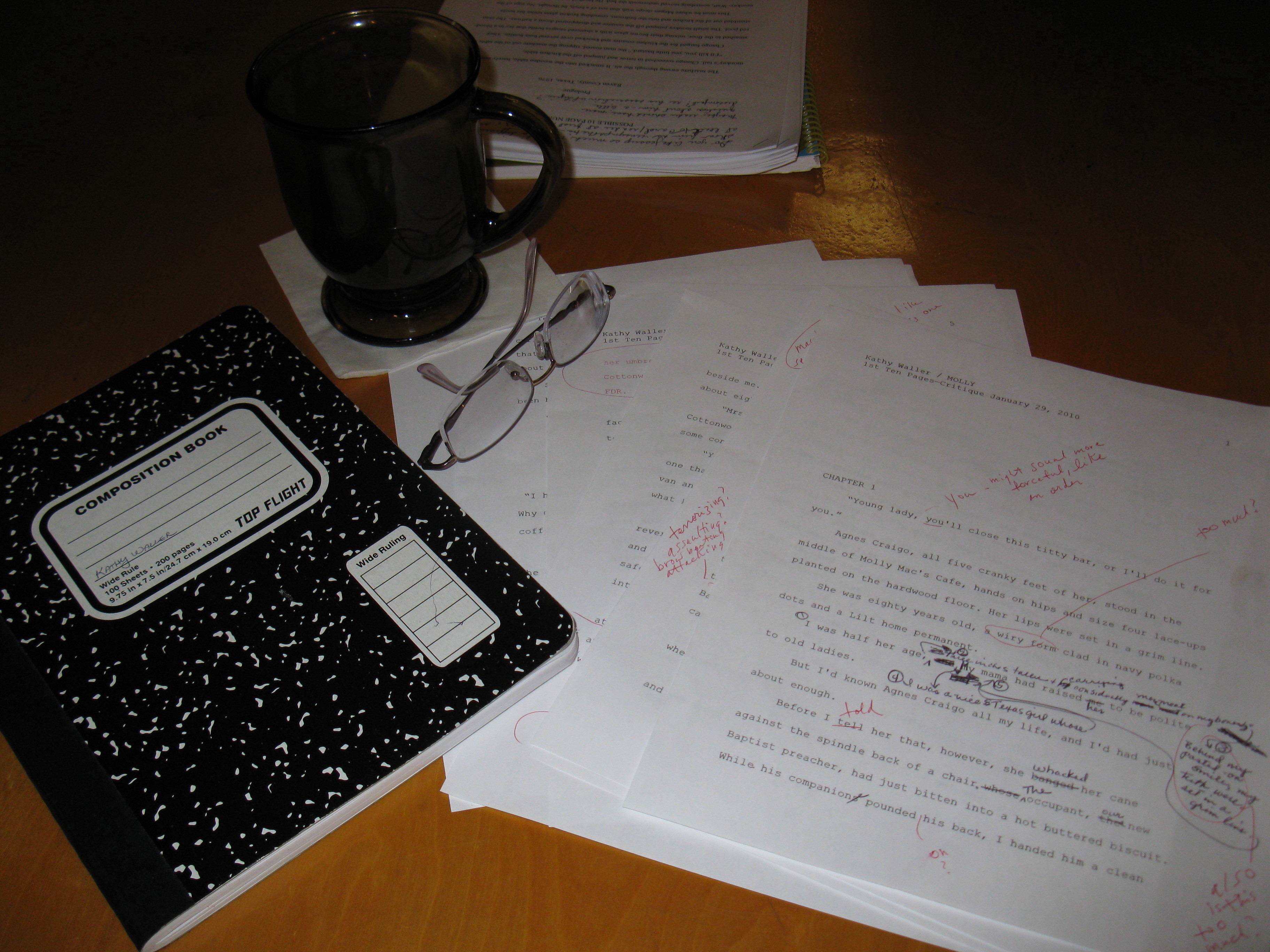
In the previous post, I wrote a paean to myself in honor of receiving a positive critique in a recent manuscript contest. I was shameless. Because the judge wrote Fannie Flagg twice on the score sheet, I used the name five times in my anthem.

I was moved to lavish self-aggrandizement by memory of my mother, who often quoted Damon Runyon: “He who tooteth not his own horn, the same shall not be tooted.”

Today I do a bit of un-tooting. Below is a list of things the song of myself didn’t include.

1. My entry did not advance to the finals.

2. The judge read only the first ten pages of the potential novel.

3. When the judge said that to get an agent I’ll have to find one who “gets” Texas and the South, she meant she “gets” Texas and the South and, as a result, my small-town setting and my dialogue.  If she’d been unfamiliar with the vernacular, I wouldn’t have fared so well.

4. The selection process is subjective. I once wrote an entire post on this topic, but the story bears repeating: Five years ago an entry I submitted received a score of 80. The next year, in the same contest, the very same (unrevised) entry garnered 18 points. Judge #1 said the entry was funny. Judge #2 said that I should take a lot of workshops, read more books, and use MS Word to identify my egregious grammatical errors. And that my pre-teen protagonist’s parents were guilty of child abuse.

Oh dear. I thought I’d made peace with that. My point: if I’d drawn another judge this year, I might have come out with a much lower score, and my paean would be different in both tone and content.

5. In a sentence beginning, “My concern,” the judge says she “would have liked” something that last year’s judge, who read version #1 of the ten pages, would have liked as well. I’ll have to fix that–change the material without sacrificing the current dialogue, pacing, tone…

6. The novel isn’t a novel. It’s potential. It’s a WIP.

7. There’s many a slip ‘twixt the cup and the lip.

To summarize–Opening that envelope and finding compliments inside encouraged me. It lifted my spirits. It showed me a glimmer of hope.

But it didn’t complete the manuscript, get me an agent, offer me a contract, hand me an advance, put me on the best-seller list, fill my coffers to overflowing, or ensure me a spot on Letterman.

In short, I have work to do. Continued self-aggrandizement will only get in the way.

After all, I’m already fighting background noise. Radio station KFKD plays continuously in my right ear, reciting my virtues. The constant yammering makes it hard to focus.

On the other hand, the “rap songs of self-loathing” pouring into my left ear don’t exactly speed me on my way either.

So I’ll take the critique sheet from the envelope, and with a loving hand smooth it flat, and place it in a spot where it will be visible as I write.

Fannie Flagg has been in the back of my mind for years. It’s time to move her right up front.

********************

Thanks to Ann Lamott, author of Bird by Bird: Some Instructions on Writing and Life, for exposing radio station KFKD for what it is.
Back in the slammer again

Today’s horoscope said, “A person who means well will throw a wrench into the works.”

That was the man who came to paint the front door. The go-between told me he would be here at 9:00 a.m. I was supposed to secure my cats before he arrived.

Securing cats meant I had to (1) get them into the bedroom and (2) keep them in the bedroom. There’s never a guarantee of either.

The only guarantee was that I would stay with them. They don’t like closed doors. I don’t like being stuck in the bedroom all day.

But I also don’t like my mattress to be shredded.

So I rose early, performed my usual exercise routine (Dear Abby, crossword puzzle, op-ed page, and letters to the editor), and considered the ordeal before me. I wished I had a can of tuna. I could have lured them upstairs with that.

But fate was on my side. Last night, according to vet’s orders, I drizzled olive oil over their midnight snack. They disapproved, so they didn’t eat it, so this morning they were hungry.

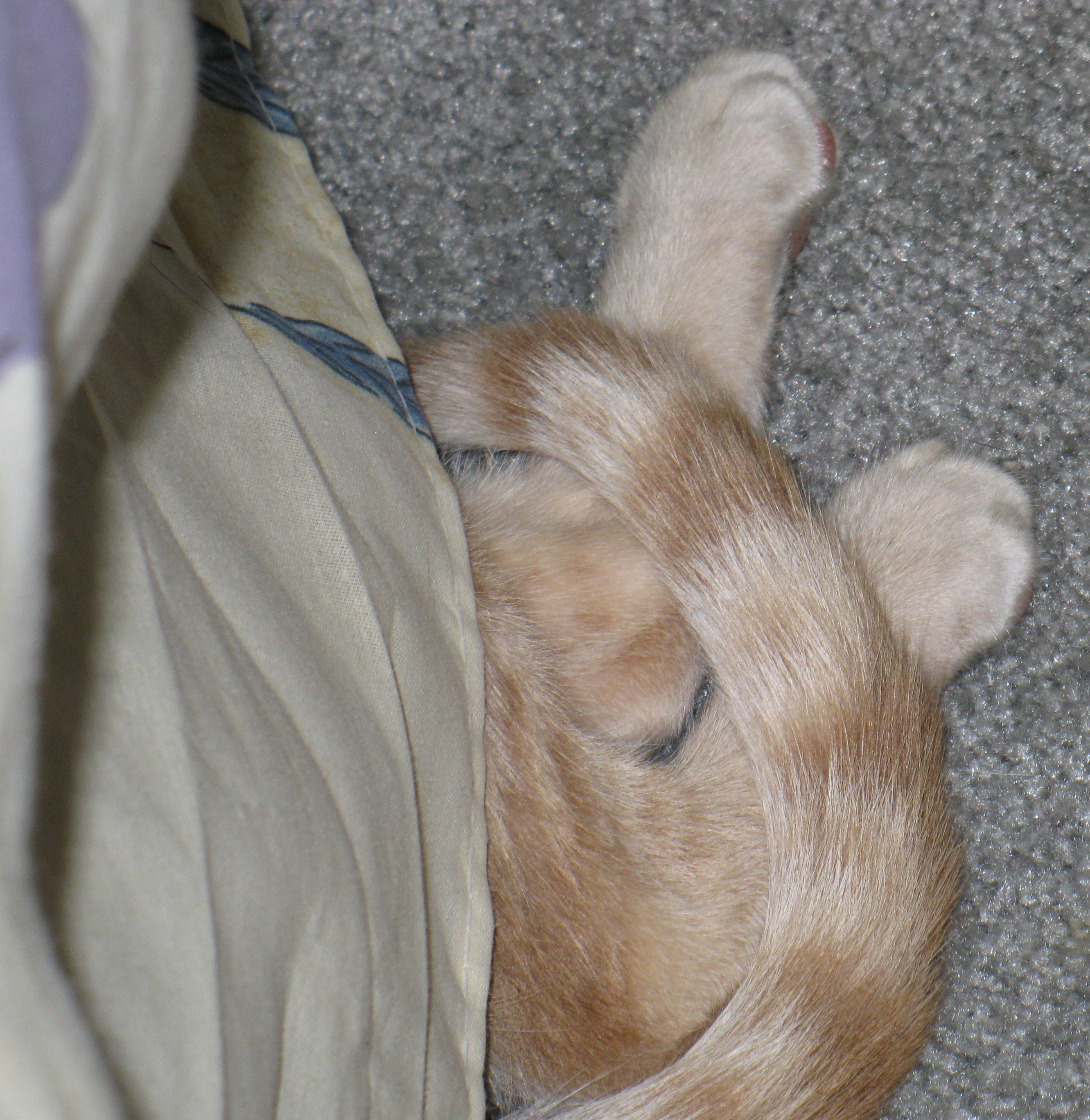
I grabbed a clean bowl and their food and climbed the stairs, crinkling the Friskies bag as I went. William and Ernest followed.

I plopped the bowl onto the middle of the bed and poured in a cup of kibble. William and Ernest followed.

I shut us in. William and Ernest leaped from the bed and prostrated themselves before the door. They reached under it with their little paws and stretched their little forelegs as far as they would go.

Knowing that within seconds they’d be using their little claws to bust out of the joint, I harrumphed as if I meant it. They ran under the bed.

I galloped downstairs and grabbed the laptop. I needed to work on my novel. There’s a manuscript contest coming up. I have a lot to do.

By the time the painter arrived at 12:25 p.m. (not his fault), we three had been sharing a cell for nearly four hours. I had canceled my lunch date. Ernest had eaten a few bites. He batted a few more bites onto the bedspread to use as pucks. Normally I would have discouraged this activity; today I saw it as a blessing.

William stayed under the bed sulking. When I lifted the bed skirt, he looked the other way. Even when I opened the blinds, he refused to come out.

Later I saw Ernest tiptoe to the door. He stretched out in a casual fashion. Then he lifted one paw and gave the door a pat. I harrumphed. Withdrawing the paw, he looked at me. Then he looked at the door. Then at me. Then at the door.

I won. He joined William under the bed.

He didn’t know that a third of that harrumph was aimed at the cramp in my back. Lying on my side to type wasn’t smart.

When fumes wafted up the stairs, I slid open the door to the balcony. The cats emerged. They lay side by side, listening to birds and enjoying the illusion of freedom. Then the yardmen turned on the mowers and the painter turned on the sander. William and Ernest scooted back under the bed.

Having scraped, sanded, and applied primer, the painter left at 2:30. I told the cats he was gone. They didn’t respond. By this time I was as stir crazy as they were.  I wanted to crawl under the bed with them.

But I didn’t. I remembered the second part of my horoscope: “The element of unpredictability will be good for you, and so will the delay this causes.”

That sentence wasn’t so easily interpreted. On the one hand, the painter told me  he refinishes furniture. I told him about my oak dining table. He said he could fix it.

Without doubt, that’s good for me. The table top has been teetering on the pedestal since ever since the movers got it off the truck and brought it inside. I’ve been expecting a lapful of lasagna  for the past six months.

On the other hand, there’s the novel. Between cats, fumes, poor posture, and funk, I didn’t get much writing done. In that respect, the delay wasn’t good.

Tomorrow the painter will come back to paint. Friday he’ll come to replace the weather-stripping. That means two more days imprisoned with cats–if they’re dumb enough to cooperate, which is questionable–and two more days of potential writing avoidance.

When it comes to not writing, I prefer to invent my own excuses.

But what’s done is done. The milk has been spilt.

I’ll get up early in the morning. I’ll do whatever has to be done to return the cats to the slammer. I’ll borrow pillows from the guest room to better prop myself up.

I’ll bow my neck and put my shoulder to the wheel and my nose to the grindstone, and I will write and write and write.

But I’ll skip the horoscope. There’s no use borrowing trouble.

An Ever-widening Wilderness

Okay. Enough of this sweetness-and-light, writing-is-my-life, revising-is-a-glorious-process, retreats-are-so-inspiring, the-daily-miracle-will-come baloney. Writing stinks.

Last night, no matter how hard I tried to make the technician at the other end of the line understand that the problem was caused by a short in the ground wire on the keyboard, and was surely related to the March 30 keyboard malfunction, he kept insisting that my hard drive is going out, and he made it clear that if I wanted to get to bed before 1:00 a.m., I’d stop asking questions and agree with him.

Back in the good old days, when faced with equipment failure, I just asked my daddy to get out his pocket knife and sharpen my pencil. But now I have to wait for the external hard drive to arrive, and back everything up–and I don’t want to hear one word about not having it backed up already; the critical things are on a flash drive and in my e-mail–and then call the service technician and tell him I’m ready for him to replace the hard drive. Of course, he will have already have called me, and I’ll have told him I’ll call him after I’ve received the external hard drive and run the backup.

That was Plan #2. Plan #1 was to send the corrupted hard drive to the factory and lose everything.

It’s enough to turn one into a raving Luddite.

Then there’s The Chair. For the past two years, I’ve sat in a recliner, feet up,  laptop on my lap, and typed away. The most discomfort I’ve felt has come from Ernest draping himself over my left forearm, and that’s not too terrible. At fifteen pounds, he’s not heavy enough to completely stop blood flow to my fingers. As long as he keeps his paws off the touch pad, I can work.

But now I’m sentenced to the desktop, which means sitting in The Chair. I love The Chair. It’s been in the family for over a hundred years. It’s an office chair. It wasn’t meant for sitting. A little while ago I sneaked upstairs and stole my husband’s vintage-1950s plastic chair with the wide contoured seat. It’s some improvement but I might as well make an appointment with the massage therapist while I’m thinking about it.

And what else? The Just for the Hell of It Writers meet tomorrow morning, and my critique partner, bless her heart, has decreed we must show up with fifty pages. Each. She has well over fifty pages of a coherent draft. I have a zillion pages of nonsense, rubbish, bilge, bunk, drivel, gibberish, hooey, hogwash, piffle, stultiloquence, and tripe. And that’s just the beginning. I haven’t even started on the adjectives.

Actually, it’s not all tripe. Some parts are decent. If they were adjacent parts, I’d be working on them now. But they’re scattered, and I’ll have to go looking for them, piece them together, and then fill in the blank spaces.

Furthermore, I’m sick of the characters. I’ve known them for a long time, and you know what they say about familiarity and contempt. If I had my way, I’d knock off the whole bunch of them: Miss Pinksie and all the suspects and Molly and her cousin Claudia and the Rat Butlerish love-hate interest and those cute twins. And the goat.

In addition, last week I received the Silver Lining Award, which made me smile, and here I am frowning before I’ve even had time to pass it on.

And to top it all off, I need to lose 900 pounds. By Monday.

The way things are going, that’s more likely to happen than my turning up tomorrow with fifty pages in hand.

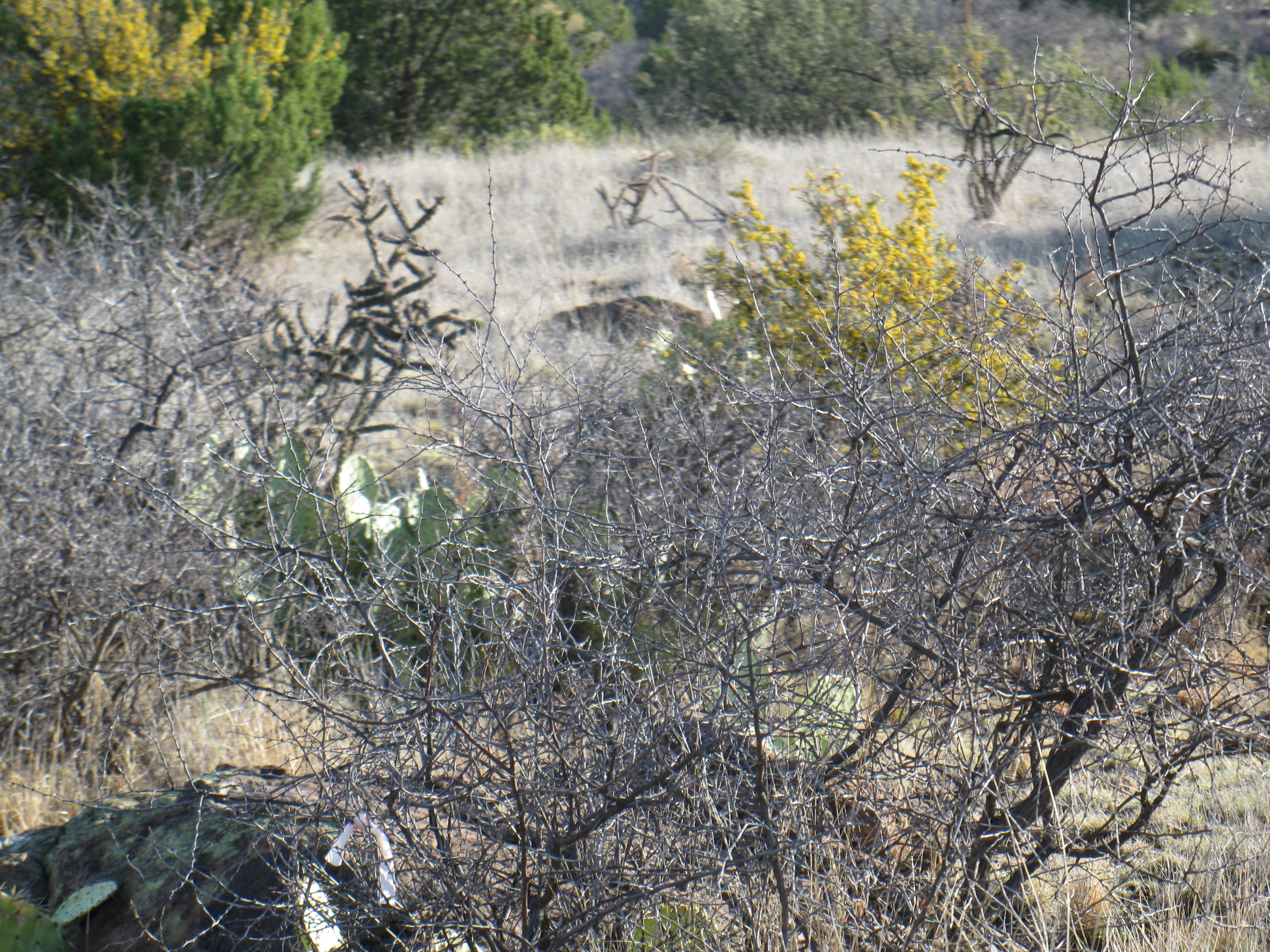
In summary, writing is Sheer Hell. It’s a Vast Wasteland, like the tangle of cholla, prickly pear, dead brush, and dried grass in the photograph at the beginning of this piece, with splashes of yellow flowers and green trees representing false hope in an ever-widening wilderness.

Not that I’m complaining, of course.

***********************

The photograph at the head of this post was taken at Paisano Baptist Encampment, near Alpine, Texas, during the Texas Mountain Trail Writers Writing Round-up. Paisano is a beautiful place. The opinions expressed in this post reflect the writer’s thoughts about writing and not about Paisano or the TMTW retreat. In fact, she likes cactus and dried grass and would love to drive so far back into a mesquite pasture that she can’t find her way out, an unlikely event in 21st-century Central Texas.

Letting the miracle happen

I ended an earlier post with the sentence, “There’s a hole I have to write myself out of.”

Parse that and you’ll find it equal parts wish, bravado, pretense, and humbug.

I had no idea how to write myself out of that hole. I thought I’d have to scrap “A Day in the Life of a Rancher’s Wife” and replace it with “A Day in the Life of a One-Room Schoolteacher.” Or anything else I could both start and finish.

But I gave it a shot, opened the document, and began revising. For the Rancher’s Wife, that meant squeezing 700 words into under 500, just in case I came up with a conclusion.

And in the middle of all that deleting, adding, shuffling, it happened. I knew how to end the story.

By the time the epiphany occurred, it was after midnight. I tacked on a couple of sentences to hold the thought and the  next day continued reworking the piece. The result is a story I’m satisfied with. Almost. There’s still time for tweaking.

When I was teaching English in the late ’70s, the latest fashion was to teach the writing process: brainstorming, prewriting, writing, revising, editing, polishing, proofreading. Sometimes prewriting was put before brainstorming. Sometimes editing and polishing were rolled into one. It was neat and tidy and linear.

But there was no step to describe that epiphany.

If there’s frustration here–and there is–it’s that I can’t explain that missing step. I had given up. I wasn’t trying think of a solution. I was playing with words. And then I knew.

Maybe that’s the heart of the process: relax, play, stay in the now, allow ideas to come. Maybe the process isn’t a process at all.

I’ve read that creativity has something to do with the frontal cortex, the anterior cingulate, the temporal lobe, the limbic brain, alpha brain rhythms, gamma brain rhythms, warm showers, long walks, and happiness. When scientists have it all observed and assimilated and indexed, I’ll try to understand.

For the present, however, I like to think that extra step is Gertrude Stein’s miracle.

Not knowing. Knowing.

And the process is letting the miracle happen.

Wormwood, wormwood

I told a little fib in that last post.

I said that before the Texas Mountain Trail Writers retreat in early April, I have to write a 500-word story.

The truth is, I don’t have to. It’s optional.

Then why do I put myself through this torture?

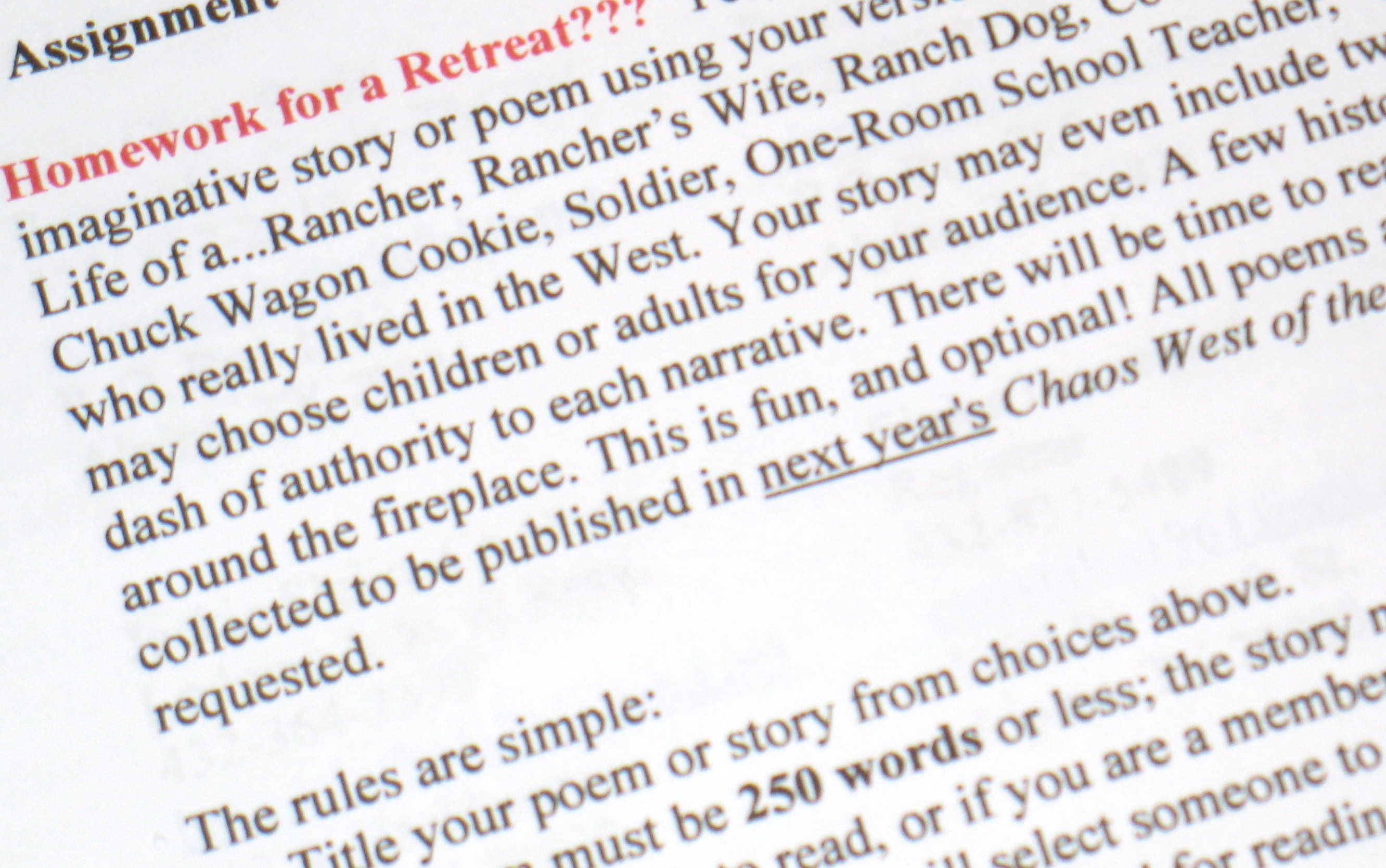
I do it because retreat participants will get to read their stories around the fireplace. And then the stories will be collected and  included in the next issue of TMTW’s annual publication, Chaos West of the Pecos.

I refuse to be the fireplace  spoil-sport, and I’m sure as all get-out not going to miss an opportunity to see my words glued between the two covers of a publication.

And then there’s the other thing. It’s fun. It says so in the retreat literature: “This is fun, and optional.”

Despite having written myself into a hole I can’t crawl out of, writing “A Day in the Life of a Rancher’s Wife” is fun. It’s like creating a puzzle and solving it at the same time. I’m partial to puzzles.

But fun and writing seldom appear in the same sentence, at least sentences that come from writers. Red Smith said to write you have to “open a vein.” E. L. Doctorow said writing is “a socially acceptable form of schizophrenia.” Colette’s husband locked her in a room to make her write. He wouldn’t let her out until she’d produced something he could sell (under his name).

I don’t have it that bad. My husband doesn’t lock me in, I have most of my marbles or at least know which pile of paper they’re under, and I’m not anemic.

But because I’ve yowled around to family, friends, and acquaintances that writing is equal parts wormwood and woe, I have to stick to the story. Claiming the TMTW assigned a composition is a minor fudge, but it’s enough to convince them I’m suffering. They remember senior English.

Confession over, I’ll end this post and move on. There’s a hole I have to write myself out of.

Channeling me

In April, CP and I will attend the Texas Mountain Trail Writers’ Spring Retreat near Alpine. We’ll stay in a cabin, go to a reception and a cowboy breakfast, hear authors and historians, hike, take photographs, write haiku, breathe clean mountain air…

I can hardly wait.

The catch is that each of us has to write a 500-word story about the Old West.

I don’t think I’ve ever written a 500-word anything. I need 500 words just to get started.

I know, I know. Revise, revise, revise.

I decided to use an amusing anecdote my uncle told about my great-grandmother, who lived in West Texas when she was first married. It begins in first person, with the Ranch Wife talking about learning to make biscuits when she was six years old. Then I have her describe the heat and the absence of shade and the patch of grass she slaves over and the wind that turns soil into dirt. And how her husband promised to take her back to Central Texas to live. And bathing children on the porch.

I’ve read it aloud several times. It sounds pretty good. It bears no resemblance to anything Grandmama would have said, at least in that tone of voice. But that’s not a problem. This is fiction.

The problem is that by the time I’m ready to insert the story my uncle told, the Ranch Wife sounds so depressed I can’t figure out how to work it in. Nothing I can say is going to cheer that woman up.

And it’s already over 500 words. After cutting.

I know what’s wrong. I’m using Grandmama’s persona but I’m channeling myself. Heat. Dirt. Wood stoves. Hauling water. Bathing on the porch. Grandmama was a pioneer. I’m a hothouse plant.

So I have a choice. I can start over in a lighter vein. Or I can come up with an ending to match the Ranch Wife’s misery.

Or I can take the easy way out: scrap the Ranch Wife and go with an account of West Texas life as told by the Ranch Dog.

Start with the headline…dear


“SCORPIO (Oct. 24-Nov. 21): No one can argue with your powers of conversation. You make language dance. Insightful without being overbearing, you’re a joy to be around. And you are about to meet your match.” ~ Holiday Mathis, “Horoscopes,” American Statesman [Austin, TX] 6 Jan. 2010, final ed. : D2.


Ha! My horoscope is way behind. I met my match years ago.

It was the fall of 1999, and I was right in the middle of one of my best stories, when my husband began to wave his hand in that circular  motion–the universal symbol for “Get on with it”– and said, “Start with the headline.”

He was actually my pre-husband then, and I hadn’t known him long, and he was telling me I wasn’t a joy to be around. I burst into tears.

He patted me and apologized. (And no doubt wondered what he was apologizing for.)

I cried some more, mourning our relationship’s untimely end. Because I was incapable of starting with the headline.

I am a Southerner. When I share an anecdote or impart information–such as the conversation I had with Cousin Bob at the post office yesterday–I am genetically programmed to start at the beginning. I may need to go back three generations before I can get to the core communication.

To properly set the stage, I must introduce Cousin Bob’s parents and grandparents, and possibly his great-grandparents, and maybe his aunts, uncles, brothers, and sisters. I have to say who married whom and why and how many children they had. I have to mention economic status, level of education, and geographic location. I have to describe outstanding traits and idiosyncrasies as well as interesting interrelationships, such as major quarrels, grudges, and feuds.

When I finally get down to Cousin Bob, I have to flesh him out as well.

Then, once I get the plot moving, I sometimes need to digress and pull in anything else I think might be helpful.

It takes time.

But I’ve  sat on enough front porches listening to old people talk to know the rule: Never start with the headline.

Still, in the interest of continuing romance, I made an effort. And in the interest of same, my pre-husband said no more about my tendency to mosey.

A couple of years later, however, taking a course in legal writing, I heard the lawyer at the front of the room say, “Start with the headline.” In other words, when you’re writing a legal memo or a case brief, state the conclusion; then explain how you got there.

The light dawned. My pre-husband had a law degree. He was trained to start with the headline. He didn’t want me to tell my stories backwards. He just wanted me to talk like a paralegal. Eleven months later, I emerged from the university with an official certificate in paralegal studies and an unofficial certificate in interpersonal communication, probably a first for that program.

Still, starting with the headline seemed a dreary thing for both writer and reader. How can the reader understand the headline before he’s met all the characters, seen where they live and how they’re related? And isn’t starting with the headline like reading the last page first? All the suspense oozes out.

I was so glad fiction doesn’t have to start with the headline.

A few years later, however, I decided to try my hand at writing a mystery. I set it in a small Southern town populated with characters whose family relationships go back several generations. I developed an intriguing plot. I jumped into the action. I wrote several chapters, revised them, and handed them off to a friendly writer.

She handed them back with some positive comments and a great big, “GET THE BACKSTORY OUT OF THE FIRST CHAPTER.”

In other words, start with the headline.


I’m good enough, I’m smart enough…

Before we go further, we have to talk about the P-word: publication.

I want it.

Now. Often. And accompanied by immense public acclaim and financial reward.

I want to go on book tours and do readings. I want to be wined and dined by the literati.

I want to be the literati.

I want a loft in The Village. I want a croft on the Isle of Mull.

I want it all. And I can have it.

The thing is, before I can have it, I have to finish a manuscript.

That last has become a bit problematic.

My critique partner and I have discussed the situation at length. We’re weary of writers who have a string of books to their credit advising us to forget about being published, to “just write for yourself.” Easy for them to talk.

Unfortunately, they seem to have a point. The more we obsess about agents, editors, and cover design, the flatter our prose becomes. And the more we feel like tossing our multiple revisions into the air and walking away.

Which would be a shame after so much work, and which would probably make the BookPeople barista, who’s been so nice to us, really mad.

So at a recent powwow we decided that from now on, we will write just for the hell of it.

We are now, officially, the Just for the Hell of It Writers.

**********

I should make clear that my critique partner has finished one manuscript and has won a manuscript contest, so she’s considerably closer to being literati than I am. She says, however, that her accomplishment hasn’t made manuscript #2 any easier to birth.

The daily miracle

The most serious problem the writer encounters is coming up with a topic, coming up with an original topic, finding the form you’re comfortable with, writer’s block, creating interesting characters, writing sparkling dialogue, finding your voice, weeding out unnecessary modifiers, weeding out passive voice, appealing to the five senses, revising, finding a good critique group, accepting criticism, polishing the manuscript, f inding an agent, selling the manuscript, hanging in there… forgetting how the process works, forgetting the process works, forgetting the process forgetting the daily miracle will come.