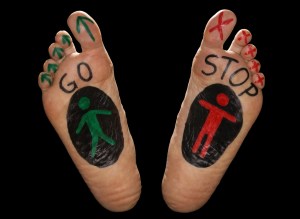
The next driver who honks at me while I’m waiting for a pedestrian to get across the street before I turn will find out I’m not so nice a person as I tell people I am.
I don’t mean I’m going make a rude gesture.
I mean that right there in the middle of the street, I’m going to put my car in Park and get out and drag that driver out of his car, and then all hell will break loose.
And I’ll repeat my performance for the policeman.
And then I’ll go to jail and get out and use the experience as background for my crime fiction. And non-crime fiction. And blog posts.
*
Imageof feet is courtesy of PaintedFeet01, via Pixabay.com.
I said to my critique partner this morning, The whole project is stinky it stinks it’s just nothing no hope.
She read chapter 13 and said, But it’s so good so funny Molly is so funny it’s not stinky.
I said, Yes, the first part of chapter 13 and the last part of chapter 13 are funny and very very good but there’s still no middle of chapter 13 and what there is stinks and anyway the other 47,000 words stink except for a few hundred here and there.
And she said, But the middle could be revised edited it has promise.
I said, But it won’t work because I have written myself into a hole and can’t get out so I have to trash that part and anyway the whole concept stinks.
And she said, NO you can fix it just keep going because I like Molly she’s so funny.
And that is why I go to critique group every blessed week.
*****
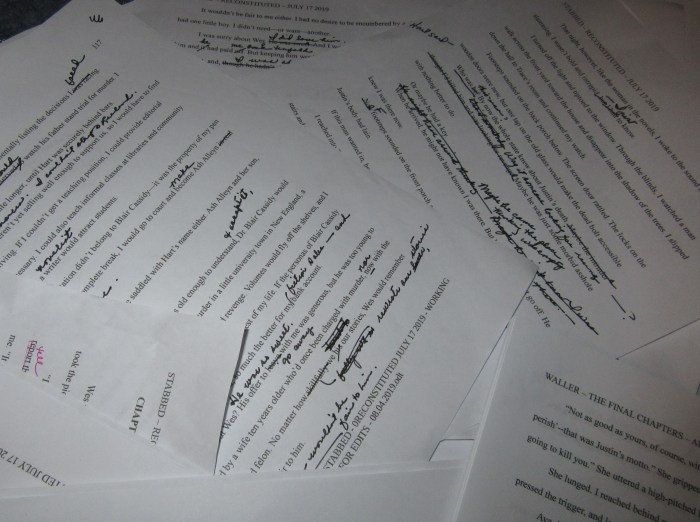
Writing is a solitary activity, but most of writing isn’t writing. It’s rewriting, rewriting, and rewriting. And then it’s revising and revising. And editing editing editing. And rewriting again. And . . .
Sometimes it’s whingeing and complaining and eating peanut butter out of the jar with a spoon and buying larger clothes and telling Molly she’s a heartless ***** who doesn’t deserve one paragraph of her own, much less a whole book.
And it’s feeling like a fraud and deciding you’d be happier if you gave up and dedicated yourself to French cookery or tatting or riding a unicycle.
But if you’re lucky, it’s also going to critique group and then going home and writing and writing and writing and . . .
I posted “Why I Go to Critique Group” here on July 9, 2010, when I was a member of the two-member Just for the Hell of It Writers, which was soon swallowed up by Austin Mystery Writers (a consummation devoutly to be wished).
I periodically pull it out and repost. It’s important.
If you haven’t read the preceding post, “Disregard 15 Pages,” please do so before reading on. That post isn’t very long, but if you read it first, you’ll get more out of this very short one.
*
So finally, afterrevising and revising and revising, you give in, and give up, and stop, because you know it’s as good as it’s going to get—
and because the person you’re writing it with said she’ll “put you in a straightjacket if you try to change it again”—quoted verbatim from her email—
and you believe she’s capable of it—
and you think maybe it’s not the gosh-awful purple-prosed horror you dreaded—
and maybe it even has a couple of redeeming qualities—
and maybe you won’t be embarrassed to have your name on the cover—maybe—
and someday you might even tell people you did it—
and then the real critics come in—
and they put their heads together and consult and confer and say—
You know how even when you know what you’ve written isn’t as good as it ought to be, you think you’ve gone as far as you can go with it, but you also know you haven’t, and your deadline is tomorrow, about 18 months after your original deadline, so you give it one more going-over, and you spend a whole day marking and then a whole day making changes to the manuscript in LibreOffice, because there were so many things you found that needed to be changed, and when it’s finally done, both your brain and your body are just fried, and you send it off, and then even though you know you shouldn’t, you show 15 pages to your writer friends, and they say it’s better than it was the last time you showed it to us, BUT, and they scribble all over your pages, and they’re so right, and so you go back and change the manuscript again, here and here and here, everywhere they said to, and you send the 15 pages off with the message, Disregard that last part of what I sent yesterday and substitute these, and then your brain and body are re-fried, and you sleep for nearly twelve hours, and then even though you know you should let it alone, you send another 15 pages to your writer friends, and you know they’re going to say, Change this and Change this and Change this, and they’re going to be right, and tomorrow afternoon you’re going to be back at that manuscript, putting in changes there and there and there, and you’ve looked at the d****** thing for so long that the words are turning into squiggles on the page, but you’ll change it anyway because your artistic and OCD temperament won’t let you just leave it alone, and then you’ll send another email saying, Disregard another fifteen pages of what I sent you before and substitute these, and the person on the other end is already at the end of her rope, waiting and waiting and waiting for you to finally finish the thing, but you can’t help it, and when you say it’s a never-ending story, you’re not talking about the book . . .
Here is what I’ve accomplished since arriving Sunday afternoon.
(I believe I’ve mentioned I sometimes have a little trouble walking? Like from parking lots to buildings? If I didn’t, I would be bopping all over campus and wouldn’t have anything to put in this post.)
Sunday
Registered
Saw doe wandering around dorms
Didn’t know where camera was so didn’t stop for picture of doe
Hauled provisions into the dorm
Noticed it was as hot as . . . I thought it would be
Drove to cafeteria; parked in nearby lot (very nearby)
Walked from lot to cafeteria; on the way, noticed my back was out
Considered possibility of walking to orientation
Skipped orientation
Said to myself, “I should not have retreated this summer.”
Drove into town for more provisions
Couldn’t make room key work
Threw two sets of keys down onto the walk as hard as I could, set my tote down carefully because it had breakable stuff in it, and swore I would go home the next morning to my husband, who does everything for me, and my cats, who don’t
Made room key work
Crashed in room
Monday, before leaving room
Got out of bed
Noticed my back was still out
Loaded totes for day of writing at Junkin Worship Center
Lost my room key
Found my room key
Lost my car key
Found my car key
Divested totes
(Do I really need my Kindle? No. Do I really need my camera? No. Do I really need eight pens?No. Do I really need three bottles of orange juice and a bunch of breakfast bars? Only if I want to stay upright. )
Lost my room key.
Found my room key.
Lost and found several other things.
Monday, after leaving room
Drove to WLT office; parked in nearest lot
Walked to office; took emergency contact info to director because I missed orientation
Lost my room key
Walked back to car
Became traditionally hungry for the first time in over three years
Considered walking to cafeteria
Drove into town to Burger King
Considered possibility of legally adopting my massage therapist
Lost my handicap parking permit
Parked in regular space at Burger King, no big deal
Bought Whopper, Coke, and Hershey shake; didn’t want Hershey shake but was unhappy about parking permit
Found my room key in my pocket
Put Hershey shake in freezer at dorm
Was still hungry
Ate remaining half of Whopper
Found my handicap parking permit
Flopped on couch, revised a few lines of manuscript
Regretted eating remaining half of Whopper
Fell asleep
Skipped buffet
Said if this walking thing keeps up, I will spend the whole week in my room writing, because that’s what I came to do, and the room is Very Nice, and the A/C works beautifully
Tuesday before leaving room:
Got out of bed
Noticed my back was better
Didn’t lose anything
Tuesday after leaving room
Drove to mid-campus and parked in lot across from Moody Science Building
Walked to Junkin Worship Center Quiet Writing Room
Collapsed onto couch
Found my handicap parking permit in tote bag
Emailed director re giving her permit numbers so she could testify for me in court, or of my calling campus security
Emailed husband for numbers on license plate because I remember only letters
Decided paying $500 – $750 in fine plus court costs a small price for not walking back to parking lot
WLT rep came from across room and walked permit to car, bless her heart, and I mean that most sincerely
And here I am.
Please note that none of the adventures listed here has anything at all to do with the Writers’ League of Texas. The director offered to have me golf-carted (that’s what they do) where I needed to go, but I can drive and park just about anywhere. My problem is getting from parking lots to doors, so I declined. The League and the Retreat are doing just fine. It’s all me, me, me.
I’m going to stay in the Junkin Center drinking orange juice and eating breakfast bars (horrid but convenient) till it closes and later try to make it to the dining hall.
When I started chemo, I vowed I would not excuse any of my shortcomings on chemo brain or chemo body or anything else related to it.
I might un-vow that. There’s probably some truth in it, and it’s much better than blaming everything on age.
Now, PLEASE don’t pity me or say you’re sorry about my trials and tribulations.
Okay. I’ve caught my breath. Now I have to stop this and do the writing I came here to do.
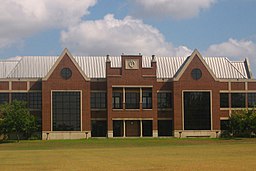
This is a photo of the Butt-Holdsworth Memorial Library in Kerrville, Texas. Round, two stories. I used to come here for library conferences. The interior is beautiful.
When we tried to medicate William last night, a pill fell into the pit between the seat of my recliner and the arm, and we weren’t able to locate it. It’s in there somewhere, or it fell through onto the floor under the chair. After a cursory look, we gave up. We feel safe leaving it there because it’s a sure thing neither cat will gobble it up. If it were one of my pills, they would vacuum it up in a nanosecond.
The pill fell because I was careless and William got his tongue in gear and spat it out. We got another pill. Which means he’ll get only twenty-nine pills instead of thirty. William thinks that’s okay.
William
William is being dosed for pancreatitis. David is the cat holder. Due to my vast experience, I am the pill poker. It took a week for me to remember that coating the pill with butter makes the job easier. William doesn’t resist as enthusiastically and once in his mouth, the pill slides down more easily. He also doesn’t run upstairs after the ordeal, just jumps down and licks the inside of his mouth with vigor but no expression of distaste. Hurrah for butter. We have about two more weeks to go.
Ernest is probably unpillable. We haven’t tried, and I don’t want to.
I use a piller now. I had a piller in years past, but Chloe didn’t take to it, and I didn’t take to Chloe’s offer to use her fangs on my fingers while they were nearby. Every time she had to be pilled, I left her with the vet and let the experts handle her. Same with Christabel. Chloe was wiry and muscular and if she didn’t bite me, she wriggled out of my grasp. Christabel was big and built like Jello and rolled out of every half Nelson I applied.
At the end of this post, there’s a link to a video tutorial on pilling cats. I include it so you can see the piller. The starring vet says the process is easy peasy. Take that with a grain of salt. He’s a vet. He’s had practice. The cat knows resistance if futile. I suspect he’s a clinic cat. Those animals tolerate many outrages with aplomb. I suspect they have no reflexes at all.
My old neighbor, Steve Dauchy, a big orange tom, was a retired clinic cat. One cold winter day, his family smelled something burning and found Steve sleeping on a propane space heater in the kitchen with his tail hanging down beside the vent. His hair was singeing. He woke up when they pulled him off.
One winter night, I woke, reached out my hand, and touched fur I recognized as not my cat. Scared me half to death. I turned the light on, and there was Steve, snoozing away, the third cat on the bed. He’d sneaked into the house when I opened the door, hidden somewhere, and emerged at lights out, I guess. He was very astute. On cold nights, he slept on the seat of the riding lawnmower in his humans’ garden shed, a nice, tight bedroom, but when he saw a chance of a mattress, he jumped at it. The next morning, while Steve breakfasted in my kitchen, I called next door and told the worried humans about the slumber party he’d engineered, and later, when it warmed up, put him outside.
Tonight’s dose went down in record time. David wanted to medicate him before he went to the grocery store, but we waited for him to come downstairs under his own steam. Between four and five-thirty every day, awakened by his circadian rhythms, he waltzes downstairs for insulin and dinner. Mainly dinner. He hardly notices the insulin.
When I was a teen, I read a book about caring for cats. There was a chapter about medicating them. The authors, a married couple, used the terms cat holder and pill poker.
When I pilled my Siamese, Ms., I was both cat holder and pill poker, but after the first few confrontations, she cooperated. I didn’t have a piller, but she didn’t Didn’t open her mouth on command, but I didn’t have to use much force, and she sat still. She was highly intelligent and behaved more like a dog than a cat, except for pilling. Dogs never cooperated.
The Siamese’s first name was Mademoiselle–for some ridiculous reason–until I realized she was liberated, the Gloria Steinem of cats, good looks and all–and I changed it to Ms. That was ridiculous, too, because I called her Kitty. And Puddy. And Puddy-Wuddy. And Feetie-Pie. All the usual cat names.
Ernest
She produced kittens when she was eleven months old. Her idea, not mine. Wonder of wonders, they were Siamese kittens. Praise goodness for the gentleman Siamese down the street. The kittens would probably have been just as easy to give away as if they’d been generic, but people seemed extra pleased to have purebreds. No official papers, of course. Ms. was not an aristocrat, and considering the kittens were conceived under dubious circumstances, they would never have been accepted into High Society.
My one disastrous encounter with a sick cat occurred at the veterinarian’s. The tech was attending to one end of William and I was holding the other end, the one with teeth. He’d buried his head as far back between my body and my forearm as he could go, considering I had my arm clamped to my side. After suffering indignity for longer than I thought he would, he rebelled. I think he tried to bite me, but he managed only to rub his fang against my arm, hard enough to scrape the skin slightly. Within minutes, I had a budding case of cellulitis–I recognized it as such because I’d had it before from an encounter with cat teeth–and I had to go to the urgent care clinic for pills of my own plus shot of antibiotic. It turned out that William wasn’t sick. That night I wrote a verse about the experience and posted it on my blog, here:
William bit me at the vet,
Didn’t like the aide’s assistance,
Used his claws and fangs to set
On the path of most resistance.
Say I’m teary, say I’m mad,
Say that pills and needles hit me,
Say my arm’s inflamed, and add,
William bit me.
It’s patterned after one of my favorite poems, Leigh Hunt’s “Jenny Kissed Me”:
Jenny kissed me when we met,
Jumping from the chair she sat in;
Time, you thief, who love to get
Sweets into your list, put that in!
Say I’m weary, say I’m sad,
Say that health and wealth have missed me,
Say I’m growing old, but add,
Jenny kissed me.
If Hunt and Jane (Jenny) Carlyle were around to read the parody, they might not approve, but if I didn’t like the original, I wouldn’t have used it. I don’t consider my version an homage, exactly, but I’m fond of it. I’m a rotten poet, but I do pretty well at parody, if I do say so myself. I wish I could write them for a living.
I’m can’t write anything for a living. I don’t write fast enough, and as yet I haven’t hit upon the Great American Novel. I haven’t hit upon any novels at all, just short stories. A couple have brought in a few dollars from contests, and those that have been anthologized bring in a few cents in royalties (which are divided with the other authors), but the cents are donated to charity every year (supplemented, of course). The truth is–like many lightly published authors, I would be tempted to pay to get my stories in print or online. But I wouldn’t do that. My efforts are worth at least $0.00.
I didn’t plan to say anything about my literary efforts, but in a stream-of-consciousness post, things just happen, so I’ll happen to add that my stories appear in the three anthologies pictured in the sidebar–MURDER ON WHEELS, LONE STAR LAWLESS, and DAY OF THE DARK. My best stories, two of them, are in Murder on Wheels, which has an unimpressive cover but good stuff inside, so if you buy one, please buy that one. They’re all available in paperback and ebook formats. They might be available from your local public library–if they’re not, I’d appreciate your requesting the library acquire copies.
Royalties from Murder on Wheels go to Meals on Wheels in Austin, Texas. Royalties from Lone Star Lawless go to the Port Aransas Public Library, which lost its collection and everything else to Hurricane Harvey in 2018. Royalties from Day of the Dark go to Earth & Sky, which through its website presents information about science and nature. The radio program Earth & Sky (EarthSky) used to air on commercial, NPR, and other public radio stations, but since June 2013 has concentrated on its website and social media.
So there it is, a disjointed post. I went to bed too late last night and woke up too early this morning, so I can’t work on my novella-in-progress, because the characters are too tired to do or say anything interesting. They’ve already said and done one hundred + pages, but they need to do and say it better. Anyway, since they’re not cooperating, and since I’m tired, too, I abandoned them for this post.
The novella will be out this fall. I won’t mention the title or anything else, because it’s a secret, but you can be sure more Blatant Self Promotion will appear in a future post. Not a disjointed one, I hope.
Now I’ll go back to those characters and try to rev them up. They produced pretty well yesterday, when they were rested, so I know they can do it. With the deadline they’re working under, they need to get on a stick.
*
This turned out less disjointed than I expected it to. Half about cats, my default topic, and the rest about books and writing. All about me, my perpetual topic. The experts say not to write about yourself, but except for Helen Hunt Jackson’s nineteenth-century novel RAMONA, I’m about all I know.
I’m putting what I know about Ramona on a separate blog, but doing so requires typing a lot of footnotes, and that’s a slow and sleep-inducing procedure. The text is interesting, though, if I do say so myself.
“Rural Virginia, 1945. The Second World War had just ended when Alice Hannon found the lifeless body of her five-year-old daughter, Eugenie, floating in Blue Lake. The tragedy of the little girl’s death destroyed the Hannon family.
“More than twenty years later, Alice’s youngest daughter, Regina, returns home after a long estrangement because her father is dying. She is shocked to discover, quite by accident, that her sister’s drowning was briefly investigated as a murder at the time.
“For as long as she can remember, Regina has lived in the shadow of her family’s grief. She becomes convinced that if she can discover the truth about Eugenie’s death, she can mend the central rift in her life. With little to go on but old newspapers and letters, the dead girl’s hairpin, and her own earliest memories, Regina teases out a family history of cascading tragedy that turns her world upside down.”
*
When I began Elizabeth Buhmann’s BLUE LAKE, I was–I’m ashamed to say–afraid I would be disappointed. Her first novel, LAY DEATH AT HER DOOR, was so well constructed, clues so obviously placed, that I should have been able to predict the ending–but so deftly woven into the plot that the last chapter was a complete surprise. More than a surprise–a shock. That novel was so good, I knew BLUE LAKE couldn’t match it.
I was wrong. BLUE LAKE is different from its predecessor, of course, but just as well written and just as suspenseful. And when I reached the end, I said, “I should have known.”
BLUE LAKE does not disappoint.
Buhmann hides things in plain sight–the mark of a good mystery writer, and the delight of every mystery reader.
*
Tomorrow I’ll post an interview with Elizabeth Buhmann.
FTC Disclaimer: Elizabeth Buhmann is a friend and fellow writer. When we were both members of Austin Mystery Writers, I read the first chapters of BLUE LAKE in draft form and then waited impatiently for it to reach publication. The synopsis above is quoted from Amazon. The rest is mine. Nobody told me what to think or to say, and I posted because I wanted to. I bought the ebook with my very own money. No reviewers were bribed in the writing of this review.
Buyer’s remorse. And not even five hours have elapsed since the purchase. It happens every time. Why do I do this to myself? (W-Word: Why)
News of the Writers‘ League of Texas’ annual summer retreatarrived via email this afternoon, and I pounced–checked the calendar to confirm it doesn’t fall on an infusion week, asked my husband to confirm what I’d already confirmed, filled out the online form, and clicked Register. [W-Word: Writers’]
Some people think it over before clicking Register, especially when clicking Register requires an outpouring of funds.
If I made a list, it would look like this:
Don’t Go to the WLT Summer Retreat in Kerrville – Reasons
Time away from home – six days
The retreat is in July and I already miss David
Indulgence-induced guilt
I shouldn’t have to drive 100 miles to write what I could write staying at home
Can write at home without paying registration fees plus gasoline and wear-and-tear on the car
More guilt
I miss David
Go to the WLT Summer Retreat in Kerrville – Reasons
I want to [W-Word: Want]
And then there’s the year I came home with a two-hundred-word timed writing that three years later turned into a 4,000-word short story, and a year after that appeared in a crime fiction anthology–the Murder on Wheels pictured in the sidebar to the right.
Writing is a lonely pursuit, and reading it aloud transformed it into an interactive experience It also brought the text to life. When Anne read her material to Meg she picked up the difficulties and polished them out so that the writing flowed more smoothly. Occasionally, there were a few ruffled feathers and a spot of wounded pride, but almost always the process was revealing and sometimes downright entertaining.
Joanne Drayton, The Search for Anne Perry
In seventh-grade literature, two questions were asked about every short story in our textbook:
Q: Why did the author write the story?
Q: Why did the author make the character do such-and-such?
I had a ready answer for each:
For money.
Because that’s the way it happened.
But I knew my teacher wouldn’t be happy with that, so every day, I made up an acceptable answer to each question. Looking back, I realize I was doing creative writing. My first foray into fiction, I guess.
At that time, I thought writers started at the beginning of the story and stopped at the end. I thought everything that occurred was inevitable. I knew about revision–I’d done plenty of that getting my master’s thesis in order–but my idea of revision was really editing and polishing. I didn’t know it meant restructuring, creating new characters, taking out some of the best parts if they didn’t fit with the rest, sometimes tossing the whole manuscript and starting over.
Writing is a lonely occupation. Revision, however, isn’t. Writers are people who need people.
I spent months writing the first three [what I called] chapters over and over. Somewhere in that over and over I figured out that those chapters weren’t going to turn into a book. I was lucky–the Writers’ League of Texas held a meeting designed to help writers form critique groups. I took two pages of my manuscript–in small pieces, the chapters weren’t too bad–and by the end of the evening was part of a three-person group.
In the course of ten years, membership has changed. I’m the only one of the originals still involved. We’ve worked, done some struggling, learned how to detach and see our work with new eyes. We’ve occasionally ruffled one another’s feathers, but we’ve learned how to ruffle, and be ruffled, appropriately. We’ve gone together to workshops and retreats. We’ve encouraged one another. We’ve become better writers. Because of repeated critiques, we’re all now published.
Without the aid of other writers, I might have given up a long time ago. With their aid, I don’t just rewrite–I look again. I re-vise.
I’ve also come up with better answers to those seventh-grade questions.
And I’m not lonely any more.
***
Why did the author write the story?
Definitely not for money.
***
Joanne Drayton. The Search for Anne Perry. New York: HarperCollins, 2012.
How weary, stale, flat, and unprofitable
Seem to me all the uses of this world!
Fie on’t! O fie! ’tis an unweeded garden,
That grows to seed; things rank and gross in nature
Possess it merely.
~ William Shakespeare, Hamlet, I, ii
I woke this morning feeling perfectly fine but at the same time not quite quite, so I took a little white pill. Because the label says not to drive a car or operate heavy machinery, David drove me downtown to BookPeople for my biweekly critique group meeting. For the next two hours, I took part in a lively discussion about the craft of writing.
After the meeting, I fired up my trusty Chromebook and wrote three paragraphs of my Day P post.
Then my eyelids began to droop. I had a definite case of the drowsies.
Lest I fall asleep in CoffeePeople, I called David. He came and escorted me to the car, drove me home, steered me to the house, and poured me into my chair.
Since that time, I’ve felt, in turn, apathetic, detached, draggy, droopy, lethargic, impassive, passive, pedestrian, plodding, and what Hamlet said.
I couldn’t care less and I could care less.
I feel fine.
It’s just that, my dear, I don’t give a damn.
Anyway, I’m dismissing all thought of finishing my original Day P post (“P Is for Pat Boone”) and submitting this instead. Then I turn my face to the future.
A lone woman hears a sound in the middle of the night. She doesn’t know what it is, so she goes in search of the source: to the attic, the basement, the back yard, the barn, the woods, the creek. She might take a flashlight and/or a bat. She wears her pajamas and bedroom slippers.
Chief Detective Smith, sitting at her desk in the incident room, after weeks of an investigation with too many clues and no idea how they fit together, suddenly jumps up, says to Detective Sergeant Jones, “Call the traffic division and find out the name of the Dalmatian that rides with Firetruck #12,” picks up her gun, and heads for the door. “Where are you going?” says Detective Sergeant Jones. Chief Detective Smith runs out to nobody knows where. [Alternate: The ransom note says, “Come alone to a dark corner of the park.” And the detective does.]
A man or a woman, take your pick, kneels in the garden cutting roses/stands over the stove stirring soup/hears a knock and answers the door, take your pick, and looks up and says, “Oh, it’s you. What are you doing here?” And then doesn’t say anything else at all.
I see them all the time in mystery/suspense/thrillers on television, but I don’t believe them because
If I hear a sound at night, I don’t go looking for it. I crawl under the covers or, depending on the nature of the noise, under the bed. Even when I know it’s just an armadillo banging on the water pipes under the house.
Any detective who does what Chief Detective Sergeant Smith does–and she does it nearly every week, same time, same station–would end up getting either fired by her boss or coshed by the suspect she’s chasing, or by her partner, who’s had enough.
The “You?” is old and tired.*
Why do writers use them?
Because the character needs to know. The lone woman needs to know what the sound is. The detective needs to know if she’s right about whodunit. The victim needs to know the murderer.
And the writer needs to conceal. A lone woman sneaking around in a dark attic builds suspense. A detective flying to a showdown builds suspense. A victim recognizing his murderer builds suspense.
And because they work. Viewers, and readers, are willing to temporarily suspend disbelief. I am willing to suspend disbelief for the sake of the story playing out on the screen–even when one side of my brain is saying to the other, “That is totally unrealistic.”
Now to my real concern: Will I ever stoop to using one of these conventions? Send a woman into the dark where a hobgoblin awaits? Send a detective off to meet a bad guy without telling anyone where she’s going? Let a little old lady in gardening gloves be axed by her best friend without giving her the chance to get out of the way?
I don’t know.
***
*Actually, come to think of it, #3 might be totally realistic.
A sign at the San Marcos RiverBridge in Fentress, Texas, on the western boundary of Caldwell County, reads GaudalupeCounty. That wouldn’t be worth mentioning, except that when you get across the bridge, you’re in Guadalupe County.
I assume the error arises from its similarity to words like gauge, gaunt, and gauze. In other words, the writer was thinking in English, not in Spanish: Guadalajara, Guadalupe Hidalgo, guacamole.
The excuse may be wishful thinking on my part, but since I retired, I’ve been kinder and gentler with misspellers in the hope they’ll be kinder and gentler with me. It’s a sad day when an English major has to admit this, but nearly every time I write gauge, I have to look it up to be sure.
Anyway, you know how it is with dictionaries: open one to find a word and ten minutes later you’re browsing, engrossed in a book that doesn’t have characters, much less a plot. That’s how I came across gnomist, defined as a writer of aphorisms.
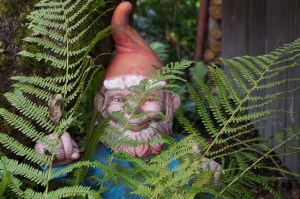
Unable to imagine little red-capped garden dwellers channeling Benjamin Franklin, I checked Dictionary.com for gnome, and about half-way down the page found it: a gnome is a short, pithy saying of a general truth.
Which led me to my G topic: gnomes. (Franklin would say some of them aren’t gnomes, but they’re close.)
If you have a skeleton in the closet, take it out and dance with it. ~ Carolyn MacKenzie
A hunch is creativity trying to tell you something. – Frank Capra
Imagination is a good horse to carry you over the ground–not a flying carpet to set you free from probability. ~ Robertson Davies
The opposite of a shallow truth is false. But the opposite of a deep truth is also true. ~ Niels Bohr
A writer should value his blockages. That means he’s starting to scale down, to get close. ~ Robert Pirsig
Each book is, in a sense, an argument with myself, and I would write it, whether it is ever published or not. ~ Patricia Highsmith.
Even if my marriage is falling apart and my children is unhappy, there is still a part of me that says, “God, this is fascinating!” ~ Jane Smiley
A computer allows you to make more mistakes faster than any other invention in human history, with the possible exceptions of handguns and tequila. ~ Mitch Ratcliffe
The form chooses you, not the other way around. An idea comes and is already embodied in a form. ~ Michael Frayne
You’ve got to be smart enough to write, and stupid enough not to think about all the things that might go wrong.~ Sarah Gilbert
People become writers because they can’t do things that bosses tell them to do. ~ Les Whitten
Keep away from people who belittle your ambitions. Small people always do that, but the really great make you believe that you, too, can become great. ~ Mark Twain
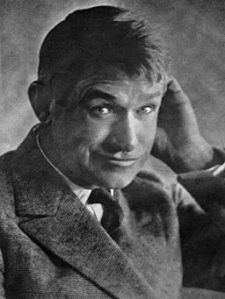
Will Rogers
People’s minds are changed through observation and not through argument. ~ Will Rogers
Whether you believe you can do a thing or not, you are right. ~ Henry Rod
If you would lift me, you must be on higher ground. ~ Ralph Waldo Emerson
It is certain that no culture can flourish without narratives of transcendent origins and power. ~ Neil Postman
My mother wanted us to understand that the tragedies of your life one day have the potential to be comic stories the next. ~ Nora Ephron
No passion in the world is equal to the passion to alter someone else’s draft. ~ H. G. Wells
In the sense that there was nothing before it, all writing is writing against the void. ~ Mark Strand
How do I work? I grope. ~ Albert Einstein
Sometimes it is more important to discover what one cannot do, than what one can do. ~ Lin Yutang
Walt Whitman didn’t sing as a white man or a gay man. He didn’t even sing as a living man, as opposed to a dead man. He made the human race look like a better idea. ~ Sharon Olds
One of the most wicked destructive forces, psychologically speaking, is unused creative power. . . . If someone has a creative gift and out of laziness, or for some other reason, doesn’t use it, the psychic energy turns to sheer poison. That’s why we often diagnose neuroses and psychotic diseases as not-lived higher possibilities. ~ Marie Louise Von Frantz
As much as I like the actual process of writing, there’s always a point, after a half hour, that I really love it. There’s a real lightness of imagination that you let happen when you’re writing. ~ Ethan Canin
I know life. I have had a full measure of experience. Shouldn’t I take advantage of it? These days my acts are the essence of what I have accomplished. The fruit is on the tree. Should I let it rot? ~ Victor Borge
The only way to write is to write today. ~ Susan Shaughnessy
***
Regarding the Gaudalupe County sign, it’s been there for years. At first it irritated me (twice a day), but as time went on, it became a source of amusement, something I needed both going to and coming from work. Still, as an official publication of the State of Texas, not to mention a source of information, it should be accurate. A friend called the agency a good while back and reported it, but it’s still there. Since my husband’s email brought about a positive result, I might ask him to take up the cause.
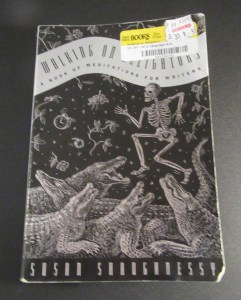
I like this book so much I bought it twice. I bought it once, donated it to my library, and missed it so much I bought this used copy. Each meditation is headed by a quotation. Meditations are excellent, worth revisiting often, but the quotations are what I missed.
***
For information about the A to Z Blogging Challenge, click here.
For a list of all blogs in the challenge, click here.
A story from my friend the high school business teacher:
A student in her bookkeeping class asked what arrears means.
Said the teacher, “It means you’re behind.”
And twenty-five shocked teenage faces stared in profound silence.
***
I’m behind. Nothing new. I don’t live a hurry-up-and-wait existence; mine is wait-and-hurry-up.
The condition won’t be cured by planners, lists, date books, Google calendars, anti-procrastination classes, or prayer and fasting. I’ve tried them all.
I’m a compulsive organizer. Back in the day, I owned a series of Franklin planners: big, little, zippered, non-zippered, black, colored (red and teal). If anything could have organized me, that teal planner would have done it.
In a sad development, the teal planner disappeared from my car in late August of 1998, the night before the first day of faculty in-service. I went out in the morning and found the driver’s side window open; the seat where I’d left two tote bags was empty.
I called 911. The local constable came out and said he knew who did it–they lived next door to the post office a few blocks away, and they were the ones who did everything around there–but the authorities wouldn’t be able to prove it. A deputy sheriff came out and dusted for fingerprints but found only the ones I’d left when I closed the door.
I was late to work, which wasn’t a problem because I missed only the meeting at which nothing happens except coffee and donuts. I learned more from the breaking-and-entering experience than I would have at the meeting.
To wit:
Fingerprint powder is black and sticky. Very sticky.
If you drive a dusted car without first draping seats, doors, and steering wheel, you’ll be sorry.
Fingerprint dusters don’t clean up after themselves.
People who steal from parked cars will take anything and everything. They got my favorite tote bag, the one displaying the Edward Gorey tuxedo cat lying across a stack of books, and the caption, “books. cats. life is sweet.” That bag meant a lot to me. So did the teal Franklin planner with zipper and page after page of contact information that I’d recently compiled and entered in my neatest handwriting. [As in, I organized it.] The can of asparagus wasn’t all that important to me, or probably to them, but they took it. What galls me–even today–is that I know the entire haul ended up in the river.
If you leave a car in front of your house, as I did, instead of pulling it into the driveway, someone will break into it. If you pull the car into the driveway, the same people will break into it. Evidence: An electrician who spent that night with his mom, just around the corner, parked his van in her driveway. The next morning–a broken window and no equipment.
If you’re going to park a car where it’s an easy target, make sure it’s a rental car. My car was in the shop overnight and I was driving a little Geo Metro the color of Pepto-Bismol. At the end of the day, I returned it to the agency, picked up my well-oiled car, and headed home. Somebody else dealt with the sticky black stuff.
If you’ve lived all your life in a small town where people never bothered to lock their doors when they went on vacation, and you think you’re still living in that same small town, you’re wrong.
But I digress. And that’s one reason I’m behind.
Before turning in, I must post this for A to Z Blogging and then complete two more writing assignments, one for a critique group, another for an informal class in memoir. Tomorrow I have to put out my Sisters in Crime chapter’s newsletter–and put up my C post for A to Z Blogging–and then the next tomorrow there’s the D post–
Tomorrow, and tomorrow, and tomorrow, Creeps in this petty pace from day to day, To the last syllable of recorded time;
and when I get there, there’ll be one more thing to write.
Such pressure!
And the crazy part–my teenaged English-student-self would never have believed it–it’s all self-imposed. Nobody makes me do this. I blog for myself; I do blog challenges for myself; I take writing classes for myself; I write stories for myself; I go to critique group for myself.
Because I want to.
Crazy.
Now, before I fall further behind, I shall stop, post, and move on.
***
Find a list of all A to Z Blogging participants here.
Some consequences you can predict. Some you can’t predict. Some you should predict but don’t.
It’s the last of the three that’ll get you.
I had just read a brief bio in my memoir class and turned to leave the lectern, when something in my left hip went pop. Not an audible pop, but a pop nonetheless. I limped back to my chair.
With David (poor thing) half carrying me, I staggered across the parking lot, groaning every time my left foot touched the ground. At home, neighbors had the pleasure of hearing me ascend the steps and walk to the door. Yelp, yelp, yelp.
Getting into and out of the car was worse. I couldn’t climb in as usual.
Get into a car like Audrey Hepburn does, my mother said. Sit sideways, then swing both legs in. The Emily post method.
Phooey on Audrey and Emily.
Until hip day. That’s when I learned Audrey had an advantage. She had leather seats she could slide on. I have fabric that grabs your breeches and holds on. Entering and exiting, I didn’t yelp. I shrieked.
The pain wasn’t exactly excruciating, I guess, but it was close.
At home I fell into a chair, texted my massage therapist, whom I hadn’t seen in over a year, and begged for an appointment. That’s how panicky I was. I hate texting.
Anyway, the next day, David hauled me (shriek) to her office. She mashed my spine back into place, then laid her hands lightly around me just below the waist, and said, “How do you sit when you use your laptop? Is it right in front of you?”
And I said, “Noooooooooooooo.” And thought, Well, d’oh.
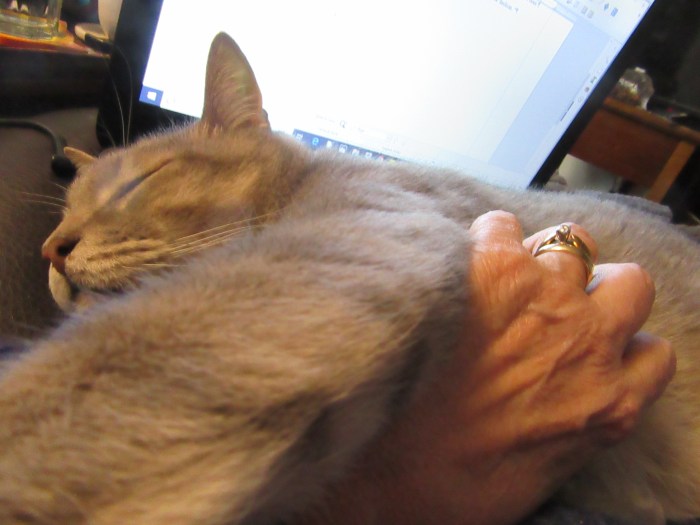
This is the way I sit when I use my laptop:
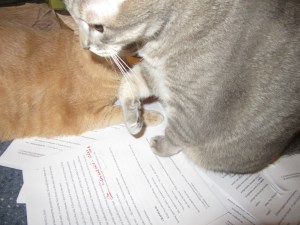
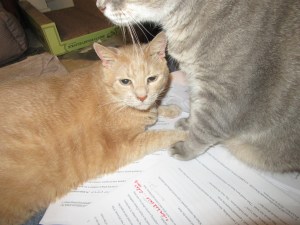
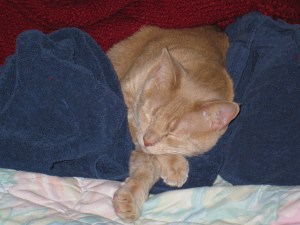
Ernest correctly positioned
More contented
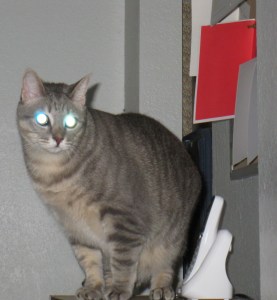
Ernest incorrectly positioned
Contented
Controlling enter key
“Uh-huh,” she said, “I can tell you’ve been sitting crooked.”
So what’s girl to do?
A girl’s going to do whatever it takes to stop the pain.
But the guilt was excruciating. Ernest has only recently learned to liiiiiiiieeeeeeeeeee downnnnnnnnnnnnnnnnnn, sometimes without being begged, or even ordered, as if it’s his own idea.
He’s the only cat I’ve ever had who followed instructions. Or, more likely, said to himself, She’s been a good and faithful servant. If this is so important to her, I’ll cooperate. I taught him to sit that way. It prevented him from laying his head on the keyboard and typing. (Once he sent an email.) I didn’t realize my hip would suffer.
And he’s a Velcro cat. He can’t help that I have to move the laptop waaaaay over to the left and stretch sideways to reach the keyboard. He needs almost constant physical contact. Denying him my lap could crush his spirit. He’s sensitive.
But for the most part, he’s done well. I gave the I-wuv-oo-oodles-but-we-can’t-go-on-sitting-like-this speech, and he gave up and moved down to lean on my leg.
Mostly. We’ve had wrestling matches. Occasionally I catch him sitting in a straight-backed chair across the room, his lips set in a grim line, staring at me. But over all, we sit in peaceful companionship.
I saw the massage therapist a second time.
My hip has improved.
And the best news is that, with practice, I’ve learned to get into a car like Audrey Hepburn.
*
Audrey’s legs aren’t visible in this clip, but you can get the drift. She does the swing-around about 1:35. That might not be leather upholstery, but she’s had more practice than I have.
 The next driver who honks at me while I’m waiting for a pedestrian to get across the street before I turn will find out I’m not so nice a person as I tell people I am.
























 M. K. Waller