“The writer of an article about Dr. Seuss reported that at the end of an interview Theodore Geisel congratulated him for not asking the one question that people invariably ask. When the writer asked him what that one question might be, Dr. Seuss replied, “Where do you get your ideas?” “Well, all right,” said the reporter. “Where do you get your ideas?” “I’m glad you asked that,” Dr. Seuss said, and pulled out a printed card. On the card was spelled out the secret that the world pants for. It seems that on the stroke of midnight at the full moon of the summer solstice, Dr. Seuss makes an annual pilgrimage into the desert, where an ancient Native American hermit and wise man has his abode. That old Indian, Dr. Seuss declared, is the source of all of his ideas. But where the old Indian gets his ideas, he has no notion.
“Where do you get your ideas? I suppose the people who ask this question are expecting a rational, one-sentence reply. What they get from me is a rather stupid stare.”
“This past fall I spent an afternoon talking with a group of persons who work with children at risk. The question I had asked them to help me answer was this: Why do our children turn to violence? It was a question many of us have struggled with this past year.
“These professionals were very concerned about the Internet. Today, they said, when a child behaves aggressively at school, the routine solution is expulsion. At the very time when a child is most vulnerable, most reachable, he is further isolated. Often he goes home to an empty house and spends time with violent video games or on the Internet, desperately seeking out connections, and whom does he make connections with? All too often with other desperate, isolated, self-hating individuals who confirm his belief that all his hatreds are justified and that violence is the only way to relieve his mortal pain.
“Access to the Internet is not the answer for these attic children. They need much more than that. They need much more even than access to good books. Fortunately, what they need is precisely what you can give them–and that is yourself. ‘Every child,’ said the director of the program, ‘needs a connection with a caring adult.'”
“Last month I was asked to speak to a group of teachers who would be taking their classes to see a production of the play version of Bridge to Terabithia. I spent more than an hour telling them about how the book came to be written and rewritten and then how Stephanie Tolan and I adapted it into the play their classes would see. There was the usual time of questions, at the end of which a young male teacher thanked me for my time and what I had told them that morning. ‘But I want to take something special back to my class. Can you give me some word to take back to them?’
“I was momentarily silenced. After all, I had been talking continuously for over an hour; surely he could pick out from that outpouring a word or two to take back to his students. Fortunately, I kept my mouth shut long enough to realize what I ought to say–it is what I want to say to all of you.
“‘I’m very biblically oriented,’ I said, ‘and so for me the most important thing is for the word to become flesh. I can write stories for children, and in that sense I can offer them words, but you are the word become flesh in your classroom. Society has taught our children that they are nobodies unless their faces appear on television. But by your caring, by your showing them how important each one of them is, you become the word that I would like to share with each of them. You are that word become flesh.'”
“What I want to say to that isolated, angry, fearful child in he attic is this: You are not alone, you are not despised, you are unique and of infinite value in the human family. I can try to say this through the words of a story, but it is up to each of you to embody that hope–you are those words become flesh.”
~ Katherine Paterson, “The Child in the Attic,”
Ohio State University Children’s Literature Festival, February 2000
I’ll start by saying I have recovered from my major irritation with WordPress. It was malfunctioning to the max the night I wrote the humorous post that took a downhill turn (as WP) slid further down the hill–but everyone is allowed one major malfunction. I’ve had several myself whose results were worse than a paragraph-challenged blog. WP works now, I work now, we all work now. Amen.
Now to the heart of the matter:
Last Saturday, with my Sisters in Crime, I sold and signed books at the Heart of Texas chapter booth at the Boerne Book Fest.
Next Saturday, October 20, I’ll sign and sell at the Fort Worth Bookfest. Organized in 2018, the festival’s goal is “to raise awareness of the transformative power of literacy through the BookFest platform to showcase the wealth of talent among all cultures that call Fort Worth and the southwest region home.”
In addition to selling and signing, I’ll participate in an Author Spotlight, where I’ll have the opportunity, in “TED-talk style,” to introduce myself, share some interesting facts, and read from one of my stories. On the same venue will beTabi Slick, author of Tompkins School Trilogy,set in Oklahoma, and Kimberly Packard-Walton, author of Prospera Pass, set in Texas.
First on the agenda, though, is Friday evening’s Books ‘n Boots Soiree at Lou’s Place on the Texas Wesleyan University Campus. Sounds like fun.
David has been, as the Five Little Pepperswould say, a brick during preparations for BookFest. He had a banner for my table made and then spearheaded the drive for business cards. He found book easels around the corner at Wal-Mart so I don’t have to drive all the way across town to Michaels. He’s charged my phone, my camera, and the hotspot. I predict that before we leave town, he’ll do a dozen or two other tasks I haven’t even thought of.
I’m still making a to-do list.
This procrastinator is so lucky to have attracted her opposite–a man who does things now. And who knows how to hurry things along in the nicest way possible.
As a beginning blogger, I wanted to be serious. I intended to write about the writing process, to quote famous authors, and to record my progress toward publication (or toward the satisfaction of having written). I wanted to write about Literature and Life.
Halfway through my first post, I discarded that notion. Once upon a time, I could tear apart novels and poems with the best of them, but as soon as they put that Master’s Degree in my hand, every scrap of every thought about literature leaked out of my head. And I didn’t want to work hard enough to get them back.
And my writing process is chaos, pure and simple. Chaos. Other people write books about how they write books. They say, This is the way to write a book, as if they know. But I don’t know.
So I write about life with a lower-case l. Life with a lower case l comprises cats, a mis-spent career in education, memories of my youth, my crazy family, and my general ineptitude. General ineptitude comprises such things as the time I dropped theremote control into the Jello instant pudding mix and milk that I was trying to beat into pudding.
For a while, I was reluctant to share stories of ineptitude. I envisioned applying for a job with a company whose personnel director googles me and learns more than is good for me.
But then I realized I wasn’t going to apply for anything, and if I did it wouldn’t be a job important enough to require a background check, so I said, What the heck, just tell it all.
I titled this blog Telling the Truth–Mainly because I admire Mark Twain as both a writer and a social critic, and because I thought the name appropriate.
I embroider some of the stories I tell; the embroidery relates to the Mainly.
But nearly every post begins with Truth, and most of them stick pretty close to it. The story about the remote and the pudding, for example, didn’t need any embroidery at all. I told the story exactly as it happened.
“Hell on Wheels,” the story about the librarian,which appears in the crime anthology Murder on Wheels, is not true. I didn’t find my mother pouring ground glass into lemon pie filling, and I didn’t plan to push her off a bluff. I was a librarian, but I didn’t take belly dancing lessons for years so I could fit into a bikini and spend the rest of my life on the beach in Aruba.
The completely true, entirely non-fiction story: I took three belly dancing classes because I once saw a belly dancer on the Tonight Show lie on the floor and roll a quarter over and over all the way down her torso, all that was open to public view, so the speak, and I thought it was really neat. I also liked the costumes. I had no illusions about ever replicating the act, but basic belly dancing looked like fun.
I stopped after the third lesson because I was so tired after working all day and then driving to Austin to attend class that gyrating around a room with a bunch of other middle-aged women was not doable.
I used belly dancing in the story to add verisimilitude, etc., etc., etc.
So. The librarian story was fiction, plus a few bits from lower-case l life, merely corroborative detail, intended to give artistic verisimilitude to an otherwise bald and unconvincing narrative.*
The question now arises: Is fiction ever true? Yes. But it’s complicated and I don’t want to discuss it.
I planned to end with a few comments on my writing process–not how I write, or how to write, but lessons I have learned from chaos.
But that will wait till next time.
*
*”Merely corroborative detail, intended to give artistic verisimilitude to an otherwise bald and unconvincing narrative” is a phrase written by W. S. Gilbert for the character Pooh-Bah in Gilbert and Sullivan’s The Mikado. (The funniest play ever written, with music or without.)
While at the store, I also made notes about a second book about libraries. Three days later, they look like runes, though not nearly so attractive or so organized.
Poet Alice Massa asks, “What Is the Name for a Group of Poets?” She answers the question in a poem–and if you read all the way to the end, you get more than just the answer.
I like the term she chose very much, but I wondered if there are alternatives. So I went to the glossary of literary terms–several of them, in fact, since they’re all over the Internet–and came up with some possibilities:
a verse of poets
a rime of poets
an iamb of poets
a lyric of poets (although lyric is more suited to songwriters)
a scansion of poets
a prosody of poets
The search sparked a new question: What is the name for a group of mystery writers?
a plot of mystery writers
a conspiracy of mystery writers
a complication of mystery writers
a murder of mystery writers (perhaps to close to a murder of crows)
a grit of mystery writers
a cozy of mystery writers
And another question: What are the members of a critique group called?
This one is easy. Borrowing from an unkindness of ravens, I choose to call members of a critique group a kindness.
K is obviously for Kathy, a name at the heart of a lifelong kerfuffle.
The plan was to name me Katherine for my great-grandmother and to call me Kathy. But at the last minute, when the nurse came in and asked for the baby’s name so they could type up a birth certificate, my mother added Mary for my grandmother. Later she told my father what she’d done and he said that was fine with him. He liked his mother-in-law. My grandmother liked the name.
Mother later told me she’d wanted to spell Katherine with a C, but she was afraid her grandmother would say I wasn’t really named for her (the family was funny that way).
Thus was I denied the privilege of assuming the mantle of romanticism connected with hearing Heathcliff call across the moor, Catherine! Catherine! (I don’t think he did that in the book or the movie, but I have a good imagination.)
The precaution turned out to be unnecessary,because every time my great-grandmother, whom we called Grannygirl (that’s another story) wrote my name, she spelled it Catherine.
(I was glad I’d been spared her first name, Minna. She didn’t like it either and changed it to Minnie but later wished she hadn’t.)
My grandmother, Mary Veazey Barrow, front row 3rd from left (big hat); my great-grandmother, Minna Katherine Stagner Veazey, front row 5th from left.
Otherwise, my name was fine with me, too, as long as we stayed put. But when we moved and I had to enroll in a new school in the middle of second grade, the teacher said they already had a Kathy so I had to be Mary. I didn’t mind–it was just one more of the slings and arrows of being uprooted from my hometown and moving halfway across the universe*–but when I discovered the other Kathy was always called Kathleen, I thought the teacher’s reasoning was a little off.
The next September, I sat with twenty-something other third-graders and their mothers while the teacher called names from a stack of book cards. She got to Mary K. Waller; my mother marched me up and said she’s here, and she’s called Kathy; the teacher said, No this is Mary K-A-Y. I sat back down. Mary Kay didn’t appear. The teacher went through the no-shows and once again, Mary Kay didn’t appear. My mom said she thought that must be a clerical error–one person read the names, another person wrote them down?–and so I settled in as Kathy.
The next year, mothers didn’t hang around for the settling in–I suppose fourth graders were deemed able to fend for themselves–and when the teacher called Mary Waller? I let it slide. Later when my mother asked why, I said something like, “Meh.” Vicki, my best friend from third grade, called me Kathy; others who’d known me before took their pick.
Fast forward to college: Roommates said Kathy, but otherwise, I was Mary. Once I was Mark. The first time the philosophy professor called for Mark Waller, I said nothing, but when Mark didn’t answer the second time, I raised my hand and said in a small voice–one doesn’t want to accuse a prof of illiteracy on the first day of class–Mary? he rechecked the list and laughed. Since then, two more people have made the same error. Perfectly understandable: when you’re skimming, Mary K. resembles Mark.
I was a bit miffed, however, last Christmas Eve, when the young man at Best Buy told me he didn’t have my order. I said the computer said he did have it. He said he didn’t. I said would he check again. He pointed at his monitor and said there was only one Waller on the list.
I said, “Mark?”
He said, “Yes.”
I said, “Mary K.?”
He said, “Oh,” and forked over the box. I was as sweet about the situation as I could manage, considering it was Christmas Eve and I knew he’d been extra busy; but, considering it was late afternoon on December 24th, and I’d started shopping on December 23rd, my store of sweetness was at low ebb. My words might have carried an undertone that said, Knothead.
My adult life has comprised a series of minor tangles with officialdom. Minor, because I’ve defaulted to Mary. Sometimes I forget. Last week, the nurse assigned to handle my infusion looked up from her monitor and said, “Hi. I’m Holly.”
I said, “I’m Kathy.”
Her expression changed from welcoming to stricken. I got it, admitted I was Mary, and watched her begin to breathe normally again.
My mother once said she thought I didn’t like my name. I did, and I do. It has a pleasant sound, and my written initials have a pleasing symmetry.
It’s sharpened my mental acuity and flexibility by requiring me to (usually) remember who I am in (almost) any setting.
But there are drawbacks. The first hearkens back to the third-grade Mary Kay thing. I do not like being confused with a cosmetics company.
The second concerns two questions I’m asked more and more frequently by young people who don’t understand that Mary Katherine was a perfectly acceptable, mainstream, plain, ordinary, everyday name before it gave way to Lisa and Jennifer and Ashley and Madison:
Are you Catholic?
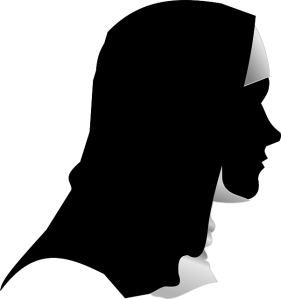
Are you a nun?
Neither.
I’m a member of a large Protestant family that recycles names.
#####
* About 250 miles to the southwest, to Del Rio, on the border with Mexico. It was a nice place, and after a few months, I loved being there. Sometimes I wish we’d stayed.
Ben has the good sense to never say, “I told you so,” no matter how many times we go through this. And we’ve gone through it a lot, because I am a serial quitter. Like an alcoholic, I need to put this statement in the present tense. I don’t think I’m cured. I could quit again when the going gets tough. I know I’ll feel the urge.
But quitting exacts a price, not just on my writing but also on my soul. When I can’t give my soul what it needs through writing, I go off in search of some other bright ball of yarn. And what I need to learn is that I don’t have to be so extreme. When my soul yearns for the tactile, it’s okay to weave. In fact it’s a good thing for a writer to be nonverbal for a while. It’s a big lesson for me to learn that being a writer shouldn’t mean that I’m chained to my desk twenty-four-seven.
Another big lesson is to finally understand that once I am a published writer I will always be a published writer, but that I will also always be an unpublished writer. I will get rejection slips, no matter what the New York Times said about my first novel. And hopefully I will always have material in need of some work, because if I don’t have the pages I hate I will never have the pages I love.
***
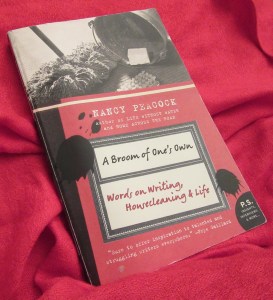
Nancy Peacock, A Broom of One’s Own: Words on Writing, Housecleaning and Life
Harper Perennial (2008)
ISBN: 987-0-06-135787-9
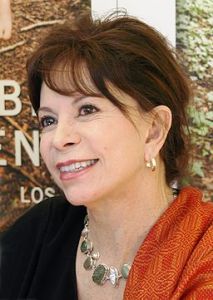
Isabel Allende by Mutari. [Public Domain] via Wikipedia Commons“Paula is a soul-baring memoir that, like a novel of suspense, one reads without drawing a breath. The point of departure for these moving pages is tragic personal experience. In December 1991, Isabel Allende’s daughter Paula became gravely ill and shortly thereafter fell into a coma. During months in the hospital, the author began to write the story of her family for her unconscious daughter. In the telling, bizarre ancestors appear before our eyes; we hear both delightful and bitter childhood memories, amazing anecdotes of youthful years, the most intimate secrets passed along in whispers. Chile, Allende’s native land, comes alive as well, with the turbulent history of the military coup of 1973, the ensuing dictatorship, and her family’s years of exile.”
“Note from Isabel:I have received more letters from readers in response to Paula than for any other book.”
Allende quotation from Why We Write. Meredith Maran, ed.
One dollar and eighty-seven cents. That was all. And sixty cents of it was in pennies. Pennies saved one and two at a time by bulldozing the grocer and the vegetable man and the butcher until one’s cheeks burned with the silent imputation of parsimony that such close dealing implied. Three times Della counted it. One dollar and eighty-seven cents. And the next day would be Christmas.
There was clearly nothing left to do but flop down on the shabby little couch and howl. So Della did it. Which instigates the moral reflection that life is made up of sobs, sniffles, and smiles, with sniffles predominating.
While the mistress of the home is gradually subsiding from the first stage to the second, take a look at the home. A furnished flat at $8 per week. It did not exactly beggar description, but it certainly had that word on the look-out for the mendicancy squad.
In the vestibule below was a letter-box into which no letter would go, and an electric button from which no mortal finger could coax a ring. Also appertaining thereunto was a card bearing the name “Mr. James Dillingham Young.”
The “Dillingham” had been flung to the breeze during a former period of prosperity when its possessor was being paid $30 per week. Now, when the income was shrunk to $20, the letters of “Dillingham” looked blurred, as though they were thinking seriously of contracting to a modest and unassuming D. But whenever Mr. James Dillingham Young came home and reached his flat above he was called “Jim” and greatly hugged by Mrs. James Dillingham Young, already introduced to you as Della. Which is all very good.
Della finished her cry and attended to her cheeks with the powder rag. She stood by the window and looked out dully at a grey cat walking a grey fence in a grey backyard. To-morrow would be Christmas Day, and she had only $1.87 with which to buy Jim a present. She had been saving every penny she could for months, with this result. Twenty dollars a week doesn’t go far. Expenses had been greater than she had calculated. They always are. Only $1.87 to buy a present for Jim. Her Jim. Many a happy hour she had spent planning for something nice for him. Something fine and rare and sterling – something just a little bit near to being worthy of the honour of being owned by Jim….
A group blog I write for is seeking bloggers to write one or two guest posts next month.
We’re also looking for bloggers interested in posting once or twice a month on a regular basis.
If you’ve published books or stories, or if you aspire to publish, blogging with us is a good way to publicize your work and to show readers what you do. Other members of the group will share your posts on their social media, so there’s the potential for hundreds, maybe thousands, of readers to see your work.
We’re family friendly, but aside from that, topics are up to you.
If you’re interested, leave a comment and I’ll get in touch.
At my office/coffee shop/bookstore, sitting at the computer bar at the side of the room, laptop plugged into an outlet beneath, iced Atzec mocha against the wall where I hope it won’t spill, two industrious critique partners on my right.
I am scrimshanking.
The spell checker says scrimshanking isn’t a word. That’s what it knows.
Scrimshankingis a word, because I saw it on Dictionary.com five minutes ago, just in time to use it.
We are sixteen days into National Novel Writing Month. Writers following the plan are 26, 762 words into their projected 50,000-word novels.
I am 75,000 words behind.
I DO NOT WORK THE NANO WAY.
Someday that will sink in.
It sinks in every year, but someday it will sink in.
NaNoWriMo –National Novel Writing Month–the month* in which participants vow to write a 50,000-word novel–and some of them do–began yesterday.
The goal–if you want to reach 50,000 words and win NaNoWriMo (which from this point on will be called NaNo), you need to write an average of 1667 words a day.
I’ve registered for NaNo–there’s a website–at least three times, maybe four. Unfortunately, every year, as soon as I signed on, I became claustrophobic and began to hyperventilate. Mentally, not physically, but mentally is bad enough. There was something about having to write a novel in a month that made me feel the walls were closing in, as if I had to do something I didn’t want to do, as if someone were forcing me to write that novel in a month. No one was forcing me, but seeming can feel a lot like being.
For example, consider what Hamlet** says to his mother the first time we see them together. He’s been going around wearing customary suits of inky black day after day, and suspiring all over the palace, and although his mother knows he’s grieving for his dead father, she says everybody does that at one time or another, and asks why he seems so much more miserable than others in the same situation.
In other words, this isn’t put on, he’s genuinely perturbed. Of course, there’s more to it than he lets on: After his father died, before the funeral baked meats, like the casseroles and tuna sandwiches the neighbors brought in, had been consumed, his mother went and married her husband’s brother, who doesn’t have much to recommend him. That would make any prince suspire. And Hamlet must be irritated that his mother is so clueless. She asks a silly question, and he sasses her. “Nay, it is; I know not “seems,” is, in modern terms, something like, Well, d’oh.
Anyway, back to NaNo. The mere act of registering gives me a serious case of the fantods.
Hamlet could have addressed his fantods by confronting his mother and his uncle and asking straight out what in the world they thought they were doing, but instead he takes the passive-aggressive route and pretends he’s unhinged.
I, on the other hand, have, every year, faced my dilemma head on: I’ve dropped out. No novel, no problem.
This year, however, I’m confronting it by plowing on through. I shall, and I will, write 50,000 words by November 30. I’ll go from beginning to middle to end, I’ll submit my scrambled manuscript through the NaNo website, and I’ll win.
On the basis of my experience, both past and present, I’ve come up with some helpful hints I’m happy to share:
After you register for NaNo, be proactive. Fill out your profile. You don’t have to use your real name. Title your book. It doesn’t matter what, just name it and record it on the website. Join a community. Then write a synopsis. If you don’t have a plot, wing it. Nobody’s going to read it, and it might end up working out. Complete these steps and you’ll receive badges. I got one for filling out my profile, one for joining my community (I told them where I live), and one for “creating” my novel. I take issue with that creating business, but if it makes them happy to think so…
Badges make you feel better, so award yourself some for personal achievement. I gave myself a Plantser badge, because I usually have to write for a while before my characters tell me what they want to do (flying by the seat of my pants, or pantsing), but then, once things get going, I come up with a rudimentary framework (plotting). Plotter + pantser = Plantser. I also gave myself a Rebel badge to declare myself a NaNo Rebel!, state my belief “that rules are meant to be broken,” and admit that on November 1, I’ll “start writing anything but a brand new novel.” I could not have phrased that better myself. Plantser and Rebel might seem contradictory, but who cares.
Relax. Getting all het up won’t help. By Thanksgiving you’ll be so antsy your family will make you take your plate and eat out on the porch.
Now for the Don’ts:
On November 1, don’t let a podiatrist operate on your foot. It won’t hurt, but it’ll take a chunk out of your day that you should spend working on your novel.
On November 1, don’t have two meetings, even if they promise to be interesting and you want to go. See #1 regarding chunks.
On November 1, when you want to quit, don’t. If you feel the queasies coming on, follow Eloise’s lead: Say, “Pooh pooh to you,”*** and get over it. (Eloise and Hamlet’s mother have a lot in common.)
Don’t schedule the Sisters in Crime chapter newsletter you edit (and write) to post on November 1. Before you post, you’ll have to tweak, and you’ll tweak everything, even things that don’t need tweaking, and you’ll add content, and it’s already too long, and it’ll be 9:00 p. m. before you press Publish.
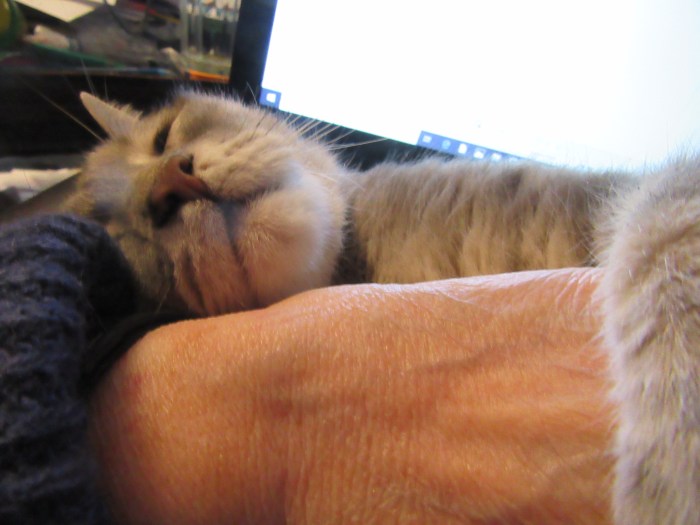
Don’t download the trial version of Scrivener**** that’s available to every NaNo participant. Even if you’ve used it before, you won’t remember how it works, because it’s big and complicated, and you don’t need it right now anyway, you can get it later, and MS Word is sufficient, and if you have Scrivener, you’ll open it and work out how to color code, and then you’ll spend the rest of November color coding everything from plot points to red herrings to subplots to your cats, if you can figure out how (blue for Ernest’s gray coat, much of which currently adorns my sweats, and rust for William’s elegant cream tabbiness).
On November 2, don’t open your email. Don’t open Facebook. For goodness’ sake, don’t open your blog. Opening your blog will lead to writing a post, any post, because you’ll do everything in your power, even write, to get out of making up 1667 words, which by now have increased to 3334 words because you had surgery and two meetings and a newsletter on November 1. Email might not pose a problem– it depends on how popular you are–but Facebook will take you directly to Candy Crush and you’ll be lost. (Candy Crush Saga, Candy Crush Soda Saga, and Candy Crush Jelly Saga, all of which you sneered at during the years sanity prevailed.)
Screen shot of Scrivener; ready open a new project
There are other d0’s and don’ts, but I’m too tired to remember what they are. Except for the one about getting enough sleep. Last night, I didn’t. A nap is inevitable, but there goes another chunk of writing time.
Anyway, that’s my take on NaNoWriMo. Contrary to the what you’ve read here, I have a positive attitude. I’m going to make it.
Because I want to call myself a winner. I want to experience the satisfaction of a job well done. I want to finish a novel so I can go back to short stories where I belong. I want to be a winner. I want a tee-shirt.
But above all, I want Scrivener. I want Scrivener when I create, plot, organize, research, file, write, revise, prepare a final document. I want to join the legions who say Scrivener is the greatest gift to writers since the eraser. I want the 50% discount on Scrivener that winning will earn me.
But above all else, I want Scrivener so I can color code.
***
* A man invented NaNoWriMo. We know this because it takes place in November.
** For a quotation, an example, a whatever, go to Hamlet. Hamlet and Mark Twain. Everything you need is there.
*** I think Eloise says “Pooh pooh to you.” Somebody says it.
****Scrivener is a sponsor of National Novel Writing Month.
***
I’ve now written about 1370 words. Only 1964 to go before midnight and I’ll be caught up. Blog posts don’t normally count, but if your main character participates in NaNoWriMo and writes a blog, they do.




 Next Saturday, October 20, I’ll sign and sell at the












 M. K. Waller