[Links are scattered throughout this post. If you slide your pointer across the screen, you’ll see where to click. In the meantime, I’ll choose a theme that makes finding links easier.]
In yesterday’s abbreviated post, I promised an announcement to end all announcements.
Confession: Kaye George was quicker than I. She made the announcement on another blog, whose title and URL I will display later in this post. I’d hate for readers to click on that link and forget to come back here.
The Announcement: “Murder on Wheels,” an anthology of eleven short stories written by members of Austin Mystery Writers critique group and two of its friends, has been accepted for publication by Wildside Press.
It’s occurred to me that we might be sending out this news prematurely, that we should wait for the book to appear. But yesterday the contract, and self-restraint, went the way of the dial telephone.
I doubt we’d have had the energy keep the secret anyway. We’ve been on the verge of dancing in the streets ever since receiving word that Wildside would publish. When one AMW member heard the good news, she broke into song. Thanks to the miracle of modern technology and a husband who knows how to make an .MP3 file from a voice mail, I have a recording. I would share it, but I value my life.
The next question, of course, is WHEN?
We don’t know. There’s a lot to do between now and the launch date. Before Wildside’s final acceptance come edits. The others have informed me it’s gauche to tell a publisher that your stories are already perfect. So I imagine compliance with the editor’s requests won’t be an issue.
I promised I would display the address of Kaye George’s official announcement. An Agatha-nominated author, Kaye has published a number of mystery stories and novels. Although she’s no longer around attend AMW’s meetings, she’s still our leader and our guide through this new territory. She writes about how the idea for “Murder on Wheels” came about. Her account of this Eeeeeeeeeeeeeeeeee! experience is more detailed and more interesting than mine.
Below is a piece I originally posted, under a slightly different title, several years ago. I don’t know why the text looks as it does, but it will stay that way until tech support and I find a remedy. I hope you will read and enjoy anyway.
“Ophelia,” oil on canvas, size: 49 x 29 in (Photo credit: Wikipedia) John William Waterhouse [Public domain], via Wikimedia CommonsAt HEB this afternoon, having verified that I had, indeed, spent my last sou on a cup of coffee at Waterloo Writers, I ran my credit card through the scanner. The resulting screen read, Select Tender Type.
Tender.
Such a formal, old-fashioned word for this new-fangled device.
It reminded me of the scene in which Polonius asks Ophelia about her relationship with Hamlet:
Polonius: What is between you? give me up the truth.
Ophelia: He hath, my lord, of late made many tenders Of his affection to me.
Polonius: Affection! pooh! you speak like a green girl, Unsifted in such perilous circumstance.
Do you believe his tenders, as you call them?
Ophelia: I do not know, my lord, what I should think.
Polonius: Marry, I’ll teach you: think yourself a baby;
That you have ta’en these tenders for true pay,
Which are not sterling. Tender yourself more dearly;
Or–not to crack the wind of the poor phrase,
Running it thus–you’ll tender me a fool.
Poor Ophelia. She was a sweet thing, and young, and the men in her life treated her so shabbily.
But even while Polonius belittles his daughter to her face, the way Shakespeare moves tender through the passage, varying its meaning from one line to the next, makes the language as briliant as its meaning is dark. Polonius, as Hamlet later implies, is a rat—and he pays for his treachery a couple of acts down the road—but he has such a way with words.
Thinking of Polonius and Ophelia reminded me of Lord Capulet‘s rage when Juliet tells him she will not marry Paris. He explodes, and Juliet adds fuel to the fire.
Capulet: How! will she none? doth she not give us thanks? Is she not proud? doth she not count her blest, Unworthy as she is, that we have wrought So worthy a gentleman to be her bridegroom?
Juliet or The Blue Necklace (1898) by John William Waterhouse (Photo credit: Wikipedia)
Juliet: Not proud, you have; but thankful, that you have: Proud can I never be of what I hate; But thankful even for hate, that is meant love.
Capulet: How now, how now, chop-logic! What is this? ‘Proud,’ and ‘I thank you,’ and ‘I thank you not;’ And yet ‘not proud,’ mistress minion, you, Thank me no thankings, nor, proud me no prouds, But fettle your fine joints ‘gainst Thursday next, To go with Paris to Saint Peter’s Church, Or I will drag thee on a hurdle thither. Out, you green-sickness carrion! out, you baggage! You tallow-face!
“Thank me no thankings, nor, proud me no prouds, / But fettle your fine joints ‘gainst Thursday next,…” Beautiful. Just seeing it on the page gives me the shivers.
To some, Capulet sounds like a terrible father, but, as I pointed out to my freshmen, year after year, Juliet starts it. She’s rude and disrespectful. Her father doesn’t know she’s already married; he thinks she would be thrilled to marry Paris. But she behaves like a brat. It’s no wonder Capulet threatens to drag her on a hurdle thither.
The two female characters present an interesting contrast: Ophelia refuses to speak for herself; Juliet shouts. But neither one lasts to the end of Act V.
A scholarly paper might lurk in there somewhere: “Shakespeare’s Women: A Study of the Consequences of Self-Actualization Within the Context of the Father-Daughter Relationship Complicated by Nascent Heterosexual Bonding, with a Focus on Hamlet’s Ophelia and Romeo and Juliet’s Juliet.”
Or perhaps not.
By the time I finished with the Capulets, the cashier had almost finished scanning. While she bagged the items, I had time to wonder whether the name of Jasper FForde‘s protagonist, Thursday Next, was inspired by the once-projected date for Juliet’s wedding.
I also remembered that The Idylls of the King contains a line echoing Thank me no thankings, nor, proud me no prouds; I believe it’s spoken by Guinevere–maybe–but I’ve not been able to locate it, and it looks as if I’ll have to re-read the entire Idylls to ease my mind.
But I did catch the next lines that drifted by: Guinevere, jealous of Elaine, takes up Lancelot’s gift of diamonds
“And thro’ the casement standing wide for heat Flung them and down they flash’d, and smote the stream. Then from the smitten surface flash’d, as it were Diamonds to meet them, and they past away.”
That image—diamonds falling into the sunlit stream, and water splashing up, like diamonds to meet them—remains with me when the rest of the book has passed from memory.
Well. By this time, the cashier and I had completed our transaction. I wheeled the groceries to the car. End of shopping.
End of post.
Except to point out that I stood for ten minutes in one of the most boring places imaginable and forgot to be bored.
being informed that the hood of the car I’d just driven for seven hours through the Texas Hill Country and the Trans-Pecos, and into the Chihuahuan Desert, wasn’t properly latched;
finding the hood up again two days later;
recovering my camera;
losing my cash;
knocking the back off my mobile phone;
scattering my purse, my camera, a take-out box of Creamy Bolognese over penne pasta, and myself all over the sidewalk in front of La Trattoria;
wallowing on the floor wielding a broom and a flashlight, scraping my cash from under the far side of the bed;
abandoning my purse in the cafeteria;
recovering my purse;
Porch of Hotel Limpia, Fort Davis, TX. By Kathy Waller.
leaving Alpine, missing another turn, and winding up in Marathon;
watching Gale lean out the window to ask a man where we could get petroleo;
being told petroleo was in Alpine (26 miles) or in Fort Stockton (58 miles), but not in Marathon;
on advice of residents (“There’s nothingout there”), giving up impromptu plans to swing through Del Rio;
retracing our steps to Alpine for petroleo;
on second attempt, not missing the turn;
arriving at home without further incident worth mentioning.
I will mention that
Karleen Koen’sclass was up to her usual standard: As I’ve written before, she’s honest about what she can
Karleen Koen’s novels plus other incentives on classroom floor. By Kathy Waller.
and cannot do for her students, but she shows them ways to increase their own creativity;
the reading at the Alpine Public Library allowed student writers to share pieces written in the various classes, including a Sudan native’s account of learning to speak English, which was a scream;
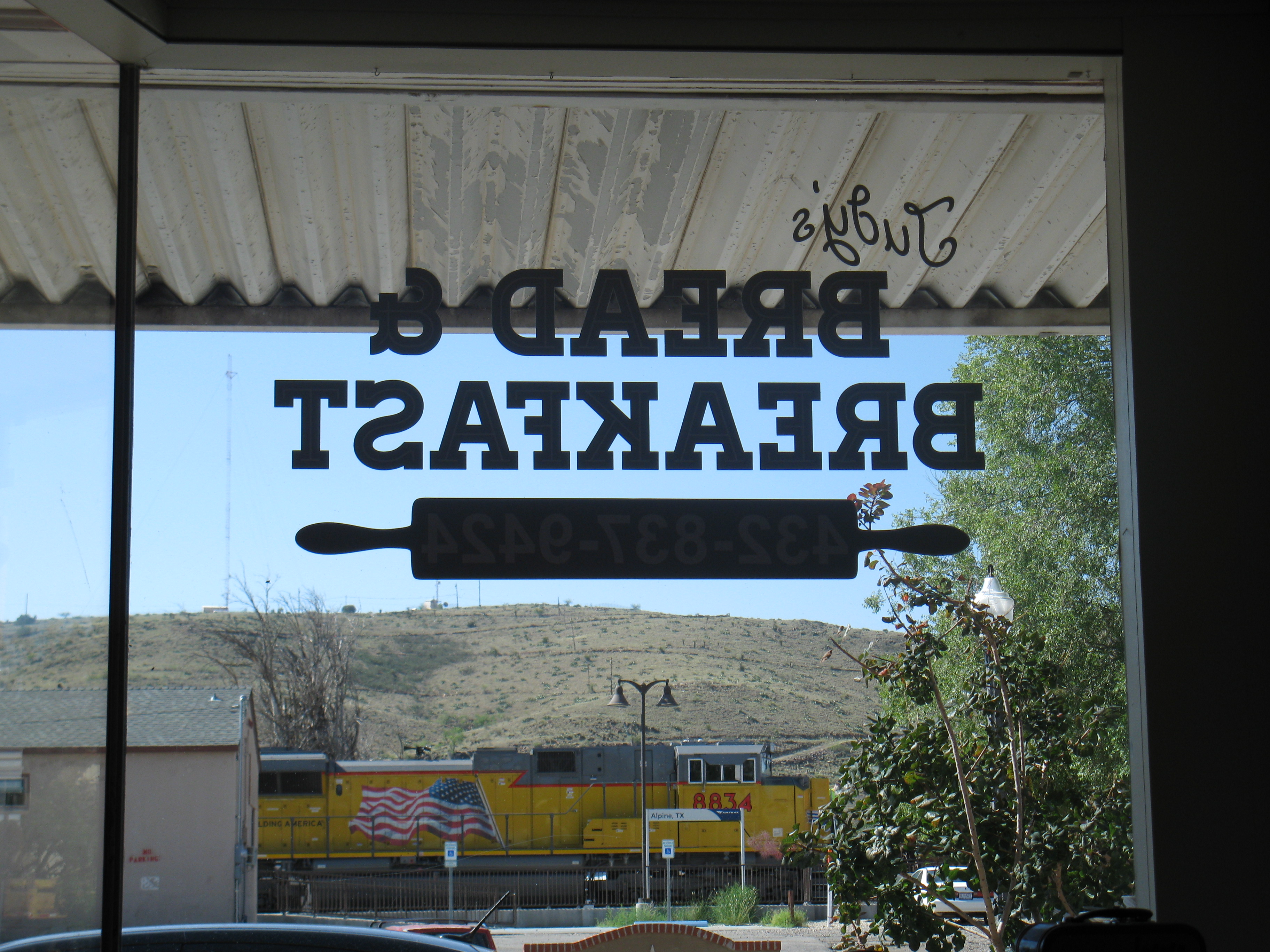
Inside view of Bread and Breakfast’s front window. By Kathy Waller.
a mobile phone will work perfectly if the back is held on with a rubber band, and, when presented with said phone, a husband will laugh and reattached the back without a rubber band;
I was not responsible for the rear-ending;
Simple Green will probably remove dead banana muck from inside the Austin Mystery Writers tote bag; it will also probably remove the remnants of Creamy Bolognese from the outside of a camera case.
A package of Oreos lifts the spirits immeasurably.
Gale has just published a post on the Austin Mystery Writers blog about the Writers Retreat. She focused on what we learned in class.
But I prefer to focus on extracurricular activities. There’s an education to be had in them, too. Especially the part about the Oreos.
When I think of my wife, I always think of her head. The shape of it, to begin with. The very first time I saw her, it was the back of the head I saw, and there was something lovely about it, the angles of it. Like a shiny, hard corn kernel or a riverbed fossil. She had what the Victorians would call a finely shaped head. You could imagine the skull quite easily. ~ Gillian Flynn, Gone Girl
“Should I have taken the false teeth?” ~ Robertson Davies, The Cunning Man
About twenty years ago, I went on a Robertson Davies binge. I plowed through a number of his big, fat, fascinating novels, one right after the other. Then I moved on to another literary addiction, but Davies’ stories still haunted me. Last week I came across a copy of The Cunning Man, opened it, read the first line, and was again hooked. I’m going to have to read all those books a second time.
“Today, celebrate three songs that are significant to you. For your twist, write for fifteen minutes without stopping — and build a writing habit.”
Oh, all right, might as well stop complaining about these Do-Not-Edit twists. Nobody’s listening.
Fifteen Minutes:
I can’t think of three songs that are significant to me. I can think of the four that were played/sung at my wedding; they’re significant, I suppose. But I’ve written about them elsewhere. What’s significant is that I chose two and the groom chose two, and our choices differed so widely.
My hand stopped. This is hard to do on a computer: it’s too easy to go back and fix things, choose another word. Even when you’re trying not to. Cursive is easier.
Anyway, David supplied recordings of “A-You’re Adorable” and “La Vie en Rose” (Jo Stafford). We opened with the Adorable song, and that set the tone for the entire day. Emily Post ran up the aisle and out the door in disbelief. But the guests visibly relaxed, and that was a good thing. No tension, no worries. Even the bride had a good time. After she saw the caterer’s van parked in front of the fellowship hall.
My songs were “Simple Gifts” and “The Prayer Perfect.” My gift to myself was a trained soprano to sing them.
***
Saturday morning I’ll spend two hours writing as Natalie Goldberg prescribes. David and I belong to a practice group called 15 Minutes of Fame. We write/read/write/read, etc. We’ve done it for years–I met him in another practice group–and I enjoy it. But we don’t publish our work. Well, we do, if we want, on our blog, but we clean them up a bit first.
And I never write on computer in practice. Cursive is faster. If schools stop teaching cursive, how will students ever be able to scrawl a note? Or write in a margin? Or practice writing their names in different styles? Educators need to think.
Only Day 2, and I’m already tempted to drop out of Writing 101.
Yesterday I had all day. I started early, ignored the instructions and wrote what and how I wanted, and took my time doing it. Fine.
Today I had both morning and afternoon meetings, and now I’m as tired as I was when I had an eight-to-five job. In addition, I don’t like the topic. There’s no place I want to beam up to right now except bed. I’m trying to get my sleep patterns straightened out, and I can’t do that if I stay up writing.
Furthermore–and this the heart of the matter–I don’t like doing descriptive writing. I’m not good at it. When reading, I often skim or skip. I miss a lot of great prose, I know, but I prefer to get on to what the characters are doing. A professor remarked that Hemingway‘s description of the scenery during a drive through the Pyrenees in The Sun Also Rises was some of the finest writing in the English language. We had just read the novel. I tried to look as if I agreed about the quality of the description I hadn’t noticed.
Now that I’ve expressed my discontent with the topic, I’ll move on to a place I memorized:
My great-grandmother’s house two blocks from the house where I grew up. After you cross FM 20, the street angles off toward the left, and the one house and the foliage between hid Grandmama’s house from ours. The houses weren’t far apart, but when you crossed the two-lane road we called “the highway,” and the street made that little jog you felt like you were in a different part of town altogether.
My great-grandmother died three years before I was born. When I was a child I called it “Aunt Ethel’s house” for the great-aunt who lived there. When my uncle inherited it, it became “Donald’s house.” My father, who, with his four brothers, had lived there as a child, after his mother died called it simply “the house.” “I’m going up to the house,” he would say. No one ever asked him to explain.
It sat on the corner a block from Main Street, a white frame house with a big front porch. At each end a door led to a bedroom; the door to the living room was in the middle. Queen’s crown growing up the brick supports (pillars and columns sound too grand) and provided shade in summer and sometimes a measure of privacy. Inside there was no privacy at all: there were lots of windows, and most rooms had french doors. That they had sheers was little comfort. When we spent the night there once, my mother commented it was like living in a fish bowl. Surrounded by trees, it was hot in summer. On winter nights, when propane space heaters were turned off, it was absolutely freezing.
While my father called it “the house,” my mother called it “Grand Central Station.” Two of Grandmama’s sons lived across the street. Their children and grandchildren were in and out all day. Some walked in through the front door, stopped in the kitchen for a glass of water, and walked out the back without saying Hello. (I always said Hello.) When there was a funeral, four generations met there for lunch, sitting in the dining room, spilling out onto the front porch and the back yard. Those who lived there gathered there in the evenings. Mother offended my father early in their marriage by saying she’d rather stay home and listen to Jack Benny on the radio.
By the time I was out of high school, things had changed. For the first time, I knocked on the door before walking in. The house was no longer a gathering place. Later, it passed out of the family, and none of us went there at all.
Several years ago, I was invited back. An estate sale had been scheduled, and the auctioneer, knowing that many things there had been in my family for years, allowed me to come in for a pre-sale sale. I bought an old china cheese keeper that my mother had coveted, and some demitasse spoons from what had probably been Grandmama’s first set of flatware, and a place setting of the flatware used daily when I was a child, entirely utilitarian and, in my opinion, about the ugliest pattern imaginable.
It was strange being back after all those years. I remembered huge bedrooms, huge living room and dining room . . . Everything had shrunk. Except the porch. There was still room for several card tables of domino-playing ladies on summer afternoons.
For years, I felt as if that house belonged as much to me as to the great-aunts and the uncle who lived there. When it passed into new hands, I was sad. But it was a house. People had made it special.
The house was sold. My memories were not.
*****
Recently, the house was sold again, this time to a friend. I’m pleased to know it’s in good hands.
That’s what I said when I received my M.A. No more school. I’d learned enough. More to the point, I’d stayed up for thirty-six hours at a stretch drafting and typing reams of literary criticism too many times. I’d tired of having to take off the weight (peanut butter) that appeared with each paper. The Idylls of the King alone added five pounds.
Six years later, after receiving library certification, I said the same thing. Enough.
Several years ago, I tried posting every day for a year from January 1 but fell out around March. It was fun but exhausting–sometimes Emily Dickinson had to step in for a guest post–and I had no energy to write anything else. I don’t write fast. I revise and edit as I go. (Please don’t bother telling me I shouldn’t.) I suffer; how I suffer.
But last night I saw the word challenge, which is the emotional equivalent of chocolate, and my resistance is low, so I cratered and registered. It’s just one month with weekends off, so perhaps I will last it out. The catch is that WP provides a topic and a twist.
Today’s topic, or goal, is to unlock the mind: free write for twenty minutes. Follow Natalie Goldberg and access the pure thoughts and ideas of your wild mind.
Today’s twist is to post the free write. It doesn’t matter, says WP, if what you write is incomplete, or nonsense, or not worthy of the “Publish” button.
Yes, it does.
I respect Natalie Goldberg, but I’m not about to put my wild mind out for the public to view. I will display irony and self-deprecating humor, keep my tongue lodged in my cheek, and present myself as flippant, superficial, frivolous, shallow, and self-absorbed.* My thoughts, which are seldom pure and never simple, thank you Oscar Wilde, plumb a depth those who read my blog and listen to me talk cannot imagine. And I don’t share.
That’s one reason I’ve cut down on Facebooking: It’s too easy to record what I think.
This free write has gone on for an hour and will go on until the manager of the book store tells me my car is about to be towed for violating the three-hour limit on parking if I don’t make myself stop.
You write because you have an idea in your mind that feels so genuine, so important, so true. And yet, by the time this idea passes through the different filters of your mind, and into your hand, and onto the page or computer screen — it becomes distorted, and it’s been diminished. The writing you end up with is an approximation, if you’re lucky, of whatever it was you really wanted to say.
Irish Murdoch expressed a similar idea in fewer words: Every novel is the wreck of a perfect idea.
What jumps out at me is this: Most of life is a wreck of a perfect idea. And we publish it anyway.
There: I’ve accessed a pure thought and idea of my wild mind.
Well. It’s been drummed into me that an essay must have a conclusion. The previous paragraph, although an abrupt ending, is close enough. I’ll leave this and work for a while on the *I#%+)(^! rough draft of the novel, which is what I’ve been avoiding for the past three-plus hours.
Thanks, WP, for supporting procrastination.
*****
*I am self-absorbed.
Note: This place isn’t busy and the manager hasn’t said anything, so I assume my car is where I left it.
Note: With all respect to Mr. Hosseini, who writes beautiful books, I had no idea to express when I began writing this. I wrote it because WP told me to.
Portrait of Samuel Clemens as a youth holding a printer’s composing stick with letters SAM. Daguerreotype; sixth plate. Plate mark: Scovill. Inscribed in case well: G.H.[?] Jones Jonco? / Hannibal Mo / 1850 / Nov. 29th. On case pad: Samuel L. Clem-/ens – [illegible] / Taken Dec. 1850 / Age 15. (Photo credit: Wikipedia)
*
*
*
*
*
*
*
*
*
My mother had a great deal of trouble with me, but I think she enjoyed it.
It is 3:30 a.m. I stayed up working on a website for a friend. Then I replied to some emails. Then I wrote several more emails to the same people, as if I thought they were awake and waiting for them. In fact, one of them was awake, and she read my email and replied, so I replied to her.
Then I checked out a page of Shakespearean insults. Earlier in the evening I had found a blog with a title very like the one at the top of this page, so it’s obvious I need a new one–the fact that I’m down to a cow as header is another clue things here are wearing thin; I love cows, but I don’t consider them header material–and before I can do anything else, I must have a title, and the title must be literary. And since Lewis Carroll is pretty well taken up, I turned to Shakespeare. Why I chose insults, I don’t know, except that a while back I found a perfect title there–Guts and Midriff. It’s from Henry IV Part I: Act 3, Scene 3. The entire quotation goes this way:
There’s no room for faith, truth, nor honesty in this bosom of thine. It is all filled up with guts and midriff.
For vivid imagery, there’s no one better than Shakespeare.
Except for Mark Twain. Finding no insult that seemed appropriate, I turned to a site of Twain quotations and, of course, ended up on the cat page. Twain liked cats. A lot. And his family had a passel of them. Put Mark Twain and cats together, and I’ll read quotations all night without a thought of a blog title.
I think my love of Twain comes from growing up among men who talked like Twain wrote. My father and his Woodward uncles, one of whom lived next door, had the same–I don’t know what, but they had it. If a stenographer had followed them around, the transcripts would have had a lot of Huck Finn in them. When Huck says that Pap has a couple of his toes leaking out the front end of his boot–I can hear my dad saying it. One of my greatest regrets is that the last time he and his three brothers were together, I sat there for three or four hours listening to them remember but didn’t get up and go into the next room for the tape recorder. Well, spilt milk.
Anyway, in my moseying through the Twain and cats page, I discovered the quotation at the first of this post–not something Twain wrote, but something he said to his secretary about the cat that was shredding her dress–and thought it would make a decent post. But when I got it on the page, it looked so small all by itself, so I decided to add a few words of my own. And now I have, so I without further ado, I shall sign off.
I am a distractible adult. I suffer from Monkey Mind.*
I wasn’t a distractible child. I listened in class, turned my assignments in on time, and made the honor roll. It’s true that I didn’t practice the piano or the clarinet as I should have, but there were extenuating circumstances.
Regarding the piano, my mother encouraged me and saw that a certain miminum standard was observed. But she also said she wanted me to learn to play well enough for the piano to be a pleasure rather than a burden.
The piano was a pleasure. I amused myself for hours playing pieces I wanted to play.
Pieces I wanted to play included anything my teacher hadn’t assigned. Scales, arpeggios, Czerny exercises–all those repetitive activities designed to develop skill–fell into the didn’t-want-to column.
As a result, the piano is now a major frustration, and I wish Mother had declared all-out war on her musical slacker.
The clarinet situation was more complex. As a fifth- and sixth-grader, I played daily for my own amusement, and for the amusement of my white-faced Hereford, Marie, who stood on her side of the fence while I entertained from a lawn chair on mine.
But when the euphoria triggered by receipt of my very own Boosey and Hawkes in its very own case had worn off, I realized that, in the hands of a novice, the clarinet is at best a noisemaker. And in concert, the trumpet gets all the good parts, like the melody. Practice was all tootle-tootle-tootle-rest-ooh-ooh-ooh-rest-tootle-tootle-tootle-rest-tootle-rest-rest-rest-repeat.
I loved music, so listening to myself was misery. My mother loved music as well, so being part of a captive audience must have been worse. Consequently, I believe my mother, realizing the clarinet would never be a pleasure to me or to anyone else in the family, except Marie, made certain accommodations. Possibly something like, The less tootling I have to listen to, the less I’ll nag her about the piano.
(No. That’s unfair, even in jest. Music was in my mother’s DNA. She’d have gladly put up with all the tootling I thought necessary.)
(For his part, my father was a saint. He used to joke that when he didn’t want to listen to something–or someone–he turned off his hearing aid. But he kept it on through all my noise. I know because twenty years later, Mother told me that during one evening’s tootling, “Polly Wolly Doodle,” to be exact, he looked up and said, “She’s playing a song.”)
###
Well. Having concluded that digression, whose connection to the rest of this post isn’t clear to me either, I’ll return to the original topic, and say that, aside from a talent for locking myself out of my car, the tendency to ditsiness lay dormant until a sudden surge six years ago this month. That’s when I left my position as a paralegal (and the structure it provided) to stay home and write. Or, to be more specific, when I bought a laptop and discovered wireless connectivity.
It’s strange how a device that should aid writers can be such a hindrance. Even when good intentions coincide with opportunity, there’s that tempting little Firefox icon lurking at the bottom of the screen. Throw in a tinge of curiosity about anything at all–the current state of your email inbox, the definition of a particular word, the spelling of distractibility, a peek at who’s doing what on Facebook, how old Peter Vaughn is and what Billie Whitelaw, who married him in 1952, looks like, since you know you’ve seen her but you can’t for the life of you remember her face . . . and you have to know now, and then one click leads to another . . .
It’s a slippery slope.
Anyway, I chose to write about Monkey Mind because after sitting in this coffee shop, staring at a blank LibreWriter screen and watching my mentor across the table just typing away, I grew restless, both physically and mentally. After a time, I gave up and in, opened Firefox, and surrendered to the lure of the Web.
Then a funny thing happened. Surfing usually stops the jiggliness I feel when staring at a blank page. Instead, the feeling increased. My mind scattered. My hands shook. To make things worse, an intense irritability set in. I was not in good shape.
Finally, just as I was ready to slam my laptop closed and stalk out, a word unrelated to icons and mice floated through my brain: hunger. Breakfast was only a distant memory. I wobbled to the counter. One orange juice and one banana later, jiggliness abated and writing began.
End of story.
###
Now for the Moral, which I direct to all those people–and they know who they are–who claim Monkey Mind is completely psychological, a self-indulgence created by literary Camilles, would-be writers who like to talk the talk but don’t want to walk the walk:
The Moral
Monkey Mind can’t always be cured by meditation, relaxation, Artist Dates, discipline, yoga, warm showers, outlining, daily affirmations, or a good swift kick.
Sometimes the only cure for Monkey Mind is lunch.
###
* a Buddhist term meaning “unsettled; restless; capricious; whimsical; fanciful; inconstant; confused; indecisive; uncontrollable” ~ Wikipedia
Have I mentioned that I can open a locked 1977 Chevy Malibu with a large paperclip in under a minute? And a locked 1977 Buick LeSabre with a metal coat hanger in under thirty seconds? That’s if the metal hanger is coated with plastic and if you discount the time it takes to go into Wal-Mart to buy it.
I was musing on cars and paperclips this afternoon during a pause in my drive home from Writers Who Write. I’d arrived at the coffee shop where we meet feeling rather jiggly in both mind and body, possibly because I’d been awake for only thirty minutes, most of which I’d spent en route. The banana and iced mocha I counted as breakfast didn’t help, so three hours later I left feeling just as jiggly as when I’d come in.
On the way home, I pulled into Trader Joe’s. The voice inside my head–the same one that told me to slow down only seconds before I hit the Black Angus cow back in 1996–had already warned me to go straight home. But guilt over ceding grocery shopping to David for most of the past four years overcame intuition, also known as good sense, and I stopped anyway.
There I faced a dilemma: what to do with the laptop lying on the passenger seat. I knew I should take it in with me, so I reached into the back seat, brought forth several large grocery sacks, and piled them on top of it.
That’s one advantage of Austin’s disposable plastic bag ban–I forget mine so often that I have to buy a reusable from the HEB cashier nearly every time I shop. There are enough of those things in my car to hide several laptops and a baby elephant besides.
Now. Here’s where the pause I mentioned earlier started. Satisfied no one could see the laptop, maybe, I shouldered my purse, picked up one of the grocery bags, and headed for Trader Joe’s. No more than a dozen steps later, I did a U-turn, headed back to the car, and peered through the window. Just as I’d expected, the ring of keys still hung from the ignition. Laying my hand on the hood, I felt a vibration. The car was running.
(Said car is ten years old. Because it’s been sitting in the sun, the red paint has begun to oxidize, so the outside looks totally disreputable, but it runs beautifully, knock wood. If the A/C hadn’t been on, I might not have felt a vibration at all.)
Well. My first impulse was to dump my purse onto the hood and follow it with my forehead. So I did. My second impulse was to hide a couple of cars away and wait for a burglar to break in for the laptop. Then I had a better idea. I stood up straight, head up, shoulders back, and asked myself, “What would Nancy Drew do (if she’d left her cell phone at home?)”
I’m certain she would do something more dramatic than finding a real phone and calling Ned Nickerson. But I’m not Nancy. I marched into Trader Joe’s, asked (in the most pitiful voice I could manage) to use the phone, and called David. He said he would run right over. I headed for the produce.
Back at the car, I set my own HEB insulated reusable shopping bag, with groceries, on the trunk. The putative temperature was 68 degrees, but sunshine had warmed the metal to at least 400, and I figured with any luck the salmon I’d bought might be cooked by the time I got home. Later I decided acting on whimsy might not be wise and took both the groceries and myself to a small, sandy promontory in the shade of a live oak tree at the other end of the car. Leaning against the tree’s trunk, I remembered other trees I’ve known:
The first high school I taught in was built around an open patio. Two young live oak trees grew on one side of it, outside the library. They were about the size of the tree I stood under while I waited for David.
The patio was a lovely spot. Students sat on the steps and at picnic tables during lunch, and the honors banquet was held there on spring evenings, and one pep rally that’s best forgotten (and that I’ll write about sometime) took place there. It was, as I said, lovely. Everyone who visited the school commented on its loveliness.
And time passed, and the live oaks flourished.
Then the birds arrived. And things began to go downhill.
The birds took up residence in the trees. Others joined them, and more and more, until the trees were thick with birds.
Birds, like cats, have no idea of the rules. They chattered and shrieked. They flew into glass doors and into windows overlooking the patio, unsettling students and teachers holding class on the insides of the windows. Unlike cats, they displayed no concern for personal hygiene. The patio did not smell nice. People stopped gathering there. They would have stopped walking by it at all if they’d been able to get to class any other way.
The Powers That Were made a number of humane attempts to get the birds to leave. They hung tin pans in the trees. They draped rubber snakes in the trees. They swatted at the birds with tennis rackets. Swatting might strike some as inhumane, but it was nothing compared to the alternative. This was, after all, a community dedicated to guns and hunting. Anyway, the same students who’d been traumatized when birds hit their windows got quite a kick watching the swatters flit about the patio, swiping at thin air.
At this point I must digress. I have admitted elsewhere that I sometimes exaggerate. Hyperbole is my favorite literary device. What I’ve written about the birds, however, is true. If anyone doubts my veracity, I can call on at least a hundred other eyewitnesses to back me up.
But back to my story. I was leaning against that live oak in front of Trader Joe’s, reminiscing, when I spotted my rescuer about three lanes over. I waved. He pulled his car into a space across from me.
“Did you call from a pay phone?” he said. Then he kissed me hello and unlocked the car.
That’s when I remembered, one more time, how lovely it is to have a husband who is as kind as my father was. My father never complained about retrieving my keys from locked cars, either.
Of course, that was before 1977, when I learned to use a paperclip.
Storytelling through photography has long been a powerful method of connecting people emotionally. For authors and writers, the use of photography can greatly assist in reaching and retaining readers. However, the digitization of photography has left the public largely confused about this new medium’s rules and regulations.
At Sisters in Crime – Austin’s March 9 meeting, member Laura Oles, a photo industry journalist and author of Digital Photography for Busy Women, will cover some current issues surrounding digital photography.
Topics to be covered will include:
Basic guidelines for using photos on your author blog & website
Creative Commons: What it is and why it matters
When you can and cannot use photos you find online
How to determine if a photo has been edited (for fictional story lines, etc)
What metadata is and what it tells you about the photo
How to use photography to strengthen your author page and blog posts
Tips for taking that perfect author headshot
Examples & resources for writers to find photos to use under license
General photography tips for powerful imagery
Why authors should use Pinterest & how to get started
Laura Oles was fortunate enough to have entered the digital photography industry long before Photoshop had become a verb. She is a founding team member of Pixel Magic Imaging, which was purchased by DNP Photo Imaging America in 2006, and has continued to advocate for digital solutions that improve the experience for shooters of all skill levels. She spent over ten years building and leading sales and marketing teams and understands the challenges of helping businesses establish a strong, unique presence in a crowded marketplace.
Laura has published over 200 articles in industry and consumer magazines and has been a columnist for Digital Camera Magazine, Memory Makers Magazine, Picture Business, PhotoInduced, ClubMom (now Cafe Mom)and others. Her book, Digital Photography for Busy Women, was named a photography category finalist in USA Book News.com’s ‘Best Books’ awards. In addition, she has served as an expert speaker for a variety of imaging conferences and conventions across the country. She continues to consult and write for the digital photo industry.
Sisters in Crime Heart of Texas Chapter (Austin) meets the second Sunday of each month at 2:00 p.m., at Recycled Reads, 5335 Burnet Road, Austin. Meetings are free and open to the public.








 M. K. Waller