Cottonwood School Reunion – Fentress Resort–Fentress, Texas–1930s (?)–Row 1, 2nd from left – Carl Waller; 4th from right – Jessie Waller Meadows (white collar); last on right – Ethel Waller (polka dots). Row 5, from left: Maurice Waller (partially hidden); Bettie Pittman Waller; Pearl Daniels; Frank Waller; Barney Waller
The Cottonwood community lay along Cottonwood Creek, Guadalupe County, across the San Marcos River from Fentress, Texas. The photograph above was taken at the Cottonwood School Reunion in–I believe–the 1930s. The people I know are identified in the caption. Some of the other surnames represented are probably Gregg, Rector, Daniels, Ward, and Fleming. I would be grateful for help in identifying individuals I don’t recognize. (The faces here aren’t exactly clear, but more of these pictures are out there in albums and attics, so if you find one with IDs, share the info, please?)
The picture was taken in front of the skating rink at the Fentress Resort. The skating rink now resides on Hwy 183 just south of Lockhart. It looks a lot smaller now than it did when it was in its proper home on the bank of the river.
I believe my grandfather, Frank Waller, is wearing a necktie. That didn’t happen often, at least when I was around.
In the caption, I note that Maurice Waller is partially hidden. I knew he was in the photo but had difficulty finding him until I realized he had to be beside Aunt Bettie. He was always beside Aunt Bettie. And partially hidden would have suited him just fine.
This is a picture taken at the World War Two Memorial at night. This is specifically a photo taken from a balcony above the fountains. (Photo credit: Wikipedia) By Vcelloho. Public domain.
A number of men from Fentress, Texas, served in World War II. Two did not return.
Marshall Langley was the son of Will and Essie Langley, my family’s very good neighbors. Marshall graduated from Texas A & M, which commissioned more officers during World War II than West Point did. His name appears in Texas Aggies Go to War: In Service of Their Country. He died in France in 1944, leaving a wife and an infant son.
Dunallen McCaskill was lost when the plane he was piloting went down over water. August 1942 USAAF Overseas Accident Reports lists the location as “Unknown, PAN” (Panama). Dunallen was my father’s friend. His family left Fentress before I was born but I heard many stories about them. They were described as kindhearted, spontaneous, and fun-loving, and were greatly loved by their neighbors. Dunallen’s mother never lost hope that one day he would come home.
I’m reposting part of a post that appeared here last year. I’m reposting it because I want to. I realize it’s tedious to read, and many visitors will not read it. That’s okay. It was fun to write, and I still like it. And I think if more laws were set to music, the world would be a happier place. Bad laws might disappear completely.
*****
When I was in paralegal school back in Aught Three, I wrote a mnemonic. It explains intestate succession–who gets what when a Texan dies without leaving a valid will–as laid out in the Texas Probate Code. One of our instructors had warned my class that students usually considered probate the most difficult part of the course, so I thought a little extra help when exam time rolled around might be in order.
Composing the memory aid took the better part of an afternoon. It required that I not only observe restrictions imposed by rime and meter, but that I also strictly adhere to the provisions of the Code. There was no wiggle room. It had to be correct.
At the end of the day, I was pleased. Aside from a couple of rhythmic aberrations, all the lines scanned, the rime scheme was satisfactory, and the targeted provisions of the Code were adequately covered.
It was a pretty good song.
As a mnemonic, however, it lacked a lot. It was long and complicated. I could have completed an entire exam in the time it took me to sing (silently) down to the second chorus.
It was easier to just learn the Code.
I posted this little flash of creativity on the class bulletin board. My old biology classmates would have read it and applauded. My paralegal classmates looked at me funny.
But funny looks don’t bother me. I spent years teaching in the public schools. I’m used to funny looks.
So at the risk of getting several more, I present a bit of law in verse.
Disclaimer: The content of the following composition was accurate as of November 1, 2003. The song does not reflect changes in the law since that date. Neither does it represent a legal opinion, nor is it intended to offer counsel or advice. Its appearance on this blog does not constitute practicing law without a license.
********************
“The Battle Hymn of the Republic” melody beginning Created by Hyacinth using Sibelius and Paint. Source: van der Merwe, Peter (1989). Origins of the Popular Style: The Antecedents of Twentieth-Century Popular Music. Oxford: Clarendon Press. ISBN 0193161214. Category:Music images sl:Slika:Battle Hymn of the Republic beginning.PNG (Photo credit: Wikipedia)
John Brown’s Intestacy
By Kathy Waller
(To be sung to the tune of John Brown’s Body, akaThe Battle Hymn of the Republic).
I.
John Brown died and went to heaven but forgot to make a will.
His intestate succession now the Probate Code will tell.
Was he married, was he single, do his kids sit ‘round the ingle?
Had he common prop. or sep.?
Glory, glory, Texas Probate!
Separate property Section 38!
Common property Section 45!
Make a will while you’re alive!
II.
If John’s married and he leaves a wife, no kids, or kids they share,
Then 45(a)1 leaves wife all common prop. that’s there.
But if he has an extra kid, wife ends up with just half
And the kids share all the rest.
Glory, glory 45(b)!
Don’t omit Section 43!
By the cap or by the stirpes,
Wife shares it with the kids!
III.
For separate prop., if he’s no wife, it goes to kids or grands.
If none of those, John’s parents halve the personal and lands.
If only mom or pop lives, the surviving one takes half.
John’s siblings share the rest.
Glory! Both John’s folks are deceased–
All his sibs will share the increase,
And if no siblings, 38(a)4 means
They’ll need a family tree.
IV.
If John has separate prop. and leaves a wife and kids or grands,
38(b)1 gives wife one-third of personal prop. at hand,
And a one-third interest just for life in houses and in lands.
Descendants take the rest.
Glory, glory 38(b)1!
It’s one-third/two-thirds division!
But if John leaves a wife but no kids,
Section 38(b)2 applies!
V. – VII.
John’s wife gets all his personal prop. and half the real estate.
The other half of real estate goes back to 38—
38(a), to be exact, and up the family tree,
Unless his gene pool’s defunct.
For if John Brown was an only child with parents absentee,
No brothers, sisters, uncles, aunts, or cousins on the tree,
No grandparents or great-grandparents to grab a moiety,
His wife will get it all.
BUT if John Brown leaves this life with naught a soul to say, “Amen,”
The Probate Code’s escheat will neatly tie up all the ends:
The Lone Star State will step right up to be John’s kith and kin,
And Texas takes it all!
Glory, glory Texas Probate!
Slicing up poor John Brown’s estate!
Avoid the Legislature’s dictate:
Make a will while you’re alive!
This morning I drove to Taylor to meet writing buddies at Java Junction on Main Street. I arrived in Taylor in timely fashion but, upon reaching Main Street, I realized I didn’t know whether to turn right or left.
I was not concerned. I’m an expert at driving around blocks.
First I turned left and drove a while, then turned around and drove back a while, then called friend #1 and spoke to her husband (she’d forgotten to take her cell phone), then called friend #2 and got no one, then turned around and inched along the other way again, then reversed and inched that way for a while, then called and reached friend #2, listened to directions, and inched back the other way…
I had visions of two women sitting beside the coffee shop window, watching me drive back and forth, back and forth. And pointing. And laughing.
Finally I came to my senses and turned at the little green and white sign with the graphic of the man reading a book.
If you want to make a librarian happy, someone told me, ask her a question.
I stopped at the reference desk and asked. The young lady’s face lit up.
After eliciting the information that I knew nothing about the town’s commercial district except where the Shell station was because I’d passed it several times–this is called a reference interview–she said Java Junction was right next door. Then she gave me a card with the library’s phone number, just in case I needed extra help.
I was sitting at the red light beside the Shell station when my phone rang. It was friend #2. “Do you know where the Shell station is?” she said.
I replied, “As a matter of fact, I do.”
“Java Junction is just on the other side, the building with the little blue sign.”
I turned left. It was as she had said. The sign was very little and not very blue and the lettering was not very bright. I almost drove past it.
I was thirty minutes late, and if it hadn’t been for that reference librarian, I would still be cruising Main Street.
Once again, a librarian saved the day.
But all was well. The coffee was good. The company was good. The mammoth cinnamon rolls my friends had consoled themselves with while waiting looked good. I have a doctor’s appointment tomorrow, so I didn’t check for myself.
Anyway, that’s the story of my Wednesday adventure: narrative only. Just this happened and then this happened and then this happened. Sometimes, no matter how hard you try, you just can’t squeeze out a moral.
Except that librarians rule.
*****
ROW80 has been going on for weeks. This is my first report. There was no point–there it is again!–in reporting that I was ignoring my goals and staying up till all hours of the a.m. Last night, however, I got to bed shortly after 10:00 p.m. I’m shooting for a pre-11:00 p.m. turn-in tonight. So I have to get a move on. Please forgive egregious errors. I’ll proof tomorrow.
*****
Image belongs to Library Avenger’s photostream on flickr, CC BY 2.0.
We got the official word today: William weighs nearly 19 pounds. To my sorrow, the veterinarian said he’s not overweight–he’s just enormous.
Español: Rudolf Nureyev, gran bailarín ruso, haciendo un “Entrechat l´air” (Photo credit: Wikipedia)
I’m sorry because I had hoped she would put him on a diet, reduce him by two or three pounds, and thus save me several visits to the massage therapist. Lugging his carrier from house to car and from car to receptionist’s desk has more than once resulted in parts of my sacroiliac going AWOL.
Quasimodo (Photo credit: Wikipedia)
It happens every time we board them: We stuff the cats into their crates. David carries Ernest; I carry William. Four hours later, changing planes in Atlanta (or Charlotte or Chicago or Houston or New York City or Seattle), David hoofs it down the concourse like a cross between Rudolph Nureyev and Roger Bannister, and I limp along twenty yards behind, Quasimodo dragging a carry-on.
And since William has been pronounced a perfect 10, so I will continue.
When I left him at the vet’s this morning, I wasn’t convinced he was healthy. He’d had a minor tummy problem, one the Internet had assured us was probably nothing to worry about. But when it’s your kid, or your cat, you worry anyway, at least a little.
The doctor, however, agreed with the Internet. The cause of his ailment isn’t clear, but it falls under the heading of “Sometimes Cats Do That.” We hauled him home. He’s happy to be back with Ernest and has said he might someday forgive me.
We also hauled antibiotic (1/4 tablet, twice daily, use a syringe to keep fingers out of danger), oral paste (1 dose twice daily, wait 30 minutes after administering antibiotic, just push it through his teeth), and a week’s worth of dry and canned catfood (gastroenteric). Both cats will eat the food. There’s no way we can separate them at dinner time, which lasts 24 hours.
William was a gentleman while in the examining room, which is more than I can say for him at the beginning of the expedition. He squalled from door to door and kept up the screeching even after being deposited in the vet’s reception room next to a pit bull awaiting vaccination. When Ernest sees a dog, he clams up and concentrates on making himself invisible. William says All Places Are Alike to Him, and if the dog objects to his caterwauling, he can just get over it. That’s the same message he gave me when I tried to shush him.
The vet asked one question that still hangs between David and me, unanswered: “Has William been under any stress?”
We discussed it over dinner at the Magnolia. David has been under stress. Ernest has been under stress (Ernest has an overly active fight-or-flight response). I have been under such stress that I couldn’t even put a meal on the table this evening.
But stress and William don’t move in the same circles.
Except once. Less than a week after William became part of our family, Ernest developed a severe gastrointestinal upset and had to stay at the hospital. The next morning, William stopped eating (unheard of), ran a high fever, and became lethargic. He lay unmoving in my lap. Almost catatonic, no pun intended. I raced him to the vet. She checked him out and then put him in the cage with Ernest.
Six hours later, when I called for an update, William’s temperature was normal and he was “eating like a horse.” All better. He just needed his brother.
But for the past three years, William has been serene. He’s not reactive. At times I wonder whether he even has reflexes.
Only two stimuli energize him: his partner in crime, and his toys.
At present, William lies across the room from me, his back turned. He knows he’s supposed to swallow 1/4 tablet before bedtime. He remembers I’m going to push oral paste through his teeth. He knows he’s nowhere near critical condition. He knows I know it.
He’s waiting me out, hoping I lose my nerve.
Frankly, my dear, his plan is working. I’m going to bed.
And as for the inevitable showdown, I’ll think about it tomorrow.
*****
Note: I shan’t really continue lugging William to the kennel. In future, I have dibs on Ernest. He weighs in at 16 pounds.
I’m really not trying to rely on other bloggers for all my posts, but one this from Letters of Note is too good not to share. It isn’t what I expected it to be–it’s even better.
When she was twelve, Helen Keller was accused of plagiarism. Mark Twain’s letter to her expressing his views on plagiarism, written ten years later, appears on Letters of Note.
Please don’t leave, I’m still here! Just embroiled in getting a newsletter online before the month is out.
In the meantime, I’m reposting this story about my friend Cuthbert, the free-thinking kindergartner.
*
Arthur Rackham, illustration to Hansel and Gretel (Photo credit: Wikipedia)
If I were to write a memoir about my years as a librarian, I would title it The Accidental Librarian.
Because the job wasn’t part of a plan. It just happened along.
One Sunday afternoon in early August, many years ago, I was sitting at home, minding my own business, when a school administrator /old friend called and said, “You want to be the librarian?”
The previous librarian had resigned. School would start in two weeks. The principals had talked amongst themselves and designated me The Chosen.
My end of the conversation went from Who, me? to I’m not qualified to Well, I don’t know. A week later, after conferring with a dean of the UT Graduate School of Library and Information Science (UT-GSLIC, or just the Library School), I moved on to a shaky Okay.
Three years earlier, I’d completed my M.A. in English, breathed a sigh of relief, and promised myself I was finished with grad school. Oh well. I wouldn’t have to register until after Christmas.
So. The state education agency granted a waiver. I cleaned out my classroom. I gave away most of my teaching materials. I moved across the hall to the high school library. School started. I found myself with the title of District Librarian and responsibility for three campus libraries.
Which included teaching primary and elementary students two days a week. Teaching being a relative term.
I had no education about or experience with that age group. I’d seen hardly anyone below the age of fourteen for years. I was certified to teach grades six through twelve. But Learning Resources Specialist was an all-level certification.
My certification was temporary and had been granted on a technicality. But when the going gets tough…
I learned a lot. Boy, did I learn a lot. Fast.
I learned that writing one’s name at the top of the page required fifteen minutes out of a twenty-minute class.
I learned that if second graders said, “May we write in cursive?” and I said, “Of course,” the task would take thirty.
I learned that if I showed third-graders a new historical picture book about Queen Elizabeth I, the principal would ask me, months later, why I had told students that if they went into the restroom and turned off the light and said, “Bloody Mary, Bloody Mary, Bloody Mary,” a severed head would appear in the mirror.
I learned that fourth-grade boys love to use the unabridged dictionary, because it has some fascinating words not found in the abridged dictionary. Even the abridged unabridged dictionary has some really good words. Fourth-graders are impressed by words the rest of us don’t notice. (I almost convinced them not to become hysterical at the mention of Captain Underpants.)
The most important lesson I learned was that sometimes I wouldn’t have any idea what I’d learned. To wit:
Once upon a time, I read “Hansel and Gretel” to a class of kindergartners. My audience, sitting rapt at my feet, comprised sixteen exceptionally good listeners, a fact I later regretted.
When I reached “And they lived happily ever after,” little Cuthbert (not his real name) stopped stroking my panty-hose-clad shin and tugged on my skirt. I ceded him the floor.
“But it’s a really good thing, what the witch did.”
Since he spoke kindergartner-ese, I thought perhaps I had misunderstood. Come again?
“It’s a really good thing, what the witch did.”
I should have slammed the book shut right then, or pulled out the emergency duct tape, or something, anything to change the subject. But I’m not too bright, so I asked Cuthbert to elaborate.
His elaboration went like this:
When the witch tried to shove Gretel into the hot oven she was doing a good thing. Because then Hansel and Gretel would die and go to Heaven to be with God and Jesus.
I smiled a no doubt horrified smile and said something like But But But. And, while Cuthbert explained even more fully, I did a quick analysis of my options:
a) If I said, No, the witch did a bad thing, because it is not nice to cook and eat little boys and girls, then sixteen children would go home and report that Miss Kathy said it’s bad to go to Heaven and be with God and Jesus.
b) If I said, Yes, the witch did a good thing, because cooking and eating little boys and girls ensures their immediate transport Heavenward, then sixteen children would go home and report that Miss Kathy condoned cold-blooded murder and cannibalism. Plus witchcraft. Plus reading a book about a witch, which in our Great State is sometimes considered more damaging than the murder/cannibalism package.
c) Anything I said might be in complete opposition to what Cuthbert’s mother had told him on this topic, and he would report that to her, and then I would get to have a conference that would not be nearly so much fun as it sounds.
(N.B. The last sentence under b) is not to be taken literally. It’s sarcasm, richly deserved. The earlier reference to emergency duct tape is hyperbole. I’ve never in my entire life duct taped a child.)
Well, anyway, I wish I could say the sky opened and a big light bulb appeared above my head and gave me words to untie this Gordian knot. In fact, I can’t remember finding any words at all, at least sensible ones. I think I babbled and stammered until the teacher came to repossess her charges.
I’m sure Cuthbert kept talking. There’s no telling what his classmates took away from that lesson.
I suppose, if I’d been in my right mind, I’d have said something to the effect that God and Jesus don’t like it when witches send people along earlier than expected.
But the prospect of talking theology with this independent thinker paralyzed my brain.
Anyway, I was expending all my energy trying not to laugh.
Kaye is currently in Washington, D. C. , where the Agatha Awards will be announced tomorrow at the annual Malice Domestic “fun fan” convention. Malice Domestic salutes “the traditional mystery—books best typified by the works of Agatha Christie,” and “loosely defined as mysteries which contain no explicit sex or excessive gore or violence.”
Austin Mystery Writers send congratulations and best wishes to all Agatha nominees.
To Kaye and her heroine, Immy Duckworthy, we add an orange pickup load of harmonious vibrations and a plea to get back to Texas as soon as possible.
*****
Question: If you combined Lucille Ball with Inspector Clouseau, what would you get?
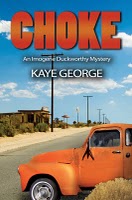
Answer: Imogene Duckworthy, amateur PI and main character of Kaye George’s new mystery, CHOKE.
Immy is a delight–the 22-year-old unwed mother of 3-year-old Nancy Drew Duckworthy (Drew), she lives with her retired-librarian mother, Hortense, in Saltlick, Texas; slings hash at her Uncle Huey’s cafe; and wants with all her heart to be a detective like her “dead sainted father.”
When Immy up and quits her job (Huey wants her to work double shifts again), and then explains her sudden unemployment by telling Hortense that Huey pinched her bottom (well, he DID pinch the other waitress’s bottom), Hortense heads to the cafe to give Huey what-for. Then Huey is murdered, the police take Hortense to the station, and Immy has her very first case. Guided by the Moron’s Compleat PI Guidebook, she sets out to find the perp.
The Moron’s Compleat PI Guidebook says nothing about staging a jailbreak, holing up in a Cowtail motel, or color-coding her list of suspects. But it does mention disguises, just what Immy needs to investigate on her home turf. An outfit that combines “Buns of Foam” with “Boobs and Belly,” however, leaves the amateur PI in need of the Jaws of Life, and the reader in stitches.
Kaye George’s CHOKE is a different kind of mystery. In most detective novels, the reader watches the sleuth-protagonist work his way through chapter after chapter, picking up clues and discarding red herrings, until he finally comes up with the answer. In CHOKE, however, the reader picks up clues while watching the gullible, ultra-literal, but enthusiastic Immy charge through to the solution while remaining blissfully clueless.
With CHOKE, first-timer Kaye George has accomplished something special: an original mystery, an original Immy, and a novel that leaves readers laughing and wanting more.
FTC Disclaimer: No one gave me this book. I bought it with my own money. Kaye George is one of my critique partners, but our relationship did not influence my review. I did not tell her how to write CHOKE, and she did not tell me what to write in my review. In fact, I never even critiqued the manuscript, and my introduction to the novel came when my copy arrived in the mail. I wish I had critiqued it, because I would like to take credit for “Boobs and Belly,” and the part about the letter opener, and the chicken. But the whole thing was Kaye’s idea. Even the orange pickup on the cover.
Ophelia by Alexandre Cabanel (Photo credit: Wikipedia)
At HEB this afternoon, having verified that I had, indeed, spent my last sou on a cup of coffee at Waterloo Writers, I ran my credit card through the scanner. The resulting screen read, Select Tender Type.
Tender.
Such a formal, old-fashioned word for this new-fangled device.
It reminded me of the scene in which Polonius asks Ophelia about the status of her relationship with Hamlet:
Ophelia, oil on canvas, size: 49 x 29 in (Photo credit: Wikipedia)
Polonius: What is between you? give me up the truth.
Ophelia: He hath, my lord, of late made many tenders Of his affection to me.
Polonius: Affection! pooh! you speak like a green girl, Unsifted in such perilous circumstance.
Do you believe his tenders, as you call them?
Ophelia: I do not know, my lord, what I should think.
Polonius: Marry, I’ll teach you: think yourself a baby;
That you have ta’en these tenders for true pay,
Which are not sterling. Tender yourself more dearly;
Or–not to crack the wind of the poor phrase,
Running it thus–you’ll tender me a fool.
Poor Ophelia. She was a sweet thing, and young, and the men in her life treated her so shabbily.
But even though Polonius belittles his daughter to her face, the way Shakespeare moves tender through the passage, varying its meaning from one line to the next, renders the speech remarkable. As Hamlet later implies, Polonius is a rat—and he pays for his treachery a couple of acts down the road—but he has a way with words.
Thinking of Polonius and Ophelia reminded me of Lord Capulet‘s rage when Juliet tells him she will not marry Paris. He explodes, and Juliet adds fuel to the fire.
Capulet: How! will she none? doth she not give us thanks?
Is she not proud? doth she not count her blest,
Unworthy as she is, that we have wrought
So worthy a gentleman to be her bridegroom?
Juliet or The Blue Necklace (1898) by John William Waterhouse (Photo credit: Wikipedia)
Juliet: Not proud, you have; but thankful, that you have:
Proud can I never be of what I hate;
But thankful even for hate, that is meant love.
Capulet: How now, how now, chop-logic! What is this?
‘Proud,’ and ‘I thank you,’ and ‘I thank you not;’
And yet ‘not proud,’ mistress minion, you,
Thank me no thankings, nor, proud me no prouds,
But fettle your fine joints ‘gainst Thursday next,
To go with Paris to Saint Peter’s Church,
Or I will drag thee on a hurdle thither.
Out, you green-sickness carrion! out, you baggage!
You tallow-face!
“Thank me no thankings, nor, proud me no prouds, / But fettle your fine joints ‘gainst Thursday next,…” Beautiful. Just seeing it on the page gives me the shivers.
To some, Capulet sounds like a terrible father, but, as I pointed out to my freshmen, year after year, Juliet started it. She was rude and disrespectful. Her father didn’t know she was already married; he thought she would be thrilled to marry Paris. But she behaved like a brat. It’s no wonder Capulet threatened to drag her on a hurdle thither.
The two female characters present an interesting contrast: Ophelia refuses to speak for herself; Juliet shouts. But neither one lasts to the end of Act V.
A scholarly paper might lurk in there somewhere: “Shakespeare’s Women: A Study of the Consequences of Self-Actualization Within the Context of the Father-Daughter Relationship Complicated by Nascent Heterosexual Bonding, with a Focus on Hamlet’s Ophelia and Romeo and Juliet’s Juliet.”
Or perhaps not.
By the time I finished with the Capulets, the cashier had almost finished with the scanning. While she bagged the items, I had time to wonder whether the name of Jason FForde’s protagonist, Thursday Next, was inspired by the once-projected date for Juliet’s wedding.
I also remembered that The Idylls of the King contains a line echoing Thank me no thankings, nor, proud me no prouds; I believe it’s spoken by Guinevere–maybe–but I’ve not been able to locate it, and it looks as if I’ll have to re-read the entire Idylls to ease my mind.
But I did find the next lines that drifted by: Guinevere, jealous of Elaine, takes up Lancelot’s gift of diamonds
Queen Guinevere’s maying, by John Collier, 1900 (Photo credit: Wikipedia)
And thro’ the casement standing wide for heat
Flung them and down they flash’d, and smote the stream.
Then from the smitten surface flash’d, as it were
Diamonds to meet them, and they past away.
That image—diamonds falling into the sunlit stream, and water splashing up, like diamonds to meet them—remains with me when the rest of the book has passed from memory.
Well. By this time, the cashier and I had completed our transaction. I wheeled the groceries to the car. End of shopping.
End of post.
Except to point out that I stood for ten minutes in one of the most boring places imaginable and forgot to be bored.
If I’m going to write anything longer than a blog post–such as a novel–I have to do three things:
Sleep–before midnight as well as after
Eat–no refined carbohydrates, no grains, no sweeteners, no processed foods, no added salt…
Exercise–as in MOVE. I didn’t buy that stationary bike just so Ernest would have a new chew toy.
And since it’s already 11:23 p.m., and I set a goal of an 11:30 p.m. computer shutdown, I don’t have time to write about the Stories from the Heart 2012 conference I attended over the weekend.
However, several other bloggers have written about it:
Linda Hoye at A Slice of Life Writing. Linda has just received the printed copy of her memoir, Two Hearts.
Pat Bean at Pat Bean’s Blog. A retired journalist, Pat spends several months out of the year on the road in her RV, blogging as she goes.
Amber Lea Starfire at Writing Through Life. Amber is a writer and teacher who focuses on telling lifestories through journaling, memoir, and art.
I hope you’ll check out what they have to say.
I would tell you more–both the blogs and the bloggers are much more interesting than my vanilla descriptions imply–but I’ve already run several minutes over my deadline, and I still have to add links.
British actress Hermione Norris: Ros. (Photo credit: Wikipedia)
PBS is airing MI5 for—what?—the fourth consecutive season? and I’m watching reruns. Again.
Last week, Ros died for the second and presumably last time. Because I’d already seen the episode (often), I used only a half box of tissues. When Adam died, I wept a puddle, but Ros’ original demise prompted a deluge. Now the team is picking up the pieces and moving on with Ros’ replacement, another attractive blonde. I find it impossible to bond with her. I’ve nicknamed her Not-Ros.
I don’t care for explosions and executions and car chases, and if that’s all MI5 had to offer, I’d have turned it off before getting hooked. Interesting characters and tight plots have kept me tuning in. That, and the fact that violence isn’t at the heart of the show: it’s the suspense, the waiting for the clock to tick down, for the bomb to detonate—or not.
And the knowledge that, in the hands of these writers, no character is safe.
Back in the olden days, one thing was certain: when he strode into the dusty Dodge City street on Saturday night, his badge glinting in the sun, his six-gun secure in its holster, to face the man in the black hat, Marshal Matt Dillon would be alive at the end of the show.
No such guarantee for Sir Harry Pearce and Section D.
No guarantee for anyone in real life either.
This afternoon, in a grocery store parking lot filled with cars but almost empty of people, a young couple passed me. The man was shouting at the woman. He reached out and pushed her shoulder. She turned away slightly, made a half-hearted attempt to fend him off. They made their way across the lot—the man shouting the same unprintable insult over and over, pushing and shoving, the woman staying beside him, hardly trying to defend herself.
Leaving the path leading to the cart return, I followed them. I didn’t consider what I could, or would, do. I just had to keep them in sight.
They had reached the sidewalk when a young woman rolling a cart filled with groceries and a toddler in the child seat stopped beside a nearby car. She called to me. “Call the police.”
“I don’t have my cell phone.”
She dug in her purse for her phone, then dialed 911. She then reported the couple’s actions and described them: jeans, black shorts, yellow t-shirt, blue and gray jersey displaying the number 31, baseball cap. I moved to a better vantage point and fed her details.
While she was on the phone, another young man and woman ran across the parking lot and managed to separate the couple. The women crossed the street. The men walked in the opposite direction across the lot. I lost them when they got into a car and drove away.
I wouldn’t recognize them if I saw them again, but I have a feeling the fellow doing the shouting and pushing would recognize me: He left staring over his shoulder at me. I wasn’t comfortable standing in that gaze. Since he obviously knew what my new friend and I were up to, he might have been uncomfortable, too, but he appeared too angry to feel self-conscious.
With no suspect, the 911 call ended. My friend turned off her phone and dropped it back into her purse. I thanked her.
“That wasn’t right,” she said.
“No.”
“She didn’t even try to get away from him.”
“I was worried about what would happen when he got her away from here.” I was still worried. He hadn’t had time to cool off, if that made a difference. If they drove around the block, found the women walking up the street…
“It just wasn’t right.” She thanked me and finished loading her groceries.
I wheeled my cart to the return, got into my car, and drove home.
Ever since, I’ve wished I could finish that scene, tie up loose ends, get everyone home safely, make them live happily ever after. But in real life, I don’t get to write the script.
And I don’t always get to know how the story ends.
*****
Image of Hermione Norris by Hermione_Norris.jpg: Sam Knox derivative work: ukexpat (Hermione_Norris.jpg) [CC-BY-SA-2.0 (www.creativecommons.org/licenses/by-sa/2.0)], via Wikimedia Commons
This morning I received a recorded message: This is blah need to call blah blah about your order blah blah issue blah blah blah immediately.
Fortunately, the 1-800 number was intelligible. I dialed it. Another recording said I would be transferred to a human in the order in which my call had been received. Music played in the background. In seconds, the human answered and said her name was Natalie.
Our conversation went something like this:
Natalie: What is your name, please?
Me: Kathy Waller
Natalie: Thank you. Now would you please read the number at the bottom of your check.
Me: (Long pause) The number where?
Natalie: At the bottom of your check.
Me: Why do you need the number from my check?
Natalie: So I can look up your account and find your order.
Me: What did I order?
Natalie: I don’t know. We represent a lot of businesses. So I need your number to find what you ordered.
Me: What is the name of the business you’re calling from?
Natalie: Blah blah. And we can’t clear up this issue and send your checks if we don’t have that number.
Me: Well, what financial institution are these checks ordered for?
Natalie: That depends, because we represent a lot of businesses, so I have to have your account number.
Me: Let me understand this. You want me to give you my bank account number.
Natalie: Uh-huh.
Me: My checks are ordered through my bank. So why don’t you call my bank for this information?
Natalie: Well, that’s the thing. I don’t know what your bank is. Because we represent a lot of financial institutions.
Me: (Getting down to the brass tacks) But I haven’t ordered any checks.
Natalie: (Hurriedly) Oh. It must have been a mistake. Goodbye. (Click)
I hung up, thought for half a moment, googled the 1-800 number, and hit on a website dedicated to reporting conversations such as the one I had with Natalie. I reported it. Then I clicked on the link to the Federal Communications Commission.
Natalie isn’t the first questionable customer service rep I’ve had the pleasure of speaking with. I used to get calls from a company offering to lower the interest rate on my credit card. The first couple of calls distressed me. I was so obviously intended to become a victim. The third time, however, I realized I didn’t have to cede control to a stranger. Over the course of the next several calls, I developed a system.
That company doesn’t call any more, but here’s how our conversations used to go:
Caller: Good morning. I’m calling to say you have the opportunity to lower the interest rate on your credit card. Does that sound good?
Me: Oh, mercy me, yes. I would love to have a lower interest rate.
Caller: That’s good. Okay. Would you please give me your account number.
Me: What account number?
Caller: Your credit card account. The number on your credit card.
Me: Oh. Don’t you have my number?
Caller: No, ma’am. You need to give that to me.
Me: Why don’t you have it? You said you would get me a lower interest rate. How can you do that if you don’t know my account number?
Caller: Ma’am, if you’ll give me the number, I’ll look it up.
Me: But if you don’t already know my account number, how do you know my current rate? You can’t promise to get me a lower one if you don’t know what it is now. Can you?
Caller: Ma’am, if you’ll just give me your credit card number, I can look it up and see what your rate is and then I can get a better one.
Me: Wait a minute. You called me, so you should know the number of the account you want to talk to me about.
Caller: Ma’am, that is confidential information. I don’t have it. You’ll have to give it to me.
Me: But I can’t give you confidential information over the phone. I mean, if you don’t already know what the account number is, and you don’t know the current rate, I just don’t see how you can get the rate lowered.
Caller: (Sounding a little testy) Ma’am, I’m not going to argue with you…
Me: Oh, good, because I don’t want to argue either. Now if you’ll just tell me what my new interest rate is going to be…
Caller: Look, ma’am…
Me: I’m sure it’s all there if you just look for it. Because you called me, so you must have all the information right there in your computer. So you read me my account number, and I’ll tell you if you have it right. Then we can talk about my new interest rate.
Caller: (Click)
I always hung up smiling.
Because–to quote my mother, the word maven, the person who cringed in physical pain upon hearing the phrase for he and I, the person who rode herd on my grammar even before I began to speak—I hadn’t had so much fun since the hogs ate my brother.








 M. K. Waller
