I’ve had a couple of minor epiphanies regarding Molly, and I was, when I broke off to post this, making some changes in Chapter 1 that will aid in plot development later.
I wish I were not OCD. I wish I could just make some notes about changes I need to make in Chapter 1 and then go on with writing Chapter Whatever. But I can’t. So I do it my way.
To see how other AROW80 participants are doing, click here.
A friend recently made a comment that has stayed with me: “And on a good day our words can change those who read them.”
Some words I heard a week or so ago changed me. Or if they didn’t exactly change me, they changed my way of thinking about a particular situation.
A couple of weeks ago, I timed pitch and critique sessions at the Writers’ League of Texas Young Adult Writers Conference (not because I write for young adults, but because WLT needed timers and I needed to get out of the house and do something useful).
At Saturday’s luncheon, author Tim Wynne-Jones spoke on the topic of “Reading Yourself Seriously.”
Here’s a summary of what I heard.
Wynne-Jones says that when we write with intention, we write with genius. We may call it a muse, genie, goddess, inner writer, “or Brenda,” but whatever we call it, we work with a co-writer.
(Muse and goddess have always sounded pretentious to me; inner writer is too close to inner child, and she and I are too busy arguing to write; and I know only one Brenda, and she doesn’t write at all. So I’m calling my collaborator the genie.)
Anyway, the genie, Wynne-Jones says, knows much more than we do. And it leaves “text messages” in the story.
So when we hit a major obstacle and can’t find a way around it–we have no idea what happens next, or we’ve written ourselves into a corner and can’t get out–we need to consult the genie, to find out what message it has left in the words we’ve already written.
We need to recapture the “feeling of enchantment” we felt when we wrote the first page.
And we do this by reading ourselves seriously: going back over our manuscript, reading creatively, paying attention to the unconscious, discovering the “tool” that will lead to the resolution of the problem.
It means sifting through the pages to see what we really want to write about, “ooching the implications to the surface.”
Reading ourselves seriously means accepting our own genius. And our genius is the ability to accept clues, which is also “the reason we write in the first place.”
Now, when Wynne-Jones began to speak, I expected to be entertained and perhaps inspired. But I got something more.
For the past umpteen weeks, I’ve been stalled. I saw a potential problem with my plot, I didn’t know how to fix it, and heaven forfend I should try to just write through it and see what happened. Oh, no, I preferred to worry, fret, and whine.
Maybe this is the time to pull out whinge. I whinged.
Sad to say, this is the same problem I wrote about several months ago. At that time, my CP convinced me I could make the thing work. I was resolved to do so.
But somewhere along the line, my courage came unscrewed from the sticking post.
So there I sat, listening to Tim Wynne-Jones, and toward the end of the talk, it suddenly hit me. I turned to CP, another volunteer timer, and said, “I have to kill Miss Q.”
Miss Q. was the original victim. But she was just so cute, I decided to give her a slight overhaul and keep her around.
But the manuscript has been telling me she has to go.
I didn’t even have to read myself seriously. The manuscript had been shouting at me for weeks, but I’d been ignoring it.
I felt as if the genie were right there, sitting on my shoulder, saying, “Kill Miss Q.”
(Perhaps instead of calling it the genie, I should refer to it as the devil.)
There you have it: Wynne-Jones words, which were supposed to provide a little R&R in the middle of a busy day, acted as a catalyst.
Or like a slap upside the head. One I’d needed for quite a while.
I left the dining room feeling changed. A bit boggled, but peaceful. I possessed the tool to resolve my problem. It had been there all along.
*****
Image of the Muse by Guillaume Seignac [Public domain], via Wikimedia Commons
Experts advise against it. When you tell people you’re writing a novel, they reply.
“You still haven’t finished that thing?”
“Why is it taking so long?”
“How much longer are you going to have to work on it?”
“You need to just get busy and write it.”
The questions above fall into the category called Irritating. But the questioners don’t know any better. They’re not familiar with the writing process, they don’t know the difficulties of getting an agent, they don’t know how competitive the market is, especially as we transition into the digital age.
There’s another category of questions that, while unsettling, might be classified as Helpful.
For example, when a writer friend told an acquaintance she was working on a mystery, the acquaintance said, “Well, there’s a formula for that, isn’t there?”
Yes, there is a formula. No, you don’t just make up some new characters and fill in the blanks. No, it doesn’t make the writing any easier.
No–and here’s the answer to the real question–a formula doesn’t make the writing any less worthy of respect.
On the topic of the formula, please take note of the following:
Shakespeare wrote his tragedies according to a formula: five acts, technical climax at the midpoint of Act III, dramatic climax at end of Act V, protagonist with tragic flaw that causes his undoing, etc., etc., etc. He used similar formulas for comedies and histories. His sonnets comprised fourteen lines, iambic pentameter, rime scheme (ababcdcdefef), tied up with a couplet (gg) at the end.
Jane Austen used a formula: Darcy’s first proposal (and subsequent withdrawal of proposal) comes at the exact midpoint of Pride and Prejudice. Open the book to the proposal, and you get half the pages on the left and the other half on the right. It marks the point at which Elizabeth both realizes her folly and loses control of the action.
Edgar Allan Poe wrote according to formula and also wrote an essay explaining the formula.
Aristotle mentioned something about a formula. Writers check out his rules to make certain they have all their bases covered.
From the uninitiated, a formula may elicit sneers.
But Writers, even the Great Unpublished, are proud of the formula, and proud of the company we keep.
I wish I could say that isn’t as bad as it sounds, but I can’t.
Pantser is one of the words I’ve learned since starting work on my novel. It means someone who writes by the seat of his pants, without an outline or other planning tools.
It’s the opposite of plotter. The plotter thinks things out before beginning. He may have a detailed outline, a timeline, character sketches, spreadsheets, charts, who knows what.
I certainly don’t know what. I’m a pantser. I start with a character, a setting, and a sentence, often a line of dialogue.
When I described my method, or lack of it, to a published writer, she was not amused.
Well, actually, she was. She laughed and told me I’d better get to outlining.
I tried. Outlining, as I’ve said before, gives me the fantods.
If I know what I’m going to write before I write it, outlining is no problem.
Some things must be planned. If I’d tried to write my master’s thesis without an outline, I’d still be sitting in front of that baby blue Smith-Corona electric typewriter, wondering where to start.
But I’d already gone through an entire year of reading, recording, scribbling, mulling over, talking to myself, boring my office mates, and engaging in various other obsessive-compulsive behaviors commonly known as pre-writing, before I typed the outline onto that official form and presented it for my adviser’s signature.
I have to approach fiction in a similar fashion. Until I know my characters–their names, their relationships, their backstories, their personalities, their likes and dislikes, their secrets, dreams, desires–I can’t outline the plot.
The only way I can know all those things is to let the characters tell me. And before they can talk to me, I have to write.
So. Knowing I’m a pantser (though the term yet), and being told I had to be a plotter, I gave plotting one more try. Then I slid into the Slough of Despond.
But for three things, I would be wallowing there still. First was an article in which mystery writer Tony Hillerman identified himself as a pantser and described how the process worked for him. It was slow, he said, but he eventually got there. If someone of Hillerman’s caliber could pants his way through novel after novel, perhaps there was hope that I could turn out one.
Second was a panelist at a meeting of the Writers’ League of Texas who said–and I quote–“I start with a character and a setting and a line of dialogue.” I was sitting in the front row that night, and when she came out with that confession, I wanted to run up and hug her.
(She also said she doesn’t plow through her first draft to the end, but periodically stops, goes back, and revises. “Sometimes,” she said, “when I get the language just right, that sparks a new idea, and I suddenly have a new path to explore.” Well, bless her heart. I do the same thing, and I’d thought that was wrong, too.)
The third thing that helped pull me from the mire was the fact that I do, in some circumstances, have the sense God promised a monkey. I knew there had to be more than one way to write a novel.
Still, the process–going where no woman has gone before without map or compass, making it up as you go along–is backward and contradictory and just plain scary. For control freaks, it can be paralyzing.
I’m a control freak. An impatient control freak. I want to do it right the first time, and I want to do it right now.
When I recently confessed to another writer that I’d been stalled for a while, she said, “Why?”
At least a half-dozen things have contributed to my inertia, but for the most part it comes down to the desire to control. And poor memory. And impatience. And lack of faith.
I forget that the surest way to get unstuck is to relax and let the story tell itself.
When I find myself so tangled up in words that all I can do is talk about how tangled up I am, I head for the bookstore. This time I came out with Jane Vandenburgh’s The Architecture of the Novel.
It’s a good book. It says, as I knew it would, to relax and let the story tell itself.
But Vandenburgh goes further. The story knows how to tell itself and it will find its own plot. First, write scenes–no backstory, no memory, no flashbacks, no thinking, no summary, no cause and effect, no consequences, no chapters, no sequencing, no beginning or ending. All those things belong to plot. Structure belongs to plot. No why—why belongs to plot.
Just tell what happens, be a witness, a noticer, a sensate camera.
I spent over an hour today reading Chapter 2, slowly, taking notes. I wanted to rush–Confession: I’ve had the book for nearly a month, and I’ve rushed through it several times and come out with nothing. It’s not a book to be hurried. I made myself read, think, record. I made myself sit in a coffee shop for over an hour, reading,thinking, recording.
It was like being in school again.
Tomorrow I’ll type up my notes, read the chapter again, push away the compulsion to move on to Chapter 3.
Chapter 3 is about plot. I’m not ready for that yet.
First I have to go back to pantsing, this time bare bones, telling the story in scenes stripped of backstory and digression and what Vandenburgh calls beautiful language. I have to relax and let the story tell itself.
How will that work with my need to get the language just right in order to spark new ideas?
I have no idea. The question makes me, quite frankly, a little queasy.
Image by BBODO at en.wikipedia [Public domain or Public domain], from Wikimedia Commons
Writing about his college years, James Thurber tells the story of Haskins, an agriculture student who takes up journalism, “possibly on the ground that when farming went to hell he could fall back on newspaper work.”
Haskins is assigned the animal husbandry beat, which comprises cows, sheep, and over two hundred horses.
Unfortunately, he is shy and doesn’t know how to use a typewriter. He writes slowly, and his stories are dull.
One day Haskins’ editor assigns him to bring in news from the horse pavilion. Haskins later comes back saying he has a story.
The editor, hoping for something more interesting than he’s been getting, says, “Well, start it off snappily.”
A couple of hours later, Haskins turns in a paper that starts with the following sentence:
“Who has noticed the sores on the tops of the horses in the animal husbandry building?”
That’s the other reason I’m not a journalist: When it comes to writing leads, I’m several steps behind Haskins.
Under most circumstances, I wouldn’t care. I don’t make my living working for a newspaper.
But a lead sentence corresponds in at least one way to the first line of a short story or novel. They both catch the reader’s attention, draw him into the text, make him want to read on.
And there’s this novel I’m working on. And this short story…
And, like Haskins, I’ve heard from some of my critique partners that my first lines leave something to be desired.
After some thought and a brief cooling-off period, I’ve forgiven them and admitted they might be right.
The sad thing is that before my abject humiliation, I never paid much attention to first lines. The sadder thing is that I can quote so many.
Scarlett O’Hara was not beautiful, but men seldom noticed it when caught by her charm as the Tarleton twins were.
This is the saddest story I have ever heard.
He was born with a gift of laughter and a sense that the world was mad.
It is a truth universally acknowledged, that a single man in possession of a good fortune must be in want of a wife.
While Pearl Tull was dying, a funny thought occurred to her.
I write this sitting in the kitchen sink.
When he was nearly thirteen, my brother Jem got his arm badly broken near the elbow.
When the lights went off the accompanist kissed her.
All children, except one, grow up.
Well, I have broken the toilet.
You don’t know about me without you have read a book by the name of The Adventures of Tom Sawyer; but that ain’t no matter.
I woke this morning with a stranger in my bed.
Last night I dreamed I went to Manderley again.
They used to hang men at Four Turnings in the old days.
And so on. With all those lines suspended in my brain, you’d think I’d have caught onto why I remember them. And why they’re important.
Here’s the way it works.
A bookstore browser sees a book on the shelf. If the writer is lucky, it sits face out. He takes the volume down, looks at the front cover, the back cover, the first paragraph…and then either buys it or walks away.
And the whole process happens in under ten seconds.
The first line of a novel can make the difference between a sale and a return. Between another advance and a canceled contract.
There’s a lot riding on Scarlett O’Hara not being beautiful. And our not knowing Huck Finn. And what happened when the lights went off.
How does one get to be that good?
The same way one gets to Carnegie Hall, I guess.
Practice. Practice.
~~~~~~~~~~
And blog blog blog.
Because my concern isn’t just for novels and money and fame. I’d also like the gentle readers who land on To write… to linger longer than the first sentence.
~~~~~~~~~~
And please discount the business about money and fame. Unless you’re Tom Clancy or Stephen King, those aren’t really part of the package. But they sound good, so I throw them in.
~~~~~~~~~~
Sorry about that linger longer. Against some things there is no defense.
Only dull people are bored. ~ Adela Rogers St. John
I’ve just begun a book about structuring the novel. So far I’ve learned that I don’t know how to write my novel because I don’t know the structure, and that, because only I know the story, no blueprint exists until I create it.
I’m pretty sure I already had that figured out.
My plot is acting up. Or, worse yet, maybe it’s the story that’s giving me fits. Several months ago, CP convinced me I could make it work, but once again, I’m not so sure.
She asked whether I’m bored with my characters. I’m not. But I’m bored with a situation. I don’t know whether I can make it work. I don’t know whether I want to make it work.
CP said maybe this isn’t the book I want to write. Maybe it’s the second. Maybe it’s just back story.
Maybe I’m afraid to push through to the end.
I wrote a post several months ago about being all grown up and adequate to the task ahead.
Yeah, right.
Today’s Scorpio says I’m filled with courage and the heart to get the job done. And my tenacity will carry me through.
Not today.
I’ll be honest: I do not feel adequate and I have no ideas for tonight’s post, which, because of more network problems, was posted prematurely and is now being fixed. A little.
I don’t think that’s what WordPress had in mind when it invited me to post daily.
Phooey.
Oh well. I’ll think about that tomorrow. It’s another day.
I never quite know when I’m not writing. Sometimes my wife comes up to me at a party and says, “Damnit, Thurber, stop writing.” She usually catches me in the middle of a paragraph. Or my daughter will look up from the dinner table and ask, “Is he sick?” “No,” my wife says, “he’s writing something.” ~ (James Thurber, in an interview with George Plimpton and Max Steele. Paris Review, Fall 1955)
Surrounded by crucifers, I calculated the odds that today’s cauliflower would make it to the dinner table rather than mummify in that mausoleum otherwise known as the vegetable crisper.
Candy to left of me, Cosmo to right, I pondered twenty-seven ways to lose fifty pounds by Thanksgiving and ninety-two prescriptions for gaining it back.
Crossing the parking lot, I put in a grocery store between the hair salon and the antique shop.
Then I hired a manager.
Joelle currently does cuts and perms–she was Margaret, the assistant postmaster, before youthening and changing her name and her career–but she could operate the grocery, which carries better stock than the Abomination out on the highway. And her husband, Scott, could take over when he retires.
I don’t know when Scott will retire. I’m not even sure his name is Scott. He used to be Herb, the postmaster. He took that job just before Margaret turned into Joelle. But he’s awfully straight-laced, and Scott suggests a certain amount of elasticity…
Grocery shopping isn’t the only endeavor that detours into writing. Sometimes I’m in the shower. Sometimes I’m driving to an appointment.
In the middle of a romantic birthday dinner at the Clay Pit, I erupted: “Ooh! I just thought of somebody else I can kill!”
That’s not the way to win friends and influence people, especially if you’re seated in the little room downstairs, where voices ricochet off stone and land in the neighbors’ chicken korma.
No matter. People look at me funny, and they think I’m scatterbrained, and rude, and some no doubt think I’m criminal.
But there is one advantage to this perpetual writing, and I wouldn’t trade it for the world.
Ever since fifth grade, when I heard a high school prose reading contestant perform “The Night the Bed Fell,” I’ve aspired to write like James Thurber.
And now, if I think about it in just the right way, I can say that I do.
I was prepared. I bought frozen stuffed peppers Sunday evening and at 4:40 this afternoon turned the oven on to 350. David took it from there.
Frozen stuffed peppers is our Tuesday night default. David is the default preparer of frozen dinners and cleaner-upper of kitchen. For all this I am grateful.
I wasn’t prepared for the blog, of course. That slipped up on me. I’ve given myself thirty minutes to write and post.
The AMW meeting was productive. CP and I exchanged manuscripts–sounds a lot like fourth grade: “Exchange papers with the person across the aisle and we’ll check our answers”–and read and discussed them.
We spent most of the time talking about what wasn’t on the page: real plots and false plots, what our characters want, how to increase suspense, plot points and midpoints.
For at least the tenth time, we hashed out my structural dilemma.
Originally, I had a perfectly good plot. Then I decided to make a major change. I’m now dealing with fallout.
Periodically I say, “I can’t make this version work.”
CP shows me how I can make this version work.
I repeat, “No, I just can’t make it work.”
CP says, “Okay, then, go back to the way it was. Kill Mr. X.”
And I say, “But I don’t want to kill Mr. X. I want to kill Mrs. Y.”
That’s a classic strategy: I argue that I can‘t until my partner agrees with me. Then I argue that I can.
My mother and I spent most of the 1984-85 school year engaged in that conversation. I was working at a university as an assistant instructor while writing my thesis. I was to receive my M.A. in August and then return a couple of weeks later as a full-time lecturer.
The catch was that by early July my thesis had to be approved, typed, signed, copied, and submitted for binding.
No thesis = no M.A. = no lectureship = no income.
Hence the weekly discussion:
K (wailing): I’ll never finish my thesis in time to graduate.
M (in the soothing tone that was both patronizing and irksome): Oh, you’ll get it finished.
K (louder wailing): No, I won’t. And if I don’t finish, I won’t have a job next year.
M (dropping the soothing tone and sounding frighteningly reasonable): Well, if you don’t think you can finish the thesis, maybe you should start looking for another high school job.
K (hysterical, offended wailing): You don’t think I can finish it! I’m going to finish it! I have to finish it!
Somewhere along the line, I think about March, my mother stopped bothering with words and began substituting, “Um-hmmmm.” Having heard predictions of academic doom since my freshman year (“I failed my biology test. No, really, I failed this one.”), she said her lines mostly to appease me. She knew I had to vent.
I suspect CP, like my mother, has figured out her role in the drama.
My high school English teacher read the Day 7 post, the one in which I wrote that she told students we had important and relevant things to say.
That is the problem with blogging. At some point, you make a remark, a perfectly innocent remark, and the person you remarked about happens across it and reads it and calls you on it. Especially if you link the post to Facebook, and that person is one of your friends.
Anyway, said English teacher (who taught me in grades 8, 10, 11, and 12, so you see what we were both up against) asked whether she really said relevant and important, or whether she said, “Hush up and write.”
I admit it. “Hush up and write” was more her style.
And I really went overboard with relevant. I don’t think anyone I knew said relevant. It was one of those television words, ubiquitous and meaningless. The curriculum wasn’t relevant. School wasn’t relevant.
Relevant isn’t complete in itself. It needs something more. Relevant to what? And in whose opinion?
The 60s didn’t get to my part of Texas until late. And being as contrary then as I am now, I rebelled against the rebellion.
According to my husband, people should never send e-mails they wouldn’t want Ted Koppel to read on the air. David is correct. That goes for Facebook and blogs and all media, I’m sure.
Although I agree with his policy, however, I don’t follow it. Anyone who has read this blog knows that.
My one hope is that any potential employer who googles me and reads my work understands self-deprecating humor.
In other words, I’m neither as dumb nor as ditsy as I portray myself. Fiction is fiction and fact is fact, and in between there is irony.
If hired, I will be on time, work through breaks and lunch and do overtime, meet deadlines, take a personal interest in my work, and play well with others. I will spell correctly and use the serial comma. And I will not write about you on my blog.
I’ve been thinking about starting every post with that paragraph. Especially the post about my hereditary tendency to burn toast.
Although I write about my flaws, or pseudo-flaws, I am a private person. I want to choose what I tell and when and to whom. I don’t appreciate Facebook’s rabid desire to help me extend my social circle. I really really don’t appreciate Facebook’s sharing my information and not telling me, or making it difficult for me to lock down information I don’t want to share with people I don’t know.
There are days when I would like to close the account completely–as if that were possible, given FB’s determination not to delete it–but I’m in too deep. Closing out of FB would be like disconnecting both the telephone and the television. I don’t use either appliance very often, but giving them up would put me completely out of the loop.
No more pictures of Kenna wearing her little pink hat and grinning.
No more surprise messages from students I haven’t seen in years.
I’ve had the good fortune to “connect” with two women I first knew when they students. They were back-to-back winners of the Writers’ League of Texas Manuscript Contest, Young Adult Division. One has signed a book contract with a publisher. The other recently signed with an agent.
When their books come out, I’ll be jumping up and down.
I hope the high school from which they graduated will honor them by inviting them back to speak to current students. I hope the elementary and middle schools do the same.
I hope the school district makes a BIG DEAL of their accomplishments.
Let me say that again.
I hope the school district makes a BIG DEAL of their accomplishments.
Not for the writers’ sake, but for the sake of children who need to see that telling stories is important, that publishing a book is an event to be celebrated, that kids who once sat in those same classrooms grew up to be writers.
I’ve spent the past week writing and rewriting a post about attending the Texas Book Festival. No matter how many times I revised it, it sounded dull and complaining. Actually, it sounded worse than complaining, but if I use the word I have in mind, I would be crossing a line drawn in the sand years ago by both my grandmother and Emily Post, a Rubicon of sorts, and then who knows what might happen to my personal lexicon. It’s a slippery slope.
Suffice it to say the day was HOT and we got the last space in the parking garage, on the eighth level, and then found the elevator out of order. On the plus side, I visited with Sisters in Crime members Russ Hall and Sylvia Dickey Smith and got an autographed copy of Sylvia’s latest novel, A War of Her Own. On the minus side, Russ and Sylvia thought it was just as HOT as I did. They’d been inside that tent for two days as opposed to my two minutes. After taking a couple of pictures, I suggested that David get the car and pick me up. He did. He reported he climbed fourteen flights of eight steps each. I thanked him and turned the AC up to gale force. We ended at the Magnolia, where David got his omelet.
It still sounds like complaining.
Never mind.
I’ve signed up to participate in NaNoWriMo–National Novel Writing Month–which begins November 1. The goal is to write a 50,000-word novel by midnight on November 30. Write-ins are planned all over the Austin area at coffee shops, bookstores, and libraries. The Writers’ League of Texas will hold a lock-down (or maybe a lock-in) one night from 7:00 p.m. to 7:00 a.m. I’ll go to write-ins but not the lock-down. I get claustrophobic thinking about being locked down, even metaphorically. It sounds too much like getting an MRI. It also sounds a lot like graduate school. Been there, done that.
Modified Rapture! I just checked the WLT Facebook page to find the date of the lock-down and instead found the sentence I wrote last Sunday at the TBF. On my way out, I picked up a prompt at the Writers’ League table, sat on the curb and wrote the rest of the sentence, then tossed it into the fishbowl. And voila! There it appears, among the Top 10. It’s #8. The honor is not on a par with publication of a book, of course, but it’ll do quite nicely for the time being.
To prepare for November 1, I’m reading No Plot? No Problem: A Low-Stress, High Velocity Guide to Writing a Novel, by Chris Baty, founder of NaNoWriMo. He offers many valuable suggestions for surviving the month. One, however, should be excised before the book goes into another printing, namely the section headed “Eating Your Way to 50,000 Words,” which includes the sentence, “Allowing yourself loads of restaurant meals, sugary treats, and exotic beverages is the best way to keep your spirits high during the exhausting mental acrobatic routines you’ll be pulling off next month as you write.”
Restaurant meals and exotic beverages might work, but if I want to keep my spirits high, I’ll stay away from sugar. Last week is proof. Again. After a period of abstinence from white stuff, I ate a slice of bread, and in five days I was tripping down the primrose path arm-in-arm with a jar of red plum jam. It was not coincidence that the day after my rendezvous with said jam jar, I decided I should make a bonfire of all my pages, destroy my files, and give up writing altogether.
Lacking the energy to do all that, I took the pledge one more time, ate meat and green stuff, and the next day was back at the laptop.
My advice to anyone trying to do anything in thirty days: stay off the sugar and most of its relatives.
I have decades of experience in this area. With every paper I wrote in grad school, I put on five pounds and then spent several weeks taking it off. Sometimes losing it took longer. I carried Lord Tennyson around for months.
To Mr. Baty’s credit, the photo on the back cover of his book suggests that he’s never had a problem with sugar. If he were told of its poisonous properties, he might add a footnote saying readers should consult their medical professionals before eating their way to 50,000 words.
It’s after 2:00 a.m., and I swore Saturday morning that I would be in bed before midnight. I need to end this post but can’t figure out how to do that. Possibly because the post has no point. Probably because it’s after 2:00 a.m.
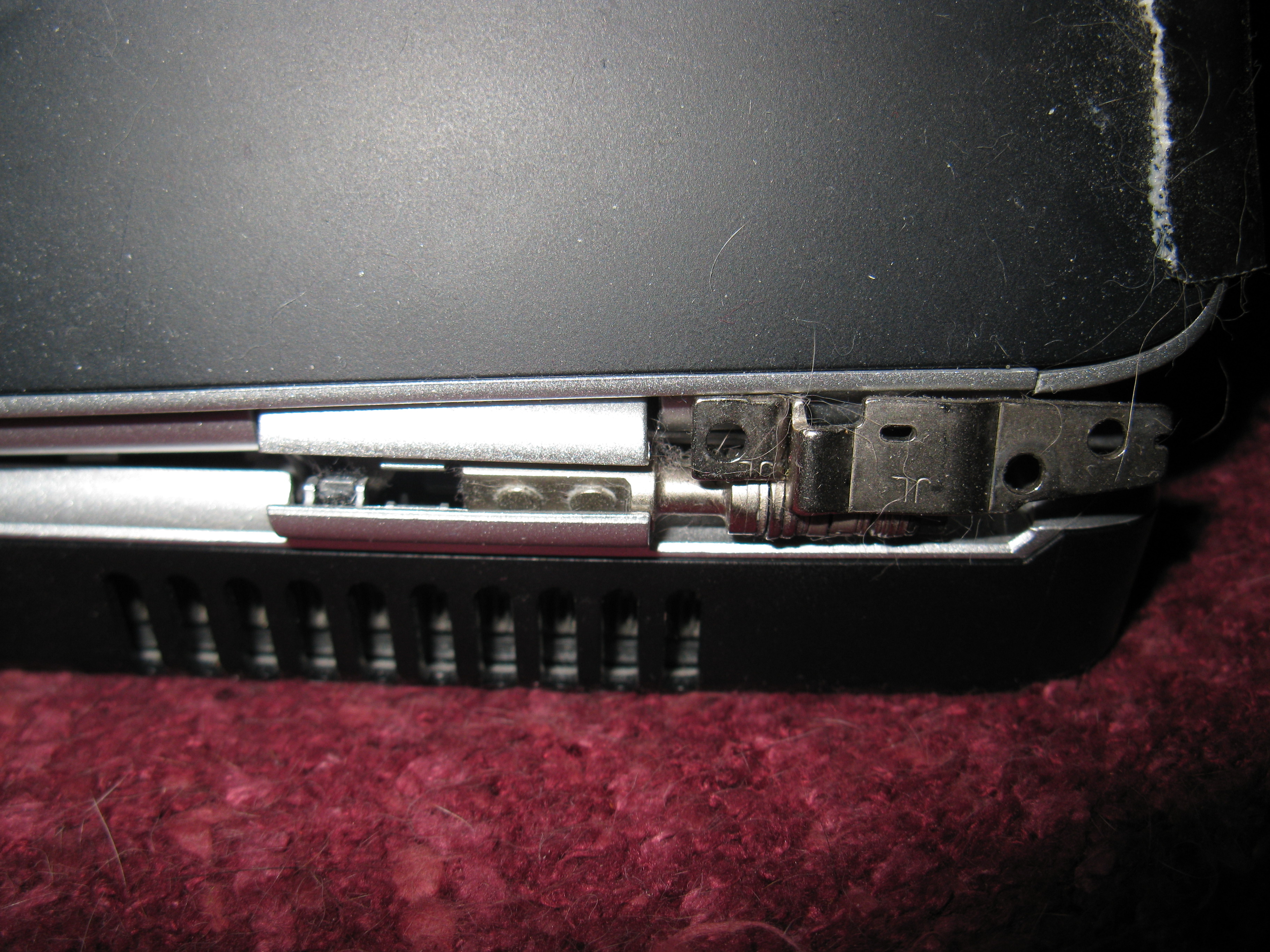
It’s been on a six-day retreat in Houston, getting its hinges fixed. Several weeks ago, one of them popped and bad things ensued. Bits and pieces in the back loosened and bent, and the monitor started to come apart at the seams. I was afraid it was going to spit little internal organs all over the carpet.
I received a phone call last week from Lucia Zimmitti, an editor who spoke at the Texas Trail Writers Roundup this spring. In mid-July, I’d sent her the first five pages of my manuscript. She reported that she’d read them and that they’re ready for query. She said she believes agents who read them will ask to see more.
Music to my ears. I was reluctant to tell her how long I’ve worked and how many revisions it’s taken to get those five pages agent-ready. Lucia said not to worry about time, that some novels are ten years in the making. Actually, it’s the ten years part that worries me, but I know it’s going to take as long as it takes.
After discussing specifics, Lucia asked how much more I have.
A pile of pages. A stack of scenes. Words, words, words, but not in order.
I described where I am in the process and told her how I work. She said not to worry.
When I hung up the phone, I was tempted to dance around the apartment. But I didn’t. My feeling of ecstasy wasn’t pure. It was an alloy, producing calm rather than chaos.
It’s good when people like what I’ve written. But having a professional say those pages show promise is more than good. It’s validating. It means the time, the effort, the embarrassing, sick-making drafts aren’t wasted.
It means that when people ask what I do, I can drop the self-mocking half-smile, the apologetic, “I’m working on a novel. But of course, EVerybody in Austin is working on a NOvel.” I can look them in the eye and say, “I write.” I can remove the quotation marks from “novel.”
I’m tempted here to insert the usual disclaimer: It’s only five pages. I haven’t completed the manuscript. The five present-perfect are future-imperfect–because, with all the twists and turns of drafting, they will have to be tweaked.
But I won’t apologize. Hearing Lucia’s assessment of the intro to Chapter One changed how I perceive both my writing and myself. I’m no longer a dilettante. I’m a writer. I have goals to meet, a manuscript to finish, and no room for excuses.
Figurative language isn’t my forte, but to clarify, I’ll give it a shot.
It’s like when I was ten years old and my Uncle Donald took me out to a pasture in his beat-up 1950 Chevy pickup and taught me to drive. I started out popping the clutch (“Let it out sloooow.“), grinding the gears (“Put in the CLUTCH!”), killing the engine (“Give it some GAS!”), turning the key, popping the clutch, jolting the passenger, bouncing across old furrows. But after a few lessons I got the hang of it and was driving along the turn row, changing gears without incident.
A couple of months later, my father put me behind the wheel of a ’56 Bel Air, which had fewer gears and no clutch at all, and let me drive home from the farm (“Don’t rush up to the stop sign, eeease up to it.”) In due time, I got my license and soon was cruising down the freeway, feeling like a driver.
After I’d invested time, energy, and angst wrestling with the clutch and grinding the gears, finally holding that license brought not only satisfaction but also a feeling of maturity.
The future won’t be a joyride. There will be (here comes the disclaimer) traffic jams and detours and wrong turns down one-way streets. And worse. Like the time I was on my way to the university and my car slid on a patch of once-in-a-decade Texas ice and landed in the ditch facing the wrong direction, right across from my father’s workplace. (“I told you to go slow.” “I DID. I was just doing 50.”)
When Lucia and I finished speaking, it was as if she’d handed me a license to write. I felt settled. Serene. Competent. Equipped for the task at hand.
Cyd Charisse, move over. I feel a dance coming on.
**********
Lucia Zimmitti is president and founder of Manuscript Rx.
P.S. I did not try to perfect the first five pages before moving on. I obsess and compulse, but not to that extent.
Cats are dangerous companions for writers because cat watching is a near-perfect method of writing avoidance. ~Dan Greenburg
I returned home from Just for the Hell of It Writers filled with enthusiasm for the next assignment. Sat down in the recliner, put my feet up, booted up the laptop, read e-mail, checked a couple of blogs, and opened to write is to write is to write. I planned to compose a brief post about characterization–specifically, my reluctance to allow Molly, my protagonist, to exhibit less-than-stellar qualities, such as being human.
Before I could start, however, Ernest climbed into my lap. With the laptop already there, he didn’t have an easy time. He never does. But he made it.
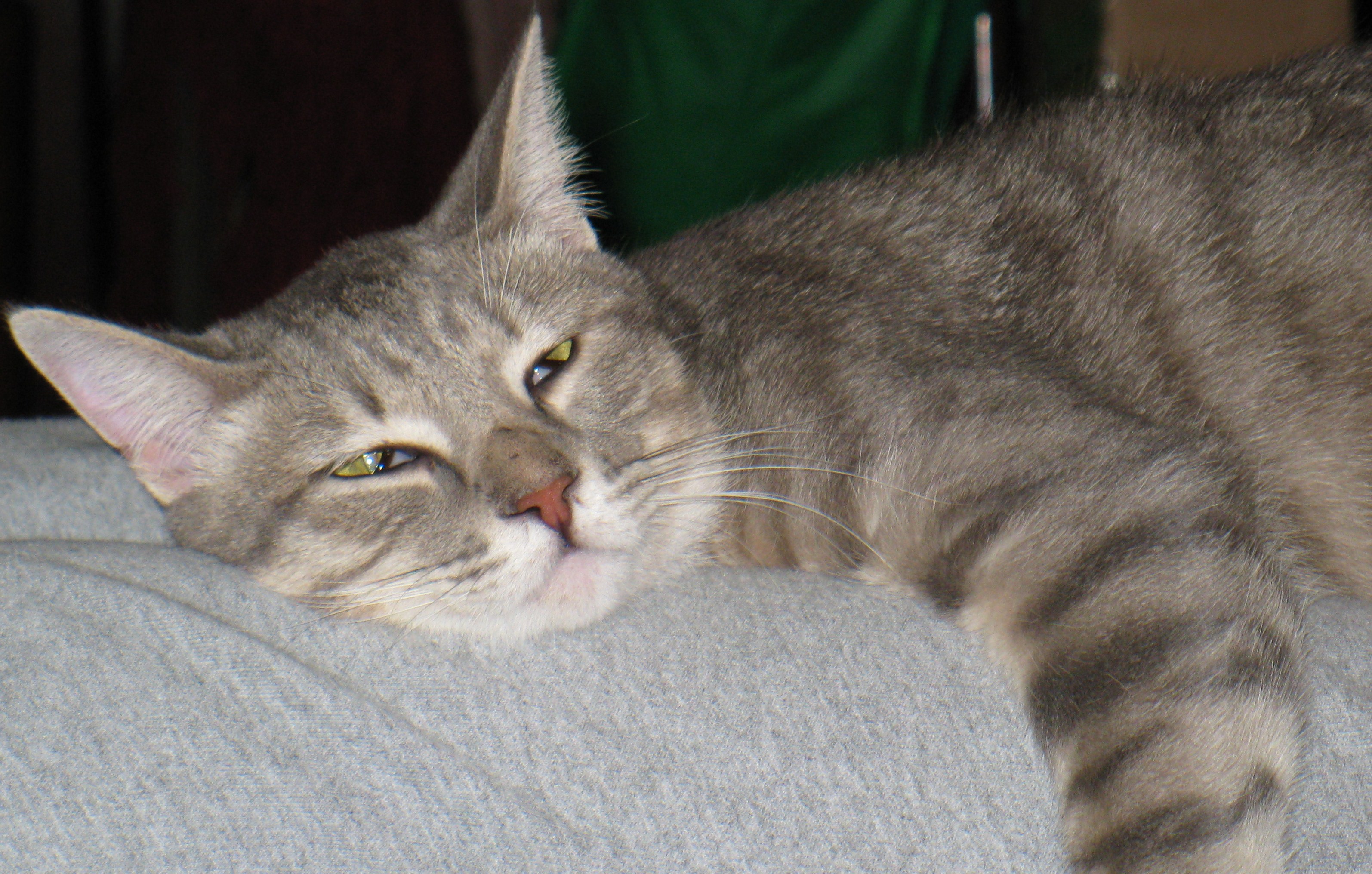
So here I sit with a fuzzy gray tiger draped across my left forearm and wrist, cutting off blood flow to my hand. I don’t know how much longer my fingers will function. I don’t know how much longer this post will function either, because Ernest just touched something–a hot key or some other doohickey outside my sphere of knowledge–and it vanished. I’m lucky he didn’t delete it. Sometimes he does. When it comes to writing, cat watching is the least of my worries.
If he were on my left, I’d be fine with the arrangement. He used to perch there. But a couple of weeks ago he changed sides. As a result, I can’t use the mouse, and I have to bend my index finger at an unnatural angle to reach the touchpad. Periodically he throws his head back to let me gaze into his green, green eyes. That means he wants his ears scratched.
I’ve tried moving him to the left, but he’s heavy and muscular, a feline Jesse Ventura. He’s also the master of his fate and the captain of his soul. After losing three consecutive matches, I gave up.
If you’ve read this far, you’re probably wondering why I don’t evict him from my person altogether.
It’s complicated.
There’s guilt. Yesterday I found him on the dining room table trying to eat a length of purple ribbon. I clapped my hands. That scared him. I spent the next five minutes trying to apologize. He spent the next five minutes evading capture. Then I realized that I’d forgotten to put out catfood on schedule, and that his acting out might have been caused by low blood sugar. I also considered that William, who has a wry sense of humor, might have dared him to jump onto the table. Ernest is impulsive, and I hadn’t taken into account the possibility of diminished capacity. I’m still making amends.
Then there’s the purr. I’ve read that the vibration guards against bone loss and muscle atrophy. Some authorities believe that holding a purring cat benefits human tissue as well. Holding Ernest could protect my writing arm against osteoporosis.
Furthermore, allowing cats a bit of leeway is a writerly thing do. Charles Dickens’ cat, Wilamena, had kittens in his study; the kitten Dickens kept later became his companion while he wrote. Raymond Chandler’s Taki, whom he called his “secretary,” sat on manuscripts he was trying to revise. T.S. Eliot sent his cats to Broadway. Mark Twain couldn’t resist cats, “especially a purring one.” I don’t know whether Garrison Keillor has cats, but he joined with the Metropolitan Opera’s Frederica von Stade to make an entire CD of cat songs (“Songs of the Cat”), and Bertha’s Kitty Boutique is one of The Prairie Home Companion’s most prominent sponsors. I can’t think of better role models than Keillor, Twain, and Von Stade.
Finally, I allow Ernest to walk all over me because I’m concerned about mental and emotional balance. My own. Sigmund Freud emphasized the cat’s importance in coping with the stresses and strains of modern life: “Time spent with cats,” he wrote, ” is never wasted.”
Freud might not have known much about women, but he had a thorough grasp of cats.
Since I began this piece, Ernest has jumped down, back up, down, back up, and down again. William, who, bless his heart, parks on the left, has visited twice.
It’s not always easy to remember my reasons for being a doormat, especially the one about balance. But when the conscious mind fails, the subconscious defaults to guilt.
Well. Once again I’ve written about not writing. Once again the obstacle has been cats.
[Full disclosure: If I had my druthers, I’d emulate Miss Von Stade instead of the writers. She gets paid to sing, she doesn’t have to make up the words as she goes along, her picture appears on the front cover, the Amazon reviewers simply gush at her “magnificent” voice, and she doesn’t have to read Bird by Bird twice a month to keep her spirits up. What’s not to emulate?]
Many thanks to the author of “Invictus.” If we ever get a brother for William and Ernest, we’re going to name him Henley.
Last week CP and I made a pact to write at least 100 words a day.
When I began this manuscript, I wrote at least 500 words a day. But with one thing and another, over the months, production slipped. So, although 100 seemed paltry compared to what I used to do, or what I could or should do, I thought it a reasonable minimum, small enough not to feel threatening or to spark the dreaded Writer’s Block.
If I’d known I was going to rejoin Curves today, however, I would have held out for only fifty.
I made one Curves circuit, fifteen minutes of pushing and pulling against hydraulic resistance. Twice would have possible but stupid. In the first place, I have no sense of proportion. No shades of gray. It’s all or nothing. If I’d stayed, I would have ended up putting every scrap of energy I possessed into doing battle with those machines. And at the end of the day, I’d have felt worse than I do now.
In the second place, …I’ve forgotten what’s in the second place.
That’s an indication of how fit I am to add 100 words to Molly’s story before I crater.


 M. K. Waller