I never wrote a word that I didn’t hear as I read.
~ Eudora Welty
*
Familiarity. Memory of the way things get said. Once you have heard certain expressions, sentences, you almost never forget them. It’s like sending a bucket down the well and it always comes up full. You don’t know you’ve remembered, but you have. And you listen for the right word, in the present, and you hear it. Once you’re into a story everything seems to apply—what you overhear on a city bus is exactly what your character would say on the page you’re writing. Wherever you go, you meet part of your story. I guess you’re tuned in for it, and the right things are sort of magnetized—if you can think of your ears as magnets. I could hear someone saying—and I had to cut this out—”What, you never ate goat?” And someone answering, “Goat! Please don’t say you serve goat at this reunion. I wasn’t told it was goat I was served. I thought—” and so on, and then the recipe, and then it ended up with—I can’t remember exactly now—it ended with, “You can do a whole lot of things with vinegar.” Well, all these things I would just laugh about and think about for so long and put them in. And then I’d think, that’s just plain indulgence. Take it out! And I’d take it out.
This is Alpine, Texas with the six-thousand foot plus Ranger, Twin Sisters, & Paisano Peaks in the foreground. (Photo credit: Wikipedia)
In Monday’s post, I announced my goals for Round 3 of A Round of Words in 80 Days (ROW80):
To write 300 words a day, five days a week; and
Not to haul myself out of bed at 5:00 a.m. to write the 300 words.
So far, the latter goal has been easier to accomplish than the former. Nonetheless, I made my 300-word minimum and then some both Tuesday and today.
I’m working on a short story that began as a ten-minute timed writing at the Writers’ League of Texas Summer Writing Retreat at Sul Ross State University in Alpine a couple of years ago. I spent the week in Karleen Koen’s class, Writing the Novel: The Basics. That was probably the most productive week I’ve ever had. Karleen told us she couldn’t teach us to write, but she could teach us to play. And she did. She’s teaching the class at this summer’s retreat later in July. She also teaches for Rice University’s Continuing Education Department in Houston. Anyone who has the opportunity to take one of her classes should do so. Lots of writing, lots of fun.
The timed writing that I hope becomes a full-fledged story begins, The day I found Mama stirring ground glass into the eggs she was about to scramble, I took the eggs away from her and called a family conference. When I started, I had no idea where it was going. Back at home, I added to it and showed it to my critique group. They said I should work it into a novel. I still didn’t know where it was going. Or where I could make it go. But it didn’t seem like novel material, at least in my hands. Last summer, I tried to turn it into a ghost story but kept running into obstacles, the chief of which was that the plot was forced and downright silly. Now, a year later, an invitation to write a different kind of story has come along. Once again I dragged out Mama and the ground glass. And this time I think I can pull it off. It’s not over till it’s over, of course, but I’m optimistic.
It takes time to get some things right.
***
To see what other members of ROW80 are writing, click here.
To all who read yesterday’s post and voted for Kate in Penguin’s Wayfarer contest, many thanks. Here’s a sticker for you.
Lacking stickum, it’s not technically a sticker, of course, more like a pin-on-er. And you’ll have to print and cut it out and provide your own pin. I hope you don’t mind.
I’m not quite competent in Windows Paint and am amazed I got the text box to stand still long enough to put words in it.
To anyone who hasn’t yet cast a ballot, there’s still time. Voting runs through June 24.
Kate’s entry needs to be in the top 10 to advance to the next round. At last check-in, Kate’s entry ranked 11th out of 20. That’s close, but not close enough. And it’s not enough to send harmonious vibrations. More clicks of the VOTE icon–that’s what it’ll take.
Look for the only Kate on the page. Her entry is “A Walk Round Caesar’s Camp, Brackell.” Here’s the link: http://www.ajourneyonfoot.com/
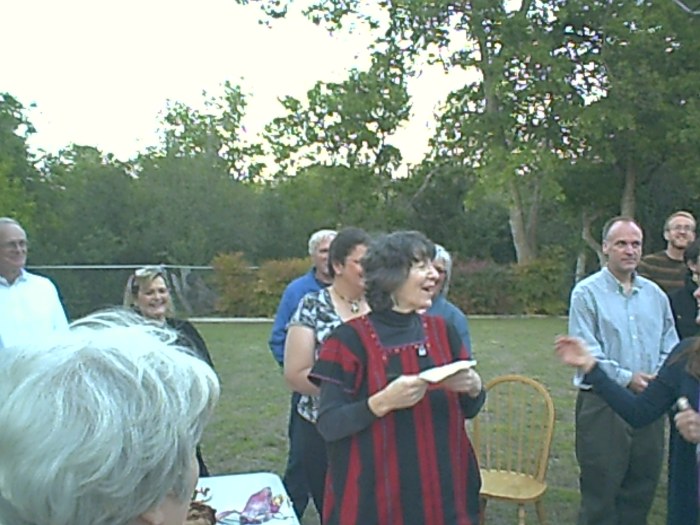
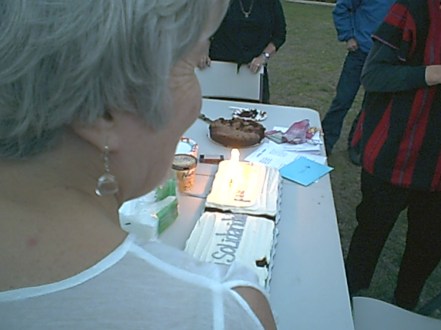
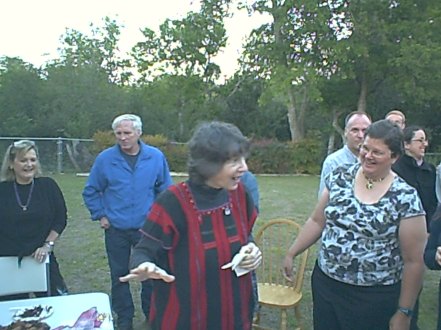
Yesterday evening we had the pleasure of attending a celebration of our friend Judith Rosenberg’s seventieth birthday.
We first met Judith several years ago when she joined the 15 Minutes of Fame writing practice group. Through both her writing and our conversations over lunch, we’ve learned that she hails from New York, that she earned a Ph.D. from the University of Texas at Austin, that she sings and plays the guitar, that she writes poetry, that she likes Indian cuisine, that she has thought of writing fiction based on her doctoral dissertation.
Now. Reading over the preceding paragraph, I’m struck by its inadequacy. I should have taken notes during the open mic segment of the party, when people who have known her for many years, worked with her, traveled with her to the Texas-Mexican border reminisced about their friendships, using words such as dedication, service, tirelessness, brazenness, and spirit of anarchy.
In fact, brazenness and spirit of anarchy make me wish I’d both taken notes and asked questions. I believe I missed some interesting stories.
The Judith story I’ll share will seem trivial compared to what others have told, but it relates to something in her personality and character that I have personal knowledge of, and that appeals to me: Judith likes dogs. Not long after we met her, she adopted Chucho (Chuchi to his friends).
According to my research, chucho means dog, mutt, ormongrel. Depending on where in Latin America you happen to be, it can also mean long-eared owl, sweetheart, rawhide whip, jail, shiver and shake, gossipy, tamale, and custard-filled doughnut. It can mean something else, too, but I won’t go into that. It’s enough to say that Judith’s Chuchi is a sweetheart. There’s a bit of custard about him, too.
When Chuchi became part of Judith’s family, our writing group was meeting in the large back room of a small but popular coffee shop. We arrived early on Saturdays and took over a far corner, moved tables together to accommodate the usual six or seven people, and settled in for the next two or three–or four–hours. Because the City of Austin allows dogs on decks and patios of eating establishments, Judith brought Chuchi along. He was blessed with the enthusiasm of (large teenage) puppyhood, but he behaved admirably, especially when Judith was with him. When she went inside the main room to order breakfast, leaving David to act as dogsitter, Chuchi loosened up, danced around a bit, greeted strangers. David is not a strict disciplinarian.
While we breakfasted, wrote, and read, Chuchi lay on the floor beside Judith’s chair. Occasionally he took a stroll, bumping legs, poking his nose out from under the table, reminding us he was there, willing to accept all morsels that came his way, probably wondering why none ever did. Chuchi wasn’t allowed people food.
This pattern continued for the better part of a year, until one day a man with an air of authority about him approached Judith and kindly told her that Chuchi was violating a city ordinance: dogs are allowed on decks and patios outside. The room we met in had once been outside, but since the gaps in its concrete block walls and its partial roof had been closed, and it had been gussied up with paneling and A/C and a heater, it was now inside. He was sorry, but Chuchi could not return.
We were sad, but soon afterward we moved our meetings to a library, where dogs don’t even think about entering. So Chuchi wouldn’t have been able to stay much longer anyway. And since libraries don’t serve food, he probably didn’t regret his banishment. He enjoyed our society, but the aroma of sausage seemed to be the real draw.
We couldn’t get a picture of Chuchi last night because instead of attending the party, he went to a sleep-over.
All right. End of Chuchi story and back to his owner.
Judith’s passion is social justice. She is board president of Austin tan Cerca de la Frontera, an organization that seeks to address conditions of social and economic injustice along the Texas/Mexico border particularly as they affect women and communities of color, and to find community-driven alternatives through transnational solidarity and fair trade. She’s also involved in Women on the Border, the Texas Fair Trade Coalition, and Fuerza Unida. She organizes delegations to travel to Mexico to meet with maquiladora workers in communities along the border.
You can read more about Judith and Austin tan Cerca’s activities at the ATCF website. Judith may show up again here as well. There’s still research to be done on that spirit of anarchy thing.
Deutsch: “Kopfschmerzen”. Die wohl berühmteste – stark von James Gillray beeinflußte – Arbeit in einer Reihe von sechs Blättern “medizinischer” Karikaturen, in denen Cruikshank Krankheiten als Teufelswerk brandmarkt. Erstmalig publiziert: 12. Februar 1819. Originalgröße: 210 x 255 mm (Photo credit: Wikipedia) George Cruikshank [Public domain], via Wikimedia Commons, PD-Art Yesterday Dominica felt faint, and Molly, my main character, steered her to a bench on the courthouse lawn and then dithered over what to do. She couldn’t leave Dominica, but she thought asking a passerby (of which there were none at the time) for help sounded lame.
Today, talking about treatments for migraines, one of my brilliant critique partners took a bottle of peppermint oil from her purse and passed it around. At the first whiff, I said, “Molly carries peppermint oil in her purse! She’ll use it to revive Dominica.”
In one fell swoop, I both saddled Molly with migraines and solved a knotty problem.
“I think the biggest myth that writers might have about themselves is that we’re somehow more important than we really are. I always cringe a little when I hear a writer say it’s our duty to make social commentary, expose social injustice, etc. I don’t think it’s my duty at all. My duty as a writer is to tell a good story, and to tell it well. If I’m faithful to my characters first and foremost, then it often happens that some sort of social commentary occurs. But honestly, if it doesn’t, it doesn’t. It’s not my job to be lofty, or to somehow ‘have my finger on the pulse of the nation.’ I’m just a writer, a modern-day storyteller. If I thought I was anything more, I’d get frightened and completely shut down.”
~ Nancy Peacock, A Broom of One’s Own: Words on Writing, Housecleaning & Life
Despite all the time I’ve wasted scrolling through Facebook, I’ve received more from the site than I’ve lost. It’s allowed me to reconnect with students I taught thirty years ago.
Last night I was chatting with a member of the class of 1982. She gave me permission to link to her website. She didn’t give me permission to comment, but I will anyway. What can she do–flunk me?
I want to make it clear that I never taught Judy anything. I couldn’t have taught her anything. She already knew what she needed to know. She was a writer. A poet.
She entertained us periodically with essays describing her part-time job at a nearby country club. I have vivid memories of long, furry tendrils reaching out and wrapping themselves around her legs while she was cleaning out the walk-in refrigerator. Those memories, and others, told in nauseating detail, made me laugh even as I vowed to avoid that particular dining room.
In her junior year, Judy placed in a poetry contest at a nearby college. One of the judges said she’d wanted to place the poem higher, but it was too short. The next year, she won the competition with another poem–the same length as last year’s. I memorized it and later, when I was teaching at a local university, posted a copy of it on the door of my office.
After Judy graduated, I found her mentioned in an article in the Austin newspaper: UT student Judith Edwards had appeared at Eeyore’s Birthday Party in Pease Park wearing a python draped across her shoulders. The accessory seemed to me entirely appropriate. Her goals had never included conformity.
Browse through her poems and stories. You’ll get an idea of the pleasure I had being her student.
***
P.S. I hesitate to add this–I mean, I hate to give readers who live outside the United States such a…truthful…view of Texas, but if you have a mind to, read Judy’s story “The Big Texan.” She didn’t make it up. I wasn’t there, but I know it really happened.
Last night I did the unthinkable. Or the un-thought-out.
I stumbled upon StumbleUpon, joined, and stumbled upon websites I would be better off not knowing about. I could click click click for hours, and did. Quotations. The Pre-Raphaelites. Cats…
One site, however, has oodles of redeeming creative value–so many oodles, in fact, that I wanted to pass the word. Once I began, I thought of other worthwhile online resources that have been shared with me.
So here, beginning with the stumbledupon, are four places any writer battling a surfing habit can visit safely and without guilt.
Oneword offers a one-word prompt–and then sixty seconds in which to write–on the site itself. You can use the site free or join–free. If you join, you can submit what you’ve written to a members-only page. You also get access to the archive of words.
Oneword is social media site, if you want to use it as such. I’m interested in seeing what I can write in only 60 seconds. And in finding out whether I improve with practice. And in stumbling upon a few lines that spark an idea for a story. Here’s what I wrote tonight using the word placed.
Tacos (Photo credit: YardSale)
placed
He placed the plate on the table in front of her.
Tacos? she said. They’ll crumble and spill all over my dress.
Why’d you wear white? he said.
Men, she thought. They don’t understand anything.
Write or Die allows you to set goals–# of words and # of minutes–plus consequences and a grace period if you fail to hit your targets. Choice of consequence and grace period comprise such words as gentle/normal/kamikaze/electric shock and forgiving/strict/evil.
I’ve used this site several times when I needed external stimulation; at one particular setting, if you pause too long to think, the backspace function starts eating the words you’ve already written. It’s fun if you’re not the anxious type. If you are, set it at the lowest levels. (Scroll down till you see the free Web App Online, unless you want to pay for a download to your desktop.)
Written? Kitten! (writtenkitten.net) gives you a picture of a kitten every time you complete your target word count: 100, 200, 500, or 1000. No restriction on time. Strictly reward, no punishment. No words are gobbled up. Great for cat lovers, but if cats give you the fantods, skip it.
Note that Written? Kitten! is a dot net, not a dot com like the other sites described here. If you look for dot com, you’ll find something you don’t want.
Rescuetime tracks the sites and programs you use and analyzes your productivity. To use the site, you must join, but it’s free. RescueTime gives you points (+, 0, -) for the sites you use during each accounting period. You can reset values–for instance, you may designate your blog site as productive for +2 points rather than as entertainment (social media, -2 points). You can also target when you want RescureTime to track–if you write in the afternoon, set it to track just the afternoon. Check how productive you are by by day, week, month.
There’s a great deal of information here, lots of graphs and charts, more than you need if all you want tracked is time you’re writing/not writing. Still, it can be an eye-opener. So far, it’s told me I’m a first-class slacker, but that was less of an eye-opener than a confirmation. Which is why I’m using RescueTime.
Have you found any online resources that aid your writing or creativity? Would you share?
3) write a daily blog post, and if that becomes too difficult, reduce to three posts per week;
4) participate in at least one A Round of Words in 80 Days challenge, which is no problem for anyone who sets out suggestions and then blogs at least once a week;
5) fix up an office in the spare room;
6) go to bed before midnight so the rest of this list has a chance of being done;
7) keep a timesheet;
8) trim this list to #s 1, 2, and 5 if necessary; do some calculations and acknowledge that #s 1-6 won’t be a burden if the person doing them just gets up and DOES them.
Amen.
***
For the first week of A Round of Words for 80 Days, I’ll focus on Suggestion #2.
Earlier today, I decided to enter the WordPress Post Every Day 2013 challenge. I added the badge, which had just become available, to the blog’s sidebar and congratulated myself on having already posted on January 1.
At 11:58 p.m., something moved me to look at the date of the previous post, which I’d published on January 1. It read, December 31, 2012.
I won’t explain the mental gyrations I went through to turn today into yesterday and tomorrow into today, but for a person of my genius, it was nothing, really nothing.
Something, really something would have been composing and publishing the January 1 post in less than two minutes.
Here’s where genius stepped back in and righted things. I entered an appropriate title, saved the empty draft, and clicked Publish.
To some, this might seem dishonest, underhanded, unscrupulous, unethical–cast your own aspersion–but I see it as artful and astute. Foxy, but in the nicest way.
If the calendar hadn’t betrayed me, I would have laid out my New Year’s Suggestions. But I’ve already messed up on Suggestion #5 (Go to bed before midnight), which is the foundation for #2 (Honor theSacred Writing Time Pledge, 2013 that I signed this morning), which, in turn supports Suggestion # 1 (Write for at least one hour a day.)
And because I don’t want to spend a second midnight scrambling for a calendar, I’ll retire at the first opportunity. Like now.
***
Coming tomorrow (aka later today): The Seven Suggestions
Every week, I meet a friend for coffee at a shop near my house. Every week, she says, “What have you been doing?”
Every week, I pause and say, “I can’t remember.”
Memories (Photo credit: Wikipedia)
Then I ask her the same question and she can’t remember what she did either.
We’ve agreed not to worry about our mutual amnesia. It doesn’t prevent us from conversing for the next two or three hours. And, all things considered, it isn’t surprising that nothing outstanding springs to mind. We have rich internal lives, but otherwise, our days do tend to swamp together once they’re past.
Oops. I just stopped and re-read the previous paragraph and realized it could herald the start of a downhill slide straight into a maudlin mire. Sort of like an inverse fiscal cliff.
But no. Here’s what I’m getting at: I intended to look back on 2012, capture its high points, before moving on. But suddenly my mind is a blank.
I didn’t keep a journal. The closest thing I have to a record of the year is this blog, and the problem there is–well, you know how I exaggerate. And you might have noticed I was absent for long stretches; that leaves some big holes in the narrative. I could elaborate, but I’ll say simply that I was not lying on the beach at Cannes, no was I in a mountain cabin finishing the Great American Novel. More’s the pity.
I’ll also say a sincere Thank you to those who kept on visiting here when I was neither reading nor writing, and also when I was writing but not answering mail. As Polly Pepper would say, you are all bricks.
(Fifty years after meeting Polly Pepper [my mother read Phronsie Pepperto me when I had the chickenpox and the measles in rapid succession], I (tonight) looked up you’re a brick and discovered it started, possibly, with King Lycurgus of Sparta describing his soldiers. It’s amazing what one can find to distract one from one’s purpose.)
This post is beginning to sound like one of those afternoons at the coffee shop, so I will end it. The waiters tolerate meandering because the shop is nearly empty, and because upon leaving we tip well. I don’t expect readers, who receive no gratuity at all, to mosey along for what’s likely to be a dead end.
So. I wish you a happy, healthy 2013.
Talk to you next year.
***
P.S. Regarding the photo above. That is exactly what I look like when I’m trying to remember what I did last week. Right down to the big black eyes, long black lashes, and dimpled elbow.
Whenever I find myself growing grim about the mouth; whenever it is a damp, drizzly November in my soul; whenever I find myself involuntarily pausing before coffin warehouses, and bringing up the rear of every funeral I meet; and especially whenever my hypos get such an upper hand of me, that it requires a strong moral principle to prevent me from deliberately stepping into the street, and methodically knocking people’s hats off—then, I account it high time to get to sea as soon as I can. ~ Herman Melville
National Novel Writing Month–NaNoWriMo–started yesterday. Because I can’t resist challenges, I’d already registered as a participant. All I had to do was begin. Boot up the laptop, write 1667 words every day for a month, and pat myself on the back. And publicize my accomplishment. Publicizing allows other people to pat your back, too.
The number of the beast is 666 by William Blake. (Photo credit: Wikipedia)
Here I must digress. 1667 reminds me of a story:
When my library converted to an automated circulation system, the staff typed, barcoded, laminated, and distributed several zillion library cards. A couple of days later, a freshman girl appeared at the circ desk and told me she wanted a different card.
She pointed to the barcode. “This one is against my religion.”
I examined it for heresy: # 1666.
I was tempted to say–quite reasonably–“No, dear. The number 666 is against your religion. This is 1-666, a different thing entirely. Now run along and have a nice day.”
Instead, I said, “It’ll take about five minutes.”
Some things aren’t worth arguing about.
NaNo isn’t worth arguing about either, and that’s what NaNo makes me do. Argue. With myself.
Every year, I sign up to write 50,000 words in thirty days, and as soon as November 1 arrives, I tie myself in knots.
NaNo is supposed to be fun. It’s supposed to be about freedom. It’s about pouring words onto paper. It’s about turning off the inner critic and going with the flow.
I’ve never been good at fun. And I like to do things right the first time so I don’t have to do them over. These are not the best traits for a NaNo participant. Or for any aspiring writer.
Here’s another story. About ten years ago, I read Tracy Chevalier’s Falling Angels. I’d loved her Girl With a Pearl Earring, but Falling Angels was better. Exquisite.
Later I read an article in which Chevalier told how she’d written the novel. She’d completed the manuscript but felt something about it–she couldn’t say exactly what–was wrong. So she set it aside. Then she read Barbara Kingsolver’s The Poisonwood Bible, which is told from multiple points of view, and saw potential. She completely rewrote her manuscript, changing the third-person narrative to multiple first-person points of view.
Chevalier’s description of her “process” impressed me, but for the wrong reason. I should have focused on her dedication, her craftsmanship, her openness, her perseverance in the pursuit of art. Instead–and I’m ashamed to admit this–I put down that article thinking, “How could she bear to write an entire manuscript,draft after draft,hundreds of pages, and then cast it aside and write the whole thing all over again?”
I had hardly enough energy to read about it, much less to contemplate doing it.
Well, there’s my dirty little secret, spilled all over cyberspace.
I’m not lazy. I just have an active imagination. I become exhausted in advance of need.
And the thought of the NaNo variety of freedom leaves me in shackles of my own design.
Gosh, it’s so nice to have a blog. There’s nothing I like better than sharing my neuroses with people I don’t know. And some I do.
On the other hand–looking at the subject from, as it were, a different point of view–it’s possible that my neuroses are responsible for everything I write. For my compulsion to return to the keyboard. For my love-hate relationship with NaNo. For my ability to jabber all over a blog and then have the fantods at the sight of a blank MS Word screen.
I started this post intending to thank my critique partners for encouraging me to dive into NaNoWriMo, letting the devil and my 3400-word deficit take the hindmost. Unfortunately, in the course of self-psychoanalysis, I wandered off topic, and now I can’t think of an appropriate transition.
Nevermind.
This is November. NaNoWriMo. Freedom. Death to transitions! Throw convention to the wind! Write bad drafts! Worse drafts! Quantity, not quality, counts.
So thanks, Austin Mystery Writers, for aiding me in this damp, drizzly November in my soul.
And thanks, dear reader, for enduring another 700+ words of self-indulgent cliched prattle.
Writing about the pain of writing is such sweet sorrow, I could prattle on till it be morrow.
I [Billy Hathorn] took photo of Eudora Welty at National Portrait Gallery in Washington, D.C. U.S. government collection, public domain (Photo credit: Wikipedia)How could The New Yorker reject the writer who coined the word concubineapple? And who had the nerve to use that word in her letter of application?
Beats me.
See what other qualifications Ms Welty offered her potential employer at Letters of Note: “How I Would Like to Work for You!”
“Do you remember when you learned to read, or like me, can you not even remember a time when you didn’t know how?” ~ Harper Lee, in a letter to Oprah Winfrey
Last week the manager of the neighborhood HEB told me the store no longer accepts checks written with pink ink. They would take mine this time, but in the future…
What a shame. I’ve always thought my colored ink–especially the pink–added a certain flair to my checks. I imagined it made people in the back office happy to see pink ink. I believed my checks provided a bright moment in their dreary numerical lives.
I wheeled groceries to my car thinking of Amy, my first paralegal instructor, who said she signed everything in purple. I wondered whether the Bexar County District Clerk has since told her to stop it.
But I digress.
Act III of Shakespeare’s Hamlet: King Claudius and the theater. (Photo credit: Wikipedia)
We now return to grocery store, where we are reminded that Shakespeare’s themes are indeed universal, and that perfectly nice people still suffer the slings and arrows of outrageous fortune and bear the Oppressor’s wrong, the proud man’s Contumely, the insolence of Office, and–especially–the Spurns that patient merit of the unworthy takes. To wit:
Yesterday I wrote another check to HEB–in black ink this time–for $48.26; but on the second line I spelled out forty-six. I considered voiding the check and writing another, but instead struck through the six, wrote eight above it, and initialed the change. I also wrote my phone and drivers license numbers. Handing the check and my license to the cashier, I said, “I made a correction. Is that all right?”
The cashier looked at my check. She looked at my license. She looked at me. At the license. At me. At the check…and so on, back and forth. I wished she would stop.
Just when I was on the verge of offering to write another check, or, better yet, pulling out my credit card, she said, “You didn’t spell this right.”
Huh?
“It needs an h.”
She pointed to the word eight.
“It’s spelled correctly,” I said. It had an h. Adding another would have made it eighth.
She looked at me, looked at the check. Examining the check, she appeared confused, but the looks she gave me were accusing. Frown. Narrowed eyes. You know the look I’m talking about.
Now I was on the verge of saying, I have known how to spell eight since I was seven years old, so there! But again I remained silent.
Finally she hit on a solution. She set the check on the counter, dotted the i, and went over the word, tapping each letter with the point of her pen. Then she said, “Okay,” ran the check through the little machine thingy, and handed me the receipt. I gathered my groceries and left.
It was fortunate our conversation ended there, because I’d been on the verge of saying, In fifth grade, I won the district University Interscholastic League spelling and plain writing contest with a perfect paper, which means I closed all my o‘s and a‘s and made the k‘s and l‘s taller than the t‘s and d’s, AND I dotted all the i’s. And I didn’t misspell eight.
Walking across the parking lot, I once more noted my unfortunate resemblance to Frasier. I didn’t go to Harvard, but I know how to spell eight, and I left the i undotted for aesthetic reasons. Nyah nyah nyah.








 M. K. Waller