J Is for Juliet & Ophelia & Paying for Groceries: #atozchallenge

When students asked, “Why do we have to read all this literature?” I told them it would help them to play Jeopardy. You never know when Alex Trebek will ask you a question. Since leaving the classroom, I’ve come up with other reasons. Here’s one I wrote about back in 2012.

*

At HEB this afternoon, having verified that I had, indeed, spent my last sou on a cup of coffee at Waterloo Writers, I ran my credit card through the scanner. The resulting screen read, Select Tender Type.

Tender.

Such a formal, old-fashioned word for this new-fangled device.

It reminded me of the scene in which Polonius asks Ophelia about the status of her relationship with Hamlet:

Polonius: What is between you? give me up the truth.

Ophelia: He hath, my lord, of late made many tenders
Of his affection to me.

Polonius: Affection! pooh! you speak like a green girl,
Unsifted in such perilous circumstance.
Do you believe his tenders, as you call them?

Ophelia: I do not know, my lord, what I should think.

Polonius: Marry, I’ll teach you: think yourself a baby;
That you have ta’en these tenders for true pay,
Which are not sterling. Tender yourself more dearly;
Or–not to crack the wind of the poor phrase,
Running it thus–you’ll tender me a fool.

Poor Ophelia. She was a sweet thing, and young, and the men in her life treated her so shabbily.

But even though Polonius belittles his daughter to her face, the way Shakespeare moves tender through the passage, varying its meaning from one line to the next, renders the speech remarkable. As Hamlet later implies, Polonius is a rat—and he pays for his treachery a couple of acts down the road—but the old man has a way with words.

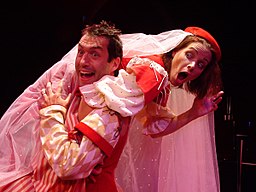
Thinking of Polonius and Ophelia reminded me of Lord Capulet‘s rage when Juliet tells him she will not marry Paris. He explodes, and Juliet adds fuel to the fire.

Capulet: How! will she none? doth she not give us thanks?
Is she not proud? doth she not count her blest,
Unworthy as she is, that we have wrought
So worthy a gentleman to be her bridegroom?

Juliet: Not proud, you have; but thankful, that you have:
Proud can I never be of what I hate;
But thankful even for hate, that is meant love.

Capulet: How now, how now, chop-logic! What is this?
‘Proud,’ and ‘I thank you,’ and ‘I thank you not;’
And yet ‘not proud,’ mistress minion, you,
Thank me no thankings, nor, proud me no prouds,
But fettle your fine joints ‘gainst Thursday next,
To go with Paris to Saint Peter’s Church,
Or I will drag thee on a hurdle thither.
Out, you green-sickness carrion! out, you baggage!
You tallow-face!

“Thank me no thankings, nor, proud me no prouds, / But fettle your fine joints ‘gainst Thursday next,…” Beautiful. Those are the words of an angry man. Just seeing them on the page gives me the shivers.

To some, Capulet sounds like a terrible father, but, as I pointed out to my freshmen, year after year, Juliet started it. She was rude and disrespectful. Her father didn’t know she was already married to Romeo; he thought she would be thrilled to marry the wealthy and handsome Paris. But she behaved like a brat. It’s no wonder Capulet threatened to drag her on a hurdle thither.

These two female characters present an interesting contrast: Ophelia refuses to speak for herself; Juliet shouts. But neither one lasts to the end of Act V.

A scholarly paper might lurk in there somewhere: “Shakespeare’s Women: A Study of the Consequences of Self-Actualization Within the Context of the Father-Daughter Relationship Complicated by Nascent Heterosexual Bonding, with a Focus on Hamlet’s Ophelia and Romeo and Juliet’s Juliet.”

Or maybe not.

By the time I finished with the Capulets, the cashier had almost finished with the scanning. While she bagged the items, I pondered the relationship between the name of Jason FForde’s protagonist, Thursday Next, and the once-projected date for Juliet’s wedding.

Then I remembered that Tennyson’s The Idylls of the King contains a line echoing Thank me no thankings, nor, proud me no prouds. I don’t remember which character says it, and I’ve not been able to locate it online; I guess if I’ll have to re-read the entire Idylls just to ease my mind.

But I recognized other lines that drifted across the screen: Guinevere, jealous of Elaine, takes up Lancelot’s gift of diamonds


And thro’ the casement standing wide for heat
Flung them and down they flash’d, and smote the stream.
Then from the smitten surface flash’d, as it were
Diamonds to meet them, and they past away.


That image—diamonds falling into the sunlit stream, and water splashing up, like diamonds to meet them—has been with me for thirty-five years and will remain when the rest of the book has passed from memory.

Well. By the end of my reverie, the cashier and I had completed our transaction. I wheeled the groceries to the car. End of shopping.

End of post.

Except to observe that I stood for ten minutes in one of the most boring places imaginable and forgot to be bored.

I was busy elsewhere.

***

Here are some A to Z Challenge blogs–and some not A to Z Challenge blogs–you might like to visit.

Sparkonit Science Simplified

Charles Heath — Author

iScriblr

A Pondering Mind

Anne’s Family History

FranceSays

Ailish Sinclair: Stories and Photos from Scotland

Zombie Flamingos

Beth Lapin’s A to Z Blog

Abbie’s Corner of the World

***

Images from Wikipedia:

“Ophelia” by John William Waterhouse

“Juliet” by John William Waterhouse

I Is for I Like Alien Resort: #atozchallenge


About a zillion words into a post about ifferisms, I discovered I was so bored I couldn’t go on, and if I couldn’t go on, neither could anyone else. So I abandoned it. That left a void in the topic area, but the only I word I could think of was I.

Well, they say write what you know: I like these books. I like these movies. I like chocolate.

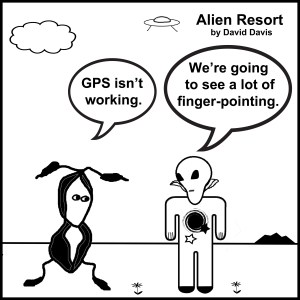
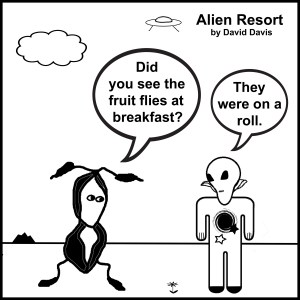
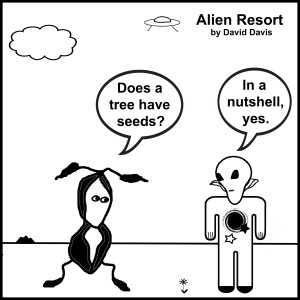
Then  David gave me permission to write about Alien Resort, a cartoon peopled–or, more accurately, aliened–by visitors from outer space.

Creator, writer, and illustrator, Earthling David Davis, is aided by the four ETs pictured below: Coy, Plucky, Deadpan, and Lmao. Coy founded Alien Resort after crash landing on Earth. The others arrived later. Read their bios here.

Alien Resort. © David Davis.

The cartoon appears in newspapers from California (Alameda Sun) to Brooklyn (Canarsie Courier) to Cumbria, UK (Egremont 2day ) to Australia (Dunoon and District Gazette), plus a number of other publications along the way. They’re listed at the Hall of Fame.

Here’s a sample of what you see at Alien Resort:

*

In 2015, David’s submission won John Kelso’s Funny Christmas Card Contest (Austin American-Statesman).

His short film Invisible Men Invade Earth has been screened at a number of festivals. It was named Most Original Concept at the 2016 Houston Comedy Film Festtival and Judges’ Choice at the 2017 What the Fest in Dallas. Read more about it and watch it on vimeo.

H Is for The House of the Seven Gables: #atozchallenge

Unable to think of an H word I could get a post out of (I searched the dictionary for a likely candidate, but in vain), I fall back on a post that appeared April 9, 2018, exactly one year ago, for Day H of the A to Z Challenge. It’s a little English majory, but I restrained myself as best I could. For example, I used only five semicolons.


*


In November 2016, I posted about my upcoming visit to Salem, Massachusetts for UnCon, the writers’ conference hosted biennially by Writer Unboxed.

And in my usual flippant fashion, I said, “Cold is what I wanted when I registered for the conference last summer. Sweater weather. I don’t get nearly enough.”

The truth is that I’d heard good things about the conference and wanted to go to it.

But there’s also truth in the flippancy: the Austin fall was unseasonably warm, and I wanted to wear sweaters.

So my wishes were granted. Good conference; cold weather.

The the other draw was Salem itself and specifically, the House of the Seven Gables, the house Nathaniel Hawthorne used as his setting for the novel of the same name. What English major could resist?

I attended a class in the annex, a modern building on the property, and during a break walked around outside. Across a courtyard sit the Counting House and Hawthorne’s birthplace.

Hawthorne and his wife, Sophia Peabody, moved from Concord to Salem in 1845 and the next year he was appointed “Surveyor for the District of Salem and Beverly and Inspector of the Revenue for the Port of Salem.” While in the position, he had difficulty writing, and told writer Henry Wadsworth Longfellow, whom he’d met in college, “Whenever I sit alone, or walk alone, I find myself dreaming about stories, as of old; but these forenoons in the Custom House undo all that the afternoons and evenings have done. I should be happier if I could write.”
After Whig Zachary Taylor’s election to the presidency in 1848 election Hawthorne, a Democrat, lost his job. A letter he wrote in protest was published in a Boston newspaper, and his dismissal became known and talked about throughout New England. But he returned to writing and in 1850 published The Scarlet Letter

It was one of the first mass-produced books in America, selling 2,500 volumes within ten days and earning Hawthorne $1,500 over 14 years. The book was pirated by booksellers in London and became a best-seller in the United States; it initiated his most lucrative period as a writer. (Wikipedia)

It has been called the first psychological novel, and writer D. H. Lawrence later said that there “could be no more perfect work of the American imagination.

Unfortunately, Hawthorne died long before Lawrence expressed his opinion; among his contemporaries, the novel became the subject of controversy.

Hawthorne’s friend Edwin Percy Whipple objected to the novel’s “morbid intensity” and its dense psychological details, writing that the book “is therefore apt to become, like Hawthorne, too painfully anatomical in his exhibition of them.”


It also added to his troubles. There was a “furious” response from newspapers, politicians, and members of the clergy. (Hawthorne also mentioned his job in the introduction and referred to certain politicians, so he shouldn’t have been surprised that those readers weren’t complimentary. Just my opinion.)

In A Chapter from Nathaniel Hawthorne: Studies In The House Of The Seven Gables, Thomas St. John quotes Hawthorne on Salem:

I detest this town so much that I hate to go into the streets, or to have the people see me. . .I feel an infinite contempt for them, and probably have expressed more of it than I intended; for my preliminary chapter has caused the greatest uproar that ever happened here since witch-times.

“He half-expected the crowds to tar and feather him,” says St. John: ‘from such judges as my fellow-citizens, I should look upon it as a higher honor than a laurel-crown.'”

The Scarlet letter was published in mid-March 1850. In late March, the Hawthorne family moved to Lenox, Massachusetts, in the Berkshires. In 1851, he published The House of the Seven Gables, which poet  James Russell Lowell said was better than The Scarlet Letter and called “‘the most valuable contribution to New England history that has been made.'”

When I began this post, I intended it to comprise mostly pictures of the House of the Seven Gables. But to ensure I got my facts straight, I googled, found the chapter by St. John, and was struck by Hawthorne’s opinion of Salem. I’d assumed he was happy there. After all, he’d set a novel there.

Never assume. Research instead.

I also thought I would post early for a change. Vain hope. Once I began clicking, I followed one bunny trail after another–for over three hours. And I enjoyed every minute. I learned Hawthorne translated The Aeneidfor entrance to Bowdoin College when he was sixteen , and that The House of the Seven Gables is closely linked to Virgil’s epic. That in itself makes the search worthwhile.

Now, end of digression and on to the heart of the matter.

*

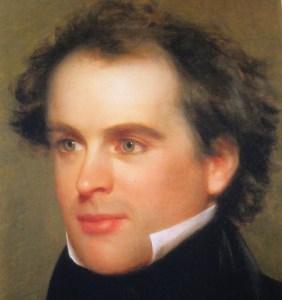
I took the photographs in this post during the break between classes. The image of Nathaniel Hawthorne is detail from a portrait hanging in the House of the Seven Gables Museum store.

G Is for Gnome–No, Not That Kind: #atozchallenge


A sign at the San Marcos River Bridge in Fentress, Texas, on the western boundary of Caldwell County, reads Gaudalupe County. That wouldn’t be worth mentioning, except that when you get across the bridge, you’re in Guadalupe County.

I assume the error arises from its similarity to words like gauge, gaunt, and gauze. In other words, the writer was thinking in English, not in Spanish: Guadalajara, Guadalupe Hidalgo, guacamole.

The excuse may be wishful thinking on my part, but since I retired, I’ve been kinder and gentler with misspellers in the hope they’ll be kinder and gentler with me. It’s a sad day when an English major has to admit this, but nearly every time I write gauge, I have to look it up to be sure.

Anyway, you know how it is with dictionaries: open one to find a word and ten minutes later you’re browsing, engrossed in a book that doesn’t have characters, much less a plot. That’s how I came across gnomist, defined as a writer of aphorisms.

Unable to imagine little red-capped garden dwellers channeling Benjamin Franklin, I checked Dictionary.com for gnome, and about half-way down the page found it: a gnome is a short, pithy saying of a general truth.

Which led me to my G topic: gnomes. (Franklin would say some of them aren’t gnomes, but they’re close.)

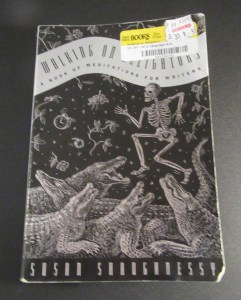
The the following come from one of my favorite books about writing–Walking on Alligators: A Book of Meditations for Writers.

*

If you have a skeleton in the closet, take it out and dance with it. ~ Carolyn MacKenzie

A hunch is creativity trying to tell you something. – Frank Capra

Imagination is a good horse to carry you over the ground–not a flying carpet to set you free from probability. ~ Robertson Davies

The opposite of a shallow truth is false. But the opposite of a deep truth is also true. ~ Niels Bohr

A writer should value his blockages. That means he’s starting to scale down, to get close. ~ Robert Pirsig

Each book is, in a sense, an argument with myself, and I would write it, whether it is ever published or not. ~ Patricia Highsmith.

Even if my marriage is falling apart and my children is unhappy, there is still a part of me that says, “God, this is fascinating!” ~ Jane Smiley

A computer allows you to make more mistakes faster than any other invention in human history, with the possible exceptions of handguns and tequila. ~ Mitch Ratcliffe

The form chooses you, not the other way around. An idea comes and is already embodied in a form.  ~ Michael Frayne

You’ve got to be smart enough to write, and stupid enough not to think about all the things that might go wrong.~ Sarah Gilbert

People become writers because they can’t do things that bosses tell them to do. ~ Les Whitten

Keep away from people who belittle your ambitions. Small people always do that, but the really great make you believe that you, too, can become great. ~ Mark Twain

Will Rogers

People’s minds are changed through observation and not through argument. ~ Will Rogers

Whether you believe you can do a thing or not, you are right. ~ Henry Rod

If you would lift me, you must be on higher ground. ~ Ralph Waldo Emerson

It is certain that no culture can flourish without narratives of transcendent origins and power. ~ Neil Postman

My mother wanted us to understand that the tragedies of your life one day have the potential to be comic stories the next. ~ Nora Ephron

No passion in the world is equal to the passion to alter someone else’s draft. ~ H. G. Wells

In the sense that there was nothing before it, all writing is writing against the void. ~ Mark Strand

How do I work? I grope. ~ Albert Einstein

Sometimes it is more important to discover what one cannot do, than what one can do. ~ Lin Yutang

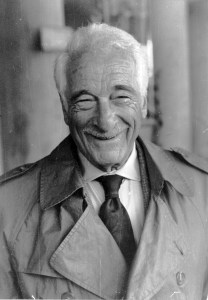
“Victor Borge” by Jesper Jurcenoks, licensed under CC BY-SA 3.0

Walt Whitman didn’t sing as a white man or a gay man. He didn’t even sing as a living man, as opposed to a dead man. He made the human race look like a better idea. ~ Sharon Olds

One of the most wicked destructive forces, psychologically speaking, is unused creative power. . . . If someone has a creative gift and out of laziness, or for some other reason, doesn’t use it, the psychic energy turns to sheer poison. That’s why we often diagnose neuroses and psychotic diseases as not-lived higher possibilities. ~ Marie Louise Von Frantz

As much as I like the actual process of writing, there’s always a point, after a half hour, that I really love it. There’s a real lightness of imagination that you let happen when you’re writing. ~ Ethan Canin

I know life. I have had a full measure of experience. Shouldn’t I take advantage of it? These days my acts are the essence of what I have accomplished. The fruit is on the tree. Should I let it rot? ~ Victor Borge

The only way to write is to write today. ~ Susan Shaughnessy

***

Regarding the Gaudalupe County sign, it’s been there for years. At first it irritated me (twice a day), but as time went on, it became a source of amusement, something I needed both going to and coming from work. Still, as an official publication of the State of Texas, not to mention a source of information, it should be accurate. A friend called the agency a good while back and reported it, but it’s still there. Since my husband’s email brought about a positive result, I might ask him to take up the cause.

***

Susan Shaughnessy. Walking on Alligators: A Book of Meditations for Writers. Harper Collins, 1993.

I like this book so much I bought it twice. I bought it once, donated it to my library, and missed it so much I bought this used copy. Each meditation is headed by a quotation. Meditations are excellent, worth revisiting often, but the quotations are what I missed.

***

For information about the A to Z Blogging Challenge, click here.

For a list of all blogs in the challenge, click here.

Image of gnome by Melly95, via Pixabay.com

Image of Will Rogers, public domain, via Wikipedia


F Is for Survival of the Fitting: #atozchallenge

My F post was almost ready to go online–Fairy Tales and Fiery Furnaces–when David showed me the new stopper he bought this afternoon for our bathtub. I immediately scrapped that F topic and replaced it with a new one: Fitting.

When a topic like that falls into your lap, you don’t go looking a gift horse in the mouth.

The story goes like this:

The little lever that opens and closes our bathtub drain (technical term: drain switch) hasn’t been working at 100% efficiency. It closes just fine but when opened, it sometimes doesn’t stay open all the way. Water drains too slowly. It’s more like seeping.

The defect is common in this type of bathtub fitting. A little flaw in product design, I assume.

Because having it repaired would cause considerable disruption, David took the route of reason. He brought home an old-fashioned stopper.

Old technology, but reliable. It fits most sink or tub drains.

On the back of the package are a diagram and instructions for installation. The first instruction is, “Read All Instructions Carefully Before Using.” Fortunately, no tools are needed for installation.

David hasn’t yet installed our stopper. I don’t expect him to have trouble. But if he does, he can check the company website or call a 1-866 telephone number.


E Is for Error, Correction Pending: #atozchallenge


I am happy to report a pleasing development:

The ramp from TX SH 130 to TX SH 71 at Austin has a sign reading “Merge Right,” when it should say, “Merge Left.” After the second time we passed it, David emailed the government agency in charge of highway signs and told them about the error (which could have caused a problem). The third time we traversed the ramp, the wrong sign was still there.

Today he received an email from the agency that said, “You are correct in your assessment, that sign will be removed and replaced with a merge left sign.”

(Well, d’oh. Of course he was correct. He reads words of one syllable and knows his left from his right. So do I.)

We’re both gratified that performance of his civic duty will improve traffic flow and, better yet, will stop irritating the Davises every time we use the ramp. I’m considering emailing the authority to tell them their email contains a comma splice (a variety of the irritating run-on sentence) but am afraid that if I do, they will retaliate by not replacing the sign. I’m also afraid they’ll email me to point out an error in my email to them. I occasionally make one.

I couldn’t find an image of a sign exactly like the one that will replace the sign on the ramp–or of the current sign either–so I cropped the one below from some clip art. The words are correct, and that’s what counts.

After posting this for the benefit of my friends on Facebook, I realized that in the A to Z Blogging Challenge, today is E, and I could post this story about an error. I did not include the name of the government agency, of course. See “retaliation” paragraph, above.


D Is for Stinky, Ruffy, and a Dollop of Muggs*: #atozchallenge

Probably no one man should have as many dogs in his life as I have had, but there was more pleasure than distress in them for me except in the case of an Airedale named Muggs. He gave me more trouble than all the other fifty-four or -five put together, although my moment of keenest embarrassment was the time a Scotch terrier named Jeannie, who had just had six puppies in the clothes closet of a fourth floor apartment in New York, had the unexpected seventh and last at the corner of Eleventh Street and Fifth Avenue during a walk she had insisted on taking.

~ James Thurber, “The Dog That Bit People”


Now you would probably rather read “The Dog That Bit People” instead of the rest of this post, and so would I, but bear with me for the next few paragraphs and then you can do what you want.

The Muggs James Thurber references was a “big, burly, choleric” Airedale who acted as if Thurber wasn’t one of the family. “There was a slight advantage in being one of the family, for he didn’t bite the family as often as he bit strangers.” Over the years, he bit everyone but Thurber’s mother, “and he made a pass at her once but missed.” Mrs. Thurber felt sorry for Muggs and often said, “He’s not strong.” Thurber says, ” [B]ut that was inaccurate; he may not have been well but he was terribly strong.” He was also sorry after he bit someone, she said, but Thurber observed he didn’t act sorry either. Mrs. Thurber’s philosophy was, “If you didn’t think he would bite you, he wouldn’t,” but the ice man didn’t buy it. “Once when Muggs bit Mrs. Rufus Sturtevant and again when he bit Lieutenant-Governor Malloy” she told the cops “that it hadn’t been Muggs’ fault but the fault of the people who were bitten. ‘When he starts for them, they scream,’ she explained, ‘and that excites him.'” The time he emerged from under the couch and bit elderly Mrs. Detweiler, Mrs. Thurber said it was just a bruise and, “He just bumped you,” but “Mrs. Detweiler left the house in a nasty state of mind.”

I met Muggs and got to know him intimately (practice, practice, practice) for a high school prose reading competition, and I’ve loved him ever since.

Well, enough. If you want to read the story, here’s the link, but I hope you’ll wait till I’ve told you about my dogs.

First came Stinky, when I was about three years old. He was a rat terrier. My dad had tied a rope to the handle of my little red wagon so he wouldn’t have to bend double when he pulled me around in it. Stinky watched, and, intelligent dog that he was, often took hold of the rope and replaced my dad at the helm. He also took the helm when I wasn’t in the wagon; on hot, moonlit summer nights, through their open bedroom windows, my parents heard him pulling the wagon around the back yard. I don’t remember it, but I was told that one day I ran into the house crying as if my heart would break and said, “I hit Stinky.” I know what happened–I had invited him to jump up on me, and he did, but pretty soon I’d had enough and he hadn’t, and I hit him to get him to back off. My heart was breaking, and over sixty years later, I still get teary when I think of it. I’m always sorry after I’ve someone. Except for my friend Phyllis, but that’s a story for another time. H, perhaps, for hit.

My mother brought home Ruffy, a Border Collie-Shepherd mix, when he was only four weeks old. The giver insisted that was old enough. It wasn’t. The acquisition of a second dog surprised my father, who, I presume, thought it should be a family decision (even at that age I was surprised they didn’t discuss it, but I suppose Mother thought a 2/3 majority was enough), but he didn’t say anything, simply set his jaw in the same way he did the summer before my senior year of college when I said I was going to drop out and go to work for the IRS. I stayed in college and got my degree, but if I hadn’t, I’d have been spared a lot of school-teacher grief and would now have federal employee health insurance, which is a super deal.

(My dad played ball with all our dogs when he thought no one was looking.)

Except for a white bib and little brown “eyebrows,” Ruffy was all black, even his eyes; his hair was thick and wavy. His official name was Rough Bones, which shows why you should never ask a pre-schooler what she wants to name a pet. We gave our dogs bones from steaks and roasts, and they gnawed on and then hid them in the lush St. Augustine grass, and I stepped on them with my perpetually bare feet and cried out in pain. Two or three times a day. At four weeks, Ruffy wasn’t yet weaned, so Mother had to feed him warm milk mixed with white Karo syrup from little doll bottles I’d gotten for Christmas. At first I woke for the four a.m. feeding–yip yip yip–but soon stopped hearing his call and slept through it.

As a young adult, Ruffy, who spent most of his time confined to a big back yard plus the adjoining quarter-acre of chicken yard that lay on the other side of the driveway, chased a twelve-year-old neighbor boy who was passing the house, and ran another one up onto the porch across the street. The stiff, heavy pocket of his new jeans saved the second one from puncture wounds. After that occurrence, we confined the dog for ten days, the time prescribed for making sure he didn’t have rabies (he’d been vaccinated).

My parents took his behavior seriously but my mom noted that both boys teased him through the hog wire fence every time they walked down the street. She believed the dog considered himself provoked; she definitely considered him provoked. (She’d told the boys to stop teasing him, to no avail.)

However, when some of Mother’s out-of-town relatives couldn’t rouse anyone at the front door and offered to enter the back yard through the picket gate, Ruffy told them in no uncertain terms not to bother.  We decided he was being a conscientious, if overzealous, watch dog. We weren’t home when they came and so couldn’t call him off. Considering these particular relatives, I thought he’d been provoked.

(When it came to me, my parents always gave the dog the benefit of the doubt. “You know Sabre snaps when you pet him; leave him alone.” Sabre, my cousins’ Cocker Spaniel, didn’t often see me, and didn’t like me bothering him (probably didn’t like me at all), and he did snap, and I knew he would snap, but he was a dog and I couldn’t help myself. I saw a dog, I petted the dog. When common sense set in, about the time I was forty, I learned restraint.)

The situation with Ruffy became clear, unfortunately, the evening we had a yard full of other relatives sitting in lawn chairs and eight-year-old Sharan appeared from down the street. While she was standing in the middle of the family circle, Ruffy walked up, in my mother’s words, “smiling, with his tongue lolling out and his tail wagging,” and bit her on the thigh.

I was in the house and didn’t see him bite. When they told me they had to take Ruffy to Dr. Matthews to be watched for ten days, and then Dr. Matthews would find him another home, I cried so hard they gave me a St. Joseph’s (baby) aspirin and put me to bed. The aspirin didn’t help. Dr. Matthews told my parents Ruffy was too good a dog to put down, and he would give him to some rancher living out in the country, away from little girl visitors. I was sad but understood. Later Dr. Matthews told them that when the ranchers he offered Ruffy to learned he’d bitten someone, they declined to take him, and so . . .  It was years before I realized what had happened to him. I asked and was told the whole story.

We later learned that Smoky, a litter mate owned by another family in town, also bit. They were both sweet, beautiful dogs, good playmates for their children, and we wondered if there was something in the genes that prompted them to bite strangers. Probably not.

I have pictures of Stinky and Ruffy, but they’re not, shall we say, accessible, so I can’t post them. The dogs pictured here don’t do them justice.

So. I’ve expended all these words on two dogs. Like Thurber, I’ve probably had more dogs than one person should have, but I’ll have to write about the rest of them later, perhaps for M, as in More Dogs.

Okay. Go read “The Dog That Bit People.” You’ll be glad you did.

***

*D is also for Dogs.

***

I wish I could post pictures of Muggs, but I’m sure they’re under copyright. However, the two links in the second paragraph take you to Thurber’s sketches of him.

Image of James Thurber by Fred Palumbo, via Wikipedia. Public domain.

Image of Rat Terrier by kteri3565, via Pixabay.com

Image of Border Collie by PascalCottel, via Pixabay.com

C Is for Current Events Redux + Updates: #AtoZChallenge

The following article, first published here on November 26, 2017, focuses on one of the most Shocking Crimes in the annals of our nation, and on the three Heroic Felines who helped Investigators Crack the Case.

***

Muffy, Puffy, and Sybil-Margaret “Pud-Pud” Poff Cleared of All Wrongdoing, FBI Reports

Three cats suspected of helping owner Julia Poff mail explosive devices to former President Barak Obama and Texas Governor Greg Abbott were released from custody Thursday afternoon following questioning by federal law enforcement officers.

FBI crime lab investigators had found a cat hair under the address label on the package containing the explosives and traced it to the Poff cats. It is alleged that Ms. Poff sent the potentially deadly devices to former President Obama and Governor Greg Abbott because she was mad at them.

Muffy, Puffy, and Sybil-Margaret “Pud-Pud” Poff were taken from the Poff home in Brookshire, Texas, 34 miles west of Houston, Thursday around 9:00 a.m.

Muffy


FBI Agent Arnold Specie, chief of the Houston Bureau, announced in a press conference late Thursday that after intense grilling, officials were satisfied the cats had no connection to any nefarious activities.

“The only thing they’re guilty of is shedding on paper their owner later used to wrap the explosive devices. You can’t fault cats for shedding.”

He said there’s no doubt these are the right cats. “The fur of all three exhibits white hair. That’s true even of Puffy Poff, who is mostly orange but has a couple of white spots on her underside.” He assured the press that DNA testing will confirm the hair belongs to one of the Poff cats.

A reliable source, speaking on condition of anonymity, however, said he’s not so sure. “They know more than they’re telling,” he said. “It’s impossible to get anything out of suspects that keep falling asleep in the middle of questioning. And every time Muffy rolled over, Specie gave her a belly rub. Specie’s always been soft on cats.”

The early morning raid, which involved a number of federal agents as well as a Houston PD Swat team on stand-by, rocked this usually quiet community to its very core.

“I could tell something was going down,” said neighbor Esther Bolliver. “I was outside watering my rose bushes when I saw these men wearing dark suits and ties crouching behind Julia’s privet hedge. One of them was holding out what looked to be a can of sardines, and saying, ‘Kitty kitty kitty,’ in a high-pitched voice, you know, like you use whenever you call cats. I thought it was Animal Control.”

Mrs. Bolliver ran inside and told her husband. “I said, ‘Bert, come outside and look,'” she said.

“I knew they was G-Men first thing,” said Bert Bolliver. “It was the fedoras give ’em away. Animal Control don’t wear fedoras.”

Puffy


Ten-year-old Jason Bolliver, who had been kept home from school with a sore throat, added that the raid was exciting. “It’s the best thing that’s happened here since my teacher had her appendix out.”

Agent Garrison Fowle (pronounced Fole), who led the raid, said capturing the cats proved remarkably easy. “The sardines did the trick. Those cats ran right over and we grabbed them and wrapped them in big terry cloth bath sheets and stuffed them into carriers. It was a snap.”

Neighbors, however, contradict Agent Fowle’s account, pointing out that the Brookshire Fire Department had to be summoned to get Sybil-Margaret “Pud-Pud” out of a  live oak near the corner of the Poff property. It is believed she bolted when she realized the sardines were bait instead of snacks.

Sybil-Margaret “Pud-Pud”


While at the Poff residence, BFD EMTs bandaged second-degree scratches on Agent Fowle’s face. They also administered Benadryl to Agent Morley Banks, who had broken out in hives.

Agent Delbert Smits was airlifted to Ben Taub Hospital in Houston. Information about his condition has not been released, but Mrs. Bolliver observed Ben Taub has a first-class psychiatric emergency room, and she thinks that’s why Smits was taken all the way into Houston.

“By the time they got Pud-Pud down from that tree, the poor man was staggering around like he had a serious case of the fantods.”

After their release, Muffy, Puffy, and Sybil-Margaret “Pud-Pud” were relocated to an unspecified location.

Special Agent Fowle said the initial plan was to fly them to Washington, D. C., in the care of Agent Banks,  for further debriefing, but Agent Banks put the kibosh on that, saying there was no way in hell he was going to spend one more minute in the company of “those [expletive deleted] cats.” Fowle said Agent Banks has been granted sick leave until he stops itching.

When the commotion has died down a bit, Muffy, Puffy, and Sybil-Margaret “Pud-Pud” will be honored for their part in the capture of their owner at a joint session of the Texas Legislature at the State Capitol in Austin and a reception hosted by Governor Greg Abbott at the Governor’s Mansion.

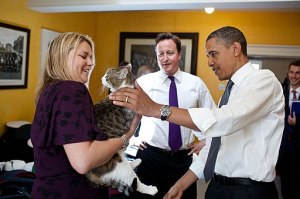
President Obama with Larry the Cat and PM David Cameron at 10 Downing Street. 

Former President Barak Obama announced that on their next swing through Texas, he and Michelle want to take the cats out for a catfish dinner.

“Let me be clear,” President Obama said. “Although totally and completely innocent of any crime, these cats surely had a positive influence on the perp. The activity Muffy, Puffy, and Sybil-Margaret “Pud-Pud” witnessed was fair and balanced, targeting both a Democrat and a Republican, and as such is the first bipartisan effort I’ve come across since my first inauguration.”

After law enforcement officers left, neighbors expressed concern about the cats’ future welfare. The Bolliver family, noting the three felines spent most of the day sleeping on the hood of their Buick anyway, wanted to take them, but their offer was rejected.

Instead, Muffy, Puffy, and Sybil-Margaret “Pud-Pud” will make their home in Houston with Special Agent Specie.


Updates:

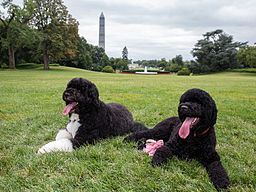
Bo and Sunny

Former President Barak Obama and Mrs. Obama threw a festive catfish dinner for the Poff cats at Clear Springs Restaurant in New Braunfels, Texas, where the President pronounced the onion rings “terrific.” Michelle Obama presented the cats with an autographed photo of former hypoallergenic First Dogs Bo and Sunny

Festivities at the Texas Capitol and the Governor’s Mansion were axed after Muffy, Puffy, and Sybil-Margaret “Pud-Pud” sent word they’d heard about Austin traffic and didn’t care to see it for themselves. 


Robert Mueller

Special Counsel Robert Mueller sent the Poff kitties a note of congratulations for a job well done.

The White House reluctantly announced that President Donald Trump would invite the Poff cats to a gala celebration at the White House, a huge one, huger than Obama’s fish dinner or Trump’s inauguration even. Muffy, Puffy, and Sybil-Margaret “Pud-Pud,” however, said  thanks but no thanks on the grounds they would be busy that night grooming one another’s hair.


***


Sources:

New York Times. “Cat Hair Links Woman to Bombs Sent to Obama and Texas Governor, Officials Say.” Nov. 24, 2017.

Houston Chronicle. “Houston-area woman accused of mailing bombs to Abbott, Obama, benefits agency.” Nov. 23, 2017.


Images:

President Obama and Larry the Cat, public domain, via Wikipedia

Bo and Sunny, public domain, via Wikipedia

Muffy, Puffy, and Sybil-Margaret “Pud-Pud,” © M. K. Waller, all rights reserved

***

Find more posts in the #AtoZChallenge here.


B Is for Behind: #atozchallenge

A story from my friend the high school business teacher:

A student in her bookkeeping class asked what arrears means.

Said the teacher, “It means you’re behind.”

And twenty-five shocked teenage faces stared in profound silence.

***


I’m behind. Nothing new. I don’t live a hurry-up-and-wait existence; mine is wait-and-hurry-up.

The condition won’t be cured by planners, lists, date books, Google calendars, anti-procrastination classes, or prayer and fasting. I’ve tried them all.

I’m a compulsive organizer. Back in the day, I owned a series of Franklin planners: big, little, zippered, non-zippered, black, colored (red and teal). If anything could have organized me, that teal planner would have done it.

In a sad development, the teal planner disappeared from my car in late August of 1998, the night before the first day of faculty in-service. I went out in the morning and found the driver’s side window open; the seat where I’d left two tote bags was empty.

I called 911. The local constable came out and said he knew who did it–they lived next door to the post office a few blocks away, and they were the ones who did everything around there–but the authorities wouldn’t be able to prove it. A deputy sheriff came out and dusted for fingerprints but found only the ones I’d left when I closed the door.

I was late to work, which wasn’t a problem because I missed only the meeting at which nothing happens except coffee and donuts. I learned more from the breaking-and-entering experience than I would have at the meeting.

To wit:

  1. Fingerprint powder is black and sticky. Very sticky.
  2. If you drive a dusted car without first draping seats, doors, and steering wheel, you’ll be sorry.
  3. Fingerprint dusters don’t clean up after themselves.
  4. People who steal from parked cars will take anything and everything. They got my favorite tote bag, the one displaying the Edward Gorey tuxedo cat lying across a stack of books, and the caption, “books. cats. life is sweet.” That bag meant a lot to me. So did the teal Franklin planner with zipper and page after page of contact information that I’d recently compiled and entered in my neatest handwriting. [As in, I organized it.] The can of asparagus wasn’t all that important to me, or probably to them, but they took it. What galls me–even today–is that I know the entire haul ended up in the river.
  5. If you leave a car in front of your house, as I did, instead of pulling it into the driveway, someone will break into it. If you pull the car into the driveway, the same people will break into it. Evidence: An electrician who spent that night with his mom, just around the corner, parked his van in her driveway. The next morning–a broken window and no equipment.
  6. If you’re going to park a car where it’s an easy target, make sure it’s a rental car. My car was in the shop overnight and I was driving a little Geo Metro the color of Pepto-Bismol. At the end of the day, I returned it to the agency, picked up my well-oiled car, and headed home. Somebody else dealt with the sticky black stuff.
  7. If you’ve lived all your life in a small town where people never bothered to lock their doors when they went on vacation, and you think you’re still living in that same small town, you’re wrong.

But I digress. And that’s one reason I’m behind.

Before turning in, I must post this for A to Z Blogging and then complete two more writing assignments, one for a critique group, another for an informal class in memoir. Tomorrow I have to put out my Sisters in Crime chapter’s newsletter–and put up my C post for A to Z Blogging–and then the next tomorrow there’s the D post–

Tomorrow, and tomorrow, and tomorrow,
Creeps in this petty pace from day to day,
To the last syllable of recorded time;

and when I get there, there’ll be one more thing to write.

Such pressure!

And the crazy part–my teenaged English-student-self would never have believed it–it’s all self-imposed. Nobody makes me do this. I blog for myself; I do blog challenges for myself; I take writing classes for myself; I write stories for myself; I go to critique group for myself.

Because I want to.

Crazy.

Now, before I fall further behind, I shall stop, post, and move on.

***

Find a list of all A to Z Blogging participants here.

***


Image of fingerprint by stux, via pixabay


A Is for Anne Tyler: #atozchallenge

Anne Tyler has done it again.

The last time I wrote about her, I was in a snit. She’d killed off my favorite character halfway through the novel I was reading, and I was not happy.

I’m writing this time because she’s made me laugh. The book is Vinegar Girl, a retelling of Shakespeare’s The Taming of the Shrew, and in it she kills no one at all. She must have had a wonderful time writing it.

“Petruchio and Kate” by Smatprt licensed under CC BY-SA 3.0.

For a quick recap: Shakespeare’s shrew is Katherina, daughter of Baptista and older sister of the gentle Bianca. Afraid Katherina, whose reputation precedes her, will never receive a proposal, Baptista tells two young men eager to marry Bianca that his older daughter must marry before the younger. The suitors recruit Petruchio to woo Katherina; Katherina resists, but finding him her intellectual equal, agrees to marry him. Then Petruchio sets about “taming” his bride. At the end, Petruchio presents her to the public as the model of a sweet-tempered, obedient wife

Tyler’s Katherina is Kate Battista. Ten years before the story begins, Kate was invited to leave college after telling her botany professor his explanation of photosynthesis was “half-assed.” Her medical research scientist father made no fuss about her expulsion because he agreed the explanation was half-assed.

Since then, Kate has worked as a teacher’s aide at the Charles Village Little People’s School, where she spends a lot of time in Mrs. Darling’s office, being counseled in the need to use tact, diplomacy, and restraint when speaking with parents. For example, when Jameesha’s father asked her to do something about Jameesha’s finger sucking–Jameesha has a “habit of sucking her two middle fingers, with her pinkie and her index finger sticking up on either side like the sign language for ‘I love you'”–Kate told him not to worry: “Chances are she’ll stop soon enough, once her fingers grow so long that she pokes both her eyes out.” Mrs. Darling says she must develop “some social skills. Some tact, some restraint, some diplomacy.” Difficulty navigating the school’s “mysterious” etiquette has Kate on what Mrs. Darling calls “thin ice.”

Kate also runs the household and takes care of her father and her fifteen-year-old sister Bunny. Taking care of her father includes delivering his oft-forgotten lunches to his lab and doing his taxes. Taking care of Bunny includes preventing her from getting too friendly with her “Spanish tutor,” next-door neighbor, Edward Mintz, whose mother says he has “that Japanese disease . . . the one where young people shut themselves in their bedrooms and refuse to go on with their lives.” Bunny, who was normal until about the time she turned twelve, also has the “irksome habit” of “turning declarative sentences into questions.” Bunny isn’t easy to deal with, and Kate has been dealing with her since their mother died, when Bunny was six years old.

Working at a preschool and being a family manager isn’t the life Kate expected to have, but when the story opens, she’s not expecting anything to change. Then her father introduces her to his research assistant, Pyotr Cherbakov.

When they meet, Kate says, “Hi,” but Pyotr says, “Vwwouwv!” That’s the kind of thing men often say when they first see Kate, “due to a bunch of dead cells: her hair, which was blue-black and billowy and extended below her waist.”

(She stopped getting her hair cut when she was thirteen because she couldn’t take any more of the “Chatty Cathy act”:

“In the beauty parlor. Talk, talk, talk; those places are crawling with talk. The women there start going before they even sit down–talk about boyfriends, husbands, mothers-in-laws. Roommates, jealous girlfriends. Feuds and misunderstandings and romances and divorces. How can they find so much to say? I could never think of anything, myself. I kept disappointing the beautician. Finally I went, ‘Shoot. I’ll just quit getting my hair cut.'”)

Then Dr. Battista brings Pyotr home to dinner. And snaps photos of her and Pyotr with his cell phone, which he never uses because he’s a little afraid of it. And tells her that in two months, Pyotr’s visa will expire and he’ll have to leave the country, and he’s the best assistant Dr. Battista has ever had, ever could have, and the whole scientific community knows about Pyotr Cherbakov, and he’s the only one Dr. Battista can possibly work with, and without Pyotr he might as well abandon his research, because it’s doomed . . . unless . . .

“Unless, perhaps, we could get him an . . . adjustment of status.

“Oh, good, get him an adjustment of status.”

She brushed past him and went out to the hall. “Bunny!” she shouted. “Supper’s on!”

“We could adjust his status to ‘married to an American.'”

“Pyotr’s married to an American?”

“Well, not quite yet,” her father said. He trailed her back to the dining room. “But he’s fairly nice-looking, don’t you agree? All those girls working in the building: they seem to find different reasons to talk to him.”

“So he could marry a girl in the building?” Kate asked. She sat down at her place and shook out her napkin.

“I don’t think so,” her father said. “He doesn’t . . . the conversations never seem to develop any further, unfortunately.”

“Then who?”

Her father sat down at the head of the table. He cleared his throat. “You, maybe?”

And so it begins. Such fun.

Or maybe not.

Shrews aren’t usually born shrewish. Shakespeare shows that Baptista favors Bianca; it’s no wonder Katherina is out of sorts.

Kate Battista, too, is the daughter of a widowed father who seems to take her for granted while focusing his attention on his younger child. When Pyotr observes Kate is pretty, Dr. Battista says, “You should see her sister.” That must hurt.

And then he makes a heartless request, urges her to marry a man she doesn’t know so he can keep his research assistant.

“I guess I just couldn’t believe my own father would conceive of such a thing.  . . . You would never ask Bunny to do this . . . Your precious treasure Bunny-poo.”

The Taming of the Shrew poses a problem for modern audiences: It is misogynistic? Maybe. Maybe not. Some scholars say Katherina isn’t tamed at all, but that she and Petruchio are putting on an elaborate show for the banquet guests and are enjoying every minute of it.

Vinegar Girl poses no such problem. Kate is no Katherina, rife for taming. But after ten years of routine, she suddenly has a lot more to think about than doing taxes and cooking meat mash and keeping Bunny in line. The idea of marrying Pyotr is unthinkable. But it’s so important to her father.

Will she please her father or herself? Can she do both? Will her sense of honor and self-respect survive the ordeal?

Does she have the tact, diplomacy, and restraint to carry her through? Or will her own mysterious etiquette be enough?

And, by the way, where does Pyotr fit into this puzzle?

Tyler’s Vinegar Girl is a delightful romp, part Shakespeare, part Jane Austen, all Anne Tyler. It would make a fine summer read. Or fall. Or winter.

Or now.

***

Anne Tyler. Vinegar Girl: William Shakespeare’s The Taming of the Shrew Retold. Hogarth Shakespeare, 2016.