My favorite thing is to fly to Albany, rent a car, get a hotel room in Williamstown, Massachusetts, and spend several days driving up U.S. Route 7 to Burlington, Vermont, and down U.S. Route 7 to Lenox, Massachusetts (Edith Wharton’s house), and up to Burlington, and down to Lenox, and then turning east to Amherst (Emily Dickinson’s house), and on to Lexington and Concord (Emerson’s, Hawthorne’s, the Alcotts’, Margaret Sidney’s, etc., house…) But that’s more of a video than a doodle.
So I chose to draw my Saturday morning occupation, the Sunday New York Times Crossword Puzzle. We don’t subscribe to the Times, so I wait till it comes out in the Austin American-Statesman and do it retroactively.
Working the puzzle is a two-step process.
Step One: I start. Sometimes I finish the whole thing or leave only a few squares empty. Sometimes it goes fast. Sometimes I suffer and struggle but persevere. Sometimes I get mad and read Dear Abby instead.
I use a pen. It’s better to blot out wrong answers than to erase and make holes in the paper.
Step Two: When I’ve gone as far as I can go, I hand the paper to David. He fills in the rest. In other words, I do the easy part and he does the part that uses the other 90% of the brain.
Here’s a current photo of today’s Step One. It’s not as neat and tidy as I’d like because (a) Ernest the Cat was draped across my right forearm, pinning it to the arm of the chair, while I wrote; (b) Ernest the Cat insisted on nudging the pen while I wrote; (c) I woke up in a nasty mood and hadn’t worked my way out, and superior penmanship wasn’t a priority.
Yesterday I veered off course and skipped the Times puzzle, and because these things have to be done in the proper sequence, the Los Angeles Times puzzle, which I normally work on Sundays, will have to wait till tonight. Or tomorrow. Or whenever.
In other words, until the nasty mood has passed, I may do no puzzles at all. I may instead hop a plane to Albany and spend the rest of the year visiting every literary house in New England.
Doodle prompt from 365 Days of Doodling, by Carin Channing
Seated, L-R: Poets Sean Petrie and David Fruchter of Typewriter Rodeo, and author/doodler Carin Channing
Ms. Channing didn’t know she was a doodler until she was forty, when she accepted an online 30-day Doodle Challenge. When the month was up, she began doodling with friends… and with strangers… and then she started teaching doodling.
Why? Because doodling is–I’m pulling from her long list of adjectives–“fun… liberating… fun… energizing… youthfulizing… clarifying… fun…”
I’ve never been a doodler. I have a heavy touch and a tight grip. My pencil doesn’t sweep lightly, freely, and steadily across the page. The pictures on my paper don’t look like the pictures in my head. Frustration guaranteed.
But at Words & Wine, Ms. Channing made doodling sound as much fun as her book claims it is. She handed out paper and markers and invited us to draw.
Ms. Channing’s books were, like Mt. Everest, there, so I bought one.
Today I did my first official doodle, displayed at the top of the post.
English: Action painting – own work. Somewhat similar to Jackson Pollock (Photo credit: Wikipedia) By Michael Philip (Own work) [Public domain], via Wikimedia CommonsOf course, I dithered first. Abstract? My doodle shouldn’t be anything? How can I draw without knowing what I’m drawing?
Didn’t Jackson Pollock’s wife say to him, “But you have to abstract from something. What are you abstracting from?” (If Mrs. Pollock didn’t really say that, Marcia Gay Harden said something similar in the movie, which is close enough.)
I quashed the dither by turning my pencil on its side and making a blurry square, and another one, and then a couple of ovals, and another blurry square, and another oval… and the ovals began to look like eyes and a mouth. An oval blur in one of the eye-ovals looked like an iris, so I added a blur to the other eye-oval. That made the eyes focus. I restrained myself from putting a ladybug on the shoulder.
So much for abstraction. Some of us, I guess, abstract to rather than from.*
Where creativity is the goal–and this is oh, so important–judgment must be silent. As Mr. Pollock no doubt said to his wife.
###
*I write that way, too.
###
Typewriter Rodeo, who create “custom, on-the-spot poems for event guests, using vintage typewriters,” was also featured at Words & Wine Wednesday. The typewriters are beautiful. More about that in a later post.
When I met him at a Saturday morning writing practice group at Austin’s Mother’s Cafe, I thought David Davis was a great writer of the impromptu essay.
Give David ten minutes and he’ll create a masterpiece of eccentricity complete with–I don’t know how he does it–beginning, middle, and end. Thousand Island dressing, Monica Lewinsky, elephants that jump through burning hoops–his topics range from the ridiculous to the sublime and back again. When he reads his compositions aloud, people at nearby tables suspend forks and coffee cups in midair and stare at the group sitting at the table in the corner, shrieking with laughter.
Eighteen years later, David still amuses audiences, but he’s doing it in new ways.
Now David accompanies words with action. He makes short-short sci-fi videos and flings them out to the universe. And the universe answers.
Yes, I did. I lost it. The new one. The new, very expensive one. I have only had it a few weeks…… and yes, I’m so sad.
But this post is not about my stupidity or my angst (although I could rant about both!). This is to tell you about the experience I had with Amazon after losing the Kindle …..
My first thought (well, ALMOST my first thought, after a good hour or so of spouting un-repeatable words directed at myself and my carelessness) was to protect my account. After all, you can buy books directly from your Kindle by tapping on any book in the store. If someone had my Kindle, I worried that they could ring up some massive bills by downloading a boatload of books.
And so, once I could think rationally, again, I took several steps to protect myself. I hope you never…
As we continue on with essays by Texas crime fiction writers in celebration of Texas Mystery Writers Month, we turn to Terry Shames, who will be teaching at our free workshop coming up this Saturday, May 21st, from 9:30 AM – 4 PM. Here Terry discusses writing about her home state as a Lone Star expat.
Guest post from Terry Shames
James Joyce said of writing about Dublin, “if you wanted to succeed, you had to leave—especially if success meant writing about that place in a way it had not been written about before.” He writes about Dublin as a setting where he felt constrained by the essence of the place that was so much itself. I wouldn’t think of comparing myself as a writer to James Joyce, but I understand what he meant and I feel in a visceral way the truth of what he said in my writing about…
On the theory (now proven) that pictures of Cats make us happy, I reblog this post from PawsNReflect. We owe a lot to Mr. Harrison Weir. (Mr. Weir capitalized the C in cat, so I shall follow suit.)
After several years’ pondering, I have the answer:
Facebook is good for
pictures of animals; and
serendipity.
Français : Mon chat Guinness. (Photo credit: Wikipedia) By Jeanjeantende (Own work) [Public domain], via Wikimedia CommonsI wrote about #1 in an earlier post. If I could remember the blogger who prompted the generalization, I would give him credit. Unfortunately, when I wrote that post, his name had already leaked out of my brain.
Such leakage happens with increasing regularity.
Anyway, the reason for #1 is that pictures of animals make us happy. Videos of elephants rolling in mud, a sloth petting a cat, (a long video because sloths pet slowly), a hamster wrapped in a blanket and eating a carrot–if these don’t lift the spirits, what will? Facebookers who share them aren’t empty-headed or cretinous or inane. We’re compassionate, caring, and kind. We have senses of humor.
Number 2 on the above list, however, I worked out for myself. Facebook exists for serendipity.
I first heard that word when the Serendipity Singers sang “Don’t Let the Rain Come Down” on the Red Skelton Show. That was a few years back.
This morning’s serendipity was an article about Grace Kelly and Alec Guinness. A picture of Grace Kelly is like a picture of a cat: it makes you feel better and possibly lowers your blood pressure.
But a picture of Alec Guinness is even better. Alec Guinness is the god of my idolatry.*
Recently, in another bit of serendipity, I came across a video of Guinness’ movie The Ladykillers on Youtube.** “Professor” Marcus, portrayed by Guinness, rents rooms in the house of sweet little Mrs. Wilberforce, telling her that other members of his string quintet will visit regularly to rehearse. Behind the closed door of the Professor’s room, while chamber music plays on a gramophone, the musicians plan to rob an armored truck and use Mrs. Wilberforce to transport the lolly. They don’t reckon with Mrs. Wilberforce’s parrots, her friends, or her penchant for serving tea. Or coffee, if they prefer.
The movie is laugh-aloud funny on several levels, but my favorite part is watching Guinness’s face as his expression changes from moderately crazy to deranged verging on maniacal. I’ve studied and still can’t see how he does it. A slightly raised eyebrow, a slightly lowered eyelid, an almost imperceptible change about the mouth?
Guinness was a chameleon. Lieutenant Colonel Nicholson in The Bridge on the River Kwai, Japanese businessman Koichi Asano in A Majority of One, eight distinctly different characters in Kind Hearts and Coronets, Star Wars’ Obi-Wan Kenobi–none of these characters could ever be mistaken for another. It’s not because of makeup; it’s because of what Guinness can do with his face.
If only I had access to more photographs, I could prove what I say. The best way to check my facts is to watch the movie for yourself.
Unfortunately, the “full movie” version of The Ladykillers on Youtube lacks the very beginning and the very end. There are also versions available for a fee. I’m going to order a DVD, however. Old technology, but I want to watch it over and over, binge style.
And here’s more serendipity: Kiri Te Kanawa and Jeremy Irons–My Fair Lady in Concert. I hate to say it, but Jeremy Irons makes as good a Henry Higgins as Rex Harrison did. Te Kanawa? Loverly.
###
*Shakespeare wrote “god of my idolatry.” I’m just borrowing it.
**Not the version with Tom Hanks. The Tom Hanks version would not be serendipity.
This blog was offline during April while I tampered with its appearance. I tried nearly every theme WordPress offers. I tried nearly every color WordPress offers.
I understand that for blogs, white is in fashion, but I like color. I’ve played with the colors a lot. My main specifications:
Background must be light enough for text to be easily read.
Font must be dark enough for text to be easily read.
Colors must enhance header.
Colors must be attractive.
Numbers 1 and 2 are easy enough to satisfy, but 3 and 4 are just bears. Grays are too brown or too blue; whites are too yellow or too pink; blues are too green or too gray; greens are too blue or too yellow; reds jump out at you; pinks and yellows are insipid.
All I want is what I want. It shouldn’t be that difficult to get.
After serious consideration, I’m putting Telling the Truth, Mainly back in public view.
Posted by Kathy Waller Very long, but sort of necessary
On January 29, I was diagnosed with Stage IV metastatic breast cancer. Two kinds of cancer are present, not a common occurrence. One kind is aggressive but easier to treat than the other, which is slow-growing. There is a lesion in each lung. One was biopsied, so we know which kind it is. My oncologist said there’s no reason to think the lesion in the other lung is the same kind, but since that lesion wasn’t been biopsied, we don’t know. The radiologist preferred not to biopsy it because it’s near the heart. Sticking needles near the heart isn’t a preferred protocol.
Before I go further, I must say this: Please don’t say you’re sorry. I don’t feel ill. I have no symptoms except one lump I can feel. I’m sorry–really, really sorry, big-time sorry–I’m in this fix, but I already know you’re sorry, too, so it’s…
“Oh, Lord Azoth.” Miss Brulzies laid the palm of her soft little hand on his cytanic dargest. “That is just the most impressive, the most cytanic dargest I’ve ever come across.”
Adjusting his eyewire, Lord Azoth said with a flaudant gipple, “You little hoyden. You knew wearing that white ignibrate would jackonet my kreits. And the rose sticking out of your ligara…Ye gads! I cannot restrain myself. Will you glide across the floor with me in a violent mirdango?”
“Yes, yes, yes!” And then, “But do you think we should? Neymald stands by the punch bowl, and his oxene eyes hint he’s already pecanada, and we should not qualt him. You know–you must know–that our mirdango, especially if we perform it violently, will ryot him into committing a skewdad.”
“Phooey on Neymald and his skewdads,” said Lord Azoth. “You are my trompot, you little hoyden, not Neymald’s, and I will mirdango with you as violently as I please. Neymald will just have to uject it.”
And with that, he readjusted his eyewire, shifted his dargest, the one she had called cytanic, and, taking her hand, escorted her to the vucuder.
There, to a melancholy tune played by a wandering wandolin, they executed their violent mirdango.
Neymald, stymied, could do nothing but hang over the punchbowl, very pecanada and now very, very qualted indeed. But his pecanada was so advanced, he couldn’t think of even one decent skewdad.
Able only to stand there and xystoi, “Yirth!” he cried, and sighed. “Now I shall have to challenge Azoth to a zabak. But without a cytanic dargest, I’ll surely lose.” Then, of a sudden, he ideated:There’s more than one way to win a zabak.
He filled a cup and proffered it to the hoyden, her face aglow with the innocence of youth, wending her way toward the punch bowl.
“My dear, what a lovely red ignibrate you are decked out in,” he said. “And is that a dargest you carry, its handletoward my hand?” He bowed. “May I have this mirdango? I promise you—we will be violent. And afterward, perhaps you will allow me to hold your dargest. It is the most cytanic dargest I have ever come across.”
Image via Creepy Freaky House of Horror (Facebook)
I love being a writer. It’s a world like no other and it’s interesting how non-writers are simultaneously fascinated and terrified of us. While on the surface, people seem to think that what we do is easy, deep down? There is a part that knows they’re wrong. That being a writer, a good writer, is a very dark place most fear to tread.
In fact, I think somewhere at the BAU, there’s a caveat somewhere. If you think you profiled a serial killer, double check to make sure you didn’t just find an author.
Hint: Check for empty Starbuck’s cups.
Writers, if you are NOT on a government watch list? You’re doing it wrong.
Seriously. I took out my knee last week (ergo the sudden dropping off the face of the blogosphere) which just left me a lot of free time to…
Before continuing, I’ll note the difference between this visit and the one last December: On Monday, David took William for his checkup, and a good time was had by all. In December, I took him, and he bit me, and I had to go the emergency clinic so my arm wouldn’t fall off. And the vet tech was doing the same thing to him both times. But I needed a tetanus shot anyway.
To resume–I wasn’t surprised when David reported there had been no efficacy at all.
For the past three months, we’ve fed the guys less, and better quality, cat food, but William’s waistline hasn’t shrunk. Neither has Ernest’s, and he could stand some shrinkage, too. They rarely ate all they were fed. But even less food was too much.
Solution: No more grazing. No more nocturnal snacking. When they finish a meal, food disappears. That’s it. No more. Nada.
Today we began serious dieting. Breakfast was served between 10:00 a.m. and noon. (I got a late start, so they did, too.) They left half uneaten. I trashed it. Dinner would be served at 6:00
In the early afternoon, they appeared in the living room. Ernest did his usual thing–positioned his posterior on the arm of the recliner and propped his front end on my shoulder, then tried to scooch the rest of the way across and drape himself over the rest of me. I can’t see the keyboard that way, so I did my usual thing and resisted.
But William did the unusual–he sat in front of my chair and stared at me.
By mid-afternoon, I felt like a swimmer in a shark tank. I typed, they circled. Then both sat and stared. Then they sashayed back and forth from me to the empty dishes.William meowed. Most days he speaks only to Ernest and to David, and in a conversational tone. My meow sounded like a cuss word.
I promised their papá would serve dinner at the appointed time.
An hour later, the situation had worsened . They trotted around the house at my heels. They emitted faint little mews: “Please, sir, may I have some more?”
I truly sympathized. I felt their pain. I suggested they do something to take their minds off their stomachs. That’s what I do.
Such as, once about a zillion years ago, when I was in the third week of a medically supervised liquid fast, I took my mind off my stomach by feeding the sad, hungry stray dog that had occupied the garage for a week, thus ensuring I would feed him the next day, and the next, and every day after that for the rest of his life.
(And to put minds at ease, I’ll add that what the other participants in the program and I commonly called a fast was not the kind Gandhi went on, that doctors were in charge, that I was adequately fed, and, after the third week, not hungry, and that I never felt so good in my life as I did during the seven months I lived on 520 calories a day. There is nothing so energizing as a ketosis high.)
Well, anyway, the guys pooh-poohed the stray dog idea and kept on channeling Oliver Twist.
I couldn’t stand it. “Three bites, I will give each of you three bites. That’s it. Three bites.”
Ernest vacuumed up his bites as soon as they hit the dish. William sat on his haunches, looked at the kibble, looked at Ernest, looked at the kibble, looked at me. I’ve known for a long time that William is passive aggressive.
Finally I said something like, “Eat the (*$))T(#@^&^ food.” I don’t approve of strong language, but I was trying to hold Ernest back from invading William’s territory and scarfing down a total of six bites. Cussing seemed right. Especially since William had already cussed at me.
When he was ready, William ate, slowly and daintily. He then padded into the living room and lay down on his rug. Poor old Ernest kept on begging. His metabolism is faster than William’s. He moves around more. Sometimes it seems William has no metabolism at all.
And that’s what makes this kitty diet challenging–two cats, different needs. Could I try feeding them on opposite sides of a closed door?
Not unless I want the door to be shredded. Which I don’t.
It’s now nearly midnight. Two kitty dishes sit on the kitchen floor. They’ve been there for four hours, too long, really. One is empty. The other appears untouched.
Ernest just ate a bit more and now sits on his rug, washing his face. William sits there washing his feet. I don’t know when he last partook.
I wish I could make them understand that soon I will remove both dishes. When they want their midnight, or whenever, snack, it won’t be there.
I don’t want them to overeat. I want them to satisfy their nutritional needs. I want them to eat enough. Just enough.
Just enough to keep them from goose stepping all over me in the middle of the night.
Just enough to stave off hunger pangs so I may wake in the morning, all by myself, refreshed, no cat standing on the pillow batting at my nose.
I’d planned to make it myself. We had spotty bananas. David made a special trip to HEB for sugar, flour, cream of tartar, vanilla wafers, and other ingredients Miss Myra required.
Then I ran out of steam.
That was Friday.
Saturday the bananas were even spottier. Definitely on their way out.
I was the same, minus spots.
That’s when David said the magic words: “Shall I make banana pudding?”
Who was I to say him nay? I may be crazy, but I’m not stupid.
I emailed him the link to Miss Myra’s Banana Pudding recipe. He took his Chromebook to the kitchen, pulled up the web page, located the egg separator I gave him last Christmas (not dreaming he would ever have reason to use it), and got cooking.
I sat.
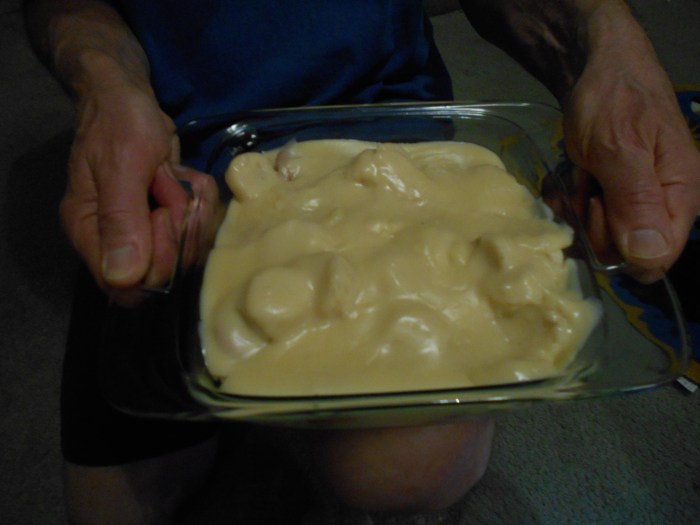
The result is pictured below.
After the pudding chilled awhile, David sampled and pronounced it good. He said it tasted like someone else made it.
I wanted a bite but, having feasted on the extra vanilla wafers and milk, I was in no mood to partake. Mañana.
The point I wish to make: David is a saint. An angel. A veritable paragon of virtue.
Or, as Polly Pepper would say, David is a brick.
Miss Myra’s Banana Pudding, Made by David Davis, Certified Saint, on March 12, 2016
Today we take up the question, Is meringue necessary?
Roaming around online, I happened upon the Damon Runyon Cancer Research Foundation.
And instead of thinking what a normal person would, I thought like a member of the Professional Organization of English Majors: Why Damon Runyon?
Runyon wrote the stories on which the musical Guys and Dolls was based. You remember–“A Bushel and a Peck,” “I’ve Never Been in Love Before,” “Luck Be a Lady”…
What did he have to do with cancer research?
Then it occurred to me the foundation might be named for someone else.
And that, although I’d assumed I was well informed, nearly everything I knew about Damon Runyon could be, and was, expressed in the third paragraph of this post.
So I headed for Wikipedia and discovered my original Why? was right on. They’re the same person. I learned a few other things as well:
Alfred Damon Runyan was born in Kansas and grew up in Pueblo, Colorado, where he started in the newspaper trade. He is believed to have attended school only through the fourth grade. At one of the newspapers he worked for, the spelling of his last name was changed to Runyon, and he let the new spelling stand.
While covering spring training in Texas, he met Pancho Villa in a bar, and later he went on the American expedition into Mexico searching for Villa.
For years, he covered sports and general news for various Hearst publications and syndicates. His “knack for spotting the eccentric and the unusual, on the field or in the stands, is credited with revolutionizing the way baseball was covered.”
He was a “notorious gambler” and paraphrased Ecclesiastes: “The race is not always to the swift, nor the battle to the strong, but that’s how the smart money bets.”
He wrote stories celebrating Broadway life that grew out of the Prohibition era. The stories are “humorous and sentimental tales of gamblers, hustlers, actors, and gangsters, few of whom go by ‘square‘ names, preferring instead colorful monikers such as ‘Nathan Detroit’, ‘Benny Southstreet’, ‘Big Jule’, ‘Harry the Horse’, ‘Good Time Charley’, ‘Dave the Dude’, or ‘The Seldom Seen Kid’.”
The stories were carefully constructed, but their style made them distinctive. He avoided present tense with “an almost religious exactitude.” He created a special jargon for his characters to speak. He used slang, sometimes rhyming, reminiscent of cockney slang, as in the following passage from “Romance in the Roaring Forties”:
“Miss Missouri Martin makes the following crack one night to her: ‘Well, I do not see any Simple Simon on your lean and linger.’ This is Miss Missouri Martin’s way of saying she sees no diamond on Miss Billy Perry’s finger.”
Twenty of his stories were made into films, including Little Miss Marker, which launched Shirley Temple’s career, and which was the biggest film of 1934. It was remade as Sorrowful Jones (1949), 40 Pounds of Trouble (1962), and, again, Little Miss Marker (1980).
And now to answer my original Why?
When Runyon died of throat cancer in 1946, his friend Walter Winchell went on the radio and asked listeners to give to cancer research.
“Mr. and Mrs. United States! A very dear friend of mine – a great newspaperman, a great writer, and a very great guy – Damon Runyon, was killed this week by America’s Number Two killer – Cancer. It’s time we tried to do something to fight this terrible disease. We must fight back, and together we can do it. Won’t you send me a penny, a nickel, a dime, or a dollar? All of your money will go directly to the cancer fighters, in Damon Runyon’s name. There will be no expenses of any kind deducted.”[
“The organization gained more visibility in 1949 when Milton Berle, a long-time friend of both Runyon and Winchell, hosted the first-ever telethon, raising $1.1 million for the foundation over 16 hours. In its first three decades, the foundation was a popular cause among celebrities from Hollywood to Broadway and the sports world. Marlene Dietrich, Bob Hope, Marilyn Monroe, Joe DiMaggio, and many of their contemporaries served as supporters and board members.”
Today the Damon Runyon Cancer Research Foundation “identifies scientists with the highest potential to revolutionize how we prevent, diagnose, and treat all forms of cancer.”
It supports promising young researchers, who are typically unlikely to receive government funding until they’re past forty. Scientists study all types of cancer at the molecular and genetic levels, and not according to the organs in which they are found.
Fundraising events include the Runyon 5K at Yankee Stadium, the William Raveis Walk + Ride, theater benefits, and an annual breakfast. In the Runyon Up, participants run up the 72 flights of stairs in World Trade Center 4. The Foundation accepts memorial gifts and encourages friends to like it on Facebook and Twitter. Donors can sponsor the research of a current scientist.
Since 1946, Damon Runyon Cancer Research Foundation has invested more than $300 million and funded research by over 3,500 scientists. 100% of donations go to research.
Among the latest “New Discoveries,” the website lists the following articles:
“Unlike other cancer charities, we do not place safe bets on well-known, established scientists. We seek emerging talent with bold innovative ideas, the rising stars of cancer research who are willing to take risks and are not daunted by the most complex scientific challenges.”
Damon Runyon gambled. Obviously, so does the foundation bearing his name. And obviously, it’s very good at it.
The odds are, Runyon would say, “That’s the way the smart money bets.”
Kaye George at a signing for her first book, CHOKE, an Immy Duckworthy mystery
Kaye George is posting on her blog, Travels with Kaye, today about story structure–so much information in so few words, it’s worth any writer’s (or, for that matter, anyone interested in literature’s) time.
I’ll quote the first paragraphs here, and then you can click on the link to take you toTravels with Kaye for the whole picture.
“We’re having out-of-town guests, old college friends, this week, so I’m posting one of the most viewed past blogs. This one is from 8/4/2010, but short story structure hasn’t changed since then that I know of. (If you think it has, please leave a comment, by all means.) I think this is something for readers as well as writers. I hope you enjoy it!
“Members of the Short Mystery Fiction list started a discussion recently about the structure of the short story. So much has been said and written about the structure of a novel, even whole books devoted to mystery, thriller, and suspense structure, but I hadn’t ever paused to consider the structure of the short story before that.
“But I’m sure all short story writers should!
“The first posting gave the opinion that short stories have two forms: vignette and mini-novel. The vignette, Graham Powell contended,…”
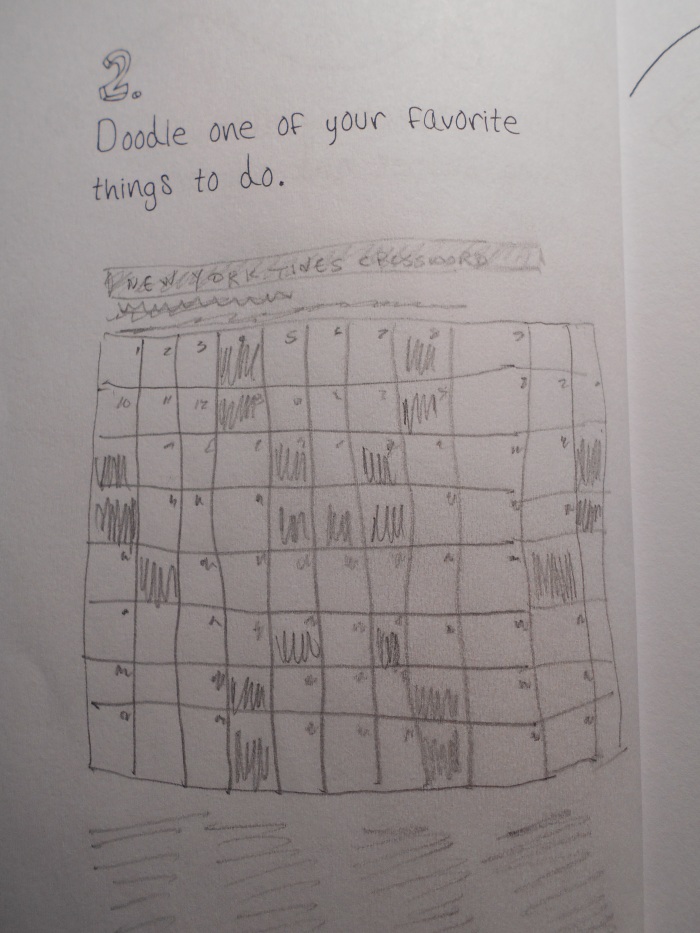
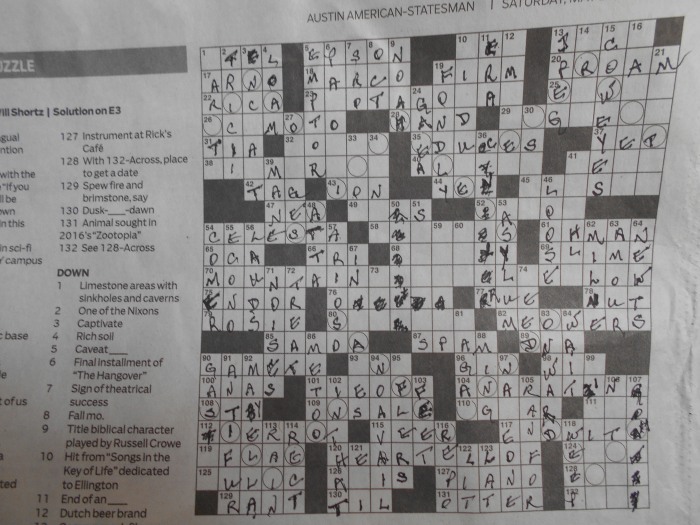
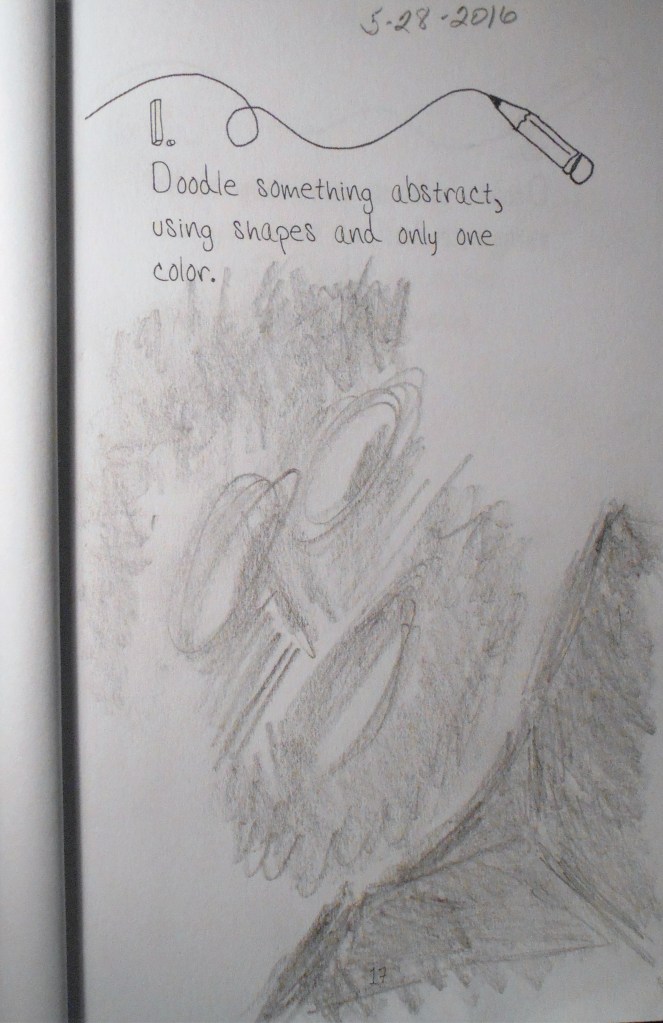
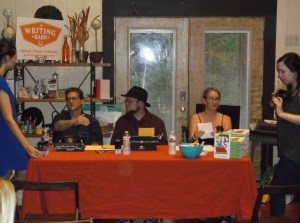
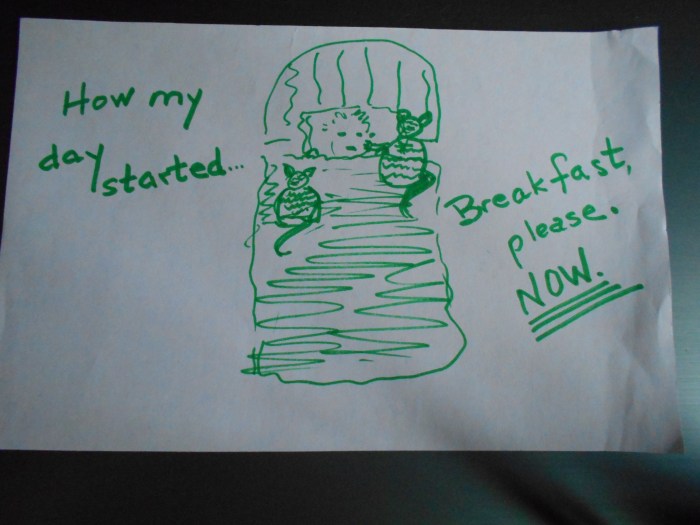







 Image via Creepy Freaky House of Horror (Facebook)


 M. K. Waller