In the previous post, I announced my intention to get up, go to BookPeople, write for an hour on a project of not-email and not-post (because Ramona DeFelice Long told me to), and get off the laptop by 7:00 p.m.
Here’s how the day went.
Ernest
At 8:00 a.m., I discovered Ernest experiencing grave digestive problems reminiscent of previous problems caused by eating string. No matter how careful we are, he’s always able to find string.
After practicing every sneaky tactic I know to wrestle him into the carrier, I hauled him to the vet, wrote a check, hauled him home, and spent the next twenty-four hours stalking him up hill and down dale, from litterbox to litterbox, to get an accurate picture of his post-doc activity.
If there wasn’t any, I would have to take him back to the vet today for reconsideration of the diagnosis of UTI to ingestion of string.
In addition to the X-ray, the veterinarian gave him a long-lasting injection of antibiotic so we wouldn’t have to catch him and fight over pills or liquid for a week. I could have chosen to start treatment without the X-ray and see what happened but wasn’t sure I could get him back into the carrier if the antibiotic didn’t work. Some things are not worth the effort.
Because we have two cats and two litterboxes, and because I knew isolation wouldn’t be possible, at least if I valued our doors, I sat up all night watching him. He slept. All night. Didn’t go near a litterbox. I played Bookworm.
David rose at 7:00 a.m. We changed shifts. I went upstairs for four hours of sleep. David stalked.
I woke at 11:00 to the news that Ernest had performed admirably. David had kept samples. I said I didn’t need to see them.
Ernest is in fine fettle. At present he’s lying on my arm, making biscuits where I wish he were not. I will tolerate this until the first claw penetrates my clothing and punctures my flesh. He means well.
In fact, he forgave and forgot as soon as we returned from the veterinary clinic. He swished around as if I had never betrayed him, sat in my lap, pinned down my left arm while I typed, lay on the footstool, gazed at me lovingly.
I’m grateful he doesn’t hold a grudge. In the fight for proper medical attention I nearly dislocated his shoulder. I’m trying to forgive and forget that my back and my right arm will once again have to be put right by the massage therapist. The carrier alone is heavy, and with Ernest inside it gains seventeen pounds.
Concerning the writing life: I did not go to BookPeople; I did not write for an hour; I did not eat breakfast or lunch until nearly 3:00 p.m. I did not do anything except be nurse and mama to a big, hulking guy tabby cat.
But hey–I got another blog post out of it.
The craziest thing is that it’s almost the same post I wrote two or three years ago, about the day I was
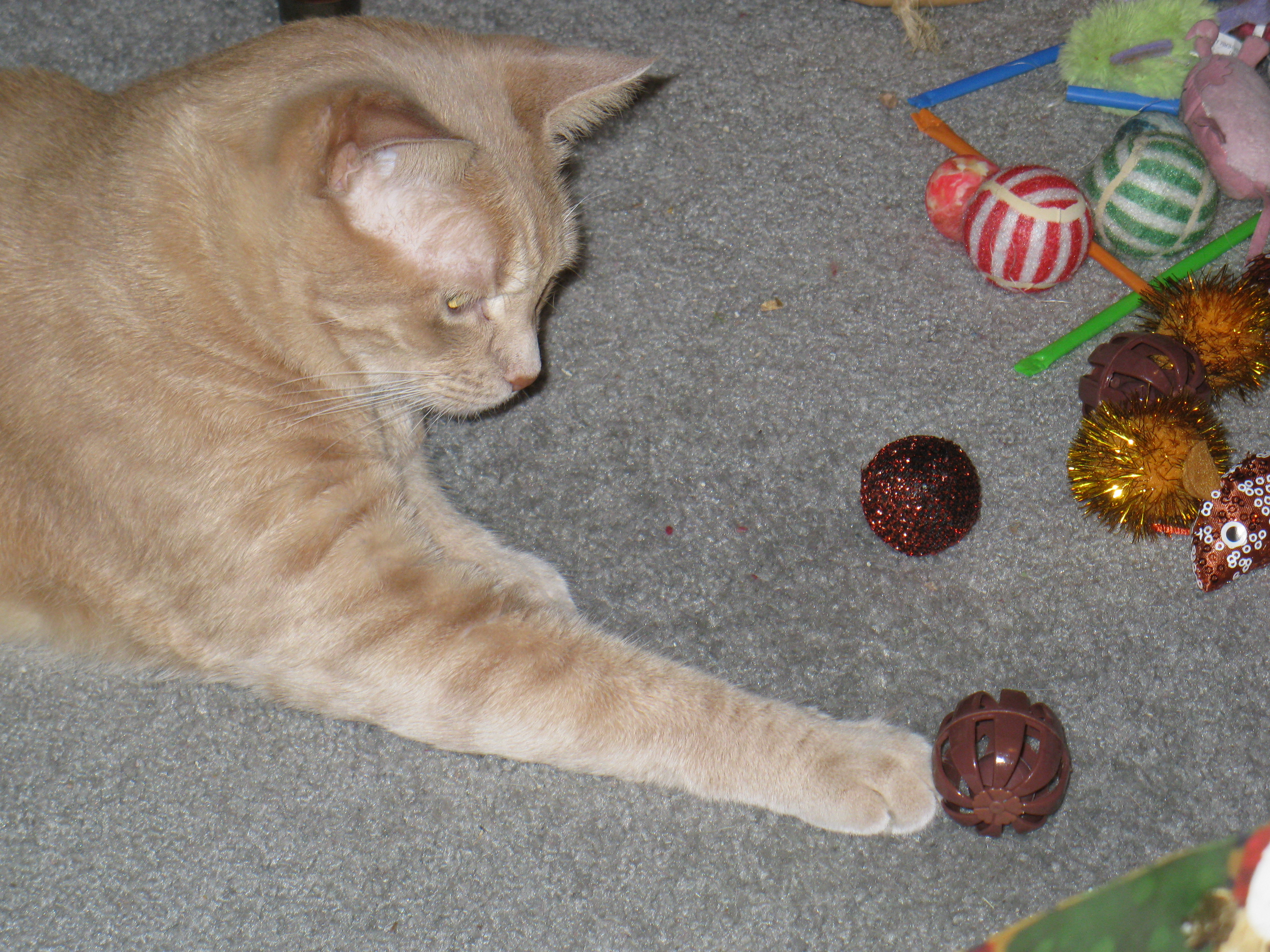
William
determined to write write write but instead spent the day lying on the floor in William’s bedroom, trying to coax an ailing Ernest out from under the bed and to the doctor.
Now the question: Do these things happen because I’m crazy, or am I crazy because these things happen?
What is the moral? (Must be a moral.)
Change in the Davis-Waller house doesn’t seem likely, at least while Ernest and I live here. Might as well accept that and go on.
I should never never never publicize my intention of writing writing writing.
Writing writing writing equals change. See first moral, above.
And failing to follow through is embarrassing. Especially reporting the failure, as is only fair. Readers deserve to know.
When this post is safely online, I shall throw things into a bag and head south to retreat with Austin Mystery Writers. I will have a cabin and a river and some pecan trees. I will not have Internet connection or decent TV reception. Phones will work only outside.
And for the next two days, I promise to sit in a porch swing and Write. Write. Write.
***
If paragraphs in this post are incorrectly spaced, please pretend they’re not. Today’s format is like Ernest–not under my control. It’s just one more miracle of modern technology.
The computer is a Kathy magnet. It wasn’t so bad until 2008, when I replaced a forty-hour work week with a laptop and my husband installed wi-fi. The Internet brings so many fine blogs and other attractions into my living room, where I sit with my feet up and examine them all; email can take up an entire day, if I leave it open while working.
Doubters would say that what I do isn’t working. I disagree. Negotiating the web is fatiguing. Commenting draws a lot of energy. I don’t want to write something that will be misunderstood; I don’t want to leave typos or incorrect punctuation; I don’t want to sound stupid.
Example: The previous sentence initially read, I want to sound stupid. It’s easy to mess up online.
Political posts on Facebook leave me just wo-ahn out. There’s the writing, of course, which is draining, but there’s also the emotion. Righteous indignation requires energy. Restraint requires more. After exercising restraint for several months, I stopped logging on. But there are friends and acquaintances–no, they’re not all friends–I want, and need, to keep up with. I like knowing how my great-niece’s first year of school is going. I like knowing that in the doctor’s waiting room when she was four, she suddenly came out with, “DOOOOOOOOOMED. We’re all DOOOOOOOOOMED.” Her fourteen-year-old brother wasn’t impressed, but I was. Her pronouncements remind me we’re not all doooooooomed.
Anyway, I logged onto FB today, discovered a post about a remark a sexist pig made on a pseudo news program, and was moved to share the post and a rousing Jeremiad of my own.
I didn’t address my remark to the sexist pig, nor did I call him one. I saved the phrase for this post. I merely suggested that his comments reinforce the ignorance and the bigotry of listeners who agree with him. Plus a couple of other salient thoughts.
Then I copied my remarks and pasted them into a Word document for future publication somewhere, perhaps here. They were scathing, simply scathing, but reasoned and polite, and they deserve a wider audience.
Another example: I’m getting all het up here just recalling the incident. Molecules of emotion surge through my body. I am giving the sexist pig power over me. That isn’t good.
Yesterday I heard a segment of a call-in program on NPR about the downside of computer technology on the culture. I’ve seen one of the effects on medicine already. When my former doctor’s practice installed computers in examining rooms, he stopped looking at me and started looking at the screen. So, to a lesser degree, did a specialist I consulted. They were excellent clinicians, and the latter possibly saved my life by doing surgery that only she and I thought I needed.*
But there’s information to be drawn from faces as well as from words, on both sides of a conversation. Eyes transmit confidence and sympathy and a number of other messages. With the Party of the First Part looking at the side of the Party of the Second Part’s Head (or, as once happened, the back of his white coat), and the Party of the Second Part looking at a screen and typing away, I wonder whether the two Parties make sufficient connection.
The internist I see now has no computer in the examining room. He taps here and there on a Palm Pilot (or something; it has a light on it for closer examination of funny-shaped moles, plus, it appears, an entire pharmacopoeia; I hope it’s not an iPhone). But he sits near me and looks me in the eye, and I reciprocate, and we get along very well.
He also asks at every visit how the writing is going, thus allowing me to infer he remembers something about me that isn’t in the file. It probably is in the file, maybe scrawled inside the cover of the folder, but as long as I haven’t seen it, it isn’t.
One day I’ll walk in and find myself looking at a 17-inch flat screen. It’s inevitable, and, all things considered, it’s a good thing. But when the time comes, I shall tell the doctor how to conduct himself while interviewing patients, just in case he doesn’t know. I’m old enough to be his mother and I taught high school English, so I’m not only entitled, I’m an expert.
But enough of doctors.
I’ve been thinking for months–years?–about the power I give technology over my life: I don’t move as much as I used to, or get out of the house as I should. I don’t read as much as I did–I read much less, in fact, and this is the first time I’ve been able to make that claim.
I don’t write with a pen and paper as often as I used to. I’ve always enjoyed putting words onto paper with a good pen, not an expensive one, but a pen that fits my hand.
And although he hasn’t said anything, my POSSLQ** might be as tired of seeing me staring at a screen as I am of seeing the doctor do the same.
So. I’ve decided to pull the plug nightly by 7:00 p.m., and to work backward towards 5:00 p.m.
To do so, I’ll have to write everything I want to write during the day. For a nocturnal animal whose brain
starts functioning about 9:00 p.m., the change won’t be easy. But it’s the right thing to do.
In my new spare time, I will read books and write in my journal with the pen of my choice. POSSLQ will follow his tradition of reading every word in the newspaper and in several magazines. We might converse.
I will go to bed at a decent hour and wake at a decent hour, in time to get a table and an electrical outlet at the BookPeople coffee shop, and there I will write–write meaning to write stories and novels for at least one hour every day. I will do it because I promised author and editor Ramona DeFelice Long that I will.
Giving away your power isn’t a bad thing as long as you know the person who receives it has good motives.
Note that I write I will, a construction implying determination, resolution, perseverance.
If I absolutely can’t help myself, I’ll toss off a blog post now and then. But only outside that sacred hour.
It hasn’t escaped me that the BookPeople part involves using a laptop and wi-fi. I can’t write what I need to write without the laptop.
But as I would not be a Luddite, so neither would I be a Zombie. And I’ve had it on good authority that computer addiction leads right down the primrose path to Zombie-ism.
###
*The subsequent biopsy agreed with us. Thank you, Dr. Carla Ortique, who now practices in Houston. I wish you were here.
**1) Person of Opposite Sex Sharing Living Quarters. 2) An affectation. We’re married. 3) See in its entirety “My POSSLQ” by Charles Osgood. A darned good poem. Here’s the first paragraph:
“Come live with me and be my love,
And we will some new pleasures prove
Of golden sands and crystal brooks
With silken lines, and silver hooks.
There’s nothing that I wouldn’t do
If you would be my POSSLQ.” . . .
In yesterday's post I wrote about Lynna Williams' story "Personal Testimony." Here are the first three paragraphs of the story.
###
“The last night of church camp, 1963, and I am sitting on the front row of the junior mixed-voice choir looking out on the crowd in the big sanctuary tent. The tent glows, green and white and unexpected, in the Oklahoma night; our choir director, Dr. Bledsoe, has schooled us in the sudden crescendos needed to compete with the sounds cars make when their drivers cut the corner after a night at the bars on Highway 10 and see the tent rising out of the plain for the first time. The tent is new to Faith Camp this year, a gift to God and the Southern Baptist Convention from the owner of a small circus who repented, and then retired, in nearby Oklahoma City. It is widely rumored among the campers that Mr. Talliferro came to Jesus late in life, after having what my mother would call Life Experiences. Now he walks through camp with the unfailing good humor of a man who, after years of begging hardscrabble farmers to forsake their fields for an afternoon of elephants and acrobats, has finally found a real draw: His weekly talks to the senior boys on “Sin and the Circus?” incorporate a standing-room-only question-and-answer period, and no one ever leaves early.
“Although I will never be allowed to hear one of Mr. Talliferro’s talks—I will not be twelve forever, but I will always be a girl—I am encouraged by his late arrival into our Fellowship of Believers. I will take my time, too, I think: first I will go to high school, to college, to bed with a boy, to New York. (I think of those last two items as one since, as little as I know about sex, I do know it is not something I will ever be able to do in the same time zone as my mother.) Then when I’m fifty-two or so and have had, like Mr. Talliferro, sufficient Life Experiences, I’ll move back to west Texas and repent.
“Normally, thoughts of that touching—and distant—scene of repentance are how I entertain myself during evening worship service. But tonight I am unable to work up any enthusiasm for the vision of myself sweeping into my hometown to be forgiven. For once my thoughts are entirely on the worship service ahead.”
###
Yesterday I wrote that the narrator of “Personal Testimony” is eleven years old. When I discovered the excerpt, I was reminded she’s really twelve. I’ll correct my error. My narrator in “Personal Experience,” however, continues to be eleven.
On my way home from work one night in the ’90s, I heard actress Judith Ivey on Selected Shorts, reading “Personal Testimony,” a short story by Lynna Williams.
The narrator is eleven-year-old Ellen Whitmore, a preacher’s daughter from Fort Worth, who is at Southern Baptist summer camp in Oklahoma. At evening services, when campers are expected to witness to their experiences of sin and repentance, Ellen demonstrates a talent that catches the attention of fifteen-year-old Michael. Although he’s reputed to be most spiritual boy in camp, Michael has what Ellen’s brother calls “Jesus Jaw”– he has plenty to say but can’t complete a simple sentence: “I just–I mean, it’s just so–I just . . .” He tells Ellen he wishes he could speak about his spiritual life as easily as she can speak about hers, so, following her mother’s example, she offers to help. Within days, she has a thriving business writing personal testimonies for older campers, a gratifying popularity, and a fat stack of bills stashed in her Bible at John 3:16. Her adventure in capitalism ends at the summer’s final service, when she sees her father in the congregation, realizes he knows, and makes one last and very public attempt to avoid his wrath.
I’ve heard that people don’t laugh aloud when alone. That’s not true. I sailed down I-35 guffawing and then quickly broke out in tears.
(I hate it when writers manipulate me like that. It’s just one more skill to covet.)
I’d been writing off and on for a few years but hadn’t produced anything even marginally successful. A small circle of friends and family liked the pieces I showed them, but they also liked me– most of the time–and they weren’t seasoned critics anyway. The writing was bad. I was frustrated. Not knowing what was wrong, I couldn’t make it right. Classes and workshops didn’t help.
The night I heard Judith Ivey read, all that changed. I didn’t experience an epiphany, per se, but there was a definite moment of enlightenment: My best work was bad because it had no voice. I had no voice. The nearest I could manage was a small-time literary critic in love with semicolons.
Listening to “Personal Testimony,” I heard Lynna William’ voice and knew what I should do.
My work should sound natural to my ear. Informal. Fluid. First person narration by a self-absorbed eleven-year-old girl with attitude, precocious in some areas and in others absolutely clueless. That comprised Enlightenment, Part I.
Then came Enlightenment, Part II: I’ve been hearing that voice most of my life. It’s the one I think in. I didn’t have to worry about copying Williams–it’s my voice, too. I’d just never recognized its potential.
Not long after hearing “Personal Testimony,” I allowed the eleven-year-old in my head to dictate a story while I wrote. Then she dictated another. And they worked.
My inner child is different from Ellen, as is only right. Mine is sharper, has more attitude. I have no idea why.
A year ago, my eleven-year-old suddenly morphed into a forty-year-old woman. She has so much attitude she’s scary. Now there’s a third voice, very different from the other two, stronger and scarier even than the forty-year-old. The third voice came as a relief. I’d wondered whether the pre-teen was all I had. What if everything I wrote came from the same source and sounded just like what had come before? The child is fun to listen to, for a while, but after a time, she can become wearing. I spend enough time with her as it is. Readers would soon get their fill.
There are some things that can’t be learned in a classroom. An instructor might have told me my work lacked voice, but he couldn’t have said how to find the right fit.
I’m indebted to Lynna Williams for helping me to hear a girl’s voice, and to recognize its value. She inspired hope. She showed me that if I listen, the eleven-year-old in my head will tell me what I need to know.
[Links are scattered throughout this post. If you slide your pointer across the screen, you’ll see where to click. In the meantime, I’ll choose a theme that makes finding links easier.]
In yesterday’s abbreviated post, I promised an announcement to end all announcements.
Confession: Kaye George was quicker than I. She made the announcement on another blog, whose title and URL I will display later in this post. I’d hate for readers to click on that link and forget to come back here.
The Announcement: “Murder on Wheels,” an anthology of eleven short stories written by members of Austin Mystery Writers critique group and two of its friends, has been accepted for publication by Wildside Press.
It’s occurred to me that we might be sending out this news prematurely, that we should wait for the book to appear. But yesterday the contract, and self-restraint, went the way of the dial telephone.
I doubt we’d have had the energy keep the secret anyway. We’ve been on the verge of dancing in the streets ever since receiving word that Wildside would publish. When one AMW member heard the good news, she broke into song. Thanks to the miracle of modern technology and a husband who knows how to make an .MP3 file from a voice mail, I have a recording. I would share it, but I value my life.
The next question, of course, is WHEN?
We don’t know. There’s a lot to do between now and the launch date. Before Wildside’s final acceptance come edits. The others have informed me it’s gauche to tell a publisher that your stories are already perfect. So I imagine compliance with the editor’s requests won’t be an issue.
I promised I would display the address of Kaye George’s official announcement. An Agatha-nominated author, Kaye has published a number of mystery stories and novels. Although she’s no longer around attend AMW’s meetings, she’s still our leader and our guide through this new territory. She writes about how the idea for “Murder on Wheels” came about. Her account of this Eeeeeeeeeeeeeeeeee! experience is more detailed and more interesting than mine.
Our fabulous sponsor Eden Mabee is giving us a twofer this round. Given a lot of what I’ve seen flying around the interwebz, I think it’s well timed. Particularly as we’re approaching the end of Round 3 and some folks won’t have made their goals and will take that really hard.
~*~
I want to bring up one of those “we’d rather not think about it” topics: depression. Given that the word “depress” as in to “press down” is right in the name, it should be no surprise that it can stop us dead in our tracks, keeping us from achieving not only our writing dreams but also almost anything. Depression is a serious concern, and it’s important to know how what to do about it when it happens.
Writing is a generally solitary craft. Except for the rare conference or critique group, much of our community contact…
It’s one p.m. Texas time. I’m in a coffee shop, procrastinating, and I can’t think of a better way to procrastinate than to googleScottish Referendum and check on how things are proceeding.
I thought the results might have already been announced, since Scotland is several hours ahead of us, but so far they haven’t. Further googling pulled up news that numbers will start trickling in about one a.m. Friday. The final result might be announced much later on Friday.
In Scotland, one a.m. is drawing nigh. I’d like to stay up to watch the exit polls, but getting a full night’s sleep at night is more important than watching coverage of a Scottish election, especially when I avoid most election coverage here in the U. S.
I read–or maybe heard on NPR–that if one votes Yes, he’s supposed to go directly to the Yes lady and report how he voted. It’s expected to be more accurate than exit polls.
If a large number of citizens vote like my father did, however, the Yes ladies could get it wrong. My father did not discuss his vote, either before or after an election. His political leanings were his business, and he didn’t even engage in political discussions. I know he discussed issues with my mother, but she was about the only one. I’m pretty sure he voted a straight Democratic ticket, but I can’t swear to it.
My mother was more of an Independent, at least in 1960. She preferred Richard Nixon for president, but she liked Lyndon Johnson for vice-president. That required her to vote for men from opposing political parties for the top two positions. She said she was going to split the ticket. At the age of nine, I imagined her taking a pair of scissors into the voting booth and cutting the ballot into two strips.
If enough voters had followed her lead, we could have ended up with Richard Nixon and LBJ governing the country together. How I’d love to have seen that partnership.
I just realized that the phrase split theticket still conjures up a vision of Mother holding her sewing scissors.
I guess it’s like Bringing in the Sheepand Jesus the Cross-Eyed Bear. And Up on the housetop, reindeer paws. No matter how hard you try to banish them, some things just stick.
###
It’s nearly one a.m. in my area of the United States. I’ve been home for about twelve hours. The writing is slow (a fact that shouldn’t surprise me). That could pose a problem.
This post is time-sensitive–it won’t have much oomph after the results have been announced. And if the world already knows, I’ll have to go back and change all my tenses.
But for the past twelve hours I’ve neither turned on the television nor googled. I know nothing about what’s happening outside this room. And if I know nothing, my tenses can stay the same. Where ignorance is bliss, etc. Now back to the referendum.
Both sides have concerns about the future of an independent Scotland. CNN Money lists five reasons to worry: the currency mess; the debt debate; oil rights; the effect on the financial industry (the Royal Bank of Scotland is threatening to move headquarters to England [If it does, will it have to change its name?]); and the country’s relationship to the European Union. Or, to condense things a bit, one reason to worry: money. The Scotch Whisky Association expresses concern about financial repercussions of independence, but so far there’s been no indication whisky makers will move south. (If they move to England, will it still qualify as Scotch?)
Back to the referendum. Actor James McAvoy, who, for the good of his career, kept his opinion to himself, expressed the gravity of the choice:
“This is the first time in years a developed country has talked about splitting up and it’s a massive thing,” he said. “If you vote for a president or a prime minister based on political or economic issues and they don’t deliver, that’s not so bad – you can protest four years down the line and vote them out. If you vote for continued unification or independence there is no protest vote – that’s it. And that could be it for decades, for centuries.”
Centuries. That’s what makes this such a grand process. Scotland has been part of the Union for hundreds of years. Today’s decision will affect that it and the countries it separates from far into the future. And the question is settled not by soldiers on a battlefield but peacefully, by individuals at the ballot box.
I don’t want to descend into the mire of sentiment. I’m best at detachment, standing a safe distance from the subject, letting irony handle things.
But, putting irony aside, isn’t what happened in Scotland today remarkable?
Not as remarkable as the 1994 election in South Africa in 1994, the first in which citizens of all races were allowed to take part.
But remarkable nonetheless.
And not just Scotland. The other countries behaved remarkably, too. After all, the English could have dressed up like Birnam Wood and marched right up the hill to Dunsinane and put a stop to the whole troublesome business.
There are probably laws and ordinances in place to prevent the English from doing any such thing, but if you’ll suspend disbelief for the length of the previous paragraph and, for the sake of the post, just imagine Birnam Wood marching up that hill . . . It could happen . . . There’s precedent. It wouldn’t be the first time Scotland was invaded by trees.
I should have published this well before midnight, but because I set my own deadlines, I’m free to shuffle them around as I please. Blogging should generate pleasure, not stress.
I’ll end by saying I’ve always been fascinated by the British Isles, and especially Scotland. I’ve said dozens of times, and will continue to say, that if my ancestors had just stayed put, I might be living–and voting–there now. My one visit there was too brief. I love the weather. I was not designed to live in Texas heat and drought. I dream of going back and seeing more of the country, standing in the mist and the rain, eating haggis (I liked it.), and listening to the beautiful, musical brogues.
And when I’m a rich and famous author, I shall pack up the cats and my husband and fly over (all of us first class) and while the cats are in quarantine, I’ll find and purchase a croft with some pigs and chickens and sheep and a pony and some dogs and central heating and A/C, because you never know when the weather will turn, and learn to dance the Highland Fling, and sit amongst the heather and write more best sellers and rake in the dough and get a flat in London and every year go to Bloody Scotland and sit at the bar hobnobbing with other famous writers and drinking Scotch. Unless I discover I don’t like Scotch. I haven’t tried it yet.
But I’m not going to get rich and famous or anything else but tired, sitting up till five a.m. to indulge myself by composing rambling, stream-of-consciousness blog posts.
When did you last attend a genuine English afternoon tea?
English: An Afternoon Tea (Photo credit: Wikipedia)
I helped host one yesterday at Sisters in Crime ~ Heart of Texas Chapter in Austin. The program focused on the life and work of English mystery novelist P. D. James, who recently marked her ninety-fourth birthday. Ms James’ latest novel, Death Comes to Pemberley, will be aired on PBSMasterpiece Mystery later this fall. All things considered, this seemed the proper time to celebrate the author’s contribution to literature. What better way than with a tea?
Here I must insert a disclaimer: When I call it a genuine English afternoon tea, I really mean a genuine Texas-style English afternoon tea. Dress was admittedly casual–very few hats or tea dresses–and I forgot to take the table linens. And the Earl Grey was made with teabags…
This week, a group of hackers released a list of about 5 million Gmail addresses and passwords. This list was not generated as a result of an exploit of WordPress.com, but since a number of emails on the list matched email addresses associated with WordPress.com accounts, we took steps to protect our users.
We downloaded the list, compared it to our user database, and proactively reset over 100,000 accounts for which the password given in the list matched the WordPress.com password. We also sent email notification of the password reset containing instructions for regaining access to the account. Users who received the email were instructed to follow these steps:
Go to WordPress.com.
Click the “Login” button on the homepage.
Click on the link “Lost your password?”
Enter your WordPress.com username.
Click the “Get New Password” button.
In general, it’s very important that passwords be unique for each account. Using the same…
Below is a piece I originally posted, under a slightly different title, several years ago. I don’t know why the text looks as it does, but it will stay that way until tech support and I find a remedy. I hope you will read and enjoy anyway.
“Ophelia,” oil on canvas, size: 49 x 29 in (Photo credit: Wikipedia) John William Waterhouse [Public domain], via Wikimedia CommonsAt HEB this afternoon, having verified that I had, indeed, spent my last sou on a cup of coffee at Waterloo Writers, I ran my credit card through the scanner. The resulting screen read, Select Tender Type.
Tender.
Such a formal, old-fashioned word for this new-fangled device.
It reminded me of the scene in which Polonius asks Ophelia about her relationship with Hamlet:
Polonius: What is between you? give me up the truth.
Ophelia: He hath, my lord, of late made many tenders Of his affection to me.
Polonius: Affection! pooh! you speak like a green girl, Unsifted in such perilous circumstance.
Do you believe his tenders, as you call them?
Ophelia: I do not know, my lord, what I should think.
Polonius: Marry, I’ll teach you: think yourself a baby;
That you have ta’en these tenders for true pay,
Which are not sterling. Tender yourself more dearly;
Or–not to crack the wind of the poor phrase,
Running it thus–you’ll tender me a fool.
Poor Ophelia. She was a sweet thing, and young, and the men in her life treated her so shabbily.
But even while Polonius belittles his daughter to her face, the way Shakespeare moves tender through the passage, varying its meaning from one line to the next, makes the language as briliant as its meaning is dark. Polonius, as Hamlet later implies, is a rat—and he pays for his treachery a couple of acts down the road—but he has such a way with words.
Thinking of Polonius and Ophelia reminded me of Lord Capulet‘s rage when Juliet tells him she will not marry Paris. He explodes, and Juliet adds fuel to the fire.
Capulet: How! will she none? doth she not give us thanks? Is she not proud? doth she not count her blest, Unworthy as she is, that we have wrought So worthy a gentleman to be her bridegroom?
Juliet or The Blue Necklace (1898) by John William Waterhouse (Photo credit: Wikipedia)
Juliet: Not proud, you have; but thankful, that you have: Proud can I never be of what I hate; But thankful even for hate, that is meant love.
Capulet: How now, how now, chop-logic! What is this? ‘Proud,’ and ‘I thank you,’ and ‘I thank you not;’ And yet ‘not proud,’ mistress minion, you, Thank me no thankings, nor, proud me no prouds, But fettle your fine joints ‘gainst Thursday next, To go with Paris to Saint Peter’s Church, Or I will drag thee on a hurdle thither. Out, you green-sickness carrion! out, you baggage! You tallow-face!
“Thank me no thankings, nor, proud me no prouds, / But fettle your fine joints ‘gainst Thursday next,…” Beautiful. Just seeing it on the page gives me the shivers.
To some, Capulet sounds like a terrible father, but, as I pointed out to my freshmen, year after year, Juliet starts it. She’s rude and disrespectful. Her father doesn’t know she’s already married; he thinks she would be thrilled to marry Paris. But she behaves like a brat. It’s no wonder Capulet threatens to drag her on a hurdle thither.
The two female characters present an interesting contrast: Ophelia refuses to speak for herself; Juliet shouts. But neither one lasts to the end of Act V.
A scholarly paper might lurk in there somewhere: “Shakespeare’s Women: A Study of the Consequences of Self-Actualization Within the Context of the Father-Daughter Relationship Complicated by Nascent Heterosexual Bonding, with a Focus on Hamlet’s Ophelia and Romeo and Juliet’s Juliet.”
Or perhaps not.
By the time I finished with the Capulets, the cashier had almost finished scanning. While she bagged the items, I had time to wonder whether the name of Jasper FForde‘s protagonist, Thursday Next, was inspired by the once-projected date for Juliet’s wedding.
I also remembered that The Idylls of the King contains a line echoing Thank me no thankings, nor, proud me no prouds; I believe it’s spoken by Guinevere–maybe–but I’ve not been able to locate it, and it looks as if I’ll have to re-read the entire Idylls to ease my mind.
But I did catch the next lines that drifted by: Guinevere, jealous of Elaine, takes up Lancelot’s gift of diamonds
“And thro’ the casement standing wide for heat Flung them and down they flash’d, and smote the stream. Then from the smitten surface flash’d, as it were Diamonds to meet them, and they past away.”
That image—diamonds falling into the sunlit stream, and water splashing up, like diamonds to meet them—remains with me when the rest of the book has passed from memory.
Well. By this time, the cashier and I had completed our transaction. I wheeled the groceries to the car. End of shopping.
End of post.
Except to point out that I stood for ten minutes in one of the most boring places imaginable and forgot to be bored.
The photo display below illustrates what happens when the photographer reads the rules but immediately forgets them. Instead of photos engaged in dialogue, she shoots photos of objects engaged in dialogue.
It also shows what happens when one sock of each pair is eaten by the dryer: Those left behind have nothing to do but sit around and talk.
If there’s any justice in this world, this will be the last inane piece I’ll post, at least for a while. The previous post spotlighting the filthy mouse appeared because I was trying to attach my blog to Bloglovin‘ and wasn’t sure it would work, and I wanted to do more than post a possibly unworkable link. And after reading reams of instructions and not being convinced I understood them, I was disgusted enough to advertise the state of my refrigerator’s underside. I do move the appliance to mop, but I’m not compulsive about it. And I don’t want to offend by tossing my children’s favorite toy. Unfortunately, sponging mousie off does nothing for its appearance.
WordPress advises not to post when you have nothing to say. Once more I’ve violated the rule. Forgive me. As atonement, I offer socks and a cat.*
Also, please forgive the sock with the hole. I don’t wear it unless I want to make a statement. Then I pair it with the adjacent mismatch. I’m not comfortable that way, but people know that I’m my own person and that I have no shame.
See what other photographers have posted to this week’s photo challenge here.
*Sometimes, like around midnight, I post from impulse. Sometimes I’m just weak.