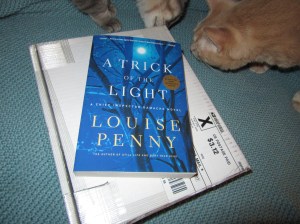
William and Ernest examine Louise Penny’s A Trick of the Light and the box it came in.
When I was eight, my grandmother gave me two Nancy Drew mysteries for Christmas: The Secret in the Old Clock and The Clue of the Tapping Heels, and I was hooked. One title led to another.
A Trick of the Light has received the following honors:
English: Louise Penny (Photo credit: Wikipedia). By Ian Crysler (Transferred from en.wikipedia) [CC BY-SA 3.0 ]
Winner of the Anthony Award for Best Crime Novel 2012
Finalist for the Macavity Award for Best Crime Novel in the US 2012
Finalist for the Agatha Award for Best Mystery of 2011
Finalist for the Arthur Ellis Award for Best Crime Novel in Canada in 2011
Finalist for the Dilys Award from the Independent Mystery Booksellers Association for the book they most enjoyed selling in 2011
Finalist GoodReads Choice Awards for 2011
Publishers Weekly top 10 Mysteries of 2011
Amazon.com top 10 Thrillers and Mysteries of 2011
Aunt Agatha’s Bookstore: Favorites of 2011
The Toronto Star: Favorite Read of 2011 New York Times Book Review: Favorite Crime Novel of 2011 BookPage, Readers’ Choice: Best Books of 2011 (#6 all genres)
Women Magazine: Editor’s Pick #1 Book of 2011
The Globe and Mail: Top 10 Mystery of 2011
The Seattle Times: Top 10 Mystery of 2011
Quill and Quire: Top 10 Mystery of 2011
I-Tunes: Top 10 AudioBook of 2011
Richmond Times-Dispatch: top 5 Fiction Books of 2011
NBR reviews a variety of genres by both established authors and those newly published. Subscribers receive notice of reviews by email. Only recommended books are reviewed–“books that are great reads.”
NBR also conducts drawings for free books from the list of email subscribers. I’m a subscriber. My name was drawn. A Trick of the Light arrived in today’s mail.
I hate that. I hate the author. I continue to like the book, but the author I despise.
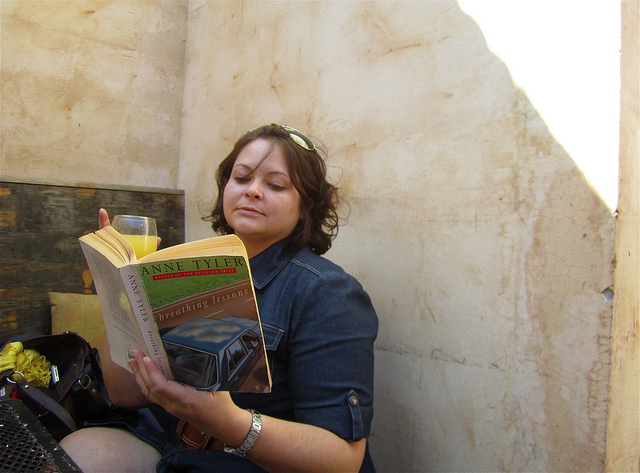
This time it’s Anne Tyler. I love her novels. The Accidental Tourist. Breathing Lessons. Dinner at the Homesick Restaurant. My favorites, if I have favorites, are Back When We Were Grownups and Saint Maybe.
Tyler’s plots are rather loose. Instead of going directly from here to there, they detour, turn corners you didn’t see coming, abandon the now for backstory that might take you a generation or two into the past before returning to the main narrative. “[C]haracter is everything,” Tyler said in an interview. “I never did see why I have to throw in a plot, too.”
She writes about families: ordinary, quirky, dysfunctional families–dysfunctional as ordinary families tend to be. They’re humble people, living in ordinary houses, working at ordinary jobs; their furniture is often mismatched and their carpet runners often worn from someone’s pacing. Her families stick together; children and grandchildren don’t stray far, come home often, and sometimes don’t leave at all.
Even their extraordinary problems are ordinary, the kinds of problems real people experience.
Her characters’ days are filled with matters of little importance. “As for huge events vs. small events,” says Tyler, “I believe they all count. They all reveal character, which is the factor that most concerns me….It does fascinate me, though, that small details can be so meaningful.”
She loves to “think about chance–about how one little overheard word, one pebble in a shoe, can change the universe…The real heroes to me in my books are first the ones who manage to endure.”
If her plots meander, it’s because they reflect the common, insignificant, everyday events that are so important, because, taken together, they form the essence of life.
Tyler cares about her characters. “My people wander around my study until the novel is done,” she said in another interview. “It’s one reason I’m very careful not to write about people I don’t like. If I find somebody creeping in that I’m not really fond of, I usually take him out.”
And therein lies my problem, and the reason that Anne Tyler is, for the moment, on my bad list.
She isn’t alone in liking her characters. I like them, too. Some of them, I love. And when one dies–or, as I see it, when she kills one–I take it personally. The character’s family stand around in the kitchen saying all the plain, simple, often awkward, frequently funny things that real people say when someone they love has died. They crowd together in pews to hear a sermon by a minister who didn’t know the loved one and might not know how to pronounce his name. They return home to refrigerators stuffed with casseroles and play host to friends and neighbors until they’re so tired they’re about to drop. Left alone, they get on one another’s nerves and offend with, or take offense at, the most innocent remarks. Then they pick themselves up and go on with their lives.
But I don’t. Because even though I stand outside the novel, reading about people who don’t exist, never have, never will, I know them. I’ve been where they are, said what they say, done what they do. And when I have to go through it one more time, with them–that seriously messes up my day.
Tyler always manages to redeem herself, though. One of her characters says or does something so remarkable, so absolutely right. And the world of the novel shifts. And so does mine.
In the book I’m reading now–I won’t mention the title so as not to spoil it for you–Tyler gives that role to the “disconcertingly young” minister who conducts the funeral. After a friend and a sister-in-law and a fourteen-year-old granddaughter wearing “patent leather heels and a shiny, froufrou dress so short she could have been a cocktail waitress,” have paid tribute to the deceased, he approaches the lectern and does what the deceased wanted–to “say something brief and–if it wasn’t asking too much–‘not too heavy on religion.'”
He starts by saying he didn’t know their loved one and so doesn’t have memories like they have.
But it has occurred to me, on occasion, that our memories of our loved ones might not be the point. Maybe the point is their memories–all that they take away with them. What if heaven is just a vast consciousness that the dead return to? And their assignment is to report on the experiences they collected during their time on earth. The hardware store their father owned with the cat asleep on the grass seed, and the friend they used to laugh with till the tears streamed down their cheeks… The spring mornings they woke up to a million birds singing their hearts out, and the summer afternoons with the swim towels hung over the porch rail… and the warm yellow windows of home when they came in on a snowy night. “That’s what my experience has been,” they say, and it gets folded in with the others–one more report on what living felt like. What it was to be alive.
And so Anne Tyler performs her magic. Once more I start bawling. I reconsider. My hostility passes into nothingness. I forgive her. We’re friends again.
I leave the church and go home with the family to a refrigerator stuffed with casseroles, and visit with their friends, and watch them give and take offense but then quickly, or perhaps slowly, repair their relationships, and pick themselves up and go on with life.
Now I have to read the second half of the book. That’s a lot of pages to cover without the character I love. But, like the others, I pick myself up and get on with it.
If I can’t have the character, I can still love Anne Tyler. And I will. And I do.
I am grateful. For my husband, my family, parents who gave me a good start and kept on giving, my home, teachers, education, friends, time to use as I wish, the rights guaranteed to me by the Constitution, the freedom to pursue happiness, good health, and a host of other blessings.
But when I write about blessings, the resulting essay is maudlin, insipid, schmaltzy, and trite.*I just can’t do sincere.*******
So this post is about things not usually seen on Grateful-For lists.To wit:
Coffee shops with enough electrical outlets, appropriately placed, to serve nearly all the people who want to plug in. (There’s no way they could serve all of them.) And that say your car will be towed if it’s parked in their lot for more than three hours but don’t really mean it. (BookPeople. They probably do mean it, but I’ve never been towed. I think it depends on how full the parking lot is.)
Everywhere that provides free Wi-Fi.
Coffee shops that allow a critique group to sit around a table and discuss manuscripts, and moan about how hard writing is, and what their kids and their cats are up to, and what their dysfunctional families are up to, and that don’t mind when one member reads aloud a scene involving torture and murder** because both staff and other customers are entranced, listening and wondering whether they’re hearing part of a memoir. And that don’t tow their cars.*****
Blogs. Mine allows me to write to write to an audience, real or imagined. I need that audience. So do most other writers, including students of all ages.
Books. I like them. I like to read them. I like to buy them. Unfortunately, I like buying more than reading, which is why I have so much to-be-read nonfiction on my bookshelves and elsewhere.***
Bookstore going-out-of business sales. Closing a bookstore is a terrible thing, but if they’re going to close anyway, I don’t mind helping reduce inventory. That’s how I acquired most of that unread nonfiction.
English: Borders in West Quay Retail Park, Southampton (Photo credit: Wikipedia) Public domain.
Printers that work.****** Most of them work now, but years ago most didn’t. That’s why my students at the university turned in so many papers with text starting at the middle of the page and running diagonally to the bottom right corner. I told them they really couldn’t do that, and that they needed to do the work earlier and start printing days rather than minutes before leaving for class. But I knew if I used a printer, my papers would look like theirs. I was still using a typewriter. When I put the paper in straight, my pages looked okay.
Mark Twain, Emily Dickinson, William Dean Howells, Henry James, Edith Wharton, Clyde Edgerton, Kathie Pelletier, T. R. Pearson, Olive Ann Burns, Fannie Flagg, Elizabeth Berg, Josephine Tey, Ruth Rendell, P. D. James, and the list runs on. If there are any questions about why I’m grateful, pick up some of their books. For Elizabeth Berg, begin with Durable Goods (her first novel, and yes, I despise her). For Clyde Edgerton get Raney, Walking Across Egypt, Killer Diller (WAE’s sequel), or Lunch at the Picadilly; the man is a genius. For Olive Ann Burns, read Cold Sassy Tree, her first and only complete novel; I feel about her like I feel about Elizabeth Berg, see above. I’d like to feel that way about Clyde Edgerton, but I can’t, because I want to be Clyde Edgerton.
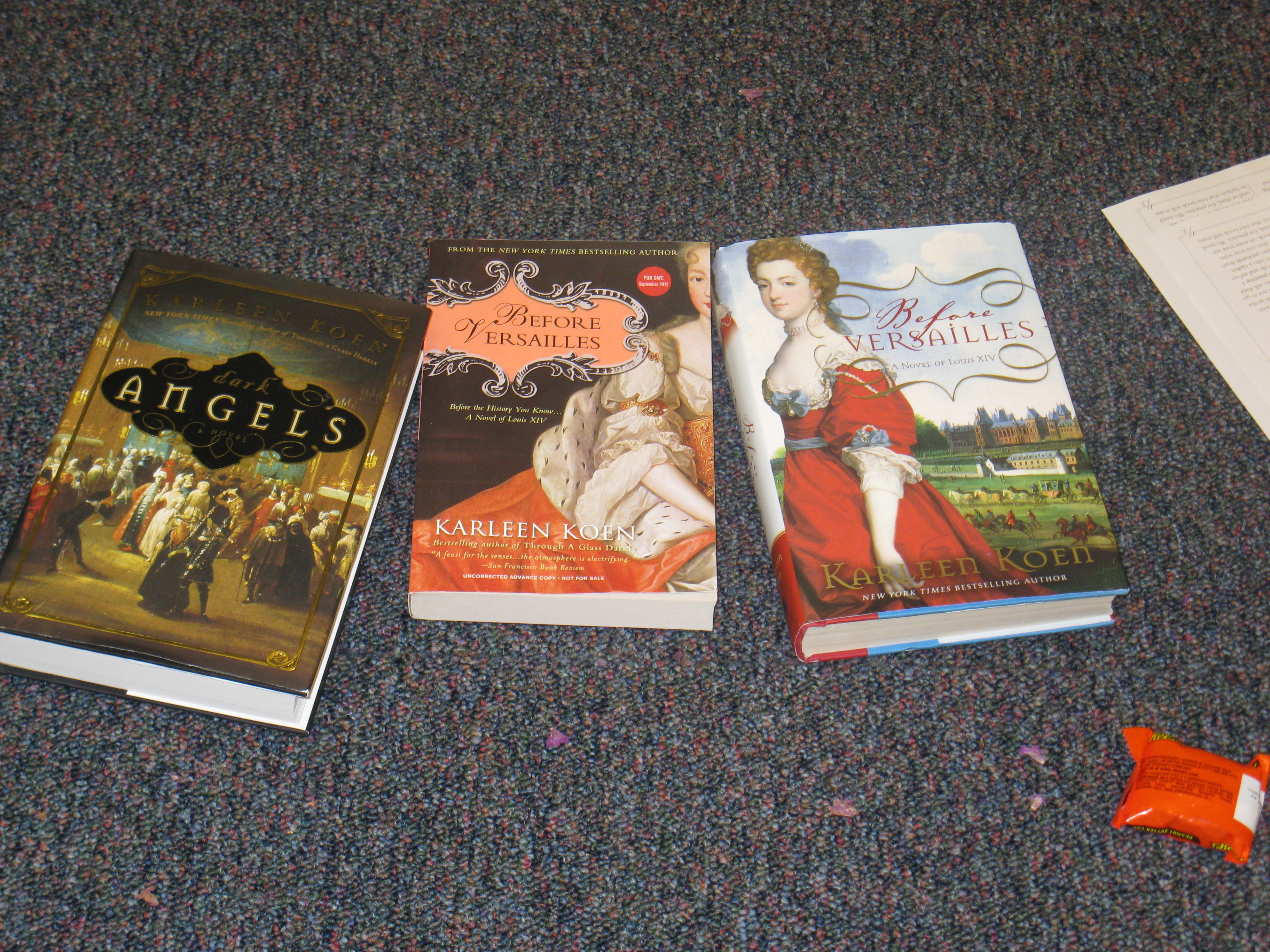
Karleen Koen,**** writer and instructor, who said, “I can’t teach you to write, but I can teach you to play.” And she can. And she did. And I had the time of my life writing and writing and writing. Anyone who wants to write and has the opportunity to take one of her classes should sign up asap. See her blog, Karleen Koen – Writing Life, and her webpage, Karleen Koen. Find information about the courses she teaches at Karleen Koen – Courses. Karleen has published four impeccably researched historical novels, set in the seventeenth and eighteenth centuries; the latest, Before Versailles, takes place in the court of Louis XIV, in the early years of his reign.
Karleen Koen
Three of Karleen Koen’s novels displayed on classroom floor at WLT retreat, Alpine, TX, 2014. The little orange things in the lower right corner might be peanut butter cups.
Dictionary.com and Thesaurus.com,which I keep running in the background when I work. Dictionary.com gives me exact definitions of words. Thesaurus.com answers the question, What’s that word that means something like XXXXXXXXXX but not exactly, and it’s standing at the beginning of my hypoglossal nerve but refuses to sprint on down to my tongue, and I cannot finish this sentence without it? These sites are a godsend for people who hyperventilate at the thought of leaving a blank space and moving on.
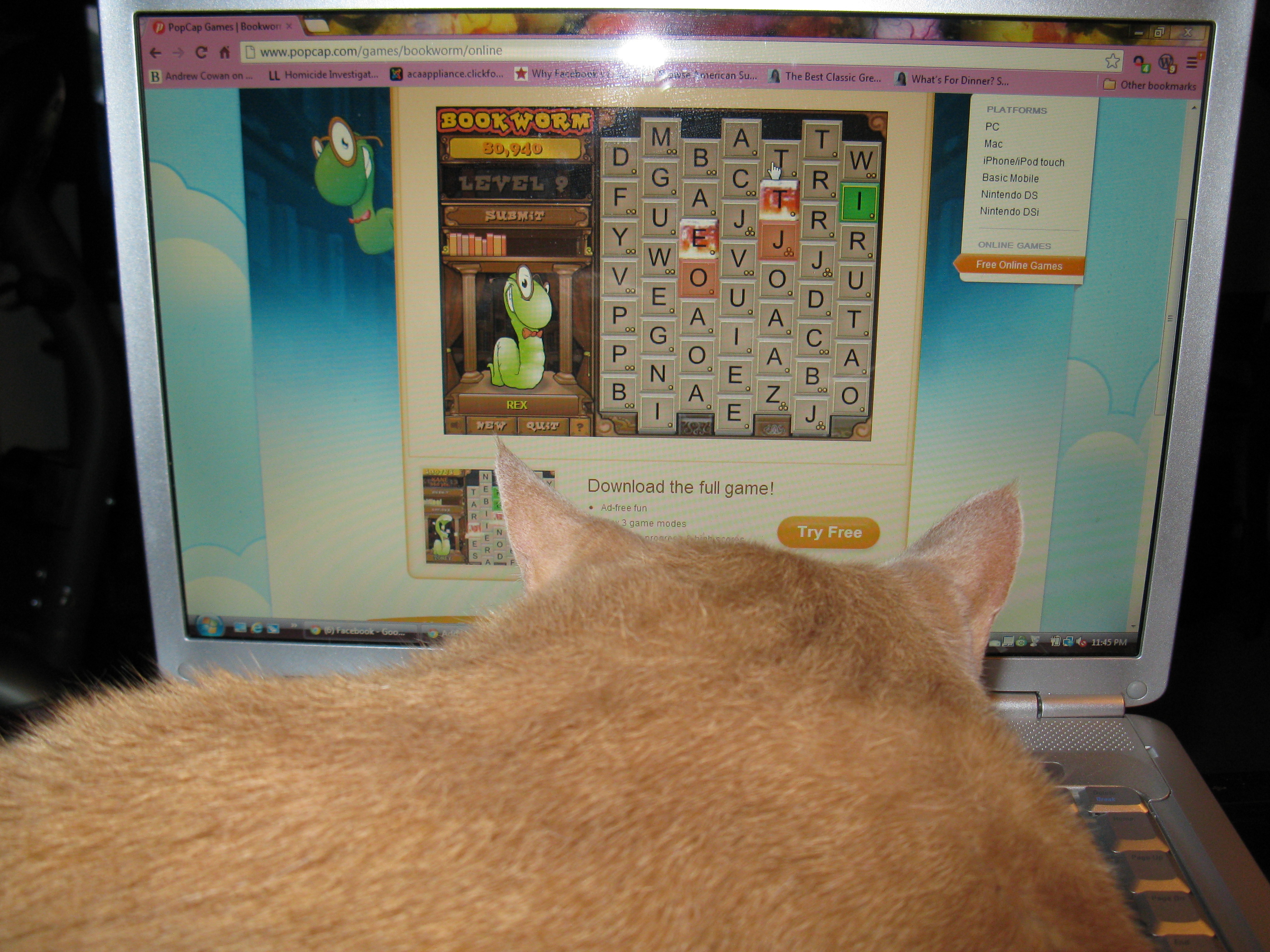
Bookworm.Yes, that one. The vile, disgusting, devilish online game that is a thousand times worse than solitaire, because if the Bookworm player is good enough, the game never ends. The player can sit mindlessly clicking on letters to make words, and if the letters he clicks don’t make a word, he just tries again, and he can play while he’s watching-listening to television, or petting the cat, or carrying on a conversation, or trying to think what his Main Character should do next because he’s painted her into a corner . . . Obviously, I know whereof I write.
I’m grateful for Bookworm, however, because sometimes I need the comfort of a mindless, repetitive task. Playing Bookworm can be a method of avoidance, but it can also be a way of putting the mind on autopilot, giving it the freedom to figure out how to get the Main Character out of the corner she’s stuck in.
Caveat: Playing Bookworm for too long at one sitting, day after day, month after month, can result in repetitive stress injuries. For example, the mouse hand and all that’s attached to it, right on up to the shoulder, can be rendered painful and practically useless until the light dawns and the victim realizes why she can’t raise her right arm.
Readers. I’m grateful for everyone who reads my posts, especially the posts that are two or three times as long as blog posts should be. This one is four times as long. Contrary to my expectations, everything on the list relates to writing. I had intended to include Relaxed Fit Slacks and The Demise of the Girdle. But tomorrow is another day.
(The Demise of the Girdle. Wouldn’t that make a marvelous title for a novel? Should it be mystery, romance, or science fiction?)
William Davis & Bookworm
* See Thesaurus.com. That’s where I found all these synonyms for bathetic.
*** Don’t ask where elsewhere is. It’s not relevant.
**** This is not an advertisement, paid or otherwise. Karleen is an excellent teacher–few instructors can keep twenty tired adults happy for a whole week by assigning more homework. (See Morning Pages)
***** See Coffee Shops, above.
****** And printers that don’t drink ink.
******* Last summer, when I wept bitter tears because I couldn’t write what I was trying to write (not my usual practice, but I was having a bad summer), Karleen told me what to do instead, and before anyone says Hahahahahah, I’ll add she was quite nice about it, and said I should aspire to write like David Sedaris. Have you ever known of David Sedaris to do sincere?
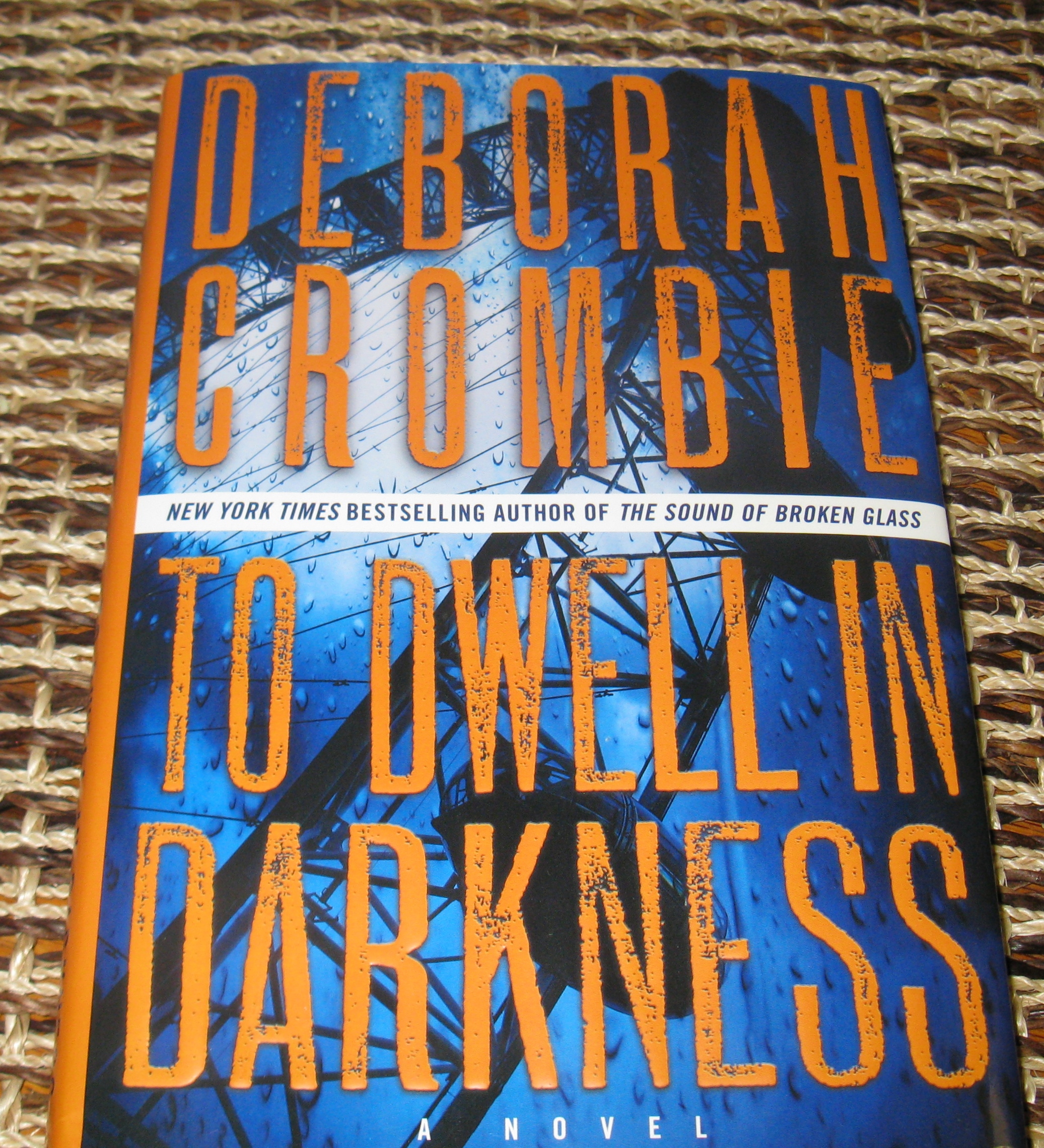
Deborah Crombie is the New York Times best-selling author of the Detective Superintendent Duncan Kincaid/Sergeant Gemma James novels. A SHARE IN DEATH, her first novel, received Agatha and Macavity nominations for Best First Novel of 1993. She has won two Macavity awards for Best Novel and her books have been nominated for a number of other awards. Her fifth novel, DREAMING OF THE BONES, was named a New York Times Notable Book for 1997, was short-listed by Mystery Writers of America for the 1997 Edgar Award for Best Novel, won the Macavity award for Best Novel, and was voted by the Independent Mystery Booksellers Association as one of the hundred best mysteries of the century. The most recent book in the Kincaid / James series,TO DWELL IN DARKNESS, was published by William Morrow in September 2014.
A native of Dallas, Crombie has lived in both Scotland and England, and visits England, where are novels are set, several times a year.
Critical acclaim for Deborah Crombie’s novels
Crombie has laid claim to the literary territory of moody psychological suspense owned by P. D. James and Barbara Vine.– Washington Post
Deborah Crombie is an American mystery novelist who writes so vividly about England, she might have been born within the sound of Bow Bells. (She) gets better with each book…lyrical, biting and evocative.– Cleveland Plain Dealer
*****
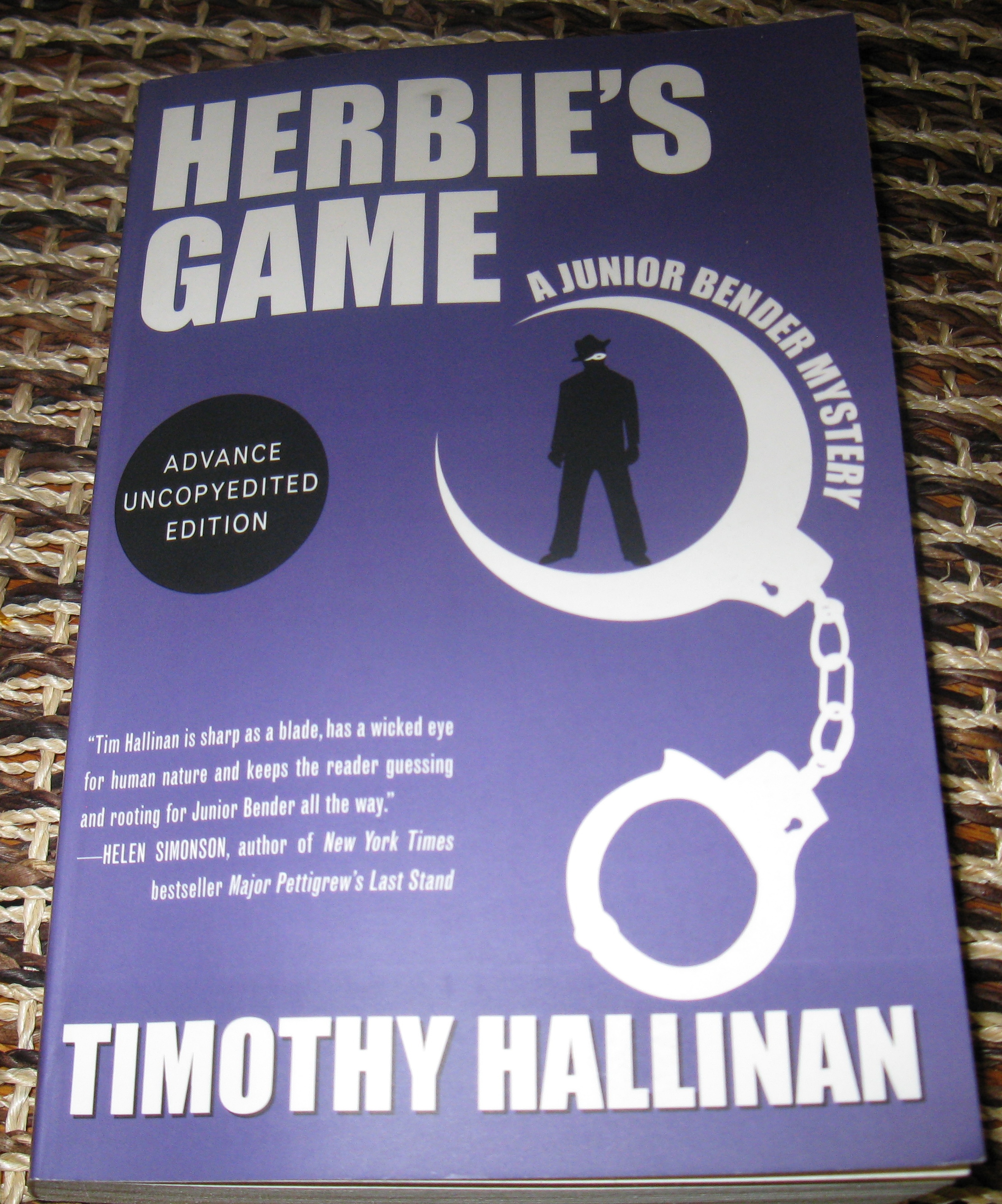
Timothy Hallinan has written eighteen critically acclaimed novels. He’s been nominated for the Edgar, Macavity, and Lefty, among others, and is currently a Shamus nominee for his book LITTLE ELVISES. He writes two series, one set in Bangkok, where he lives half-time, and the other in Los Angeles, where he lives the rest of the time. The Bangkok books feature an American travel writer named Poke Rafferty, who has married a Thai woman and adopted a Thai daughter, a street child, right off the sidewalk. The books are as much about family as they are about crime. The seventh Rafferty novel, FOR THE DEAD, comes out November 4, and William Kent Krueger described it as . . .”not only a fast-paced, compelling tale, but also, on every level, a fine literary read.” His Junior Bender series, about a San Fernando Valley burglar, who works as a private eye for crooks, has just been bought by Iddie Izzard as an NBC television series. The fourth and most recent to be published is HERBIE’S GAME. [Thanks to Timothy Hallinan for writing this copy, which appears here unaltered.]
Critical acclaim for Timothy Hallinan’s novels
“Bender’s quick wit and smart mouth make him a book companion on this oddball adventure.” ~ New York Times Book Review
“A modern-day successor to Raymond Chandler.” ~ Los Angeles Daily News
*****
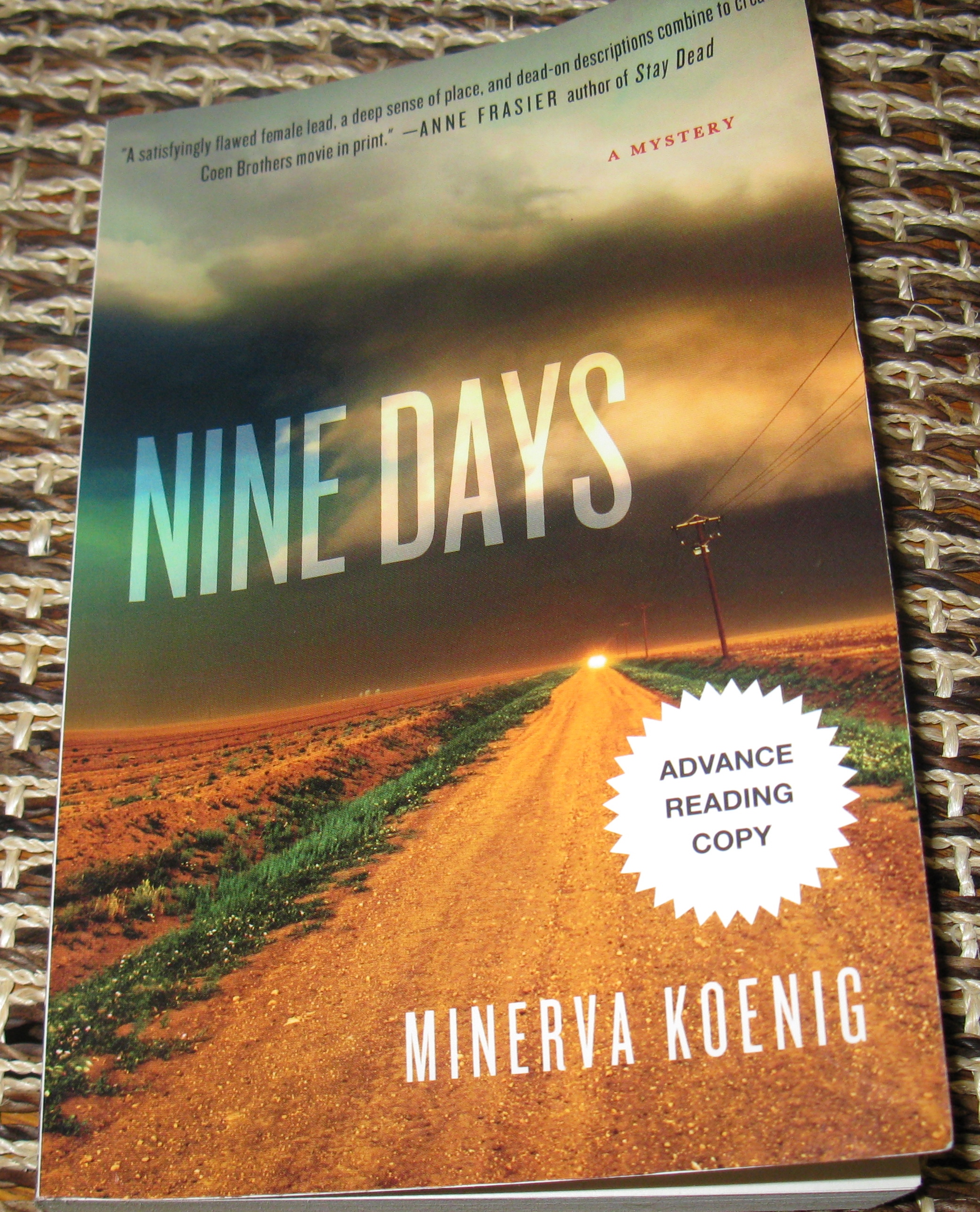
Minerva Koenig is the author of NINE DAYS, published by Minotaur in September of this year. The main character, Julia Kalas, is described as “short, round, and pushing forty, but … a damned good criminal. For seventeen years she renovated historic California buildings as a laundry front for her husband’s illegal arms business. Then the Aryan Brotherhood made her a widow, and witness protection shipped her off to the tiny town of Azula, Texas. Also known as the Middle of Nowhere.” With a local law enforcement officer as watchdog.
Julia has no intention of lying low, but she also doesn’t intend to raise her profile so high that half of Texas—good guys, bad guys, and who-knows-what-kind-of-guys—are either chasing, or being chased, by her. One thing is sure–Julia won’t be pushed around by any of them.
Scott Montgomery, crime fiction coordinator at BookPeople Book Store, says, “NINE DAYS introduces us to a fresh-hardboiled voice. Koenig embraces the genre, yet doesn’t completely play by its rules. I can’t wait to see what other conventions she breaks.”
Joy Tipping of the Dallas Morning news hails Julia Kalas as a successor to Sue Grafton’s Kinsey Milhone, saying, “Let us praise the literary gods, then, that a worthy successor has arrived with Austin author Minerva Koenig and her debut novel, the funny, scary and devilishly twisty NINE DAYS.”
A long-time resident of Texas, Minerva is a licensed architect who runs a one-woman practice in Austin. Among her other interests are sewing, playing chess, and fighting the patriarchy.
Critical acclaim for Minerva Koenig’s novels
“Small-town Texas is vividly brought to life in this atmospheric and entertaining debut that also introduces a memorable and unusual protagonist.” ~ Library Journal
“…a dizzying mix of rival groups, arms dealing, crooked cops, citizens turned private investigators and Central American politics.” ~ Patrick Duprey, Omaha World-Herald
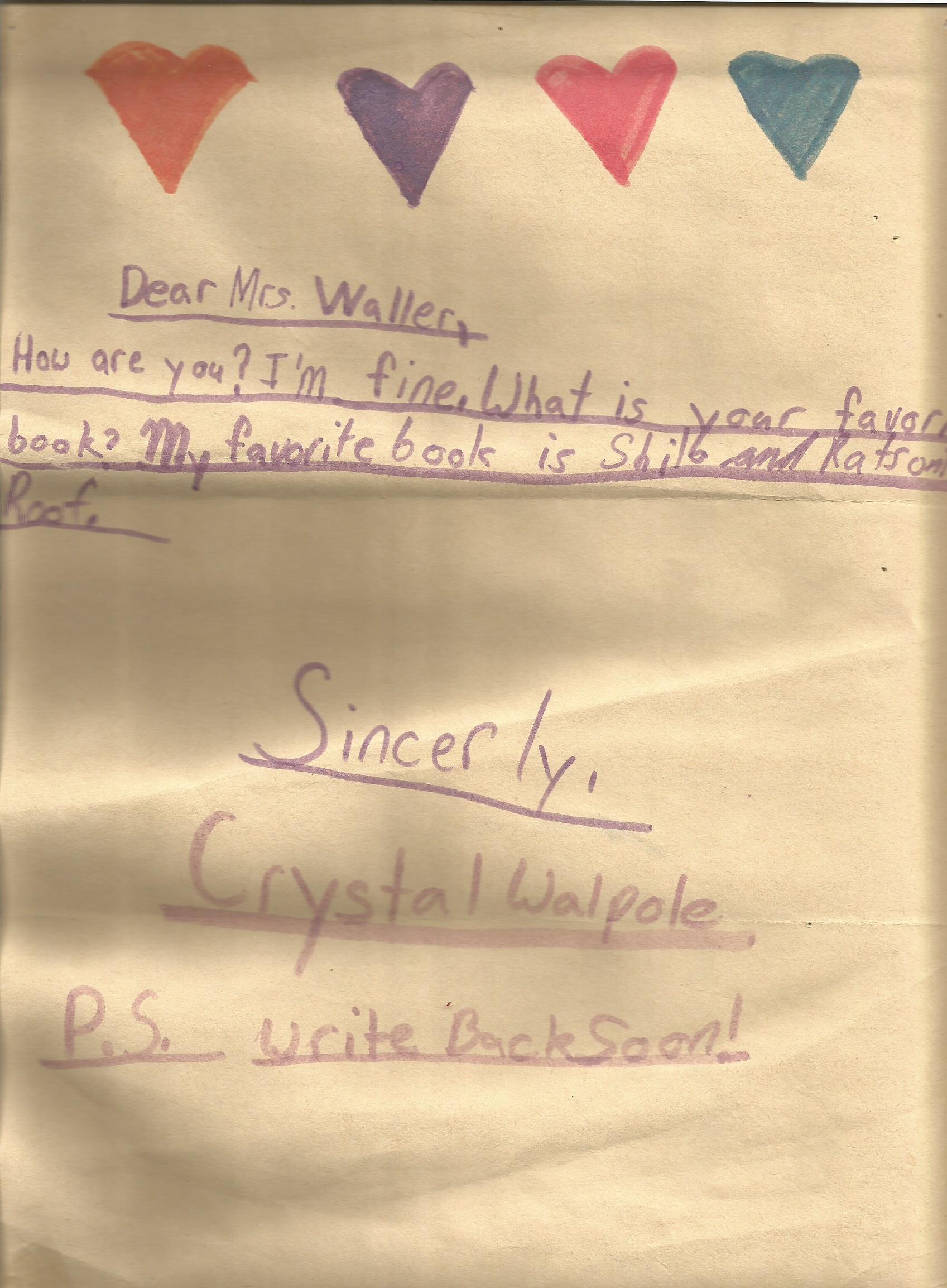
I received the letter pictured below when I worked at Norma Krueger Elementary School’s Scharf Library. Crystal Walpole wrote asking what my favorite book was. She dropped the letter into her classroom’s mailbox. Krueger’s Wee Deliver postal service stamped and delivered it to the library.
At the time, Crystal’s address was 683 Cocker Spaniel Drive in Sporting Dog, Texas. The library’s was 123 Yorkshire Terrier Avenue in Terrierville, Texas.
For a previous WordPress photo challenge (Object), I posted
Sisters in Crime Heart of Texas Chapter Book Swap, December 2013
I don’t know why. I’d already picked out several shots I liked better, such as
Shiner Beer truck parked at Valero gas station and convenience store, February 4, 2014
and
William putting his stamp of approval on my new Kindle, October 21, 2014
either of which is more interesting than books on chairs.
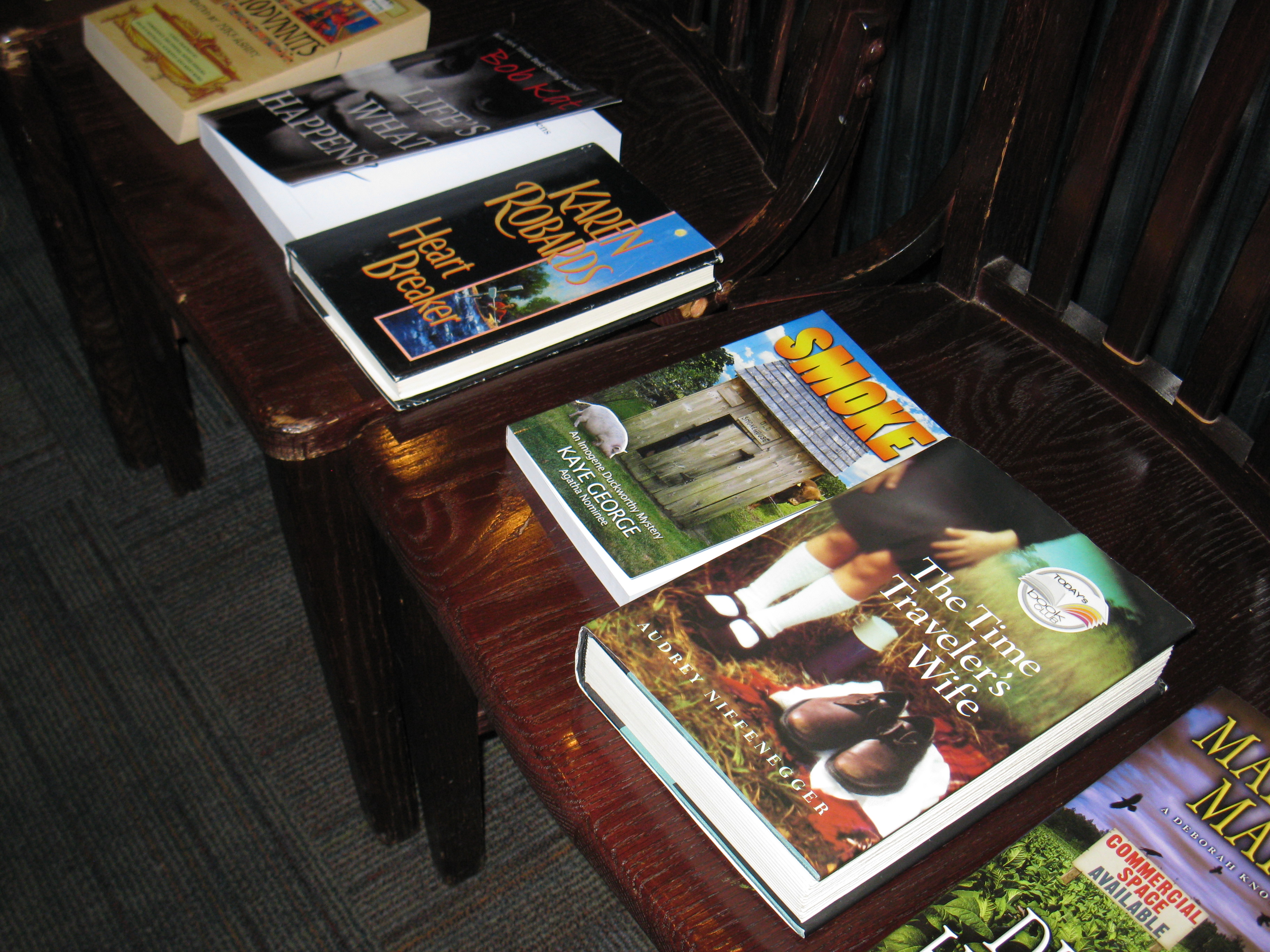
But at the last minute the books jumped out and said, Pick me! So I did. I was later appalled at how foolish the photo looked in comparison to those other bloggers posted.
On the other hand, considered as geometric shapes–two right triangles formed from a rectangle, their common hypotenuse composed of mysteries–the picture assumes a significance bordering on the semi-artistic.
Had I cropped more precisely, or had I posted before midnight, I might have observed that before now. But probably not.
You see, I didn’t discover the books formed a hypotenuse by studying the photograph. I saw it while composing this post. I wrote the word diagonal to describe the line of books, and suddenly saw triangles.
In other words, I didn’t know what I knew until I’d written it.
It sounds backward, especially to people who’ve been told they must outline before they write. Which is practically everyone who passed through an English class before the process theory taught by Donald Murray, Ken Macrorie, Peter Elbow, and other teachers was widely recognized. Writing as process allows students to use language to discover what they know and think before they try to organize.
(Ironically, most of those early outliners could have told their teachers that outlining with an empty head doesn’t work.)
When Gertrude Stein says writers have the daily miracle, this must be what she means: allowing language to lead, using the hand to stimulate the mind, being surprised by your own creation, discovering yourself through words you’ve written.
Thinking with a pen, or a keyboard, in hand works for anyone willing to put words on paper or pixels on a monitor.
Results vary, of course.
Stephen King starts writing and ends up with The Shining.
“Do you remember when you learned to read, or like me, can you not even remember a time when you didn’t know how?” ~ Harper Lee, in a letter to Oprah Winfrey
This week I did not meet my writing goals, and I joined four groups.
The groups are activity-optional, so I can’t get too bent out of shape about signing up. One of them sends me recipes I have no intention of trying.
Although I didn’t achieve my target would count, I worked on plotting Molly. A couple of knotty problems appear to be unraveling. It’s about time.
I also offered to read and comment on three novels. I initially volunteered to read only two, but the one I left on the table had a very pink cover, and the face of the young man across the table from me was very pale. Because if I didn’t read the pink book, he would have to.
Sometimes you just have to give in and do the decent thing.
Teaser Tuesdays is a weekly bookish meme, hosted by Miz B of Should Be Reading. Anyone can play along. Just do the following:
Grab your current read.
Open to a random page.
Share two (2) “teaser” sentences from somewhere on that page.
BE CAREFUL NOT TO INCLUDE SPOILERS! (Make sure that what you share doesn’t give too much away! You don’t want to ruin the book for others!)
Share the title and author too, so other TT participants can add the book to their TBR lists if they like your teasers.
My teasers:
Cover via Amazon
“As Eyler Coates puts it, ‘We’ve always heard that a million monkeys banging on a million typewriters will eventually produce a masterpiece. Now, thanks to the Internet, we know this is not true.'”
***
“It turns out that problems such as procrastination are usually better treated by putting the writer in the appropriate limbic or motivational state than by cognitive strategies such as making To Do lists. Most procrastinators are very aware of exactly what they are not doing.” ~ Alice W. Flaherty, The Midnight Disease: The Drive to Write, Writer’s Block, and the Creative Brain
My high school English teacher read the Day 7 post, the one in which I wrote that she told students we had important and relevant things to say.
That is the problem with blogging. At some point, you make a remark, a perfectly innocent remark, and the person you remarked about happens across it and reads it and calls you on it. Especially if you link the post to Facebook, and that person is one of your friends.
Anyway, said English teacher (who taught me in grades 8, 10, 11, and 12, so you see what we were both up against) asked whether she really said relevant and important, or whether she said, “Hush up and write.”
I admit it. “Hush up and write” was more her style.
And I really went overboard with relevant. I don’t think anyone I knew said relevant. It was one of those television words, ubiquitous and meaningless. The curriculum wasn’t relevant. School wasn’t relevant.
Relevant isn’t complete in itself. It needs something more. Relevant to what? And in whose opinion?
The 60s didn’t get to my part of Texas until late. And being as contrary then as I am now, I rebelled against the rebellion.
According to my husband, people should never send e-mails they wouldn’t want Ted Koppel to read on the air. David is correct. That goes for Facebook and blogs and all media, I’m sure.
Although I agree with his policy, however, I don’t follow it. Anyone who has read this blog knows that.
My one hope is that any potential employer who googles me and reads my work understands self-deprecating humor.
In other words, I’m neither as dumb nor as ditsy as I portray myself. Fiction is fiction and fact is fact, and in between there is irony.
If hired, I will be on time, work through breaks and lunch and do overtime, meet deadlines, take a personal interest in my work, and play well with others. I will spell correctly and use the serial comma. And I will not write about you on my blog.
I’ve been thinking about starting every post with that paragraph. Especially the post about my hereditary tendency to burn toast.
Although I write about my flaws, or pseudo-flaws, I am a private person. I want to choose what I tell and when and to whom. I don’t appreciate Facebook’s rabid desire to help me extend my social circle. I really really don’t appreciate Facebook’s sharing my information and not telling me, or making it difficult for me to lock down information I don’t want to share with people I don’t know.
There are days when I would like to close the account completely–as if that were possible, given FB’s determination not to delete it–but I’m in too deep. Closing out of FB would be like disconnecting both the telephone and the television. I don’t use either appliance very often, but giving them up would put me completely out of the loop.
No more pictures of Kenna wearing her little pink hat and grinning.
No more surprise messages from students I haven’t seen in years.
I’ve had the good fortune to “connect” with two women I first knew when they students. They were back-to-back winners of the Writers’ League of Texas Manuscript Contest, Young Adult Division. One has signed a book contract with a publisher. The other recently signed with an agent.
When their books come out, I’ll be jumping up and down.
I hope the high school from which they graduated will honor them by inviting them back to speak to current students. I hope the elementary and middle schools do the same.
I hope the school district makes a BIG DEAL of their accomplishments.
Let me say that again.
I hope the school district makes a BIG DEAL of their accomplishments.
Not for the writers’ sake, but for the sake of children who need to see that telling stories is important, that publishing a book is an event to be celebrated, that kids who once sat in those same classrooms grew up to be writers.









 M. K. Waller