John Brown’s Intestacy, or Singing the Texas Probate Code

On Old Olympus’ Towering Tops A Finn and German Viewed Some Hops.

Some Say Marry Money But My Brother Says Bad Business, My My.

Cranial Nerves
By Government [Public domain], via Wikimedia Commons

I learned the above mnemonics in a human anatomy and physiology class about a thousand years ago. The first relates to the names of the cranial nerves, in order. The second relates to the functions of the cranial nerves: sensory, motor, or both.

The memory aids worked well for me on exams over the nervous system. That was back in the days when I could remember which of the three O’s is optic, which olfactory, which…the other one. And whether the trochlear nerve or the trigeminal comes first in Towering Tops. The catch is that if you list the nerves in the wrong order, you’ll assign the wrong functions too. At least that’s how I think it works. But that was in 1971. Do not take my word for it.

At this point, I need a mnemonic to remember the mnemonics.

When I was in paralegal school back in Aught Three, I wrote a mnemonic of my own. It explains intestate succession–who gets what when a Texan dies without leaving a valid will–as laid out in the Texas Probate Code. One of our instructors had warned my class that students usually considered probate the most difficult part of the course, so I thought a little extra help when exam time rolled around might be in order.

Composing the memory aid took the better part of an afternoon. It required that I not only observe restrictions imposed by rime and meter, but that I also strictly adhere to the provisions of the Code. There was no wiggle room. It had to be correct.

At the end of the day, I was pleased. Aside from a couple of rhythmic aberrations, all the lines scanned, the rime scheme was satisfactory, and the targeted provisions of the Code  were covered.

It was a pretty good song.

As a mnemonic, however, it lacked a lot. It was long and complicated. I could have completed an entire exam in the time it took me to sing (silently) down to the second chorus.

It was easier to just learn the Code.

In addition, I posted this little flash of creativity on the class bulletin board. My old biology classmates would have read it and applauded. My paralegal classmates looked at me funny.

But funny looks don’t bother me. I spent years in education. I’m used to them.

So at the risk of getting several more, I present a bit of law in verse.

Disclaimer: The content of the following composition was accurate as of November 1, 2003. The song does not reflect changes in the law since that date. Neither does it represent a legal opinion, nor is it intended to offer counsel or advice. Its appearance on this blog does not constitute practicing law without a license.

********************

John Brown’s Intestacy

By Kathy Waller

(To be sung to the tune of John Brown’s Body, aka The Battle Hymn of the Republic).

I.

John Brown died and went to heaven but forgot to make a will.
His intestate succession now the Probate Code will tell.
Was he married, was he single, do his kids sit ‘round the ingle?
Had he common prop. or sep.?

Glory, glory, Texas Probate!
Separate property Section 38!
Common property Section 45!
Make a will while you’re alive!

II.

If John’s married and he leaves a wife, no kids, or kids they share,
Then 45(a)1 leaves wife all common prop. that’s there.
But if he has an extra kid, wife ends up with just half
And the kids share all the rest.

Glory, glory 45(b)!
Don’t omit Section 43!
By the cap or by the stirpes,
Wife shares it with the kids!

III.

For separate prop., if he’s no wife, it goes to kids or grands.
If none of those, John’s parents halve the personal and lands.
If only mom or pop lives, the surviving one takes half.
John’s siblings share the rest.

Glory! Both John’s folks are deceased–
All his sibs will share the increase,
And if no siblings, 38(a)4 means
They’ll need a family tree.

IV.

If John has separate prop. and leaves a wife and kids or grands,
38(b)1 gives wife one-third of personal prop. at hand,
And a one-third interest just for life in houses and in lands.
Descendants take the rest.

Glory, glory 38(b)1!
It’s one-third/two-thirds division!
But if John leaves a wife but no kids,
Section 38(b)2 applies!

V. – VII.

John’s wife gets all his personal prop. and half the real estate.
The other half of real estate goes back to 38—
38(a), to be exact, and up the family tree,
Unless his gene pool’s defunct.

For if John Brown was an only child with parents absentee,
No brothers, sisters, uncles, aunts, or cousins on the tree,
No grandparents or great-grandparents to grab a moiety,
His wife will get it all.

BUT if John Brown leaves this life with naught a soul to say, “Amen,”
The Probate Code’s escheat will neatly tie up all the ends:
The Lone Star State will step right up to be John’s kith and kin,
And Texas takes it all!

Glory, glory Texas Probate!
Slicing up poor John Brown’s estate!
Avoid the Legislature’s dictate:
Make a will while you’re alive!

Another fine mess…

Did you know that when you edit a monthly newsletter, you have to produce a newsletter every single month?

Well, you do.

You don’t publish an August issue and then just rest on your laurels.


In thirty days–fewer than that in February–another month rolls around, and you’re supposed to come up with something new. People expect it. They don’t want to read about last month.

Truly, there is no rest for the weary. Or for the wicked.
I am wicked.
I moan and whinge about the drudgery–Double, double toil and trouble–but once I start working, I also start having fun. I lose track of time. The latest issue missed my self-imposed deadline not just because the computer fell by the wayside, but because I kept tweaking: a link here, a comma there, delete this, insert that, bold this, italicize that, change black to red, red to black.
Eye of newt, toe of frog, wool of bat, tongue of dog…

 With fire burning and cauldron bubbling, and so many poisoned entrails, as well as thesaurus.com, at my disposal, I didn’t want to call it quits. Once again, I stayed up later than late, but I wasn’t laboring. I was playing. Concocting a brand new potion. Elixir. Charm. Beguilement.

If you want the pure, unadulterated version of my writing process, there it is.

And in a couple of weeks, it’s back to the cauldron again.

This time, though, there’s potential for sanity.

For the past couple of months, the assistant editor and I have been running as fast as we could to stay in the same place. Before the next issue comes out, we’re going to meet, discuss goals, nail down a format. I’ll show her what I can about using WordPress. She’ll come up with more good ideas. I’ll write them down so I won’t forget.

After we confer, the whingeing could abate.

But it won’t.

Because, contrary to decades of experience, I think I can do everything in five minutes.

Because my brain kicks in–really–at the last minute.

Because I do my best work–really–between 10:00 p.m. and 4:00 a.m.

Because I have these flashes of cock-eyed optimism that temporarily override my normally rational, pessimistic nature.

Because I like to whinge.

I mean, what do you think those Weird Sisters were doing, stirring that cauldron, waiting for Macbeth to wander in for a consultation? They were whingeing. It’s a good Scottish word, and they were Scottish Sisters, and, no matter how much pleasure they derived from their culinary endeavour, they’d been standing over a hot stove all night. Furthermore, quality frog toes aren’t easy to come by. What’s not to whinge about.

So expect no change. Proper prior planning may prevent weariness, but it won’t improve my character.

I’m wicked. And it’s comfortable. And I think it’s what I want to be.

********************

All the news that’s fit to print

I spent the evening putting the finishing touches on a newsletter blog for the Sisters in Crime Heart of Texas Chapter.

My goal was to get it out by September 4th. Actually, my goal was to get it out by September 1st.

Unfortunately, a couple of other goals ran concurrently. I was revising a section of a manuscript to enter in a contest. I was writing a synopsis to go along with the revision. I was doing several other things as well. I can’t remember what.

It is now the wee hours of September 5th.

For most of the evening, something did not work: the computer, the Internet connection, the website. I don’t know which.

Just minutes ago, I sent an e-mail to the HoTXSinC officers explaining why the blog didn’t come out as promised. Then I accessed this blog and began a new post. So far, nothing has frozen. Nothing has grayed out. I haven’t had to log off or reboot. Things are going swimmingly.

I don’t know why. I do know that if I logged on to Hotshots!, the system would freeze. I also know it’s after 1:00 a.m.

I agreed to edit the newsletter a couple of months ago. One of the Sisters said she would help. She’s creative. The first time we discussed our collaboration, she rattled off a list of ideas. I took notes. I have a strong suspicion that she should be editing and I should be helping.

I have another strong suspicion that I should give this computer a good swift kick and go to bed. And that is what I shall do.

I’ll think about all this tomorrow.

After all, tomorrow is another day.*

~~~~~~~~~~~~~~~~~~~~

*Technically, it’s already tomorrow, and consequently, the same day. But poetic license dictates that technicalities be ignored. It’s another day.

…considering what you have to work with

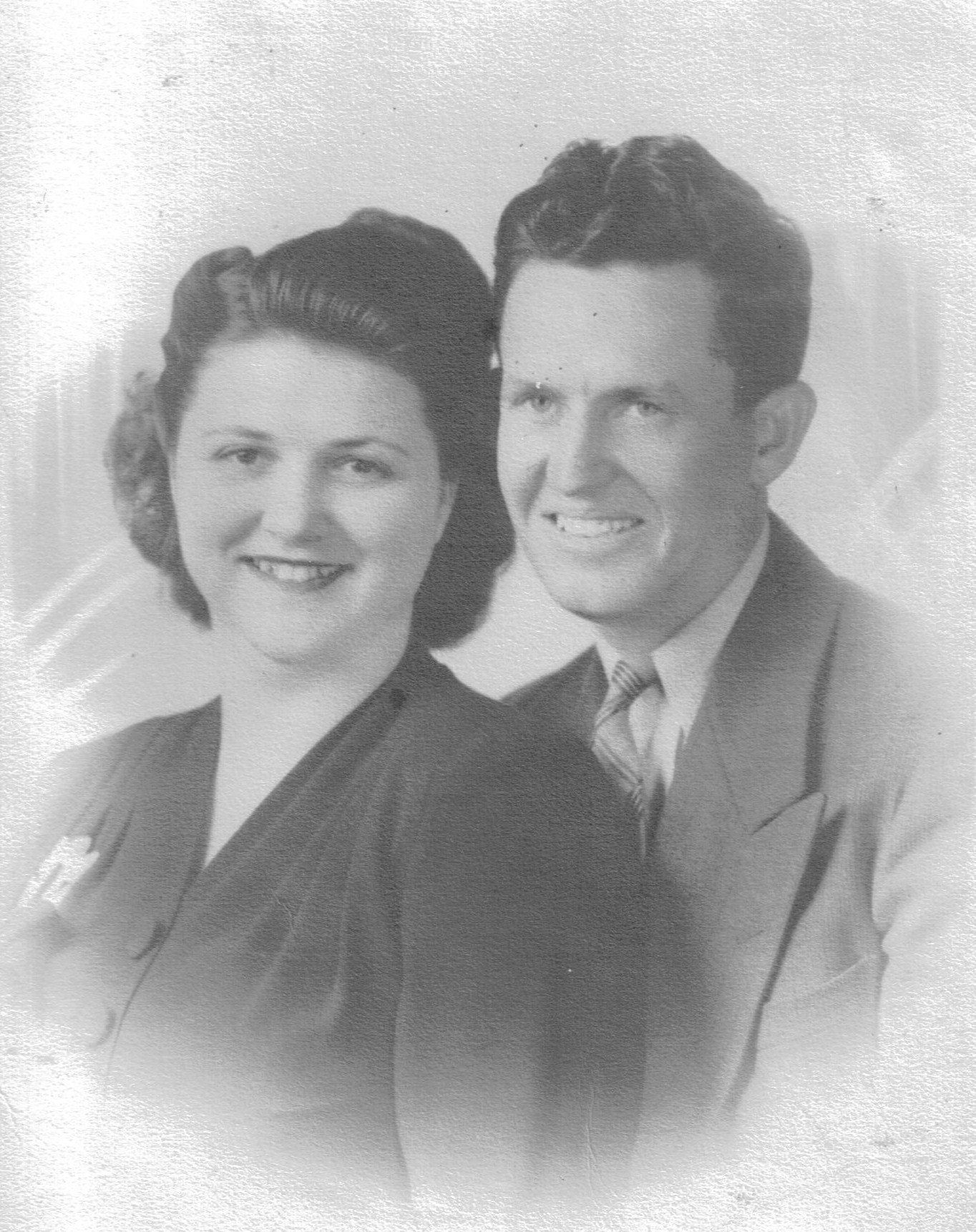
Crystal and Bill Waller. October, 1942

My mother told a story about the first time she hosted Thanksgiving dinner in her own home. She’d laid out the china and the crystal and the sterling and the silver gravy boat my grandmother insisted every married woman must have (even when the married woman was going to live near an oil field where the silver would immediately turn black.)

Finished with the table, she indulged in whimsy. She went outside and picked some purple wildflowers she thought particularly unattractive. (“Ugly” was her exact word.) She arranged them and placed them on the table.

When my grandmother arrived, Mother said, “What do you think of my centerpiece?”

My grandmother, missing the humor, replied, “Well, dear, I think you did as well as can be expected, considering what you had to work with.”

That line entered the Waller Book of Familiar Quotations. We used it for every achievement: making pies, mowing the lawn, climbing on top of the house to turn the TV antenna, explaining first semester grades from college: I did as well as can be expected, considering what I have to work with.

I wish my parents could read that story. I wish they could see other things I’ve written. They would laugh at Miss Pinksie Craigo whacking her cane against a chair, and Mr. Archie Parsons using his favorite (marginally) un-blasphemous expletive, and Aunt Lydia…Oh my, I can just imagine them reading about Aunt Lydia.

Some old ladies are worth more than an ode. Some, however, are marked 75% off–too good to resist.

My parents were generous. They gave me language and laughter. I think they would approve of the way I’m using them. They would be pleased to know I’m trying.

If I could ask, I believe they would also grant permission: We gave you words. Use them as you will. No secrets. No holding back.

With such a blessing, a writer doesn’t have to be ruthless or to rob anyone.

She just has to do as well as can be expected, considering what she has to work with.

What’s an old lady worth?

The writer’s only responsibility is to his art. He will be completely ruthless if he is a good one….If a writer has to rob his mother, he will not hesitate; the “Ode on a Grecian Urn” is worth any number of old ladies. ~ William Faulkner

One of my instructors, citing William Faulkner’s statement that good writers are ruthless about their art, asked the class whether there were any subjects we could not write about.

William Faulkner
Image via Wikipedia

One of the students came up with an extensive, and very funny, list of things she couldn’t write about.

But for anyone aspiring to publish, it’s a serious question.

In her memoir, Limbo, A. Manette Ansay writes that to tell her story, she had to tell a story about her father as well. It was a memory so painful  that he disclosed it to her only when she was experiencing a deep personal crisis and he believed hearing it might lessen her pain. If he hadn’t given permission to tell his secret, she would not have written her memoir. Her father was more important than her art.

Against all the rules, I’ll digress to say that Limbo is a wonderful book, and everyone reading this post should run to wherever you go and borrow or buy one. I borrowed the book from my library, when I had one, and received no perks for stating this opinion. I say this in a spirit of full disclosure and a certain amount of pique that I have to say it at all. (Actually, since this isn’t a review, I probably don’t have to say it, but I’ve always wanted to use the word pique, and this way I have an excuse to do so.)

Back to the original topic. Because so much of my so-called inspiration comes from people I’ve known or heard about, I’ve spent a fair amount of time thinking about what I can’t write about. Is there anything in my life or that of my family that would be best left alone? Is there anything I cannot use as fodder? Anything really really good that, if I were lucky enough to get it into print, might be considered indiscreet? I can use my grandfather’s roll-your-own Bull Durhams and my Cousin Ruth’s statuesque leg, but is there anything that simply must not find its way into the bookstores?

General Robert E. Lee mounted on Traveller, hi...
Image via Wikipedia

I’m talking about family here.

Of course there are things I can’t write about.

In my case, family includes a whole raft of people I’m not related to, I hardly know, or I’ve merely heard about from other people. For example, my grandfather once knew a man who, as a boy, saw General Robert E. Lee sitting astride Traveler.

There’s nothing wrong with writing about a boy seeing Traveler (who both my grandfather and I knew was much more important than General Lee), but, for the purposes of my art, I consider that boy part of the family. It’s complicated.

Anyway, back to the question, What can’t I write about?

Like many other answers, it depends. Fiction allows–requires–the writer to stretch the facts to get to the truth. Characters aren’t people. Plot isn’t memoir. With that kind of leeway, the possibilities are endless.

And let’s face facts. I am neither a William Faulkner nor an A. Manette Ansay, and I’m in no danger of producing anything that will cause readers to confuse me with Keats. Or even with Janet Evanovich, more’s the pity.

Still, if I were forced to give a straight answer to the question, I would agree with Ms. Ansay.

Whenever I read Faulkner’s declaration, I think of “Ode on a Grecian Urn.”

Bold lover, never, never canst thou kiss,
Though winning near the goal – yet, do not grieve;
She cannot fade, though thou hast not thy bliss,
For ever wilt thou love, and she be fair!

Keats took comfort from the urn. I take comfort from the poem. “When old age shall this generation waste,” those things of beauty will continue to delight. It’s difficult to put a price on that.

But then I think of all the old ladies I’ve known.

From what I’ve read about him, I believe even Keats would consider them worth more than an ode.

Is there anything you can’t write about?

~~~~~~~~~~~~~~~~~~~~~~~~~~~~

Another disclosure: Zemanta didn’t help me write this post, but it did provide the pictures and the link below, which accesses an audio archive of William Faulkner’s lectures and speeches. According to the accompanying article, the author was “quite the wit” and would “routinely slay audiences.” I’d planned to say I felt guilty for using Zemanta, but I’m so pleased at getting to hear Faulkner speak that I’m going to allow Z to assist me as often as it wishes.

Image of William Faulkner by Carl Van Vechten,  Library of CongressPrints and Photographs DivisionVan Vechten Collection, reproduction number {{{2}}}

Image of Gen. Robert E. Lee, September 1866, author unknown; [Public Domain]; file has been extracted from an original image in The New Student’s Reference Work:Image:LA2-NSRW-3-0037.jpg.

Image of Grecian Urn by John Keats (1795-1821) (http://www.flickr.com/photos/litmuse/64111434/) [Public domain], via Wikimedia Commons


It’s not an excuse. It’s a reason.

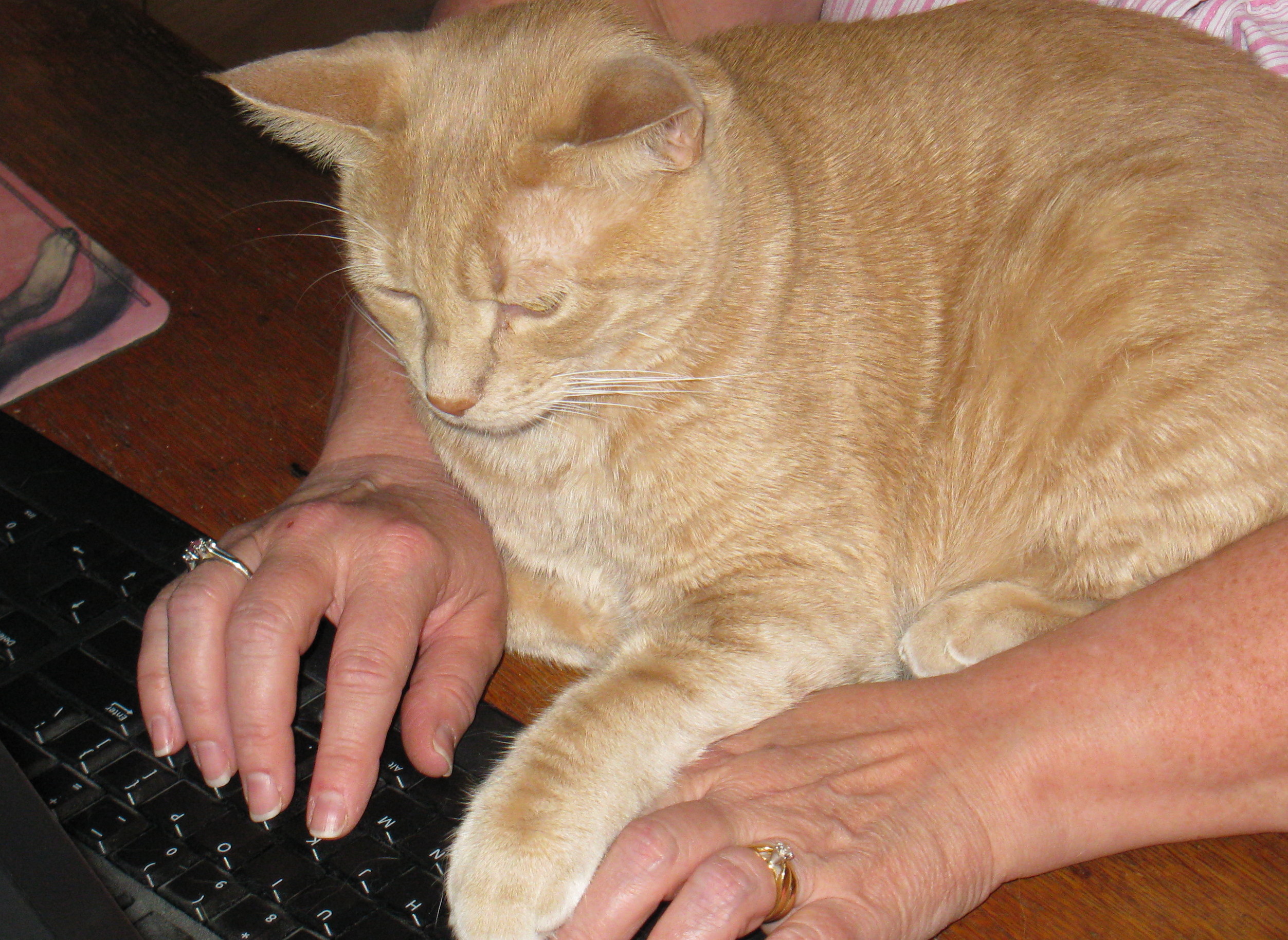
The last time William appeared here, he had sat on the keyboard and turned the working title into gobbledygook.

I suppose tonight’s activity is progress.

Yes, I know it’s progress. Because a year ago at this time, his hobby was lying across my lap and biting my fingers. Lunge-chomp-lunge-chomp. Tonight he’s helping.

But Just for the Hell of it Writers meets tomorrow morning, and my promise (to myself) to finish my critique chapter early and, for once, get to bed at a reasonable hour is vaporizing even as I type.

Especially since I took a half-hour out of the evening to prepare this post. That’s okay. It was necessary. I needed a break.

I also needed to memorialize this event so in a couple of years I can look back and say, Wasn’t that darling of him?

Because it’ll be a couple of years before I think so.

***********************

Note: That isn’t dust. We have a super-duper fancy two-toned gray-and-black keyboard.

***********************

Update: Two hours later: I heard growling and turned to find William and Ernest arguing over a cricket. Ernest grabbed it and shot up the stairs. I grabbed a paper towel and ran after him, hissing, “Spititoutspititoutspititout.” At the first landing, after some indecision, he let it go. The cricket is no more. David was asleep but probably isn’t now.

My cousin Ruth’s statuesque leg

Where do you get your ideas?

According to what I’ve read, writers often hear that question. Answers are as varied as writers themselves. Don and Audrey Wood said they get their ideas from an idea box. Dr. Seuss said he got his in Switzerland. Other writers aren’t so forthcoming as Dr. Seuss and the Woods. Possibly they don’t know.

I never want to be in that position.

When my book graces the shelves–face out–at Barnes & Nobles nationwide, and I sit on stage wearing a suit purchased at Neiman’s and my Stuart Weitzman pumps, and Oprah says, “Where do you get your ideas?” I want the answer on the tip of my tongue.

To prepare, I did some research. I examined the first page of the manuscript I’m working on and identified the following sources:

1. My Aunt A, who, when she was nine, told Aunt B, who was six, to touch the electric fence to see whether it was on. (It was.)

2. Five-year-old neighbor C, who collected wiggle-tails in a jar and took them home to watch them turn into mosquitoes.

3. Mrs. D and Miss E, who, when added together, equal Miss Pinksie Craigo.

4. My mother, whose two little sisters, one a redhead, got involved with an electric fence, and who knew someone named Miss Pinksie.

5. My first dog, Stinky, who dug his way out of the yard to chase cars so many times that my father put up an electric fence to keep him confined. (After one contact, Stinky gave up digging, and my father shut off the electricity.)

6. Stories about a family named MacCaskill, who were universally loved for their humor, spontaneity, and love of life.

7. My father, who chose to settle his family in his hometown, which afforded pecan trees, mosquitoes,  a beautiful river, and a passel of eccentric residents (most of them related to him), and who taught me to respect property lines.

For one page, only 216 words, not even an entire scene, that’s a lot of sources. In fact, one might think I just pulled some stories out of my head, threw in a few conjunctions, and started typing page two.

One wouldn’t be far from wrong.

When I go looking for ideas, I go no further than my own back yard, with side trips to San Antonio, Dallas, and Houston. Hometown and family are all I need.

My grandfather believed stop signs caused wrecks. My Great-aunt Eula said Man would never set foot on the moon because it wasn’t in the Bible. Our family doctor agreed. He also worried that people using the new dial telephone system would get the O and the zero mixed up.

When I started writing fiction, I latched on to those folks right quick. I put them on the first page. Because I’d set down their remarks almost verbatim–I was born with a tape recorder in my head–I wondered briefly about the ethics of calling it fiction. But only briefly. The conjunctions, I rationalized, were mine.

On the second page, I introduced a younger character, based on my cousin Ruth.

Ruth is eight years older than I. She spent her twelfth and thirteenth summers with my family in that little country town. Ruth was tall, which I wanted to be, and a teenager, which I wanted to be, and she wore lots of petticoats and got to ride the horse wherever she wanted without supervision and listened to “Purple People Eater” on a transistor radio, which I wanted to do, and she was my hero. She also tried to boss me around.

I was little and cute and had a pony tail and I wanted to go everywhere she did, and usually my mother made her let me tag along. I was the bane of her existence.

We got along quite well.

One summer we shared a bedroom. (I’ll admit at the outset that the two summers are jumbled in my memory.) Two green army cots were set up as bunk beds against the wall. I wanted to sleep in the top bunk. So did Ruth. I set up a howl, so I won. My mother kept saying, “You’re going to be hot up there,” but I didn’t care.

Ruth tried to talk me out of it. Her argument went something like this: “Look. If you sleep in the bottom bunk, you can kick the underside of my mattress in the middle of the night.” I was young, but I wasn’t dumb. She might kick me, but there was no way my short leg would even touch the mattress, much less give it a shove. I slept in the top bunk and, as my mother had predicted, nearly burned up. As I’d predicted, Ruth kicked me.

Ruth, an artist, decorated the wall beside her bed with crayon drawings of horses. I’m sure she drew me some, too, but they didn’t look nearly so attractive as the ones lower down that got more light.

Ruth’s main interest then was the sorrel mare, Lady, who lived up the street at my great-aunt’s. Whenever she could catch Lady and get a saddle on her, they went riding together. Lady didn’t like Ruth nearly as much as Ruth liked Lady, so catching and saddling gave both of them plenty of exercise.

When she wasn’t out on Lady, she was lying on the bed reading Gone With the Wind. Day after day after day. It wasn’t easy to get her away from that book when I wanted to play. I deduced that thirteen-year-old girls were supposed to read Gone With the Wind, so when I was thirteen, I did.

Also in town that summer–whichever it was–was a boy Ruth’s age. The boy, Jack, lived in California and was officially visiting my aunt and uncle, who lived a mile north of town. He spent most of his time, however, staying in town with my grandfather, who served canned Pillsbury biscuits and sorghum molasses three times a day and was just generally more fun to be with than people who insisted you eat vegetables and asked where you were going and when you would be back.

There being only two short blocks between our house and my grandfather’s, Ruth and Jack were inevitably thrown together. They rode horseback and worked on getting an ancient automobile of my grandfather’s to run. Jack rode Jolie Blonde, the Palomino, down to our house after everyone had gone to bed and sat in the saddle talking to Ruth through the screen of her open bedroom window. At least he did it once. I was probably asleep, but I’m sure I saw him anyway. (That was probably the second year, when she had a bedroom to herself. Or it may be that my mother got tired of our wrangling and separated us.)

The highlight of the summer was the week we spent camping at Uncle Cal’s pecan bottom. To get there we made a loop about a mile in length and ended up on the opposite side of the river, just above town. We took army cots and mosquito netting and bathing suits and cardboard boxes of food, and my fox terrier, Pat Boone, and my grandfather, and my cute, little red-headed Aunt Betty from Houston. (My father’s youngest brother, and various other adults, used to ask, “How is that cute little red-headed aunt of yours?” That’s where I got the idea for those adjectives.) We also took Jack.

We ate breakfast, swam, ate lunch, swam, ate supper, swam. Mother sat on a towel on the gravel bar and periodically shouted, “Jack, let Ruth get her head out of the water so she can breathe.” My grandfather tried to teach Jack how to saucer his coffee, but Jack had to hold the saucer with both hands. If he’d removed one, he’d have scalded himself. He never quite passed the course.

One day when we were sitting around waiting for our food to digest before we went back into the water, Mr. John Maxwell’s Santa Gertrudis bull crossed the river and wandered up the hill into camp. Everybody ran and piled into the car, except for Pat Boone, who ran around putting himself in harm’s way. Mother whistled and called, “Here, Pat, come here, Pat.” Betty said, “I hope the bull’s name isn’t Pat.” I don’t know what happened after that. I was laughing too hard to pay attention. I think the bull scratched his neck on a tree stump and then went back home.

I’m throwing all this on the page as I remember it. Ruth swears we spent only one night on the river. She says after that, we spent the nights at home and went back to camp in the morning. I say we spent every night for a week, that my father went home in the mornings to shave before going to work and came back every evening, and that it was the happiest week of my life.

When something is the happiest week of your life, you can remember it any way you want to.

When you’re writing fiction, you can remember it any way you want to as well.

Ten years ago, I took those summers, Ruth and Jack, my grandfather and Pat Boone and Lady and the rest, and put them together into a narrative.

Some of it is fact. I put in a scene where Ruth takes her statuesque leg and kicks the underside of my mattress. I put in a scene where Jack sits outside Ruth’s window at night. I put in the Santa Gertrudis and all the swimming. I put in my grandfather’s Bull Durham and saucered coffee.

Some of it is fiction. I bumped up my age from four to eleven to give more opportunity for conflict. I also added scenes that didn’t happen anywhere except inside my head. And then I added one more thing.

And I shaped it all into a true story: Stop Signs.

Later I entered Stop Signs in a fiction contest. It won first place. I was, of course, pleased, in  part because who wouldn’t be, in part because the contest sponsor sent me a check, and in part because I had such fun writing it. In fact, it practically wrote itself.

But, confidentially, although I accepted the Certificate Suitable for Framing, and cashed the check, I can’t take full credit for the success of Stop Signs. I have to acknowledge the town and the people (and the animals) who comprise my Muse. Thanks to all of you.

And thanks to the person at the heart of the story.

Happy Birthday, Cousin Ruth.

********************

Names have been changed to protect me.

Move over, Cyd Charisse

I received a phone call last week from Lucia Zimmitti, an editor who spoke at the Texas Trail Writers Roundup this spring. In mid-July, I’d sent her the first five pages of my manuscript. She reported that she’d read them and that they’re ready for query. She said she believes agents who read them will ask to see more.

Music to my ears. I was reluctant to tell her how long I’ve worked and how many revisions it’s taken to get those five pages agent-ready. Lucia said not to worry about time, that some novels are ten years in the making. Actually, it’s the ten years part that worries me, but I know it’s going to take as long as it takes.

After discussing specifics, Lucia asked how much more I have.

A pile of pages. A stack of scenes. Words, words, words, but not in order.

I described where I am in the process and told her how I work. She said not to worry.

When I hung up the phone, I was tempted to dance around the apartment.  But I didn’t. My feeling of ecstasy wasn’t pure. It was an alloy, producing calm rather than chaos.

It’s good when people like what I’ve written. But having a professional say those pages show promise is more than good. It’s validating. It means the time, the effort, the embarrassing, sick-making drafts aren’t wasted.

It means that when people ask what I do, I can drop the self-mocking half-smile, the apologetic, “I’m working on a novel. But of course, EVerybody in Austin is working on a NOvel.” I can look them in the eye and say, “I write.” I can remove the quotation marks from “novel.”

I’m tempted here to insert the usual disclaimer: It’s only five pages. I haven’t completed the manuscript. The five present-perfect are future-imperfect–because, with all the twists and turns of drafting, they will have to be tweaked.

But I won’t apologize. Hearing Lucia’s assessment of the intro to Chapter One changed how I perceive both my writing and myself. I’m no longer a dilettante. I’m a writer. I have goals to meet, a manuscript to finish, and no room for excuses.

Figurative language isn’t my forte, but to clarify, I’ll give it a shot.

It’s like when I was ten years old and my Uncle Donald took me out to a pasture in his beat-up 1950 Chevy pickup and taught me to drive. I started out popping the clutch (“Let it out sloooow.“), grinding the gears (“Put in the CLUTCH!”), killing the engine (“Give it some GAS!”), turning the key, popping the clutch, jolting the passenger, bouncing across old furrows. But after a few lessons I got the hang of it and was driving along the turn row, changing gears without incident.

A couple of months later, my father put me behind the wheel of a ’56 Bel Air, which had fewer gears and no clutch at all, and let me drive home from the farm (“Don’t rush up to the stop sign, eeease up to it.”) In due time, I got my license and soon was cruising down the freeway, feeling like a driver.

After I’d invested time, energy, and angst wrestling with the clutch and grinding the gears, finally holding that license brought not only satisfaction but also a feeling of maturity.

The future won’t be a joyride. There will be (here comes the disclaimer) traffic jams and detours and wrong turns down one-way streets. And worse. Like the time I was on my way to the university and my car slid on a patch of once-in-a-decade Texas ice and landed in the ditch facing the wrong direction, right across from my father’s workplace. (“I told you to go slow.” “I DID. I was just doing 50.”)

When Lucia and I finished speaking, it was as if she’d handed me a license to write. I felt settled. Serene. Competent. Equipped for the task at hand.

Cyd Charisse, move over. I feel a dance coming on.

**********

Lucia Zimmitti is president and founder of Manuscript Rx.

P.S.  I did not try to perfect the first five pages before moving on. I obsess and compulse, but not to that extent.


Just for the Hell of It Writers adopt motto*

*Motto: a short phrase that usually expresses a moral aim or purpose. Or, in this case, an immoral aim or purpose. Or an amoral one. Whatever. Anyway, writing is high on our to-do list, and tomorrow is most assuredly another day.**

**JFTHOI Writers–at least the one responsible for this blog–hope readers understand that (1) irony is the spice of life, and (2) we write a lot more than we let on, and (3) the process is more fun when we can laugh about it.

-0p[bgggggggggggggggggggggggggggggggggggggggggggggggggggggggggggggggggggggggggggggggggggggggggggggggggggggggggggggg=]kkkkkkkkkkkkkkkkkkkkkkkkkkkkkkkkkkkkkkkkkkkkkkkkkkkkkkkkkkkkkkkkkkkkkkkkkkkkkkkkkkkkkkkkkkkkkkkkkkkkkkkkkkkkkkkkkkkkkkkkkkkkkkkkkkkkkkkkkkkkkkkw2

William and I had a fight over which of us would occupy the recliner.

I won.

William retaliated by sitting on the keyboard and retitling this post.

I should have trashed it. Instead, I publish it as an example of the limitations under which I operate.

Retread: Why I go to critique group

I said to my critique partner this morning, The whole project is stinky it stinks it’s just nothing no hope.

She read chapter 13 and said, But it’s so good so funny Molly is so funny it’s not stinky.

I said, Yes, the first part of chapter 13 and the last part of chapter 13 are funny and very very good but there’s still no middle of chapter 13 and what there is stinks and anyway the other 47,000 words stink except for a few hundred here and there.

And she said, But the middle could be revised edited it has promise.

I said, But it won’t work because I have written myself into a hole and can’t get out so I have to trash that part and anyway the whole concept stinks.

And she said, NO you can fix it just keep going because I like Molly she’s so funny.

And that is why I go to critique group every blessed week.

**********

The post above originally appeared on Whiskertips, September 13, 2009. A modified version is posted here by popular request.

Clicking hopefully

Little do ye know your own blessedness; for to travel hopefully is a better thing than to arrive, and the true success is to labour. ~ Robert Louis Stevenson


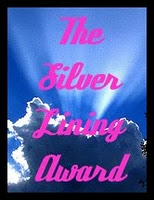
In April, I received the Silver Lining Award from writer and freelance editor Helen Ginger. Her blog, Straight from Hel, offers advice and information about writing and writers, books, publishing–there’s “God’s plenty” here for the writer, aspiring or experienced. Helen posts daily, and she also contributes to The Blood-Red Pencil, another blog I follow.

The Silver Lining Award was a surprise. I couldn’t wait to display it on to write is to write is to write and to pass it on to other bloggers.

But I ran into an obstacle. I didn’t know how to display it. I knew to use a widget, but how to grab or capture or whatever to get the proper code to put into that widget was outside my realm of experience. I knew I had to get the image to my computer. I knew I wasn’t supposed to link to the image on Helen’s blog. I knew I had to have its URL. Actually, all of this was inside my realm of experience, because I’d done something similar a couple of months before.  I had just forgotten what and how.

The obvious thing to do in such a situation, after googling for instructions and increasing the confusion, is to ask for directions.

I don’t ask for directions. Anyone who has ever taken a road trip with me will vouch for that. When I get lost, I drive around until I find what I’m looking for. When lost in cyberspace, I click around.

So I clicked for a couple of hours. After engaging in mind-clearing activities, I clicked some more. I took a break and wrote a blog post about silver linings.  I reminded myself this was not rocket science; it was a simple procedure. The next day, I clicked again. After skipping a few days, I clicked some more. I went to a conference. I spent a week recovering from the conference. I clicked. I fell into the Slough of Despond and decided I would never write again. I crawled out and decided I would. The entire time, both clicking and non-clicking, I was straining to dredge up the technical details of that brief moment of competency only sixty days past.

And all the while, the still, small voice was whispering, “Ask.”

But the truth is–and now I’m exposing my darkest secret–I like clicking around. I have such a feeling of accomplishment when things fall into place. I bump into all kinds of serendipities along the way. And I’m too ornery to give up. I can’t help that last thing. It’s genetic.

Sometimes it’s also a failing. I’m working on it.

Anyway, I finally discovered how to display the Silver Lining Award on my blog. Laboring along the road to discovery was an accomplishment. It was, in fact, a silver lining.

To Helen, a belated public thanks for giving me the this award. I’m supposed to pass it on to five other people. I nominate the following bloggers for the Silver Lining Award:

1. Susan Ideus

2. Linda Hoye

3. Sharon Lippincott

4. Gale Albright

5. Nita Lou Bryant

Ladies, thanks. You’re all silver linings to me.

**********

Helen Ginger blogs about The Name Game today on The Blood-Red Pencil. On Straight from Hel, she interviews author Jean Henry Mead.


Building bridges, forming bonds

When I was teaching English, I arranged for students to have pen pals. I don’t remember the details–whether I required them to participate in the project or promised those who did extra credit. I might have simply offered to send names to an agency to be matched with potential correspondents.

I do remember why I did it. I wanted to show them that writing could be fun. I wanted them to see it as more than essays and research papers, to understand that it could build bridges and form bonds and open new worlds.

I also wanted them to write freely, without fear of judgment, so after getting them started, I withdrew from the project.

Last week I received an e-mail from K.M., one of those students. She told me she and her pen pal have been corresponding for twenty-eight years. He’s coming from Australia this month to meet her.

She said she’s thrilled and ended with, “Thank you!”

I’m thrilled, too. Consider: how many letters, how many words they’ve written; how much they’ve learned; how much they’ve shared; how much has changed since they stamped and mailed those first envelopes. They’ve gone from pen and paper to e-mail. They’ve moved from adolescence to adulthood. Twenty-eight years. My mind boggles just thinking about it.

But I don’t deserve thanks. I spent probably less than an hour on the project. I got things going.

K.M. and her pen pal did the rest. They took an exercise and made it real. The bridge, the bond, the new world–everything I wanted for them, they did.

So thank you, K.M., for writing, and for telling me the rest of the story.

That’s one of the finest gifts I’ve ever received.

But what will he do for clothes?

Our weekly movie on DVD was about John, a young editor sent to Italy to persuade Robert, a famous writer, to end a twenty-year hiatus and start writing again. It’s a sweet story with all the necessary ingredients, including John’s falling in love with Robert’s daughter, Maria, and Robert’s encouraging John to leave publishing and concentrate on his own writing.

There was also the requisite hitch in the romance:  Maria told John that, although she loved him, she couldn’t go to London with him because she didn’t belong there.  And she didn’t show up at the railroad station to tell John goodbye.

That’s when I perked up. It appeared there might be a realistic ending. John wasn’t yet a published writer, and he wasn’t a risk-taker. That kind of person doesn’t throw away a stable career for a beautiful girl and a typewriter.

But when it comes to romance, movie makers don’t like risk either. Boy-meets-girl rarely turns into girl-tells-boy-she-won’t-go-with-him-and-boy-leaves-anyway. Writers share the characteristic. Even Charles Dickens couldn’t end Great Expectations as he wanted. Advised that the public wouldn’t be pleased to see Pip and Estella go their separate ways, he revised asap. Nobody wants the audience to go away mad.

Understanding caution, I doubted the chance of a realistic conclusion. John was still at the station. There was plenty of time for Maria to show up with her suitcase.  There was also the possibility that when John boarded the train, he’d find Maria waiting for him.

I watched. John got on the train, put his suitcase on the overhead rack, and sat down. An old woman carrying a birdcage sat down across from him. No Maria. The train pulled out of the station.

They’ve done it, I thought.

Then John spoke to the old lady, and the old lady spoke to John, and a light appeared in John’s eyes. He looked out the window and saw Maria on horseback, loping alongside the train. She held the reins of a second horse, its saddle empty. John pulled the emergency cord, jumped off the train, mounted the riderless horse, and loped back to the village with the beautiful girl to resume typing.

It was lovely.

And I spoiled it by shouting, “Don’t forget your suitcase!”

That exclamation exemplifies the difference between me and the scriptwriter. I worry about suitcases. I worry about paychecks. I worry about horses. My father didn’t let me run a horse on unfamiliar terrain. He said the horse might step in a hole and break a leg, or throw me off. He didn’t think much of horses in parades either, because they might slip on the pavement, especially if they were shod. When I see a mounted sheriff’s posse in the Tournament of Roses Parade, I cringe.

Lest anyone blame my father for my nitpicking, I offer another example to show I didn’t need instruction: Every time I thought about running away from home (which I considered once a week the year I was four), I got hung up on one detail: I didn’t know how to work a can opener.

Anyway, when it comes to stories, I have a handicap. I see the holes, the lapses, the flimsy, the far-fetched. I never believed Carson Drew really let Nancy leave home by herself. After the time she went detecting and ended up locked in the back of that truck, she was either grounded or sent to a convent. And when I see a man run away from his suitcase, my suspended disbelief goes plop.

That’s a shame. I like happy endings. If John hadn’t stayed in Italy with Maria, I’d have been sad. I wanted ET to stay with Elliot, and Rhett to stay with Scarlett, and Gilly Hopkins to go home to Trotter, and all the terrorists and the hostages in Bel Canto to live in harmony forever.

But life doesn’t work like that. Nor do all writers. Some of them understand about suitcases.

Still, if the writer who conceived the story of John and Maria wasn’t thinking about me, he was thinking about the rest of his audience. He wrote for people who want romance, and he gave them the appropriate ending: boy got girl, girl got boy, horses cantered off into the sunset. Everyone was happy.

Including me.

Because, as David pointed out, John could always buy another toothbrush.

A nice turn of events

I learned yesterday evening that my story “Personal Experience” won the second place prize in the Fiction: Short Story category of the 2010 Brazos Writers Writing Contest.

My critique partner’s story, “Taffy Lomita,” won first place and will be published online.

CP and I are officially Pleased With Ourselves. I’ve given myself permission to remain that way for at least a week.