“Hell on Wheels”: The Story of a Lethal Librarian

Excerpt from “Hell on Wheels” by Kathy Waller appears in MURDER ON WHEELS: 11 TALES OF CRIME ON THE MOVE, published by Wildside Press, 2015

Join Austin Mystery Writers for the launch of MURDER ON WHEELS at 7:00 p.m. on August 11, 2015, at BookPeople Bookstore, 6th and Lamar, Austin. Authors will read and sign. Refreshments will be served.

***

The day I found Mama stirring ground glass into the filling for a lemon meringue pie, I took the bowl away from her and called a family conference. We had to do something before she dispatched some poor, unsuspecting soul to his heavenly rest and got herself thrown so far back into prison she couldn’t see daylight.

The next day, while Mama was down at Essie’s Salon de Beauté, my brothers and sister and I crowded into a booth at the old Dairy Queen, just across the corner from the library where I worked. The DQ was practically empty. The only customers—besides Frank and Lonnie and Bonita and me—were senior citizens, and most of them had their hearing aids turned off.

When the waitress had delivered our orders and retreated behind the counter to her copy of People magazine, I explained why I had called the meeting.

“It hurts me to say it, but the time has come to put Mama out of her misery.”

Lonnie stabbed his straw through the plastic lid on his frosted Coke. “Mama don’t have no misery. I never seen nobody so contented with her lot.”

Bonita poked her pointy elbow into my side and reached across the table to pat Lonnie’s hand. “I think Marva Lu’s talking about a different kind of misery, baby brother. I’ll explain later.”

That was a case of the pot calling the kettle black. Bonita’s explaining was why it took Lonnie till he was twenty-nine to get his GED.

Frank, sitting across the table from me, grabbed a napkin and wriggled his way out of the booth. “Now look what you made me do. Scared me half to death, making such a mean joke about Mama.”

He dabbed at his tie with a napkin. “This necktie is a souvenir from when we took the kids to Disney World. That gravy landed right on Donald Duck’s tail feathers.”

I glanced over my shoulder at the other diners, several of whom were looking our way. “Frank Dewayne Urquhart, stop carrying on and sit back down,” I hissed. “You’re attracting attention.”

Frank unclipped his tie and laid it across the back of the booth. By the time he settled down to finish his steak fingers, the senior citizens had turned back to their burgers.

“Now, quit worrying about that duck’s derriere and look me in the eye,” I said, in the steely tone of voice I used on seventh-grade boys I found hiding in the how-to books, giggling over The Joy of Sex. “I am not joking. This is serious.”

Frank stuffed a couple of napkins into his collar and dunked another steak finger. “Serious?” He leaned toward me, his eyes wide and his voice just a whisper. “You want to … put Mama down … just because you saw her add something to the pie? I bet you didn’t have your contacts in. Might’ve been powdered sugar. She’s probably practicing something new for the Methodist ladies’ fundraiser cook-off.”

“The new bishop’s going to judge the cook-off.” I took a sip of my Diet Dr. Pepper and gave Frank time to think. “I can see the headlines now: ‘Murderous Methodist Does in Bishop with Omelet’. And every penny of our inheritance will go to pay a lawyer to try to keep Mama out of prison. Squeaky Vardaman says defense attorneys charge more when the client’s guilty. And Squeaky’s the district attorney, so he ought to know.”

Bonita stabbed me again with her elbow. “Uh-oh, look who’s coming.” We all followed her gaze.

A bright red Corvette was racing up the street. Ignoring the stop sign, the driver shot through the intersection, just missing a pedestrian, who scrambled onto the high curb and wrapped his arms around a light pole for support.

“There she is, on her way to Essie’s to get her hair screwed up.” Lonnie grinned. “Man, Mama can drive that car, can’t she?”

Frank cleared his throat and wiped his fingers on a napkin. “Yeah, Marva Lu, I see your point.”

Bonita wrinkled her nose and wound a blonde curl around her finger, a habit she’d gotten into when she was five years old and people told her it was cute. “Why don’t we keep a real close watch on Mama and make sure she doesn’t have a chance to put anything bad in the food? I mean, killing her seems a little extreme.”

“Are you volunteering to babysit around the clock?” I said.

Bonita wrinkled her nose again. “Well, what about putting her in the Silver Seniors Retirement home? We could have her committed. Then she couldn’t cook at all.”

“No way,” said Frank. “Old Dr. Briggs is as loony as Mama. He isn’t about to certify her. Hell, there’s not a man, woman, or child in the county, including us, who’d dare to cross her. After all, she owns the bank.” He wadded his napkin into a ball and dropped it into the empty basket. “You going to convince her to move to the home, Bonita?”

Before Bonita could get her nose back in gear, Lonnie finally caught up with the conversation. He sat up straight. “Killing her? What do you mean, killing her? You saying you want to kill Mama?”

“Shhh. Use your library voice, Lonnie.” Bonita patted his hand again. “Kill is just a figure of speech. Like one of those smilies we talked about before your test.”

I rolled my eyes. “No, it’s not a smilie. We’d better make sure right now that everybody understands what we’re doing.”

“I’m not doing anything,” whispered Lonnie. “If you’re going to kill Mama, I’m heading for the sheriff right now. Move, Frank, and let me out of this booth.”

I glared at Frank. He stayed put. I smacked Bonita’s hand off Lonnie’s and closed my hand around his. Poor Lonnie, he’d always been Mama’s favorite, and so softhearted. I should have known our talk would upset him.

I assumed the sympathetic tone I used when citizens called to complain about the library having dirty books. “Lonnie, sweetheart, you heard what I said about Mama’s new recipe. And you remember how Uncle Percy died last month, just hours after Mama cooked him a special birthday lunch.”

“Dr. Briggs said that was Uncle Percy’s ulcer.” Lonnie jerked his hand back. “Frank, let me out.”

I grabbed his hand again and hung on. “Jasper Alonzo, calm down. I’m going to ask you a question, and I want you to think about it carefully and then give me an honest answer. After that, Frank will let you out, and you can go to the sheriff or anywhere else you want.

“Now, here’s the question: How would it make you feel if they put Mama on trial for killing Uncle Percy? Or somebody else she fed bad food to? And what if she had to spend the rest of her natural life locked up in the prison at Huntsville?”

Lonnie’s brow wrinkled like it always did when he was turning something over in his mind. One thing about my baby brother, he never made snap decisions. I usually admired him for that. In this case, however, even with the answer so obvious, I threw in some details.

“Think about what prison’s like, Lonnie. There wouldn’t be a soul Mama knows. And most of those inmates are so common, not our kind of people at all. Mama would have to share a room, and you know how she values her privacy. There’d be no more trips up to Neiman Marcus, and she’d have to dress just like everybody else, in horizontal stripes. She’s always been dead-set against horizontal stripes. Essie wouldn’t be there to keep up her weekly White Mink rinse, and without that, her gray hair would get that ugly yellow tinge to it. And how would she survive without her Friday bridge club? Think about it, Lonnie. What kind of life would Mama have?”

By the time I got to “yellow tinge,” all the fight had gone out of Lonnie. His brow unwrinkled. Tears welled up in his soft brown eyes. It was just the saddest expression I’d ever seen on that sweet face. He looked so miserable I was tempted to toss the rest of my chocolate sundae into the big red waste bin and tell my siblings to forget the whole thing.

But I didn’t get to be Director of the Kilburn County Public Library and Archives by caving in to every pathetic face that stared at me across the circulation desk.

“All right, Lonnie,” I said. “What’s your answer?”

He pulled on his straw but got only a gurgle, so he quit stalling. “Mama wouldn’t like prison at all. So I guess I’d feel pretty bad.” He shook his cup and managed to suck up one more taste of frosted Coke. “But I still don’t feel good about planning to kill her.”

I looked out the window. Old Judge Vardaman was shuffling down the sidewalk from the courthouse, heading for the library, where he would spend his usual hour dozing over the Wall Street Journal. On his way out, he would tiptoe into my office and sit down for what he called “a little visit with my sweetie-pie.”

Bonita saw me watching him and smirked. “Well, here comes Big Sister’s gentleman caller. Honestly, Marva Lu, I don’t know how you can stand to have that old goat around. He’s older than God.”

“You should talk,” I said. “The way you drool over the old goat’s son since he got elected D. A. is a disgrace.” I passed the remainder of my sundae across the table to Lonnie and smiled. “Anyway, Bonita, he’s not so bad. Goats can be very useful animals.” I shouldered my purse and stood up to leave. “Don’t worry, Lonnie,” I said. “You won’t have to do a thing. I’ll take care of all the planning myself.”

***

Our anthology!

Print and Kindle editions available at Amazon.com
Print edition available at Barnes and Noble.com and at Wildside Press.com
Excerpt: “A Nice Set of Wheels”

Excerpt from “A Nice Set of Wheels” by Kathy Waller appears in MURDER ON WHEELS: 11 TALES OF CRIME ON THE MOVE, published by Wildside Press, 2015

***

When the stranger stepped through the door, everyone in the store looked up. Old men playing dominoes at the Formica-topped table beside the front window. Farmers sitting in metal lawn chairs, their boot soles propped against the cold pot-belly stove, cussing Khrushchev and the Russians. Teen-aged girls wearing shorts and white blouses, pink hairnets protecting their pin curls, looking at the makeup shelf.

They checked out the worn jeans, the frayed collar on the plaid shirt, the scuffed boots. The beat-up old black suitcase he carried. The black hair close-clipped but with a lock falling across his forehead. The scar on his cheekbone. The eyes like pale blue ice.

In those few seconds he stood in the doorway, with the sun shining through the screen door behind him, they sized him up.

He didn’t look to left or right, just walked straight to the counter. I should have asked how I could help him, but I didn’t. I was holding my breath.

“Are the Coca-Colas cold?”

I nodded at the cooler half hidden by a rack of chips. He opened the lid and pulled out a king-sized bottle, shook it a bit to get some of the water off, and brought it to the counter. I took it from him and dried it with a clean terry cloth towel I kept behind the counter, then gave him the towel to dry his hands. When Uncle Harry sold Cokes, he let the bottles drip. He said if customers wanted them ice cold, they’d have to put up with a little water. But I like to make things nice.

I handed him the Coke and pointed to the bottle opener nailed to the end of the counter.

“That’ll be a dime,” Uncle Harry shouted from behind the meat counter at the back of the store. “Seven cents if you drink it here and leave the bottle.”

The man pulled a dime from his pocket and dropped it into my hand. “I’ll bring the bottle back tomorrow.”

Uncle Harry left the meat counter and walked up to the front, still holding a butcher knife. His apron was stained with blood. “Where’d you come from?” he said.

That was none of his business, but the stranger didn’t take offense. “Shreveport, last stop. Working my way west. Been hitching rides, decided to stop here and look for work. You know anybody needs odd jobs done, or farm work?”

The girls hiding behind the makeup shelf giggled and shushed each other, except for Wanda Patterson, who looked directly at the man and smiled. Uncle Harry’s eyes narrowed. His frown told me he was about to say “No,” like he always does when men from outside talk about hanging around, but before he could say anything, Old Brother Fisher, who always tried to help people, slapped down a domino and called out, “Try the Conrad place. Frank Conrad owns several hundred acres the other side of the river. Heard him say the other day he needs some fences repaired, and three of his hands got caught in the draft and left for the Army. Bet he’d take you on. Might keep you to haul hay, maybe pick cotton.”

The stranger raised the Coke bottle and nodded at the old man. “Much obliged, sir.”

“Go up the road about a half mile to where there’s a gap in the fence on the left. Go on through—it’s private property, but nobody’ll care—and follow the old wagon ruts down to the river. Cross the footbridge. Other side belongs to Conrad. Big white house at the top of the hill.”

The stranger picked up his suitcase and started toward the door. Every eye followed him.

“Wait.” The eyes all looked my way. “What’s your name?”

He turned around and smiled right at me. Just at me. “Campbell. Campbell Reed. What’s yours?”

“I’m Rosemary.”

“I’m pleased to meet you, Miss Rosemary.” Still smiling, he pushed through the screen door and was gone.

Uncle Harry grabbed my arm and jerked me around to face him. “What have I told you about talking to strange men? That one’s trouble. Leave him alone.”

I pulled away and ran through the storeroom and out the back door, past Uncle Harry’s house and the outbuildings, up the footpath and onto the gravel bar that lay along a stretch of the river bank. Wading in to where the water was clear, I bent down and splashed some on my cheeks, then straightened up and let the slight breeze cool my face. I was fifteen years old, and I’d had enough of Uncle Harry treating me like a baby. I would stay down here till time for supper. If Uncle Harry wanted me back at the store, he could come find me.

I recognized the looks the men had given Campbell. Except for Old Brother Fisher, they thought the same as Uncle Harry: he was trouble. I knew what Wanda Patterson and her friends thought, too: not trouble, but a good-looking man to take them out on Saturday nights, to park with in the cemetery after dark, to beg their mamas to invite for dinner, and, if they were lucky, to marry and have babies with.

But when I looked at him, I didn’t see trouble or fun or babies or anything like that.

In the time it took Campbell Reed to tell me his name, I looked at him and saw a savior.


***

Austin Mystery Writers' New Crime Fiction Anthology

Join Austin Mystery Writers for the launch of MURDER ON WHEELS at 7:00 p.m. on August 11, 2015, at BookPeople Bookstore, 6th and Lamar, Austin. Authors will read and sign. Refreshments will be served.

Print and Kindle editions available at Amazon.com
Print edition available at Barnes and Noble.com and at Wildside Press.com

Join AMW for the Launch of Murder on Wheels ~ August 11

Please join

Austin Mystery Writers

Gale Albright, Valerie Chandler, Kaye George,
Scott Montgomery, Laura Oles, and Kathy Waller
&
Earl Staggs and Reavis Wortham

as they celebrate the launch of their first crime fiction anthology

MURDER ON WHEELS:
11 Tales of Crime on the Move

“Eleven stories put the pedal to the floor and never let up! Whether by bus, car, tractor, or bike, you’ll be carried along at a breakneck pace by the talented Austin Mystery Writers. These eight authors transport you from an eighteenth-century sailing ship to the open roads of modern Texas, from Alice’s Wonderland to a schoolbus yard in the suburbs of Dallas. Grab your book, hold on to your hat, and come along for the ride!”

Tuesday, August 11, 2015
7:00 p.m.

BookPeople Bookstore
6th Street and Lamar

Austin, Texas

“There is something for everyone…” ~ Amazon Review

“…light-hearted (and occasionally black-hearted) collection of short stories… I thoroughly enjoyed it. … take your choice–historical, humorous, dark and light. Good reading for mystery fans.” ~ Amazon Review

 “… dialog that is realistic and makes the characters believable and three dimensional. There is something for everyone…” ~ Amazon review

“… a diverting read.” ~ Barry Ergang, Kevin’s Corner

71QiKRIkj+L

Murder on Wheels: 11 Tales of Crime on the Move

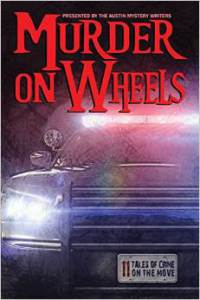
murder on wheels largeMURDER ON WHEELS, Austin Mystery Writers’ first crime fiction anthology, has been released by Wildside Press.

Since it appeared, the Writers have been difficult to live with. We’ll get over it, but only after a decent interval of frolicking.

The cover copy reads–

“The eleven stories in MURDER ON WHEELS put the pedal to the floor and never let up! Whether by bus, car, tractor, or bike, you’ll be carried along at a breakneck pace by the talented Austin Mystery Writers. These eight authors transport you from an eighteenth-century sailing ship to the open roads of modern Texas, from Alice’s Wonderland to a schoolbus yard in the suburbs of Dallas.”

For a sample of what’s between the covers, see below.

CONTENTS

INTRODUCTION, by Kaye George

A NICE SET OF WHEELS, by Kathy Waller

FAMILY BUSINESS, by Reavis Wortham

ROTA FORTUNA, by Valerie Chandler

MOME RATH, MY SWEET, by Gale Albright

THE WHEELS ON THE BUS GO ROUND AND ROUND, by Kaye George

BUON VIAGGIO, by Laura Oles

APORKALYPSE NOW, by Gale Albright

HAVE A NICE TRIP, by Kaye George

DEAD MAN ON A SCHOOL BUS, by Earl Staggs

HELL ON WHEELS, by Kathy Waller

RED’S WHITE F-150 BLUES, by Scott Montgomery

Reavis Wortham and Earl Staggs aren’t Austin Mystery Writers–they’re Texas authors who kindly contributed stories to the anthology. We’re pleased they joined us.

Kaye George, a former member, now lives in Tennessee, but she hasn’t managed to escape the AMW. Before she left, we named her Grand Pooh-Bah Emerita. Now we email every day. (See Kaye’s certificate, here.)

When Austin Mystery Writers was formed twelve years, members had no intention of publishing anything together. They (and we) simply wanted to improve their writing.

The idea for MURDER ON WHEELS came from banter via email late one night.

In the midst of our silliness, we began naming as many vehicles as we could think of. Then we switched to using them in titles for mystery novels:

Crime in a Convertible; Victim on a Velocipede; Garrotted in a Gas Guzzler; Whopped in a Wheelbarrow, Bumped Off in a Barouche-Landau…

Then Kaye said, “Let’s put together an anthology.”

So we did.

Ramona DeFelice Long edited the manuscript. Wildside Press published it.

Modified rapture! And now we frolic.

The moral–must be a moral!–of the story is this: Creativity begins in play.

This morning another group email arrived: When will we begin the next anthology?

Well, one thing does lead to another. . .

Amazon
Barnes & Noble


What I Learned from Ernest Hemingway, Plus a Photo of Gregory Peck, Plus Snakes

What if soy milk is just milk introducing itself in Spanish?*

***

To Write, etc., has been dormant for a while because I’ve been (a) playing spider solitaire, and (b) working on two pieces of literature:

(1) a story entitled “When Cheese Is Love,” which needs to be 5,000 words but is currently 6,200 words, necessitating radical surgery and the murders of a few darlings; and,

(2) a post for the Austin Mystery Writers blog that would have been online last Monday had I not suffered at tiny fall (and, no, I’m not going to tell how it happened), which rendered me indisposed for just long enough to figure out the post wasn’t coming together as I wanted because I was trying to write about two different topics at once.

I can’t complain about an indisposition that allows me time to realize the first half of a post I’ve drafted says one thing and the second half contradicts it.

My next project will appear right here on To Write, etc. It is tentatively entitled “Snakes I Have Known.”

I spent this evening telling snake stories on Facebook and suddenly realized–it’s like that chapter in For Whom the Bell Tollsno, it’s in “The Snows of Kilimanjaro,” actually–where Hemingway wastes a lot of material writing about what his character would never write:

Now he would never write the things that he had saved to write until he knew enough to write them well. . .

***

He remembered the good times with them all, and the quarrels. They always picked the finest places to have the quarrels. And why had they always quarrelled when he was feeling best? He had never written any of that . . .

***

No, he had never written about Paris. Not the Paris that he cared about. But what about the rest that he had never written?

What about the ranch and the silvered gray of the sage brush, the quick, clear water in the irrigation ditches, and the heavy green of the alfalfa. The trail went up into the hills and the cattle in the summer were shy as deer. . . 

About the half-wit chore boy who was left at the ranch that time and told not to let any one get any hay, and that old bastard from the Forks who had beaten the boy when he had worked for him stopping to get some feed. The boy refusing and the old man saying he would beat him again. The boy got the rifle from the kitchen and shot him when he tried to come into the barn . . . 

So there it is. Hemingway threw away all those stories by putting them inside of a dying character thinking about the stories he will never write.

And Hemingway never wrote them either. He wrote about them. What a waste.**

Heaven forfend that I should meet a similar fate. I’m not going to write about those snake stories. I’m going to write them.

So watch this space.

In case you don’t care for snakes, don’t worry–I won’t include pictures of them. And no one will be bitten. All my snake stories are true, but I kept my distance while they were happening.

***

*The question is rhetorical and appears only because I’m feeling whimsical. And because this is  my blog and nobody’s grading it and I can do whatever I please. So there.

**For most of this post, my tongue is firmly planted in my cheek, but this paragraph comes from the heart. It’s sad that Hemingway left stories untold. It’s sad that any writer does that. And I guess they all do.

The Stand-Up

Jane Austen at a PUB? Yes!
Maddie Shrewsday, Kate’s fourteen-year-old daughter, speculates on what Jane did there.
Prepare to be enlightened. And to LAUGH.

kateshrewsday's avatarKate Shrewsday

Screen Shot 2015-02-02 at 19.02.11

She’s a stand-up, and she’s only 14.

So we’re driving down to Winchester on one of our Saturday afternoon jaunts, and I come off the soulless M3 motorway to take the old carriage way. The road the postal carriages would have taken to get post to the south and south west. The route the stagecoaches flew along moving visitors from one big house to the next.

And I am doing that thing mothers do where they repeat ad infinitum the litany of landmarks on a road; those that have personal significance (ah, that’s where our car broke down in 1989; that’s the Little Chef where I left my handbag and never went back to get it) and those which have a greater, more elevated place in history.

“Look, darling,” I gesture expansively over the steering wheel, “you see that pub?”

It is labelled ‘The Wheatsheaf’ and it’s a member of…

View original post 337 more words

100 Words: Lovestruck

Friday Fictioneers: Write a 100-word story based on the prompt.

PHOTO PROMPT – Copyright – Georgia Koch

When Derek fell for LucyMae, he immediately introduced her to his wife.

“Look, Mandy.” His tone was reverent; his eyes betokened lust. “Isn’t she gorgeous?”

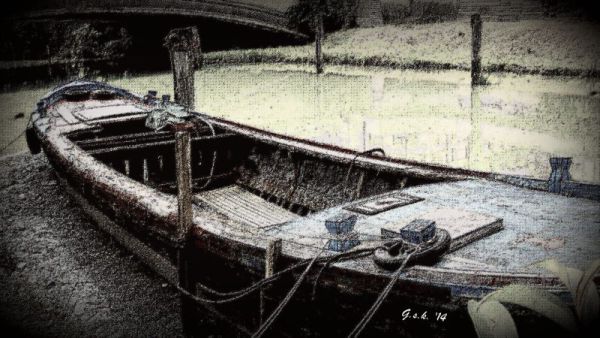
“Good gosh.” Mandy touched the hull. “Water, water everywhere and all the boards did shrink. Where does the albatross sit?”

“Hydrate her, the boards’ll plump up.”

“They’re rotten. . . . What’s that thingy?”

“It’s a . . . I’ll fix her.”

He switched on pleading puppy eyes.

Sigh. “Okay.” Mandy took his arm. “Let’s go look at that treadle sewing machine I want.”

“You can’t sew.”

“No. But it was love at first sight.”

***

Every Wednesday, Rochelle Wisoff-Fields issues the Friday Fictioneers challenge. She posts a picture prompt and invites readers to write stories of 100 words or fewer and to post them on their blogs the following Friday. This week’s prompt is here (scroll down the page to see it). Rochelle’s story follows it.

To see more stories by Friday Fictioneers, click on the frog, below.

(Friday is the official post date, but Thursday is fine, too. :-))

Poetry: Huck Finn Praises Emmeline Grangerford’s Tribute to Stephen Dowling Bots

Mark Twain is given official credit for this poem, but it was really composed by Emmeline Grangerford, whose family Huckleberry Finn met on his Adventures down the Mississippi River.

Below, Huck quotes Emmeline’s tribute to Stephen Dowling Bots, who came to a watery end. He also records what happened to Emmeline, whose compulsive rhyming finally led to her sadful demise.
This young girl kept a scrap-book when she was alive, and used to paste obituaries and accidents and cases of patient suffering in it out of the Presbyterian Observer, and write poetry after them out of her own head. It was very good poetry. This is what she wrote about a boy by the name of Stephen Dowling Bots that fell down a well and was drownded:

 
Ode to Stephen Dowling Bots, Dec’d.
 
And did young Stephen sicken,
      And did young Stephen die?
And did the sad hearts thicken,
      And did the mourners cry?
*
No; such was not the fate of
      Young Stephen Dowling Bots;
Though sad hearts round him thickened,
      ‘Twas not from sickness’ shots.
*
No whooping-cough did rack his frame,
      Nor measles drear, with spots;
Not these impaired the sacred name
      Of Stephen Dowling Bots.
*
Despised love struck not with woe
      That head of curly knots,
Nor stomach troubles laid him low,
      Young Stephen Dowling Bots.
*
O no. Then list with tearful eye,
      Whilst I his fate do tell.
His soul did from this cold world fly,
      By falling down a well.
*
They got him out and emptied him;
      Alas it was too late;
His spirit was gone for to sport aloft
      In the realms of the good and great.

 
If Emmeline Grangerford could make poetry like that before she was fourteen, there ain’t no telling what she could a done by-and-by. Buck said she could rattle off poetry like nothing. She didn’t ever have to stop to think. He said she would slap down a line, and if she couldn’t find anything to rhyme with it she would just scratch it out and slap down another one, and go ahead. She warn’t particular, she could write about anything you choose to give her to write about, just so it was sadful. Every time a man died, or a woman died, or a child died, she would be on hand with her “tribute” before he was cold. She called them tributes. The neighbors said it was the doctor first, then Emmeline, then the undertaker- the undertaker never got in ahead of Emmeline but once, and then she hung fire on a rhyme the dead person’s name, which was Whistler. She warn’t ever the same, after that; she never complained, but she kind of pined away and did not live long.

###
Note: The stamp is German. Here’s a link to a Russian stamp honoring Mark Twain, if a buyer hasn’t already snapped it up.

“Use the right word . . . “: Mark Twain’s Mother

Mark Twain cared about words: Pa’s boot with a couple of his toes leaking out of the front end; the sow lying in the middle of the street looking as happy as if she was on salary; and Miss Watson, a tolerable slim old maid, with goggles on.

The difference between the almost right word and the right word,” he wrote, “is really a large matter – ’tis the difference between the lightning-bug and the lightning.

And, “Use the right word, not its second cousin.”

In his autobiography, he tells the story of a time his mother used the right words to teach him a lesson that lasted a lifetime.

Troy Cawley - www.flickr.comphotosthecawleys - 3827566489
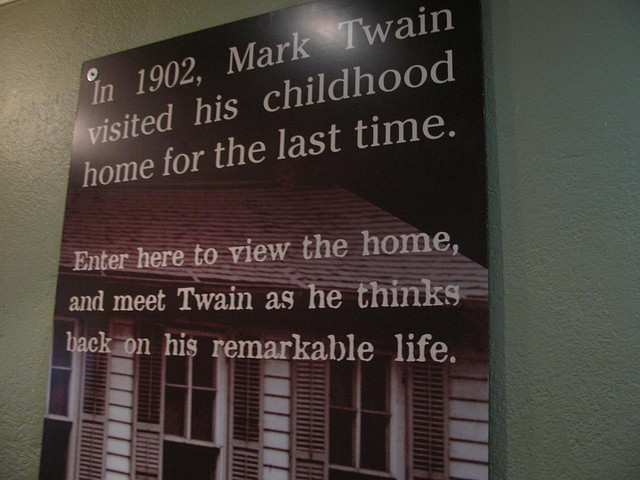
Mark Twain Museum. By Troy Cawley via flickr. CC BY-NC-SA-2.0

There was, however, one small incident of my boyhood days which touched this matter, and it must have meant a good deal to me or it would not have stayed in my memory, clear and sharp, vivid and shadowless, all these slow-drifting years. We had a little slave boy whom we had hired from some one, there in Hannibal. He was from the Eastern Shore of Maryland, and had been brought away from his family and his friends, half way across the American continent, and sold. He was a cheery spirit, innocent and gentle, and the noisiest creature that ever was, perhaps. All day long he was singing, whistling, yelling, whooping, laughing – it was maddening, devastating, unendurable. At last, one day, I lost all my temper, and went raging to my mother, and said Sandy had been singing for an hour without a single break, and I couldn’t stand it, and wouldn’t she please shut him up. The tears came into her eyes, and her lip trembled, and she said something like this—

“Poor thing, when he sings, it shows that he is not remembering, and that comforts me; but when he is still, I am afraid he is thinking, and I cannot bear it. He will never see his mother again; if he can sing, I must not hinder it, but be thankful for it. If you were older, you would understand me; then that friendless child’s noise would make you glad.”

It was a simple speech, and made up of small words, but it went home, and Sandy’s noise was not a trouble to me any more. She never used large words, but she had a natural gift for making small ones do effective work. She lived to reach the neighborhood of ninety years, and was capable with her tongue to the last – especially when a meanness or an injustice roused her spirit.

From “Mark Twain on Slavery, How Religion Is Used to Justify Injustice, and What His Mother Taught Him About Compassion”


Priceless

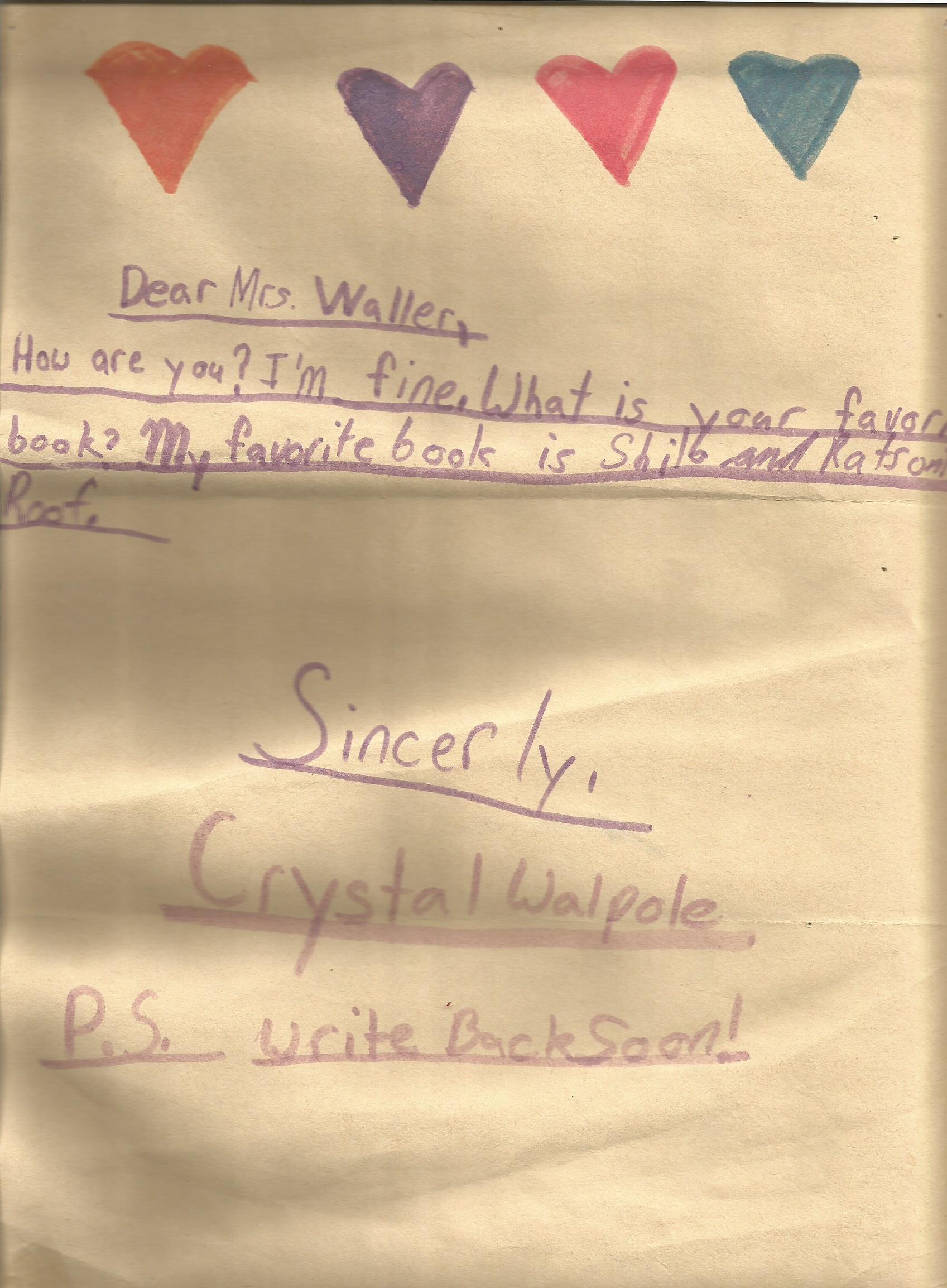
I received the letter pictured below when I worked at Norma Krueger Elementary School’s Scharf Library. Crystal Walpole wrote asking what my favorite book was. She dropped the letter into her classroom’s mailbox. Krueger’s Wee Deliver postal service stamped and delivered it to the library.

At the time, Crystal’s address was 683 Cocker Spaniel Drive in Sporting Dog, Texas. The library’s was 123 Yorkshire Terrier Avenue in Terrierville, Texas.

Crystal’s favorite books were Shiloh by Phyllis Reynolds Naylor and Rats on the Roof by James Marshall. Those were my favorite books, too.

And Crystal Walpole is one of my favorite writers.

 Crystal Walpole frontCrystal Walpole back###

 The towns of Terrierville and Sporting Dog existed for a brief but happy time as part of Marion Independent School District in Marion, Texas.


Addiction, Facebook, Doctors, Pigs, and Zombies

I confess: I’m hooked.

IMG_2800
By kathywaller1. All rights reserved.

The computer is a Kathy magnet. It wasn’t so bad until 2008, when I replaced a forty-hour work week with a laptop and my husband installed wi-fi. The Internet brings so many fine blogs and other attractions into my living room, where I sit with my feet up and examine them all; email can take up an entire day, if I leave it open while working.

Doubters would say that what I do isn’t working. I disagree. Negotiating the web is fatiguing. Commenting draws a lot of energy. I don’t want to write something that will be misunderstood; I don’t want to leave typos or incorrect punctuation; I don’t want to sound stupid.

Example: The previous sentence initially read, I want to sound stupid. It’s easy to mess up online.

Political posts on Facebook leave me just wo-ahn out. There’s the writing, of course, which is draining, but there’s also the emotion. Righteous indignation requires energy. Restraint requires more. After exercising restraint for several months, I stopped logging on. But there are friends and acquaintances–no, they’re not all friends–I want, and need, to keep up with. I like knowing how my great-niece’s first year of school is going. I like knowing that in the doctor’s waiting room when she was four, she suddenly came out with, “DOOOOOOOOOMED. We’re all DOOOOOOOOOMED.” Her fourteen-year-old brother wasn’t impressed, but I was. Her pronouncements remind me we’re not all doooooooomed.

Anyway, I logged onto FB today, discovered a post about a remark a sexist pig made on a pseudo news program, and was moved to share the post and a rousing Jeremiad of my own.

I didn’t address my remark to the sexist pig, nor did I call him one. I saved the phrase for this post. I merely suggested that his comments reinforce the ignorance and the bigotry of listeners who agree with him. Plus a couple of other salient thoughts.

Then I copied my remarks and pasted them into a Word document for future publication somewhere, perhaps here. They were scathing, simply scathing, but reasoned and polite, and they deserve a wider audience.

Another example: I’m getting all het up here just recalling the incident. Molecules of emotion surge through my body. I am giving the sexist pig power over me. That isn’t good.

Yesterday I heard a segment of a call-in program on NPR about the downside of computer technology on the culture. I’ve seen one of the effects on medicine already. When my former doctor’s practice installed computers in examining rooms, he stopped looking at me and started looking at the screen. So, to a lesser degree, did a specialist I consulted. They were excellent clinicians, and the latter possibly saved my life by doing surgery that only she and I thought I needed.*

But there’s  information to be drawn from faces as well as from words, on both sides of a conversation. Eyes transmit confidence and sympathy and a number of other messages. With the Party of the First Part looking at the side of the Party of the Second Part’s Head (or, as once happened, the back of his white coat), and the Party of the Second Part looking at a screen and typing away, I wonder whether the two Parties make sufficient connection.

The internist I see now has no computer in the examining room. He taps here and there on a Palm Pilot (or something; it has a light on it for closer examination of funny-shaped moles, plus, it appears, an entire pharmacopoeia; I hope it’s not an iPhone). But he sits near me and looks me in the eye, and I reciprocate, and we get along very well.

He also asks at every visit how the writing is going, thus allowing me to infer he remembers something about me that isn’t in the file. It probably is in the file, maybe scrawled inside the cover of the folder, but as long as I haven’t seen it, it isn’t.

One day I’ll walk in and find myself looking at a 17-inch flat screen. It’s inevitable, and, all things considered, it’s a good thing. But when the time comes, I shall tell the doctor how to conduct himself while interviewing patients, just in case he doesn’t know. I’m old enough to be his mother and I taught high school English, so I’m not only entitled, I’m an expert.

But enough of doctors.

I’ve been thinking for months–years?–about the power I give technology over my life: I don’t move as much as I used to, or get out of the house as I should. I don’t read as much as I did–I read much less, in fact, and this is the first time I’ve been able to make that claim.

I don’t write with a pen and paper as often as I used to. I’ve always enjoyed putting words onto paper with a good pen, not an expensive one, but a pen that fits my hand.

And although he hasn’t said anything, my POSSLQ** might be as tired of seeing me staring at a screen as I am of seeing the doctor do the same.

So. I’ve decided to pull the plug nightly by 7:00 p.m., and to work backward towards 5:00 p.m.

To do so, I’ll have to write everything I want to write during the day. For a nocturnal animal whose brain

starts functioning about 9:00 p.m., the change won’t be easy. But it’s the right thing to do.

In my new spare time, I will read books and write in my journal with the pen of my choice. POSSLQ will follow his tradition of reading every word in the newspaper and in several magazines. We might converse.

I will go to bed at a decent hour and wake at a decent hour, in time to get a table and an electrical outlet at the BookPeople coffee shop, and there I will write–write meaning to write stories and novels for at least one hour every day. I will do it because I promised author and editor Ramona DeFelice Long that I will.

Giving away your power isn’t a bad thing as long as you know the person who receives it has good motives.

Note that I write I will, a construction implying determination, resolution, perseverance.

If I absolutely can’t help myself, I’ll toss off a blog post now and then. But only outside that sacred hour.

It hasn’t escaped me that the BookPeople part involves using a laptop and wi-fi. I can’t write what I need to write without the laptop.

But as I would not be a Luddite, so neither would I be a Zombie. And I’ve had it on good authority that computer addiction leads right down the primrose path to Zombie-ism.

###

*The subsequent biopsy agreed with us. Thank you, Dr. Carla Ortique, who now practices in Houston. I wish you were here.

**1) Person of Opposite Sex Sharing Living Quarters. 2) An affectation. We’re married. 3) See in its entirety “My POSSLQ” by Charles Osgood. A darned good poem. Here’s the first paragraph:

“Come live with me and be my love,
And we will some new pleasures prove
Of golden sands and crystal brooks
With silken lines, and silver hooks.
There’s nothing that I wouldn’t do
If you would be my POSSLQ.” . . .

###

Excerpt: Lynna Williams’ “Personal Testimony”

In yesterday's post I wrote about Lynna Williams' story "Personal Testimony." Here are the first three paragraphs of the story.
###

“The last night of church camp, 1963, and I am sitting on the front row of the junior mixed-voice choir looking out on the crowd in the big sanctuary tent. The tent glows, green and white and unexpected, in the Oklahoma night; our choir director, Dr. Bledsoe, has schooled us in the sudden crescendos needed to compete with the sounds cars make when their drivers cut the corner after a night at the bars on Highway 10 and see the tent rising out of the plain for the first time. The tent is new to Faith Camp this year, a gift to God and the Southern Baptist Convention from the owner of a small circus who repented, and then retired, in nearby Oklahoma City. It is widely rumored among the campers that Mr. Talliferro came to Jesus late in life, after having what my mother would call Life Experiences. Now he walks through camp with the unfailing good humor of a man who, after years of begging hardscrabble farmers to forsake their fields for an afternoon of elephants and acrobats, has finally found a real draw: His weekly talks to the senior boys on “Sin and the Circus?” incorporate a standing-room-only question-and-answer period, and no one ever leaves early.

“Although I will never be allowed to hear one of Mr. Talliferro’s talks—I will not be twelve forever, but I will always be a girl—I am encouraged by his late arrival into our Fellowship of Believers. I will take my time, too, I think: first I will go to high school, to college, to bed with a boy, to New York. (I think of those last two items as one since, as little as I know about sex, I do know it is not something I will ever be able to do in the same time zone as my mother.) Then when I’m fifty-two or so and have had, like Mr. Talliferro, sufficient Life Experiences, I’ll move back to west Texas and repent.

“Normally, thoughts of that touching—and distant—scene of repentance are how I entertain myself during evening worship service. But tonight I am unable to work up any enthusiasm for the vision of myself sweeping into my hometown to be forgiven. For once my thoughts are entirely on the worship service ahead.”

 ###

Yesterday I wrote that the narrator of “Personal Testimony” is eleven years old. When I discovered the excerpt, I was reminded she’s really twelve. I’ll correct my error. My narrator in “Personal Experience,” however, continues to be eleven.

A Finely Shaped Head

When I think of my wife, I always think of her head. The shape of it, to begin with. The very first time I saw her, it was the back of the head I saw, and there was something lovely about it, the angles of it. Like a shiny, hard corn kernel or a riverbed fossil. She had what the Victorians would call a finely shaped head. You could imagine the skull quite easily. ~ Gillian Flynn, Gone Girl


Books for Soldiers: Can You Help?


A U.S. Army chaplain is requesting donations of books to help soldiers he is counseling. His wish list is here, on the Amazon site.


Operation Paperback, a nonprofit organization that collects and sends “gently used” books to members of the military and their families, has approved his request.


If you can buy a gift book, Amazon will send it directly to the chaplain.


 ###

I thank mystery novelist Sandra Parshall, a Facebook friend, for sharing this information and the Amazon link. Visit Sandra at her website and on Facebook.


Enhanced by Zemanta

Monkey Mind

I am a distractible adult. I suffer from Monkey Mind.*

I wasn’t a distractible child. I listened in class, turned my assignments in on time, and made the honor roll. It’s true that I didn’t practice the piano or the clarinet as I should have, but there were extenuating circumstances.

Regarding the piano, my mother encouraged me and saw that a certain miminum standard was observed. But she also said she wanted me to learn to play well enough for the piano to be a pleasure rather than a burden.

The piano was a pleasure. I amused myself for hours playing pieces I wanted to play.

Pieces I wanted to play included anything my teacher hadn’t assigned. Scales, arpeggios, Czerny exercises–all those repetitive activities designed to develop skill–fell into the didn’t-want-to column.

As a result, the piano is now a major frustration, and I wish Mother had declared all-out war on her musical slacker.

The clarinet situation was more complex. As a fifth- and sixth-grader, I played daily for my own amusement, and for the amusement of my white-faced Hereford, Marie, who stood on her side of the fence while I entertained from a lawn chair on mine.

But when the euphoria triggered by receipt of my very own Boosey and Hawkes in its very own case had worn off, I realized that, in the hands of a novice, the clarinet is at best a noisemaker. And in concert, the trumpet gets all the good parts, like the melody. Practice was all tootle-tootle-tootle-rest-ooh-ooh-ooh-rest-tootle-tootle-tootle-rest-tootle-rest-rest-rest-repeat.

I loved music, so listening to myself was misery. My mother loved music as well, so being part of a captive audience must have been worse. Consequently, I believe my mother, realizing the clarinet would never be a pleasure to me or to anyone else in the family, except Marie, made certain accommodations. Possibly something like, The less tootling I have to listen to, the less I’ll nag her about the piano.

(No. That’s unfair, even in jest. Music was in my mother’s DNA. She’d have gladly put up with all the tootling I thought necessary.)

(For his part, my father was a saint. He used to joke that when he didn’t want to listen to something–or someone–he turned off his hearing aid. But he kept it on through all my noise. I know because twenty years later, Mother told me that during one evening’s tootling, “Polly Wolly Doodle,” to be exact, he looked up and said, “She’s playing a song.”)

 ###

Well. Having concluded that digression, whose connection to the rest of this post isn’t clear to me either, I’ll return to the original topic, and say that, aside from a talent for locking myself out of my car, the tendency to ditsiness lay dormant until a sudden surge six years ago this month. That’s when I left my position as a paralegal (and the structure it provided) to stay home and write. Or, to be more specific, when I bought a laptop and discovered wireless connectivity.

It’s strange how a device that should aid writers can be such a hindrance. Even when good intentions coincide with opportunity, there’s that tempting little Firefox icon lurking at the bottom of the screen. Throw in a tinge of curiosity about anything at all–the current state of your email inbox, the definition of a particular word, the spelling of distractibility, a peek at who’s doing what on Facebook, how old Peter Vaughn is and what Billie Whitelaw, who married him in 1952, looks like, since you know you’ve seen her but you can’t for the life of you remember her face . . . and you have to know now, and then one click leads to another . . .

It’s a slippery slope.

Anyway, I chose to write about Monkey Mind because after sitting in this coffee shop, staring at a blank LibreWriter screen and watching my mentor across the table just typing away, I grew restless, both physically and mentally. After a time, I gave up and in, opened Firefox, and surrendered to the lure of the Web.

Then a funny thing happened. Surfing usually stops the jiggliness I feel when staring at a blank page. Instead, the feeling increased. My mind scattered. My hands shook. To make things worse, an intense irritability set in. I was not in good shape.

Finally, just as I was ready to slam my laptop closed and stalk out, a word unrelated to icons and mice floated through my brain: hunger. Breakfast was only a distant memory. I wobbled to the counter. One orange juice and one banana later, jiggliness abated and writing began.

End of story.

###

Now for the Moral, which I direct to all those people–and they know who they are–who claim Monkey Mind is completely psychological, a self-indulgence created by literary Camilles, would-be writers who like to talk the talk but don’t want to walk the walk:

The Moral

Monkey Mind can’t always be cured by meditation, relaxation, Artist Dates, discipline, yoga, warm showers, outlining, daily affirmations, or a good swift kick.

Sometimes the only cure for Monkey Mind is lunch.

###

 * a Buddhist term meaning “unsettled; restless; capricious; whimsical; fanciful; inconstant; confused; indecisive; uncontrollable” ~ Wikipedia

Enhanced by Zemanta