No, it’s not the swimming pool. It’s not the hot tub. It’s not the gorgeous male trainers.
It’s the closed captions.
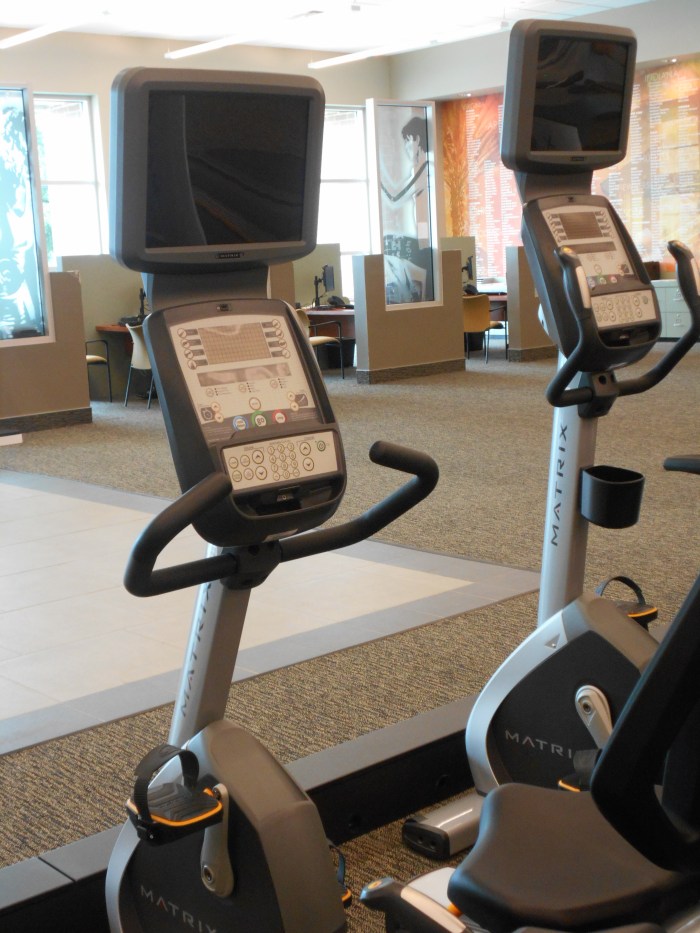
Some machines at the gym have TV monitors attached so users won’t become bored. A wise move.
My first day on the recumbent bike, I said to myself, “Oh, pish-tosh! I don’t need television. I have an active mind and a rich internal life.”
The second day, I discovered my internal life isn’t rich enough to keep me pedaling for twenty minutes without my active mind imploding. So–on with the TV. Since I hadn’t brought earbuds, I turned on the closed captions.
Viewing choices are limited: some cable movies, lots of sports, a travel show, all about as stimulating as watching your knees rise and fall. But one news station runs unscripted programs, most related to business and the economy.
And the closed captions for those unscripted programs are a hoot.
During one session, I managed to take notes. Here are some of the fragments I recorded. Remember, the program was about finance, and my knees were moving up and down at 9.4 mph.
Captions
1. … when people gathered to talk about the economy and cucumbers…
2. …too much of Peoria for political to sin…
3. …when like at Europe the monkey is struggling and falling apart…
4. …and to see Barry big surprise interest from some pastries…
5. …we have the armpit that all of our options fade with time…
6. …the importance of a kiwi in Europe…
7. …call the stow the hillbilly of what is coming…
8. …take on a ministry the comics not to forget…
9. …the markets found some milk without the markets coming up…
10. …learned from a tumor and people said a tomato…
All that in just one session of violent bodily exertion. What more could I want?
Yesterday earbuds were available, but plugging them in didn’t cross my mind. Nor did announcing my find.
Those captions are my own little secret. When other cyclers look my way, wondering why I laugh aloud, they can just wonder.
And when the rest of the health nuts have dropped out from indolence and ennui, and I alone register perfect attendance, and when the muscleiest trainer can’t drag me off the bike, the Powers That Be will admire, nay revere, me. And they will give me head pats.
What if soy milk is just milk introducing itself in Spanish?*
***
To Write, etc., has been dormant for a while because I’ve been (a) playing spider solitaire, and (b) working on two pieces of literature:
(1) a story entitled “When Cheese Is Love,” which needs to be 5,000 words but is currently 6,200 words, necessitating radical surgery and the murders of a few darlings; and,
(2) a post for the Austin Mystery Writers blog that would have been online last Monday had I not suffered at tiny fall (and, no, I’m not going to tell how it happened), which rendered me indisposed for just long enough to figure out the post wasn’t coming together as I wanted because I was trying to write about two different topics at once.
I can’t complain about an indisposition that allows me time to realize the first half of a post I’ve drafted says one thing and the second half contradicts it.
My next project will appear right here on To Write, etc. It is tentatively entitled “Snakes I Have Known.”
I spent this evening telling snake stories on Facebook and suddenly realized–it’s like that chapter in For Whom the Bell Tolls—no, it’s in “The Snows of Kilimanjaro,” actually–where Hemingway wastes a lot of material writing about what his character would never write:
Now he would never write the things that he had saved to write until he knew enough to write them well. . .
***
He remembered the good times with them all, and the quarrels. They always picked the finest places to have the quarrels. And why had they always quarrelled when he was feeling best? He had never written any of that . . .
***
No, he had never written about Paris. Not the Paris that he cared about. But what about the rest that he had never written?
What about the ranch and the silvered gray of the sage brush, the quick, clear water in the irrigation ditches, and the heavy green of the alfalfa. The trail went up into the hills and the cattle in the summer were shy as deer. . .
About the half-wit chore boy who was left at the ranch that time and told not to let any one get any hay, and that old bastard from the Forks who had beaten the boy when he had worked for him stopping to get some feed. The boy refusing and the old man saying he would beat him again. The boy got the rifle from the kitchen and shot him when he tried to come into the barn . . .
So there it is. Hemingway threw away all those stories by putting them inside of a dying character thinking about the stories he will never write.
And Hemingway never wrote them either. He wrote about them. What a waste.**
Heaven forfend that I should meet a similar fate. I’m not going to write about those snake stories. I’m going to write them.
So watch this space.
In case you don’t care for snakes, don’t worry–I won’t include pictures of them. And no one will be bitten. All my snake stories are true, but I kept my distance while they were happening.
***
*The question is rhetorical and appears only because I’m feeling whimsical. And because this is my blog and nobody’s grading it and I can do whatever I please. So there.
**For most of this post, my tongue is firmly planted in my cheek, but this paragraph comes from the heart. It’s sad that Hemingway left stories untold. It’s sad that any writer does that. And I guess they all do.
That was the most invigorating experience I’ve had since the Director of the Tort Litigation Division of the largest law firm in Austin hit me smack in the chest with a water balloon. No cause of action was involved. We were engaged in a water balloon fight.
She was contrite, apologized all over the place, but, as I told her, hitting someone was her job. I just happened to move into range.
If the fault fell on anyone, it was my attorney. I was parked at a picnic table with other paralegals and secretaries who were pleading headaches–one pleading a migraine, which she was subject to–when my attorney came over and said, “C’mon, Kathy.” I don’t know how he knew I didn’t have a headache. I could have pleaded migraine, but I didn’t.
He had migraines, as well, so he knew one when he saw one.
I had migraines, too, and I never lied about having one. I preferred to embarrass myself in a three-legged race than to tempt fate.
Anyway, lying to lawyers is not a good idea. They know.
So I participated and got the balloon treatment. And I benefited from the experience. In addition to forgiving the Director, I told her the water was a relief. Pease Park isn’t air-conditioned in late spring.
Best of all, I was the only paralegal wearing a wet tee-shirt. It wasn’t the kind that turns transparent, but it was a tee-shirt, and it was wet. Normally when I tell the story, I leave out the phrase not transparent.
Yesterday’s waterfall didn’t have nearly the joie de vivre of the water balloon incident. My friends were appalled and tried to dry me off. Several suggested I head for the restroom and wring myself out (staff had supplied terry cloth hand towels), but moving would have been disastrous. I would have left a trail of water from here to yonder.
Then friends worried I would freeze in the exceptionally cool room. I assured them I wouldn’t. I haven’t frozen since the Great Snow of 1986.
Anyway, after the initial surprise, I laughed and said, “I’m all right, I’m really all right, really, I’m all right.” And I was.
But I also wanted to spare the waiter’s feelings. There’s a reason I’ve never been a waiter, and dumping food and drink on people is it.
I’m glad I behaved graciously about the deluge, because later, the same waiter tipped another tray–while it was resting on a stand, which takes a goodly portion of dexterity–and lost an order of tacos pastor. That time our entire table laughed (except, perhaps, the woman who had ordered the tacos). I made a point of saying, “We’re not laughing at you; we’re laughing with you.”
The waiter appeared to take the business with equanimity. He probably zenned it. A lot of zenning goes on in Austin.
Telling the whole truth, as I must in a post involving attorneys, requires me to admit I took the cascade with aplomb for the reason every writer with half a grain of sense lives by:
It’s all material.
*****
I tell the story of the water balloon because I think it’s public record, I hope. I hope also I can’t be fired retroactively. For anyone who just has to know, I’ll explain someday why a bunch of lawyers and support staff were lobbing liquid at one another. But the story is better if you don’t know.
I’m told, however, that listening to tort lawyers plan an afternoon of vigorous recreational games is most instructive, because they spend half the time discussing injury, liability, damages, duty of care, breach, proximate cause, and such.
My own speculation–and it is mere speculation, not legal opinion, so I’m not practicing law without a license–is that in any potential suit, sovereign immunity and res ipsa loquitur, plusa modicum of intentional infliction of emotional distress would battle it out in the courts.
And, yes, I had to check Wikipedia to brush up on most of those terms. I knew them for the test, but since then they’ve re-filed themselves in short-term memory. I do remember quite a bit about res ipsa loquitur and sponges, and I have vivid memories of putting together many trial notebooks.
Jane Austen at a PUB? Yes!
Maddie Shrewsday, Kate’s fourteen-year-old daughter, speculates on what Jane did there.
Prepare to be enlightened. And to LAUGH.
So we’re driving down to Winchester on one of our Saturday afternoon jaunts, and I come off the soulless M3 motorway to take the old carriage way. The road the postal carriages would have taken to get post to the south and south west. The route the stagecoaches flew along moving visitors from one big house to the next.
And I am doing that thing mothers do where they repeat ad infinitum the litany of landmarks on a road; those that have personal significance (ah, that’s where our car broke down in 1989; that’s the Little Chef where I left my handbag and never went back to get it) and those which have a greater, more elevated place in history.
“Look, darling,” I gesture expansively over the steering wheel, “you see that pub?”
It is labelled ‘The Wheatsheaf’ and it’s a member of…
I feel lousy! Oh so lousy! I feel lousy, and frowzy, and a fright!
And that’s the truth.
My whole body, except for my brain, is out of commission. My brain is set on Grouse. To the widest audience I can find.
I’ve already told my niece and my great-niece, through Facebook, what I think about a couple of things. Niece offered to buy me a drink. I suggested codeine or paregoric instead. Great-niece hasn’t responded.
At this point, even the brain is running out of steam, so, gentle readers, you will be spared the Grouse. Instead, I will post pictures of a family get-together in Houston a year–two?three?–ago.
Both of the mothers said I could post photos of their children. The children’s grandmother didn’t give permission to post a photo of her, but she doesn’t get to say. When I was sixteen and she was almost twice that, and old enough to know better, she set an ice pack on my stomach in the middle of the night, when I was sound asleep.
I have forgiven her, but I will never forget.
Anyway, here are a bunch of very bad photos of people having fun.
P. S. I’ll see how many of gentle family are aware of this blog by counting the number of comments I get from them here and on Facebook.
Disclaimer: They say if you write, you’re a writer, but I don’t believe taking photographs makes you a photographer. Nor does taking a lot of photographs ensure your efforts will improve. But I usually write with tongue planted in cheek, so I might as well post photos the same way. If a photo is just plain bad, I can claim posting it was an attempt at irony. Now and again, I might hit upon something interesting..
They also say not to apologize in advance, but I just did.
My blog. My rules.
I took the following shots when I was looking for something for Converge but became more interested in Shadows.
Photos are organized from shadowed to not shadowed. The last is there not for shadows or no shadows, but because I like it.
I am grateful. For my husband, my family, parents who gave me a good start and kept on giving, my home, teachers, education, friends, time to use as I wish, the rights guaranteed to me by the Constitution, the freedom to pursue happiness, good health, and a host of other blessings.
But when I write about blessings, the resulting essay is maudlin, insipid, schmaltzy, and trite.*I just can’t do sincere.*******
So this post is about things not usually seen on Grateful-For lists.To wit:
Coffee shops with enough electrical outlets, appropriately placed, to serve nearly all the people who want to plug in. (There’s no way they could serve all of them.) And that say your car will be towed if it’s parked in their lot for more than three hours but don’t really mean it. (BookPeople. They probably do mean it, but I’ve never been towed. I think it depends on how full the parking lot is.)
Everywhere that provides free Wi-Fi.
Coffee shops that allow a critique group to sit around a table and discuss manuscripts, and moan about how hard writing is, and what their kids and their cats are up to, and what their dysfunctional families are up to, and that don’t mind when one member reads aloud a scene involving torture and murder** because both staff and other customers are entranced, listening and wondering whether they’re hearing part of a memoir. And that don’t tow their cars.*****
Blogs. Mine allows me to write to write to an audience, real or imagined. I need that audience. So do most other writers, including students of all ages.
Books. I like them. I like to read them. I like to buy them. Unfortunately, I like buying more than reading, which is why I have so much to-be-read nonfiction on my bookshelves and elsewhere.***
Bookstore going-out-of business sales. Closing a bookstore is a terrible thing, but if they’re going to close anyway, I don’t mind helping reduce inventory. That’s how I acquired most of that unread nonfiction.
English: Borders in West Quay Retail Park, Southampton (Photo credit: Wikipedia) Public domain.
Printers that work.****** Most of them work now, but years ago most didn’t. That’s why my students at the university turned in so many papers with text starting at the middle of the page and running diagonally to the bottom right corner. I told them they really couldn’t do that, and that they needed to do the work earlier and start printing days rather than minutes before leaving for class. But I knew if I used a printer, my papers would look like theirs. I was still using a typewriter. When I put the paper in straight, my pages looked okay.
Mark Twain, Emily Dickinson, William Dean Howells, Henry James, Edith Wharton, Clyde Edgerton, Kathie Pelletier, T. R. Pearson, Olive Ann Burns, Fannie Flagg, Elizabeth Berg, Josephine Tey, Ruth Rendell, P. D. James, and the list runs on. If there are any questions about why I’m grateful, pick up some of their books. For Elizabeth Berg, begin with Durable Goods (her first novel, and yes, I despise her). For Clyde Edgerton get Raney, Walking Across Egypt, Killer Diller (WAE’s sequel), or Lunch at the Picadilly; the man is a genius. For Olive Ann Burns, read Cold Sassy Tree, her first and only complete novel; I feel about her like I feel about Elizabeth Berg, see above. I’d like to feel that way about Clyde Edgerton, but I can’t, because I want to be Clyde Edgerton.
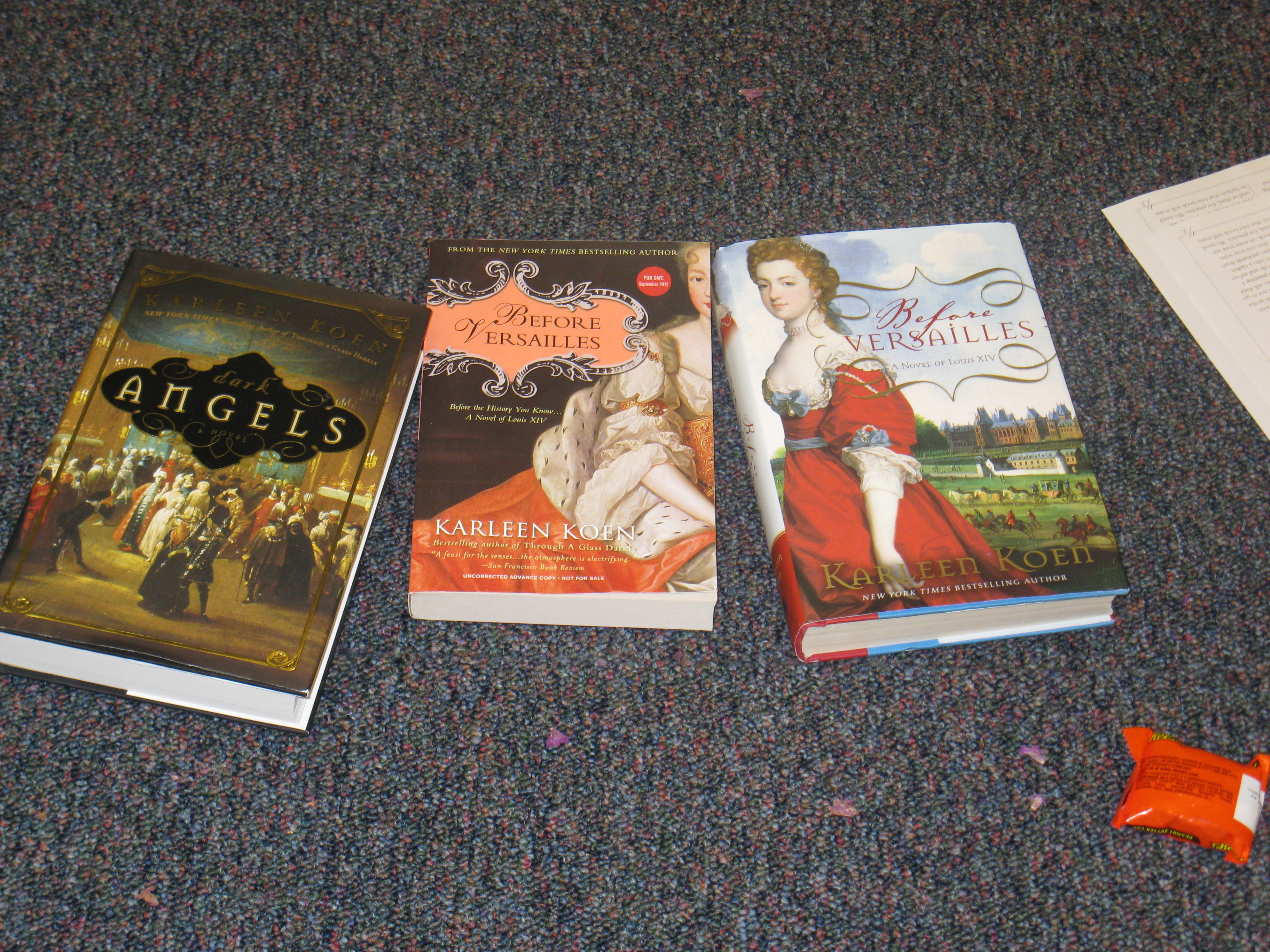
Karleen Koen,**** writer and instructor, who said, “I can’t teach you to write, but I can teach you to play.” And she can. And she did. And I had the time of my life writing and writing and writing. Anyone who wants to write and has the opportunity to take one of her classes should sign up asap. See her blog, Karleen Koen – Writing Life, and her webpage, Karleen Koen. Find information about the courses she teaches at Karleen Koen – Courses. Karleen has published four impeccably researched historical novels, set in the seventeenth and eighteenth centuries; the latest, Before Versailles, takes place in the court of Louis XIV, in the early years of his reign.
Karleen Koen
Three of Karleen Koen’s novels displayed on classroom floor at WLT retreat, Alpine, TX, 2014. The little orange things in the lower right corner might be peanut butter cups.
Dictionary.com and Thesaurus.com,which I keep running in the background when I work. Dictionary.com gives me exact definitions of words. Thesaurus.com answers the question, What’s that word that means something like XXXXXXXXXX but not exactly, and it’s standing at the beginning of my hypoglossal nerve but refuses to sprint on down to my tongue, and I cannot finish this sentence without it? These sites are a godsend for people who hyperventilate at the thought of leaving a blank space and moving on.
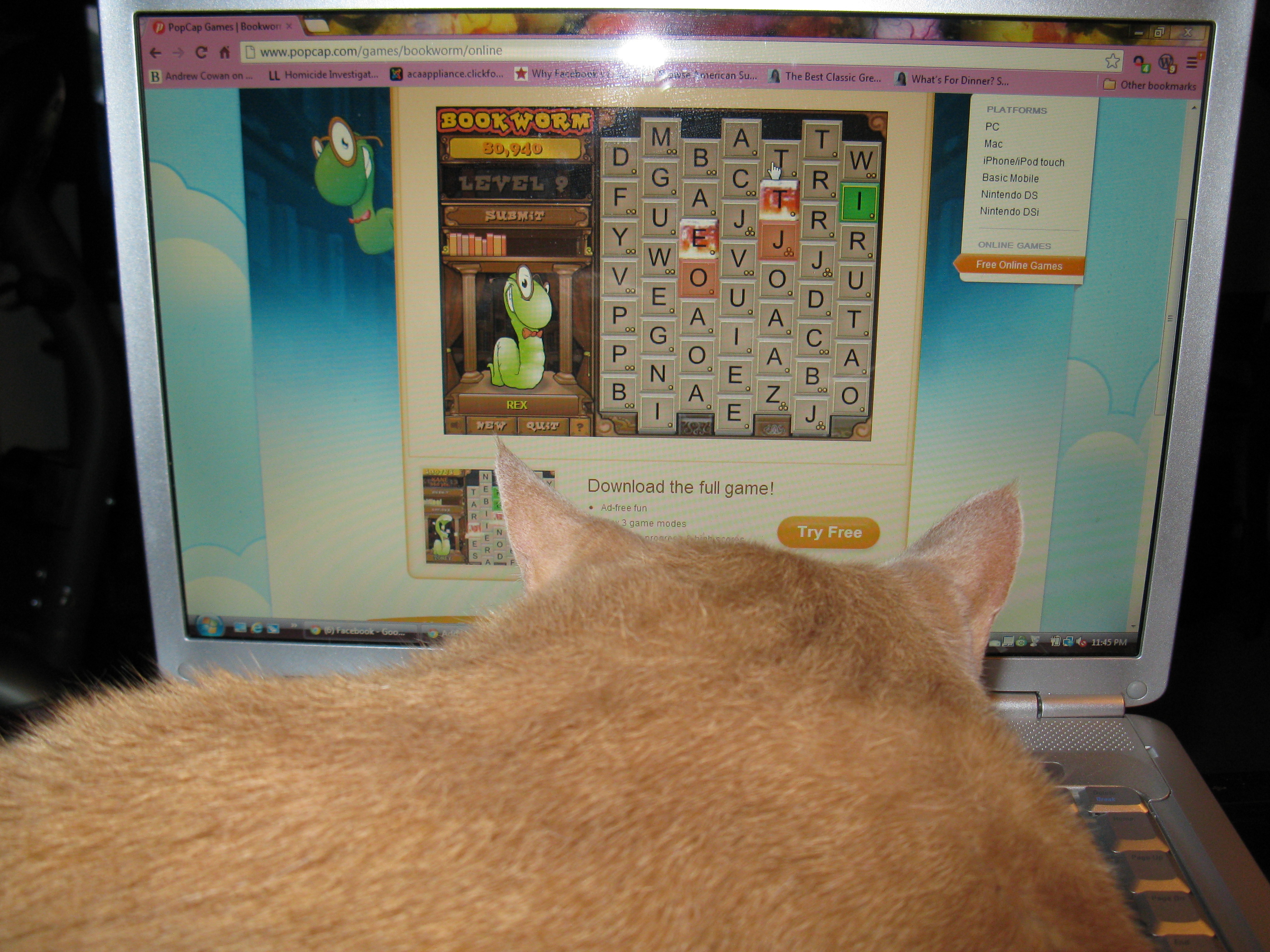
Bookworm.Yes, that one. The vile, disgusting, devilish online game that is a thousand times worse than solitaire, because if the Bookworm player is good enough, the game never ends. The player can sit mindlessly clicking on letters to make words, and if the letters he clicks don’t make a word, he just tries again, and he can play while he’s watching-listening to television, or petting the cat, or carrying on a conversation, or trying to think what his Main Character should do next because he’s painted her into a corner . . . Obviously, I know whereof I write.
I’m grateful for Bookworm, however, because sometimes I need the comfort of a mindless, repetitive task. Playing Bookworm can be a method of avoidance, but it can also be a way of putting the mind on autopilot, giving it the freedom to figure out how to get the Main Character out of the corner she’s stuck in.
Caveat: Playing Bookworm for too long at one sitting, day after day, month after month, can result in repetitive stress injuries. For example, the mouse hand and all that’s attached to it, right on up to the shoulder, can be rendered painful and practically useless until the light dawns and the victim realizes why she can’t raise her right arm.
Readers. I’m grateful for everyone who reads my posts, especially the posts that are two or three times as long as blog posts should be. This one is four times as long. Contrary to my expectations, everything on the list relates to writing. I had intended to include Relaxed Fit Slacks and The Demise of the Girdle. But tomorrow is another day.
(The Demise of the Girdle. Wouldn’t that make a marvelous title for a novel? Should it be mystery, romance, or science fiction?)
William Davis & Bookworm
* See Thesaurus.com. That’s where I found all these synonyms for bathetic.
*** Don’t ask where elsewhere is. It’s not relevant.
**** This is not an advertisement, paid or otherwise. Karleen is an excellent teacher–few instructors can keep twenty tired adults happy for a whole week by assigning more homework. (See Morning Pages)
***** See Coffee Shops, above.
****** And printers that don’t drink ink.
******* Last summer, when I wept bitter tears because I couldn’t write what I was trying to write (not my usual practice, but I was having a bad summer), Karleen told me what to do instead, and before anyone says Hahahahahah, I’ll add she was quite nice about it, and said I should aspire to write like David Sedaris. Have you ever known of David Sedaris to do sincere?
Mark Twain is given official credit for this poem, but it was really composed by Emmeline Grangerford, whose family Huckleberry Finn met on his Adventures down the Mississippi River.
Below, Huck quotes Emmeline’s tribute to Stephen Dowling Bots, who came to a watery end. He also records what happened to Emmeline, whose compulsive rhyming finally led to her sadful demise.
This young girl kept a scrap-book when she was alive, and used to paste obituaries and accidents and cases of patient suffering in it out of the Presbyterian Observer, and write poetry after them out of her own head. It was very good poetry. This is what she wrote about a boy by the name of Stephen Dowling Bots that fell down a well and was drownded:
Ode to Stephen Dowling Bots, Dec’d. And did young Stephen sicken, And did young Stephen die? And did the sad hearts thicken, And did the mourners cry?
* No; such was not the fate of Young Stephen Dowling Bots; Though sad hearts round him thickened, ‘Twas not from sickness’ shots. * No whooping-cough did rack his frame, Nor measles drear, with spots; Not these impaired the sacred name Of Stephen Dowling Bots.
* Despised love struck not with woe That head of curly knots, Nor stomach troubles laid him low, Young Stephen Dowling Bots.
* O no. Then list with tearful eye, Whilst I his fate do tell. His soul did from this cold world fly, By falling down a well.
* They got him out and emptied him; Alas it was too late; His spirit was gone for to sport aloft In the realms of the good and great.
If Emmeline Grangerford could make poetry like that before she was fourteen, there ain’t no telling what she could a done by-and-by. Buck said she could rattle off poetry like nothing. She didn’t ever have to stop to think. He said she would slap down a line, and if she couldn’t find anything to rhyme with it she would just scratch it out and slap down another one, and go ahead. She warn’t particular, she could write about anything you choose to give her to write about, just so it was sadful. Every time a man died, or a woman died, or a child died, she would be on hand with her “tribute” before he was cold. She called them tributes. The neighbors said it was the doctor first, then Emmeline, then the undertaker- the undertaker never got in ahead of Emmeline but once, and then she hung fire on a rhyme the dead person’s name, which was Whistler. She warn’t ever the same, after that; she never complained, but she kind of pined away and did not live long.
In yesterday's post I wrote about Lynna Williams' story "Personal Testimony." Here are the first three paragraphs of the story.
###
“The last night of church camp, 1963, and I am sitting on the front row of the junior mixed-voice choir looking out on the crowd in the big sanctuary tent. The tent glows, green and white and unexpected, in the Oklahoma night; our choir director, Dr. Bledsoe, has schooled us in the sudden crescendos needed to compete with the sounds cars make when their drivers cut the corner after a night at the bars on Highway 10 and see the tent rising out of the plain for the first time. The tent is new to Faith Camp this year, a gift to God and the Southern Baptist Convention from the owner of a small circus who repented, and then retired, in nearby Oklahoma City. It is widely rumored among the campers that Mr. Talliferro came to Jesus late in life, after having what my mother would call Life Experiences. Now he walks through camp with the unfailing good humor of a man who, after years of begging hardscrabble farmers to forsake their fields for an afternoon of elephants and acrobats, has finally found a real draw: His weekly talks to the senior boys on “Sin and the Circus?” incorporate a standing-room-only question-and-answer period, and no one ever leaves early.
“Although I will never be allowed to hear one of Mr. Talliferro’s talks—I will not be twelve forever, but I will always be a girl—I am encouraged by his late arrival into our Fellowship of Believers. I will take my time, too, I think: first I will go to high school, to college, to bed with a boy, to New York. (I think of those last two items as one since, as little as I know about sex, I do know it is not something I will ever be able to do in the same time zone as my mother.) Then when I’m fifty-two or so and have had, like Mr. Talliferro, sufficient Life Experiences, I’ll move back to west Texas and repent.
“Normally, thoughts of that touching—and distant—scene of repentance are how I entertain myself during evening worship service. But tonight I am unable to work up any enthusiasm for the vision of myself sweeping into my hometown to be forgiven. For once my thoughts are entirely on the worship service ahead.”
###
Yesterday I wrote that the narrator of “Personal Testimony” is eleven years old. When I discovered the excerpt, I was reminded she’s really twelve. I’ll correct my error. My narrator in “Personal Experience,” however, continues to be eleven.
The photo display below illustrates what happens when the photographer reads the rules but immediately forgets them. Instead of photos engaged in dialogue, she shoots photos of objects engaged in dialogue.
It also shows what happens when one sock of each pair is eaten by the dryer: Those left behind have nothing to do but sit around and talk.
If there’s any justice in this world, this will be the last inane piece I’ll post, at least for a while. The previous post spotlighting the filthy mouse appeared because I was trying to attach my blog to Bloglovin‘ and wasn’t sure it would work, and I wanted to do more than post a possibly unworkable link. And after reading reams of instructions and not being convinced I understood them, I was disgusted enough to advertise the state of my refrigerator’s underside. I do move the appliance to mop, but I’m not compulsive about it. And I don’t want to offend by tossing my children’s favorite toy. Unfortunately, sponging mousie off does nothing for its appearance.
WordPress advises not to post when you have nothing to say. Once more I’ve violated the rule. Forgive me. As atonement, I offer socks and a cat.*
Also, please forgive the sock with the hole. I don’t wear it unless I want to make a statement. Then I pair it with the adjacent mismatch. I’m not comfortable that way, but people know that I’m my own person and that I have no shame.
See what other photographers have posted to this week’s photo challenge here.
*Sometimes, like around midnight, I post from impulse. Sometimes I’m just weak.
Today we highlight a shop that offers the latest wrinkle in Texas style a la mode.
First, for her, a tunic top made of Jersey and adorned with tiny embroidered rosettes. For him, a shirt of dark blue denim. Both are suitable for casual meandering or for more formal trailer transport to greener pastures.
In the background, a lovely dress in Angus black, falling in front to just above the knee, and in back to the hock.
A closeup, below, highlights flowers fashioned from brightly colored silk ribbons bordering a modified V-neck, redolent of the meadows in a Texas spring.
Next, another his-and-her combo: He sports a striped shirt, narrow verticals in navy blue, wider horizontals in alternating Babe ox blue, sea gray, and straw yellow, over a brown dun polo shirt. She looks stunning in a zebra-patterned skirt topped by a bodice of stone gray with dapples, red roan, brindle, and spring timothy. A circlet of bailing twine around her neck gives the outfit a festive air. Both garments could be worn for an evening of frolicking through maize stubble, or a midnight raid on the corn crib.
Finally, an accessory no true gentleman cow can do without: a western-styled hat. Fashioned after the world-famous Stetson, this chapeau is bilaterally symmetrical, allowing it to be worn on either the right or the left horn with equal panache. One caveat, however: The wearer must take care to remove the hat before attempting to roll under a barbed wire fence, lest damage occur.
It should also be noted that, although all the lady models are polled, the clothing displayed here can be worn by unpolled cows with no alteration whatsoever. Gentlemen cows, however, might have some difficulty wearing the hats without horns on which to hang them.
*****
The reviewer thanks Lone Star Attitude, DFW International Airport, for providing models and clothing, and for keeping her amused during a ninety-minute layover. In publishing this post, she intends no disrespect, but only admiration for those responsible for choosing to market their merchandise in such a delightful way.
I [Billy Hathorn] took photo of Eudora Welty at National Portrait Gallery in Washington, D.C. U.S. government collection, public domain (Photo credit: Wikipedia)How could The New Yorker reject the writer who coined the word concubineapple? And who had the nerve to use that word in her letter of application?
Beats me.
See what other qualifications Ms Welty offered her potential employer at Letters of Note: “How I Would Like to Work for You!”
William and Ernest: No relation to the content of this post
A friend asked recently, “Why do you blog? It’s for the numbers, right?”
No.
Numbers are nice. I won’t pretend I don’t look at them. Several times a day, in fact. Compulsively. As one who for a long time was her own audience, I’m delighted by every little hit.
Better than numbers, however, are what the numbers represent: people who take the time and make the effort to visit, read, subscribe, like, and comment. People I’ve gotten to know and like through reading their blogs. People who boost my morale and my ego.
Possibly more of the latter than is good for me, but that’s no reason to stop.
Anyway, I’ve wanted for a long time to say thanks, and now I’m saying it: Thanks.
*
A recent post concerned my being behind in reading, writing, and a number of other activities. It occurs to me, not for the first time, that sharing my troubles, especially those I myself generate, might not be wise.
As I said, people read these posts. They might get the wrong idea.
So, once more, I shall explain: Like Mr. Mark Twain, I tell the truth—mainly.
In other words, it’s never as quite bad as I say it is. Except when I lock the keys in the car.
I periodically vow to stop yowling about my little quirks, but doing so would raise another problem: I wouldn’t have much to write about.
Posts would go something like this:
*
The new refrigerator didn’t come again today, so we are still surviving on microwaved frozen entrees (the freezer works), P. Terry burgers, Wendy’s salads, and Chinese take-out.
[At one time, I could have made that into lively, amusing fiction. But I’ve lost all enthusiasm for the topic. David kindly left work and brought me a McDonald’s burger for lunch today. I think that’s about the point at which enthusiasm began to leak.]
*
On Saturday afternoon, our right front tire began to unravel at 60 mph in the middle lane of IH-35. It went flap-flap-flap, and we knew intuitively that the rubber had met the road and intended to take up residence there. Fortunately for all southbound traffic, it didn’t abandon us completely. We exited the freeway, crept back home, and set out again in the other car. The ailing vehicle is spending the night at the tire store, being completely reshod.
*
There are the facts, no yowling, no self-recriminations, just the happenings of the past week. Not the stuff of which blogs are made.
One thing did happen today that I would love to post. The bare naked facts, lacking all embellishment, would raise laughter from stones. I’ve been all giggly ever since I hung up the phone. Or perhaps since I relayed the story to David. He didn’t laugh, but I saw the corner of his mouth turn up. That was just after I said, “You were right all along, and you may now say, ‘I told you so.'”
But as much as I want to share, I can’t. Won’t. I am a good, kind, generous, compassionate person of maximum integrity, and I cannot in good conscience send that story into cyberspace. No matter how much the main character deserves it.
What I can do is to tuck it away, let it age, and bring it out again as fiction.
I’ve spent all afternoon trying to figure out how to fit it into my current novel in progress.
But if that doesn’t work, stay tuned. All this laughter is shaking my integrity to its very core. Sooner or later, it’s bound to crack.
In yesterday’s post, I introduced my first best teaching story, that of Kerwin. Tonight brings that story’s stirring conclusion.
If you have not read Part I, please do so now. Part II will pack a much harder punch if you know what came before.
Since publishing Part I, I’ve realized I failed to name the librarian who serves as our main character. For convenience, I shall call her Mary.
And before beginning, I once again emphasize that although I know every detail of this story, and that Mary’s every thought and emotion resonates with me as if it were mine alone–even so, the story is not mine. The fact that Mary is my name as well as hers is mere coincidence.
Now to resume.
You recall that Mary has been stressed almost to the point of saying a word she has never said. And that it is the Class from Hail that she fears she will say it to.
I will not identify the C from H except to say that its students were old enough to know better. Period.
Mary and the C from H had maintained a peaceful coexistence for several months without incident. Mary had simply begun carrying a strong antacid in her purse on their class day.
On the day we meet them, Mary has prepared a lesson on reference books. She has made a set of transparencies. She plans to lecture. She plans to assign class work. She has great expectations. In the next forty-five minutes, she will turn the C from H into crack encyclopedia users.
Things did not go as Mary planned. Students came barreling across campus from the gymnasium. They were jiggly. They were wild. They did not care to sit and listen. Every time Mary opened her mouth, one of the C from H opened his or her mouth and spoke a gross irrelevancy. Mary thought about the antacid in her purse.
When, after eight or ten interruptions, Mary thought she had things under control, she began her lecture–again–but here came Kerwin. Late. Loud. Fully aware of the production he was making of himself.
Mary stopped, got Kerwin settled in his chair, got him settled again, got everybody settled again. Then she began–how many times now?–her talk.
For some reason, Kerwin decided he needed to move his chair. Halfway across the room. He stood, reached between his legs, took the seat of the chair in hand, and scooted it backwards across the carpet.
Now for another digression. I have described Mary as soft-spoken, polite, well-mannered. She was. But when pushed too far, Mary sometimes snapped. She increased in height. She became majestic. She spoke–not loudly–but even more softly, but in majestic, measured tones. She became Maya Angelou, Dame Edith Evans, John Gielgud, and the Incredible Hulk, all rolled into one. She was a most impressive sight.
And when Kerwin and his chair went scooting across the room, Mary snapped.
She strode over to Kerwin and took him oh-so-gently by the nape of the neck.
“Come with me,” she said. She turned and marched Kerwin to the door to the front room.
She had no idea where she was going or what she was going to do when she got there.
Once in the front room, she saw a chair by the front door. She marched Kerwin over to it.
“Sit there and don’t move,” she said.
She waved to the computer teacher to let her know Kerwin was there. Then she walked–majestically–back to the C from H.
When she walked in, the C from H were sitting at their tables. They were hushed. Their eyes were enormous.
Mary walked to the overhead projector, switched it on, pointed to the first transparency, and defined encyclopedia. She talked and talked and talked about the encyclopedia.
The C from H sat and stared with their great big eyes.
Finally, one of the C from H mustered enough courage to speak.
“Where’s Kerwin?” he said.
Mary answered, as if she’d never even heard of an antacid, “Kerwin has been ostracized.”
And in the little silence that followed, she saw one member of the C from H lean toward his neighbor and heard him whisper:
“She castrated him?”
If Mary’s career had a high point, this was it. Because she kept her cool. She got right back to her lecture.
She did not smile. She did not laugh. She did not fall on the floor and have a first-class case of hysterics.
She maintained her dignity.
When the time came, she escorted her class to the back door and shooed them out. Then she packed up her transparencies, shelved some books, did whatever had to be done before leaving campus.
Twenty minutes later, when she walked into the front room to return a reference book, she found Kerwin, still sitting in the chair by the door.

















 M. K. Waller