MURDER ON WHEELS, Austin Mystery Writers’ first crime fiction anthology, has been released by Wildside Press.
Since it appeared, the Writers have been difficult to live with. We’ll get over it, but only after a decent interval of frolicking.
The cover copy reads–
“The eleven stories in MURDER ON WHEELS put the pedal to the floor and never let up! Whether by bus, car, tractor, or bike, you’ll be carried along at a breakneck pace by the talented Austin Mystery Writers. These eight authors transport you from an eighteenth-century sailing ship to the open roads of modern Texas, from Alice’s Wonderland to a schoolbus yard in the suburbs of Dallas.”
For a sample of what’s between the covers, see below.
CONTENTS
INTRODUCTION, by Kaye George
A NICE SET OF WHEELS, by Kathy Waller
FAMILY BUSINESS, by Reavis Wortham
ROTA FORTUNA, by Valerie Chandler
MOME RATH, MY SWEET, by Gale Albright
THE WHEELS ON THE BUS GO ROUND AND ROUND, by Kaye George
BUON VIAGGIO, by Laura Oles
APORKALYPSE NOW, by Gale Albright
HAVE A NICE TRIP, by Kaye George
DEAD MAN ON A SCHOOL BUS, by Earl Staggs
HELL ON WHEELS, by Kathy Waller
RED’S WHITE F-150 BLUES, by Scott Montgomery
Reavis Wortham and Earl Staggs aren’t Austin Mystery Writers–they’re Texas authors who kindly contributed stories to the anthology. We’re pleased they joined us.
Kaye George, a former member, now lives in Tennessee, but she hasn’t managed to escape the AMW. Before she left, we named her Grand Pooh-Bah Emerita. Now we email every day. (See Kaye’s certificate, here.)
When Austin Mystery Writers was formed twelve years, members had no intention of publishing anything together. They (and we) simply wanted to improve their writing.
The idea for MURDER ON WHEELS came from banter via email late one night.
In the midst of our silliness, we began naming as many vehicles as we could think of. Then we switched to using them in titles for mystery novels:
Crime in a Convertible; Victim on a Velocipede; Garrotted in a Gas Guzzler; Whopped in a Wheelbarrow, Bumped Off in a Barouche-Landau…
Then Kaye said, “Let’s put together an anthology.”
What if soy milk is just milk introducing itself in Spanish?*
***
To Write, etc., has been dormant for a while because I’ve been (a) playing spider solitaire, and (b) working on two pieces of literature:
(1) a story entitled “When Cheese Is Love,” which needs to be 5,000 words but is currently 6,200 words, necessitating radical surgery and the murders of a few darlings; and,
(2) a post for the Austin Mystery Writers blog that would have been online last Monday had I not suffered at tiny fall (and, no, I’m not going to tell how it happened), which rendered me indisposed for just long enough to figure out the post wasn’t coming together as I wanted because I was trying to write about two different topics at once.
I can’t complain about an indisposition that allows me time to realize the first half of a post I’ve drafted says one thing and the second half contradicts it.
My next project will appear right here on To Write, etc. It is tentatively entitled “Snakes I Have Known.”
I spent this evening telling snake stories on Facebook and suddenly realized–it’s like that chapter in For Whom the Bell Tolls—no, it’s in “The Snows of Kilimanjaro,” actually–where Hemingway wastes a lot of material writing about what his character would never write:
Now he would never write the things that he had saved to write until he knew enough to write them well. . .
***
He remembered the good times with them all, and the quarrels. They always picked the finest places to have the quarrels. And why had they always quarrelled when he was feeling best? He had never written any of that . . .
***
No, he had never written about Paris. Not the Paris that he cared about. But what about the rest that he had never written?
What about the ranch and the silvered gray of the sage brush, the quick, clear water in the irrigation ditches, and the heavy green of the alfalfa. The trail went up into the hills and the cattle in the summer were shy as deer. . .
About the half-wit chore boy who was left at the ranch that time and told not to let any one get any hay, and that old bastard from the Forks who had beaten the boy when he had worked for him stopping to get some feed. The boy refusing and the old man saying he would beat him again. The boy got the rifle from the kitchen and shot him when he tried to come into the barn . . .
So there it is. Hemingway threw away all those stories by putting them inside of a dying character thinking about the stories he will never write.
And Hemingway never wrote them either. He wrote about them. What a waste.**
Heaven forfend that I should meet a similar fate. I’m not going to write about those snake stories. I’m going to write them.
So watch this space.
In case you don’t care for snakes, don’t worry–I won’t include pictures of them. And no one will be bitten. All my snake stories are true, but I kept my distance while they were happening.
***
*The question is rhetorical and appears only because I’m feeling whimsical. And because this is my blog and nobody’s grading it and I can do whatever I please. So there.
**For most of this post, my tongue is firmly planted in my cheek, but this paragraph comes from the heart. It’s sad that Hemingway left stories untold. It’s sad that any writer does that. And I guess they all do.
Jane Austen at a PUB? Yes!
Maddie Shrewsday, Kate’s fourteen-year-old daughter, speculates on what Jane did there.
Prepare to be enlightened. And to LAUGH.
So we’re driving down to Winchester on one of our Saturday afternoon jaunts, and I come off the soulless M3 motorway to take the old carriage way. The road the postal carriages would have taken to get post to the south and south west. The route the stagecoaches flew along moving visitors from one big house to the next.
And I am doing that thing mothers do where they repeat ad infinitum the litany of landmarks on a road; those that have personal significance (ah, that’s where our car broke down in 1989; that’s the Little Chef where I left my handbag and never went back to get it) and those which have a greater, more elevated place in history.
“Look, darling,” I gesture expansively over the steering wheel, “you see that pub?”
It is labelled ‘The Wheatsheaf’ and it’s a member of…
Friday Fictioneers: Write a 100-word story based on the prompt.
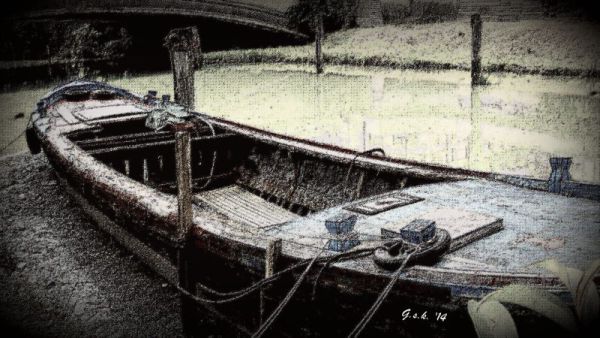
PHOTO PROMPT – Copyright – Georgia Koch
When Derek fell for LucyMae, he immediately introduced her to his wife.
“Look, Mandy.” His tone was reverent; his eyes betokened lust. “Isn’t she gorgeous?”
“Good gosh.” Mandy touched the hull. “Water, water everywhere and all the boards did shrink. Where does the albatross sit?”
“Hydrate her, the boards’ll plump up.”
“They’re rotten. . . . What’s that thingy?”
“It’s a . . . I’ll fix her.”
He switched on pleading puppy eyes.
Sigh. “Okay.” Mandy took his arm. “Let’s go look at that treadle sewing machine I want.”
“You can’t sew.”
“No. But it was love at first sight.”
***
Every Wednesday,Rochelle Wisoff-Fields issues theFriday Fictioneerschallenge. She posts a picture prompt and invites readers to write stories of 100 words or fewer and to post them on their blogs the following Friday. This week’s prompt ishere(scroll down the page to see it). Rochelle’s story follows it.
To see more stories by Friday Fictioneers, click on the frog, below.
(Friday is the official post date, but Thursday is fine, too. :-))
By No machine-readable author provided. Johntex~commonswiki assumed (based on copyright claims). [GFDL, CC-BY-SA-3.0 or CC BY 2.5 , via Wikimedia Commons
Remember when Murphy Brown and her colleagues cooked and served Thanksgiving dinner at a shelter, and Miles brought in a bunch of live turkeys in his BMW (nobody had specified they were to be ready for the oven, and on arrival the inside of the BMW was not in good shape), and the turkeys ran all around the kitchen, and no one wanted to kill them anyway, and the turkeys refused to stick their heads in the oven so Murphy could turn on the gas (her suggestion)?
I don’t know what happened next. I was laughing at the turkeys and couldn’t pay attention. All I remember is the whole thing slid downhill fast.
Well. It could have been a whole lot worse. To see how, read “When Turkeys Strike Back,” by K. B. Owen, historical mystery writer.
I am grateful. For my husband, my family, parents who gave me a good start and kept on giving, my home, teachers, education, friends, time to use as I wish, the rights guaranteed to me by the Constitution, the freedom to pursue happiness, good health, and a host of other blessings.
But when I write about blessings, the resulting essay is maudlin, insipid, schmaltzy, and trite.*I just can’t do sincere.*******
So this post is about things not usually seen on Grateful-For lists.To wit:
Coffee shops with enough electrical outlets, appropriately placed, to serve nearly all the people who want to plug in. (There’s no way they could serve all of them.) And that say your car will be towed if it’s parked in their lot for more than three hours but don’t really mean it. (BookPeople. They probably do mean it, but I’ve never been towed. I think it depends on how full the parking lot is.)
Everywhere that provides free Wi-Fi.
Coffee shops that allow a critique group to sit around a table and discuss manuscripts, and moan about how hard writing is, and what their kids and their cats are up to, and what their dysfunctional families are up to, and that don’t mind when one member reads aloud a scene involving torture and murder** because both staff and other customers are entranced, listening and wondering whether they’re hearing part of a memoir. And that don’t tow their cars.*****
Blogs. Mine allows me to write to write to an audience, real or imagined. I need that audience. So do most other writers, including students of all ages.
Books. I like them. I like to read them. I like to buy them. Unfortunately, I like buying more than reading, which is why I have so much to-be-read nonfiction on my bookshelves and elsewhere.***
Bookstore going-out-of business sales. Closing a bookstore is a terrible thing, but if they’re going to close anyway, I don’t mind helping reduce inventory. That’s how I acquired most of that unread nonfiction.
English: Borders in West Quay Retail Park, Southampton (Photo credit: Wikipedia) Public domain.
Printers that work.****** Most of them work now, but years ago most didn’t. That’s why my students at the university turned in so many papers with text starting at the middle of the page and running diagonally to the bottom right corner. I told them they really couldn’t do that, and that they needed to do the work earlier and start printing days rather than minutes before leaving for class. But I knew if I used a printer, my papers would look like theirs. I was still using a typewriter. When I put the paper in straight, my pages looked okay.
Mark Twain, Emily Dickinson, William Dean Howells, Henry James, Edith Wharton, Clyde Edgerton, Kathie Pelletier, T. R. Pearson, Olive Ann Burns, Fannie Flagg, Elizabeth Berg, Josephine Tey, Ruth Rendell, P. D. James, and the list runs on. If there are any questions about why I’m grateful, pick up some of their books. For Elizabeth Berg, begin with Durable Goods (her first novel, and yes, I despise her). For Clyde Edgerton get Raney, Walking Across Egypt, Killer Diller (WAE’s sequel), or Lunch at the Picadilly; the man is a genius. For Olive Ann Burns, read Cold Sassy Tree, her first and only complete novel; I feel about her like I feel about Elizabeth Berg, see above. I’d like to feel that way about Clyde Edgerton, but I can’t, because I want to be Clyde Edgerton.
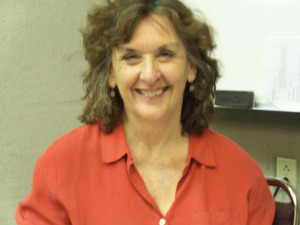
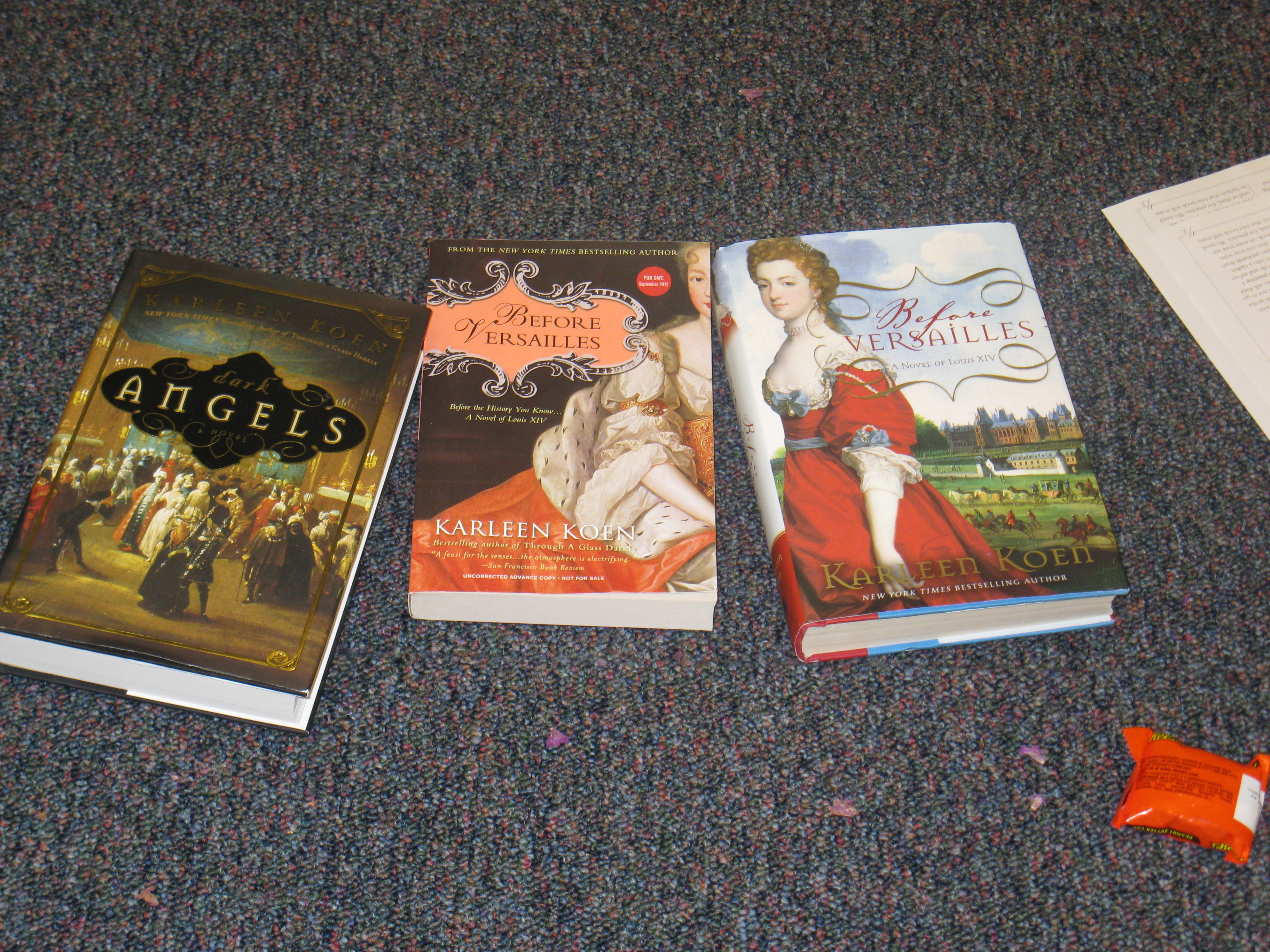
Karleen Koen,**** writer and instructor, who said, “I can’t teach you to write, but I can teach you to play.” And she can. And she did. And I had the time of my life writing and writing and writing. Anyone who wants to write and has the opportunity to take one of her classes should sign up asap. See her blog, Karleen Koen – Writing Life, and her webpage, Karleen Koen. Find information about the courses she teaches at Karleen Koen – Courses. Karleen has published four impeccably researched historical novels, set in the seventeenth and eighteenth centuries; the latest, Before Versailles, takes place in the court of Louis XIV, in the early years of his reign.
Karleen Koen
Three of Karleen Koen’s novels displayed on classroom floor at WLT retreat, Alpine, TX, 2014. The little orange things in the lower right corner might be peanut butter cups.
Dictionary.com and Thesaurus.com,which I keep running in the background when I work. Dictionary.com gives me exact definitions of words. Thesaurus.com answers the question, What’s that word that means something like XXXXXXXXXX but not exactly, and it’s standing at the beginning of my hypoglossal nerve but refuses to sprint on down to my tongue, and I cannot finish this sentence without it? These sites are a godsend for people who hyperventilate at the thought of leaving a blank space and moving on.
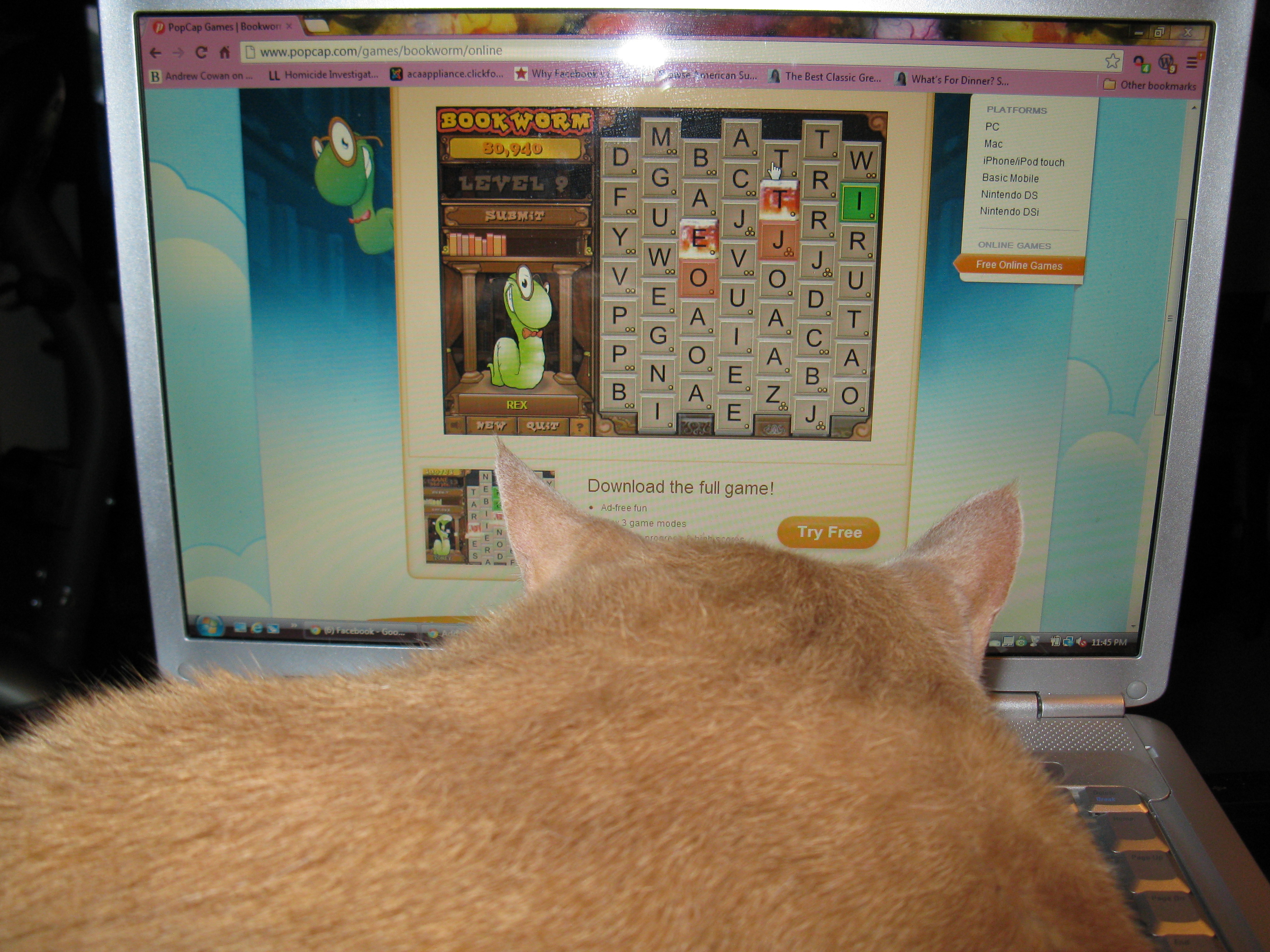
Bookworm.Yes, that one. The vile, disgusting, devilish online game that is a thousand times worse than solitaire, because if the Bookworm player is good enough, the game never ends. The player can sit mindlessly clicking on letters to make words, and if the letters he clicks don’t make a word, he just tries again, and he can play while he’s watching-listening to television, or petting the cat, or carrying on a conversation, or trying to think what his Main Character should do next because he’s painted her into a corner . . . Obviously, I know whereof I write.
I’m grateful for Bookworm, however, because sometimes I need the comfort of a mindless, repetitive task. Playing Bookworm can be a method of avoidance, but it can also be a way of putting the mind on autopilot, giving it the freedom to figure out how to get the Main Character out of the corner she’s stuck in.
Caveat: Playing Bookworm for too long at one sitting, day after day, month after month, can result in repetitive stress injuries. For example, the mouse hand and all that’s attached to it, right on up to the shoulder, can be rendered painful and practically useless until the light dawns and the victim realizes why she can’t raise her right arm.
Readers. I’m grateful for everyone who reads my posts, especially the posts that are two or three times as long as blog posts should be. This one is four times as long. Contrary to my expectations, everything on the list relates to writing. I had intended to include Relaxed Fit Slacks and The Demise of the Girdle. But tomorrow is another day.
(The Demise of the Girdle. Wouldn’t that make a marvelous title for a novel? Should it be mystery, romance, or science fiction?)
William Davis & Bookworm
* See Thesaurus.com. That’s where I found all these synonyms for bathetic.
*** Don’t ask where elsewhere is. It’s not relevant.
**** This is not an advertisement, paid or otherwise. Karleen is an excellent teacher–few instructors can keep twenty tired adults happy for a whole week by assigning more homework. (See Morning Pages)
***** See Coffee Shops, above.
****** And printers that don’t drink ink.
******* Last summer, when I wept bitter tears because I couldn’t write what I was trying to write (not my usual practice, but I was having a bad summer), Karleen told me what to do instead, and before anyone says Hahahahahah, I’ll add she was quite nice about it, and said I should aspire to write like David Sedaris. Have you ever known of David Sedaris to do sincere?
*Experts (says an article on the web) say readers are attracted to lists with numbers in the titles. We’ll see.
**I have other possibilities. These are the ones I can see without getting up and crossing the room.
***I started this post last night but fiddled so long with it that I didn’t have time to read.
I’m still fiddling with it.
But tonight . . .
***
I love WordPress, but sometimes we disagree about formatting, mostly about position of photographs and about spacing. What I see here on the edit page isn’t always what both of us see on the published page. I have done my darndest to make it do what I tell it to do. At this point, I don’t care. If the post looks funny, please just read it and ignore the WordPress deficiencies. My deficiencies you are welcome to notice and even to point out.
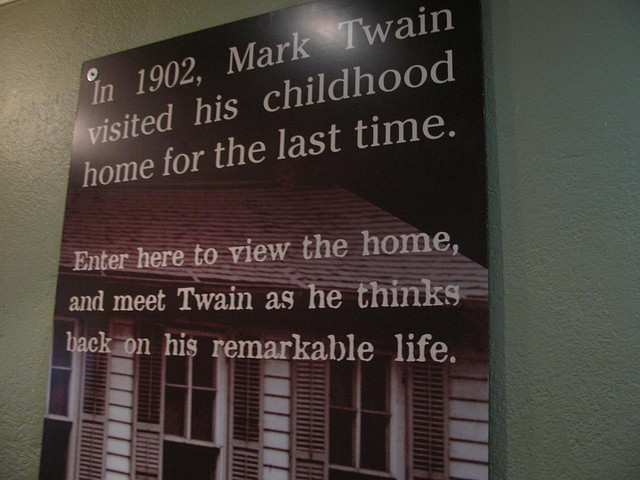
Mark Twain cared about words: Pa’s boot with a couple of his toes leaking out of the front end; the sow lying in the middle of the street looking as happy as if she was on salary; and Miss Watson, a tolerable slim old maid, with goggles on.
There was, however, one small incident of my boyhood days which touched this matter, and it must have meant a good deal to me or it would not have stayed in my memory, clear and sharp, vivid and shadowless, all these slow-drifting years. We had a little slave boy whom we had hired from some one, there in Hannibal. He was from the Eastern Shore of Maryland, and had been brought away from his family and his friends, half way across the American continent, and sold. He was a cheery spirit, innocent and gentle, and the noisiest creature that ever was, perhaps. All day long he was singing, whistling, yelling, whooping, laughing – it was maddening, devastating, unendurable. At last, one day, I lost all my temper, and went raging to my mother, and said Sandy had been singing for an hour without a single break, and I couldn’t stand it, and wouldn’t she please shut him up. The tears came into her eyes, and her lip trembled, and she said something like this—
“Poor thing, when he sings, it shows that he is not remembering, and that comforts me; but when he is still, I am afraid he is thinking, and I cannot bear it. He will never see his mother again; if he can sing, I must not hinder it, but be thankful for it. If you were older, you would understand me; then that friendless child’s noise would make you glad.”
It was a simple speech, and made up of small words, but it went home, and Sandy’s noise was not a trouble to me any more. She never used large words, but she had a natural gift for making small ones do effective work. She lived to reach the neighborhood of ninety years, and was capable with her tongue to the last – especially when a meanness or an injustice roused her spirit.
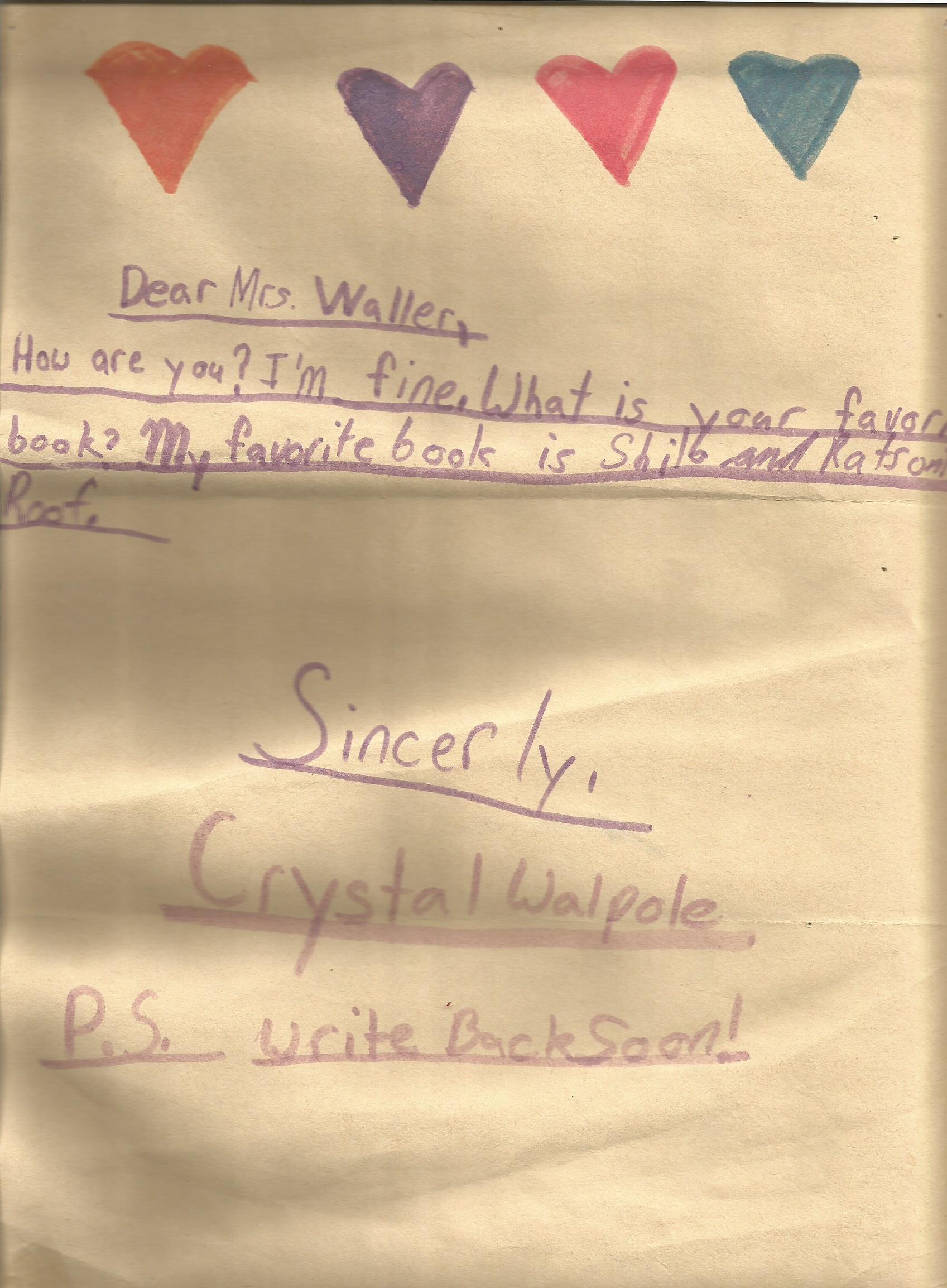
I received the letter pictured below when I worked at Norma Krueger Elementary School’s Scharf Library. Crystal Walpole wrote asking what my favorite book was. She dropped the letter into her classroom’s mailbox. Krueger’s Wee Deliver postal service stamped and delivered it to the library.
At the time, Crystal’s address was 683 Cocker Spaniel Drive in Sporting Dog, Texas. The library’s was 123 Yorkshire Terrier Avenue in Terrierville, Texas.
In the previous post, I announced my intention to get up, go to BookPeople, write for an hour on a project of not-email and not-post (because Ramona DeFelice Long told me to), and get off the laptop by 7:00 p.m.
Here’s how the day went.
Ernest
At 8:00 a.m., I discovered Ernest experiencing grave digestive problems reminiscent of previous problems caused by eating string. No matter how careful we are, he’s always able to find string.
After practicing every sneaky tactic I know to wrestle him into the carrier, I hauled him to the vet, wrote a check, hauled him home, and spent the next twenty-four hours stalking him up hill and down dale, from litterbox to litterbox, to get an accurate picture of his post-doc activity.
If there wasn’t any, I would have to take him back to the vet today for reconsideration of the diagnosis of UTI to ingestion of string.
In addition to the X-ray, the veterinarian gave him a long-lasting injection of antibiotic so we wouldn’t have to catch him and fight over pills or liquid for a week. I could have chosen to start treatment without the X-ray and see what happened but wasn’t sure I could get him back into the carrier if the antibiotic didn’t work. Some things are not worth the effort.
Because we have two cats and two litterboxes, and because I knew isolation wouldn’t be possible, at least if I valued our doors, I sat up all night watching him. He slept. All night. Didn’t go near a litterbox. I played Bookworm.
David rose at 7:00 a.m. We changed shifts. I went upstairs for four hours of sleep. David stalked.
I woke at 11:00 to the news that Ernest had performed admirably. David had kept samples. I said I didn’t need to see them.
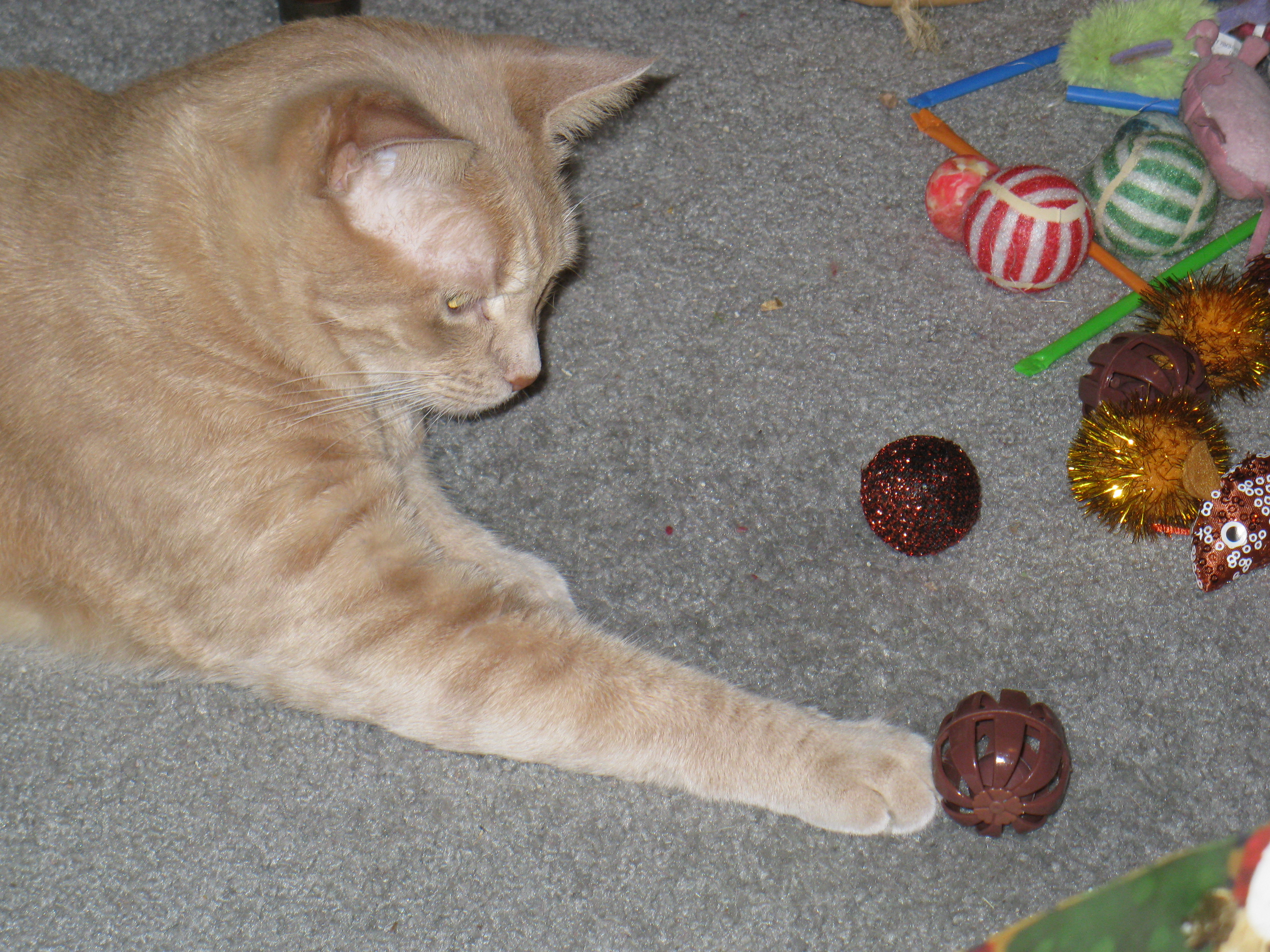
Ernest is in fine fettle. At present he’s lying on my arm, making biscuits where I wish he were not. I will tolerate this until the first claw penetrates my clothing and punctures my flesh. He means well.
In fact, he forgave and forgot as soon as we returned from the veterinary clinic. He swished around as if I had never betrayed him, sat in my lap, pinned down my left arm while I typed, lay on the footstool, gazed at me lovingly.
I’m grateful he doesn’t hold a grudge. In the fight for proper medical attention I nearly dislocated his shoulder. I’m trying to forgive and forget that my back and my right arm will once again have to be put right by the massage therapist. The carrier alone is heavy, and with Ernest inside it gains seventeen pounds.
Concerning the writing life: I did not go to BookPeople; I did not write for an hour; I did not eat breakfast or lunch until nearly 3:00 p.m. I did not do anything except be nurse and mama to a big, hulking guy tabby cat.
But hey–I got another blog post out of it.
The craziest thing is that it’s almost the same post I wrote two or three years ago, about the day I was
William
determined to write write write but instead spent the day lying on the floor in William’s bedroom, trying to coax an ailing Ernest out from under the bed and to the doctor.
Now the question: Do these things happen because I’m crazy, or am I crazy because these things happen?
What is the moral? (Must be a moral.)
Change in the Davis-Waller house doesn’t seem likely, at least while Ernest and I live here. Might as well accept that and go on.
I should never never never publicize my intention of writing writing writing.
Writing writing writing equals change. See first moral, above.
And failing to follow through is embarrassing. Especially reporting the failure, as is only fair. Readers deserve to know.
When this post is safely online, I shall throw things into a bag and head south to retreat with Austin Mystery Writers. I will have a cabin and a river and some pecan trees. I will not have Internet connection or decent TV reception. Phones will work only outside.
And for the next two days, I promise to sit in a porch swing and Write. Write. Write.
***
If paragraphs in this post are incorrectly spaced, please pretend they’re not. Today’s format is like Ernest–not under my control. It’s just one more miracle of modern technology.
The computer is a Kathy magnet. It wasn’t so bad until 2008, when I replaced a forty-hour work week with a laptop and my husband installed wi-fi. The Internet brings so many fine blogs and other attractions into my living room, where I sit with my feet up and examine them all; email can take up an entire day, if I leave it open while working.
Doubters would say that what I do isn’t working. I disagree. Negotiating the web is fatiguing. Commenting draws a lot of energy. I don’t want to write something that will be misunderstood; I don’t want to leave typos or incorrect punctuation; I don’t want to sound stupid.
Example: The previous sentence initially read, I want to sound stupid. It’s easy to mess up online.
Political posts on Facebook leave me just wo-ahn out. There’s the writing, of course, which is draining, but there’s also the emotion. Righteous indignation requires energy. Restraint requires more. After exercising restraint for several months, I stopped logging on. But there are friends and acquaintances–no, they’re not all friends–I want, and need, to keep up with. I like knowing how my great-niece’s first year of school is going. I like knowing that in the doctor’s waiting room when she was four, she suddenly came out with, “DOOOOOOOOOMED. We’re all DOOOOOOOOOMED.” Her fourteen-year-old brother wasn’t impressed, but I was. Her pronouncements remind me we’re not all doooooooomed.
Anyway, I logged onto FB today, discovered a post about a remark a sexist pig made on a pseudo news program, and was moved to share the post and a rousing Jeremiad of my own.
I didn’t address my remark to the sexist pig, nor did I call him one. I saved the phrase for this post. I merely suggested that his comments reinforce the ignorance and the bigotry of listeners who agree with him. Plus a couple of other salient thoughts.
Then I copied my remarks and pasted them into a Word document for future publication somewhere, perhaps here. They were scathing, simply scathing, but reasoned and polite, and they deserve a wider audience.
Another example: I’m getting all het up here just recalling the incident. Molecules of emotion surge through my body. I am giving the sexist pig power over me. That isn’t good.
Yesterday I heard a segment of a call-in program on NPR about the downside of computer technology on the culture. I’ve seen one of the effects on medicine already. When my former doctor’s practice installed computers in examining rooms, he stopped looking at me and started looking at the screen. So, to a lesser degree, did a specialist I consulted. They were excellent clinicians, and the latter possibly saved my life by doing surgery that only she and I thought I needed.*
But there’s information to be drawn from faces as well as from words, on both sides of a conversation. Eyes transmit confidence and sympathy and a number of other messages. With the Party of the First Part looking at the side of the Party of the Second Part’s Head (or, as once happened, the back of his white coat), and the Party of the Second Part looking at a screen and typing away, I wonder whether the two Parties make sufficient connection.
The internist I see now has no computer in the examining room. He taps here and there on a Palm Pilot (or something; it has a light on it for closer examination of funny-shaped moles, plus, it appears, an entire pharmacopoeia; I hope it’s not an iPhone). But he sits near me and looks me in the eye, and I reciprocate, and we get along very well.
He also asks at every visit how the writing is going, thus allowing me to infer he remembers something about me that isn’t in the file. It probably is in the file, maybe scrawled inside the cover of the folder, but as long as I haven’t seen it, it isn’t.
One day I’ll walk in and find myself looking at a 17-inch flat screen. It’s inevitable, and, all things considered, it’s a good thing. But when the time comes, I shall tell the doctor how to conduct himself while interviewing patients, just in case he doesn’t know. I’m old enough to be his mother and I taught high school English, so I’m not only entitled, I’m an expert.
But enough of doctors.
I’ve been thinking for months–years?–about the power I give technology over my life: I don’t move as much as I used to, or get out of the house as I should. I don’t read as much as I did–I read much less, in fact, and this is the first time I’ve been able to make that claim.
I don’t write with a pen and paper as often as I used to. I’ve always enjoyed putting words onto paper with a good pen, not an expensive one, but a pen that fits my hand.
And although he hasn’t said anything, my POSSLQ** might be as tired of seeing me staring at a screen as I am of seeing the doctor do the same.
So. I’ve decided to pull the plug nightly by 7:00 p.m., and to work backward towards 5:00 p.m.
To do so, I’ll have to write everything I want to write during the day. For a nocturnal animal whose brain
starts functioning about 9:00 p.m., the change won’t be easy. But it’s the right thing to do.
In my new spare time, I will read books and write in my journal with the pen of my choice. POSSLQ will follow his tradition of reading every word in the newspaper and in several magazines. We might converse.
I will go to bed at a decent hour and wake at a decent hour, in time to get a table and an electrical outlet at the BookPeople coffee shop, and there I will write–write meaning to write stories and novels for at least one hour every day. I will do it because I promised author and editor Ramona DeFelice Long that I will.
Giving away your power isn’t a bad thing as long as you know the person who receives it has good motives.
Note that I write I will, a construction implying determination, resolution, perseverance.
If I absolutely can’t help myself, I’ll toss off a blog post now and then. But only outside that sacred hour.
It hasn’t escaped me that the BookPeople part involves using a laptop and wi-fi. I can’t write what I need to write without the laptop.
But as I would not be a Luddite, so neither would I be a Zombie. And I’ve had it on good authority that computer addiction leads right down the primrose path to Zombie-ism.
###
*The subsequent biopsy agreed with us. Thank you, Dr. Carla Ortique, who now practices in Houston. I wish you were here.
**1) Person of Opposite Sex Sharing Living Quarters. 2) An affectation. We’re married. 3) See in its entirety “My POSSLQ” by Charles Osgood. A darned good poem. Here’s the first paragraph:
“Come live with me and be my love,
And we will some new pleasures prove
Of golden sands and crystal brooks
With silken lines, and silver hooks.
There’s nothing that I wouldn’t do
If you would be my POSSLQ.” . . .
In yesterday's post I wrote about Lynna Williams' story "Personal Testimony." Here are the first three paragraphs of the story.
###
“The last night of church camp, 1963, and I am sitting on the front row of the junior mixed-voice choir looking out on the crowd in the big sanctuary tent. The tent glows, green and white and unexpected, in the Oklahoma night; our choir director, Dr. Bledsoe, has schooled us in the sudden crescendos needed to compete with the sounds cars make when their drivers cut the corner after a night at the bars on Highway 10 and see the tent rising out of the plain for the first time. The tent is new to Faith Camp this year, a gift to God and the Southern Baptist Convention from the owner of a small circus who repented, and then retired, in nearby Oklahoma City. It is widely rumored among the campers that Mr. Talliferro came to Jesus late in life, after having what my mother would call Life Experiences. Now he walks through camp with the unfailing good humor of a man who, after years of begging hardscrabble farmers to forsake their fields for an afternoon of elephants and acrobats, has finally found a real draw: His weekly talks to the senior boys on “Sin and the Circus?” incorporate a standing-room-only question-and-answer period, and no one ever leaves early.
“Although I will never be allowed to hear one of Mr. Talliferro’s talks—I will not be twelve forever, but I will always be a girl—I am encouraged by his late arrival into our Fellowship of Believers. I will take my time, too, I think: first I will go to high school, to college, to bed with a boy, to New York. (I think of those last two items as one since, as little as I know about sex, I do know it is not something I will ever be able to do in the same time zone as my mother.) Then when I’m fifty-two or so and have had, like Mr. Talliferro, sufficient Life Experiences, I’ll move back to west Texas and repent.
“Normally, thoughts of that touching—and distant—scene of repentance are how I entertain myself during evening worship service. But tonight I am unable to work up any enthusiasm for the vision of myself sweeping into my hometown to be forgiven. For once my thoughts are entirely on the worship service ahead.”
###
Yesterday I wrote that the narrator of “Personal Testimony” is eleven years old. When I discovered the excerpt, I was reminded she’s really twelve. I’ll correct my error. My narrator in “Personal Experience,” however, continues to be eleven.
On my way home from work one night in the ’90s, I heard actress Judith Ivey on Selected Shorts, reading “Personal Testimony,” a short story by Lynna Williams.
The narrator is eleven-year-old Ellen Whitmore, a preacher’s daughter from Fort Worth, who is at Southern Baptist summer camp in Oklahoma. At evening services, when campers are expected to witness to their experiences of sin and repentance, Ellen demonstrates a talent that catches the attention of fifteen-year-old Michael. Although he’s reputed to be most spiritual boy in camp, Michael has what Ellen’s brother calls “Jesus Jaw”– he has plenty to say but can’t complete a simple sentence: “I just–I mean, it’s just so–I just . . .” He tells Ellen he wishes he could speak about his spiritual life as easily as she can speak about hers, so, following her mother’s example, she offers to help. Within days, she has a thriving business writing personal testimonies for older campers, a gratifying popularity, and a fat stack of bills stashed in her Bible at John 3:16. Her adventure in capitalism ends at the summer’s final service, when she sees her father in the congregation, realizes he knows, and makes one last and very public attempt to avoid his wrath.
I’ve heard that people don’t laugh aloud when alone. That’s not true. I sailed down I-35 guffawing and then quickly broke out in tears.
(I hate it when writers manipulate me like that. It’s just one more skill to covet.)
I’d been writing off and on for a few years but hadn’t produced anything even marginally successful. A small circle of friends and family liked the pieces I showed them, but they also liked me– most of the time–and they weren’t seasoned critics anyway. The writing was bad. I was frustrated. Not knowing what was wrong, I couldn’t make it right. Classes and workshops didn’t help.
The night I heard Judith Ivey read, all that changed. I didn’t experience an epiphany, per se, but there was a definite moment of enlightenment: My best work was bad because it had no voice. I had no voice. The nearest I could manage was a small-time literary critic in love with semicolons.
Listening to “Personal Testimony,” I heard Lynna William’ voice and knew what I should do.
My work should sound natural to my ear. Informal. Fluid. First person narration by a self-absorbed eleven-year-old girl with attitude, precocious in some areas and in others absolutely clueless. That comprised Enlightenment, Part I.
Then came Enlightenment, Part II: I’ve been hearing that voice most of my life. It’s the one I think in. I didn’t have to worry about copying Williams–it’s my voice, too. I’d just never recognized its potential.
Not long after hearing “Personal Testimony,” I allowed the eleven-year-old in my head to dictate a story while I wrote. Then she dictated another. And they worked.
My inner child is different from Ellen, as is only right. Mine is sharper, has more attitude. I have no idea why.
A year ago, my eleven-year-old suddenly morphed into a forty-year-old woman. She has so much attitude she’s scary. Now there’s a third voice, very different from the other two, stronger and scarier even than the forty-year-old. The third voice came as a relief. I’d wondered whether the pre-teen was all I had. What if everything I wrote came from the same source and sounded just like what had come before? The child is fun to listen to, for a while, but after a time, she can become wearing. I spend enough time with her as it is. Readers would soon get their fill.
There are some things that can’t be learned in a classroom. An instructor might have told me my work lacked voice, but he couldn’t have said how to find the right fit.
I’m indebted to Lynna Williams for helping me to hear a girl’s voice, and to recognize its value. She inspired hope. She showed me that if I listen, the eleven-year-old in my head will tell me what I need to know.
 MURDER ON WHEELS, Austin Mystery Writers’ first crime fiction anthology, has been released by Wildside Press.












 M. K. Waller